Skip to content
Healthcare Outsourcing Compliance
Healthcare Outsourcing Compliance Guide: HIPAA, PHI, BAAs, and Nearshore Support
Learn how healthcare organizations can evaluate outsourced support, protect PHI, manage HIPAA obligations, and build compliant nearshore support programs.
TL;DR — Quick Takeaways
- Healthcare outsourcing requires a higher standard than ordinary customer service because patient interactions can involve protected health information, billing details, appointment data, and sensitive personal context.
- If a vendor creates, receives, maintains, or transmits PHI for a covered entity, a Business Associate Agreement is generally required before PHI is shared.
- A signed BAA is not enough. Healthcare organizations still need access controls, HIPAA training, incident procedures, quality monitoring, and active vendor oversight.
- Nearshore outsourcing can be effective for healthcare teams that need bilingual support, time-zone alignment, and closer collaboration, but cross-border delivery must be governed carefully.
- The strongest healthcare outsourcing programs make compliance part of daily operations, not an annual checklist.
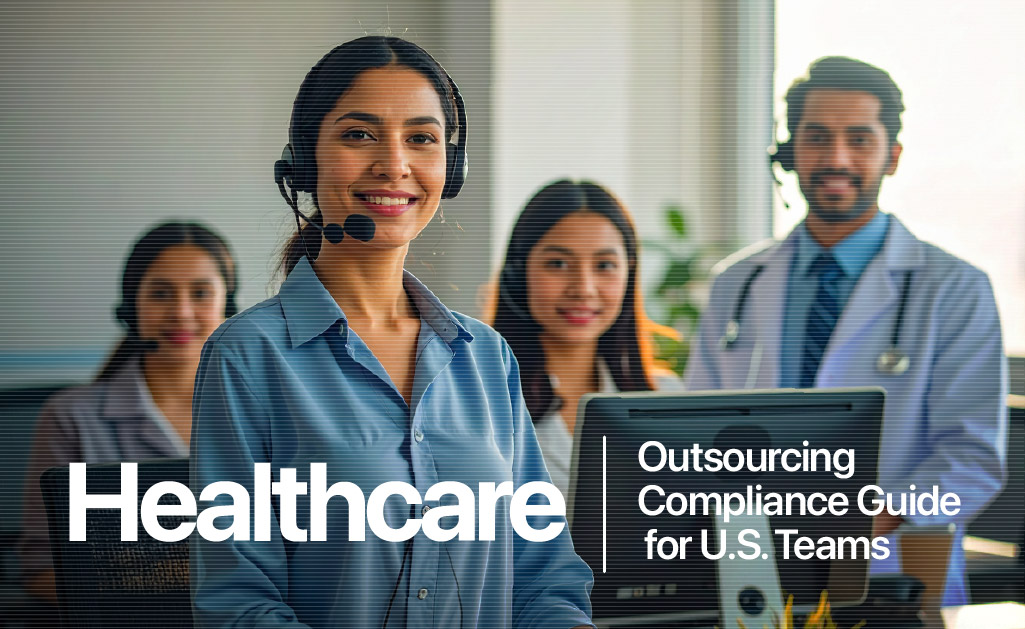
A patient calls to reschedule an appointment, dispute a bill, or ask a question about a prescription. That interaction may last only minutes, but it can expose protected health information, shape patient trust, and create real compliance obligations. This healthcare outsourcing compliance guide helps U.S. healthcare organizations evaluate outsourced healthcare support without treating compliance as a box to check after launch.
Outsourcing can give healthcare teams the coverage, bilingual capability, and operational flexibility they need to serve patients more consistently. But lower costs or faster scaling should never come at the expense of privacy, security, or patient confidence. The right partner becomes an accountable extension of your team, with clearly defined responsibilities and disciplined processes behind every interaction.
Why Healthcare Outsourcing Requires a Different Standard
Healthcare support is not ordinary customer service. A scheduling agent may see appointment details. A billing support representative may handle account balances and insurance information. A nurse triage program may operate under an entirely different clinical and regulatory model. The level of risk depends on the work being performed, the systems being accessed, and the information being shared.
For many outsourced functions, the central federal requirement is HIPAA. If a vendor creates, receives, maintains, or transmits protected health information on behalf of a covered entity, that vendor may be a business associate. In that case, a Business Associate Agreement, or BAA, is generally required before PHI is shared. The U.S. Department of Health & Human Services provides official guidance on HIPAA business associates and business associate contracts.
Still, a signed BAA is not proof that a program is compliant. It establishes contractual responsibilities, but the day-to-day safeguards matter just as much. A vendor that has access to PHI needs appropriate training, access controls, incident procedures, and oversight. Your organization also remains responsible for choosing and managing vendors with reasonable care.
State privacy laws, breach notification rules, payer requirements, contractual obligations, and specialized rules for certain data types can add further requirements. Compliance needs vary by service line, patient population, and geography. Legal counsel and compliance leaders should validate the requirements for your specific program.
Healthcare Outsourcing Compliance Guide: Start With the Work
The most effective compliance planning starts before vendor selection. Map the patient journey and identify exactly what the outsourced team will do. Vague scopes create vague accountability. A defined operating model makes it easier to determine whether PHI is involved and which safeguards are necessary.
Classify the information and access involved
Do not assume every healthcare interaction carries the same risk. An agent answering general office hours from a public script has a different exposure level than an agent verifying a patient identity, viewing medical records, or processing payments tied to a patient account.
Document what information the team can access, where it originates, how it is displayed, whether it can be downloaded, and where it is retained. Include call recordings, chat transcripts, email attachments, screenshots, quality assurance notes, and reporting exports. These overlooked channels can create unnecessary exposure when they are not included in the program design.
Apply the minimum necessary principle where appropriate. If an agent only needs a patient name, appointment time, and provider location to complete a rescheduling request, there may be no reason to provide broader chart access. Limiting access improves security and simplifies training. HHS offers official guidance on the HIPAA Minimum Necessary Requirement.
Conduct meaningful vendor due diligence
A vendor questionnaire is useful, but it should not be the end of the evaluation. Ask how the provider operates in practice, not only what policies it has on file. Strong partners can explain who has access to patient data, how access is approved, how it is reviewed, and what happens when an employee changes roles or leaves the organization.
Review the provider’s approach to workforce screening, HIPAA training, confidentiality commitments, secure workstation standards, device management, password controls, multi-factor authentication, and monitoring. For voice programs, ask whether recording can be paused or suppressed when sensitive payment information is collected and how recordings are stored and accessed. The HHS overview of the HIPAA Security Rule is a useful reference for understanding administrative, physical, and technical safeguards.
You should also understand how the provider manages subcontractors. A vendor may rely on technology providers, workforce platforms, cloud systems, or downstream service partners. The agreement should make clear whether subcontractors will handle PHI and require them to meet the same applicable safeguards.
Put accountability in the contract
The BAA should align with the actual service scope. It should describe permitted uses and disclosures, require safeguards, address reporting of security incidents or breaches, establish subcontractor obligations, and define how PHI will be returned or destroyed when the relationship ends, when feasible.
Your main services agreement should also address operational realities that a standard BAA may not cover in detail. Define service levels, audit rights, data ownership, retention periods, security responsibilities, cooperation during investigations, and the process for approving material changes to systems or workflows. If your team is building an outsourced support agreement, this guide to service level agreement best practices can help frame the operational side of the contract.
A practical rule is simple: if a responsibility is critical during an incident, it should be explicit before an incident occurs. That includes who contacts whom, how quickly the vendor must escalate a suspected event, who preserves evidence, and who communicates with affected patients or regulators if notification is required. HHS also provides official guidance on the HIPAA Breach Notification Rule.
Build training around real patient interactions
Generic annual training does not prepare an agent for a patient who asks a spouse to speak on their behalf, a caller who cannot pass identity verification, or an urgent medical question that falls outside the agent’s role. Training should reflect the exact scenarios the outsourced team will encounter.
Agents need clear guidance on identity verification, authorization, minimum necessary disclosures, escalation pathways, documentation expectations, and prohibited behaviors. They should know when to stop, when to transfer, and when to involve a supervisor. For clinical or potentially urgent concerns, the program must set strict boundaries between administrative support and licensed clinical advice.
Quality assurance should test compliance behaviors, not just courtesy and call handling time. Review whether agents verified identity correctly, followed approved scripts, avoided over-disclosure, and used the proper escalation process. Coaching works best when agents understand that compliant service protects both the patient and their ability to do great work.
Managing Cross-Border and Nearshore Delivery
Nearshore outsourcing can be a practical option for U.S. healthcare organizations that need bilingual support, time-zone alignment, and closer collaboration. A Mexico-based support team can provide those advantages, but cross-border delivery requires deliberate governance.
HIPAA does not prohibit a business associate from operating outside the United States. The question is whether the appropriate contractual, administrative, physical, and technical safeguards are in place. Your assessment should address where personnel work, where systems are hosted, whether data can be stored locally, how remote access is controlled, and whether local legal requirements affect the arrangement.
For some programs, a secure virtual desktop or controlled application environment can reduce risk by preventing local downloads and keeping information within approved systems. Restricted printing, clean-desk expectations, private workspaces, and monitored access can also matter, especially for teams handling sensitive calls at scale.
Cultural proximity should never be confused with compliance maturity. A nearshore partner should be evaluated against the same standards you would apply to any domestic provider. The advantage comes when proximity supports faster communication, stronger training alignment, and more active management of the program. For organizations comparing delivery models, this overview of nearshore outsourcing partnerships can help connect operational fit with governance expectations.
Make Compliance Part of Operations, Not an Annual Event
Healthcare outsourcing programs change. A support team may expand from appointment setting to billing inquiries, add a new channel, adopt a new CRM, or begin serving a different patient population. Each change can alter the program’s compliance profile.
Establish a governance rhythm that includes operational leaders, security stakeholders, compliance personnel, and the outsourcing partner. Review access reports, quality findings, incidents, training completion, staffing changes, and proposed process updates. The cadence can vary by program risk, but it should be consistent enough to catch issues before they become patterns.
Measure both service and compliance performance. First-call resolution and patient satisfaction matter, but so do verification accuracy, unauthorized disclosure trends, escalation adherence, access review completion, and time to report potential incidents. The strongest programs do not position quality and compliance as competing priorities. They recognize that respectful, accurate patient service depends on both. This guide to call center reporting, metrics, dashboards, and KPIs can help teams think through what should be monitored beyond basic service volume.
Document decisions along the way. If your organization determines that a specific workflow does not involve PHI, record the rationale. If you change a script to reduce disclosure risk, preserve the approval trail. Clear documentation helps demonstrate thoughtful oversight and gives internal teams a reliable reference when staff or vendors change.
A healthcare outsourcing partner should make your team more capable, not less informed. Choose a provider willing to share operational visibility, accept accountability, and treat patient information with the same care your internal staff would. When compliance is built into the relationship from the first workflow design session, scalable support can strengthen patient trust rather than put it at risk.
🚀 Build Healthcare Support With Compliance in Mind
If your healthcare organization needs bilingual, nearshore support with stronger operational visibility, CallZent can help you design a support program around your workflows, service goals, and compliance expectations.