Skip to content

Insurance Lead Operations
Insurance Lead Generation Services: A Practical Guide to Compliance, Speed, and ROI
Compare lead formats, protect producer time, and connect bilingual intake with documented permissions, accurate routing, and measurable acquisition economics.
TL;DR — Quick Takeaways
- Optimize for usable conversations and issued business, not raw lead volume.
- Compare form leads, appointments, and live transfers using their different acceptance criteria.
- Approve permissions, scripts, suppression rules, and product-specific requirements before outreach.
- Keep non-advisory intake separate from tasks requiring licensed and authorized producers.
- Measure full acquisition cost, source quality, handoff success, and retained contribution during a pilot.
Why do so many insurance teams buy more leads when the problem is that nobody calls the right prospect fast enough, with the right consent record, in the right language?
That gap can undermine an insurance lead program. Closers spend time chasing low-intent names, marketing celebrates volume that never turns into conversations, and compliance gets pulled in after the fact when a vendor can’t prove consent. This can happen in new programs and in mature operations expanding across English- and Spanish-speaking audiences.
The fix usually isn’t “more leads.” It’s tighter operations. Good insurance lead generation services don’t just deliver names. They screen, route, document, transfer, and protect the sales motion so agents spend more time quoting people who are ready to talk.
Key takeaway: Insurance lead generation services only pay off when compliance, routing, and speed-to-lead are built as one operating system.
What Insurance Lead Generation Services Actually Do
Why do insurers lose sales capacity even when demand is available? A broker may have experienced closers spending hours on cold outreach while web inquiries, referral callbacks, and quote requests remain scattered across inboxes. The constraint is usually workflow, not selling ability.
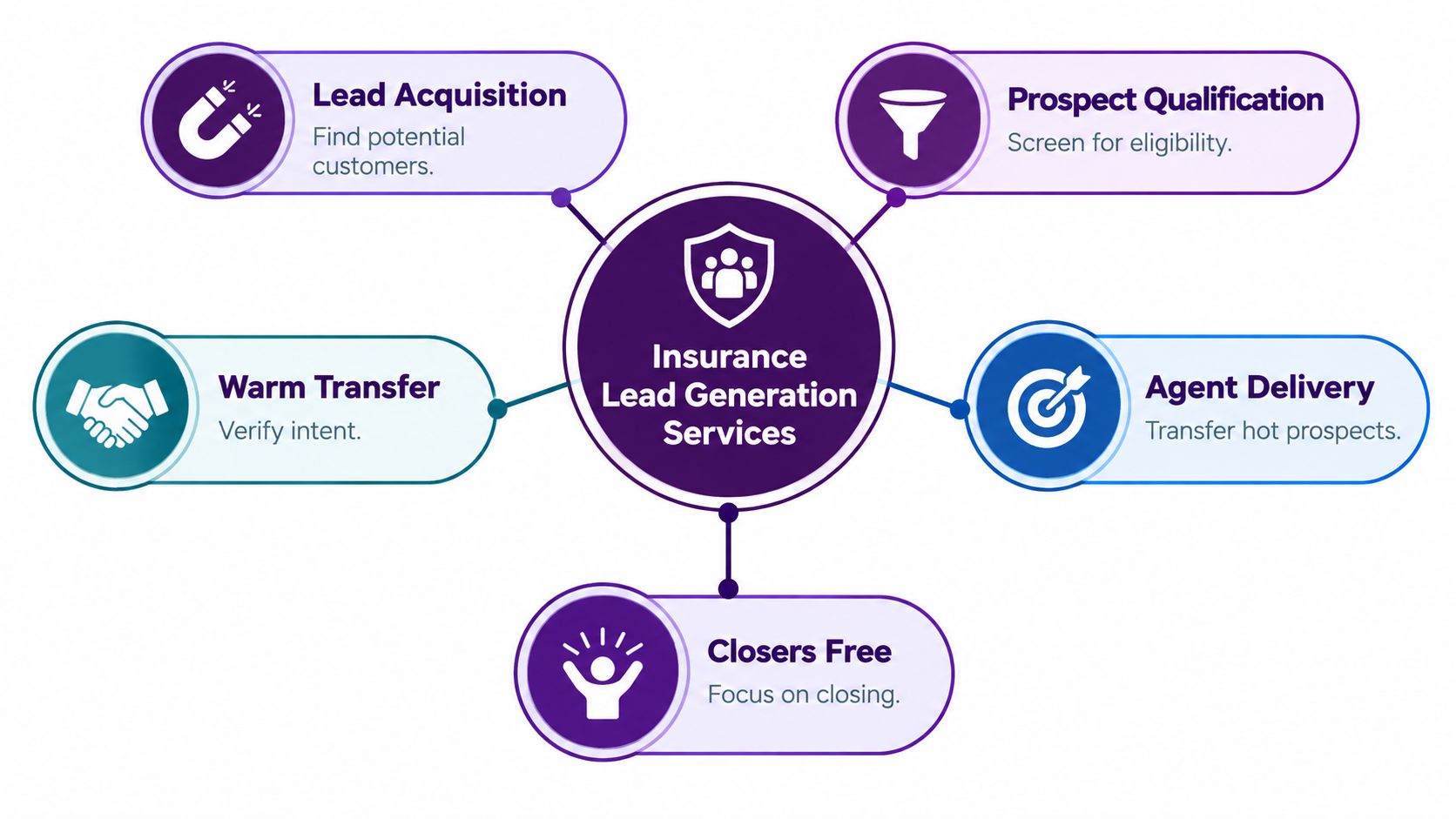
Insurance lead generation services organize that workflow. They help insurance businesses attract potential policyholders, assess whether each prospect merits an agent’s time, and move the opportunity into the sales process with usable context. The output may be a verified web lead, a scheduled appointment, or a live transfer while the prospect is still engaged.
The core job is to protect agent time
The service separates prospecting tasks from closing work. A program may manage:
- Lead acquisition: Generating inquiries through paid media, call campaigns, landing pages, referrals, and submitted forms.
- Basic qualification: Confirming the line of business, location, purchase intent, timing, and interest in receiving a quote.
- Routing: Assigning each opportunity to the appropriate licensed team, language queue, or product specialist.
- Handoff: Providing a lead record, booked meeting, or warm transfer with enough context for the agent to begin productively.
The handoff determines whether the agent continues the conversation or starts over. Missing contact details, vague intent, or absent notes force a second discovery call and create avoidable conversion loss.
Nearshore operations add another control point. A bilingual team in Mexico can work agreed U.S. coverage hours, handle English and Spanish conversations, and follow routing rules under close supervision. The operating model described in BPO in insurance can support this kind of coordinated intake and follow-up.
Separate intake from licensed selling
Define exactly what nonlicensed intake staff may ask, record, and route under the approved program. Do not let a qualification script drift into recommending coverage, interpreting benefits, quoting terms, or binding a policy. Match state, product, and appointment requirements to the receiving producer before transfer.
Volume sounds good until closers drown in it
Ask what the program is meant to buy: more records or more qualified conversations.
Evaluate the output your team can actually use: a valid record, a reachable prospect, an accepted transfer, an attended appointment, or a completed quote. A vendor delivering records should not be compared with a vendor delivering live conversations using CPL alone.
Speed matters operationally. A web inquiry routed to a Mexico agent queue within minutes can receive a useful response before the prospect contacts another broker. A delayed callback may still produce a lead record, but the sales opportunity has already weakened. Lead generation services therefore create value through acquisition, qualification, routing, and timely handoff, not volume alone.
Telemarketing, Digital, Inbound, Outbound, and Appointment-Setting Compared
Which insurance lead generation model fits the bottleneck in your sales process? Each option creates a different kind of opportunity, carries a different operating burden, and fails in a different way. Buying more leads rarely fixes slow response, weak qualification, or poor producer follow-through.
Five models, five different jobs
Telemarketing creates proactive contact and quick qualification through live conversation. It can revive older house lists, support cross-sell campaigns, and re-engage quote requests that stalled. The trade-off is a heavier compliance and training burden. Scripts must be accurate, calls must be monitored, and poor execution can damage trust quickly.
Digital lead capture scales top-of-funnel demand through landing pages, paid search, social campaigns, and other online channels. It suits carriers and agencies that can support fast routing and repeated follow-up. A form submission still requires qualification. Without prompt contact, the program produces records faster than producers can turn them into conversations.
Inbound call handling fits programs that already create enough demand to make prospects call. It can support auto, home, and other appropriately scoped insurance programs, especially when prospects need an answer immediately. The caller has chosen to start the conversation, so intent is often clearer than it is on an unworked form.
Outbound calling targets known opportunities rather than a broad audience. Potential sources include quote requests, referrals, former customers, renewal windows, and CRM segments. Each source needs a review of applicable contact permissions before use. Results depend heavily on list accuracy, contact timing, and the caller’s ability to explain why the call is relevant.
Appointment-setting moves the service closer to the sales handoff. It suits producer teams that can close but lack the capacity to chase and qualify every opportunity. A confirmed calendar slot carries more commitment than an unworked lead, provided the appointment includes accurate notes and a clear reason for the meeting. Businesses assessing this model can compare appointment setting services with live transfers and direct follow-up.
Insurance Lead Service Types Comparison
| Service Type | Pricing Considerations | Response Window | Best For |
|---|---|---|---|
| Telemarketing | Varies by list quality, scope, and compliance setup | Immediate when live contact is made | Re-engagement, qualification, cross-sell |
| Digital lead capture | Varies by channel and targeting | Very short. Fast follow-up matters | Scalable top-of-funnel demand |
| Inbound call handling | Often priced differently than form leads | Live queue; actual waits depend on staffing | High-intent quote conversations |
| Outbound calling | Varies by data source and calling model | Best when worked quickly | Warm follow-up and database mining |
| Appointment-setting | Often tied to qualification depth | Scheduled handoff | Producer teams focused on closing |
A low purchase price can hide the cost of poor contact rates, weak notes, and missed follow-up.
How to choose without overcomplicating it
Start with the constraint:
- Not enough demand: test digital capture or telemarketing.
- Low contact rates: move toward inbound calls or live conversation models.
- Limited producer time: use appointment-setting for a defined handoff.
- Stale pipeline: run targeted outbound follow-up against CRM segments.
The operating model is often mixed. A digital campaign can create the inquiry, a bilingual nearshore team in Mexico can call and qualify it during agreed U.S. coverage hours, and a licensed producer can take the appointment or live transfer while intent is still fresh. That setup adds coordination work, but it prevents closers from spending their day sorting incomplete records instead of selling.
Compliance, Consent, and Quality Metrics That Protect Your Program
Would your program withstand a carrier, regulator, or consumer asking for proof of consent tomorrow?
A usable lead is more than a name and phone number. Where permission is required, preserve what the prospect agreed to, which businesses and channels were disclosed, when the permission was captured, and how the vendor used it. Traffic volume cannot compensate for missing evidence.
Build consent records that can survive review
Review the campaign’s purpose, recipient, calling or texting technology, applicable consent requirements, calling windows, and do-not-call controls before launch. A manually dialed live call, an autodialed text, and a prerecorded marketing call do not automatically have identical requirements. The FTC’s telemarketing guidance and applicable FCC and state rules should inform the approved workflow.
Consent-rule status: The FCC’s one-to-one consent rule did not take effect as planned in January 2025. It was nullified by a court decision, and the FCC formally removed the rule in July 2025. That change does not remove existing consent, do-not-call, privacy, or product-specific obligations. Do not treat a purchased lead or vague partner disclosure as automatic permission for any contact.
Have the relevant compliance owner approve disclosure language that accurately explains the receiving businesses and contact channels, as required for that workflow. Then test the form from a consumer’s perspective. Can an auditor see the seller name, disclosure, signature or other required confirmation, and the consent timestamp without asking the vendor to reconstruct the record?
Store proof, not summaries
During an audit, a vendor’s description of its form is weaker than the form itself. Require the original submission and preserve it with the lead record.
For each lead where consent applies, retain:
- The actual consent form: Keep the version the consumer saw, including the disclosure and seller identification.
- Timestamps: Record submission, consent capture, delivery to the buyer, and each contact attempt.
- Source and version data: Store the landing-page URL, campaign, form version, and relevant submission metadata.
- Recipient and scope evidence: Preserve the receiving-business disclosures and the channels and purposes covered by the permission record.
- Retrieval access: Run a periodic retrieval test. A compliance manager should be able to locate and open a complete record quickly, without depending on a vendor’s custom report.
A Mexico-based nearshore operation can support this discipline by assigning a bilingual quality specialist to check required fields before a lead reaches a U.S. calling queue. That adds a review step and some cost, but it prevents invalid records from consuming agent time or creating avoidable exposure.
Keep Medicare requirements separate
Medicare Advantage and Part D campaigns have additional requirements for agents, brokers, and third-party marketing organizations. Do not use an auto-insurance workflow as a template for Medicare outreach. Review current CMS requirements, carrier instructions, permitted contact methods, appointment rules, recording obligations, and data-sharing restrictions before launch.
For example, 42 CFR 422.2274 addresses Medicare Advantage agent, broker, and third-party requirements. This is a separate regulatory layer from the FCC rule that was withdrawn. Assign an owner to approve the product-specific operating scope.
Measure speed, contact quality, and outcomes
Compliance protects the program. Operating metrics show whether the process is producing usable conversations.
Track speed-to-lead from submission to first attempt, contact rate by source, invalid or duplicate rate, appointment rate, transfer acceptance, disposition accuracy, and close rate. Separate results by campaign, state, product, hour, and agent team. A blended average can hide a slow queue or a weak source.
Define the denominator for each conversion measure. Appointment rate may use valid leads or live contacts; close rate may use leads, quotes, or attended meetings. Report both counts and percentages so a source with fewer but better opportunities is not hidden by a blended average.
A bilingual team in Mexico can call during agreed U.S. coverage hours, document dispositions in English, and escalate language or compliance exceptions before they reach a producer. That only works when supervisors review recordings, notes, and consent evidence through a defined call quality monitoring process.
Practical rule: Do not scale a vendor that cannot produce the consent record, explain the retrieval process, and show how a lead moves from capture to first contact.
Pricing Models, Cost Per Lead, and ROI Math for Insurers
Why does a lower-cost insurance lead sometimes produce a higher acquisition cost? The answer usually sits in three variables: exclusivity, immediacy, and qualification depth. Pricing becomes easier to judge once those variables are separated from the invoice total.
Start with your agency’s economics rather than market size. A premium amount is not the same as the agency’s earned revenue or contribution. Use commissions or other attributable revenue, adjusted for the retention, cancellation, and chargeback assumptions relevant to the product.
What you’re really paying for
Request current quotes by product, geography, source, exclusivity, qualification depth, and delivery format. Shared records, exclusive records, booked appointments, and live transfers represent different outputs. Price ranges from unrelated campaigns are not a reliable budget.
The price gap reflects how much access and timing the buyer receives:
- Shared records: Several buyers may compete for the same prospect; lower quoted prices may reflect that limited exclusivity.
- Exclusive records: Confirm what exclusive means, how long it lasts, and whether other channels or affiliates can receive the same prospect.
- Live transfers: Define qualification, producer availability, customer understanding, accepted-transfer criteria, and billing for failed handoffs.
Speed-to-lead changes the practical cost. A shared lead held in a queue can decay before the first callback. An exclusive lead routed immediately to an appropriately licensed producer with bilingual support may create a better sales opportunity, even with a higher initial CPL. The nearshore advantage only matters if coverage matches U.S. calling hours and the team can document the handoff accurately.
A simple ROI worksheet
Use a short worksheet before accepting a vendor’s projected return:
- Lead cost
- Contact rate
- Appointment or quote rate
- Close rate
- Retained commission or attributable customer contribution
- Operational handling cost
Calculate cost per acquisition by source and campaign. CPL alone cannot show whether a lead program works. Include callback labor, producer time, transfer failures, refunds, and the cost of pursuing records that cannot be used.
Illustrative calculation: Suppose 100 leads cost $3,000, intake and follow-up cost $1,000, and the program produces 10 issued policies. Acquisition cost is ($3,000 + $1,000) ÷ 10 = $400 per issued policy. If attributable contribution before acquisition cost is $600 per policy, the program contributes $2,000 after acquisition cost, for a 50% return on the $4,000 spent. These are hypothetical assumptions, not vendor prices or performance promises.
Confirm whether issued policies remain active and whether commissions are retained before judging the final return. Do not multiply lead, contact, appointment, and close rates unless their denominators form a consistent funnel.
Where buyers usually get fooled
Front-end price creates the wrong comparison. The useful question is how much each source costs to turn into a qualified conversation and then a closed policy.
Consider a Mexico-based nearshore operation. A carrier buys inexpensive shared leads but has no callback coverage after normal U.S. business hours. By the time an agent calls, competing buyers may already have reached the prospect. Another team pays more for exclusive leads or live transfers, routes them immediately, and gives the producer clear intake notes. The second team may achieve better acquisition economics despite the higher CPL.
Outsourced support can improve the calculation when staffing, routing, quality review, and producer capacity are measured together. Before signing, review this outsourcing cost-benefit framework and test the assumptions against your own close rates and handling costs.
Vendor Evaluation Checklist and Implementation Roadmap
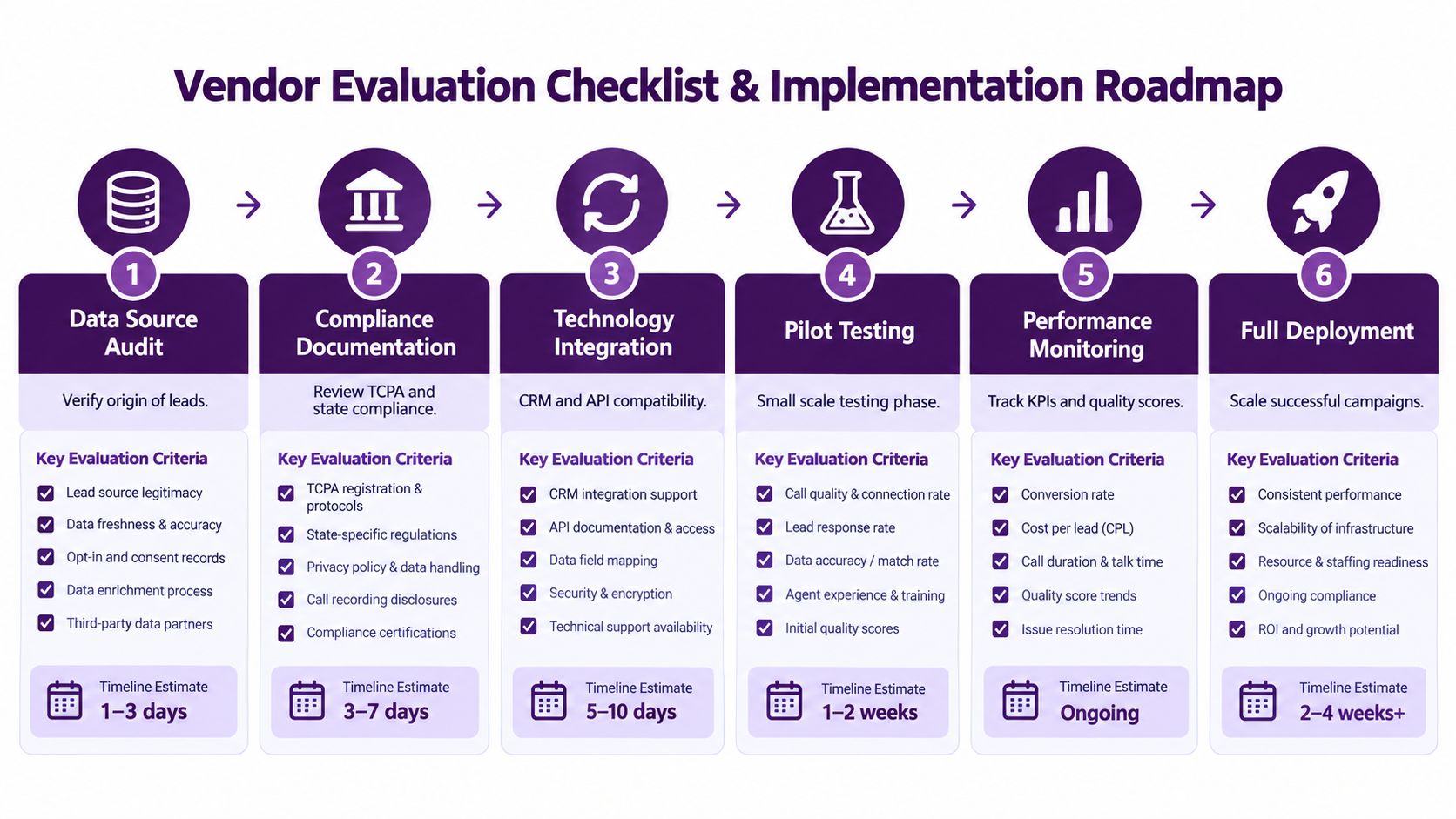
Could a vendor prove where each lead came from, when consent was captured, and what happened after delivery? Those answers matter more than polished sales materials. Differences appear in data lineage, consent records, reporting detail, and the vendor’s response when a lead is challenged.
Treat the selection process as operational due diligence. A cheap source can become expensive if agents cannot reach prospects quickly, consent cannot be retrieved, or invalid records remain in the queue.
What to ask before signing
Start with lead origin. Ask which channel generated the inquiry, how intent was captured, whether the record is shared or exclusive, and what makes it invalid. Require sample records, consent language, timestamps, and the process for retrieving them. Vague answers at this stage often become disputes after launch.
Then test the operating details:
- Consent controls: Confirm the disclosure, storage method, retrieval process, and ownership of the record.
- Routing logic: Check how the vendor routes leads by state, language, product, agent availability, and time of day.
- Return policy: Define invalid leads, dispute windows, evidence requirements, and credit or replacement handling.
- Reporting depth: Require source, disposition, contact attempt, transfer, and appointment detail rather than volume alone.
- Tech stack: Confirm CRM fields, API access, call recordings where appropriate, queue status, and timestamp visibility.
Use the criteria above to structure the review and expose gaps before contracting.
A good vendor answers hard questions quickly. A weak vendor redirects the discussion to volume.
A workable rollout sequence
Implement the program in six controlled steps:
- Audit the current funnel. Map lead sources, first-contact ownership, response timing, consent storage, and failure points.
- Define acceptance rules. Document valid, qualified, appointment-ready, and transfer-ready lead requirements.
- Integrate systems. Connect CRM fields, dispositions, language routing, agent queues, and consent records before launch.
- Run a pilot. Test one product, state group, or language lane with limited traffic.
- Review quality weekly. Listen to calls, inspect notes, compare timestamps, and identify source-specific problems.
- Scale clean sources. Expand channels that produce usable conversations and withstand compliance review. Correct or cut sources that create repeated disputes.
A Mexico-based nearshore team can make the pilot more useful when the operating window matches U.S. time zones. For example, a lead received during a U.S. evening can enter a staffed bilingual queue instead of waiting for the next day. That speed only helps if consent, routing, and call outcomes remain documented.
What success looks like operationally
A successful pilot produces more than activity. Leads enter with usable records, the correct script reaches the agent, managers can review outcomes quickly, and the compliance trail remains available. Track these conditions alongside appointments and transfers so speed does not conceal poor data quality.
Evaluate the proposed BPO scope against your workflow, language coverage, routing requirements, and compliance process. Keep product recommendations, quotes, coverage explanations, and binding decisions with appropriately licensed and authorized personnel.
Nearshore Bilingual Advantages and Case Examples
Why does nearshore support matter in insurance lead generation? The answer is operational: a prospect may need a quick response, a clear explanation in English or Spanish, and accurate documentation before a producer ever joins the call. Delays, unclear phrasing, or missing consent details can reduce the value of an otherwise promising lead.
Mexico fits many U.S. insurance programs because its working hours overlap with U.S. time zones and supervisors can stay close to daily operations. Managers can review calls, adjust training, and address a consent disclosure or routing change without waiting through a distant time difference. That proximity improves control, although it does not replace written procedures or regular quality checks.
Where shared working hours help
The advantage is not limited to labor cost. It comes from easier coordination and faster correction.
A nearshore bilingual team can provide:
- Same-day operational changes: Script edits, campaign pauses, and routing updates can reach the floor quickly.
- Bilingual first contact: English and Spanish conversations can follow one coordinated process, with language needs recorded for the next agent.
- Closer collaboration: U.S. managers can review call handling, notes, and consent details with fewer communication barriers.
- Cultural fit: Insurance calls often depend on trust, tone, and a clear explanation of next steps, not only on reading the approved script.
The trade-off is that nearshore coverage still requires disciplined supervision. A bilingual agent who sounds natural but skips a required disclosure creates a compliance problem, while a fast response with poor notes creates a handoff problem. Managers need to measure both speed-to-lead and the quality of the record left behind.
An illustrative bilingual handoff
Consider an auto-insurance quote-request campaign serving English- and Spanish-speaking households. An intake specialist confirms the customer’s preferred language, location, interest, and availability using the approved non-advisory script. A licensed producer receives the context before discussing products or coverage.
If transfers repeatedly fail because the prospect expects a quote immediately but the producer is unavailable, supervisors can adjust scheduling, queue capacity, and the opening explanation. Verify the changes against the approved contact and licensing boundaries before rollout.
Better lead generation support often appears as fewer confused handoffs, clearer notes, and agents who can advance a conversation in either language.
Where nearshore is the strongest fit
Nearshore bilingual insurance lead generation services fit programs that need close oversight, consistent QA, and frequent operational changes. They are particularly useful for multi-state campaigns, mixed inbound and outbound work, and lead flows where response speed and consent documentation require daily manager attention.
Final Recommendations and Next Steps for Insurers and Brokers
If you’re choosing insurance lead generation services, don’t start with the vendor list. Start with your bottleneck.
If closers are buried in low-quality follow-up, fix qualification and handoff first. If the sales team is strong but calendars are empty, appointment-setting may be the better purchase. If you already buy leads and can’t prove consent cleanly, stop scaling until the records are in order.
A simple decision framework helps:
- Check fit: Match the service model to the actual sales bottleneck.
- Check compliance: Review consent language, seller specificity, and record retention.
- Check economics: Compare acquisition cost to actual closed business, not just lead price.
- Check operations: Make sure routing, QA, and follow-up ownership are clear.
- Check location strategy: If bilingual speed and close oversight matter, evaluate nearshore options seriously.
A useful pilot compares lead formats against producer capacity. If form leads create repeated intake work, test a smaller stream of qualified appointments or accepted live transfers. Keep the qualification criteria and full costs visible so the comparison reflects equivalent outcomes.
Insurance lead generation services work when compliance, speed, and vendor alignment are treated as one system. Split those decisions apart, and the funnel leaks in places most dashboards won’t show.
Give any new vendor a pilot period, define the exact handoff rules in advance, and inspect call quality early. If the operation stays clean under pressure, then scale.
Frequently Asked Questions
What do insurance lead generation services provide?
They can support inquiry capture, approved intake, basic qualification, routing, appointment booking, and live transfers. Define the exact output and acceptance criteria, and keep licensed selling activities with appropriately licensed and authorized personnel.
What is the difference between shared leads, exclusive leads, and live transfers?
Shared records may be delivered to multiple buyers. Exclusive records have contract-defined distribution limits. Live transfers connect an engaged prospect with a receiving producer. Confirm exclusivity duration, qualification requirements, and charges for rejected or failed transfers.
Did the FCC one-to-one consent rule take effect in January 2025?
No. That FCC rule was nullified by a court decision and removed in July 2025. Existing consent, do-not-call, privacy, and product-specific requirements still need review. Medicare requirements are a separate layer and should not be confused with the withdrawn FCC rule.
Can nonlicensed agents sell insurance during qualification calls?
Do not assume that intake permission includes selling authority. Define permitted tasks by state, product, and program. Product recommendations, coverage explanations, quotes, and binding decisions should be handled by appropriately licensed and authorized personnel.
How should an insurer calculate lead acquisition cost?
Divide all attributable acquisition and handling costs by the agreed outcome, such as issued policies. Include source fees, intake, follow-up, producer time, and failed handoffs where applicable. Evaluate retained commissions or contribution rather than treating policy premiums as agency revenue.
How can bilingual nearshore support improve the lead workflow?
English-Spanish teams can support approved intake, scheduling, documentation, and routing during agreed coverage hours. Confirm training, permissions, producer availability, escalation ownership, and quality reporting before launch.
Bilingual Nearshore Lead Support
Give Your Producers a Clearer Path to the Right Conversation
Discuss your intake, follow-up, appointment-setting, and routing needs with CallZent. Define the English-Spanish support scope and handoff rules around your licensed producer team.