

Outbound Call Center Services
Outbound Call Center Services: A Nearshore Growth Strategy for 2026
Learn how outbound call center services drive growth with nearshore strategy, KPI tracking, compliance controls, training, and campaign optimization.
TL;DR — Quick Takeaways
- Outbound call center services help businesses proactively contact prospects and customers for lead generation, appointment setting, retention, surveys, collections, and follow-up.
- Strategic outbound is not about blasting calls. It is about reaching the right person with the right message at the right moment.
- Nearshore outbound teams can improve collaboration, bilingual coverage, campaign control, and time-zone alignment for North American companies.
- The most important outbound KPIs include conversion rate, connection rate, cost per acquisition, appointment set rate, disposition quality, and revenue or retention impact.
- The best outbound partners combine training, technology, compliance controls, QA, and reporting into a disciplined growth system.
Meta title: Outbound Call Center Services for Growth with a Nearshore Strategy
Meta description: Learn how to use outbound call center services as a growth engine with the right nearshore partner, KPI framework, training model, and compliance-first strategy.
Are you trying to grow with inbound demand alone while hoping the right buyers eventually show up?
That’s a common blind spot. A lot of companies invest in websites, ads, email, and support, but they never build a disciplined outbound motion to create pipeline, recover revenue, retain customers, or re-engage inactive accounts. Then they wonder why growth feels uneven.
The business case for proactive outreach is stronger than many leaders assume. Companies that don’t use outbound call center services show a 42% lower growth rate than companies that do, based on the verified industry benchmark provided for this article. That gap is large enough to change how you think about outreach. Outbound is not just a sales add-on. It’s a revenue operating system.
Introduction Are You Actively Driving Growth or Just Waiting for It
Most businesses don’t have a lead problem. They have a contact problem.
Good prospects sit in the CRM without follow-up. Existing customers lapse without a renewal conversation. High-intent buyers abandon forms, carts, or quotes and never hear from a real person. That is exactly where outbound call center services create value. They give your business a way to act instead of wait.
The growth gap is hard to ignore. Companies that forego outbound call center services experience a 42% lower growth rate than those that actively use them. For many operators, that’s the clearest signal that passive demand generation leaves revenue on the table. If you’re still treating outreach as optional, it’s worth reading why call centers matter in 2025.
TLDR The Outbound Advantage
- Definition: Outbound call center services help businesses proactively contact prospects and customers for lead generation, appointment setting, retention, surveys, collections, and follow-up.
- Core idea: Strategic outbound is not about blasting calls. It’s about putting the right message in front of the right person at the right moment.
- Nearshore edge: A nearshore team can improve day-to-day collaboration, language coverage, and operational control.
- What to measure: Conversion rate, cost per acquisition, and connection rate tell you far more than raw dial volume.
- Decision lens: The right partner, process, and reporting model can turn outbound from a cost center into a predictable growth engine.
Key takeaway: Outbound call center services work best when they’re treated as a revenue discipline, not a dialing activity.
A practical example makes the point. An e-commerce brand may already spend heavily on paid traffic, but still lose buyers after an abandoned cart or an unreturned financing application. An outbound team can call those high-intent leads, answer objections, confirm shipping concerns, or help complete the order. A healthcare group can use outbound to confirm appointments and reduce missed visits. A telecom provider can call customers nearing renewal before they churn.
The phone is not the answer to everything. But for moments that carry revenue, risk, or retention value, it often remains the fastest path to clarity.
What Are Modern Outbound Call Center Services
Modern outbound call center services are broader than old-school cold calling. The best programs solve specific business problems, each with a clear workflow, target audience, and expected outcome.

The core service types that matter
-
Lead generation: Sales development agents contact targeted prospects, qualify interest, and move real opportunities into the pipeline.
Example: A B2B software company gives an outbound team a list of dormant demo requests and target accounts that fit its ideal customer profile. -
Appointment setting: Agents focus on booking consultations, demos, field visits, or callbacks for your internal sales team.
Example: A home services company uses outbound call center services to fill underbooked technician slots after a seasonal slowdown. -
Customer retention: The goal is to save at-risk accounts, renew contracts, and reduce preventable churn.
Example: A subscription business calls customers near renewal to address complaints before cancellation becomes final. -
Collections and payment reminders: Agents handle overdue invoices, payment plans, and account follow-up with a structured, compliant process.
Example: A healthcare billing team outsources outbound reminder calls so internal staff can focus on patient-facing work. -
Surveys and feedback: Not every outbound campaign is sales-driven. Some calls gather customer insight, validate service issues, or check post-purchase satisfaction.
Example: A retailer calls high-value customers after delivery problems to understand what happened and preserve the relationship. -
Win-back campaigns: A trained team reaches former customers with a reactivation offer or service recovery conversation.
Example: A telecom company contacts recently lost accounts to understand why they left and present a targeted return option.
What works better than generic cold calling
The biggest shift is that modern outbound programs run on better data and tighter campaign design. The campaign should start with a business event, not a random list. Cart abandonment, trial expiration, insurance renewal, overdue balance, quote follow-up, missed appointment, and inactive account are all stronger triggers than broad untargeted outreach.
A useful example comes from stalled sales workflows. If your sales team keeps losing momentum between first interest and final close, tools and process can help remove friction. This resource on how to Eliminate stalled deals with automation is worth reviewing because it speaks directly to one of the most common outbound failures: inconsistent follow-up.
Outbound works when the call has context. It struggles when the only strategy is volume.
The role of dialing tools
The software layer matters because agents can’t spend half the day hunting through records or dialing manually. A mature setup often includes predictive or progressive dialing, CRM access, campaign management, and quality controls. If you want a practical look at one part of that stack, this guide to predictive dialing and outbound productivity is a useful starting point.
A simple rule helps here: don’t buy outbound call center services just to “make more calls.” Buy them to create more productive conversations tied to a business result.
The Nearshore Advantage for Your Outbound Strategy
Location changes the economics and the execution of outbound. It affects labor cost, communication speed, coaching quality, schedule overlap, and how closely your partner can align with your team.
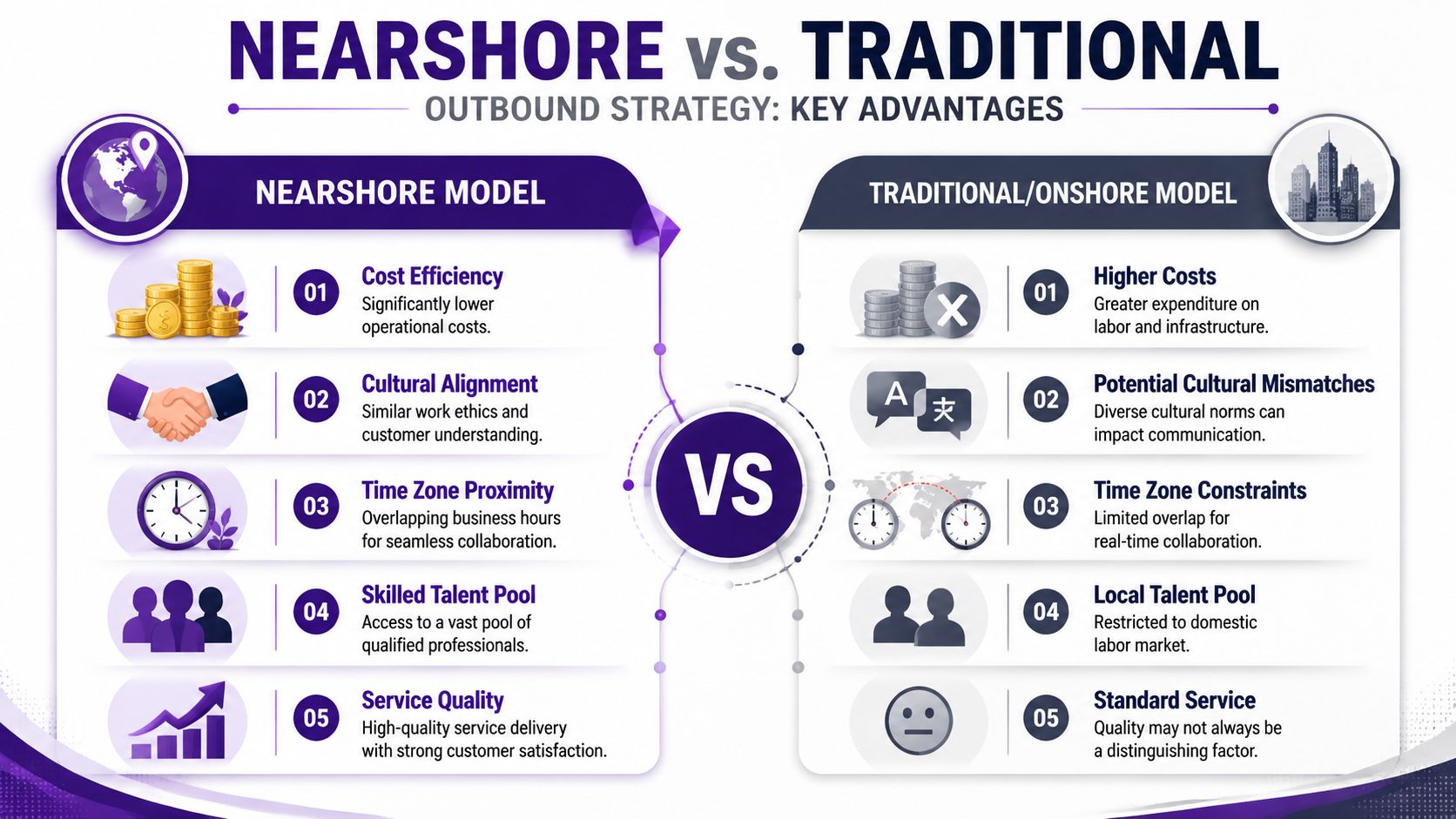
A nearshore model, especially for North American companies, often gives you a better operating balance than a purely onshore or far-off offshore setup. You can keep close time zone alignment, easier management contact, and stronger cultural familiarity while still improving cost structure.
Why the staffing model matters so much
Outbound programs live or die on consistency. That’s where the industry’s turnover problem becomes expensive. Outbound call centers are high-intensity environments with average agent turnover ranging from 30% to 45%, based on the verified benchmark provided for this article. When a provider burns through agents, quality drops. Scripts become mechanical, compliance risk rises, and campaign learning resets over and over.
“High agent turnover is the silent killer of outbound campaigns. A great nearshore partner doesn’t just offer a good price; they offer stability and quality by building a culture where skilled agents want to stay and succeed.”
A nearshore operation with disciplined hiring, coaching, and supervisor access can reduce the operational damage caused by churn. The point isn’t that turnover disappears. It’s that a better-managed environment protects your campaign from constant disruption.
Nearshore versus traditional onshore
Here’s the practical difference many buyers notice after launch:
| Model | Typical strengths | Typical trade-offs |
|---|---|---|
| Onshore | Familiar market context, local presence | Higher operating costs, tighter labor pool |
| Offshore | Lower labor cost | Greater distance, more time zone friction, possible communication mismatch |
| Nearshore | Time zone overlap, bilingual talent, easier collaboration, cost efficiency | Requires careful partner selection and process alignment |
Nearshore is not automatically better. It’s better when the partner has a real operating model behind the pitch.
What to evaluate beyond price
If you’re comparing providers, ask about the conditions agents work in, how coaching happens, and how quickly managers can adjust a live campaign. Those questions tell you more than an hourly rate ever will.
Look for:
- Schedule overlap: Can your managers and theirs review performance in real time?
- Language fit: Are agents fluent in the markets you serve, including bilingual coverage where needed?
- Supervisor accessibility: Can you reach someone who owns outcomes, not just staffing?
- Retention practices: What keeps agents from cycling out of the program after onboarding?
- Campaign flexibility: Can the provider adapt call guides, QA rules, and list strategy quickly?
For companies serving the U.S. market, the nearshore advantage is often less about geography by itself and more about operational closeness. That closeness helps when you’re adjusting scripts, refining talk tracks, or responding to shifts in lead quality.
Measuring Success The KPIs and Technology That Matter
Raw dial counts don’t tell you whether an outbound program is healthy. They only tell you that agents were busy.
What matters is whether the campaign creates profitable outcomes. That means you need a KPI set tied to business results and a technology stack that makes those metrics visible.
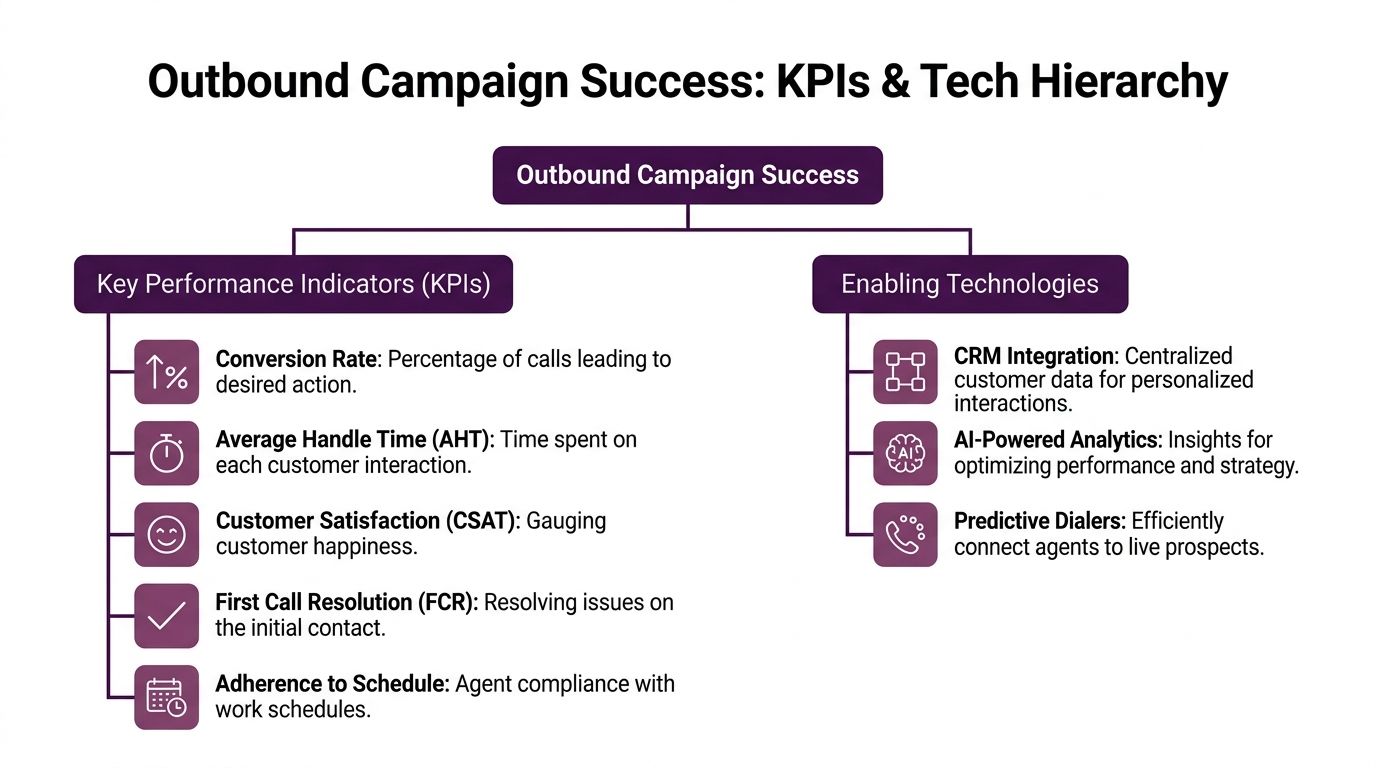
The KPIs that deserve executive attention
Some numbers help you manage. Others only create noise.
Focus first on these:
- Conversion rate: Of the people reached, how many took the desired action? That action could be a booked demo, recovered payment, completed sale, or saved account.
- Connection rate: How often does a dial become a live conversation? This often reveals list quality, call timing, and caller reputation issues.
- Cost per acquisition: What does it cost to generate one real customer or one qualified opportunity?
- Appointment set rate: Useful when the team’s job is to create meetings rather than close business directly.
- Disposition quality: Are call outcomes being logged accurately enough to improve the next touch?
- Revenue or retention impact: Did the campaign move business outcomes, not just activity metrics?
The metrics that can mislead you
High call volume can hide a weak campaign. So can long talk times.
A team can place a lot of dials against poor data and still miss target. An agent can stay on calls for a long time because the script is unclear or the lead was never qualified properly. Metrics need context. That’s why dashboards should combine productivity, quality, and outcome data.
Practical rule: If a provider reports dials first and business outcomes second, you’re probably looking at an activity-heavy program instead of a results-driven one.
The tech stack behind better outbound performance
A technically mature outbound call center stack is usually built around auto-dialers, CRM integration, call recording, analytics dashboards, campaign management, and outbound calling software, and the operational effect is clear in Nextiva’s overview of outbound call center infrastructure. Dialing automation reduces agent idle time, while CRM and analytics improve lead prioritization, disposition tracking, and campaign optimization.
That stack matters because each piece supports a different layer of performance:
| Tool | What it does in practice |
|---|---|
| Auto-dialer | Reduces idle time and keeps agents moving through contact queues efficiently |
| CRM integration | Gives agents customer context, prior contact history, and cleaner follow-up workflows |
| Call recording | Supports QA, coaching, dispute review, and script refinement |
| Analytics dashboards | Show campaign trends, connection quality, and agent-level performance |
| Campaign management tools | Control list segmentation, call logic, and workflow rules |
| Outbound calling software | Brings the execution layer together for supervisors and agents |
How technology and KPIs connect
Technology should improve decisions, not just speed. For example:
- A weak connection rate may point to list issues, poor call windows, or caller ID reputation problems.
- Low conversion with strong connection may point to script quality, targeting, or training gaps.
- Inconsistent dispositions usually indicate weak CRM process or rushed after-call work.
- High acquisition cost often reveals wasted dialing against low-intent records.
A buyer should expect transparent reporting with drill-down capability, not a weekly summary that says the team was “productive.” If you’re evaluating dashboards and reporting maturity, this overview of call center reporting, metrics, dashboards, and KPIs helps clarify what useful visibility should look like.
Navigating Outbound Compliance and AI in 2026
A lot of companies still ask the wrong question about AI in outbound. They ask whether automation can increase volume. The better question is whether automation can increase control.
That shift matters because compliance risk usually doesn’t come from one dramatic failure. It comes from small operational misses. Bad suppression logic. Poor list hygiene. Weak consent tracking. Too many attempts in the wrong sequence. Agents following a script that sounds aggressive in a sensitive context.
Where AI helps and where it does not
The most useful guidance in this area is not “use more AI.” It’s use AI carefully. A major underserved angle in outbound operations is how teams stay compliant and effective as AI-powered dialing and analytics spread, and the value comes from balancing speed with human judgment, especially in regulated or relationship-sensitive campaigns such as healthcare, finance, and collections, as noted in this discussion of outbound call center governance and AI.
That balance shows up in practical ways:
- Consent management: Systems can help flag records that shouldn’t be contacted or that require different handling.
- Cadence control: Analytics can help managers avoid contact fatigue by tightening call windows and suppression rules.
- Quality review: Recorded-call analysis can identify script drift or risky language patterns faster than manual review alone.
- List governance: AI can help surface duplicate records, stale records, or problematic dialing patterns.
What AI should not do is remove judgment from the process. Sensitive campaigns still need supervisors and trained agents making decisions around tone, timing, and escalation.
Compliance is an operating discipline
The safest outbound programs treat compliance as part of campaign design, not legal cleanup after launch.
That means the provider should have clear processes for:
- List suppression
- Consent tracking
- Script approvals
- Call recording review
- Escalation rules
- Campaign-specific dialing logic
More automation without governance usually creates more bad calls, not better outcomes.
This is especially important when your outreach touches health information, financial obligations, payment conversations, or service complaints. In those cases, “efficient” outreach can still damage trust if the workflow is poorly governed.
For a practical baseline, review what a provider includes in its call center compliance approach. You’re not looking for legal language alone. You’re looking for evidence that the operation can enforce clean rules every day.
Industry Specific Use Cases When a Phone Call Still Wins
Digital channels are cheaper to scale. That part is true. But cheap doesn’t always mean effective.
The stronger trend is that outbound is moving away from broad telemarketing and toward higher-intent, higher-touch work where live conversation still matters, such as renewal reminders, collections, and service recovery, as outlined in RingCentral’s discussion of current outbound use cases. That shift is why selective outbound call center services still outperform email-only or SMS-only workflows in the right situations.
Healthcare follow-up and appointment protection
Healthcare teams often need more than an automated reminder. A patient may need clarification on preparation instructions, insurance concerns, medication timing, or rescheduling options. A live outbound call can handle those moving parts quickly.
A practical use case is post-visit follow-up. If a patient had a confusing discharge experience or needs help understanding next steps, a real conversation can prevent complaints and improve continuity. In this setting, the call is not just a reminder. It is service recovery and care coordination.
Finance and insurance conversations with friction
Some products are too complex for a click-only journey. Buyers may hesitate because they don’t understand terms, documentation requirements, or next steps. Outbound support can help move those cases forward without forcing the customer to start over.
For example, an insurance broker may have quote requests sitting untouched because prospects have unanswered questions about coverage details. A trained outbound agent can clarify what’s missing, confirm interest, and hand off clean opportunities to a licensed advisor or account team.
When the customer has uncertainty, a phone call often beats another automated reminder.
E-commerce revenue recovery
E-commerce operators often think of outbound only for customer service escalations, but there’s a strong use case in high-value order recovery. If a shopper abandons a financing step, flags a shipping concern, or stalls after requesting product guidance, a well-timed call can answer the final objection.
This works best when the list is narrow and high-intent. A team calling everyone who browsed a product page will sound intrusive. A team calling buyers who started checkout, requested help, or abandoned a premium order has a stronger reason to reach out.
Typical examples include:
- Abandoned high-ticket orders
- Failed payment follow-up
- Backorder communication
- Post-delivery service recovery
- Warranty or protection plan outreach
Telecom and subscription renewals
Telecom, SaaS, and subscription businesses often know when churn risk is approaching. The mistake is waiting until the account is already gone.
Outbound calls can be useful when a customer has had recent service friction, ignored digital renewal notices, or reduced product usage. A live agent can surface the reason for hesitation in minutes. The business can then decide whether to adjust the offer, route the issue to support, or let the account lapse.
Collections and account resolution
Collections is one of the clearest examples of where voice still matters. Payment is not always the underlying issue. Sometimes the customer disputes the balance, needs a different payment schedule, or avoids impersonal notices.
A structured outbound call gives the business a chance to resolve the account with more context and less back-and-forth. The same principle applies in B2B receivables, where a short conversation can uncover whether the issue is AP workflow, invoice mismatch, or internal approval delay.
Service recovery after something went wrong
This is one of the most underused outbound plays.
If a shipment was missed, a reservation failed, an appointment was dropped, or a complaint escalated, the fastest way to stabilize the relationship may be an outbound call from a trained agent. Email can document the issue. A phone call can repair the relationship.
Selective outbound wins when urgency, complexity, or emotion is involved. That is why phone still earns its place in a modern outreach mix.
Choosing Your Partner and Measuring Real ROI
How do you tell the difference between an outbound vendor that keeps agents busy and a partner that produces revenue, retention, or recovered cash you can measure?
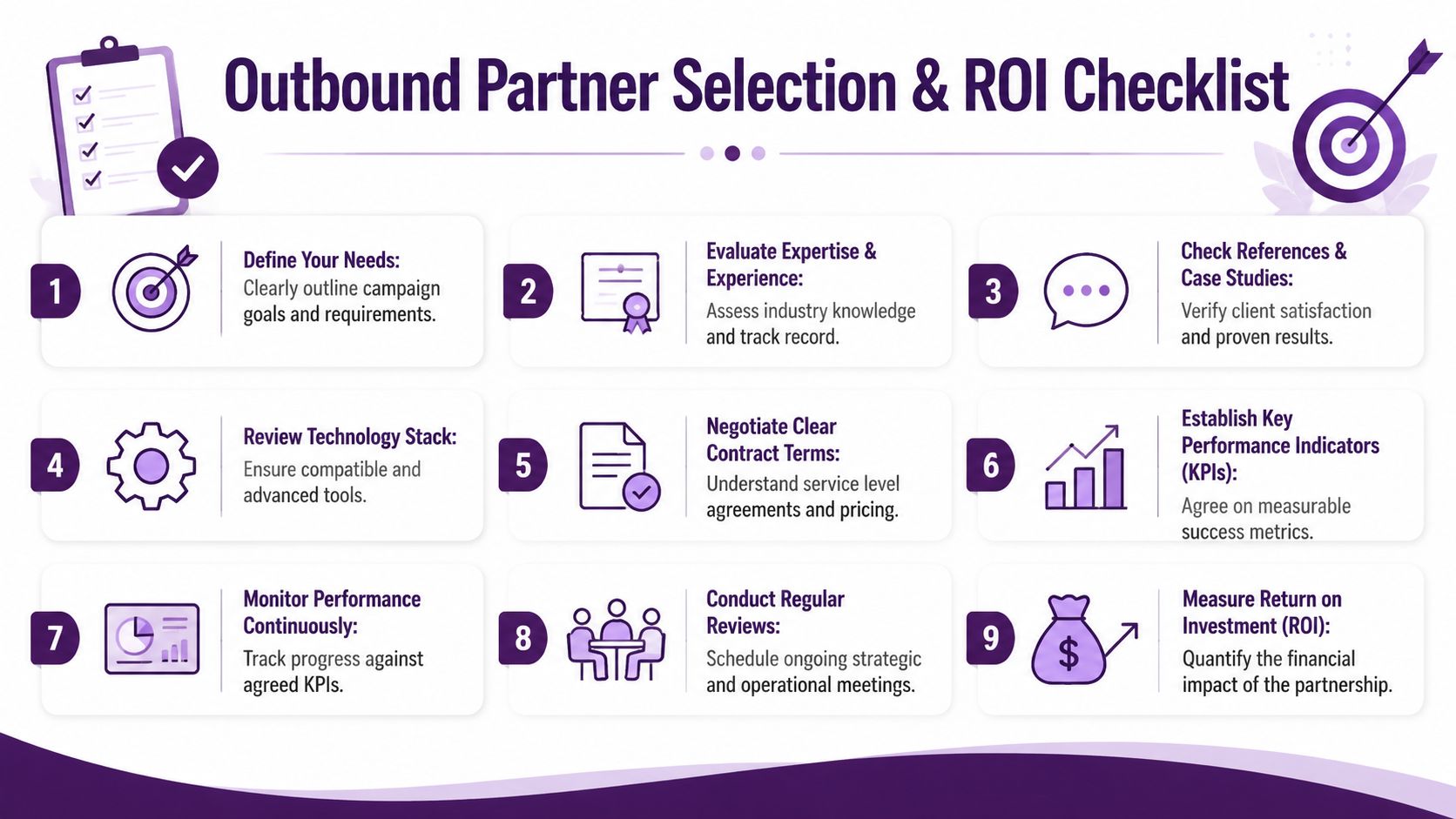
The answer is not in the pitch deck. It is in operating discipline. A capable outbound partner can explain how agents are trained, how lists are worked, how QA is scored, how compliance controls are applied, and how campaign changes are made once real call data starts coming in.
Start with training depth, not the sales deck
Outbound results are shaped more by process design and agent readiness than raw dialing volume. Contact Center Pipeline’s guidance on outbound tools, processes, and people notes that strong programs often put new hires through weeks of training across product knowledge, scripts, role-play, and coaching before they handle live conversations.
That matters because outbound work breaks down fast when agents are underprepared. Connection rates may look acceptable, but conversion quality, compliance accuracy, and call control usually suffer.
Ask direct questions before you sign:
- How are agents certified before they handle live calls?
- What role-play standard must they pass?
- How often do supervisors review calls and coach to specific gaps?
- Who owns script changes when objections shift or contact quality drops?
- How are regulated scenarios and consent-sensitive conversations handled?
A partner checklist that reveals real capability
Price matters. Headcount matters. Neither tells you whether the program will scale.
A stronger evaluation looks at how the provider builds and manages the operation after launch, especially if you are using a nearshore team to support growth across English and Spanish markets. In practice, that means checking whether the partner can connect campaign strategy, systems, QA, and reporting into one management process instead of treating them as separate functions.
Use a checklist like this:
| Area | What to ask |
|---|---|
| Campaign design | How do you segment lists, define dispositions, and build call flows by objective? |
| Technology | Which dialer, CRM, QA, call recording, and reporting tools are part of the program? |
| Training | How are agents onboarded, certified, and coached after production starts? |
| Compliance | How are suppression lists, consent rules, and script controls managed? |
| Reporting | Can results be broken out by list, agent, script version, and campaign cohort? |
| Management access | How often do we review performance, test changes, and approve optimizations? |
The right fit still depends on your campaign type, reporting needs, and compliance requirements, but that is the level at which you should evaluate any provider.
What real ROI reporting should include
A weak report lists calls made, contacts reached, and average handle time. That is activity reporting. It does not tell you whether the program is improving the business.
Useful reporting ties outreach to an outcome your finance or operations team cares about. Depending on the campaign, that may be qualified appointments, funded accounts, retained customers, collected balances, reactivated buyers, or service issues resolved before churn happens.
Look for reporting that includes:
- Lead source or list segment performance
- Connection and conversion by campaign
- Appointment quality or sales outcome
- Disposition trends
- Retention or recovery outcomes
- Acquisition cost or account resolution cost
- Agent quality notes tied to recordings
A good outbound report should help your team decide what to change next week.
A simple way to judge whether the program is working
Use a three-part ROI lens.
First, check operational efficiency. Are agents reaching the right contacts, following process, and leaving clean records your team can trust?
Second, check commercial impact. Are calls producing revenue, retained accounts, qualified meetings, or recovered receivables at an acceptable cost?
Third, check strategic value. Is the program helping you learn which segments respond, which objections block conversion, and which workflow changes improve results?
That third layer is where strong nearshore outbound programs separate themselves. They do more than execute. They help you improve list strategy, scripting, staffing, and channel mix so the program gets more predictable over time.
🚀 Ready to Turn Outbound Into a Growth Engine?
CallZent helps North American companies build bilingual nearshore outbound teams for lead generation, appointment setting, retention, collections, surveys, win-back campaigns, and service recovery.
Talk to an ExpertIf a provider cannot connect execution, outcomes, and learning, the campaign usually stays stuck as a cost center. If they can, outbound becomes a managed growth program with clearer forecasting and better control over ROI.