 Skip to content

Customer Service Outsourcing
Outsourced Customer Service Guide for 2026: Scale Support Without Losing Quality
Learn how outsourced customer service helps companies scale support, compare outsourcing models, manage quality, and build smarter customer operations.
TL;DR — Quick Takeaways
- Outsourced customer service is now a mainstream operating model for companies that need flexibility, coverage, and specialized support capacity.
- The market is large and still growing, with Grand View Research valuing the global outsourced customer care services market at USD 77.12 billion in 2024.
- The real challenge is not deciding whether to outsource. It is deciding how to protect quality, brand consistency, reporting, and customer feedback loops.
- Onshore, nearshore, and offshore models each have trade-offs around cost, communication, training, and time-zone alignment.
- Nearshore outsourced customer service can give North American companies a strong balance of cost efficiency, bilingual support, and real-time collaboration.
Growth usually breaks customer support before it breaks anything else.
Orders increase. Tickets pile up. Your team starts answering the same questions all day, response times slip, and managers get pulled into escalations instead of running the business. At that point, most leaders ask the wrong question. They ask whether outsourcing is cheaper. The better question is whether outsourced customer service can help you scale without damaging the customer experience that got you here.
That’s the decision. Not labor arbitrage. Not a quick fix. A growth strategy that has to protect brand trust while making operations more flexible.
Is Your Customer Support Ready to Scale
When support demand outgrows your internal bandwidth, three things usually happen at once. Customers wait longer, supervisors spend more time putting out fires, and internal teams lose focus on product, retention, and revenue work. That’s when outsourced customer service starts making sense.
In plain English, outsourced customer service means another team handles some or all of your customer interactions under your brand standards. That can include voice, email, chat, SMS, social support, back-office case handling, or a blend of channels.
What smart buyers are really trying to solve
Most companies don’t outsource because they want less control. They outsource because they need a support operation that can absorb volume, add hours of coverage, and hire faster than an in-house team can.
The mistake is treating this as a staffing transaction. It’s an operating model decision. If the partner can’t learn your policies, reflect your tone, and report performance clearly, lower cost won’t save the customer experience.
Practical rule: If your support volume is rising faster than your ability to train, supervise, and QA agents, you don’t have a staffing issue. You have a scaling issue.
Why this model keeps expanding
The market size tells you something important. This isn’t an experimental category. It’s a mature one, used by companies that need service capacity without rebuilding operations from scratch.
That doesn’t mean every outsourcing move is smart. It means the question has shifted. The serious buyers now want to know which work to outsource, which work to keep close, and how to keep the external team accountable once customers start talking to them.
Decoding the Outsourcing Models Onshore Nearshore and Offshore
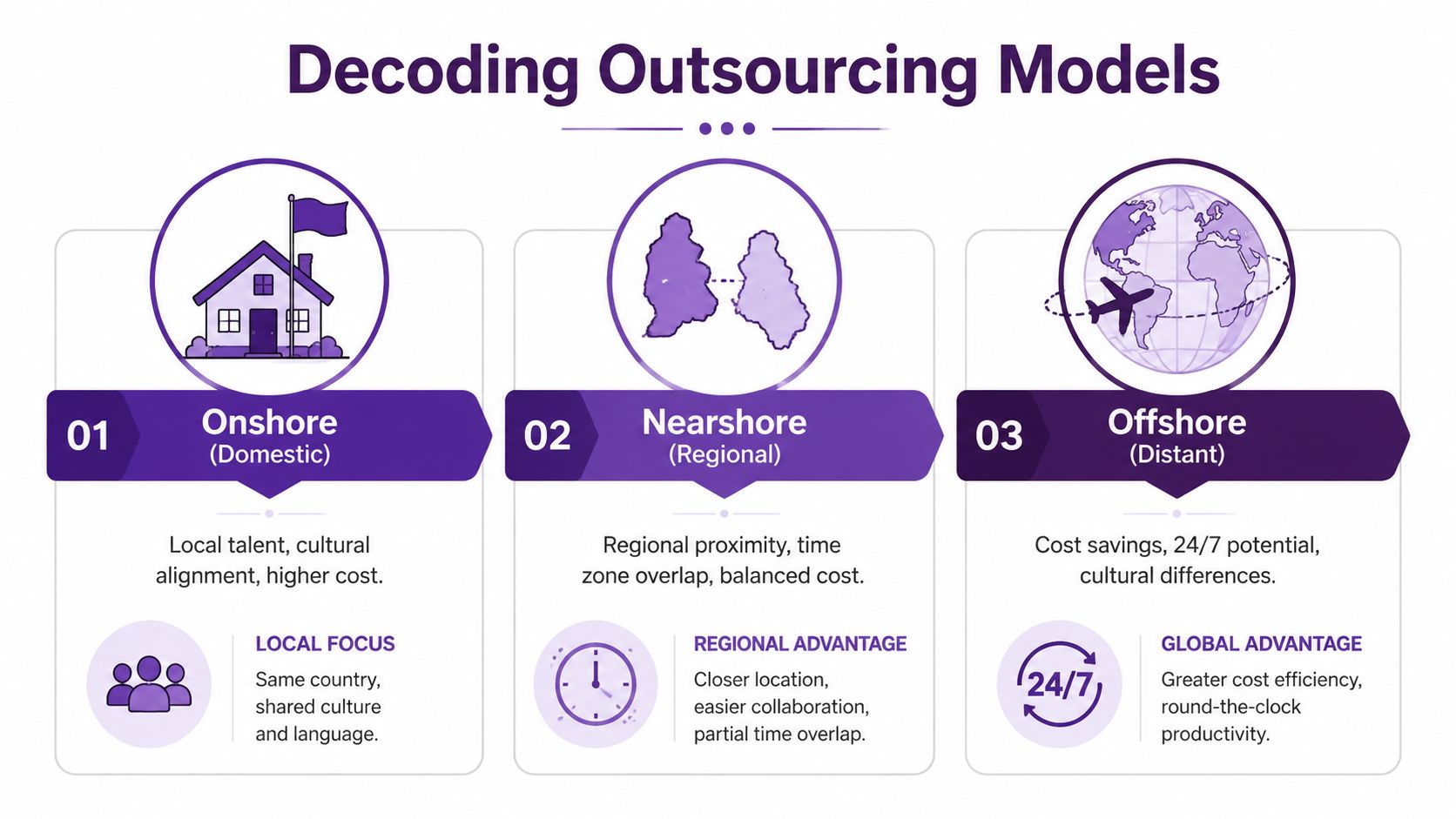
Choosing the wrong model creates friction that no SLA can fully fix. Geography affects staffing cost, time-zone overlap, training speed, escalation paths, language nuance, and how quickly managers can solve problems together.
Onshore means control and familiarity
Onshore outsourced customer service keeps the work in your home market. The appeal is obvious. Cultural alignment is easier, compliance conversations are simpler, and brand language usually feels natural right away.
The trade-off is cost. You often pay more for labor, which can limit how much coverage or specialization you can afford. For businesses with thin margins or volatile demand, that can narrow the business case quickly.
Offshore means access and cost pressure relief
Offshore models typically appeal to companies trying to lower labor costs or extend coverage across more hours. For some workflows, especially structured and repeatable support tasks, that can work well.
The trade-offs are operational, not theoretical. Large time differences can slow escalations. Nuance can get lost in handoffs. Training gets harder when managers and frontline teams rarely share the same working day.
Nearshore is the middle ground that often works best
Nearshore outsourced customer service sits between those two extremes. For North American businesses, that usually means regional partners in places like Mexico. The value isn’t just lower cost. It’s lower friction.
Nearshore models in locations like Tijuana can reduce operational costs by 35% to 40% compared to U.S. centers while also enabling real-time collaboration. That same proximity is associated with 15% to 20% improvement in First-Contact Resolution because agents can escalate issues to domestic stakeholders without time-zone delays.
The strategic advantage of nearshore support is simple: proximity gives you savings without forcing your operation into slow, asynchronous management.
A short comparison helps:
| Model | Best fit | Main strength | Main challenge |
|---|---|---|---|
| Onshore | High-touch, brand-sensitive support | Familiarity and local alignment | Higher operating cost |
| Nearshore | North American brands needing balance | Real-time collaboration and cost efficiency | Requires strong cross-border operating discipline |
| Offshore | High-volume, process-driven workflows | Cost relief and broad staffing access | Time-zone and communication friction |
For leaders weighing options, this breakdown of nearshore vs offshore outsourcing costs, risks, and ROI is useful because it frames the decision around operating reality, not just rates.
The Strategic Benefits and Real Risks of Outsourcing
The strongest case for outsourced customer service isn’t just that it can cost less. It’s that it can help a business move faster without stuffing every support problem into the org chart.

According to a 2024 PWC survey, 38% of businesses officially outsource customer service, and companies report average cost savings of 15% to 30%. The same data says outsourcing can boost operational efficiency by up to 25% and reduce time-to-market by 25%. Those figures are summarized in the verified PWC data provided for this article.
Where outsourcing creates real leverage
A good partner gives you more than extra seats.
- Scalability during spikes: Retail brands hit volume surges during promotions, holidays, and product launches. An external team can absorb that load without forcing your internal staff into constant overtime.
- Access to specialized roles: Some support queues need bilingual agents, technical troubleshooting, appointment scheduling, or order management experience. Outsourcing can make those skills available faster.
- Focus for internal teams: When frontline contact volume is handled well, your internal leaders can spend more time on product fixes, retention strategy, and process improvement.
For a broader operational view, this overview of business process outsourcing benefits is helpful because customer support rarely lives in isolation from billing, back office, or admin workflows.
Where outsourced customer service goes wrong
Most outsourcing failures come from weak management design, not from the model itself.
Brand dilution happens when agents memorize scripts but don’t understand your tone. Data risk grows when systems access is granted loosely or compliance rules are vague. Customer insight gets lost when the external team closes tickets but no one feeds recurring complaints back to product or operations.
Outsourcing works when the partner behaves like an operating extension of the business, not a detached vendor waiting for instructions.
What reduces those risks
Several practices separate healthy partnerships from expensive disappointments:
- Tight QA standards: Don’t assume “good service” means the same thing to both sides.
- Shared reporting: Track customer themes, not just queue metrics.
- Controlled system access: Agents need the right tools, but access should match the actual workflow.
- Frequent calibration: Review real conversations, edge cases, and policy changes together.
The risk isn’t outsourcing. The risk is outsourcing without governance.
How to Choose the Right Outsourced Customer Service Partner
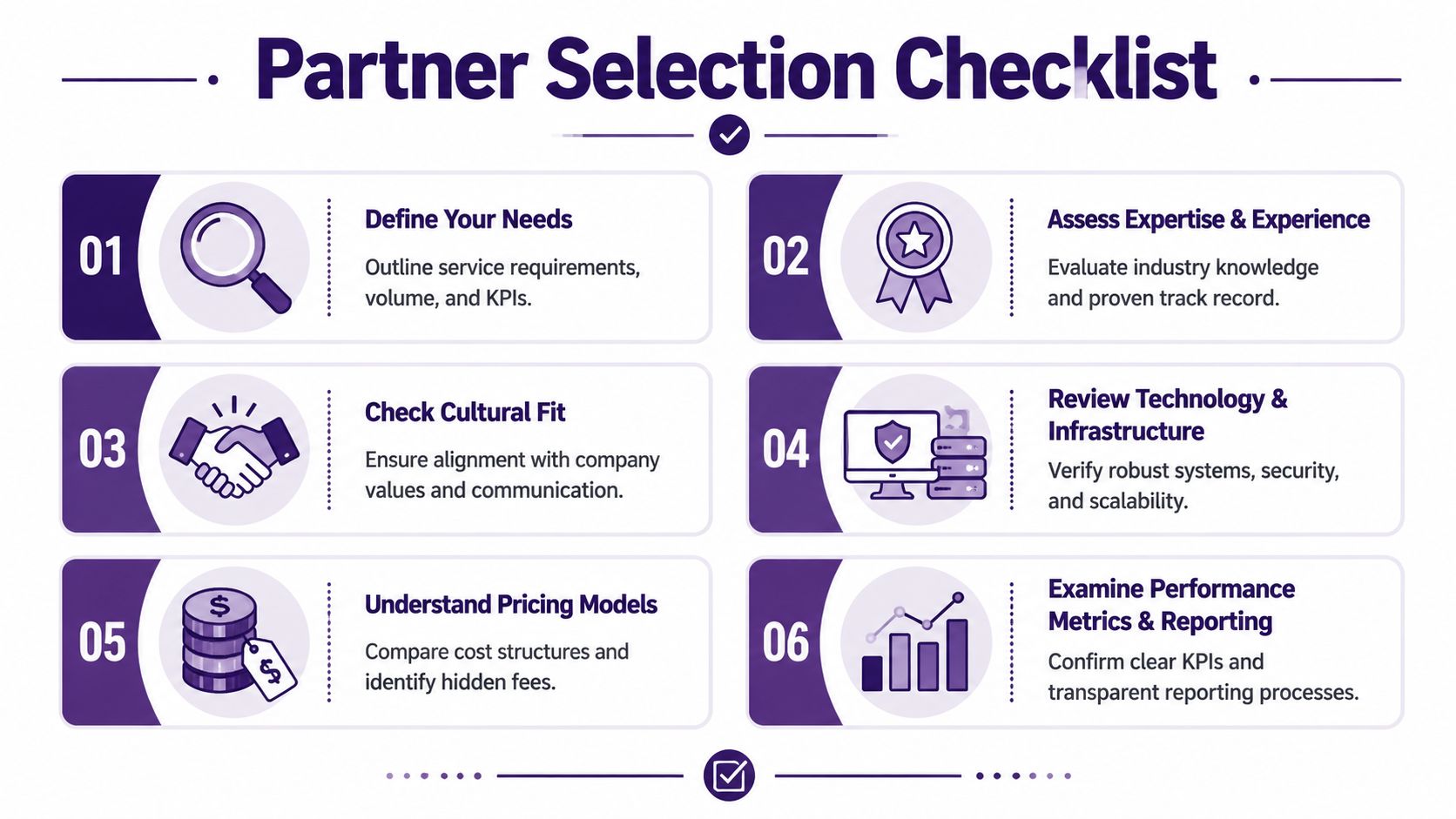
Vendor selection gets easier when you stop asking broad questions like “Can you handle support?” and start asking operational ones. How do you train? How do you QA? What does a failed escalation look like in your process? What happens when my policy changes on a Friday afternoon?
The wrong partner sells coverage. The right one shows management discipline.
Start with scope before you compare price
Before you meet providers, define what you’re outsourcing.
Some companies only need overflow voice support. Others need a blended operation that covers chat, email, and order-related back office tasks. Some need a partner that can work inside Shopify, Zendesk, Salesforce, HubSpot, or a custom ticketing environment. If you don’t define the scope, every proposal looks reasonable.
Use this checklist:
- Channels: Voice, email, chat, SMS, social, or blended.
- Hours of coverage: Business hours, extended coverage, weekends, or around-the-clock support.
- Case types: Billing questions, returns, technical troubleshooting, appointments, claims, or lead qualification.
- Escalation boundaries: Which issues agents can resolve and which must come back to your internal team.
- Brand requirements: Tone, approved language, refund rules, compliance steps, and exception handling.
Review the operating system, not just the sales pitch
A strong provider should walk you through training, QA, reporting, workforce management, security controls, and business continuity.
Ask what tools agents use to see customer history across channels. That matters because technical integration affects handle time and consistency. In high-performing outsourced environments, omnichannel API gateways let agents access unified customer history in one session context. Without that setup, context switching adds 1.5 to 2.0 minutes to Average Handle Time, while proper implementation can drive a 12% increase in operational throughput per agent hour.
One practical option for businesses evaluating regional support is a nearshore call center. For example, CallZent operates in Tijuana and provides bilingual support and BPO services for North American companies. That matters if you need English and Spanish coverage with real-time management overlap.
Know what a serious SLA should include
A vague SLA creates fake accountability. A useful SLA defines quality in measurable terms.
A high-performance SLA should require a CSAT score above 4.5/5.0 and an AHT variance of less than 10% from baseline. The QA model matters just as much. In the verified benchmark for this article, quality is defined through a unified rubric made up of Adherence to Process (40%), Communication Tone (30%), and Resolution Accuracy (30%).
Here’s what to ask for in writing:
| SLA element | What to verify |
|---|---|
| CSAT target | Minimum acceptable score and how it’s measured |
| AHT management | Baseline, allowed variance, and how complexity is normalized |
| QA rubric | Weighted scoring model, calibration cadence, and dispute resolution |
| Escalation rules | Response windows, ownership, and after-hours handling |
| Reporting rhythm | Daily queue visibility plus weekly and monthly reviews |
Buyer check: If a provider talks about speed but can’t explain how they score quality, keep looking.
Test for cultural fit in a practical way
Don’t ask if the provider understands your brand. Test it.
Give them sample tickets. Ask them to rewrite responses in your voice. Have them explain how they’d coach an agent through a frustrated customer, a policy exception, and a high-emotion complaint. You’ll learn more in that exercise than in a polished capabilities deck.
Setting Your Partnership Up for Success Onboarding and Management
Most support programs don’t fail during contracting. They fail during transition. The partner gets a product deck, a few macros, and a rushed launch date. Then everyone acts surprised when quality drifts.
A stable launch needs structure from day one.
Build the knowledge transfer in layers
Start with the fundamentals. Agents need product knowledge, policy rules, common scenarios, approved language, escalation paths, and system navigation. Then go one level deeper. They also need to understand where customers get confused, what issues trigger churn risk, and which promises your brand never breaks.
Many businesses underinvest in this area. They train for process but not judgment.
A practical onboarding rhythm often looks like this:
- Brand immersion first: Teach voice, tone, and customer expectations before queue handling.
- Workflow training second: Show exactly how to document, escalate, tag, and resolve.
- Live calibration third: Review early conversations together and correct fast.
- Feedback loop fourth: Route customer friction points back to internal teams every week.
Create a management cadence that keeps quality visible
The cleanest outsourced customer service relationships share the same operational heartbeat. Supervisors review QA. Client stakeholders review trends. Both sides look at ticket themes, not just averages.
One useful outside reference is OrderOut’s ChowNow customer service tips. It’s a consumer-facing resource, but it highlights something support leaders often forget. Customers judge service by how easy it feels to get clear, timely help. That expectation should shape how your outsourced team writes, responds, and follows through.
Good onboarding doesn’t stop at launch. It keeps translating brand intent into day-to-day agent behavior.
Treat the partner like an insight source
Frontline agents hear the same objections, complaints, and confusing moments over and over. If you only use the team to close tickets, you waste one of the most useful signals in your business.
Ask for recurring issue summaries. Review where customers get stuck in checkout, onboarding, billing, scheduling, or claims. Strong partners don’t just answer questions. They help you see where the business is creating them.
Sector-Specific Outsourcing for E-commerce Healthcare and Finance
Outsourced customer service isn’t one-size-fits-all. The model changes depending on what the customer needs, how much risk is involved, and what regulators expect.
E-commerce needs speed and order fluency
An online retailer usually deals with repetitive but time-sensitive contacts. Where’s my order? Can I change my address? Why was this item canceled? How do returns work?
That environment rewards agents who can move quickly between order systems, shipping updates, and policy explanations without sounding robotic. Seasonal spikes matter here too. A support team may need to scale around promotions, holiday volume, or new product drops while keeping replies consistent.
Healthcare needs privacy discipline and empathy
Healthcare support is less forgiving. Even when the task seems simple, such as appointment scheduling or general information handling, the workflow needs careful access control and disciplined documentation.
Nearshore operations can be especially relevant in regulated environments because geographic proximity can reduce data sovereignty complications. In the verified benchmark for this article, nearshore models help regulated industries such as healthcare and finance support compliance with HIPAA and GLBA frameworks while reducing time-to-deploy for high-security backlog operations.
Finance needs precision and controlled escalation
Financial services support often involves billing questions, account-related requests, dispute handling, and sensitive verification steps. Accuracy matters as much as courtesy. A polite wrong answer creates more risk than a slower correct one.
That’s why finance teams should pressure-test exception handling before launch. How does the provider document a disputed transaction issue? Who owns next-step communication? What language is approved when an answer depends on compliance review? Those details matter more than generic promises about white-glove service.
Your Future-Proof Outsourcing Strategy
The outsourcing conversation has changed. The old version was mostly about cost. The next version is about design.
The key question is no longer just whether to outsource. It’s which parts of service should remain human-led, which can be automated, and how an outsourced partner blends the two to improve resolution quality, as noted in this industry perspective on overlooked customer service outsourcing decisions.
That’s the practical role of AI in outsourced customer service. Use automation for repetitive routing, simple status requests, and agent-assist workflows. Keep trained humans on the interactions that need judgment, empathy, persuasion, and exception handling. A modern partner should be able to work within that blended model, not force everything into either full automation or fully manual support.
If you’re planning for the next stage of support operations, these contact center technology trends help frame what the operating model should look like going forward.
🚀 Ready to Scale Support Without Losing Quality?
CallZent helps North American companies build outsourced customer service teams with bilingual coverage, nearshore collaboration, QA discipline, and scalable BPO support.
Talk to an ExpertIf you’re evaluating outsourced customer service and want a partner that fits a North American operating model, CallZent is one option to consider. The team provides bilingual nearshore call center and BPO support from Tijuana for businesses that need scalable customer service, back-office help, and closer real-time collaboration.


