

Proactive Customer Care
Your Guide to Proactive Customer Care for 2026
Learn how to build proactive customer care with automation, agent training, measurement, and nearshore support for SMBs and growing teams.
TL;DR — Quick Takeaways
- Proactive customer care means preventing avoidable friction, not just responding faster.
- Start by mapping the customer journey and identifying high-risk moments such as shipping delays, failed payments, onboarding drop-off, and appointment no-shows.
- Use automation for routine alerts and use people for situations that require empathy, judgment, or recovery.
- Train agents to spot patterns, not just close tickets. QA and coaching matter because they reveal friction before it turns into churn.
- Measure proactive work separately from reactive work so you can see whether outreach reduced inbound demand or improved the customer experience.
- For smaller companies, cost is the main hurdle. A bilingual nearshore model can make proactive customer care more practical without requiring a large in-house tech stack.
The aspiration for proactive customer care is common. Far fewer can point to the exact moments when they’ll reach out before a customer asks for help.
That gap is where service costs rise, churn starts, and loyalty slips. Traditional support waits for a ticket. Proactive customer care looks for warning signs first, then acts while the issue is still small and fixable.
Key takeaway: Proactive customer care works best when teams combine simple triggers, disciplined follow-through, and human judgment at the right moments.
Defining Your Proactive Customer Care Strategy
Proactive customer care starts with a simple shift. Stop asking, “How fast can we answer problems?” Start asking, “Which problems are predictable enough to prevent?”
That shift matters because customers already expect it. Globally, 67% of customers find proactive customer service notifications favorable, with more than two-thirds wanting organizations to reach out and engage them with proactive notifications according to Microsoft’s customer service findings.
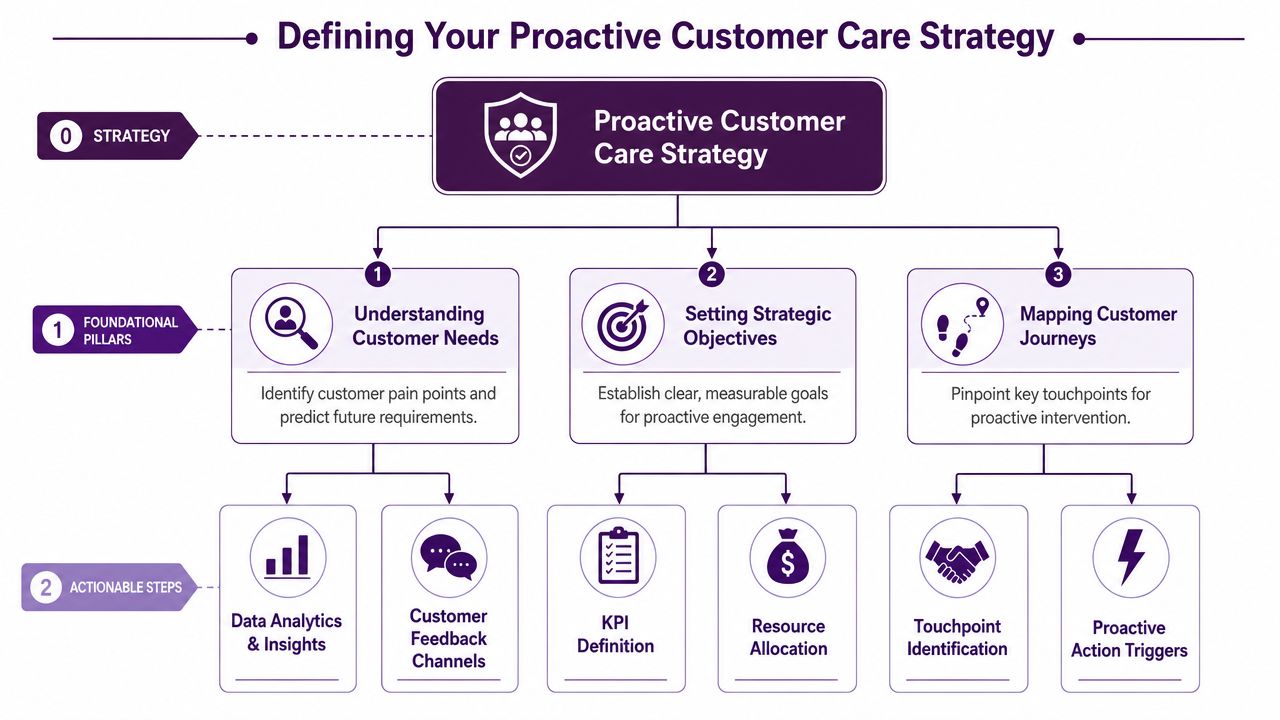
Map the customer journey by risk, not by department
Most companies map journeys in a way that mirrors org charts. Sales owns one stage. Support owns another. Operations owns fulfillment. Customers don’t experience a business that way.
A better approach is to mark the points where confidence can drop:
- After purchase: The customer wonders if the order went through correctly.
- Before delivery: A delay appears in the carrier feed.
- During onboarding: A user signs up but doesn’t complete the setup.
- Before renewal: Usage drops or repeat complaints start appearing.
An e-commerce example makes this concrete. A customer orders a birthday gift. The warehouse sees a fulfillment bottleneck. If nobody reaches out, the customer discovers the delay on their own and contacts support frustrated. A proactive model triggers an outbound message first, offers an updated delivery estimate, and gives a choice such as a replacement, expedited alternative, or refund path.
That isn’t just communication. It’s prevention.
Build your proactive touchpoints from real signals
The best proactive strategies don’t begin with fancy software. They begin with a short list of signals your team already has access to.
Use data sources such as:
- Purchase history for repeat buying patterns, reorder timing, or unusual cart abandonment.
- Support tickets for recurring complaints tied to a product, workflow, or policy.
- Usage behavior for low adoption, failed logins, setup stalls, or feature confusion.
- Billing events for failed payments, expiring cards, and subscription risk.
- Operational updates from shipping, scheduling, or service delivery systems.
If you’re evaluating tools to support those workflows, a practical starting point is reviewing the best customer service software for small businesses. The right stack should make it easier to trigger the right action at the right moment, not bury the team in dashboards.
Don’t create proactive outreach for every event. Create it for events that are both frequent and costly when ignored.
Put the strategy in writing
A useful strategy document is short. It should answer four questions:
- What event triggers outreach
- Who receives it
- What channel fits best
- What action the team should take next
A shipping delay might trigger an SMS and email update. A stalled SaaS onboarding flow might trigger a call from a trained agent. A healthcare appointment reminder might trigger a bilingual text sequence with an easy confirmation option.
Teams that need a structured service foundation can also study how strong customer care orientation practices shape day-to-day execution. Strategy only matters if frontline behavior follows it.
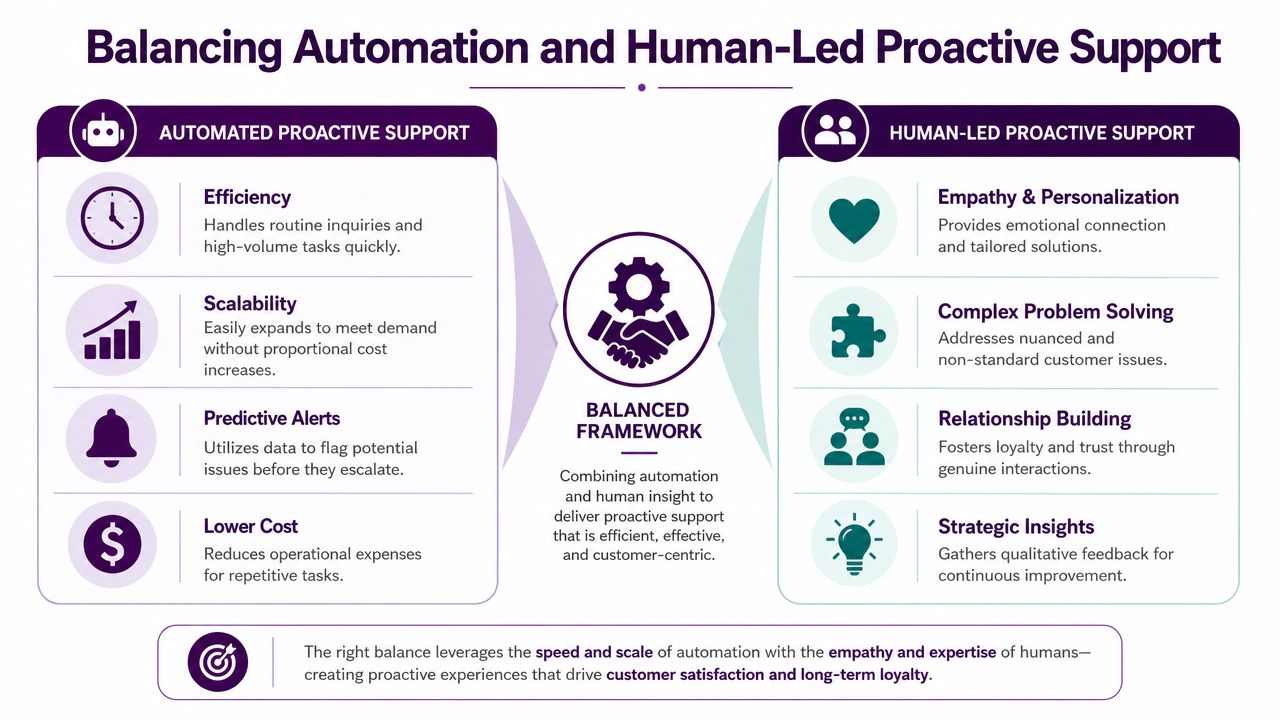
Balancing Automation and Human-Led Proactive Support
A failed payment alert doesn’t need a warm voice and a long conversation. A frustrated long-term customer with a recurring technical issue usually does.
That’s the practical line. Automate the predictable, humanize the exceptional.
Where automation earns its place
Automation is strongest when the issue is common, the response is standardized, and speed matters most. 72% of CX leaders believe AI will eventually power all proactive outreach, according to Yellow.ai’s discussion of proactive customer service. That direction makes sense, but execution still matters.
Use automation for cases like these:
| Proactive scenario | Best first move | Why |
|---|---|---|
| Failed payment | Automated reminder | Fast, simple, repeatable |
| Order status update | Automated message | High volume and low complexity |
| Appointment confirmation | Automated text or email | Routine and time-sensitive |
| Password or login trouble pattern | Automated help prompt | Easy self-service save |
Well-designed customer service automation can reduce inbound volume without making the experience feel cold. The trigger, message, and fallback path have to be clear.
Where people should take over
Human-led support matters when the customer’s emotional state, account value, or issue complexity changes the stakes.
A few examples:
- A loyal customer reports the same issue twice: A human should reach out, acknowledge the history, and take ownership.
- A new client struggles during onboarding: An agent can explain the process, clarify confusion, and keep momentum from dying.
- A service outage affects a sensitive account: A live conversation can set expectations, lower tension, and preserve trust.
A customer rarely remembers the alert itself. They remember whether the outreach felt useful or dismissive.
A simple decision filter
Use three questions before choosing automation or human outreach.
How complex is the issue?
Simple status updates lean automated. Multi-step fixes lean human.
What is the emotional impact?
Low-stress notifications can be automated. Anything involving frustration, disappointment, or confusion benefits from a person.
How valuable is the relationship?
High-value accounts, renewal-sensitive customers, or patients with urgent scheduling concerns deserve more personal attention.
The common mistake is over-automating because the system can send a message. Capability isn’t the same as judgment. Good proactive customer care uses automation to create speed and consistency, then hands off to trained people when context matters.
Empowering Your Agents for Proactive Engagement
Technology can detect a signal. Agents decide what to do with it.
That’s why proactive customer care rises or falls on training. If agents are only taught to wait for tickets, verify a policy, and close the interaction, they’ll miss the signals that matter most.

Train agents to notice patterns
Agents need a different mindset from classic queue handling. They should be able to spot the difference between a one-off issue and the start of a trend.
That means coaching them to look for signs like:
- Repeat contact behavior that suggests an unresolved root cause
- Language shifts that signal rising frustration or churn risk
- Usage or account notes that show the customer is stuck, not inactive
- Operational friction that keeps appearing across calls, chats, or emails
QA becomes essential. Zendesk’s guidance on proactive customer service notes that quality assurance processes are explicitly required to pinpoint areas for improvement and monitor customer sentiment before issues escalate into churn. In practice, that means reviewing interactions for early-warning clues, not just script compliance.
Give agents flexible playbooks, not rigid scripts
A rigid script often breaks in proactive situations because the customer wasn’t expecting the contact. Agents need a structure they can adapt.
Use playbooks like these:
Potential outage playbook
- Open with transparency
- State what happened in plain language
- Explain the likely impact
- Offer the next step or workaround
- Confirm follow-up timing
Sample language: “I’m reaching out before this affects your account further. We identified an issue that may interrupt service, and I want to walk you through the quickest workaround while our team resolves it.”
Onboarding stall playbook
- Confirm where the customer stopped
- Ask one diagnostic question
- Remove one obstacle immediately
- Schedule or complete the next action during the interaction
Sample language: “I noticed setup wasn’t completed, and I wanted to make this easier. Usually one step causes the delay. Can I help you finish that part now?”
Practical rule: If an agent can’t explain why they’re reaching out in one clear sentence, the outreach probably isn’t ready.
Build autonomy into the role
Agents need room to solve small problems on the spot. That could mean offering a replacement path, escalating a billing review quickly, or booking a follow-up without waiting on multiple approvals.
Strong teams also learn from outside examples. For a useful perspective on how service teams are structured and supported, you can learn about Intonetic and compare that with your own operating model.
Cultures that support proactive work usually invest in coaching, calibration, and frontline trust. Teams exploring that shift can look at how agent empowerment in call centers works to understand why autonomy and accountability need to develop together.
Measuring the Impact of Your Proactive Service
If proactive customer care isn’t measured separately, it gets absorbed into general support reporting and disappears.
That creates a false sense of progress. While 61% of service professionals believe their organizations address issues proactively, only one-third of customers agree, according to Salesforce’s analysis of proactive customer service. Internal confidence can be high while the customer experience still feels reactive.
Track what happened before the ticket
Traditional support metrics still matter, but they won’t tell you whether prevention is working. Add a small set of proactive measures to your dashboard.
A practical framework looks like this:
- Proactive engagement rate: How often the team contacted customers before a complaint arrived
- Prevented issue rate: Which contacts likely avoided an inbound ticket or escalation
- Proactive resolution rate: Which issues were solved through outreach without requiring the customer to chase support
- Follow-up completion: Whether the promised next action happened
- Customer feedback on proactive interactions: Whether outreach felt helpful, timely, and clear
Many teams make a fundamental mistake. They count outbound volume and assume they’re being proactive. Volume alone proves almost nothing.
Look for operational and customer signals together
A good measurement review combines contact-center data with customer feedback. If proactive outreach rises but complaints stay flat, the trigger may be too late or the message may be too generic.
Use a simple review pattern each month:
- Pull the top proactive triggers.
- Compare them with the top inbound reasons.
- Check whether customers who received outreach still had to contact support.
- Review satisfaction comments tied specifically to proactive contacts.
If customers still need to explain the problem after you contacted them first, the outreach didn’t reduce effort. It only changed the channel.
Teams that want a cleaner reporting structure should define these measures formally in their customer service KPI framework. The key is consistency. Measure proactive work on its own, then connect it to retention risk, complaint volume, and service quality over time.
Scaling Proactive Care with a Nearshore Partner
Many small and midsize companies frequently get stuck. They understand the value of proactive customer care, but building it in-house can feel expensive and operationally messy.
That’s the proactive cost paradox. Preventive service can lower pressure on reactive channels, but the systems and staffing needed to run it well often feel out of reach for non-enterprise teams. Recent data shows 68% of small businesses cite implementation cost as their primary barrier to adopting proactive strategies, according to RingCentral’s write-up on proactive customer service.
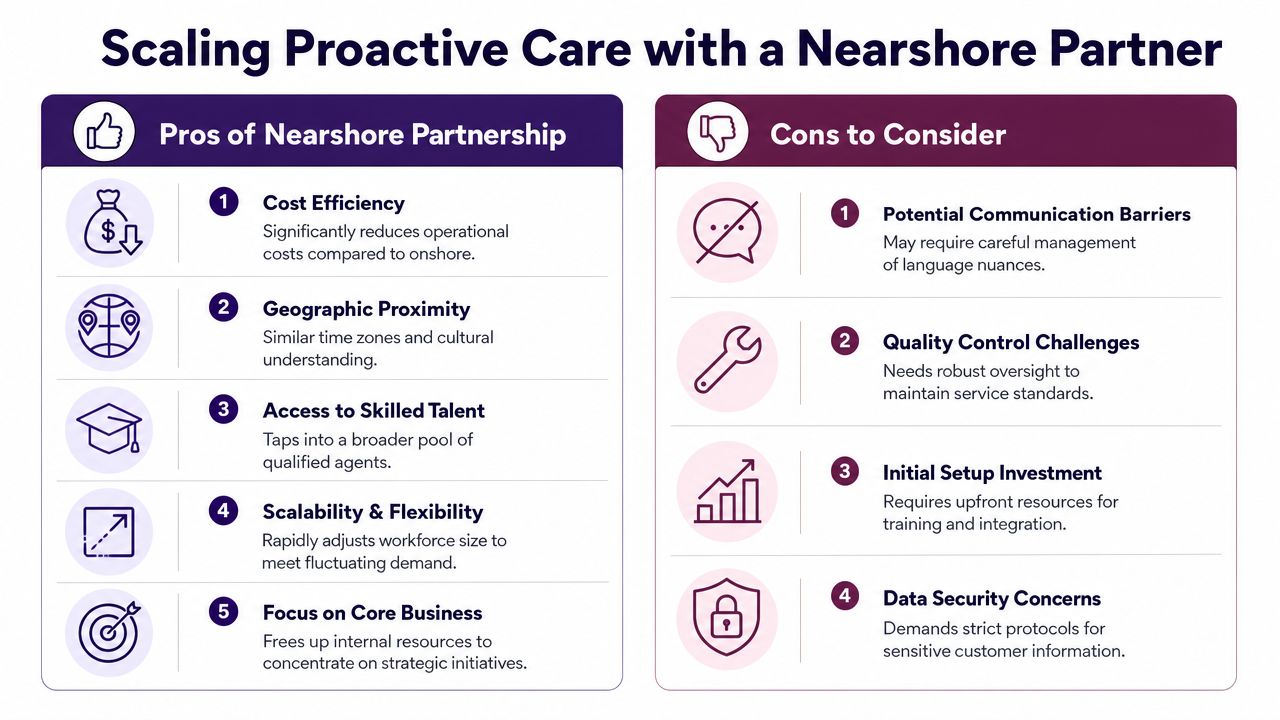
Why nearshore works for proactive service
Nearshore support gives businesses a practical middle path. Instead of choosing between a thin in-house team and a heavy enterprise tech rollout, companies can build a blended model with bilingual agents, shared processes, and tighter cost control.
For North American brands, the benefits are straightforward:
- Bilingual communication: English and Spanish outreach is often essential in retail, healthcare, telecom, and financial services.
- Closer time zone alignment: Proactive outreach works better when the support team operates close to the customer’s day.
- Cultural proximity: Tone, urgency, and service expectations are easier to align.
- Flexible staffing: Teams can add outbound coverage for seasonal spikes, returns surges, or renewal periods.
This model is especially useful when the company doesn’t need complex AI at every step. A trained human-led team can verify issues first, then use simple automation where it makes sense.
What integration should look like
A nearshore proactive program shouldn’t feel bolted on. The partner should work inside the tools the business already uses, such as the CRM, help desk, ecommerce platform, scheduling system, or order management workflow.
A sound integration model usually includes:
| Area | What needs to happen |
|---|---|
| Data access | The team can view the triggers that matter |
| Workflow rules | Outreach conditions are documented clearly |
| Escalation path | Agents know when to route issues back internally |
| QA review | Interactions are reviewed for timing, tone, and outcome |
| Reporting | Proactive contacts are tracked separately from reactive ones |
In healthcare, a playbook might focus on reminders, rescheduling risk, and no-show prevention. In e-commerce, it might center on failed deliveries, return deflection, or payment recovery. In SaaS, the playbook often starts with onboarding friction, low usage, and renewal danger signs.
Watch the trade-offs honestly
Nearshore isn’t magic. It still requires training, oversight, security discipline, and tight communication. If leadership treats the partner like a detached vendor, quality usually slips.
The best results come when the client and partner agree on a few basics:
- Who owns the trigger logic
- Which accounts need human-first treatment
- What goodwill actions agents can offer
- How success gets reviewed each week
Nearshore proactive care succeeds when the outside team feels operationally close, not contractually distant.
For companies that need a scalable operating model without building every layer internally, a nearshore call center approach can make proactive customer care feasible sooner. That matters most for SMBs that need better prevention now, not after a long transformation project.
Making the Shift to Proactive a Reality
What would change if your team solved customer issues before they turned into tickets, without adding a heavy in-house tech bill?
Proactive customer care becomes real when it fits day-to-day operations, budget limits, and staffing reality. For SMBs, that usually means starting with one journey where preventable issues already show up clearly, then building a simple process your team can run every week.
Keep the first rollout narrow. Choose one use case with visible business impact, such as missed appointments, delivery exceptions, onboarding drop-off, or renewal risk. Set the trigger. Define the outreach. Decide when automation is enough and when a bilingual agent should step in. Then review what happened, not just how many messages went out.
Many teams often get stuck on the proactive cost paradox. They know early intervention reduces repeat contacts and customer frustration, but building the full in-house stack can feel out of reach. New tools, workflow setup, coverage planning, QA, and bilingual hiring add cost fast. A nearshore model closes that gap for companies that need proactive service now, not after a long systems project.
At CallZent, we have seen the strongest programs start small and stay disciplined. One clear trigger. One playbook. One reporting view. Once the process works, expansion gets easier because the team is refining a proven operating model instead of chasing a broad transformation plan.
🚀 Build Proactive Customer Care Without Overloading Your Team
CallZent helps growing companies combine bilingual nearshore agents, simple automation, quality monitoring, and practical outreach playbooks to prevent avoidable customer friction.
Talk to an ExpertThe goal is not to predict every customer need. The goal is to build a practical habit of spotting risk early and responding in a way that feels human, timely, and affordable.