

Call Center Operations
What Is Workforce Management in a Call Center?
Learn what workforce management in a call center means, how forecasting and scheduling work, and how nearshore teams scale support efficiently.
TL;DR — Quick Takeaways
- Workforce management (WFM) aligns staffing with customer demand.
- It includes forecasting, scheduling, intraday management, and performance analysis.
- Strong WFM reduces wait times and labor waste.
- Nearshore BPO teams use WFM to scale support efficiently.
Your phones spike at noon. Chat volume jumps after a promo email. Customers wait too long during peaks, then agents sit idle in slower windows. Most businesses don’t have a customer service problem in that moment. They have a workforce management problem.
That problem gets expensive fast. Wait times rise, service levels slip, overtime creeps in, and managers start making same-day fixes that solve one issue while creating another. If you’re running support, sales, reservations, billing, or technical service, this pattern is familiar.
Predictive analytics in WFM can boost workforce efficiency by up to 30% and cut average call wait times by 20%, according to CX Foundation’s workforce management overview.
Key takeaway: Workforce management is the operating system behind a high-performing call center. Without it, even good agents and good technology get wasted.
Your Call Center Chaos Has a Name
and a Solution
When leaders ask why service feels inconsistent, the answer usually isn’t effort. It’s alignment. The center has demand arriving in one pattern and staffing deployed in another.
That’s what workforce management fixes. It gives operations a structured way to predict volume, staff to that demand, adjust in real time, and learn from the results. In plain English, it makes sure the right people are available when customers need them.
What goes wrong without workforce management
A center without disciplined WFM tends to run into the same operational traps:
- Peak-hour understaffing: Customers queue longer, abandon more often, and supervisors scramble.
- Slow-period overstaffing: Payroll runs ahead of actual workload.
- Skill mismatches: Complex contacts land with the wrong agents and bounce around.
- Reactive management: Leaders spend the day fixing surprises instead of controlling outcomes.
Those issues don’t stay inside the contact center. They show up in customer churn, lower conversion, repeat contacts, and staff frustration.
What WFM changes in practice
A solid WFM function doesn’t just publish schedules. It connects service goals to staffing decisions. If the business needs faster response times, WFM looks at expected volume, handling patterns, and agent availability, then turns that into practical staffing plans.
In a nearshore BPO environment, this becomes even more valuable. Bilingual support, extended hours, and multi-channel demand are all manageable. But only if someone is actively balancing coverage, adherence, and performance every day.
What Exactly is Workforce
Management in a Call Center
What is workforce management in a call center? It’s the ongoing process of forecasting customer demand, scheduling agents, managing live operations, and analyzing results so service stays stable without wasting labor.
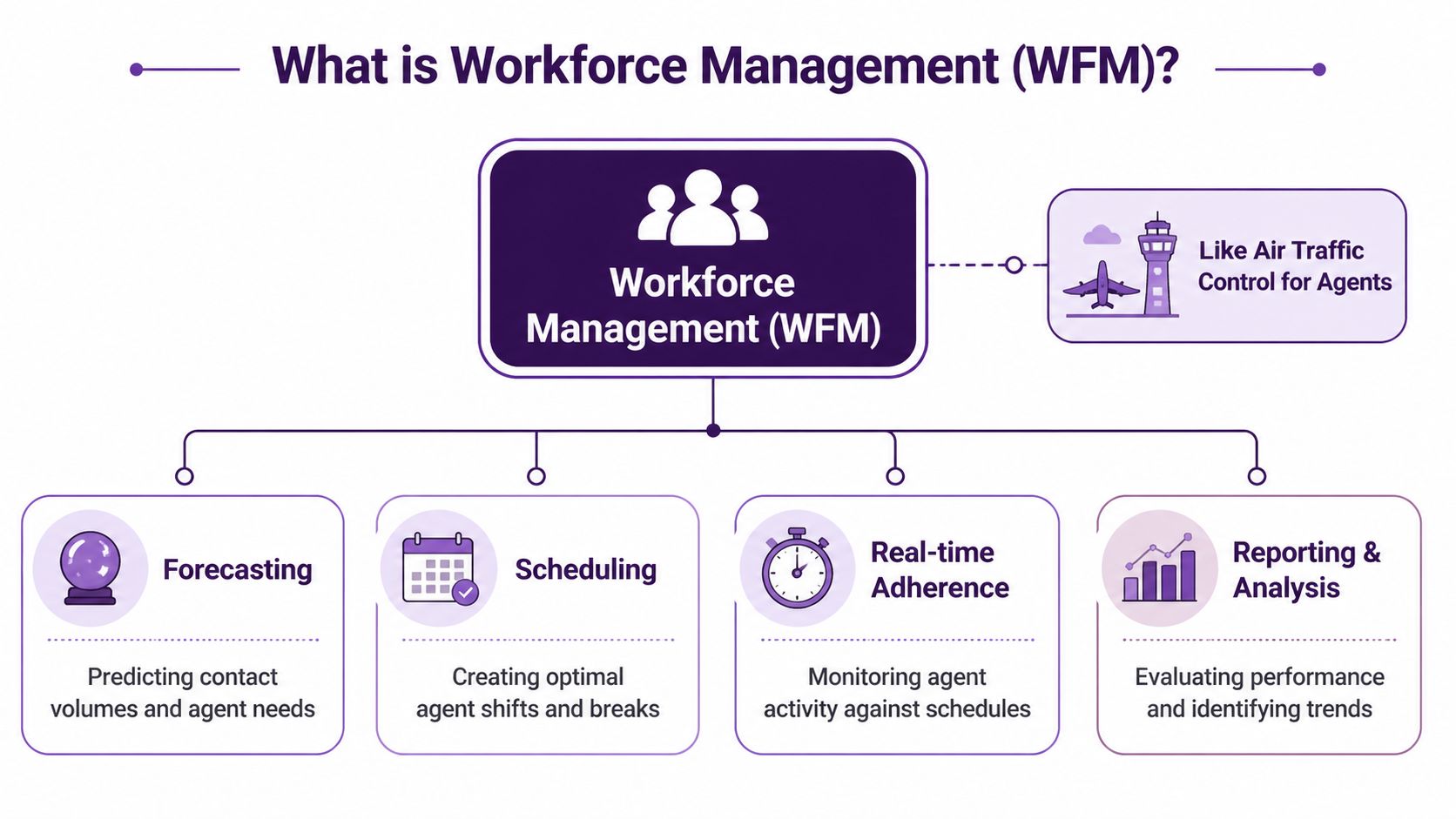
A simple way to think about it is air traffic control for customer service. Contacts keep arriving. Agents have different skills. Service goals matter. If nobody is coordinating the flow, delays pile up and the whole system becomes reactive.
It’s more than making schedules
Many teams still treat WFM as an admin task. That’s too narrow. Basic rostering only answers who works when. Real workforce management answers tougher operational questions:
- How much demand is coming
- Which skills need coverage
- Where service risk is likely to appear
- How to respond when the forecast is wrong
- What the operation should change next week, next month, and next quarter
That difference matters because a call center doesn’t run on averages. It runs on intervals, queues, and timing. You can have enough staff for the day overall and still fail badly at key moments.
The core goal of WFM
The goal is simple: put the right agent in the right place at the right time.
That means aligning people to voice, chat, email, or back-office demand based on what customers are doing, not what managers hope they will do. It also means recognizing that customer support isn’t one queue anymore. A center may have billing calls, order status contacts, escalations, technical troubleshooting, and Spanish-language interactions all moving at once.
Good WFM protects two things at the same time. Customer access and labor efficiency.
Why leaders should treat WFM as strategic
The strategic value of WFM shows up in three areas:
| Area | What WFM influences |
|---|---|
| Customer experience | Wait time, speed of answer, consistency, routing quality |
| Financial performance | Overtime, overstaffing, idle time, hiring pressure |
| Agent stability | Schedule quality, workload balance, support during spikes |
When those three stay aligned, operations become more scalable. That’s one reason advanced WFM matters so much in nearshore delivery models. A well-run nearshore center isn’t just lower cost labor. It’s a staffing engine that can absorb demand variation without breaking service.
The Four Pillars of Modern Workforce Management
The easiest way to understand WFM is to break it into four operating disciplines. Each one matters on its own. Together, they determine whether a call center runs predictably or lurches from one staffing issue to the next.
Forecasting
Forecasting is where workforce management starts. The team estimates future contact demand using historical patterns, seasonality, promotions, product launches, and known business events.
This isn’t a rough monthly guess. Strong forecasting works at a level that operations can schedule against. It looks at when contacts arrive, how long they take to handle, and where demand is likely to change.
A practical example is post-promotion support. If marketing launches a new offer on Thursday, operations should expect more than just a volume increase. It may also see a shift in contact mix, such as more billing questions or more first-time buyers asking for help.
AI-powered WFM tools can generate forecasts with up to 95% accuracy, improve service levels by 20-30%, and cut labor costs by 10-25%, according to CMSWire’s guide to contact center workforce management.
What works
- Using business inputs: Promotions, seasonality, and operational changes belong in the forecast.
- Reviewing forecast error: Teams need to know where and why misses happened.
- Planning by channel and skill: Voice demand isn’t the same as chat or email demand.
What doesn’t
- Relying on monthly averages: They hide the intervals where service breaks.
- Ignoring business context: Marketing can change the contact pattern overnight.
- Treating forecasting as one-and-done: Demand moves. The model has to move with it.
Scheduling
Scheduling turns forecasted workload into actual shifts, breaks, lunches, and staffing coverage. It is how planning becomes operational reality.
A weak schedule looks mathematically fine but fails in practice. It may put enough people on the roster while missing the need for language coverage, escalation support, or technical skills during critical windows.
The best schedules respect both service requirements and human constraints. Agents need fair start times, predictable break structures, and coverage that reflects what they can handle well.
A practical example
An e-commerce support team may need heavier staffing after campaign drops and stronger bilingual coverage later in the day. A healthcare support queue may need more disciplined routing and steadier specialist coverage. Same WFM function, different schedule design.
For teams evaluating systems that support this kind of planning, it helps to compare actual call center software features such as forecasting, skills-based routing support, adherence visibility, and reporting depth.
Practical rule: If the schedule solves for coverage but ignores skills, the center will still miss its service goals.
Intraday management
No forecast survives the day untouched. Intraday management is the live control layer of WFM. It tracks what is happening now against what was planned and tells operations when to intervene.
Supervisors and analysts make the small decisions that prevent a service failure. They may move breaks, reassign queue support, shift a cross-trained group, or escalate staffing gaps before the backlog becomes unmanageable.
A common real-world scenario is a product issue. Contacts start arriving above plan, handle time climbs because customers need more explanation, and one specialist queue backs up first. Intraday management catches that drift early.
Signs of good intraday control
- Fast variance detection: Teams see the gap between forecast and reality early.
- Actionable response: Managers know which levers they can safely pull.
- Cross-team communication: WFM, operations, and client stakeholders stay aligned.
Without intraday discipline, centers tend to overreact late. That usually means overtime, rushed coaching, and avoidable customer delays.
Performance analysis
The last pillar is performance analysis, transforming WFM into a continuous improvement function instead of a daily scheduling task.
Performance analysis looks at what happened, why it happened, and what should change next. It connects staffing decisions to service outcomes, labor utilization, and agent experience.
For example, if one queue keeps missing target despite “enough” headcount, analysis may show the underlying issue is skill mix, handle time variance, or poor schedule placement. That matters because hiring more people would solve the wrong problem.
Good analysis asks questions like these
- Where did forecast variance come from
- Which intervals repeatedly miss coverage
- Which skill groups are overloaded
- How often are repeat contacts inflating demand
- Where is schedule adherence affecting customer wait time
The best WFM teams don’t just report. They diagnose. That is what turns workforce management into an operating advantage.
Essential WFM Metrics for Measuring Success
A floor can sound fully engaged and still be missing targets that matter to customers and margin. Strong workforce management measures whether labor is landing in the right place, at the right time, at the right cost.
That requires a tight scorecard. If leaders track too many numbers, they miss the few that explain service pressure, staffing waste, and execution gaps.
The metrics that matter most
Service level
Service level measures how quickly the center answers incoming contacts against a defined goal. A widely used benchmark is 80/20, or 80% of calls answered within 20 seconds, as noted by Global Response in its overview of call center WFM metrics.
This metric matters because customers feel misses right away. Wait times rise, abandonment follows, and demand often comes back later through repeat calls, escalations, or channel switching.
In nearshore operations, service level discipline has an extra payoff. Time-zone alignment makes it easier to staff to North American demand curves without carrying as much buffer labor, which helps SMBs scale without building enterprise-sized overhead.
First call resolution
First call resolution belongs on every WFM scorecard, even though operations teams sometimes treat it as a quality metric only. The SQM Group’s call center benchmarks and research on first call resolution explain why. Repeat contacts increase operating cost and put avoidable volume back into the forecast.
From a WFM standpoint, low FCR creates fake demand. Leaders then add headcount to cover volume that better process design, stronger training, or better routing could have prevented in the first place.
Average handle time
Average handle time shows how long interactions take, including talk, hold, and after-call work. It is a core forecasting input and one of the fastest ways to spot friction in the operation.
AHT needs context. A lower number can come from cleaner workflows, but it can also come from rushed calls, poor issue ownership, or agents pushing customers into repeat contact. The better read is AHT by contact type, queue, and resolution outcome.
The execution metrics leaders often overlook
Schedule adherence
Adherence tracks whether agents are available when the schedule says they should be. Start times, breaks, lunches, coaching blocks, and offline activity all count.
Small misses add up fast. In a high-volume queue, a few points of adherence loss during peak intervals can do more damage than a forecasting miss because the staff is already on payroll but not in position to handle demand.
This is one area where good BPO operators separate themselves. The best nearshore teams pair lower labor cost with tighter schedule control, so clients get savings without accepting weaker execution.
Occupancy
Occupancy measures how much logged-in time agents spend handling work instead of waiting for contacts. It helps leaders judge utilization, but it should never be pushed blindly higher.
If occupancy runs hot for too long, burnout shows up in attrition, absences, lower quality, and longer handle time. Healthy operations balance efficiency with enough recovery time for agents to stay accurate and sustainable.
Shrinkage
Shrinkage captures paid time that is unavailable for customer handling. PTO, absenteeism, meetings, training, coaching, and system downtime all belong here.
Many staffing plans break. If shrinkage assumptions are too low, the schedule looks adequate on paper and fails in production. In nearshore environments, better labor planning and more predictable attendance can make shrinkage easier to manage, which improves staffing accuracy without overbuilding the team.
Recommended WFM KPIs by Industry
For a practical view of how leaders monitor these numbers day to day, review call center reporting and metrics dashboards KPIs used in live operating environments.
| Metric | E-commerce | Healthcare | Financial Services |
|---|---|---|---|
| Service level | Use the 80/20 benchmark for fast-moving order, return, and delivery contacts | Use the 80/20 benchmark where timely access matters and queues are compliance-sensitive | Use the 80/20 benchmark with tighter attention to specialized queue coverage |
| First call resolution | Track resolution closely and watch repeat contacts during promotions | Track resolution with extra focus on routing accuracy and transfer avoidance | Track resolution closely for authentication and account issue workflows |
| Average handle time | Monitor trend by contact reason rather than pushing blanket reductions | Review by case type because complexity varies widely | Review by queue since verification and compliance steps can lengthen calls |
| Schedule adherence | Tight adherence matters during campaign and post-sale spikes | Stable adherence matters because specialized staffing windows are harder to replace | Strong adherence matters where escalations and regulated workflows create bottlenecks |
| Occupancy | Watch for overload during peak shopping periods | Keep specialist teams from being overrun by sustained high demand | Balance utilization so agents can handle complex interactions without burnout |
| Shrinkage | Plan carefully around seasonality, training, and time-off concentration | Build for coaching, compliance tasks, and planned absences | Include training, QA, and process updates in staffing assumptions |
A healthy WFM program manages trade-offs, not isolated KPIs. The best operators
improve service level, control labor cost, and protect agent capacity at the same time.

The Transformative Benefits of Mastering WFM
When WFM is handled well, the benefits show up far beyond scheduling. Leaders see better service consistency, cleaner labor control, and a more stable operating rhythm.
Lower cost without cutting service
The biggest financial win is avoiding two expensive mistakes at the same time: understaffing and overstaffing. Understaffing damages customer experience and drives rush fixes. Overstaffing erodes margin.
Nearshore teams have another advantage here. They can pair strong WFM discipline with structurally lower delivery cost. Businesses evaluating this model often compare the broader benefits of nearshore outsourcing alongside staffing flexibility, language coverage, and operational control.
Better customer experience
Customers don’t experience WFM directly. They experience the result of it. Shorter waits, better routing, fewer transfers, and more stable service across peak periods all start with staffing decisions made earlier.
This is especially visible in centers serving North America from nearshore locations. Bilingual coverage and time-zone alignment help, but they only translate into a better customer experience when staffing is planned well.
Stronger retention and less operational drag
A good WFM practice also improves the agent environment. Clear schedules, realistic workload balancing, and fewer last-minute fixes create a more stable workplace.
That matters because turnover doesn’t just hurt morale. It hits recruiting, training, quality consistency, and management capacity. Stable operations usually come from stable staffing practices.

Common WFM Challenges and How to Overcome Them
Most WFM failures aren’t caused by lack of software. They’re caused by bad assumptions. Teams trust weak forecasts, publish brittle schedules, or optimize too hard for efficiency while ignoring what agents can realistically sustain.
Challenge one is forecast error
When the forecast is wrong, everything built on it is wrong too. Managers then spend the day covering gaps instead of running the business.
The fix is disciplined forecast review. Compare expected demand to actual demand, identify what changed, and build business inputs into the next cycle. Promotions, outages, process changes, and policy updates should never surprise the WFM team twice.
Challenge two is burnout hidden inside efficient schedules
This is the part many guides skip. A schedule can look efficient on paper and still burn people out in practice.
A primary cause of the 30-45% annual agent turnover is burnout, often caused by rigid, algorithm-driven schedules that prioritize efficiency over agent well-being, according to CX Today’s analysis of WFM and agent burnout.
That usually happens when top performers get loaded with the hardest contacts, break placement becomes too rigid, or schedule changes make life outside work hard to manage.
What actually helps
For a practical operational playbook, this related guide on how to reduce call center attrition is useful because retention problems often start upstream in WFM design.
The most effective responses are straightforward:
- Add agent preference input: Let agents express shift and time-off preferences where possible.
- Review hard-queue exposure: Rotate difficult queues instead of overloading the same people.
- Use coaching with adherence data: Don’t treat every variance as misconduct. Find the root cause.
- Protect schedule stability: Constant change feels flexible to the business and chaotic to the agent.
If your WFM model improves efficiency while making schedules less livable, it isn’t optimized. It’s unstable.
How to Implement Workforce Management in Your Business
Monday starts with a backlog from the weekend, absenteeism is higher than planned, and supervisors are pulling agents between queues to protect service levels. That situation usually gets labeled as a staffing problem. In practice, it is an implementation problem. Workforce management only works when it is built into daily operations, decision rights, and growth planning.
Step one is assess your current state
Start with the operation you run, not the one your org chart suggests you run.
Review where customers wait longest, where occupancy spikes too high, where overtime keeps appearing, and where shrinkage assumptions miss the mark. Then check whether those issues are isolated or part of a pattern by day, interval, channel, and queue. A lot of companies already have enough reporting to see the problem. They have not organized it into a WFM process with clear ownership.
A useful review covers four areas:
- Demand patterns: Peak intervals, channel mix, seasonality, and repeat contact drivers
- Staffing reality: Planned coverage versus logged-in time, shrinkage, and schedule adherence
- Process friction: Transfers, rework, long after-call work, and skill mismatches
- Management cadence: Who owns forecasts, intraday calls, and weekly corrections
If no one can answer those questions quickly, start there.
Step two is choose tools that match your complexity
Small teams with stable volume can manage with spreadsheets for a while. That breaks down fast once you add languages, channels, extended hours, or client-specific SLAs.
The right tool should support forecasting, scheduling, intraday management, adherence, and reporting in one operating flow. It should help supervisors act early, not just document misses after the fact. In a nearshore BPO model, that matters even more because the value is not just lower labor cost. It is getting access to planners, team leads, and reporting discipline without building all of it internally from scratch.
Step three is build an operating rhythm
Software does not run WFM. Managers do.
Set a daily review for prior-day performance, an intraday role for live adjustments, a weekly recalibration for forecast accuracy and staffing assumptions, and a monthly business review that ties labor decisions back to service levels, CSAT, and cost. At this stage, many implementations stall. The tool goes live, but the business never creates the habits that make the tool useful.
For teams comparing providers, how they monitor call center performance usually shows whether that rhythm exists in real operations or only in a sales presentation.
Step four is decide whether to build internally or partner
Some businesses should build an in-house WFM function. If volume is large enough and complexity is rising, the investment can make sense. Others get to stability faster with a partner that already has analysts, schedulers, QA, and intraday controls in place.
That trade-off is usually about speed, management bandwidth, and risk. Poor WFM increases overtime, hurts service consistency, and adds pressure that drives attrition and retraining costs higher. For SMBs, a nearshore partner can be the more cost-effective option because it combines labor with the operating layer behind the labor. For larger enterprises, it can add flexible capacity without forcing every new line of business through a slow internal hiring cycle.
CallZent is one example of that model. As a nearshore bilingual BPO in Tijuana, it gives North American companies access to customer support and back-office teams supported by scheduling discipline, operational oversight, and close alignment with U.S. business hours.
Step five is connect WFM to growth planning
WFM should sit inside your growth model, not beside it.
A new product launch, longer support hours, new channels, or expansion into bilingual service all change workload shape. If workforce planning is late to that conversation, service suffers first and labor cost rises right after. Strong operators bring WFM into planning early so hiring plans, training waves, queue design, and coverage assumptions are built before demand hits the floor.
It also helps to connect staffing decisions with quality signals from the contact itself. Tools built around conversation intelligence can surface why handle time is rising, where repeat contacts start, and which call types need different staffing or coaching assumptions.
The practical goal is simple. Build a WFM process that can hold service steady while the business changes around it. That is what makes a call center scalable, and that is where a well-run nearshore model often gives both SMBs and enterprises a faster path to stable growth.

The Future of WFM Is Smart and Strategic
Workforce management used to be treated as shift planning. That view is outdated. In a modern call center, WFM is a control system for service quality, labor efficiency, and operational resilience.
The next step isn’t just more automation. It’s better decisions. AI will keep improving forecasting and intraday adjustments, but the stronger centers will use that intelligence carefully. They will combine speed with judgment, and efficiency with schedule designs that people can sustain.
That future also connects WFM more closely to quality and insight tools. Teams exploring how customer interactions reveal staffing, coaching, and routing opportunities may find this explanation of conversation intelligence helpful, especially when tying voice data back to workforce decisions.
The practical takeaway is simple. If your customer operation is growing, WFM can’t stay in the background. It needs ownership, process, and the right operating model. If you want to see how that looks in a nearshore environment, talk to a team that runs it every day.
🚀 Optimize Your Call Center Workforce
Scale your support with expert workforce management, bilingual agents, and nearshore efficiency.
Schedule a CallIf you’re evaluating how to improve staffing accuracy, reduce service inconsistency, or scale support without building a full WFM function internally, talk to CallZent. A working WFM model is easier to judge in practice than in theory, and the right conversation can show where your current operation is losing time, money, or customer trust.