Skip to content

FINANCE & BACK-OFFICE OPERATIONS
Accounts Receivable Management: How to Improve Cash Flow Without Hurting Customer Relationships
Accounts receivable management improves cash flow through faster invoicing, disciplined collections, dispute resolution, automation, and bilingual nearshore support.
TL;DR — Quick Takeaways
- Accounts receivable management is a cash-flow control discipline covering credit decisions, invoicing, collections, disputes, cash application, and reporting.
- Late payments often begin with upstream friction such as inaccurate invoices, unclear payment terms, missing documentation, or slow dispute resolution.
- Key AR metrics include days sales outstanding, collection effectiveness, aging, bad-debt write-offs, dispute aging, and payment application accuracy.
- Automation works best when it removes repetitive work while keeping humans available for exceptions, sensitive collections conversations, and customer-retention risks.
- Bilingual nearshore support can help U.S. businesses scale receivables follow-up while maintaining English-Spanish communication and North American time-zone alignment.
39% of invoices are paid late in the U.S. and the average collection window stretches far beyond stated terms, which is why accounts receivable management can’t be treated like back-office bookkeeping. It’s a cash-flow control discipline, and in practice it decides how much working capital a business gets to use, how fast disputes are cleared, and how much customer goodwill survives the collection process. The companies that handle it well don’t just chase invoices, they manage the full order-to-cash cycle with discipline, visibility, and the right mix of automation and human judgment.
What Accounts Receivable Management Really Means
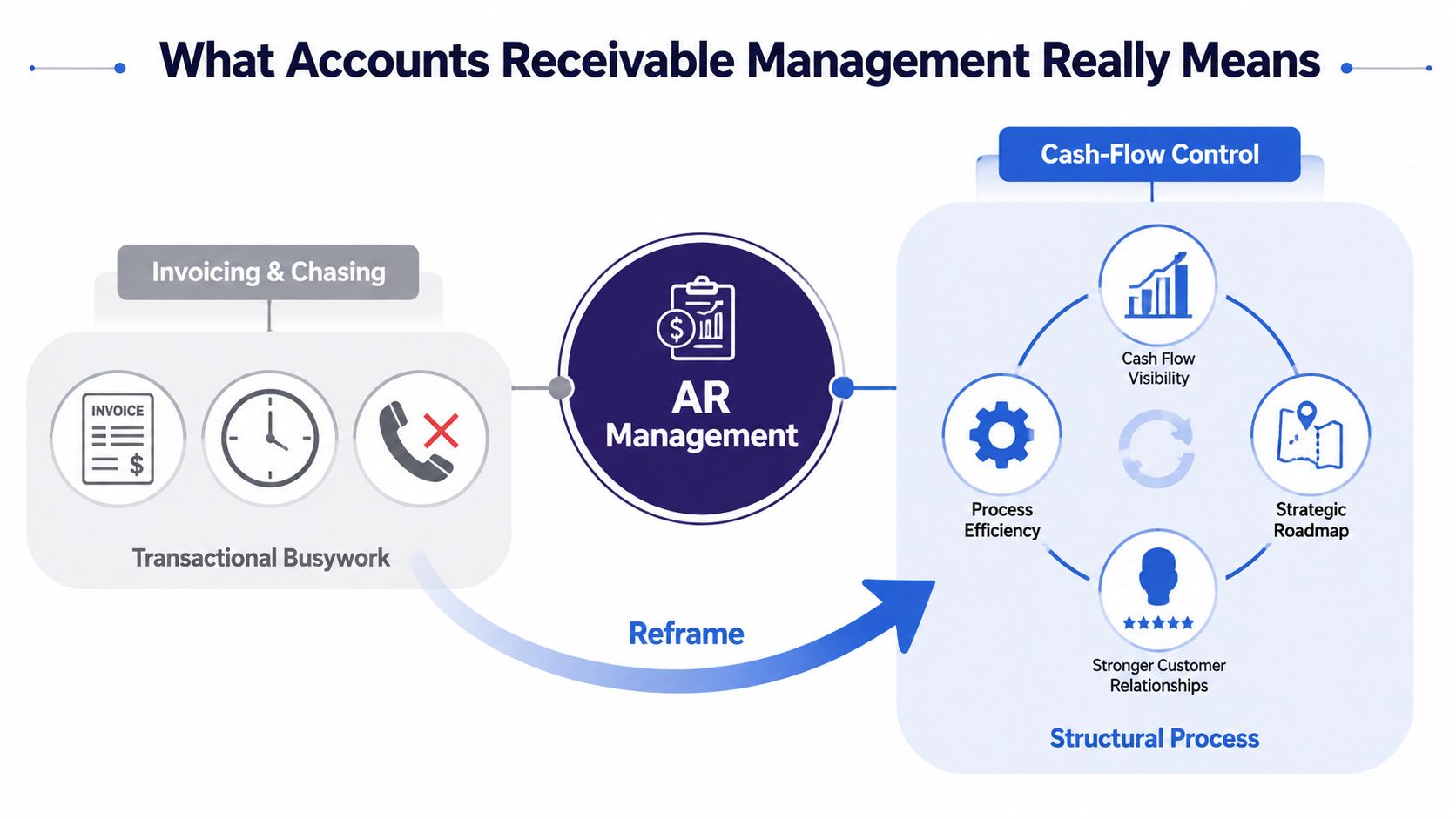
Late payment is a day-to-day reality. Atradius data summarized by Sage says 39% of invoices are paid late in the U.S., 48% of customers delay payments beyond terms, and 52% of businesses are asked for extended payment terms (Sage). That makes accounts receivable management a business control function, not a cleanup task that sits in the background until month-end.
The core job is cash-flow control
Accounts receivable management sits between a completed sale and cash in the bank. JPMorgan describes receivables as funds owed for goods or services already delivered, and notes that they sit on the balance sheet as current assets that affect working capital and liquidity (JPMorgan). That is why teams that treat AR as “sending invoices and waiting” usually end up short on visibility and slow on collections.
A stronger AR function manages the full order-to-cash flow, credit approval, invoicing, collections, dispute resolution, cash application, and reporting. ACCA breaks the discipline into three core controls, checking creditworthiness, setting and monitoring credit terms, and collecting cash rigorously at the end (ACCA). The sequence matters because a weak step upstream turns into slower cash downstream, and every manual workaround adds friction for the buyer as well as the finance team.
Practical rule: If you cannot name who owns credit, invoicing, collections, disputes, and cash posting, you do not have AR management. You have a pile of follow-up tasks.
For teams serving SMBs, e-commerce, healthcare, finance, telecom, retail, and insurance, the trade-offs are the same even when the day-to-day pressure looks different. A business can lose time on bad billing details, unclear terms, or unresolved short-pays long before an invoice becomes overdue. That is why handle slow-paying operators is a useful reminder that some customers need process discipline, not just more reminders.
When the goal is to keep follow-up firm without damaging retention, international receivable management services show what structured support can look like, especially when bilingual nearshore teams have to keep the tone professional and the response time tight.
The End-to-End Accounts Receivable Process
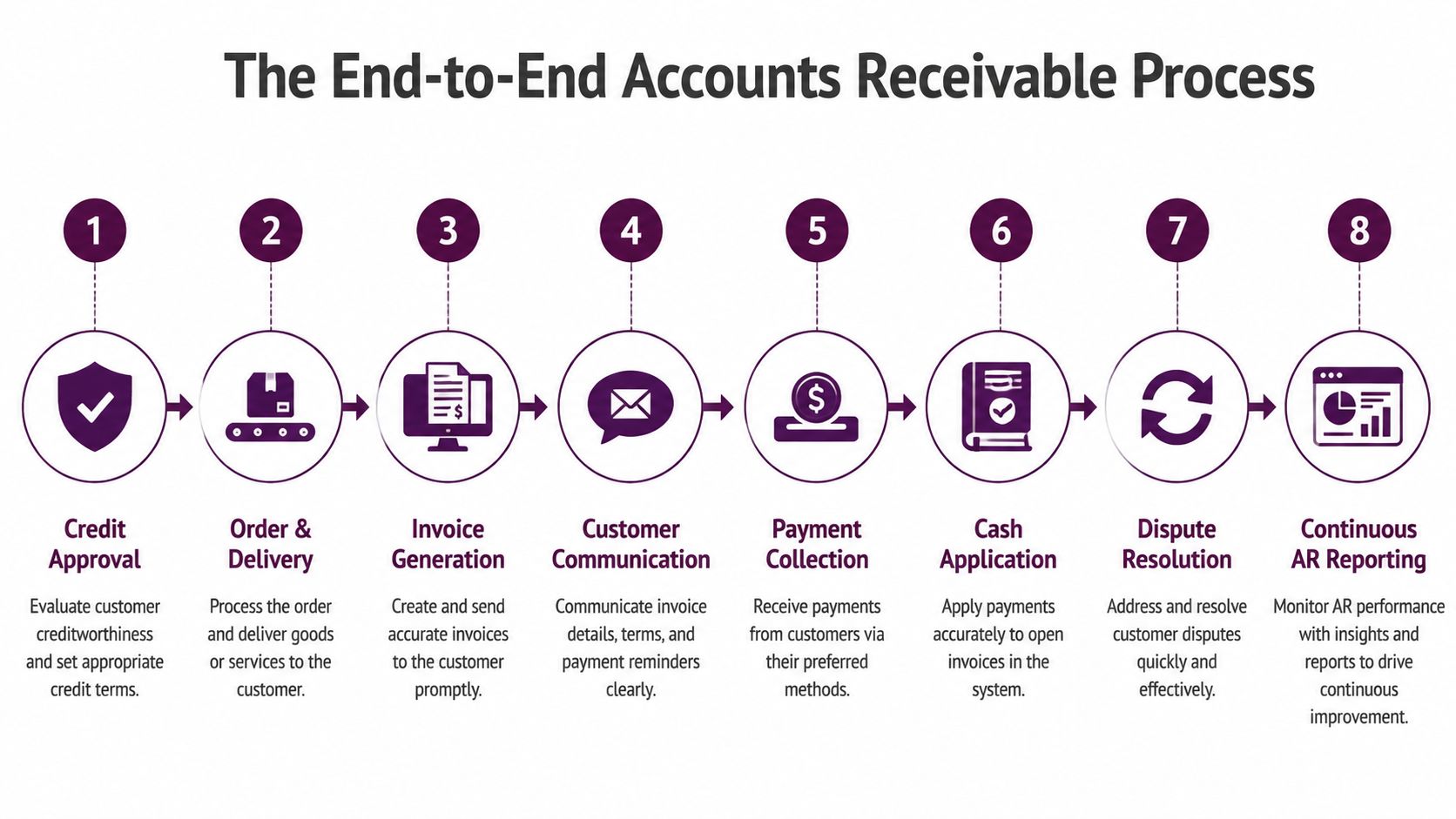
Versapay’s eight-step workflow is one of the clearest operational maps for accounts receivable management. It runs from customer order to credit approval, invoice sent, collections managed, disputes investigated, payment processed, payment posted correctly, and AR status reported continuously (Versapay). The value of that sequence is simple. It shows where ownership changes hands and where delays usually begin.
Where the cycle slows down
The first slowdown usually appears at credit approval. Credit checks are not paperwork for paperwork’s sake. They set the risk posture for everything that follows, because weak credit control raises the odds of slow payment and bad debt.
Order and delivery come next, and the handoff between sales, operations, and finance has to stay clean. If the shipped or serviced amount does not match the order record, the invoice will inherit the error and the buyer will feel it immediately.
Invoice generation is the next pressure point. The bill has to reach the right contact, carry the right terms, and include the right backup. When that step is sloppy, collections starts with a dispute instead of a payment date. UCLA’s AR best-practice guidance notes that automated invoice processing has been associated with DSO reductions of up to 15 days (UCLA). That is less about software hype and more about reducing avoidable friction before the invoice leaves the building.
Customer communication comes after that, and tone matters as much as timing. A reminder can be firm without sounding hostile, which is why bilingual nearshore support often helps teams keep response times tight while protecting the relationship. Buyers remember whether a follow-up felt organized or confrontational.
Payment collection works best when the buyer has a clear path to pay. Cash application is the back-end check that keeps the ledger honest, because a payment that lands in the wrong bucket creates avoidable aging noise. Dispute resolution is where many teams lose time to internal handoffs rather than actual customer resistance. If a short-pay sits in the wrong queue, the clock keeps running.
Reporting closes the loop. Without it, finance only knows that work happened, not whether the process is getting cleaner. Teams that already track collector workload, backlog, and dispute aging should focus on tighter handoffs and fewer manual interventions, not more reminders.
A practical checklist for the finance team looks like this:
- Credit approval owner: Define who approves exceptions and who revisits limits.
- Invoice trigger: Send invoices immediately after delivery or service completion.
- Reminder cadence: Use scheduled follow-ups, not random chases.
- Dispute routing: Assign every dispute to one accountable owner.
- Cash posting: Match payments quickly so the ledger reflects reality.
When operations teams need system integration on the customer side, a useful parallel is sync tour bookings with accounting. The principle is the same, clean handoff, less manual cleanup.
For companies that want a managed process instead of a patchwork of reminders, back office nearshore outsourcing is often where the conversation becomes practical.
Key Metrics That Expose AR Performance
The fastest way to expose weak accounts receivable management is to stop talking about “feel” and start reading the numbers that track cash behavior. HighRadius reports a cross-industry average DSO of 42 days, global B2B payments outstanding of $3.1 trillion, and 61% of organizations still using manual processes (HighRadius). Quadient adds that U.S. companies are carrying $1.7 trillion in excess working capital, global working capital reached 78 days in early 2025, the average cash conversion cycle for more than 2,700 U.S. public companies is 89 days, 44% of U.S. B2B invoices are overdue, and 3% are written off as bad debts (Quadient via Chaser’s AR stats summary).
The four metrics that matter most
Days sales outstanding, or DSO, shows how long cash stays trapped after invoicing. Lower is better, but context matters more than a vanity number. If DSO creeps up while sales stay flat, the problem usually sits in invoicing, follow-up, or dispute handling.
Collection effectiveness index, or CEI, gets ignored too often. It shows how much collectible AR you captured in a period, which makes it a better discipline check than a simple aging snapshot. A team can post a clean-looking aging report and still leak cash if follow-up is slow or inconsistent.
Aging buckets show where risk is concentrating. Current balances, 1 to 30 days overdue, 31 to 60, 61 to 90, and 90 plus all need different treatment. A 12-day overdue customer gets a reminder, a 75-day account needs escalation and root-cause review.
Bad-debt write-off rate tells you whether the credit policy is working. If write-offs keep showing up in the same segment, the problem started long before collections. That is usually a credit decision, onboarding issue, or customer fit problem, not just a collector performance issue.
| Metric | What It Measures | Industry Benchmark | Improvement Lever |
|---|---|---|---|
| DSO | Days to collect after invoicing | 42 days across industries | Faster invoicing, cleaner follow-up, fewer disputes |
| CEI | How effectively receivables are collected | Useful as a collection-quality score, no universal benchmark in the brief | Stronger cadence, escalation rules, dispute ownership |
| Aging | Where invoices sit by overdue bucket | 44% of U.S. B2B invoices are overdue | Segment by age and risk |
| Bad debt | Receivables written off | 3% written off as bad debts in the U.S. B2B context | Tighter credit controls and early intervention |
Key takeaway: If you only watch DSO, you are seeing the result. If you watch CEI, aging, and write-offs together, you can see the process breaking before cash disappears.
For teams that want sharper visibility into collector performance, call center reporting and metrics dashboards KPIs is a good model for how operational reporting should look.
Modernizing the Receivables Experience for Buyers
Older AR processes assume buyers will tolerate phone calls, mailed checks, and slow internal approvals. Many B2B customers no longer work that way. Modern AR needs electronic invoicing, integrated payment portals, and automation, and aggressive collections can still hurt retention in sectors where customer experience matters as much as speed. Stripe makes that trade-off clear, better process design has to support both cash flow and the buyer relationship.
Friction is often the core problem
The hidden issue is often the path to payment. QuickReceivable points out that unresolved disputes, deductions, and short-pays are among the most common reasons payments stall, and that disconnected AR and CRM data make the problem worse (QuickReceivable). Collections teams that only increase dunning volume usually get mixed results because they keep pressing on the symptom instead of the blocker.
A better playbook starts upstream. Electronic invoicing reduces wait time, payment portals remove the need for back-and-forth, and automated reminders keep the cadence consistent without forcing a rep to retype the same message all day. As noted earlier, receivables sit on the balance sheet and affect liquidity, but the buyer-facing side matters just as much. If the customer experience is clumsy, cash may still come in, but the relationship takes a hit.
Where balance matters most
In healthcare, telecom, retail, and financial services, buyers often expect fewer manual touchpoints and clearer self-service options. That does not mean collections should go soft. It means good accounts receivable management should make it easy to pay the right amount, resolve the right issue, and move on without friction.
A practical upgrade path looks like this:
- Electronic invoices first: Remove paper lag and routing confusion.
- Self-service portals next: Let buyers view, dispute, and pay from one place.
- Automated reminders: Keep cadence steady without sounding chaotic.
- Dispute intake by channel: Route short-pays and deductions to the right owner fast.
- Tone control: Use firmer escalation only when the customer has ignored the earlier touchpoints.
Practical rule: Faster collections are good. Lower friction is better when the account is healthy and paying on time, because it protects both cash and retention.
If your team is considering customer-facing automation, conversational AI for customer support is relevant because the same principle applies, buyers respond better when the process feels simple and responsive.
In-House vs Offshore vs Nearshore BPO
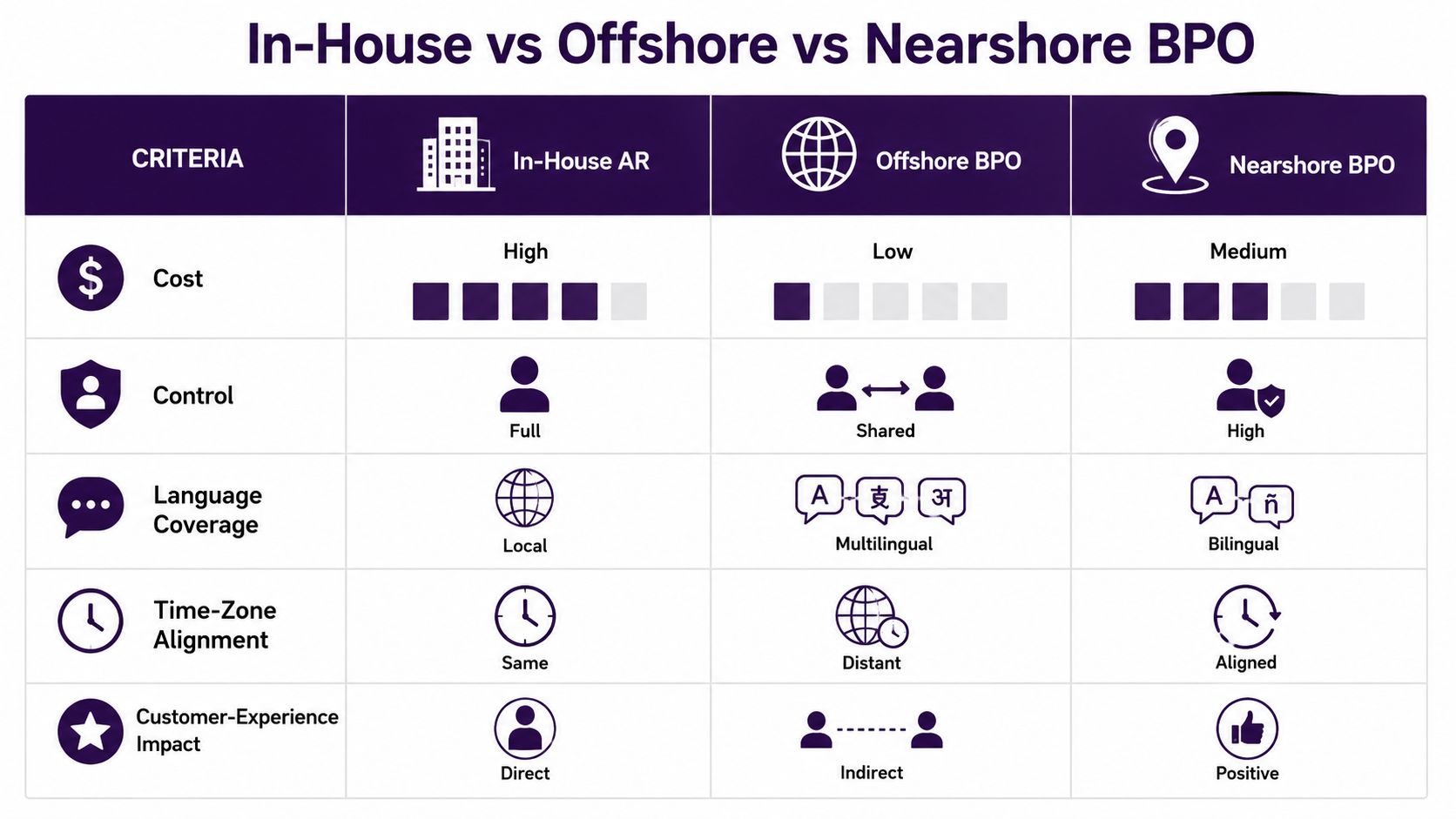
The right operating model depends on control needs, language coverage, customer geography, and how much internal bandwidth your finance team really has. In-house AR gives you direct oversight, offshore BPO can lower labor cost, and nearshore bilingual BPO usually sits in the middle with better alignment on communication and collaboration. The right answer changes depending on whether your biggest issue is volume, complexity, or customer experience.
How the three models compare in practice
In-house teams usually win on control. They know the customer context, sit close to the finance system, and can coordinate with sales or service fast. The downside is that they’re harder to scale when invoice volume grows or when collections need after-hours coverage.
Offshore BPO can work well for standardized work, especially when the task is repetitive and the communication is simple. The trade-off is that time-zone gaps and cultural distance can slow down escalation, especially when disputes need quick handoffs. That can be fine for low-complexity collections, but it’s less ideal when customers expect responsive, relationship-aware follow-up.
Nearshore bilingual BPO fits teams that need both throughput and nuance. The alignment is usually stronger for North American customers, English and Spanish coverage is easier to build, and managers can collaborate more naturally on process changes. That matters when a collector needs to explain a billing issue, calm an upset customer, or coordinate with an internal resolver quickly.
| Criterion | In-House AR | Offshore BPO | Nearshore BPO |
|---|---|---|---|
| Cost | Highest internal overhead | Lowest direct labor cost | Balanced |
| Control | Full | Shared | High |
| Language coverage | Local | Multilingual | Bilingual |
| Time-zone alignment | Same | Distant | Aligned |
| Customer-experience impact | Direct | Indirect | Positive |
If your customer base is mostly U.S. and Mexico, or you need English-Spanish outreach for billing and collections, nearshore support is often the cleaner fit. For businesses that also need to reduce internal back-office load, nearshore versus offshore outsourcing costs and ROI gives a useful way to think through the trade-offs.
Practical rule: If the work is highly standardized, a remote model can work. If the work touches retention, disputes, or bilingual customers, proximity starts to matter a lot more.
Industry-Specific Playbooks for AR Teams
SMBs usually need simplicity first. They don’t need a bloated process, they need a clean credit policy, consistent invoicing, and a lightweight reminder cadence that doesn’t eat the finance team alive. For smaller teams, the best AR model is the one that removes manual chasing without adding unnecessary tooling.
E-commerce lives on speed and volume. Orders move fast, refunds and adjustments happen quickly, and payment expectations are shaped by consumer-grade experiences. The best fit is usually a portal-driven, automation-heavy approach with strong cash application and simple dispute routing.
Healthcare needs tighter control because billing complexity and patient or payer disputes can create long delays. The right AR partner needs to be careful, accurate, and comfortable with sensitive information handling. Operationally, healthcare benefits from structured workflows and patient-friendly communication that doesn’t feel hostile.
Finance and insurance tend to care most about compliance, documentation, and exception handling. Their receivables often involve more rule-based review, so the process has to be consistent and auditable. Strong documentation and careful escalation matter more here than pure speed.
Telecom is a retention business as much as a billing business. Customers often call because of plan confusion, prorated charges, or service-related disputes, so bilingual agents and calm issue resolution can protect both cash and churn. Retail needs elasticity because seasonality changes workload fast, which makes flexible staffing and clean reporting essential.
A few practical fits stand out:
- SMBs: Keep policy tight and simple.
- E-commerce: Prioritize portals and self-service.
- Healthcare: Use careful, compliant dispute handling.
- Finance and insurance: Favor auditability and documentation.
- Telecom: Use bilingual retention-aware follow-up.
- Retail: Build for seasonal swings.
- Insurance: Track exceptions and policy-related deductions closely.
For most of these verticals, the biggest AR mistake is assuming one tone or one process fits every customer. It doesn’t. The better the team adapts the communication to the industry, the less money gets stuck waiting for clarification.
Your 90-Day AR Management Implementation Checklist
Days 1 through 30 are about visibility and control. Review credit policy, map the current aging buckets, and document who owns billing, follow-up, dispute resolution, and cash posting. If duties are blurred, fix that first, because bad handoffs create bad numbers.
Days 1 to 30
- Baseline aging: Capture current, 30, 60, and 90-plus overdue balances.
- Policy review: Confirm credit approval steps and escalation triggers.
- Role separation: Make sure invoicing, collections, and ledger posting aren’t blended.
- Data audit: Check for missing billing contacts, terms, and invoice fields.
Days 31 through 60 are the automation window. Move invoice delivery to electronic channels, set reminder sequences, and add a payment portal if one doesn’t exist. This is the point where manual follow-up starts giving way to a repeatable system.
Days 31 to 60
- E-invoicing rollout: Send invoices immediately after delivery or service completion.
- Reminder automation: Trigger follow-ups by due date and overdue status.
- Payment options: Add self-service payment methods that reduce friction.
- Cash application cleanup: Tighten how payments are matched to open invoices.
Days 61 through 90 are for scale decisions. Look at staffing, outsourcing readiness, and which tasks still require human judgment. If the team is still spending too much time on reminders and simple disputes, that’s a good sign the work is ready for a more structured support model.
Days 61 to 90
- Review KPI movement: Check DSO, CEI, aging, and write-offs against baseline.
- Segment accounts: Separate routine collections from exception-heavy accounts.
- Decide on capacity: Determine whether in-house, offshore, or nearshore support fits better.
- Document operating rhythm: Lock in weekly reviews and monthly improvement actions.
The finish line isn’t “perfect AR.” It’s a process that collects faster, creates fewer disputes, and gives customers a cleaner way to pay. If those three things are improving together, the system is working.
If your team is trying to modernize accounts receivable management without losing the customer experience, CallZent can help you build the right operating model for billing follow-up, collections support, and back-office execution. Visit CallZent to see how a bilingual nearshore team in Tijuana can help your business collect faster, communicate better, and keep more customers on the right side of the invoice.
🚀 Improve Cash Flow Without Losing the Customer
CallZent helps North American businesses build bilingual nearshore receivables workflows for payment follow-up, disputes, customer communication, and back-office support.
Talk to an Expert