

Call Center KPIs
Optimize Average Handle Time Without Hurting Customer Experience
Learn how to optimize average handle time (AHT) using real benchmarks, smarter workflows, and nearshore BPO strategies without sacrificing service quality.
TL;DR — Quick Takeaways
- Average handle time (AHT) includes talk time, hold time, and after-call work.
- AHT is a diagnostic KPI—not a speed contest.
- Improving AHT requires removing workflow friction, not rushing agents.
- Nearshore BPO teams improve AHT through better alignment, coaching, and bilingual support.
Your customer satisfaction scores are sliding. Queue times feel longer. Labor costs keep climbing. Meanwhile, your team is getting mixed messages: move faster, but don’t make mistakes.
That’s where many operations leaders get average handle time wrong.
They treat it like a speed contest. It isn’t. Average handle time is a diagnostic metric. Used well, it shows where your workflow creates friction, where agents need better tools, and where quality is being sacrificed for appearances.
A healthy AHT works like a dashboard light. It doesn’t tell you to drive recklessly. It tells you where to inspect the engine.
Introduction Are Your Call Times Hurting Your Business
Most leaders notice the symptom before they identify the cause.
They see rising support costs. They hear complaints about long waits. They review call recordings and find agents either stretching simple interactions too long or rushing through them and creating repeat contacts.
That tension sits at the center of average handle time.
Why average handle time gets misused
AHT sounds simple enough. Measure call length, set a target, push it down.
In practice, that approach backfires. When managers chase a lower number without understanding what’s inside it, agents start cutting corners. They interrupt customers. They transfer too soon. They skip useful notes. The number improves on paper, but service quality gets worse.
A better approach is to use AHT to ask sharper questions:
- Are agents searching too long for answers
- Are customers spending too much time on hold
- Is after-call work bloated by bad systems
- Are compliance steps slowing down specific call types
- Are repeat contacts making “fast” calls more expensive overall
Think of AHT like a service pit stop
A pit crew isn’t judged only by speed. They also have to finish the job correctly.
Call handling works the same way. A short interaction that fails to solve the issue isn’t efficient. It’s just delayed work.
For a practical example, think about an e-commerce customer calling about a missing package. If the agent confirms the order, checks shipment status, contacts the carrier queue, documents the case, and sends follow-up instructions, the total interaction time tells you something useful. It shows how much effort the process required. If that time is high, the fix might not be “talk faster.” It might be “give the agent one screen instead of four.”
That distinction matters for any company using outsourced support, especially when you’re balancing cost control with customer retention.
Understanding Average Handle Time Calculation and Components
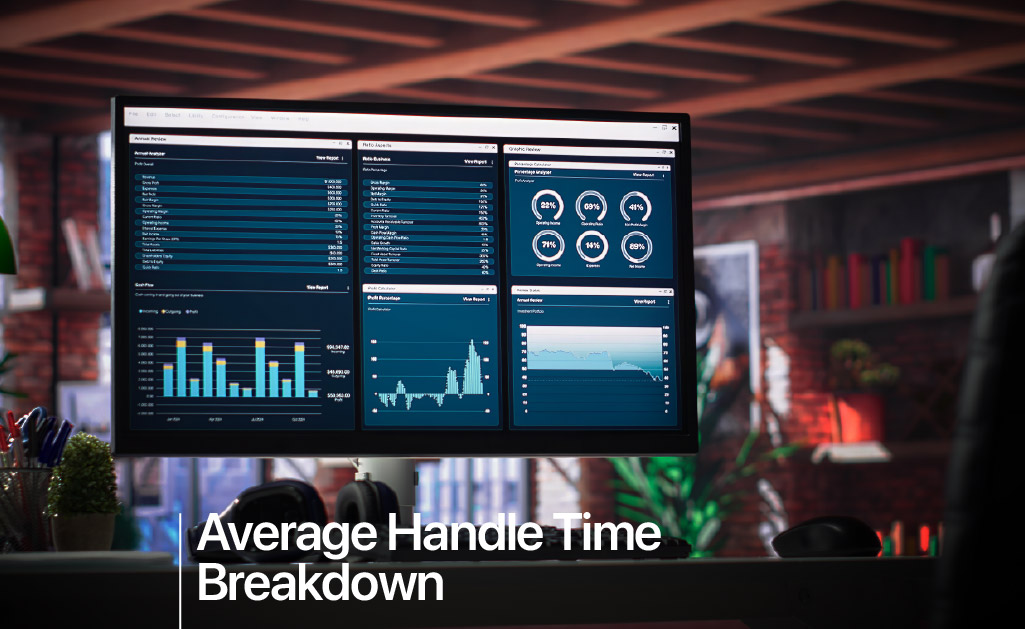
Average handle time is the full time an agent spends completing one customer interaction. It includes three parts: talk time, hold time, and after-call work.
The standard formula is:
AHT = (Talk Time + Hold Time + After-Call Work) / Total Number of Calls
That formula matters because many teams only focus on the part the customer hears. That’s a mistake. If wrap-up work is messy, or if agents rely on hold time to operate systems, your true operational cost is hiding in plain sight.
The three pieces that drive AHT
Think of the metric as a chain. If one link is weak, the total result rises.
| Component | What it includes | What usually drives it up |
|---|---|---|
| Talk time | Time spent speaking with the customer | Complex issues, unclear explanations, poor discovery |
| Hold time | Time the customer waits while the agent checks something | Slow systems, missing knowledge, weak escalation paths |
| After-call work | Notes, logging, case updates, required follow-up tasks | Duplicate entry, compliance logging, disconnected tools |
A simple example from e-commerce
Say a customer calls because a package shows delivered, but nothing arrived.
The call might look like this:
- Talk time: The agent verifies the order, asks when the customer last checked the address, and confirms the shipment details.
- Hold time: The agent places the customer on hold to review carrier notes and internal order records.
- After-call work: The agent logs the claim, updates the customer profile, and sends a follow-up email or ticket note.
Even without assigning made-up numbers to that example, you can see how AHT forms. The customer hears one call. Operations should see three separate time buckets.
Key quote: Average handle time isn’t one number. It’s three different operational stories bundled into one KPI.
What experienced teams do differently
Good managers don’t stop at the formula. They break the metric apart by cause.
If your talk time is high, the fix may be better call control or stronger product training. If hold time is the issue, your systems or approval process may be the problem. If after-call work is dragging, your CRM design probably needs attention more than your agents do.
That’s why mature teams review AHT alongside quality and workflow data, not in isolation. This is also where KPI discipline matters. If you’re building a broader measurement framework, this guide to customer service KPIs that power real results helps put AHT in the right context.
Why Average Handle Time is a Double-Edged Sword
A supervisor cuts AHT targets by 30 seconds. The dashboard looks better by Friday. By Monday, repeat contacts are up, agents are escalating avoidable calls, and QA is flagging thin documentation.
That is the problem with AHT. It is useful, but only when leadership treats it as an operating signal instead of a speed contest.

Why AHT helps and hurts at the same time
AHT affects staffing, service level, cost per contact, and customer effort in the same workflow. That makes it valuable. It also makes it easy to misuse.
An agent who resolves a complex billing issue in one call may post a longer handle time than an agent who rushes the customer, skips proper notes, and pushes the problem into a second interaction. The second call looks efficient on one report. It creates more work everywhere else.
I have seen this in BPO environments where managers put too much weight on a single handle-time target across every queue. Agents respond exactly the way the scorecard teaches them to respond. They shorten discovery, avoid ownership, and protect their number.
What overmanaged AHT usually looks like
When leaders push for lower AHT without enough context, the same patterns show up fast:
- Shallow troubleshooting: Agents move to a script close before they understand the underlying issue.
- More transfers: One team protects its own metric and sends the call downstream.
- Thin after-call notes: The next agent starts cold, which raises effort for the customer and the operation.
- Lower agent confidence: Reps feel forced to choose between doing the job right and hitting the timer.
This is why experienced operations teams do not ask, “How do we make every call shorter?” They ask, “What should this call type take if the agent does it well?”
Appropriate handle time beats minimum handle time
AHT works best when it is tied to call intent, complexity, and resolution standards.
A password reset, a fraud concern, and a bilingual benefits call should not sit under one flat target. Neither should a new hire and a tenured specialist. If you want useful control, set ranges by contact reason and pair them with QA, transfer rate, and repeat-contact trends.
That is also where agent-centric optimization matters. Long AHT is not always an agent problem. Sometimes the issue is a slow knowledge base, too many approval steps, weak CRM design, or a policy that forces the rep to put the customer on hold twice to get a basic answer.
Why the agent experience matters to AHT
Agents do not create handle time alone. The operating model creates it with them.
If systems are slow, AHT climbs. If policies are unclear, agents spend extra time explaining exceptions. If training is generic, newer reps talk longer because they are searching for confidence while the customer waits. Cutting seconds from the target does not fix any of that.
A stronger approach is to remove friction around the agent. Clean call guides. Better desktop workflow. Clear escalation paths. Coaching that focuses on call control and judgment, not just pace. Teams that build targets this way usually get lower AHT as a byproduct of better operations, not from pressure alone.
Nearshore BPO teams often have an edge here because support leaders can coach more closely, calibrate faster, and adjust workflows with less lag between frontline feedback and management action. That matters when you are trying to reduce wasted time without flattening service quality.
If you are setting those guardrails, these performance targets for customer service give a practical framework for balancing speed, quality, and accountability.
Realistic Average Handle Time Benchmarks for Your Industry
A bank dispute call, a prescription refill request, and a simple order-status check should not share the same AHT target. Teams that force one benchmark across all three usually create the wrong coaching, the wrong staffing plan, and the wrong view of agent performance.
Benchmarks work best as guardrails, not quotas. Use them to pressure-test your expectations, then set targets by queue, call reason, and service model.
2026 Average Handle Time AHT Industry Benchmarks
| Industry | Average Handle Time (AHT) |
|---|---|
| Financial services | Often planned around 4 minutes and 45 seconds for standard service environments |
| Healthcare routine calls | Commonly fall in the 3 to 6 minute range |
| Healthcare providers broader target range | Often sit closer to 6 to 8 minutes when documentation and coordination steps are heavier |
| Bilingual English-Spanish calls | Usually run longer because agents are clarifying language, context, and intent across two communication styles |
| General cross-industry reference | Around 6 minutes can serve as a rough reference point, not a universal target |
What these benchmarks are actually good for
Benchmarks help operations leaders ask better questions.
If your financial services queue is running above target, the issue may be dispute complexity, verification steps, or wrap-up requirements. If a healthcare line looks fast on paper, that is not automatically good news. Short calls can also signal rushed explanations, weak triage, or repeat contacts waiting to happen.
I have seen the same pattern across BPO programs. The benchmark matters less than the context around it.
A nearshore team often gives you an advantage here because supervisors can review calls faster, calibrate quality with less delay, and separate agent skill gaps from process design issues before bad assumptions harden into policy.
Segment before you set targets
The most useful benchmark is usually your own segmented baseline.
Break AHT into groups that reflect how work shows up in the queue:
- By call type: appointments, billing, order status, cancellations, disputes
- By complexity: routine, exception-based, escalated, compliance-heavy
- By language path: English-only versus bilingual interactions
- By channel workflow: phone only versus phone plus follow-up tasks
- By agent tenure: new hires, ramping agents, tenured specialists
That last cut matters more than many leaders expect. Newer agents often expose where the process is hard to learn, not just where the call is hard to handle.
A practical way to use benchmarks without hurting service quality
Start with the outside range. Then compare it against your own call categories, QA scores, transfer rates, and repeat contact patterns.
If one queue is high, ask operational questions first:
- Is the work itself more complex than the benchmark assumes?
- Are agents losing time in verification, hold steps, or after-call work?
- Does the workflow require manual steps that should be automated?
- Are longer calls producing better first-contact resolution, or just more drift?
That third question matters. AHT often drops when teams reduce admin burden with better workflows and customer service automation tools, not when they tell agents to talk faster.
Training also changes how benchmarks should be read. Programs that invest in targeted refreshers, call control practice, and training video customer service programs usually get more consistent handle times because agents know how to guide the interaction without sounding scripted.
Use industry benchmarks to sense-check your operation. Use segmented internal data to manage it. That is how AHT becomes a planning metric instead of a blunt performance weapon.
Smart Strategies to Optimize Average Handle Time
A queue starts slipping. Service level drops, supervisors push agents to wrap faster, and AHT improves for a week. Then transfers rise, notes get thinner, and repeat contacts climb. I have seen that pattern more than once in BPO environments. The fix is rarely speed. The fix is reducing the work that should never have been on the agent in the first place.
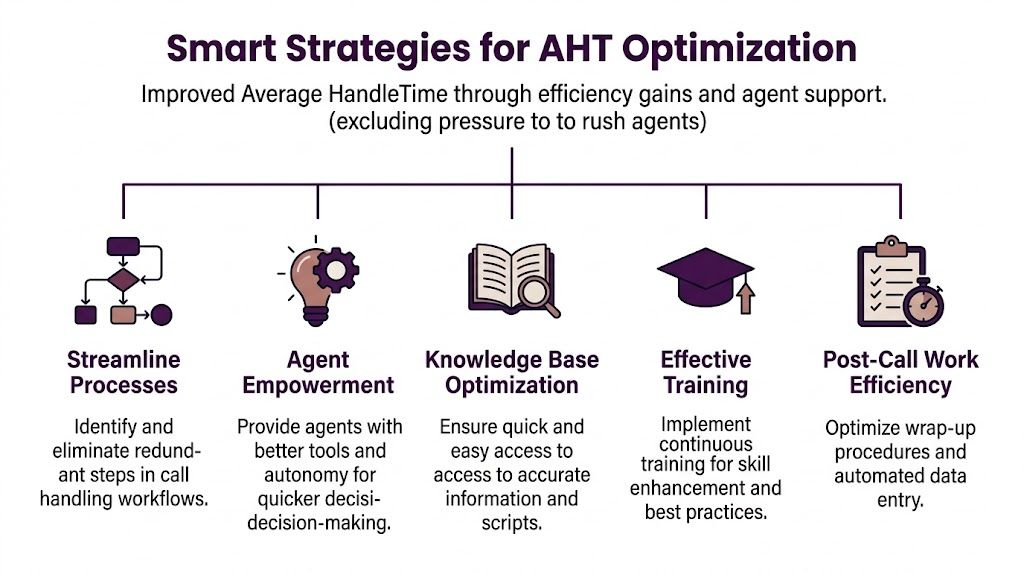
The best AHT gains come from cleaner execution at the desk level. Agents need fewer screens, clearer policies, stronger call control, and enough authority to resolve routine issues without waiting for permission. That is how teams lower handle time without trading away customer experience.
Diagnose the workload behind the call
High AHT is usually a symptom. The underlying cause sits in process design, desktop friction, weak training, or narrow agent authority.
Start by reviewing recorded calls and screen activity together. Listen for dead air, repeated authentication, long holds, unnecessary transfers, and slow after-call work. Then separate the problem by type. Long talk time needs a different fix than bloated wrap time or hold time caused by a supervisor dependency.
That distinction matters.
If leaders push one blanket AHT target across every queue, agents start protecting themselves instead of serving the customer well. Good operations teams break the metric apart, fix the source of delay, and coach judgment instead of rushing.
Five strategies that work in real operations
Streamline internal processes
Process waste adds minutes in small pieces.
An agent opens three systems, copies the same account details twice, waits for an approval, and scrolls through a generic disposition menu. None of that improves the customer conversation, but all of it shows up in AHT. Review the workflow from the agent’s screen, not from the SOP.
The highest-impact fixes are often simple. Reduce duplicate entry between platforms. Pre-fill common fields. Create clearer call outcomes for recurring issues. If a common request still requires manual workarounds, the process is telling you where to focus first.
Build a knowledge base agents can use under pressure
A knowledge base is only useful if an average agent can find the answer in seconds while managing a live conversation.
That means searchable content, clear decision paths, current policy updates, and language that sounds natural when spoken aloud. Long articles, buried exceptions, and outdated macros push agents into hold time and guesswork.
One rule I use is simple. If your top agent knows the answer from memory but your mid-tier agent has to hunt for it, the issue is documentation design.
Train for control, not speed
Shorter calls come from better structure.
Agents need to know how to confirm the issue quickly, ask the question that narrows the case, set expectations before a hold, and close with a next step the customer can repeat back. Those are operational skills, not personality traits. Teams that codify them improve consistency across tenured staff and new hires alike.
For distributed teams and fast-growing programs, structured training video customer service programs help standardize coaching without relying on every supervisor to teach the same skill the same way.
Use automation to remove admin drag
Automation should take work off the agent, not force the agent to babysit another tool.
In practice, the best use cases are repetitive tasks around the conversation. Eligibility checks, note summarization, field completion, call reason tagging, and workflow prompts can all reduce wasted handling time if they are set up well. Teams reviewing these options can start with practical examples of automation in customer service.
Healthcare is a good example. Analysts at Kayako found that routine healthcare calls often fall in the 3 to 6 minute range, and they noted that AI-driven triage can cut hold times by 20 to 30% through faster eligibility checks. The same analysis found that trimming AHT by one minute can expand an agent’s daily capacity by about 17% (Kayako healthcare AHT data).
The trade-off is real. Poorly configured automation adds clicks, creates bad summaries, and frustrates agents. Test it with frontline staff before rolling it out broadly.
Give agents room to finish the job
AHT rises when agents know the right answer but lack permission to act on it.
If every refund exception, profile correction, or shipping accommodation requires a lead, the customer waits while the agent stalls, places a hold, or transfers. A better model uses clear guardrails. Define what agents can approve, set dollar or policy limits, and audit the exceptions.
This is one place where nearshore BPO teams often have an edge. When agents work in closer cultural and time zone alignment with the client, calibration moves faster, coaching sticks better, and leaders are usually more comfortable widening decision rights. That shortens handle time because fewer calls get trapped in approval loops.
The operating principle behind all five
Treat AHT as an outcome of agent design.
If the desktop is cluttered, the rules are hard to apply, and the agent has no room to resolve common issues, handle time will stay high no matter how often leaders talk about urgency. If the workflow is clean and coaching is specific, AHT usually improves alongside quality.
That is why mature programs tie AHT work to the agent experience. CRM integration, QA feedback loops, routing logic, and live KPI visibility all shape how quickly an agent can do good work. CallZent’s operating model, for example, uses KPI visibility and support workflows as part of a broader service structure rather than treating AHT as a stand-alone pressure metric.
The Nearshore Advantage for AHT Management
AHT gets harder to manage when language, culture, and time zone friction are built into the support model.
That’s one reason nearshore operations can outperform distant offshore setups on both efficiency and customer experience, especially for North American brands serving English and Spanish speakers.
Bilingual support changes the math
Generic AHT guides often skip a major operational reality. Bilingual calls are not just standard calls in two languages.
Verified data notes that bilingual calls can increase AHT by 20 to 30% because of code-switching and cultural translation demands. The same verified data points out that a nearshore BPO with culturally aligned bilingual agents can reduce that drag compared with offshore models where language and cultural gaps stretch calls and reduce resolution quality (Zendesk AHT discussion).
That matters in industries like healthcare, finance, telecom, and e-commerce where customers switch languages mid-conversation or explain sensitive issues in the language they trust most.
Why nearshore teams handle this better
The advantage isn’t only pronunciation or vocabulary. It’s operating fluency.
Nearshore teams often improve AHT through:
- Faster rapport: Agents understand North American communication styles and customer expectations.
- Cleaner clarification: Fewer misunderstandings mean less repetition and less re-explaining.
- Better escalation speed: Proximity supports easier collaboration with U.S. teams during live issues.
- Stronger bilingual continuity: Customers don’t lose momentum when the conversation shifts between English and Spanish.
AHT benefits from proximity, not just lower labor cost
A distant operation can look cost-efficient on paper while creating hidden time loss in production.
If managers wait hours for answers, if issue escalation crosses awkward time zones, or if policy changes take too long to reach the floor, hold time and after-call work rise. Nearshore programs tend to reduce that lag because collaboration is easier and service oversight is tighter.
The fastest call isn’t the one with the shortest talk time. It’s the one where the agent understands the customer quickly and can act without operational delay.
Where this matters most
Nearshore AHT management tends to be especially useful when your operation includes:
- English-Spanish support
- Sensitive or regulated conversations
- Frequent client-side coordination
- Fast-moving policy or product changes
- Customer bases concentrated in North America
If those conditions sound familiar, the nearshore advantage is less about geography alone and more about reducing friction inside the service chain.
 Conclusion Master Your Metrics Master Your Business
AHT becomes dangerous when leadership treats it as a speed target instead of a management tool.
In real operations, the number matters because it exposes friction. Long handle time can point to weak systems, unclear procedures, poor knowledge access, limited agent authority, or a support model that makes simple coordination harder than it should be. Short handle time can look efficient while still driving repeat contacts, rushed notes, and avoidable escalations.
The better standard is straightforward. Give agents the training, tools, and decision rights to resolve the issue well on the first pass, then measure whether the time spent was productive. That is how AHT starts serving the business instead of distorting agent behavior.
I have seen centers cut seconds off calls and lose more money in rework a week later. I have also seen teams reduce AHT the right way by removing approval bottlenecks, simplifying after-call work, and placing support closer to the customer and the client team. That agent-centered approach is where nearshore BPO programs often outperform generic low-cost models. They reduce operational drag without forcing agents to rush the conversation.
AHT should sit inside a wider performance view that includes quality, resolution, transfer patterns, and workload design. A practical introduction to people analytics can help connect agent performance, process design, and business results.
Before changing targets, review AHT by call type, check what agents are waiting on, and confirm whether lower time is producing better outcomes. That is how you master the metric, and protect the business behind it.
Frequently Asked Questions About Average Handle Time
What is a good average handle time for a call center
There isn’t one universal number.
A good average handle time is the one that fits your call type, industry, and service standards. A simple routine inquiry should move faster than a regulated financial call or a healthcare interaction that requires documentation and verification. That’s why the right target is usually a range, not a single hard number.
Should I lower average handle time as much as possible
No.
Lowering AHT without checking resolution quality usually creates repeat contacts, weak documentation, and frustrated customers. The healthier goal is to remove waste from the interaction, not to force the call to end faster.
What’s the biggest mistake companies make with AHT
They manage it in isolation.
If you don’t look at AHT alongside first-contact resolution, quality review, customer feedback, and transfer patterns, the number can fool you. A short call can be excellent, or it can be incomplete. The surrounding metrics tell you which one it is.
Does after-call work count in average handle time
Yes.
After-call work is part of the metric because it’s still labor tied to the interaction. Notes, case logging, follow-up tagging, and required documentation all belong in the total. If your ACW is consistently high, the issue may be tool design or compliance burden rather than agent behavior.
How often should I review AHT
Review it regularly, but don’t react emotionally to short-term swings.
Daily monitoring is useful for staffing and queue management. Weekly and monthly reviews are better for trend analysis, coaching, and process decisions. The key is to look for patterns by call type and team, not just total averages.
Can bilingual support increase average handle time
Yes, it often can.
Bilingual calls may take longer because customers switch languages, explain issues differently across languages, or need cultural context to feel understood. That’s one reason it helps to have bilingual agents who can move naturally through the interaction instead of translating in real time.
What usually reduces AHT fastest
The fastest gains usually come from operational cleanup.
That often means better knowledge access, fewer system hops, cleaner routing, simpler approvals, and less manual wrap-up. Coaching matters, but coaching alone won’t fix a broken workflow.
Is outsourcing a good way to improve AHT
It can be, if the partner understands your call drivers and doesn’t apply a generic target.
A strong outsourcing partner should segment your interactions, identify friction points, and balance handle time with resolution quality. If they only promise shorter calls, that’s a warning sign.
🚀 Improve Your Call Center Efficiency Today
Partner with CallZent to optimize your average handle time with smarter workflows, real-time KPIs, and bilingual nearshore agents.
Talk to an ExpertIf your team is struggling to balance efficiency, customer satisfaction, and cost control, CallZent can help you evaluate where average handle time is being driven by real complexity and where it’s being inflated by avoidable friction.