Skip to content

Call Center Operations
Call Center Script Guide for High-Converting Calls
Learn how to build a practical call center script for sales and support, including bilingual EN/ES adaptation, AI branching, compliance, QA, and industry-specific examples.
TL;DR — Quick Takeaways
- A strong call center script should guide the call without making agents sound robotic.
- Scripts work best when they are built around real caller intent, emotional context, and a clear business outcome.
- Bilingual EN/ES scripting should be planned together, not translated line by line after the fact.
- AI branching, QA reviews, and compliance checks improve script performance when they support live conversations instead of replacing judgment.
A lot of teams are dealing with the same frustrating pattern right now. The phones are busy, agents are trying to move fast, and the script on screen sounds polished in a document but falls apart in a live conversation.
One caller wants a refund but is mostly upset about shipping delays. Another starts in English, switches to Spanish halfway through, and asks a technical question using product slang your script never anticipated. A third needs a compliance-required disclosure, but the agent is trying not to sound like a recording. That’s where a call center script either becomes a performance tool or a liability.
The difference usually isn’t the existence of a script. It’s how the script was built. Good scripts give agents direction, keep calls consistent, and protect quality. Bad scripts force awkward phrasing, miss real objections, and create repeat contacts that should never have happened.
Introduction with TLDR
A caller reaches your Tijuana team about a late order. The conversation starts in English, shifts to Spanish when the customer gets frustrated, then turns into a billing question the original script never anticipated. If the agent has to choose between sounding human, following policy, and finding the right next step, the script is doing a poor job.
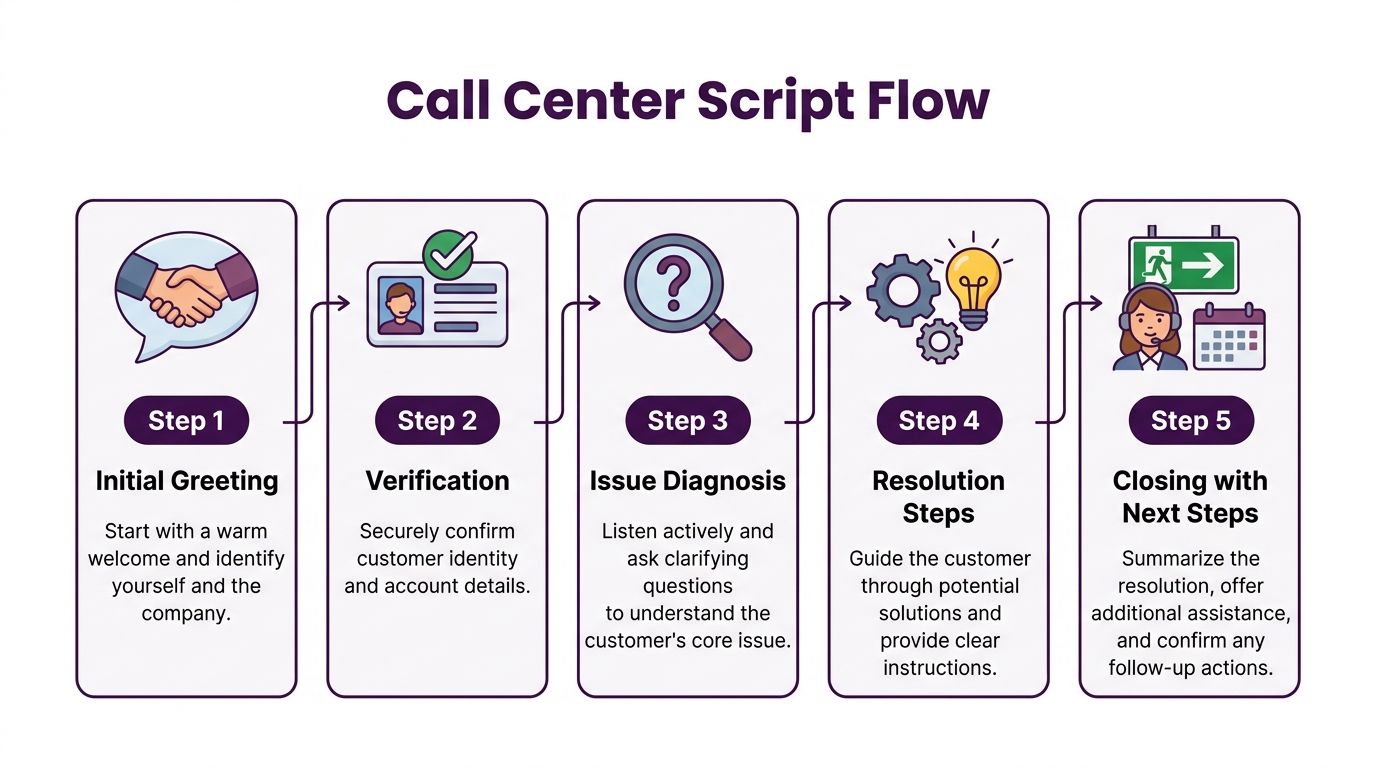
A practical call center script should guide five jobs cleanly. Open the call, confirm who the customer is, identify the issue, move to a workable resolution, and close with clear next steps. In nearshore BPO operations, it also needs to hold up across English and Spanish without turning agents into translators on the fly.
Strong scripting affects outcomes customers notice and metrics leaders track. SQM Group notes that first call resolution remains one of the clearest indicators of support quality in its research on call center first call resolution. Repeat calls usually point back to breakdowns in process, phrasing, handoff logic, or missing decision paths in the script.
For companies reviewing service models, this broader look at why call centers are important in 2025 gives useful context on where support operations fit in growth plans.
The strongest call center script sounds clear and natural to the customer, while still giving the agent enough structure to stay accurate, compliant, and efficient.
Generic script advice usually stops at opening lines and closing statements. That misses the harder part. Bilingual adaptation, AI-assisted branching, compliance wording, and nearshore delivery constraints are where scripts either hold up under pressure or create avoidable repeat contacts.
Setting Goals and Personas
Some scripts fail before the first word is written. The team starts drafting lines without deciding what the call is supposed to accomplish.
If the goal is vague, the script becomes vague too.

Match the script to one primary outcome
A useful call center script usually has one dominant outcome, even if there are secondary goals around it.
Examples:
- Sales-focused calls: Move the prospect to a next step, not a full product lecture.
- Support calls: Resolve the issue in one interaction when possible.
- Healthcare scheduling calls: Gather the right information accurately and route correctly.
- Billing calls: Explain charges clearly, reduce confusion, and confirm next action.
When leaders skip this step, they create scripts that try to sell, educate, troubleshoot, reassure, and upsell all at once. Agents then sound scattered because the script is scattered.
A simple planning question helps: What should be true by the end of this call if the script works?
Build personas from real call behavior
Personas shouldn’t read like marketing slides. They should reflect how callers sound under pressure.
A few examples make the difference clear:
| Persona | What they care about | Script tone that works | Script tone that fails |
|---|---|---|---|
| Repeat e-commerce buyer | Speed, order clarity, refund certainty | Direct, concise, proactive | Overexplaining policy before answering the question |
| Concerned patient | Reassurance, privacy, accurate instructions | Calm, structured, respectful | Casual language or rushed verification |
| Financial services caller | Security, precision, trust | Exact wording, confident pacing | Vague statements or conversational shortcuts |
| Telecom customer during outage | Status, timeline, practical next steps | Acknowledging frustration, then action | Generic apologies with no path forward |
A good script reflects the emotional state of the caller, not just the business process.
That’s also why strong service teams pay attention to what defines excellent customer service beyond politeness alone. Tone, pacing, and clarity have to fit the moment.
A simple worksheet for script planning
Before writing any live language, collect four inputs:
- Caller intent: Why are they contacting you now?
- Caller mindset: Are they impatient, worried, confused, skeptical, or ready to buy?
- Operational goal: What outcome matters most to the business?
- Agent constraints: What must be said exactly, and where can the agent adapt?
A script gets easier to use when the persona is specific enough that an agent can recognize the caller in the first 20 seconds.
One practical example. An online retail brand may think its support script is about “order assistance.” In reality, the caller segments are different. One person wants a tracking update. Another wants to cancel. Another is upset because a gift won’t arrive on time. Those are not one script with different labels. They are separate intent paths with different emotional cues.
That’s the shift that improves script performance. Write for an authentic conversation, not the abstract category.
Structuring and Wording Your Script
An agent in Tijuana takes two calls back to back. The first caller wants a billing fix in English. The second starts in Spanish, switches to English during verification, then gets frustrated when troubleshooting feels scripted. The same script framework has to hold up in both calls without making the agent sound robotic.
That is why structure matters. Good scripts give agents a reliable path through the call and leave room for natural delivery.
A practical framework is greeting, verification, diagnosis, resolution, and close. In regulated work, that structure also protects consistency. The National Institutes of Health discusses how standardized scripts support protocol adherence and reduce variation in sensitive interactions in its overview of scripted communication in research and clinical settings. The point carries over to call centers. If the sequence is clear, agents miss fewer steps and recover faster when calls go off track.
Start with a greeting that does real work
A greeting should confirm three things fast. The caller reached the right company, the agent is ready to help, and the interaction is under control.
Compare these two openings:
- “Thanks for calling. How can I help?”
- “Thank you for calling BrightPath Support. This is Elena. How can I help you today?”
The second version reduces confusion right away. It also gives the caller a name to attach to the interaction, which helps when the call needs to be transferred or referenced later.
For outbound calls, state the purpose early. Agents who hide the reason for the call usually create more resistance, not less.
Verification should sound orderly
Verification often breaks the rhythm of a call. Agents either stack too many disclaimers or sound abrupt.
Use short prompts with a clear reason:
- “Before I open the account, may I verify your full name and the email on file?”
- “For security, I need to confirm two account details.”
That wording is easier to deliver and easier to hear. In nearshore BPO teams, it also translates more cleanly into Spanish because the intent is direct and the sentence is not overloaded.
Diagnose before you choose the path
Scripts fail when they push agents into premature troubleshooting. One symptom rarely tells the whole story.
Use a short diagnosis sequence:
- Let the caller describe the issue fully.
- Restate it in plain language.
- Ask one or two clarifying questions.
- Choose the correct resolution path.
Example:
Caller: “My internet has been dropping all morning.”
Agent: “I’m sorry you’re dealing with that. Is the connection cutting out on all devices or just one?”
Caller: “All of them.”
Agent: “Got it. I’m going to check whether this looks like an area issue or a device-specific problem.”
That small pause for clarification saves time later. It also works well with AI-assisted branching, because the system can suggest the next question after the agent confirms scope instead of guessing too early.
Resolution language should be plain and directional
Weak scripts get overly formal. Customers want the next step, the timeline, and any limit on what the agent can do.
Use language like:
- “Here’s what I can do right now.”
- “The next step is…”
- “I can help you with that today by…”
- “If that doesn’t work, I’ll move you to the next option.”
Agents also need fallback language for tense moments. A resource like conversation scripts for difficult situations can be useful when teams need examples for de-escalation, boundary setting, and emotionally charged calls.
If a sentence reads well in a document but sounds stiff out loud, rewrite it.
Add AI branching where it reduces agent guesswork
Branching helps when the next best question depends on the previous answer. AI can speed that up, but it should support agent judgment, not replace it.
CallHub explains how branching scripts during a call guide agents through changing paths based on live responses. In practice, I have seen this work best in three cases. High-volume triage, technical troubleshooting, and bilingual routing where the caller may switch between English and Spanish midstream.
Use dynamic branching for:
- High-volume triage: Sort common intents into clear downstream paths
- Complex troubleshooting: Change prompts based on customer responses
- Bilingual decision trees: Support language switching and approved terminology
- Compliance prompts: Trigger required disclosures by call type or account status
Do not over-automate sensitive calls. Complaints, cancellations with retention risk, fraud concerns, and emotionally charged escalations usually need more agent discretion.
For teams working on live delivery, strong customer service communication skills for call center agents are just as important as script content. A well-written prompt still fails if the agent sounds flat, rushed, or defensive.
A practical script skeleton
This template works well across service, support, and sales environments:
- Opening
- Identify company and agent
- Set a calm, clear tone
- Verification
- Confirm required details
- Explain why if needed
- Issue statement
- Ask the customer to describe the problem
- Reflect the issue back briefly
- Clarifying questions
- Narrow down the cause
- Select the correct path
- Resolution
- State what you can do now
- Give steps one at a time
- Close
- Summarize the outcome
- Confirm follow-up
- Offer final help
That structure holds up well in nearshore operations because the logic stays stable even when phrasing changes by language, client, or call type. The script still lives or dies on the wording agents use.
Adapting Scripts for Bilingual Support
An English-only script with a Spanish translation added later usually creates problems. The phrasing becomes uneven, the terminology drifts, and agents end up improvising in the middle of live calls.
That’s a major gap in the market. Only 15% of call center scripts are customized for bilingual EN/ES contexts despite 40 million Spanish speakers in the U.S., and firms using bilingual agents with adaptive scripts can see up to 22% higher CSAT, according to Microsourcing’s analysis of call center scripting practices at this bilingual scripting overview.

Build one script framework, not two disconnected ones
The best bilingual call center script uses shared logic with language-specific wording. The intent path stays the same. The phrasing changes where needed.
That means your internal script architecture should define:
- identity verification steps
- issue categories
- escalation rules
- required disclosures
- closing language
Then each branch gets English and Spanish delivery that matches the same operational path.
This prevents a common issue in bilingual operations. The English team follows one process, while the Spanish team follows a translated approximation of it.
Plan for code-switching instead of resisting it
Many callers won’t stay in one language. They’ll start in English, switch to Spanish for emotional emphasis, then use product terms in English again.
A bilingual script should account for that reality.
A practical format looks like this:
| Script block | English prompt | Spanish prompt | Agent note |
|---|---|---|---|
| Greeting | “Thank you for calling…” | “Gracias por llamar…” | Start in caller’s language |
| Verification | “Can you confirm…” | “Me puede confirmar…” | Keep fields identical |
| Technical term | “Router reset” | “Reinicio del router” | Keep accepted product term visible |
| Escalation | “I’m transferring you…” | “Lo voy a transferir…” | Maintain same call disposition |
This side-by-side format helps agents avoid live paraphrasing when pressure rises.
Watch for cultural tone, not just translation accuracy
Literal translation is not enough. The call still has to feel natural.
A few examples:
- Some English scripts sound efficient but abrupt when translated directly.
- Some Spanish phrasing sounds respectful but too long for a high-volume support environment.
- Certain apology lines feel appropriate in one language and overly formal in the other.
That’s why regional knowledge matters. Teams serving North America often need variations by audience, and this guide to Spanish customer support by region is useful when script wording needs to reflect who’s calling.
A bilingual script should protect consistency behind the scenes while giving the caller a conversation that feels native, not translated.
One practical workflow works well in nearshore operations. Draft the script in operational blocks first. Then adapt each block with bilingual reviewers, QA leaders, and frontline agents in the room. Agents catch awkward phrases faster than anyone because they know what customers say.
Industry Specific Script Examples
A customer in Phoenix calls about a failed payment. The account notes are in English, the caller switches to Spanish when the issue gets stressful, and your Tijuana team has to keep the call clear, compliant, and short. That is where generic scripts fall apart. Industry scripts need to reflect the transaction, the risk level, and the language shifts that happen on real calls.
The examples below are intentionally brief. Use them as working patterns, then add your own policy language, system steps, and branching logic.
E-commerce
E-commerce scripts work best when they identify the order fast and set expectations before the customer asks for a refund.
Scenario: Order status and possible refund
Script sample
Agent: “Thanks for calling. I can check the order status and the next available option for you. May I have your order number or the email used at checkout?”
Caller: “I haven’t received my package.”
Agent: “I’m pulling up the shipment first. If the carrier shows a delay, I’ll explain whether replacement, refund, or wait-for-delivery is available.”
Why this holds up in production:
- It gets to the identifier quickly.
- It names the likely outcomes early.
- It reduces dead air while the agent checks the order.
For bilingual teams, keep “replacement,” “refund,” and “delivery delay” translated the same way every time. In Tijuana programs serving U.S. brands, that consistency matters because customers often repeat the exact term they saw in an email or checkout page.
Healthcare
Healthcare calls need pace control. The script has to slow the conversation down without sounding cold.
Scenario: Appointment scheduling
Script sample
Agent: “Thank you for calling the clinic. Before I access your file, please confirm your full name and date of birth.”
Caller: “I need to schedule something soon.”
Agent: “I can help with that. After I verify your information, I’ll check the earliest appointment that matches your request.”
A good healthcare script does three things in order. It verifies identity, acknowledges the need, and gives the caller a clear next step. If your team supports both English and Spanish, keep the verification fields and appointment labels identical in both versions so schedulers do not improvise.
Financial services
Financial calls punish vague wording. If an agent sounds uncertain, the customer hears risk.
Scenario: Unexpected fee on a statement
Script sample
Agent: “I can review that charge with you. First, I need to verify your account details.”
Caller: “I don’t recognize this fee.”
Agent: “Once verification is complete, I’ll explain what the fee is connected to and whether it qualifies for further review.”
Useful choices here:
- State the review sequence clearly.
- Avoid guesses before account verification.
- Use approved terms for disputes, reversals, and pending transactions.
This is also a strong use case for AI-assisted branching. If fee calls split into “merchant confusion,” “service charge complaint,” and “possible fraud,” the script should surface the right branch immediately instead of forcing agents through the same generic explanation every time.
Telecom
Telecom callers usually want two things fast. Confirmation that the issue is known, and the next action.
Scenario: Service interruption
Script sample
Agent: “I’m sorry for the disruption. I’m checking whether this is an area outage or an issue specific to your line.”
Caller: “My internet keeps dropping.”
Agent: “I’ll confirm the service status first, then I’ll walk you through the next step based on what I find.”
That wording works because it creates a diagnostic path. It also adapts well for bilingual support. “Area outage” and “service interruption” should be standardized in both languages so the customer gets the same answer whether the call starts in English or Spanish.
Retail
Retail scripts need a friendly tone, but they still have to control the process.
Scenario: Return outside the usual window
Script sample
Agent: “I can review your return options. May I have the order number or phone number used for the purchase?”
Caller: “I’m not sure I still qualify.”
Agent: “I’ll check the purchase details first, then I’ll explain what options are available based on the item and the purchase date.”
Retail teams usually do better with short explanation blocks. One reason is simple. Return calls can turn into policy debates if the first answer is too open-ended.
Insurance
Insurance scripts carry more emotional weight than they look on paper. Customers are often calling after damage, a missed update, or a denial they do not understand.
Scenario: Claim status update
Script sample
Agent: “I can check the current status of your claim. First, please verify your policy information.”
Caller: “I’ve been waiting for an update.”
Agent: “Once I verify the account, I’ll review the latest claim notes and explain the next step.”
“Review the latest claim notes” is stronger than “look into it” because it tells the caller what the agent is doing. That small wording change improves trust.
Outbound specialty campaigns need different script logic
Outbound scripts live or die on the opening ten seconds. The agent has to earn enough attention to ask the next question.
If your operation handles appointment setting, reactivation, lead qualification, or niche prospecting, study patterns outside your own vertical. These real estate cold calling scripts are useful because they show how to open with context, handle resistance early, and move toward a concrete ask without sounding mechanical.
For Tijuana BPO teams, outbound scripting also benefits from bilingual branching rules. A prospect may answer in English, ask a follow-up in Spanish, and switch back again once pricing or location comes up. If your script tree does not account for that, agents start translating live and performance drops.
One operational rule is easy to miss. Store approved industry script blocks in one controlled system, with call reasons, language variants, and escalation paths tied to the same disposition logic. Teams that pair script libraries with regular call center quality monitoring standards catch wording drift much faster. CallZent also offers customized scripting tied to brand voice and service workflow, which can help companies running inbound, outbound, and bilingual programs at the same time.
Optimizing Scripts with Compliance QA and Metrics
Monday morning in a Tijuana nearshore program, the same pattern shows up fast. English calls are clean until the disclosure block. Spanish calls run long because agents pause to translate a required phrase in real time. QA marks the agent down, but the problem sits in the script.
That is why script optimization has to happen on live-call evidence, not opinion. Once a script is in production, every repeated hesitation, skip, and customer interruption gives you usable direction. In regulated lines of business, that review matters even more because a script has to protect the company and still sound natural enough for a real conversation.
Compliance has to fit the flow of the call
Compliance language works best when it appears at the point where the customer expects it. If teams tack disclosures onto the end of a script or drop them into the middle of a troubleshooting sequence, agents rush through them and customers stop listening.
Place required language where it does the least damage to call flow and the most good for clarity:
- At verification: identity checks, consent, privacy notices, account access
- At decision points: disclosures, eligibility limits, fees, coverage gaps, approval conditions
- At close: next steps, reference numbers, escalation rights, documentation reminders
For bilingual EN/ES programs, do not translate those blocks line by line and call it done. Build approved equivalents that match legal meaning and spoken rhythm in both languages. In Tijuana operations, I have seen good agents lose confidence because the English compliance line was concise while the Spanish version sounded formal, long, and unnatural. That mismatch affects handle time and QA scores even when the agent is technically correct.
QA should grade the script, not just the rep
A weak QA process treats every miss as an agent problem. A useful one separates delivery issues from script issues.
Start with a simple question. Did the agent fail because they were unprepared, or because the script asked them to say something awkward, out of order, or hard to explain in both languages? Teams that review calls against clear call center quality monitoring standards catch that distinction much faster.
A practical review loop looks like this:
- Listen for friction: repeated pauses, customer interruptions, or ad-libbed explanations
- Calibrate reviewers: define what acceptable delivery sounds like in English and Spanish
- Collect agent notes: frontline reps know which lines create resistance
- Revise the script block: fix wording, sequence, or branch conditions
- Retest on live calls: confirm the edit improved both compliance and call control
AI can help here, especially in larger BPO teams. Use it to flag moments where agents abandon the script, where callers ask for clarification after a disclosure, or where language switching happens mid-call. That kind of branching insight is more useful than a generic transcript summary because it shows where your script tree breaks under real bilingual conditions.
Which metrics should shape script revisions
Not every KPI belongs in a script meeting. Focus on the numbers the script can influence.
| Metric | What it helps reveal | Script implication |
|---|---|---|
| First Contact Resolution | Whether the script leads to a complete outcome | Resolution steps or decision branches may be missing |
| Average handle time | Whether wording, verification, or branching slows the call | Certain blocks may be too long, repetitive, or unclear |
| QA compliance score | Whether required statements are delivered correctly | Mandatory language may be placed poorly or written awkwardly |
| Transfer rate | Whether agents can resolve within their lane | Escalation criteria or discovery questions may need adjustment |
| Clarification rate | Whether callers keep asking “What does that mean?” | Disclosure or policy language needs plainer wording |
One caution. Do not chase lower handle time at the expense of clean disclosures or accurate documentation. In healthcare, finance, and telecom, a shorter call that creates rework is not an efficiency gain.
A practical way to test script changes
Keep testing narrow. Change one meaningful element at a time so the result is readable.
Good test candidates include:
- one opening line versus another
- a shorter verification sequence
- a reordered troubleshooting path
- a revised compliance explanation in plain English and approved Spanish
- a new AI-driven branch prompt after a common objection or transfer trigger
Run the test long enough to hear real call patterns, then compare outcomes by call type and language. If English improves but Spanish worsens, the script is not ready. Nearshore teams need both versions to hold up under pressure.
The script has to earn screen space. If a line does not help the agent verify, explain, resolve, or document, remove it.
The trade-off is straightforward. Tighter scripts improve consistency and reduce compliance misses. Flexible prompts improve delivery and rapport. Strong scripts separate those jobs clearly. Required blocks stay fixed. Conversation blocks give agents room to sound human.
Conclusion and Next Steps
The strongest call center script is built with discipline before it’s written and tested with honesty after it goes live.
That means choosing a clear call objective, writing for a real caller persona, structuring the conversation in a usable flow, and giving agents language they can say out loud. It also means adapting for bilingual EN/ES interactions instead of treating Spanish as an afterthought, and using AI branching where it supports judgment instead of replacing it.
The practical pattern is straightforward:
- define the call outcome
- identify the caller type
- map the conversation flow
- write simple live language
- adapt for industry risk and tone
- review for compliance
- refine based on QA and real calls
A lot of script problems look like training problems at first. Then you listen closely and realize the script itself is doing too much, too little, or the wrong thing at the wrong moment.
That’s why the best teams review scripts as operating tools, not static documents.
A workable next-step checklist
If your current call center script feels stale or inconsistent, start here:
- Pull recent calls: Choose a small set across your top call reasons.
- Mark friction points: Note where callers interrupt, agents hesitate, or explanations drag.
- Separate required wording from optional wording: This instantly improves clarity.
- Create bilingual equivalents at the block level: Don’t translate line by line without context.
- Test one revision at a time: Keep the comparison clean.
- Bring QA and agents into the same review loop: That shortens rewrite cycles.
What good looks like
A good script is easy to scan, easy to deliver, and easy to improve.
It doesn’t bury the agent in paragraphs. It uses short prompts, clear choices, and branch logic that mirrors what callers ask. It also leaves room for judgment where judgment belongs.
A high-performing call center script is not a speech. It’s a decision tool for live conversations.
If your team is rewriting scripts now, don’t start with the greeting. Start with the call reasons that create the most confusion, escalations, or repeat contacts. Fixing those paths usually creates the fastest operational improvement.
Then build the rest of the library the same way. One call type, one persona, one tested flow at a time.
If you’re revising scripts for support, sales, bilingual service, or regulated workflows, CallZent can be a useful starting point for evaluating nearshore call center and BPO support in Tijuana. Their site includes service information across customer support, QA, back-office operations, and bilingual programs that can help teams compare options and define what kind of scripting framework they need.