
NEARSHORE CALL CENTER SERVICES
Choose the Best Tijuana Call Center Partner for Quality and Growth
Learn how to choose the best Tijuana call center that delivers bilingual talent, nearshore efficiency, scalable support, and long-term operational value.
TL;DR — Quick Takeaways
- A Tijuana call center gives North American companies bilingual support capacity, nearshore efficiency, and operational scalability.
- The real value is not just lower labor costs. Strong support operations improve retention, customer satisfaction, and management visibility.
- Nearshore teams work especially well for businesses that need fast collaboration, shared QA, and real-time operational oversight.
- The best providers focus on stability, workflow discipline, and long-term partnership quality instead of simply offering cheaper seats.
If your support team is expensive, stretched thin, and still missing the customer experience mark, the problem usually isn’t effort. It’s operating model.
A lot of companies reach the same point. Internal hiring gets slower. QA slips during peak periods. Managers spend too much time plugging scheduling gaps instead of improving service. Support starts feeling like overhead instead of something that protects revenue, retention, and brand trust.
That’s where the best Tijuana call center becomes worth serious consideration. Not as a cheap workaround, but as a practical way to build a bilingual, tightly aligned extension of your team close to the U.S. market.
Is Your Customer Support a Cost Center or a Growth Engine?
Monday morning starts with a familiar pattern. Ticket volume spiked over the weekend, first-response times slipped, two high-value customers asked for a manager, and the sales team is now fielding complaints that should have been resolved before renewal conversations began. At that point, support is no longer a back-office function. It is affecting revenue, retention, and brand confidence in real time.
That is the essential decision in front of leadership teams. Support can drain budget because it is understaffed, poorly connected to the business, and measured only on volume. Or it can protect accounts, reduce churn pressure, and create better buying experiences after the sale.
If you care about cultivating customer loyalty, frontline quality matters. Response time matters. Agent judgment matters. So does whether the team understands the customer well enough to resolve issues without creating more friction.
I have seen the difference repeatedly. Companies that treat support as a line item usually buy for seat price and react later to quality problems, attrition, and weak supervision. Companies that treat support as a growth function ask harder questions up front: How fast can new agents reach proficiency? How often can managers calibrate with the vendor team? Can the operation handle both efficiency goals and high-stakes customer interactions?
A nearshore model can answer those questions well when the operation needs real-time communication, bilingual coverage, and tighter oversight than a distant offshore setup usually provides. Training cycles are easier to manage. Escalations move faster. Feedback loops between client leaders and the support floor stay short enough to improve performance week by week, not quarter by quarter.
Key takeaway: The right support operation should lower avoidable cost and improve the customer experience in ways that protect revenue.
The Strategic Advantage of a Tijuana Call Center Location
A tijuana call center gives U.S. and Canadian companies something offshore models often struggle to match. Operational closeness.
That matters more than it sounds. If your leadership team wants live communication with supervisors, same-week site visits, and working-hour overlap for launches or escalations, distance stops being a minor detail and becomes a core operating factor.
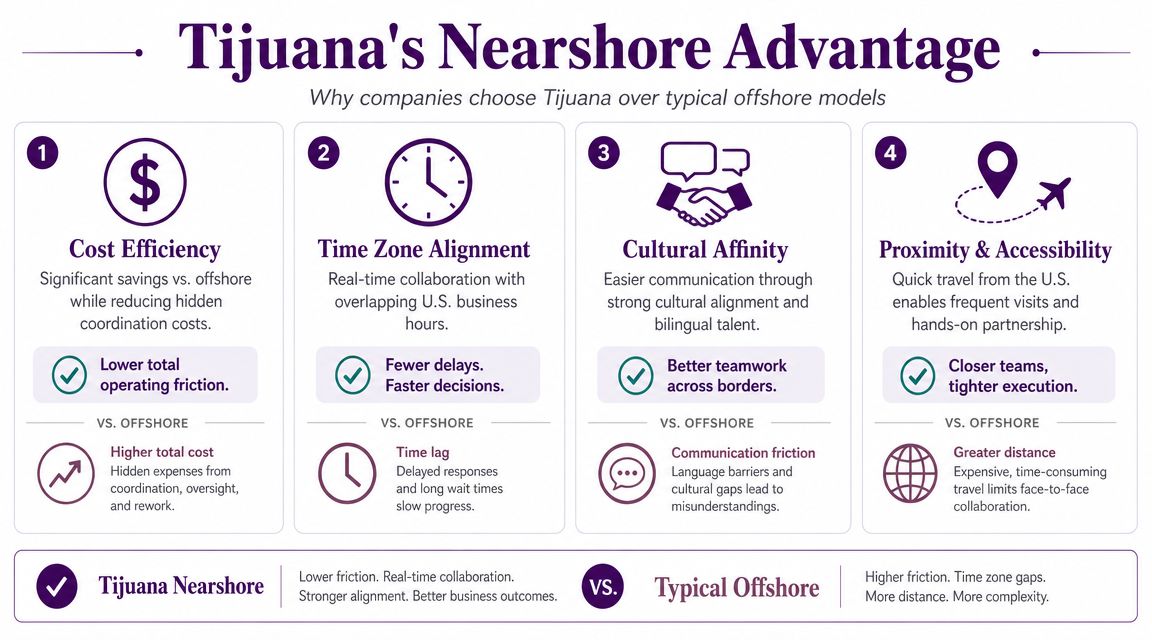
Why nearshore beats distant handoffs
One industry analysis notes that nearshore outsourcing to Tijuana can reduce operating costs by 30% to 50% compared with U.S.-based operations, driven by lower labor and infrastructure expense rather than weaker service quality, and it also highlights modern platforms such as cloud systems, redundant power, fiber connectivity, CRM integration, and AI-driven analytics tools in many sites (industry analysis on Tijuana support operations).
That combination changes daily execution. Supervisors can review call trends in real time. Client-side managers can join calibrations without overnight scheduling friction. Training updates don’t sit in a queue waiting for the other side of the world to come online.
For companies evaluating the ideal location for nearshore call center services, Tijuana is attractive because geography directly improves management rhythm.
What this looks like in practice
Consider a California retailer preparing for a product launch. Marketing pushes traffic faster than forecasted. Order-status contacts spike. A returns policy update needs to be rolled into live scripts, QA forms, and CRM macros the same day.
A nearshore team in Tijuana can handle that kind of change with less delay because operations, training, and client stakeholders can work in the same business window. That doesn’t guarantee excellence by itself, but it removes a common source of friction.
Here’s a simple comparison:
| Operating factor | Nearshore Tijuana model | Typical distant offshore model |
|---|---|---|
| Business-hour overlap | Strong overlap with U.S. hours | Often limited |
| Leadership access | Easier live oversight and visits | More planning required |
| Script changes | Faster same-day collaboration | More handoff delay |
| Customer tone | Often better aligned for North American interactions | Varies by provider |
The location advantage isn’t only about being closer. It’s about making service management easier on ordinary Tuesdays, not just during crises.
Unlocking a World-Class Bilingual and Bicultural Talent Pool
The first concern many buyers have is simple. If the cost is lower, does the talent get weaker?
In Tijuana, that’s the wrong frame. The more useful question is whether the workforce can handle North American customer expectations with the right mix of language skill, cultural fluency, and operational discipline.
Why bilingual matters less than bicultural fit
A bilingual agent can translate. A bicultural agent can interpret tone, context, urgency, and expectations.
That difference shows up every day. An e-commerce customer from Texas asking where an order is doesn’t want a technically correct answer that feels cold or robotic. A Medicare caller or insurance member may need patience, clear sequencing, and reassurance in the style they’re used to hearing. The same applies to collections, reservations, technical troubleshooting, and retention conversations.
A KPBS report notes that Tijuana’s call center market is a significant employer for English-speaking workers, including deportees who find stable work because of their language skills, which contributes to a resilient and often bicultural talent pool for North American support (KPBS reporting on Tijuana call center employment).
That labor dynamic matters because it produces agents who often understand both sides of the interaction. Not just the words, but the customer mindset.
What strong operators look for in hiring
If you’re evaluating a provider, ask how they assess more than spoken English. Solid hiring processes usually test for:
- Listening accuracy: Can the agent catch implied needs, not just stated ones?
- Tone control: Can they sound calm, natural, and brand-appropriate across tough calls?
- Context switching: Can they move between English and Spanish without losing clarity?
- Process discipline: Can they follow CRM notes, escalation rules, and documentation standards while still sounding human?
If you’re thinking more broadly about your nearshore hiring solution, that’s the right lens. Talent quality isn’t just about access to bilingual resumes. It’s about recruiting people who can protect customer trust under pressure.
For companies that need live voice support, chat, and back-office coverage in both languages, a bilingual call center in Mexico is often the better strategic fit than a single-language model patched together with translation support.
Practical rule: Don’t buy “English-speaking.” Buy customer-ready communication.
Core Services and Industry-Specific Solutions
A tijuana call center should be able to do more than answer phones. True value emerges when the provider can support the exact customer journey your business runs every day.
That usually means a mix of frontline service, revenue support, and process work behind the scenes.
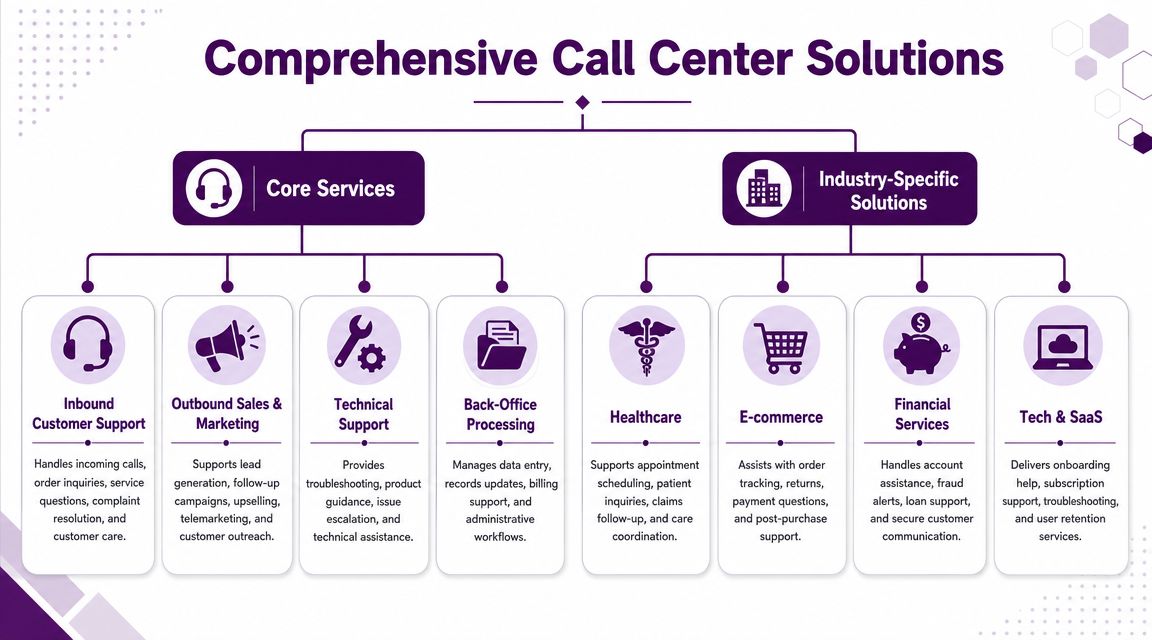
Core service lines that matter
A capable partner typically covers several operating lanes at once:
- Inbound customer support for order questions, account updates, billing help, reservation changes, and general service issues.
- Outbound programs for lead follow-up, appointment setting, win-back outreach, surveys, and collections.
- Technical support for troubleshooting, help desk workflows, password resets, and product guidance.
- Back-office processing for data entry, documentation review, ticket cleanup, and workflow administration.
If you’re comparing providers, then nearshore call center services should be evaluated in relation to your actual operation, not as a generic menu.
Industry examples that make the model real
A few examples show how this works better than abstract feature lists.
E-commerce
Holiday promotions create fast-moving contact spikes. Customers ask about shipping timelines, exchanges, partial refunds, and damaged orders. A trained inbound team can manage those queues while a back-office group updates order records and exception cases in the CRM.
Healthcare support environments
Healthcare programs often need careful call handling, identity verification, appointment coordination, and escalation routing. The requirement isn’t just friendliness. It’s consistency, documentation, and process control.
Financial services and insurance
These programs usually need agents who can stay compliant with scripts, explain next steps clearly, and document interactions accurately. A bilingual team helps when customers switch languages mid-call, which happens often in real life.
Tech and SaaS
Product support teams need agents who can work from knowledge bases, ticketing systems, and escalation trees without sounding scripted. Good providers train agents to narrow issues, log clean notes, and hand off to tier-two teams without dropping context.
One option in this category is CallZent, which provides bilingual inbound, outbound, technical support, and back-office services from Tijuana. For buyers, the useful question isn’t whether a vendor offers many services. It’s whether those services fit your systems, your call types, and your customer standards.
What doesn’t work
A broad service list means very little if the provider can’t connect it to operations. Be cautious when you hear vague promises such as “full support coverage” with no detail on:
- Queue ownership
- Escalation paths
- Training depth
- CRM workflow familiarity
- QA process by channel
A smaller scope executed well beats a giant service catalog held together by improvisation.
Your Framework for Selecting the Right Tijuana Partner
Choosing a tijuana call center on price alone is where many outsourcing projects go sideways. The sales deck looks polished. The labor rate looks attractive. Then the launch struggles because the fundamentals were never vetted.
The biggest hidden issue is usually talent stability. LA Times reporting notes that Tijuana’s call center industry grew from roughly 10 to more than 60 centers over two decades, increasing competition for skilled English-speaking agents and making retention harder. That makes turnover management a serious buyer concern, not a footnote (LA Times reporting on Tijuana call center retention pressure).
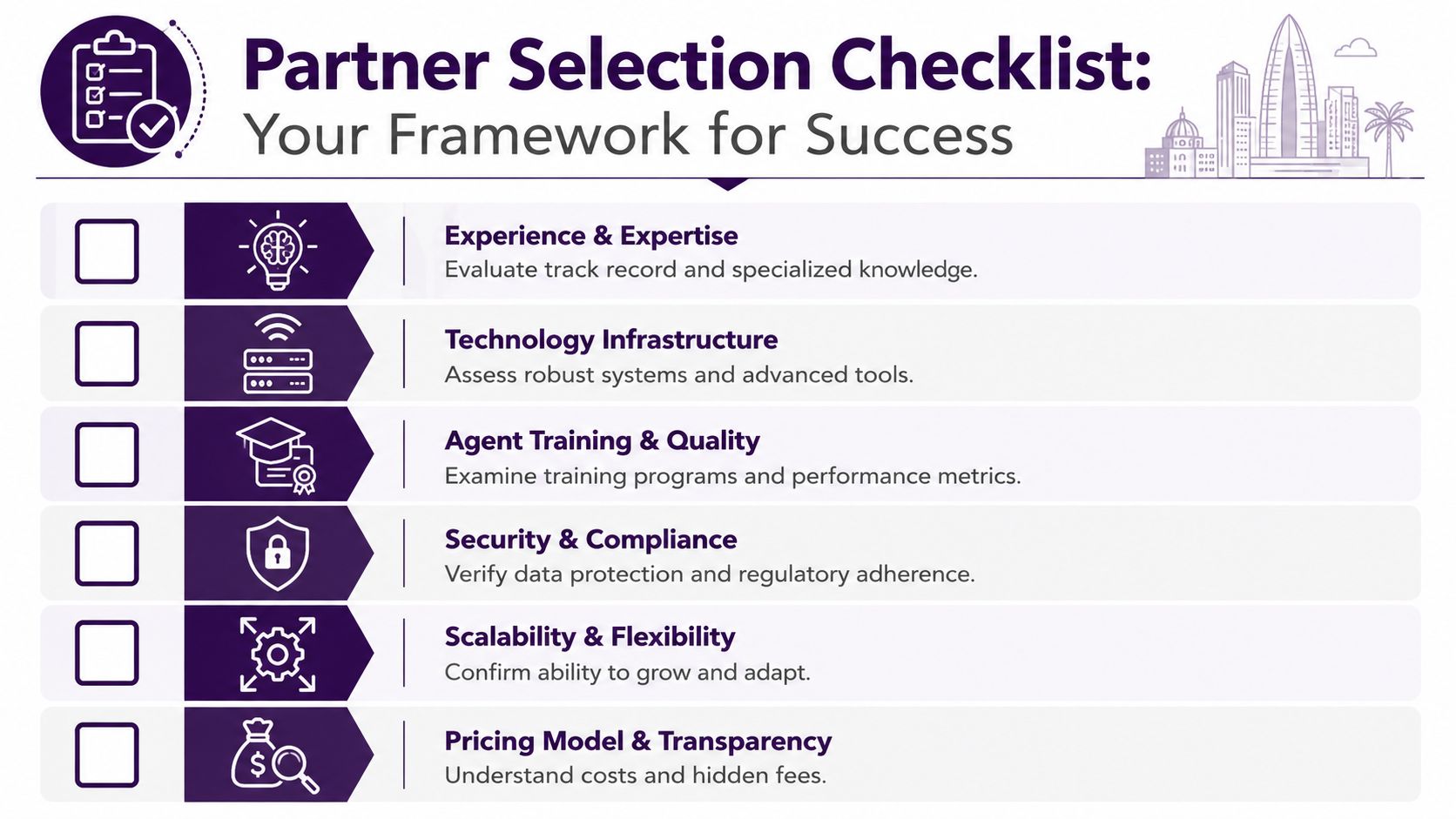
The questions serious buyers ask
Use this checklist when evaluating providers. If a partner gets vague, treat that as useful information.
-
How do you retain agents on mature programs?
Ask about tenure on comparable accounts, internal mobility, scheduling practices, supervisor ratios, and how they reduce burnout. -
What does training look like before launch and after launch?
Good partners separate product training, systems training, call handling, and QA calibration. If all of that gets bundled into “agent onboarding,” push deeper. -
What technology is standard in your environment?
You want specifics. CRM integration, cloud telephony, reporting access, recording, QA workflows, and business continuity planning should all be discussed plainly. -
How do you handle security and regulated workflows?
Especially in healthcare, insurance, and finance, a provider should explain controls, access permissions, and audit discipline without dodging.
Red flags that deserve attention
Not every risk is technical. Some are cultural.
| What to ask | Strong answer sounds like | Weak answer sounds like |
|---|---|---|
| Retention approach | Specific hiring and management practices | “Turnover is normal everywhere” |
| Reporting model | Defined cadence and ownership | “We can send updates as needed” |
| Escalations | Named path and response method | “Our team handles that internally” |
| Scalability | Clear recruiting and ramp process | “We’ll figure it out when volume grows” |
A practical short list should also include transparency, communication style, and whether the provider can work as an extension of your internal team. In this context, a structured process for finding and vetting call center outsourcing companies becomes useful.
Buyers often ask, “Can you staff this?” The better question is, “Can you staff it well and keep it stable?”
Onboarding and Measuring Success for High Performance
A strong launch doesn’t start with agents taking calls. It starts with operational clarity.
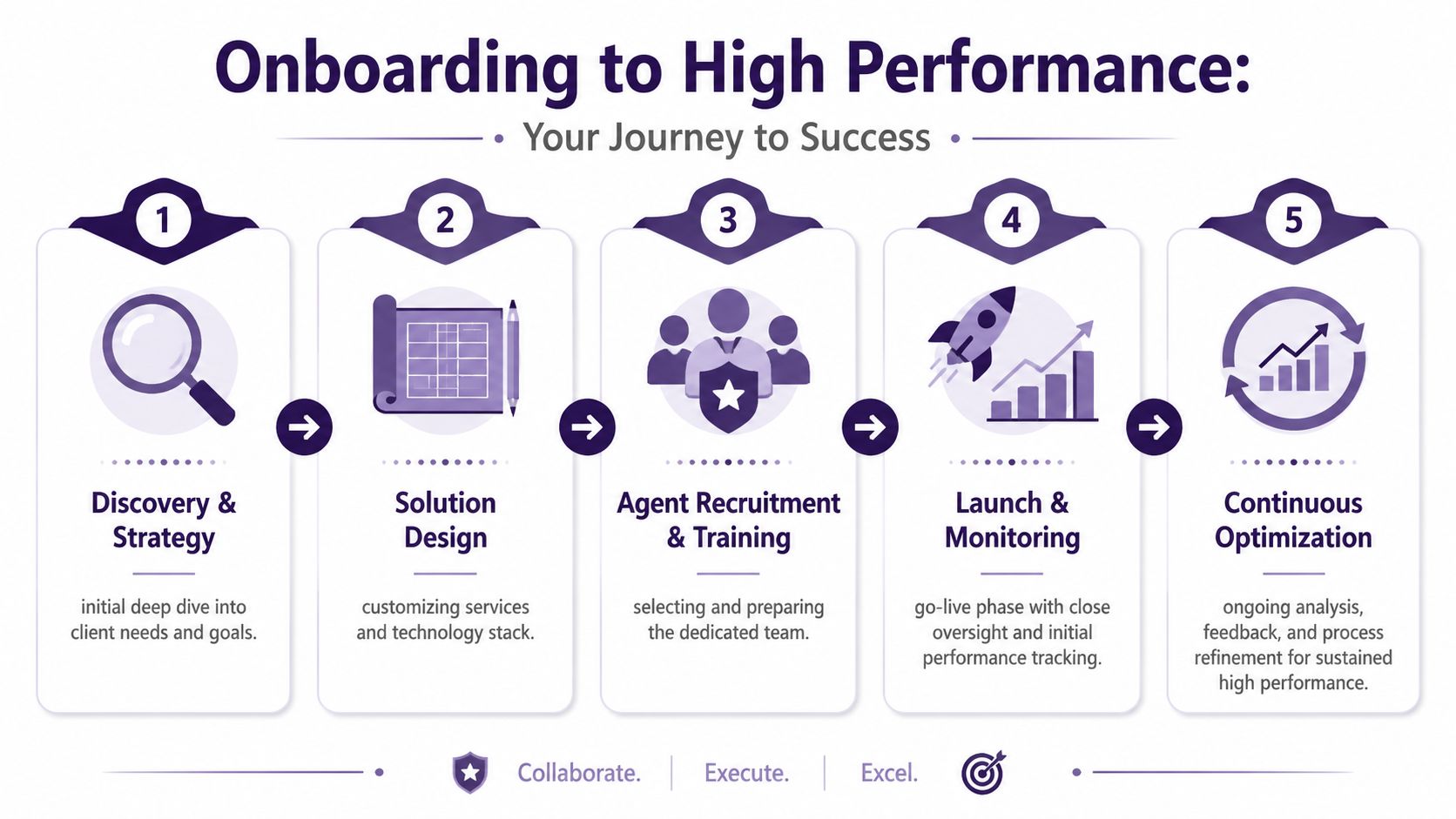
The handoff from selection to implementation is where good outsourcing decisions either become real or start drifting. The healthiest onboarding process is collaborative. Your internal team brings product knowledge, edge cases, and brand standards. The provider turns that into workflows, training paths, QA routines, and reporting.
What onboarding should actually include
A real implementation usually includes several moving parts at once:
-
Discovery and workflow mapping
Teams define call drivers, escalation rules, customer personas, and service boundaries. -
Systems setup
Agents need access to the right CRM views, ticketing tools, knowledge base articles, macros, and call flows. -
Training and nesting
New agents should practice in controlled conditions before full production. Shadowing, call review, and supervised live handling matter. -
Go-live monitoring
Early days should involve close QA review, fast coaching loops, and direct client contact for issue resolution.
The metrics that deserve executive attention
Not every KPI tells you whether the partnership is healthy. A few metrics tend to matter more because they connect service quality to business impact:
- Customer satisfaction
- First-call resolution
- Escalation rate
- Quality assurance scores
- Schedule adherence
- Backlog or response time by channel
Numbers alone don’t explain everything, but patterns do. If first-call resolution improves while escalation quality worsens, something is off. If customer satisfaction dips after a policy change, training or scripting may be the issue rather than staffing.
A provider should also show how customer complaints are captured, categorized, and acted on. If your team wants a practical external reference, this guide for managing customer feedback is useful because it focuses on response handling rather than vague service theory.
Good outsourcing doesn’t remove your visibility. It should give you better visibility than you had before.
Frequently Asked Questions About Tijuana Call Centers
How does pricing usually work with a tijuana call center
Pricing usually comes down to one question first. Are you building a true extension of your team, or buying flexible coverage for a narrower task?
A dedicated team assigns agents to your account and fits programs with specialized workflows, stricter compliance requirements, or a customer experience that directly affects retention and revenue. A shared team fits simpler support queues, overflow coverage, after-hours handling, or lower and less predictable volume. The better choice depends on process complexity, forecast stability, ramp speed, and how closely you want to control training, QA, and day-to-day management.
In practice, serious buyers should look past the hourly rate. The actual cost sits in turnover, ramp time, rework, escalations, and how much management attention the program requires from your side.
How do providers handle security and compliance
Strong providers explain security at the process level.
Ask who can access customer data, how credentials are issued and removed, what device restrictions are in place, how recordings are stored, how screens are monitored, and what happens when an incident is reported. If your operation touches healthcare, financial data, insurance claims, or other regulated workflows, bring those requirements into the first evaluation calls. Waiting until implementation usually creates delays, scope changes, or a failed launch.
A capable partner should also be clear about what they can support today and what would require added controls.
Is quality comparable to U.S. support teams
Yes, if the operator has the right hiring profile, floor management, QA discipline, and client oversight.
Geography does not determine quality. Operating model does. Tijuana gives companies a practical advantage because teams can support North American customers with strong English fluency, cultural familiarity, and working-hour alignment that makes coaching, calibration, and issue resolution easier. That creates better conditions for quality, but it does not guarantee it.
I have seen Tijuana teams outperform domestic programs when the client treated the site as part of its service operation instead of an outsourced side function. Clear SOPs, fast feedback loops, and shared accountability usually matter more than zip code.
What industries tend to benefit most
Tijuana works well for companies that need bilingual support, close operating visibility, and room to scale without losing control.
That includes e-commerce, SaaS, healthcare support environments, telecom, financial services, insurance, travel and reservations, and back-office programs tied to customer service. The common thread is not industry alone. It is the need for speed, consistency, and a team that can represent the brand well across voice, chat, email, and admin work.
What should I ask in the first serious meeting
Use the first real conversation to test operational maturity, not sales polish.
- How do you recruit and retain English-speaking agents for programs like mine?
- What does training look like before agents handle live customer contacts?
- How do you score quality, manage escalations, and report trends back to clients?
- Which CRMs, ticketing tools, and phone systems can your team work in now?
- What changes when I need to scale from a pilot to a larger production team?
The answers should be specific. Vague claims about culture, flexibility, or experience are not enough.
If you’re evaluating a nearshore partner and want a practical conversation about bilingual support, back-office operations, or scalable customer service in Tijuana, CallZent is one option to review. Their site outlines service coverage, operating model, and how a Tijuana-based team can support North American businesses that need quality, flexibility, and close collaboration.