Skip to content
CALL CENTER OPERATIONS
Call Center Agents Guide
for Business Growth and Better ROI
Learn how call center agents improve customer retention, operational efficiency, and revenue growth while comparing in-house and nearshore staffing models.
TL;DR — Quick Takeaways
- Call center agents are operational assets, not just phone operators. They directly affect retention, revenue, and customer trust.
- Modern agents handle far more than calls, including omnichannel support, CRM workflows, escalation management, and customer recovery.
- Specialization matters. Healthcare, insurance, e-commerce, technical support, and outbound sales all require different skill profiles.
- Nearshore call center models improve bilingual coverage, scalability, and operational flexibility for North American businesses.
Most companies say they care about customer experience. Fewer ask the harder question. Are their call center agents set up to protect revenue and build loyalty, or are they trapped in a system that turns every customer interaction into friction?
That gap matters more than most owners realize. A call center agent isn’t just someone who answers the phone. In practice, that person sits at the point where operations, sales, service, compliance, and brand reputation all meet. One poor interaction can trigger a refund, a cancellation, or a bad review. One strong interaction can save an account, recover an order, or create repeat business.
Business owners often treat agent staffing as a labor line item. That’s too narrow. The better view is operational. You’re deciding how quickly customers get answers, how accurately problems get solved, how well your team handles complexity, and whether your business can scale without service quality slipping.
Are Your Call Center Agents a Cost Center or a Growth Engine?
If your only goal is to answer more calls for less money, your call center agents will probably underperform.
That’s not because agents lack effort. It’s because the system around them usually forces the wrong behavior. Owners focus on queue coverage, basic scripts, and headcount. Meanwhile, customers judge the experience by speed, clarity, empathy, and whether the problem gets solved.
A strong agent operation contributes to growth in a few direct ways:
- It protects retention: customers stay when issues are handled cleanly
- It supports revenue: agents can recover abandoned sales, save churn-risk accounts, and spot upsell moments
- It reduces waste: better workflows mean less repetition, fewer transfers, and fewer preventable errors
- It strengthens the brand: customers remember the person who helped them when something went wrong
Why the old cost-center view breaks down
A basic support model often looks efficient on paper. It usually isn’t. Agents bounce between phone systems, CRM records, order screens, knowledge bases, and internal chat threads. Supervisors react to backlog instead of fixing root causes. Training gets compressed because operations are short-staffed.
That’s why many operators are rethinking systems, staffing models, and cloud-based tools for modern support teams that help agents work from one coordinated environment instead of five disconnected ones.
Practical rule: If your agents spend too much time searching, re-entering, waiting, or escalating, your business isn’t buying support. It’s buying avoidable friction.
The better question is whether your call center setup effectively supports growth. If it does, agents become part of your growth engine. If it doesn’t, every new customer adds more strain.
For owners trying to tighten margins without hurting service, this usually starts with workflow design, not just payroll. A useful next step is reviewing where money leaks from inefficient support operations and how to address it through smarter staffing and systems in this guide on how to reduce call center costs.
The main takeaway is simple: businesses that treat call center agents as strategic assets usually make better decisions about cost, service quality, and scale.
Defining the Modern Call Center Agent
The old stereotype is outdated. A modern call center agent isn’t just a person with a headset reading a script. The role now blends service, operations, software navigation, judgment, and communication under pressure.

In practical terms, agents usually fall into a few broad categories:
Inbound call center agents
Inbound agents handle customer-initiated conversations. That can include:
- Customer service: account questions, billing issues, order status, returns
- Technical support: troubleshooting devices, software, or login problems
- Reservation or scheduling support: bookings, changes, confirmations
- Escalation handling: calming frustrated customers and moving cases forward
A retail brand might rely on inbound agents during peak season to manage shipping delays and payment issues. A healthcare office may use them to confirm appointments and route urgent requests correctly. A software company may depend on them to diagnose user problems before sending a case to Tier 2 support.
Outbound call center agents
Outbound agents start the interaction. Their work is more proactive and often more commercially focused.
Common outbound responsibilities include:
- Lead follow-up
- Appointment reminders
- Win-back campaigns
- Payment collection outreach
- Customer feedback calls
The operational difference matters. Inbound work is reactive and queue-driven. Outbound work depends more on cadence, talk tracks, objection handling, and follow-through.
This is a large professional workforce
Call center work is a major labor category, not a niche job. Zippia’s call center agent demographics estimate that more than 272,688 call center agents are currently employed in the U.S. market, with 69.2% women and 30.8% men, and an average age of 40.
That tells owners something important. This is mature, professional work. It requires consistency, resilience, and process discipline. It also means staffing decisions affect a very real, very established labor market.
The businesses that get the most from call center agents usually define the job clearly before they hire for it.
If you’re refining role expectations, hiring criteria, or team structure, this breakdown of call center job descriptions for employers is useful because it separates generic support roles from the actual work agents perform.
Beyond General Support Agent Specializations
General support is only part of the picture. Many of the highest-value call center agents work in specialized roles where the conversation is tied to a process, a compliance requirement, or a revenue outcome.
A good example is healthcare and insurance. In those environments, the agent often acts less like a switchboard operator and more like a workflow coordinator. According to Commure’s overview of how AI agents are transforming the healthcare call center, call center agents are increasingly used as a workflow-orchestration layer. AI-assisted agents can automate appointment scheduling, insurance eligibility verification, and prior authorization follow-up, which reduces manual work and leaves human agents to handle empathy and escalation.
What specialization looks like in practice
A healthcare support agent may need to:
- verify eligibility information
- document details accurately
- route patients to the right department
- explain next steps without creating confusion
An insurance support agent may spend the day guiding policyholders through claim-related questions, collecting structured information, and keeping the interaction compliant.
An e-commerce sales agent has a different profile. That person needs speed, product familiarity, comfort with objections, and a good sense of when to save a sale versus when to resolve a complaint.
Why one-size-fits-all staffing fails
A common management mistake is using the same hiring profile and training plan for every queue. That usually creates avoidable errors.
For example:
- Technical support needs diagnosis and system logic
- Healthcare support needs accuracy, empathy, and workflow discipline
- Outbound sales needs persistence and conversational control
A specialized queue needs a specialized agent profile. If the work changes but the hiring rubric doesn’t, quality drops fast.
Role design matters more than slogans about service culture. Businesses with mixed support and outreach needs often split responsibilities across dedicated teams rather than asking one group to do everything. For companies planning proactive campaigns as part of that model, outbound call center agents deserve their own staffing and coaching approach.
Must-Have Skills and Key Performance Indicators
Most agent scorecards miss the point. They track outputs but ignore the conditions that produce them.
A call center agent is doing several things at once. As noted in CRMxchange’s discussion of the “four jobs at once” reality for agents, high performers are simultaneously managing the conversation, following a process, solving a problem, and operating a tech stack under pressure. That same piece notes that sites with 150 agents or fewer account for 95% of call centers worldwide, which is why system design and training matter so much in lean teams. You can review that perspective in the CRMxchange article on agent cognitive load.
Skills that actually matter
The best agents usually combine soft skills and execution skills.
- Listening under pressure: hearing what the customer means, not just what they say
- Process discipline: following the right steps without sounding robotic
- Problem-solving: deciding what can be fixed immediately and what needs escalation
- System fluency: moving through CRM, ticketing, telephony, and knowledge tools without losing the thread
- Written clarity: documenting the interaction so the next person doesn’t have to reconstruct it
- Emotional control: staying steady when the customer is upset
What doesn’t work is hiring only for friendliness. Friendly agents who can’t operate systems or follow process create expensive mistakes. The reverse also fails. Highly technical agents who can’t communicate clearly create avoidable friction.
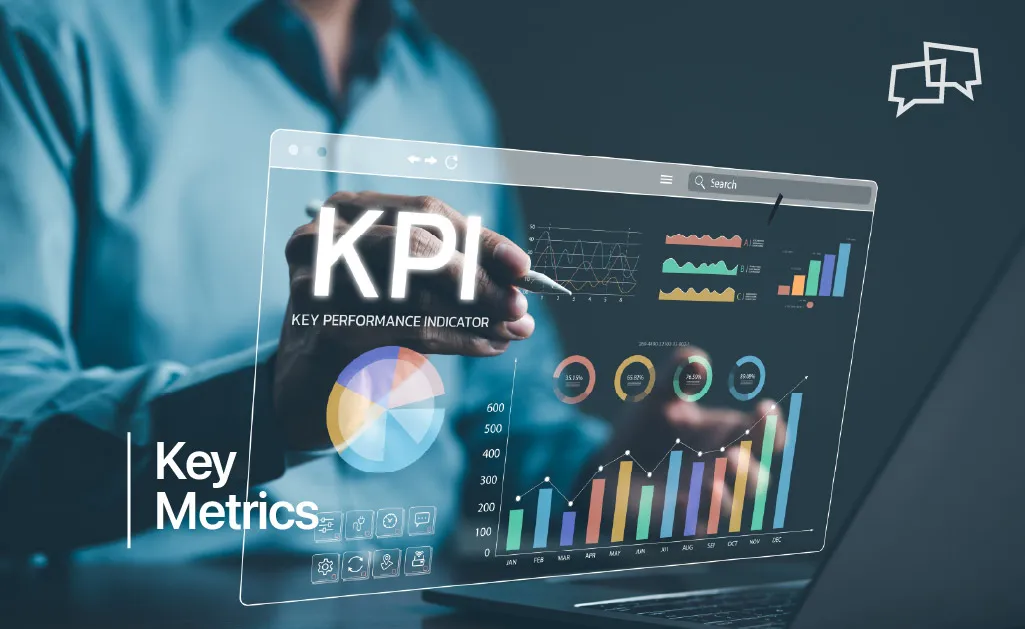
KPIs that help managers make better decisions
The most useful KPIs are diagnostic, not decorative.
| KPI | What it tells you | Common misuse |
|---|---|---|
| AHT | How long interactions take | Treating shorter calls as automatically better |
| FCR | Whether the issue was resolved the first time | Ignoring whether the resolution was actually correct |
| CSAT | How customers felt about the experience | Using it without context from QA and case complexity |
| QA score | Whether the agent followed standards | Turning QA into a script-compliance exercise |
| Escalation rate | How often agents need help | Penalizing escalations instead of analyzing root causes |
AHT is a good example. Lower handle time can mean efficiency. It can also mean agents are rushing, transferring, or ending calls before the issue is solved.
Operational note: A KPI only helps if it leads to a coaching decision, a workflow fix, or a staffing adjustment.
For managers building a more useful scorecard, this resource on KPIs in customer service can help connect metrics to day-to-day performance management.
Building and Retaining a World-Class Agent Team
Most companies don’t have an agent problem. They have a matching problem, an onboarding problem, and a career-path problem.
That distinction matters because attrition is expensive and disruptive. Teams lose knowledge, supervisors spend time rehiring, and customer consistency drops. Weak retention itself often signals that the role was poorly designed from the start.

EvaluAgent’s write-up on common call centre challenges makes a useful point here. High attrition is often tied to skills mismatch and weak emotional connection to the job. Retention improves when agents see stronger training and clearer career prospects. It also notes that productivity can rise by roughly 64% with tenure, which is exactly why stable teams create compounding operational value.
What works in hiring
The wrong hiring approach focuses too heavily on generic personality traits.
A better process screens for:
- Role fit: can this person handle the specific queue type?
- Learning speed: can they absorb systems and policy quickly?
- Communication judgment: can they explain clearly without overtalking?
- Stress tolerance: can they stay composed when the customer is tense?
If you’re hiring for bilingual service, test for actual working fluency in the situations the agent will face. Conversational fluency and service fluency aren’t always the same thing.
What works in onboarding and retention
Retention improves when the job feels structured, teachable, and worth staying in.
Here are the practices that consistently help:
- Clear ramp plans: agents should know what good performance looks like in the first weeks and months
- Useful QA feedback: coaching should point to specific behaviors, not vague reminders to “do better”
- Visible progression: senior agent, QA, trainer, team lead, and specialist paths keep strong people engaged
- Recognition tied to real work: praise quality, judgment, and improvement. Not just speed
- Manager accessibility: agents stay longer when supervisors help remove friction instead of only enforcing metrics
Some businesses also improve retention by redesigning repetitive queues so agents handle fewer low-value tasks and more meaningful exception work. That’s often where automation helps most. It removes routine clutter and makes the human role more sustainable.
Don’t wait for attrition to show up in a dashboard. You can usually see it earlier in attendance patterns, QA drift, repeat errors, and disengaged coaching sessions.
In-House vs Nearshore A Strategic Business Decision
Choosing between in-house and nearshore staffing isn’t just a budget decision. It affects control, hiring speed, language coverage, management load, and how resilient your operation is when demand changes.
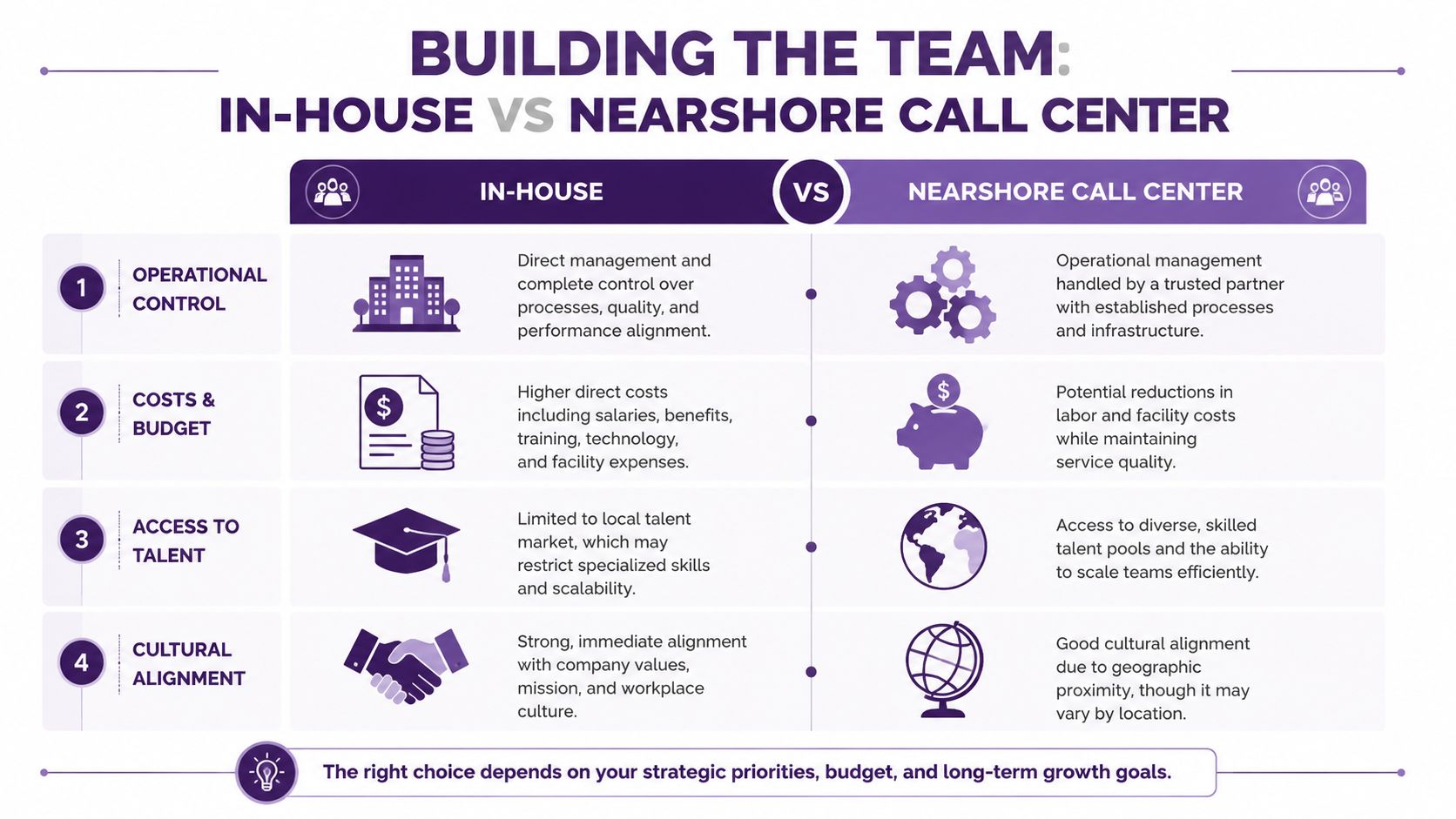
A lot of owners start with in-house because it feels safer. You control the team directly, shape the culture internally, and keep operations close. That can work well for small, highly specialized teams or for businesses with unusual compliance or product complexity.
The trade-off is management burden. You own recruiting, training, scheduling, retention, coverage gaps, equipment, supervision, QA, and performance correction.
HiringBranch’s roundup of call center industry statistics highlights one major financial factor: replacing a departing call center agent can cost $10,000 to $20,000, and in-house teams often face annual attrition in the 30% to 45% range. That changes the math quickly. If your operation churns through agents, labor isn’t your only cost. Instability becomes a recurring expense.
Side-by-side decision view
| Decision factor | In-house model | Nearshore model |
|---|---|---|
| Direct control | Highest day-to-day control over staff and workflows | Shared control with provider-managed operations |
| Management overhead | Internal leaders carry full staffing and HR load | Provider handles much of recruiting, scheduling, and supervision |
| Bilingual hiring | Depends on local labor market | Often easier to access English-Spanish talent at scale |
| Scalability | Slower to ramp if hiring is tight | Faster to expand or contract service coverage |
| Cost predictability | More variable when turnover and infrastructure rise | Often easier to plan around service-level agreements |
When nearshore makes sense
Nearshore is usually the stronger model when a business needs:
- bilingual support for North America
- extended hours or round-the-clock coverage
- faster ramp capacity
- lower internal management burden
- more operational flexibility without building a full call center internally
For many U.S. companies, nearshore also solves a practical communication issue. Teams can collaborate in similar time zones, train in real time, and maintain tighter oversight than they often get with more distant offshore structures.
One example is a call center in the US support model that still needs Spanish-language coverage, overflow handling, or cost-efficient expansion. In that situation, a nearshore team can complement the domestic operation instead of replacing it.
This is also where one provider option may be relevant. CallZent operates as a bilingual nearshore call center and BPO from Tijuana, which fits companies that need English-Spanish support, proximity to the U.S. market, and outsourced operational management.
Nearshore isn’t automatically better than in-house. It’s better when your growth plan requires flexibility, bilingual staffing, and less internal friction.
Transform Your Customer Experience with the Right Partner
Call center agents influence far more than call volume. They affect retention, brand trust, workflow quality, and the day-to-day experience customers have with your business.
The companies that get strong results usually make a few disciplined choices. They define roles clearly. They hire for the actual work, not vague service traits. They use KPIs for coaching instead of punishment. They reduce repetitive effort with better systems. And they choose a staffing model that matches their growth plan.
That’s the shift. You stop treating call center agents as a necessary expense and start treating them as an operating asset.
If your current setup creates delays, inconsistency, or management drag, it may be time to redesign the model. For many businesses, that means combining stronger process design with bilingual support and a more scalable staffing structure. If you’re exploring that route, CallZent’s Bilingual Call Center Services are one practical place to start.
🚀 Scale Smarter With CallZent
CallZent helps North American businesses improve customer experience with bilingual nearshore call center agents, scalable support operations, and performance-driven workflow management.
Talk to an ExpertIf you want to evaluate whether in-house staffing, nearshore support, or a blended model fits your business, talk with CallZent. A focused review of your workflows, language needs, service hours, and growth targets can show where your current agent strategy is helping and where it’s holding you back.