Skip to content
CUSTOMER SUPPORT / BPO STRATEGY
Bilingual Call Center Guide
for US Businesses and Nearshore Growth
Learn how bilingual call centers help US businesses improve customer experience, increase retention, support Spanish-speaking customers, and scale efficiently with nearshore teams.
TL;DR — Quick Takeaways
- Bilingual call centers provide customer support in multiple languages, typically English and Spanish.
- Nearshore bilingual support offers a balance of affordability, quality, and time-zone alignment.
- Industries like healthcare, finance, telecom, and e-commerce benefit significantly from bilingual customer service.
- CallZent helps businesses scale bilingual customer support with nearshore teams and proven workflows.
Bilingual Call Center Services for U.S. Businesses
CallZent provides bilingual English-Spanish call center support for U.S. businesses that need scalable customer service without building an additional in-house team. Nearshore agents in Mexico can support customer interactions across phone, email, live chat, SMS, and other service channels while working within your existing workflows and systems.
Bilingual teams can support:
- Customer Service: Billing questions, account updates, order inquiries, returns, and general support.
- Technical Support: Troubleshooting, product assistance, ticket handling, and escalation.
- Sales & Lead Generation: Lead qualification, outbound follow-up, appointment setting, and sales support.
- After-Hours Support: Extended-hours, weekend, overflow, and 24/7 coverage.
- Back-Office Support: CRM updates, documentation, order processing, and administrative workflows.
Bilingual Support in Practice: Insurance Case Snapshot
A national insurance company partnered with CallZent for bilingual customer support focused on claims and policyholder updates. The program launched with 4 agents and scaled to 25 agents within six months.
CallZent reports that the program achieved a 32% reduction in handle time and a 27% improvement in customer satisfaction (CSAT), demonstrating how a properly trained bilingual team can scale while maintaining service quality and workflow consistency.
If a customer can buy from you in English but struggles to get help in Spanish, your business isn’t serving the full market it already reaches.
That gap is bigger than many leaders realize. The U.S. customer base is multilingual at scale, and customer service teams are under pressure to keep up with both language expectations and rising service complexity. At the same time, the broader contact-center technology market keeps advancing. The global CCaaS market is valued at $7.08 billion in 2025 and projected to reach $30.15 billion by 2034, according to federal call center industry data and market projections cited here. That matters because bilingual service is no longer just about having a few Spanish speakers on staff. It now depends on routing, reporting, workflow design, and staffing flexibility.
Is Your Business Truly Listening to All Its Customers
A lot of companies still treat bilingual support like an accommodation. That’s the wrong frame. For many North American businesses, it’s a revenue protection issue first and a growth opportunity second.
When customers can’t explain a billing issue, ask a technical question, or clarify an order in the language they’re most comfortable using, service quality drops fast. Not because your team lacks effort, but because the operating model was built for a narrower audience than the market you serve. That’s why many companies turn to a dedicated bilingual customer support model instead of trying to patch the issue with ad hoc interpreter use or occasional internal language help.
Why this matters in daily operations
The business impact usually shows up in ordinary interactions:
- A support queue gets longer because Spanish-speaking callers wait for the one available bilingual rep.
- Transfers multiply because the first agent can greet the customer but can’t complete the transaction.
- Documentation suffers because the conversation is bilingual but the workflow and CRM standards are not.
- Retention risk rises because customers remember friction more than they remember your intent.
Key takeaway: A bilingual call center isn’t a cost line to minimize. It’s a service design choice that affects retention, resolution quality, and how far your business can grow in North America.
The strongest operators don’t ask, “Do we have some bilingual capacity?” They ask, “Can we resolve the whole interaction, correctly, in the customer’s preferred language?”
What a Bilingual Call Center Is Really
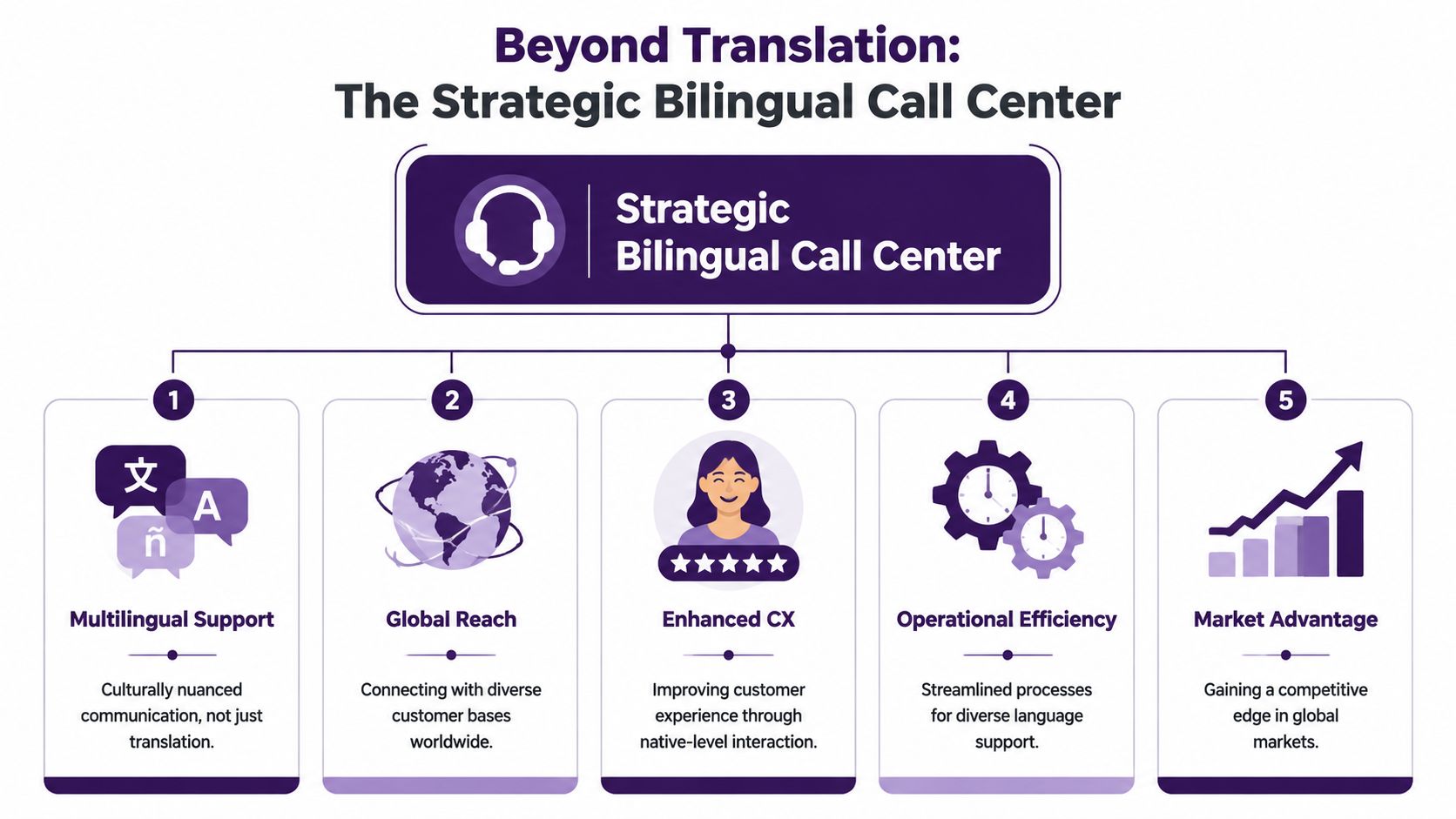
A bilingual call center involves more than a room full of agents who can switch between English and Spanish.
It’s a service operation designed so language support holds up under real demand, real compliance requirements, and real customer expectations. That means agent fluency, yes. It also means culturally aware communication, workflow training, QA standards for both languages, and routing logic that sends the customer to the right person before frustration builds.
In the United States, that capability is foundational. There are at least 41 million native Spanish speakers plus 12 million additional bilingual speakers in the U.S. Yet 86% of contact centers report serving non-English-speaking customers, while only 66% have formal support options in another language, according to this bilingual support market overview.
Language skill is only one layer
A practical bilingual operation needs several parts working together:
- Native or near-native communication: Customers hear confidence, not hesitation. That matters in escalations, refunds, technical troubleshooting, and payment discussions.
- Cultural fluency: Words can be translated, but tone, expectations, and trust signals are often cultural.
- Operational fit: Agents must know how to verify accounts, document cases, use scripts appropriately, and close the interaction without bouncing the customer elsewhere.
- Routing discipline: If your IVR, skills mapping, and queue priorities are weak, good bilingual agents still get used badly.
What weak setups get wrong
Many teams make one of two mistakes.
First, they overestimate what “bilingual” means. A rep may speak conversational Spanish but still struggle with policy language, technical terms, or written CRM notes.
Second, they assume language alone fixes CX. It doesn’t. A customer wants resolution, not just comprehension.
The goal isn’t translation. The goal is accurate, confident resolution in the customer’s preferred language.
That’s why a strong bilingual call center often performs best when leadership treats it as a specialized operation, not a side capability tucked into a general queue.
Onshore vs Nearshore vs Offshore Models Explained
When companies compare service models, they usually start with hourly cost. That’s understandable, but it’s not enough. A bilingual program has to be judged on what it costs to run well, not what it costs to launch.
For North American businesses, the decision usually comes down to four factors: labor cost, language depth, time zone overlap, and cultural alignment. Those factors affect response quality every day, especially when calls involve verification, troubleshooting, payments, renewals, or complaint handling.
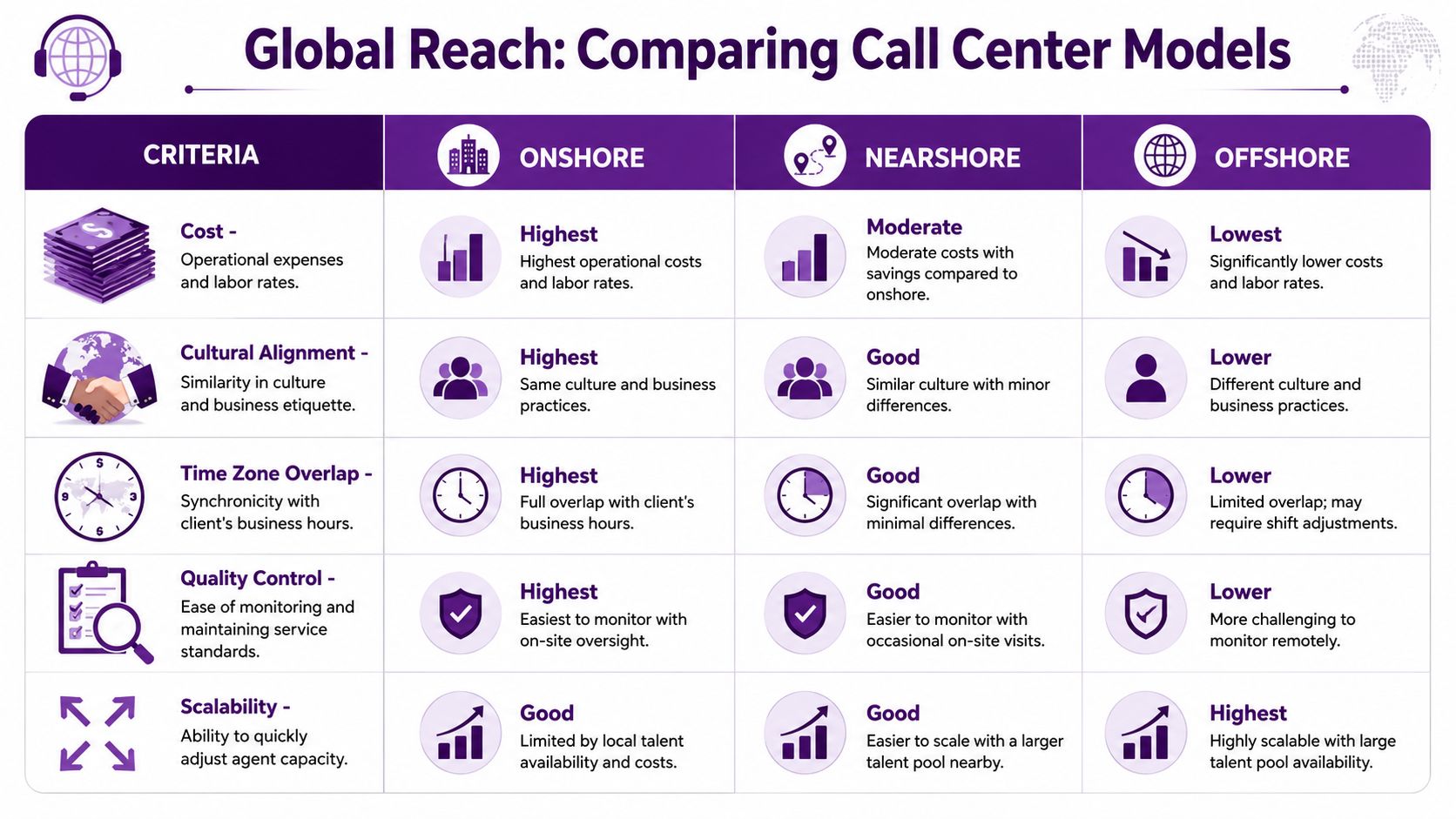
How the three models differ in practice
| Model | Best fit | Main strength | Main trade-off |
|---|---|---|---|
| Onshore | Brands that need domestic staffing for internal, regulatory, or brand reasons | Tight market familiarity | Higher labor cost |
| Nearshore | North American companies serving English and Spanish customers | Balance of cost, alignment, and collaboration | Requires careful vendor selection |
| Offshore | High-volume programs where lowest price is the top priority | Lower direct labor cost | More risk around time zones, communication style, and process nuance |
Nearshore tends to be the sweet spot when the customer journey includes more than basic call handling. A bilingual agent handling a loan inquiry, an insurance update, or a technical support escalation has to do more than speak clearly. They need to understand customer expectations, de-escalate naturally, and move through the workflow without avoidable friction.
That’s where quality gets won or lost. As noted in this hiring example for bilingual customer service work, the role often includes complex work such as account verification and troubleshooting, not simple language relay. In other words, the operating challenge is not vocabulary. It’s execution.
Why nearshore often creates better value
For U.S. and Canadian companies, nearshore support usually offers three practical advantages:
- Closer collaboration: Teams can train, calibrate, and solve issues during the same business day.
- Better cultural read: Agents are often more comfortable with U.S. service norms, bilingual switching, and cross-border customer expectations.
- Lower friction in management: QA reviews, coaching sessions, and schedule adjustments are easier when the operation works in aligned time zones.
A Tijuana-based model is a good example of this middle ground. It gives companies access to bilingual talent close to the U.S. market without forcing them into the cost structure of a fully domestic team. For a broader framework, this guide to nearshore vs offshore outsourcing costs risks and ROI is useful when you’re weighing long-term operating value rather than headline rates.
Staffing flexibility also matters more than many buyers expect. Seasonal peaks, promotions, claim events, and service disruptions can shift language demand quickly. If you want a clear explanation of why flexible capacity planning matters operationally, Fluidwave’s flexible staffing insights are worth reviewing.
A cheap bilingual queue becomes expensive when transfers rise, QA slips, and supervisors spend their day correcting avoidable errors.
Core Services and Key Performance Indicators
A bilingual call center creates value when language capability is tied to actual service lines, not parked in a separate bucket.
That usually starts with core functions your customers already need help with: order status, billing questions, technical support, appointment setting, renewals, returns, collections, and outbound follow-up. The language layer matters because each of those interactions has a different risk profile. Some need empathy. Some need precision. Some need speed. Most need all three.

Where bilingual service makes the biggest difference
A few examples show the difference between basic language access and real operational value:
- Inbound customer care: A caller asks about a shipment delay. A bilingual agent can explain status, update the address, document the issue, and prevent a repeat contact.
- Technical support: A customer describes a device issue in Spanish but understands product labels in English. The agent must move smoothly between both without losing accuracy.
- Outbound sales or retention: A rep can build rapport faster when they understand both language and tone. That often matters more than a script.
- Collections and payment support: Sensitive conversations go better when the customer fully understands options, commitments, and next steps.
The KPIs that actually tell you if it’s working
Most programs track the usual contact center metrics, but bilingual operations should pay close attention to a few that expose execution quality:
- First Call Resolution: Did the agent solve the issue without another contact or transfer?
- Customer Satisfaction: Did the customer leave the interaction feeling heard and helped?
- Transfer rate: Are calls reaching the right language-skilled resource first?
- Documentation accuracy: Did the rep capture the details clearly for the next workflow step?
- Queue performance by language: Are Spanish interactions getting the same operational attention as English ones?
Workforce data shows bilingual roles require more than conversational skill. Employers commonly look for fluency in written and spoken English plus a second language, CRM navigation, and the ability to manage records across multiple systems while meeting FCR and CSAT targets, as described in this bilingual call center job profile. That’s why the right team tends to improve outcomes beyond the language itself.
If you want a deeper framework for measuring service performance, this breakdown of KPIs in customer service gives a practical view of which metrics deserve executive attention.
Practical rule: If your bilingual agents can talk well but can’t document, navigate systems, and close the loop, your KPIs will expose it quickly.
Which Industries Benefit Most from a Bilingual Call Center
Some sectors get incremental value from bilingual support. Others depend on it to avoid operational mistakes, compliance exposure, or lost revenue.
Healthcare is the clearest example. A patient calls to confirm an appointment, clarify a referral, or understand a coverage issue. If language support is slow or awkward, the problem isn’t just customer frustration. It can disrupt care access and create compliance pressure. CMS requires interpreters to be available within 8 minutes of a caller reaching a CSR, according to CMS call center monitoring guidance. That requirement changes how a healthcare support team has to staff, route, and monitor calls.
Healthcare and insurance
In healthcare, a bilingual operation has to do more than answer politely. The agent may need to verify identity, explain next steps, document the case correctly, and know when to escalate.
For insurance, the same principle applies. Policy language, billing details, and claims explanations are not simple “yes or no” conversations. Customers need clarity, and the business needs accuracy.
E-commerce and retail
An online store may think bilingual support only matters after the sale. In practice, it influences the entire funnel.
A Spanish-speaking shopper might ask about product fit before ordering, call about a failed payment, or need help with a return. If the interaction feels clumsy, the customer may abandon the purchase or never come back. If it feels natural, the service team becomes part of retention.
Finance and collections
Finance teams see the stakes quickly because trust and precision are central to the interaction.
A customer discussing a balance, payment arrangement, or loan question needs exact language, not a rough translation. The agent has to explain terms clearly, verify identity, and keep records clean. That’s one reason bilingual support in finance usually performs better when the operation is built around process discipline, not just language coverage.
Telecom and technical services
Telecom, utilities, and tech support environments often deal with high-contact issues under time pressure.
In those queues, bilingual capability reduces confusion during troubleshooting. It also lowers the chance that a customer repeats the problem to multiple agents because the first conversation wasn’t fully understood.
The industries that benefit most from a bilingual call center are usually the ones where misunderstanding is expensive.
Your Vendor Selection Checklist
Choosing a bilingual partner gets easier when you stop asking only, “What’s the rate?” and start asking, “How does this team prevent service failures?”
A strong vendor should be able to explain how they recruit, validate, route, coach, and scale bilingual talent. If the answers stay vague, the risk is high. Language support breaks down in operations through small failures, not dramatic ones. An untested agent. A queue without language prioritization. A surge plan that exists only on paper.
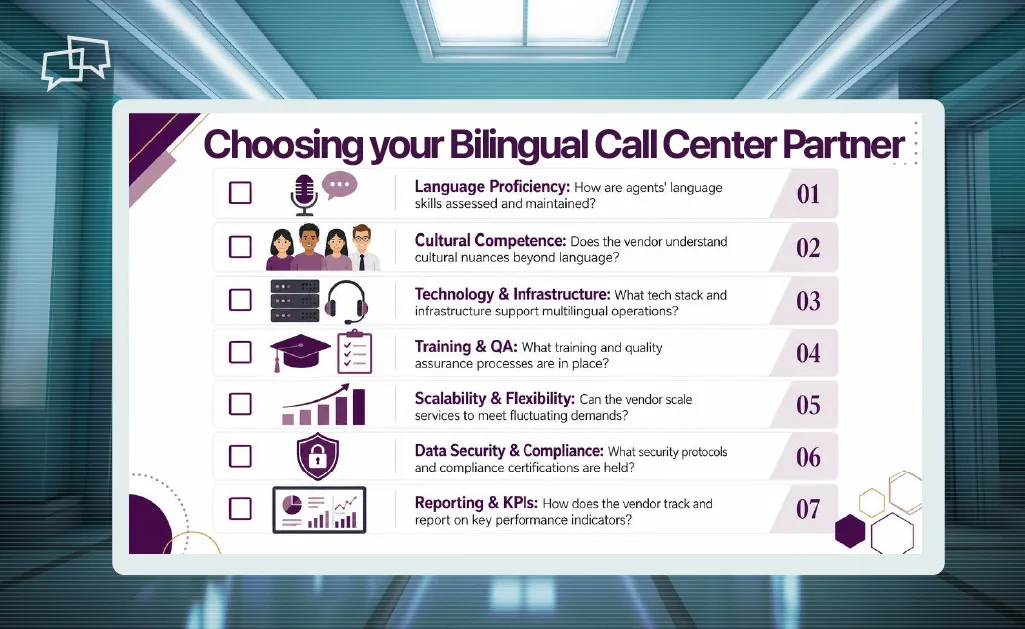
Questions worth asking before you sign
- How do you test language proficiency? Ask whether the vendor measures spoken and written skill separately, and how often revalidation happens.
- How do you train for process accuracy? Fluency is not enough. Agents need workflow training for the exact transactions they’ll handle.
- What routing tools do you use? Skills-based routing, queue segmentation, and escalation rules matter in bilingual environments.
- How do you handle language spikes? This is one of the most overlooked questions.
- How do you report by language? You want visibility into service levels, QA, and outcomes for English and Spanish separately.
- What security and compliance controls are in place? Especially important in healthcare, finance, insurance, and payments.
- How involved can our team be? Good partnerships allow calibration, feedback loops, and operating transparency.
A key stress test is surge handling. An advanced operation can route overflow traffic to a live interpreter platform within seconds and bridge it back to an agent, as described in this overview of bilingual overflow handling. That doesn’t replace a core bilingual team, but it can protect service levels when demand by language shifts unexpectedly.
What a good answer sounds like
Look for specifics, not slogans.
A credible vendor will talk about QA forms in both languages, calibration routines, queue thresholds, interpreter escalation logic, and how supervisors monitor performance by language group. They should also be comfortable discussing what they don’t handle well.
If you’re building a shortlist, this guide on how to find and vet the best call center outsourcing companies can help structure your evaluation.
One practical option in the nearshore category is CallZent’s Mexican call center for scalable bilingual support, which reflects the type of cross-border operating model many North American companies evaluate when they want bilingual capacity with close time zone alignment.
Engaging a Bilingual Partner Like CallZent
A bilingual call center should be evaluated as a growth system, not just a staffing line.
The right partner helps you serve more of the market you already reach, protect quality in high-stakes interactions, and scale without adding unnecessary friction between your team and your customers. For many U.S. businesses, the nearshore model is the practical balance. It supports cost control, but it also gives you stronger alignment on language, culture, and day-to-day collaboration than a purely price-driven offshore setup.
The smartest buyer mindset is simple. Don’t ask which vendor can answer in two languages. Ask which vendor can resolve customer issues accurately, consistently, and at scale in the languages your market uses.
If you’re evaluating options, compare operating models carefully, test how each provider handles complexity, and make sure reporting, QA, and overflow planning are part of the conversation from the start.
🚀 Expand Your Reach with Bilingual Customer Support
Discover how CallZent’s nearshore bilingual call center solutions help businesses improve customer experience, reduce costs, and scale efficiently.
Talk to an ExpertIf you want to explore a nearshore bilingual support model in more detail, visit CallZent to review services and start a conversation about your customer mix, workflows, and coverage needs.