Skip to content

INSURANCE CUSTOMER EXPERIENCE
Insurance Customer Service: A Practical Guide for 2026
Insurance customer service improves claims, billing, retention, and trust through omnichannel support, bilingual teams, strong QA, and compliant workflows.
TL;DR — Quick Takeaways
- Insurance customer service must handle claims, billing, policy changes, complaints, renewals, and trust—not simply answer routine questions.
- Digital intake works well for simple transactions, but human escalation remains essential for emotional, disputed, regulated, and complex cases.
- The most important metrics include CSAT, NPS, first-contact resolution, speed, quality assurance, complaint volume, and policyholder retention.
- Bilingual nearshore support can reduce language friction when it is built around training, intelligent routing, clear ownership, and complete context transfer.
Insurance customer service is no longer a “nice to have.” In this market, service quality decides whether a policyholder stays, complains, or leaves the minute something goes wrong. When CX leaders in insurance beat competitors in total shareholder return by 20% for life insurers and 65% for property and casualty insurers between 2017 and 2022 (McKinsey summary via InMoment), the message is blunt, service is a financial lever.
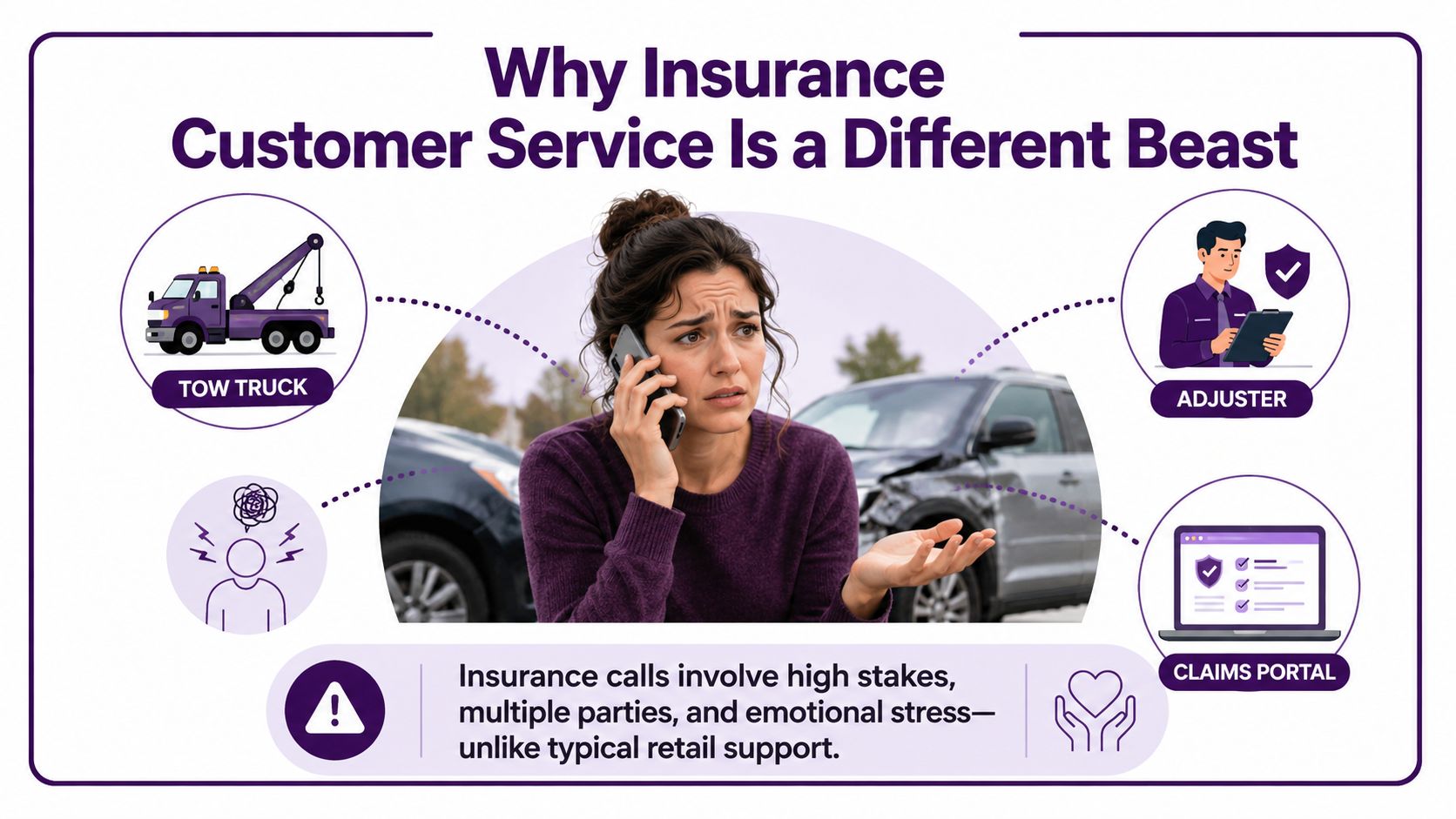
Why Insurance Customer Service Is a Different Beast
A policyholder calls after a fender bender. The tow truck is late. The adjuster wants photos. The claims portal is asking for a document the customer can’t find. That one call carries operational, emotional, and financial weight that retail support never sees, because insurance service sits inside a live loss event, not a simple product question.
That’s why generic CX advice fails here. Insurance customer service has to protect the relationship, move the claim, and keep the carrier out of trouble at the same time. McKinsey’s insurance research, summarized by InMoment, shows why this work matters at the board level, not just the contact center, with CX leaders outperforming peers on shareholder return and about 1 in 6 customers saying insurers didn’t follow up after an initial discussion (InMoment summary of McKinsey).
The practitioner’s playbook starts with the right definition
The rest of this article does four jobs. It defines the discipline clearly. It separates the right channels from the wrong ones. It picks the KPIs that move retention. And it shows the operating model that keeps service from collapsing under pressure.
Practical rule: If your service process can’t handle a claim, a billing issue, and a language handoff without losing context, it isn’t customer service, it’s fragmentation with a phone number.
A carrier can’t fake continuity. McKinsey also found that 20% of customers would switch insurers if their adviser left, which tells you how fragile trust really is in this space (InMoment summary of McKinsey). Human agents and advisers still rate highest for satisfaction, so service isn’t just about speed. It’s about memory, ownership, and calm under stress.
The core claim is simple, service quality in insurance is now a financial lever, not a soft metric.
Defining Insurance Customer Service and Its Real Scope
Insurance customer service covers every interaction that helps a policyholder understand, maintain, and use coverage. That includes quoting questions, underwriting follow-up, billing, endorsements, claims FNOL, claim status, renewals, complaints, and the handoff between a carrier, a broker, and an adjuster. If your team only thinks about “support tickets,” it’s already missing half the job.
Policy lifecycle, not just problem solving
The cleanest way to define the work is by lifecycle stage. Before the policy, service explains eligibility and coverage. During the policy, service handles changes, payments, and account updates. During a loss, service becomes triage, reassurance, and next-step coordination.
That’s why insurance customer service is partly information work and partly emotional reassurance. The customer isn’t only asking, “What happens now?” They’re asking, “Am I covered, who owns this, and will anyone call me back?” The trust issue is real, because roughly 1 in 6 customers reported no follow-up after an initial conversation in the insurance CX research summarized by InMoment (InMoment).
Regulatory exposure changes the rules
Insurance isn’t like a subscription app where a slow reply just annoys the user. A missed response can trigger complaints, delay a claim, or create a compliance headache. That means service teams need tight documentation, clear disclosures, and discipline around handoffs.
If you want a practical model, think of three layers:
- Explain the policy so customers understand what they bought.
- Protect the process so the carrier meets its obligations.
- Resolve the moment so the policyholder doesn’t have to call back.
Insurance service fails when the organization treats every contact as isolated. Customers experience one conversation, not your org chart.
The contact center sits in the middle of all of this. It is the place where policy language becomes human language, and where good follow-up turns into retention. That’s the scope of insurance customer service.
Service Channels and How Customers Use Them
Phone still carries the hardest conversations, especially when the issue is emotional, disputed, or unclear. Insurance customers move across phone, IVR, chat, email, self-service portals, mobile apps, SMS, social, and broker handoff, and each channel should do one job well. Forcing every task into one lane creates delays and bad handoffs.
Put the right task in the right channel
Digital intake now owns the front door. Analysts at Gitnux, summarizing a 2023 LexisNexis claims report, found that 75% of claims were initiated digitally, up from 52% in 2021, and that average auto claim cycle time fell to 18 days with digital tools (Gitnux summary). That points to what policyholders want for routine starts, fast entry, clear status, and fewer forms.
Human support still has a bigger role than many decks admit. In health insurance, average call wait time was 18.7 minutes, 32% of callers hung up because the wait was too long, only 28% of insurers offered 24/7 phone support, and 51% relied on after-hours email support (ZipDo summary). That signals a gap in channel strategy, not a strategy itself.
A channel map that holds up under load
Use routing with purpose:
- Self-service portal and app for ID cards, address changes, premium payments, and claim status.
- Chat for simple clarification, document requests, and policy updates.
- Phone for FNOL, coverage disputes, escalations, and moments where the customer is upset or confused.
- Email for non-urgent follow-up, document confirmation, and written records.
- Broker or agent handoff for relationship-heavy cases where the channel owner already has trust.
- SMS for status nudges, reminders, and appointment-style updates.
If the customer starts in chat, gets bounced to email, then calls the carrier, the case is already slipping. Each bounce weakens ownership, even when every individual touchpoint looks fine on paper.
The process has to keep one owner on the case and one record of what happened. That also matters for insurance call center compliance, because handoffs, disclosures, and callbacks need to be documented cleanly.
Operational rule: If the customer has to repeat the story twice, the handoff failed.
Bilingual nearshore teams are useful here because they can cover live phone work, chat, and follow-up without stretching U.S. hours. They also give carriers a way to keep service responsive without treating every contact like a premium-cost interaction. That is where operational discipline starts to protect retention instead of just absorbing volume.
The best insurance customer service setups match channel to task, keep live help available for complex cases, and assign a clear owner when the conversation turns messy. When carriers need to hold the line on denials, the same channel discipline helps policyholders understand how adjusters deny claims without turning every contact into a second complaint.
Common Pain Points and Regulatory Pressure
Insurance service breaks in the same places over and over. Long waits. Repeat-call loops. Inconsistent answers across channels. Broken handoffs between carriers and brokers. Language gaps for Spanish-speaking policyholders. Weak follow-up after the first contact. None of that is cosmetic. It drives churn, complaints, and claim escalations that should never have happened.
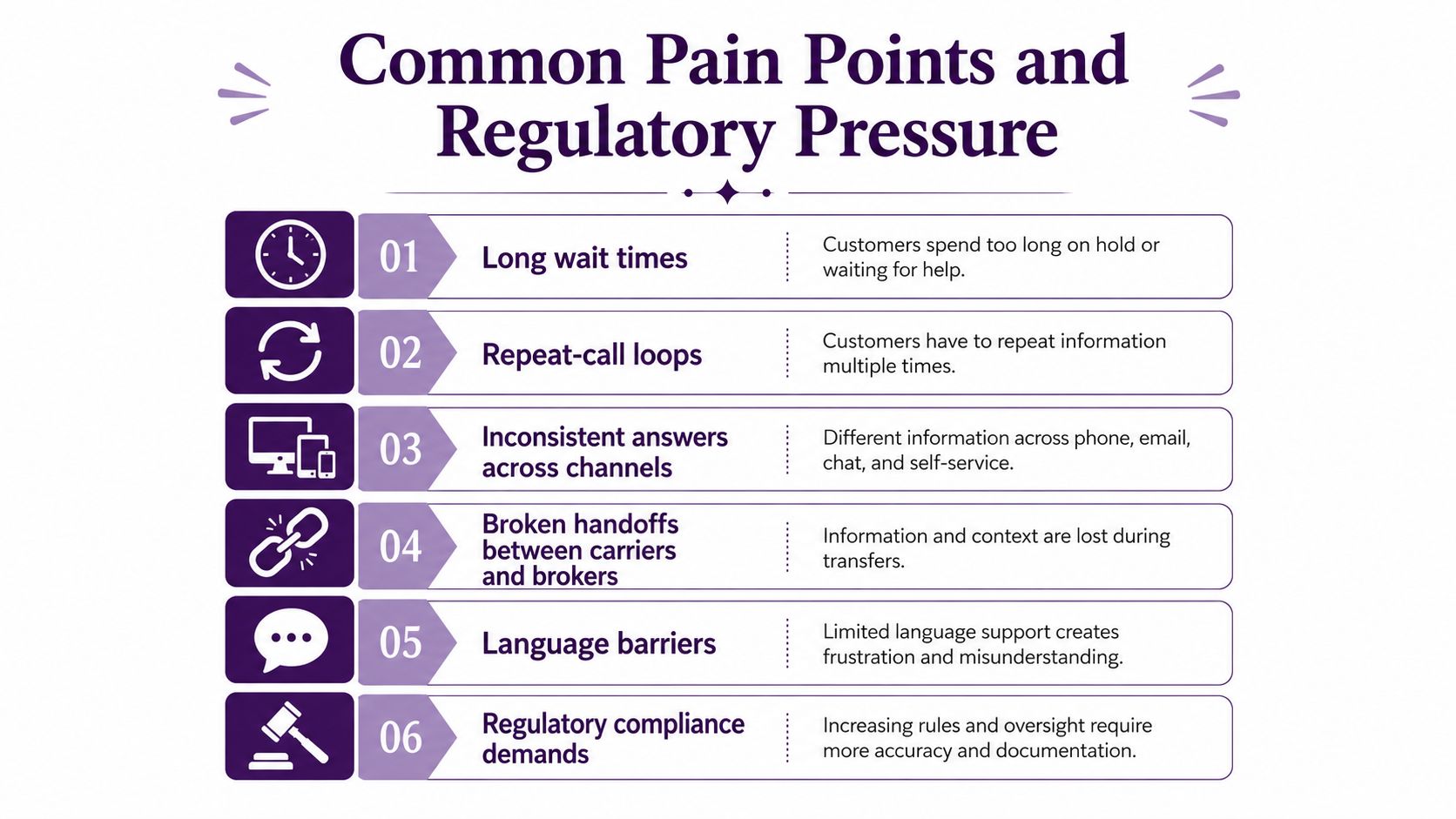
The failures that keep costing money
The follow-up gap is the one that gets ignored until retention slips. In the insurance CX material from InMoment, a sizable share of customers said insurers failed to follow up after the first conversation. That is not a minor miss. When the first contact ends without a clean next step, the customer assumes nobody owns the case.
Wait time creates the same kind of damage. Callers who sit too long do not just get annoyed, they drop out, call back later, and often hit a different agent who has no context. The result is more volume, weaker trust, and a longer path to resolution.
These failures matter because service and compliance sit in the same workflow. Customers who cannot get a straight answer escalate faster, and teams that mishandle handoffs expose themselves to avoidable risk. If you want a practical check on disclosure, documentation, escalation, and callback discipline, use this insurance call center compliance guide as the standard.
One outside resource worth reading
Claim friction also shows up when customers do not understand why a claim slows down or gets denied. For a plain-language look at that side of the process, how adjusters deny claims is useful because it shows why explanations need to be clearer, not shorter.
What to track when pressure rises
A serious insurance contact center should watch:
- Wait time trends for phone and chat.
- Repeat-contact rates for the same issue.
- Complaint volume by workflow.
- Language coverage gaps by queue.
- First-contact follow-up completion for claims and escalations.
When those numbers move the wrong way, the problem is usually not more scripts. It is broken ownership. Insurance customer service falls apart when the handoff chain is weak and nobody closes the loop.
KPIs and Quality Metrics That Move Retention
Insurance teams still chase activity metrics and call them progress. Calls answered do not prove problems were solved. Tickets closed do not prove customers stayed. The scorecard has to show service quality, process efficiency, and loyalty, in that order.
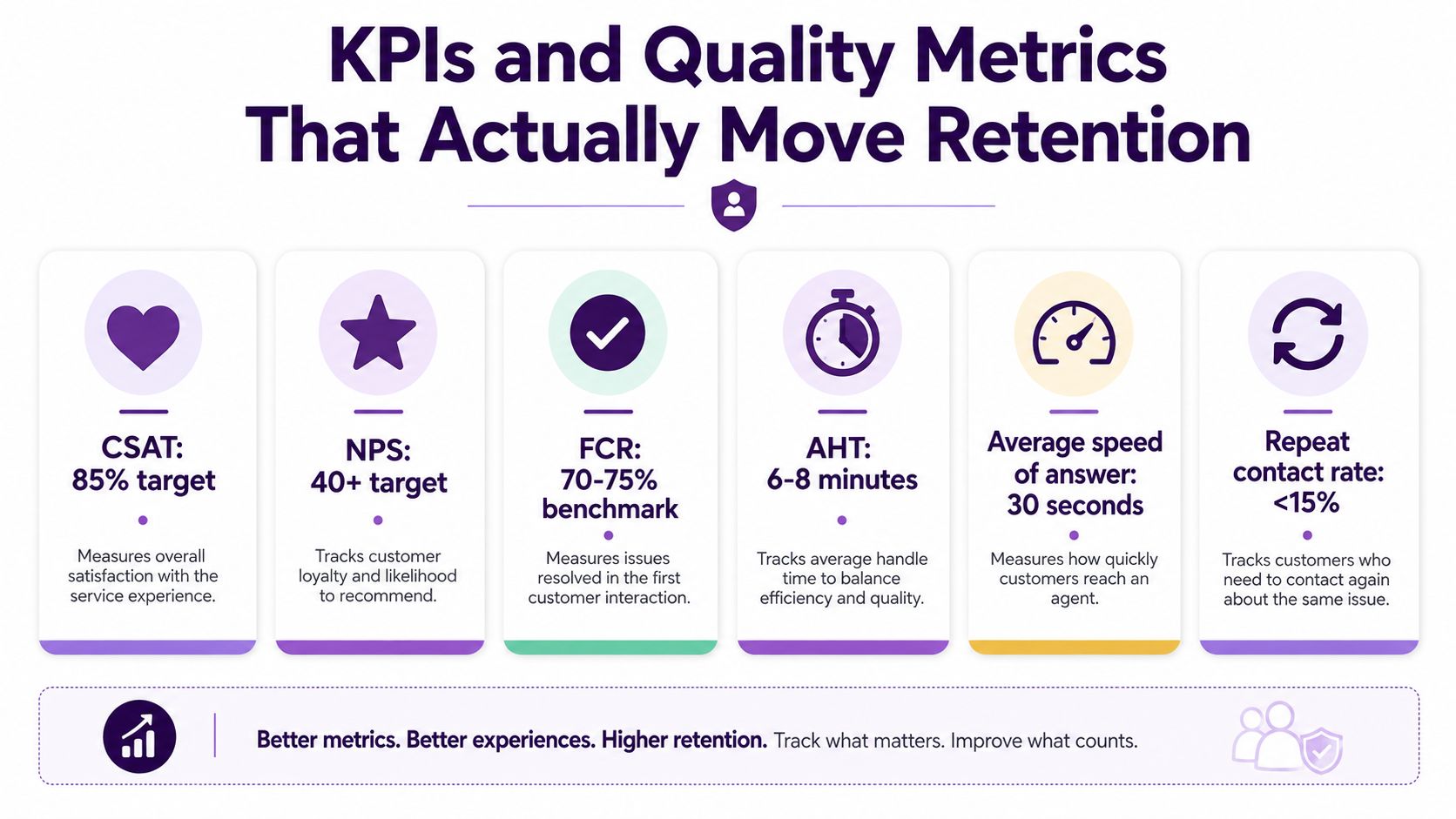
The metrics that belong on the weekly dashboard
Start with CSAT and NPS to measure relationship health. Add FCR to see whether the team solves the issue on the first pass. Use AHT and average speed of answer for staffing and queue control. Track claim-specific NPS where the claim journey carries the most weight. Keep QA scorecards on compliance behavior. Then tie the whole set to policyholder retention, because that is the outcome that tells you whether the work is holding customers.
The call center KPI framework is a useful way to sanity-check which numbers deserve a place on the scorecard. For a broader market view, the ZipDo summary shows that customer experience has a direct link to retention in insurance, and that customers will move when service is poor. That is not a branding issue. It is a service leak.
Do not let one metric break the rest
AHT matters, but only when the team uses it with discipline. If agents rush through calls to hit a time target and FCR falls, the customer pays for it twice. In insurance, the right target depends on the workflow, but the rule stays simple, shorten handling time without creating repeat contacts.
Specific teams should watch the numbers that reveal where service breaks down:
- Wait time trends for phone and chat.
- Repeat-contact rates for the same issue.
- Complaint volume by workflow.
- Language coverage gaps by queue.
- First-contact follow-up completion for claims and escalations.
Use the rest of the stack to support those numbers.
- CRM for the customer record.
- IVR and routing for intake and triage.
- Knowledge base for consistent answers.
- AI assist for suggested responses.
- QA tools for compliance scoring.
- WFM for staffing against real demand.
If a tool does not help an agent solve a claim, a billing issue, or a renewal question faster and more accurately, it is decorative. The right KPI stack does more than measure service. It shows whether retention is at risk before the lapse shows up.
The Tech Stack Behind a Modern Insurance Support Operation
Good insurance support runs on integration, not software clutter. The CRM needs to be the single record of truth. IVR and intelligent routing should send the right issue to the right queue. The knowledge base should give agents one place to confirm policy language, claim steps, and escalation rules. If those tools don’t talk to each other, agents spend their day tabbing between systems instead of helping customers.
What each tool does on a real Tuesday
A billing question should be easy. The customer calls, the IVR identifies the account, the CRM pulls the policy, and the knowledge base gives the agent the correct explanation. AI assist can suggest the answer and surface the right disclosure so the agent doesn’t waste time searching. In a clean setup, that can cut handle time on routine questions without sacrificing accuracy.
A complex auto claim is different. The customer may start in IVR, get routed to a claims specialist, and need live status updates from a connected claims system. If the agent has to re-key data into separate screens, the customer feels the lag immediately. If the systems are connected, the specialist can focus on the next best action instead of data entry.
Buy integration, not feature bingo
The biggest mistake buyers make is stacking tools that look smart in demos but don’t integrate well in production. A pretty knowledge base won’t save a broken claims workflow. A speech analytics tool won’t help if agents can’t see the policy history in the same screen.
That’s why buyers should prioritize APIs and pre-built insurance connectors over long feature checklists. Ask whether the platform can pull policy data, push claim updates, and preserve context across channels. If it can’t, you’ll pay for software twice, once in licensing and once in agent frustration.
For teams evaluating service platforms and support operations, this call center software features guide is a practical starting point because it keeps the focus on workflow, not marketing language.
Insurance customer service works best when the tech stack removes friction from the Tuesday problems, not just the boardroom ones.
Sample Workflows and Training Practices That Hold Up Under Load
Insurance service breaks into two operating modes. Routine work needs speed and tight control. Complex claims need structure, empathy, and clean handoffs. Teams that mix those up create delays, repeat contacts, and avoidable frustration.
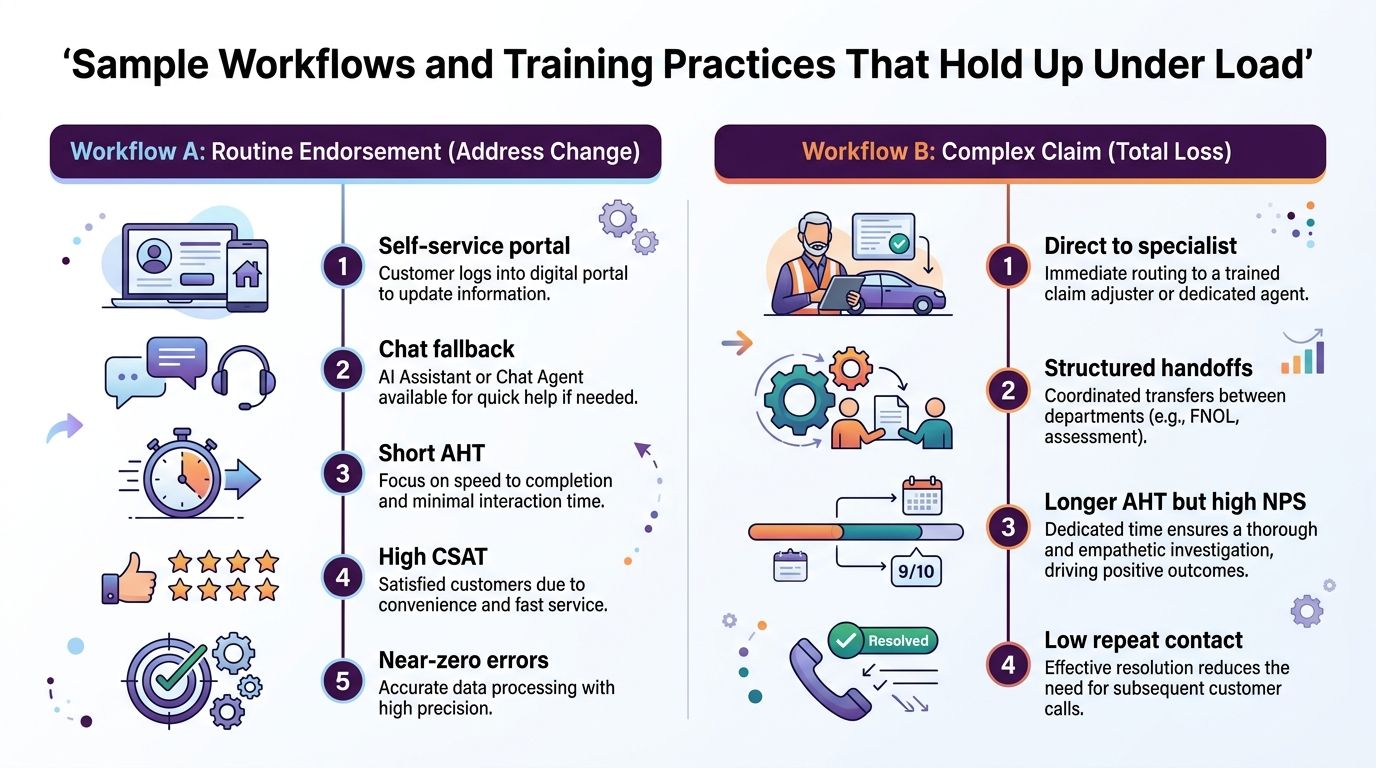
A routine endorsement, like an address change, should start in self-service. If the customer gets stuck, chat or a live agent can finish the job. The point is a short path, accurate verification, and a clean confirmation. No one should spend agent time re-living a basic form change.
A total loss claim needs a different playbook. The customer may open the contact emotionally charged, confused, or both. The first agent should use a scripted empathy opening, collect the facts, and state the next step clearly. If the process calls for follow-up, the customer should hear back without drift. Silence after a loss kills trust fast.
Train to the work, not the slogan
Routine work calls for precision. Agents need exact language for endorsements, billing changes, and document checks. Claims work calls for tone control, escalation judgment, and clean disclosure. QA has to score both accuracy and behavior, because a correct answer delivered badly still hurts retention.
A bilingual nearshore operation works well here because it keeps the rules close to the queue and reduces agent overload. Training also has to be continuous. If your team needs outside support, service training with CE credit is a useful reference point because insurance teams need coaching that matches real call handling, not one-time onboarding.
A clean operating model usually comes down to four choices:
- Separate routine and complex workflows before staffing the queue.
- Write clear escalation triggers for claims, coverage disputes, and language support.
- Score post-call quality on empathy, accuracy, and closure.
- Coach to actual call types, not generic customer service theory.
If the work is tied to the right training path, agents stop improvising and start resolving. For teams building that path, the agent training programs page is the right place to start. Training only works when it is tied to the actual work agents handle, not generic customer service theory.
Outsourcing to a Bilingual Nearshore Contact Center and the Decision Checklist
A bilingual nearshore contact center makes sense in insurance when you need English and Spanish coverage, overlap with U.S. business hours, and a team that can handle sensitive conversations without pushing the customer through offshore friction. That is the trade-off. The value is tighter service, cleaner handoffs, and more useful coverage.
CallZent is one example of that model, a bilingual nearshore call center and BPO in Tijuana offering 24/7 inbound and outbound services including customer service, technical support, lead generation, debt collection, virtual assistance, and reservation management, with over two decades of experience serving clients across North America. That matters in insurance because the work is often time-sensitive, language-sensitive, and process-sensitive at the same time.
How the ROI Logic Works
The math is straightforward. Fewer repeat calls mean less wasted time. Faster claims cycle handling means fewer frustrated customers. Better bilingual support reduces escalation friction for Spanish-speaking policyholders. When routine work moves outside the internal team, in-house staff can focus on specialty claims, retention saves, and compliance-heavy issues.
Do not oversell the model. Define the scope. Outsource the workflows that are repeatable, measurable, and scriptable. Keep the high-complexity or high-risk cases where your internal experts can control them. That balance usually beats a pure onshore or pure offshore setup because insurance service rewards proximity, clarity, and consistency.
Use this checklist before you sign anything
- Define the workflows to outsource by volume, complexity, and language need.
- Set SLA targets for speed, quality, and follow-up.
- Confirm integration with your policy admin system and CRM.
- Validate bilingual QA with real call samples, not sample scripts.
- Run a 60-day pilot with parallel reporting so you can compare results fairly.
- Lock in knowledge transfer so the vendor learns your policy language, not a generic script.
For vendor selection, this vendor evaluation criteria guide is useful because it forces the conversation onto operations, not promises.
Insurance customer service is a financial lever because it changes retention, claim experience, and complaint load. If you are serious about improving it, build the workflow, choose the right KPIs, and evaluate a nearshore partner against the actual work, not the slide deck.
🚀 Build Insurance Support Policyholders Can Trust
CallZent helps insurers build bilingual nearshore service teams for claims support, billing, policy questions, renewals, customer retention, and overflow coverage.