Skip to content

Call Center Service Level Agreements
Call Center Service Level Agreements Guide for Better BPO Partnerships
Learn how call center service level agreements work, which metrics matter, how to draft realistic terms, and how to negotiate a stronger nearshore BPO partnership.
TL;DR — Quick Takeaways
- Call center service level agreements define expected performance, reporting, responsibilities, and remedies.
- The most common service level target is 80% of inbound calls answered within 20 seconds according to The Octopus Tech on SLA standards, but that number alone never tells the full story.
- A practical SLA also needs supporting metrics, realistic staffing assumptions, review cycles, and room for joint problem-solving.
- In a nearshore model, the best agreement becomes a working plan for communication, accountability, and growth.
- The strongest SLAs define success clearly, reflect operational reality, and support partnership instead of finger-pointing.
Is your current call center contract helping your customer experience, or making it harder to deliver good service?
A lot of companies treat service level agreements like legal paperwork. That’s the mistake. In practice, call center service level agreements decide how your team staffs, reports, escalates issues, handles peak periods, and recovers when volumes shift. They shape the working relationship long before anyone talks about penalties.
The best SLAs don’t exist to punish a vendor. They create a shared operating model. That matters even more when you’re outsourcing customer support, sales support, or back-office work across borders and time zones. If the agreement is vague, every service issue turns into an argument. If it’s clear, realistic, and built around the right metrics, both sides can solve problems faster.
Your Guide to Call Center SLAs
A strong SLA answers one simple question. What does good service look like, and how will both sides know if they’re getting it?
That sounds obvious, but many contracts still rely on broad promises instead of clear operating targets. One side expects fast response times, better customer outcomes, and flexible staffing. The other side is trying to meet demand with the people, schedules, systems, and training available. If those expectations aren’t aligned on paper, they won’t be aligned in production.
For companies evaluating outsourcing partners, this starts with understanding who you’re working with and how they operate day to day. That’s why it helps to review a provider’s background, operating model, and service philosophy before the SLA conversation even begins. A quick look at CallZent’s company background and approach is a good example of the kind of context buyers should gather early.
Three points separate useful SLAs from frustrating ones:
- They define success clearly: Both parties know what’s being measured and why it matters.
- They reflect operational reality: Targets match actual volume patterns, staffing limits, and channel mix.
- They support partnership: Reporting and reviews lead to improvements, not finger-pointing.
That’s the difference between a contract that sits in a folder and one that improves service.
What Is a Call Center Service Level Agreement
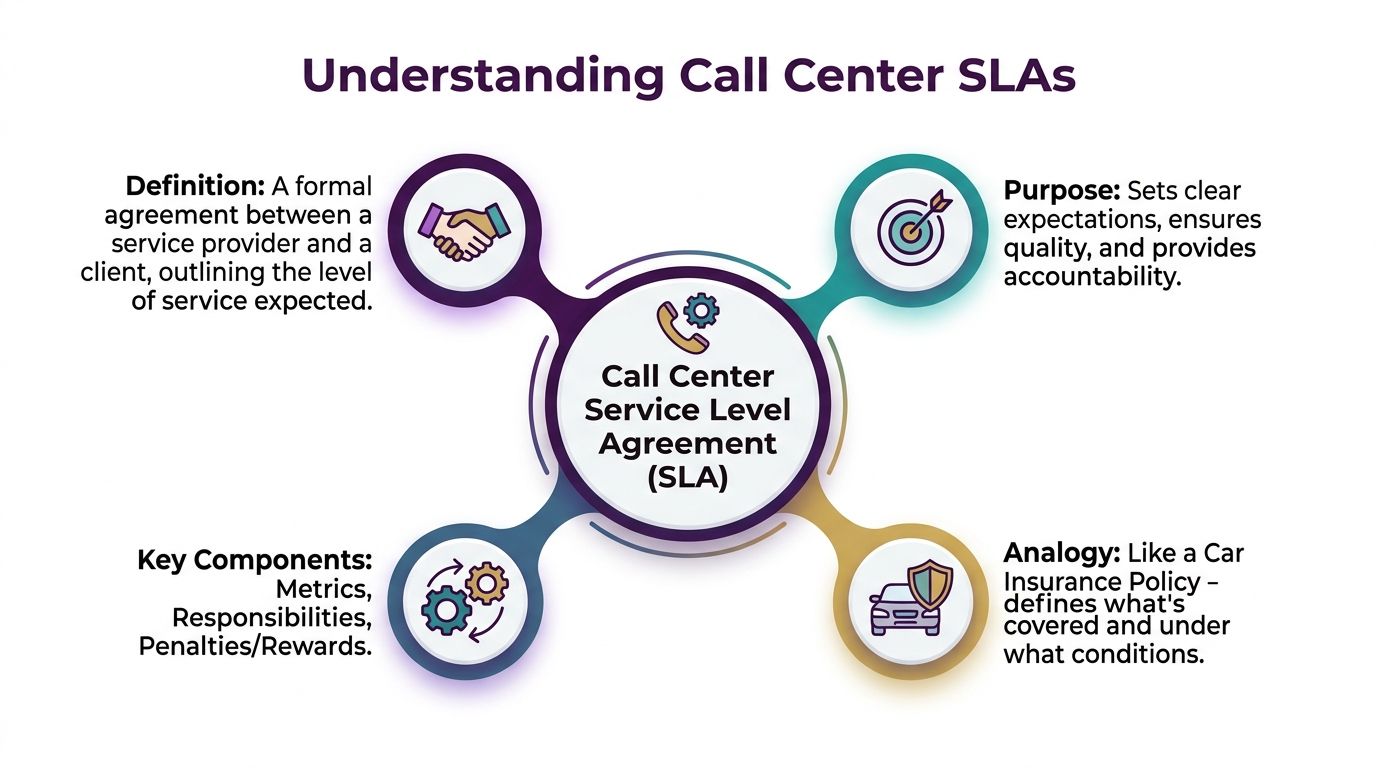
A call center SLA is a formal agreement between a service provider and a client that defines the expected level of service and the standards used to judge performance. In practical terms, it’s the blueprint for how support will run.
The approved plan for building a house provides a clear example. If the blueprint is vague, every decision becomes a debate. If it’s detailed, the teams know what to build, what quality looks like, who owns what, and what happens when something changes. An SLA does the same job for outsourced support.
Why call center service level agreements matter
Most companies say they want “great customer service.” That phrase isn’t useful by itself. One client may mean fast answer times. Another may care more about accurate resolutions, bilingual support, or strict compliance workflows.
An SLA turns those broad expectations into measurable commitments. It usually covers response times, resolution targets, reporting cadence, escalation paths, service scope, and the responsibilities of both client and provider. It also creates accountability in both directions. The provider has to deliver what was promised. The client has to provide the inputs, systems access, training support, and decision-making needed for the provider to perform.
That two-way structure gets overlooked. A call center can’t hit service targets if forecasting is poor, product updates arrive late, or ticket priorities change without notice.
What an SLA is not
An SLA is not the same thing as one service metric. It’s also not a penalty sheet.
A service level metric measures one piece of performance. The SLA is the larger agreement that explains which metrics matter, how they’re calculated, how often they’re reviewed, and what corrective actions follow if results drift. It sets the rules of the game so everyone is working from the same playbook.
A useful SLA doesn’t ask, “How do we catch failure?” It asks, “How do we make success repeatable?”
That shift in mindset changes how people negotiate, report, and improve operations.
The Core Metrics That Define Your SLA
What should a call center SLA measure if the goal is a partnership that holds up under real operating pressure?
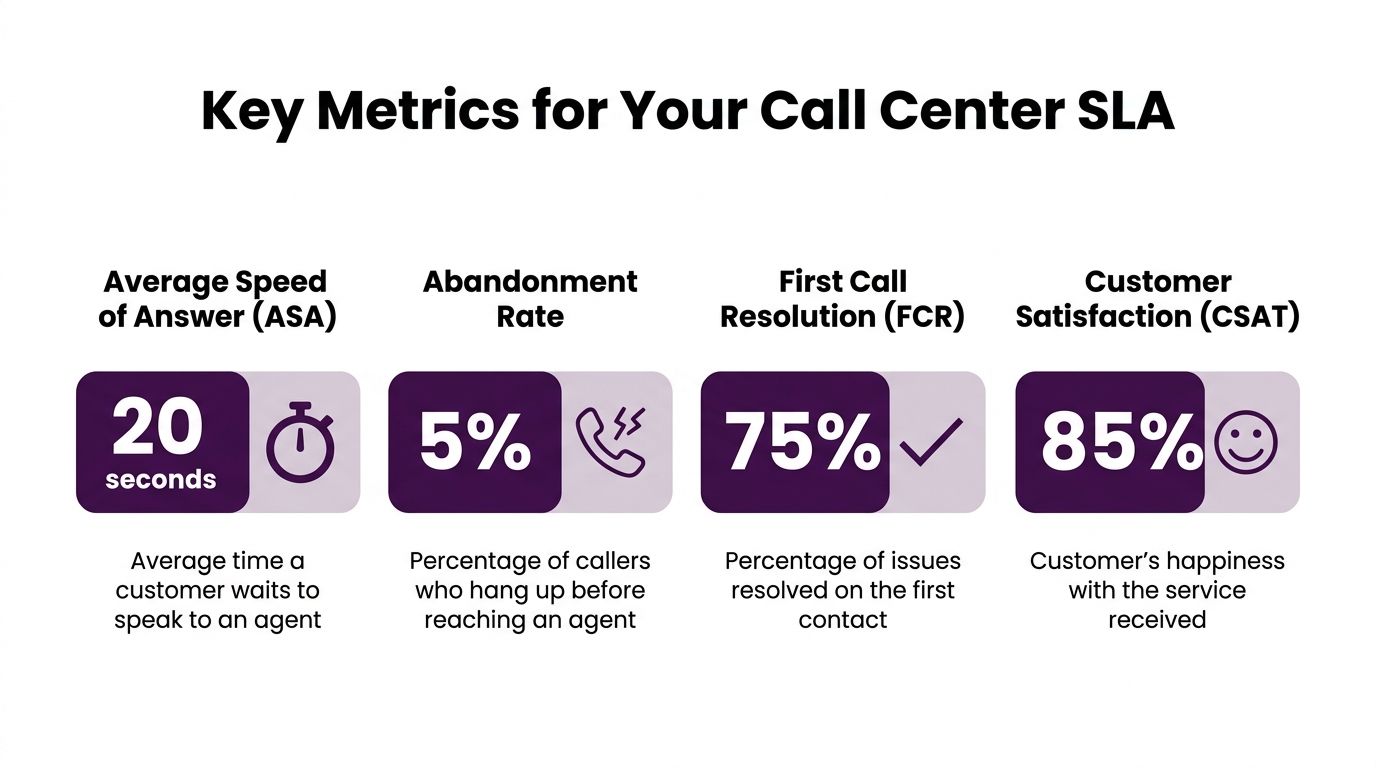
Start with this: the famous 80/20 target is a reference point, not a strategy. Many teams use it to mean 80% of inbound calls answered within 20 seconds. That can be a reasonable starting target, but it should never be copied into a contract without context. A retail queue during peak season, a healthcare support line, and a bilingual nearshore program handling complex billing calls will not perform the same way, and they should not be managed the same way.
The practical question is not whether 80/20 is “right.” The practical question is whether the target fits the customer experience you need, the staffing model you can support, and the cost of missing calls in that queue.
The metrics that deserve a place in the agreement
A useful SLA balances speed, quality, and sustainability. These are the metrics I expect to see defined clearly.
- Service level: This measures the share of contacts answered within the agreed threshold. Balto’s breakdown of service level calculation and Erlang-based staffing explains the standard formula: Service Level (%) = (Calls Answered Within Threshold ÷ Total Calls Offered) × 100. This metric shows whether the operation is meeting the response promise made to customers.
- Average Speed of Answer or ASA: ASA shows the average time callers wait before an agent picks up. It helps explain the customer experience behind the headline service level number, especially when a queue technically hits target while a smaller group of callers waits far too long.
- First Call Resolution or FCR: FCR measures whether the issue was solved in the first interaction. This is where many SLAs go wrong in practice. Fast answer times can still produce a poor experience if customers have to call back two or three times to get a real fix.
- Abandonment rate: This tracks how many callers leave before reaching an agent. In nearshore programs, this metric often becomes a negotiation point because high abandonment can come from staffing gaps, poor IVR design, bad routing logic, or sudden forecast misses on the client side. The SLA should define which causes sit with the provider and which require joint action.
- Average Handle Time or AHT: AHT measures the total time spent on each interaction, including talk time and after-call work. It matters for staffing and cost control, but it should be handled carefully. If a provider is pushed to reduce AHT without protecting quality, FCR usually suffers and repeat contacts go up.
- Agent occupancy: Occupancy shows how much of an agent’s paid time is spent handling demand. It is a useful planning metric because an operation can hit service level for a while by running occupancy too high, then pay for it through burnout, absenteeism, and declining QA scores.
How these metrics work together
No single metric should control the relationship.
A strong SLA reads like an operating model. If service level is healthy but abandonment is climbing, the queue may still be failing the customers who do not get answered quickly. If ASA is acceptable but FCR is weak, the team may be responding fast without solving enough. If AHT drops while CSAT or QA slips, agents are probably being rushed or working around broken processes.
That is why experienced operators separate contractual commitments from management KPIs. The contract should cover the metrics that define the service promise and assign responsibility clearly. The operating rhythm should track a broader set of measures, including quality trends, schedule adherence, shrinkage, and coaching outcomes. This guide to customer service KPIs and what they reveal operationally is a useful reference when deciding what belongs in the SLA versus what should stay in weekly business reviews.
For workforce planning, scheduling improvements with KPIs can help teams connect staffing decisions to the targets written into the agreement.
The best SLA metric set does more than score the vendor. It shows both sides what has to be true for the program to scale without breaking service, margin, or trust.
How to Draft an Effective SLA That Drives Performance
A weak SLA copies a benchmark and drops it into a contract. A strong SLA connects targets to operating reality.
That difference matters because unrealistic commitments don’t create excellence. They create churn, escalations, and avoidable friction between the client and the provider.

Start with business needs, not industry folklore
Every support environment has its own shape. A healthcare line, an e-commerce order support queue, and a telecom retention team shouldn’t all use the same service target without discussion. The right SLA depends on business hours, contact reasons, seasonality, escalation paths, system dependencies, and the cost of delay for the customer.
Verint’s guidance makes the operational risk clear. Setting SLA goals that are too ambitious without realistic resource alignment can directly cause employee burnout and decreased customer satisfaction, and agreements should be grounded in realistic, data-driven benchmarks derived from historical volume patterns rather than arbitrary heuristics, as noted in Verint’s manager guide to call center service levels.
That’s why historical volume review has to come before target setting. Pull contact arrival patterns, peak intervals, repeat contact drivers, and queue behavior. Then decide what service levels are commercially important and operationally sustainable.
Write terms that remove ambiguity
An SLA should answer operational questions before they become disputes.
A practical draft should define:
- Service scope: Which channels are included, which customer segments are covered, and what’s out of scope.
- Hours and coverage model: Business hours, after-hours handling, holiday support, and overflow assumptions.
- Metric definitions: Exact formulas, data source, exclusions, and whether transfers or callbacks count.
- Reporting cadence: Daily dashboards, weekly reviews, monthly summaries, and quarterly SLA resets if needed.
- Escalation workflow: Who gets notified, when, and how quickly joint action plans must be created.
- Client responsibilities: Training materials, access credentials, approval timelines, and forecast sharing.
A common failure point is leaving key terms implied. “Fast response” is not a contract term. “Answered within the agreed threshold measured from queue entry” is.
Penalties matter, but incentives matter too
Most buyers focus first on service credits or penalties. That’s understandable, but one-sided clauses rarely create a healthy operating rhythm. They make the provider defensive and push teams to optimize for contract survival instead of customer outcomes.
A better model includes both remedies and rewards. If the provider consistently exceeds agreed targets, supports a new product launch smoothly, or improves resolution quality, the agreement should recognize that performance. The reward doesn’t always have to be financial. It can be expanded scope, a longer commitment term, or a formal performance review process that opens the door to deeper partnership.
Practical rule: Use the SLA to encourage the behaviors you want repeated, not just the failures you want avoided.
If you’re building a shortlist or comparing partners before contract drafting, a structured set of vendor evaluation criteria for outsourced support will make the SLA negotiation easier because you’ll already know which capabilities matter most.
Negotiating Your SLA with a Nearshore Partner
Negotiating with a nearshore provider is usually more productive when both sides can work through service design in real time, with less delay and less translation of business context.
That’s one reason the nearshore model changes the SLA conversation. When your partner operates in a nearby time zone and supports North American customers with bilingual teams, the agreement becomes easier to shape around actual operating needs instead of generic assumptions.
Why nearshore negotiations are often smoother
In a domestic partnership, you may get proximity but lose cost flexibility. In a distant offshore arrangement, you may lower cost but create lag in communication, escalation, and decision-making. Nearshore sits in the middle in a practical way.
Shared or closely aligned business hours make contract workshops, queue reviews, and launch planning easier. When leaders from both sides can look at the same dashboard during the same workday, it’s simpler to agree on targets, review exceptions, and adapt quickly when a campaign, outage, or seasonal spike changes demand.
Cultural alignment also matters more than people admit. If your customers are in the U.S. or Canada, service expectations often depend on tone, language nuance, pacing, and issue ownership. Those details influence quality standards, QA scorecards, escalation language, and resolution expectations inside the SLA.
What to negotiate beyond the headline metrics
The best nearshore SLA discussions go beyond service level and into operating mechanics.
Consider negotiating around these areas:
- Forecast sharing: How far in advance the client will provide campaign calendars, promotions, and anticipated spikes.
- Training ownership: Who updates scripts, product knowledge, and process documents when the business changes.
- Bilingual quality expectations: How calls, chats, and emails will be evaluated across English and Spanish interactions.
- Rapid escalation paths: Which managers join an issue bridge when queue performance slips or system issues appear.
- Flexibility clauses: How temporary volume swings, pilot programs, or new channels will be handled before a full contract rewrite.
A nearshore model works best when the provider isn’t treated as a distant labor pool. It works when both sides plan together, review together, and adjust together. If you’re assessing whether that model fits your organization, this overview of nearshore call center operations and support benefits is a useful place to compare it with other outsourcing structures.
The strongest negotiation outcome isn’t the strictest SLA. It’s the one both teams can actually run without constant escalation.
Monitoring Reporting and Continuous Improvement
Signing the SLA is the easy part. Running it well is where most partnerships either mature or start to fray.
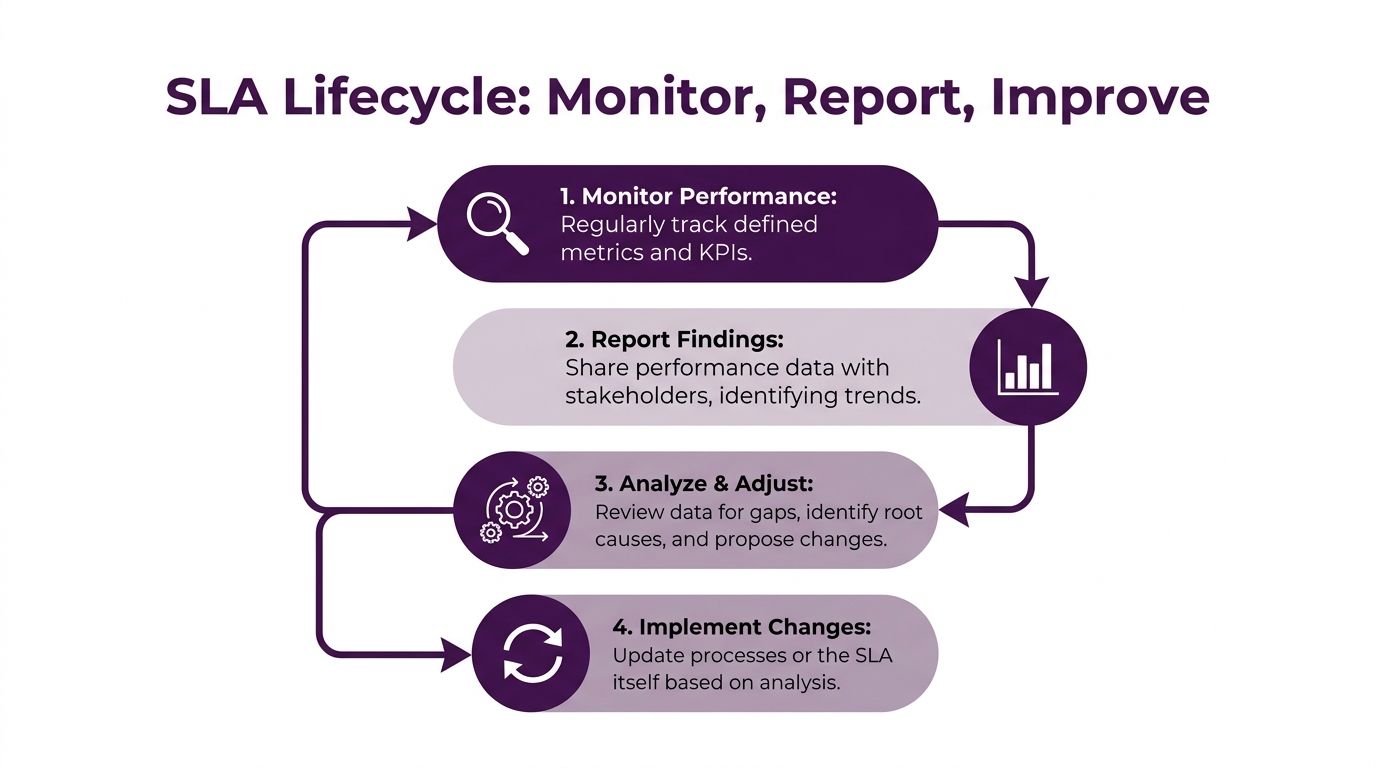
An SLA should function like a living operating document. If performance data only shows up when someone misses target, the process has already failed. Good reporting gives both sides enough visibility to fix problems while they’re still manageable.
What useful SLA reporting looks like
A solid reporting rhythm usually includes a real-time or near-real-time dashboard for operational teams, plus recurring summaries for leadership. The dashboard should show whether service is on track right now. The recurring review should show patterns, not just snapshots.
Useful reporting includes:
- Trend views: Week-over-week and month-over-month movement, not isolated daily wins or misses.
- Context notes: Product launch, system outage, staffing gaps, training ramp, or unusual queue mix.
- Root-cause analysis: Why the metric moved, not just that it moved.
- Action ownership: Specific next steps, owners, and review dates.
If ASA dips for a few hours, the answer might be schedule misalignment. If it dips repeatedly on the same daypart, the issue may be forecasting. If service level is stable but customer frustration rises, the queue may be staffed correctly while process design remains broken.
Use data to improve, not just to judge
Xima Software notes that effective SLAs must be realistic and achievable and warns that if targets are set too ambitiously without proper Erlang-based modeling against actual call volume and staffing, they can lead to employee burnout and lower customer satisfaction in Xima’s discussion of call center statistics and SLA planning. That’s an operations lesson, not just a planning lesson.
Monitoring should trigger adjustment. Maybe the queue needs new intraday staffing rules. Maybe call routing needs refinement. Maybe the self-service flow is sending simple contacts to live agents unnecessarily. Sometimes the SLA itself needs revision because the business changed after launch.
A good performance review meeting should end with decisions, not just commentary.
Review meetings should answer three questions. What happened, why did it happen, and what are we changing before the next review?
If your team is trying to build that kind of visibility, this guide on how to monitor call center performance with more clarity can help frame the reporting process.
SLA Checklist and Your Path Forward
What should be true before anyone signs a call center SLA?
The answer is not just that the targets look reasonable on paper. Both sides should understand how the agreement will work under real operating conditions, especially in a nearshore model where time zones, language expectations, staffing strategy, and growth plans all affect performance. A strong SLA gives the client and provider a shared operating system for decision-making, not just a document to reference when results slip.
One point deserves a final check. The familiar 80/20 benchmark is often treated like a default setting, but Nextiva’s review of service level nuances across channels shows why that shortcut causes problems when teams apply the same threshold to voice, chat, and SMS. Multi-channel support needs queue-specific targets, or the SLA will create confusion instead of control.
A practical SLA checklist
Use this checklist before signature:
- Parties and scope: Name the client, provider, covered services, channels, service hours, and exclusions.
- Definitions: Document every KPI, data source, calculation method, and exception rule.
- Performance targets: Include service level, plus the supporting metrics that explain whether the customer experience is holding up.
- Responsibilities: State what the provider owns and what the client must provide for the operation to succeed.
- Reporting and review cadence: Define dashboards, meeting frequency, escalation timing, and formal review windows.
- Remedies and incentives: Set fair consequences for misses and clear upside for sustained performance.
- Change management: Document how both sides will revise targets, staffing assumptions, or channel coverage as the business changes.
- Governance contacts: Identify the people who can approve decisions, resolve disputes, and remove blockers.
What the best agreements do
They remove ambiguity early. They improve planning conversations. They speed up escalation when service risk appears. They also protect frontline teams from targets that were never achievable in the first place.
In practice, the strongest SLAs are negotiated with the operating model in mind. A nearshore partner may be able to give better schedule overlap, faster communication, and more flexibility than an offshore model, but only if the agreement defines how those advantages will be used. If you want a stronger final review process, these service level agreement best practices for outsourced support offer a useful reference.
The primary value of call center service level agreements is operational alignment. When the terms are clear, realistic, and reviewed often, the client and provider spend less time arguing about the scorecard and more time fixing what is slowing the customer experience.
If you’re evaluating a nearshore support partner, CallZent can help you build an SLA that fits your service goals, channel mix, and growth plans without forcing a one-size-fits-all model. That gives both sides a clearer path to better customer outcomes.
🚀 Build a Stronger SLA for Your Nearshore Support Program
If you’re evaluating a nearshore support partner, CallZent can help you build an SLA that fits your service goals, channel mix, and growth plans without forcing a one-size-fits-all model. That gives both sides a clearer path to better customer outcomes.