Skip to content

Call Center Outsourcing ROI
ROI of Call Center Outsourcing in 2026 | Nearshore vs Offshore Guide
Learn how to evaluate the ROI of call center outsourcing with a CFO-focused framework, ROI formula, KPI benchmarks, and a nearshore vs offshore comparison.
TL;DR — Quick Takeaways
- The ROI of call center outsourcing is not just a cost question. It is the combination of cost reduction, service quality, retention impact, and scalability.
- The global call center outsourcing market reached an estimated $381.53 billion in 2026 because companies use outsourcing to turn fixed support costs into variable operating costs and preserve capital for growth, according to Retell AI’s 2026 outsourcing cost breakdown.
- For the right operation, outsourcing can deliver strong returns. But the best ROI usually comes from the model that protects customer loyalty while controlling cost.
- Nearshore outsourcing deserves more attention than it gets. It often creates better long-term economics than offshore because cultural alignment and language fluency reduce friction that basic cost models ignore.
- If you are a CFO or COO, judge partners on resolution, customer experience, agent stability, and operational control. Do not reward the cheapest bid.
Are you measuring the ROI of call center outsourcing, or are you only comparing hourly rates?
That’s where most outsourcing decisions go wrong. A lower labor rate looks good in a spreadsheet, but it can hide the costs that shape margin: repeat contacts, weak customer experience, turnover, poor escalation handling, and lost lifetime value. If you only price labor, you’ll often pick the wrong model.
Key takeaway: The best outsourcing decision is rarely the lowest-cost option. It’s the option that protects customer lifetime value while improving operating efficiency.
 Beyond Cost Savings Understanding True Outsourcing ROI
What are you buying when you outsource a call center. Lower wages, or better unit economics across the entire customer operation?
That question separates smart outsourcing decisions from cheap ones.
Finance leaders usually start with visible costs. Payroll, benefits, software, telecom, workspace, and management overhead. Fine. But a real ROI model also measures what happens after the interaction. Does the customer get resolved faster. Do they stay longer. Does the team stay staffed. Does management spend less time fixing service failures. Nearshore providers tend to outperform on those points, and that is where hidden ROI shows up.
What belongs on the return side
A serious ROI case includes four categories of gain:
- Direct cost reduction: lower delivery cost for frontline support, QA, scheduling, and recruiting
- Capital efficiency: no need to add internal seats, systems, or support infrastructure
- Operating flexibility: easier ramp-up for seasonality, new channels, and extended hours
- Revenue protection: stronger resolution and customer experience that reduce churn and preserve repeat revenue
That last category is the one buyers undercount.
A support vendor is not just replacing labor. The vendor is influencing retention, escalation volume, refund rates, average handle time, and conversion from service conversations. If your model ignores those outcomes, your ROI calculation is incomplete.
The hidden ROI companies miss
The biggest mistake is comparing hourly rates and calling it analysis.
A lower-cost offshore team can still produce worse financial results if customers repeat contacts, ask for supervisors more often, or leave after a poor experience. Nearshore changes that math because cultural alignment, accent neutrality, and time-zone overlap usually improve communication on the first interaction. Better communication drives better resolution. Better resolution protects lifetime value.
Turnover is another ignored cost center. Every resignation triggers recruiting, training, nesting, lower early-stage productivity, and QA risk. In a 100-agent environment, even modestly lower attrition can remove a meaningful amount of annual hiring and training expense. It also improves consistency on the floor. Stable teams know the product, handle edge cases better, and escalate less.
If you want a useful baseline, start with the basic economics behind labor arbitrage and outsourcing cost advantages. Then expand the model. Cost per hour is only the entry point. The better question is cost per resolved contact, cost per retained customer, and cost per revenue dollar protected.
Nearshore ROI is usually stronger than the spreadsheet suggests
Nearshore outsourcing often beats both offshore and in-house models on the metrics that matter to a CFO.
You get labor savings, but you also get easier collaboration with your internal team, faster supervisor access, and fewer quality issues caused by language gaps or cultural misreads. That reduces friction inside the operation and outside it with customers. For brands with bilingual support, complex products, or high-value customers, those gains are not cosmetic. They affect margin.
Consider a common scenario. An ecommerce brand shifts support to the cheapest distant provider and cuts the invoice. Six months later, repeat contacts rise, refund requests climb, CSAT drops, and customer retention softens. The vendor looks cheaper on paper. The business gets worse. A nearshore team in a market like Tijuana often produces the better financial outcome because the customer experience stays closer to your in-house standard while delivery cost still comes down.
True outsourcing ROI comes from lower operating cost plus stronger customer retention, lower turnover, and better management efficiency. Nearshore usually gives you the best balance of all four.
The Definitive Guide to Calculating Call Center ROI
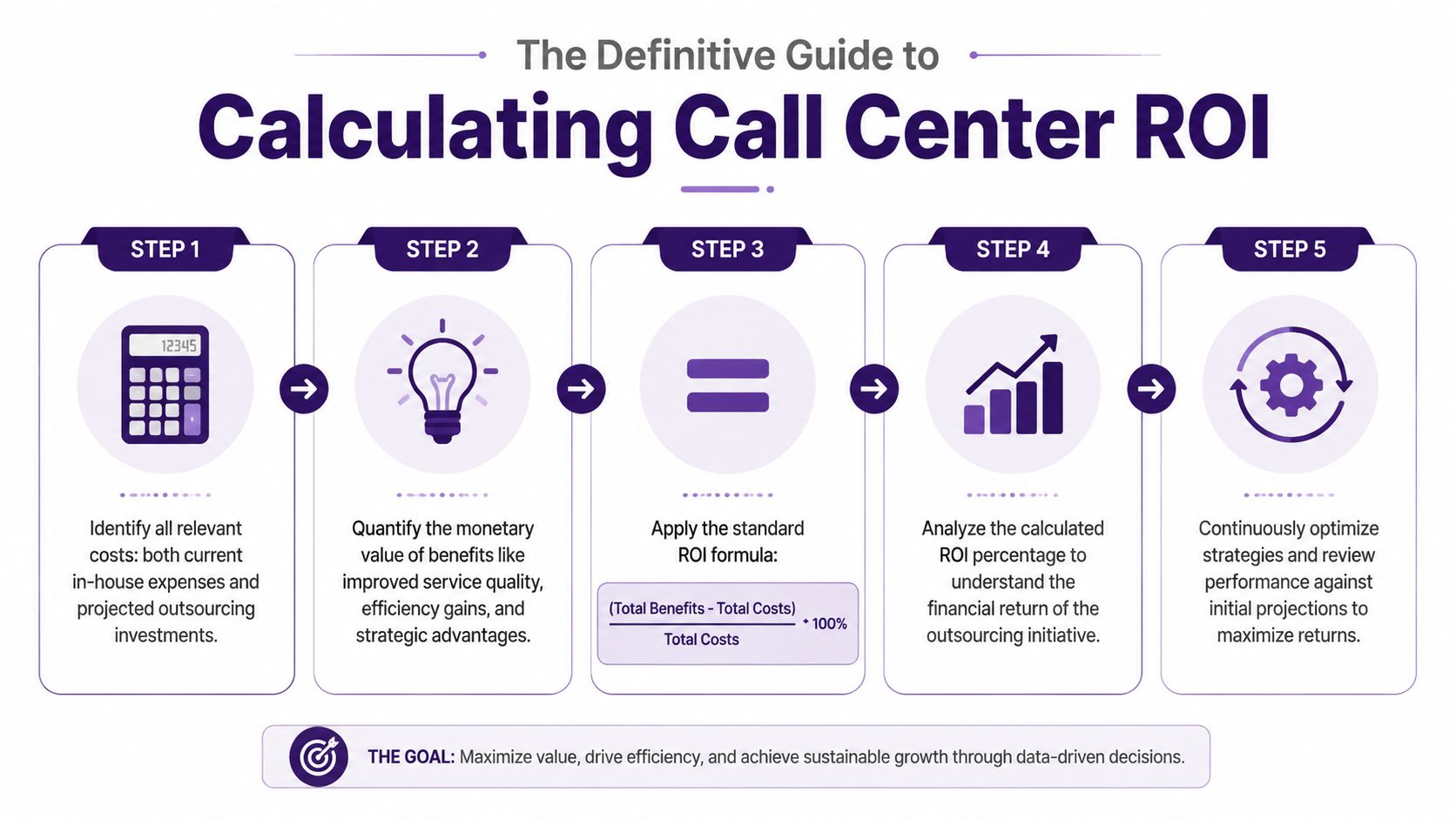
If you can’t model the return, you shouldn’t sign the contract.
The basic formula is straightforward:
ROI = (Total Benefits – Total Costs) / Total Costs × 100%
That formula matters because it forces discipline. It separates what you gain from what you spend. Too many outsourcing decisions skip that step and jump straight to rate comparison.
Build the cost side first
Start with current in-house cost. Use annualized numbers, not rough monthly estimates.
Include:
- Labor expense: Agents, supervisors, QA, trainers, workforce managers.
- Technology stack: CRM licenses, phone systems, QA tools, reporting tools.
- Facilities and overhead: Workspace, equipment, utilities, support functions.
- Recruiting and training: Hiring cycles, onboarding time, refresher training.
- Management oversight: Executive and operational time spent running the function.
Then build the outsourced cost side:
- Vendor fees
- Implementation and transition costs
- Internal vendor management time
- Any temporary overlap cost during migration
For buyers who need a grounded pricing starting point, review typical call center pricing structures before building assumptions.
Then quantify the benefits
At this stage, finance teams either do serious work or produce a weak model.
Benefits can include:
- Lower cost per contact
- Less internal overhead
- Improved service coverage
- Better handling of volume swings
- Better customer outcomes that protect revenue
Don’t force fake precision if your operation doesn’t have clean baseline data. Use the data you trust, then stress-test it.
A practical example using contact volume
Here’s a concrete benchmark. Call center outsourcing generates a median cost reduction of 30–50% compared to in-house operations. For a business handling 50,000 monthly contacts, that can produce $2.5M in annual savings, a first-year ROI of over 200%, and a payback period between 6–18 months, according to GigaBPO’s outsourcing statistics analysis.
That example is useful because it gives operators a reference point, not because every company will match it. Your numbers depend on complexity, channel mix, staffing model, and service expectations.
A five-step calculation process that works
- Map current state clearly: Pull the full cost of your existing operation, including the costs that usually get buried in admin or leadership overhead.
- Define what moves out: Decide which queues, shifts, languages, or support functions the vendor will handle.
- Estimate financial gain conservatively: Use expected savings and operational improvements, then test a base case and a downside case.
- Apply the formula: Compare annualized benefits to annualized outsourcing cost.
- Set a payback threshold: If the model doesn’t produce acceptable payback, don’t proceed yet.
Practical rule: If your ROI model only compares hourly wages, it’s incomplete and probably misleading.
A healthcare provider gives a good example. If the outsourced partner covers overflow scheduling and bilingual support, the savings may be obvious. But the bigger win may come from fewer missed calls, better patient communication, and less internal strain on front-desk staff. Those gains are operational first, financial second. They still belong in the model.
Nearshore vs Offshore vs In-House A Financial Breakdown
The hardest truth in outsourcing is simple. The cheapest labor option is often not the best ROI option.
A U.S.-based in-house team gives you control, but usually at the highest operating cost. Offshore gives you lower direct labor cost, but often introduces language, culture, and time-zone friction. Nearshore sits in the middle on price and often wins on total business value.
Outsourcing Model ROI Comparison Annualized Estimate
| Factor | In-House (US-Based) | Offshore (e.g., Philippines) | Nearshore (e.g., CallZent in Tijuana) |
|---|---|---|---|
| Cost structure | Highest fixed cost base | Lowest direct labor cost | Lower cost with strong operating flexibility |
| Management control | Highest direct control | More distance and oversight complexity | Easier collaboration and faster decisions |
| Time-zone alignment | Strong | Often weaker for North America | Strong alignment for North America |
| Cultural and language fit | Strong | Can vary by program | Strong, especially for bilingual support |
| Scalability | Slower and more expensive | Fast for volume hiring | Fast with closer operational coordination |
| CX risk | Lower if managed well | Higher if communication friction appears | Lower than offshore in many North American programs |
| Hidden ROI upside | Limited by cost base | Reduced by service friction and escalation | Strong due to loyalty, resolution, and collaboration |
That last row matters most.
According to Vonage’s call center outsourcing analysis, 70% of customers feel more loyal when supported by agents who understand their culture. That is not a soft benefit. It directly affects customer lifetime value, retention quality, and revenue durability.
Why nearshore often beats offshore on total return
Nearshore outsourcing gets dismissed too often as “not cheap enough.” That’s the wrong lens.
If your customers are in North America, nearshore teams often work better because they sound familiar, understand customer expectations, and collaborate in real time with your internal teams. That reduces the operational friction that offshore models can create.
The best way to think about this is through total economic effect:
- Lower misunderstanding risk: Fewer escalations and less customer frustration.
- Better alignment with U.S. operating hours: Faster issue resolution and easier management.
- Cleaner communication with your internal teams: Quicker changes, quicker approvals, quicker fixes.
- Stronger customer loyalty: Better service interactions protect repeat business.
For leaders weighing the tradeoffs, this breakdown of nearshore vs offshore outsourcing costs, risks, and ROI is the right place to focus your evaluation.
If your support model saves money but weakens loyalty, it isn’t improving ROI. It’s just moving cost from operations to churn.
Turnover is the hidden profit leak
Another issue gets ignored in basic sourcing discussions. Agent turnover.
Call centers deal with annual turnover in the 30–45% range, and those replacement cycles can erode 15–20% of the apparent cost savings from outsourcing, according to Ringly’s 2026 call center statistics. That matters because every attrition event creates retraining, inconsistency, and temporary productivity loss.
Here’s a practical example. A retail brand hires an offshore team for seasonal support because the unit cost looks attractive. Three months later, agent churn creates quality inconsistency right when order status calls spike. The company then adds internal supervisors, extra QA review, and manual escalation support to stabilize service. The original savings story gets weaker fast.
Nearshore providers aren’t magically immune to staffing challenges. But from a business standpoint, the model tends to support better coordination, stronger cultural fit, and more stable performance in North American programs. That’s why serious operators should evaluate nearshore first, not last.
KPIs That Multiply Your Outsourcing ROI
A bad outsourcing partner can hit a lower cost target and still destroy value. That’s why ROI governance has to go beyond spend.
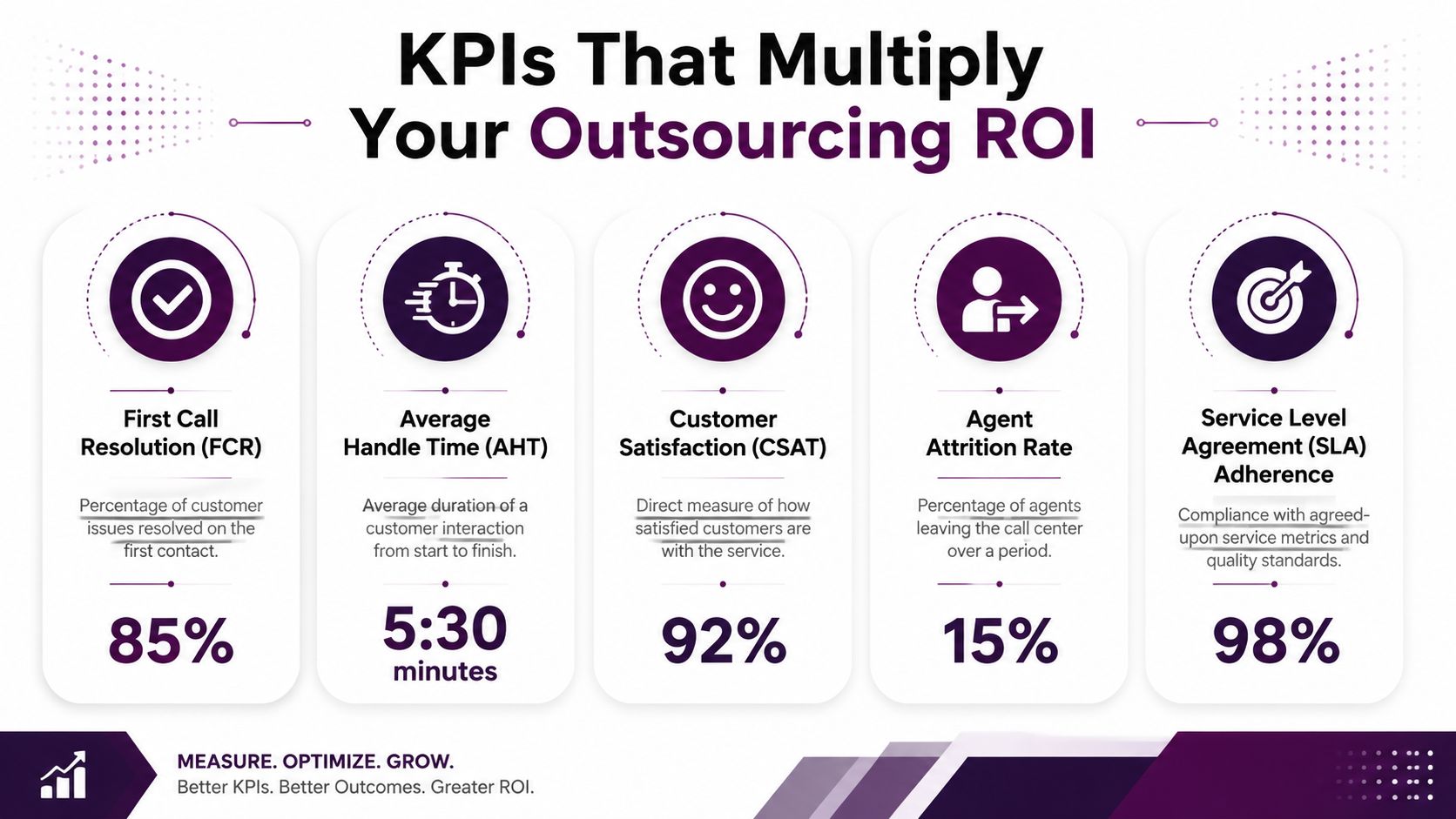
The operators who get strong returns manage a short list of KPIs ruthlessly. Not vanity metrics. Financially meaningful ones.
First Contact Resolution is the strongest signal
If a customer has to call back, your cost goes up and confidence goes down.
Vendors achieving First Contact Resolution of 75% or higher deliver 22% greater ROI than their peers, and that efficiency lowers total cost per case by 18–25%, according to IBT Evolve’s ROI evaluation framework.
That one metric tells you a lot:
- whether agents are trained well
- whether knowledge systems are usable
- whether handoffs are clean
- whether the operation is solving problems instead of recycling them
The KPI stack that deserves board-level attention
Use a scorecard that ties operations to financial consequence.
- FCR: This is your clearest measure of efficiency and service quality combined.
- AHT: Useful, but only when paired with resolution. Short calls that don’t solve the issue are expensive.
- CSAT: A direct signal that helps you understand whether cost savings are damaging customer experience.
- SLA adherence: This tells you whether staffing and workflow discipline are stable.
- Agent attrition: A leading indicator for future service disruption and retraining drag.
A useful way to benchmark role expectations is to review real-world job profiles like this Customer Contact Centre Hotline job. It shows how employers frame accountability around service quality, responsiveness, and customer handling discipline. That’s the kind of operational standard your outsourcing partner should hire for.
Tie customer metrics to financial outcomes
You don’t need a giant data science project to connect service metrics to money. You need discipline.
A simple example: if your outsourced team resolves more issues on first contact, repeat volume falls. That lowers cost per case, reduces queue pressure, and frees capacity for higher-value interactions. If the same team also protects customer satisfaction, your revenue quality improves over time.
Operating advice: Put FCR, CSAT, and attrition in the contract review rhythm. If they drift, ROI will drift right behind them.
One more point. Don’t let vendors hide behind average performance. Ask for trend lines, exception review, and root-cause analysis. A partner that can explain why performance changed is worth more than one that only reports a dashboard.
How CallZent Maximizes Your Nearshore ROI
A nearshore partner should do more than answer calls. It should improve the economics of your service operation.
That starts with the basics. Tijuana gives North American businesses the advantages that matter most in daily operations: proximity, time-zone alignment, bilingual talent, and easier management collaboration. Those aren’t nice extras. They influence speed, consistency, and issue resolution every week.
What stronger nearshore execution looks like
A well-run nearshore BPO improves ROI by removing friction from both sides of the business.
- Customer-facing gain: Agents communicate naturally with English and Spanish-speaking customers.
- Operational gain: Your internal team can coach, audit, and adjust the program without long delays.
- Management gain: Changes in scripts, policies, or workflows move faster because collaboration is simpler.
- Retention gain: Better customer experience protects long-term value.
That last point has real financial weight. A 5% improvement in customer retention can increase profitability by 25% to 95%, according to Net2Phone’s contact center ROI analysis.
A practical business example
Take a healthcare group with high inbound volume, bilingual patient demand, and strict expectations around responsiveness. A distant team may cover the phones, but if scheduling errors rise or patient conversations feel awkward, the organization pays for it through friction, repeat calls, and weaker patient trust.
A nearshore team in Tijuana is usually better positioned to support that environment. The language coverage is stronger. Collaboration with U.S.-based managers is easier. Escalations happen in closer sync with the client’s business day. The result is a smoother operation.
For companies evaluating the business case, this guide on how nearshore call centers reduce costs is useful because it focuses on the broader operating model, not just wage comparison.
You can see the same value logic across both Customer Service solutions from CallZent and Back Office Solutions from CallZent. Significant gains emerge when front-office and support operations work together instead of creating new internal bottlenecks.
Making the Final Decision Your ROI-Driven Checklist
A good outsourcing decision should survive scrutiny from finance, operations, and customer experience leadership at the same time. If it only works for one of those groups, it probably won’t hold up.
Use a short checklist and keep it strict.
The checklist I’d use before signing
- Know your real baseline: Build a full in-house cost model, including support management, hiring, training, QA, and operational overhead.
- Define the business outcome: Decide whether you need lower cost, better coverage, bilingual support, stronger retention, or all of the above.
- Judge the model, not just the rate: Compare in-house, offshore, and nearshore based on total business impact.
- Pressure-test hidden ROI: Ask how the partner will affect customer loyalty, escalation volume, internal coordination, and agent stability.
- Set KPI accountability early: Require clear reporting on FCR, CSAT, SLA adherence, and attrition.
- Review the vendor with discipline: Use a proper vendor evaluation criteria framework instead of relying on a polished sales deck.
- Protect the payback case: If the transition cost and service risk don’t support a credible return, wait.
The recommendation
If you serve North American customers and care about both cost and customer value, nearshore is usually the smartest strategic choice.
In-house often costs too much. Offshore often introduces too much friction. Nearshore gives you a stronger balance of efficiency, collaboration, language quality, and customer alignment. For many businesses, that’s where the ROI of call center outsourcing becomes durable instead of temporary.
Choose the partner that can protect customer lifetime value while running a tighter operation. That’s the one that improves enterprise value, not just this quarter’s expense line.
🚀 Build a Smarter ROI Case for Call Center Outsourcing
If you want a sharper view of your support economics, CallZent can help you build a custom ROI projection based on your volume, service mix, and growth goals.
Talk to an ExpertIf you want a sharper view of your support economics, contact CallZent to build a custom ROI projection based on your volume, service mix, and growth goals.