Skip to content
Healthcare Customer Service Outsourcing
Healthcare Customer Service Outsourcing Guide for Providers Choosing Nearshore Support
Learn how healthcare customer service outsourcing works, how to vet HIPAA-ready vendors, and why nearshore teams in Mexico offer a strong balance of cost, quality, and control.
TL;DR — Quick Takeaways
- Healthcare customer service outsourcing covers non-clinical patient communications such as scheduling, insurance verification, intake support, billing questions, and follow-up outreach.
- HIPAA compliance, secure workflows, and a clear Business Associate Agreement should be baseline requirements.
- Outsourcing can improve responsiveness and scalability, but only if the vendor understands healthcare workflows and trains agents properly.
- Nearshore outsourcing in Mexico often gives North American providers a stronger balance of cost, time-zone alignment, bilingual service, and management visibility than onshore or distant offshore models.
- Vendor selection should focus on security, training, integration, QA discipline, and reporting, not just price.
- Long-term success depends on careful implementation, realistic service levels, and active performance management.
Healthcare Contact Center Outsourcing
Healthcare contact center outsourcing allows providers to extend patient communication across phone, email, messaging, scheduling, billing support, insurance verification, and other non-clinical touchpoints through a specialized external team. Unlike a basic answering service, a healthcare contact center can support multiple communication channels while following documented workflows, escalation procedures, quality standards, and patient privacy requirements.
Most healthcare leaders ask the wrong first question about outsourcing.
They ask, “How much will it save?” A better question is, “Can this partner protect the patient experience while reducing pressure on our staff?” If the answer is no, cheaper support becomes expensive fast. Missed appointments, confused callers, billing frustration, and poor handoffs all come back to the practice.
Healthcare customer service outsourcing works when it’s treated as an operational design decision, not just a staffing shortcut. The right model gives clinics, medical groups, hospitals, and health-adjacent organizations more coverage, better consistency, and room for internal teams to focus on care delivery. The wrong model creates compliance headaches and a patient journey that feels fragmented.
What Is Healthcare Customer Service Outsourcing
Healthcare customer service outsourcing is the practice of assigning non-clinical, patient-facing support work to a specialized external team. That team handles communications that are essential to the patient experience but don’t require a licensed clinician.
For many providers, that distinction matters. Front-desk staff, care coordinators, and billing teams often spend too much time switching between phones, portal messages, intake tasks, insurance checks, and follow-up calls. Outsourcing shifts those operational contacts to a support partner so internal staff can stay focused on treatment, escalation, and in-office patient needs.
A good outsourcing relationship doesn’t feel like a disconnected answering service. It should feel like an extension of your practice operations, with clear workflows, documented scripts, escalation paths, and system access rules. Providers exploring broader administrative support often also understand revenue cycle outsourcing for practices because patient communication and revenue workflows often overlap at scheduling, eligibility, and billing touchpoints.

What functions are commonly outsourced
The scope is usually broader than people expect. Common services include:
- Appointment scheduling: Booking, rescheduling, cancellations, waitlist handling, and referral-based scheduling.
- Insurance verification: Confirming eligibility, checking plan details, and identifying missing coverage information before the visit.
- Billing support: Answering patient questions about balances, statements, payment options, and claim status.
- Pre-registration and intake: Collecting demographics, updating records, confirming forms, and preparing the patient before the appointment.
- Patient follow-up calls: Post-visit outreach, reminder calls, care plan check-ins, and no-show recovery outreach.
- Inbound patient inquiries: Handling routine questions about office hours, provider availability, directions, and documentation requirements.
- Overflow and after-hours coverage: Capturing calls when internal staff are unavailable and routing urgent matters properly.
Why providers use it
The main reason isn’t just labor arbitrage. It’s workflow control.
When a clinic’s internal team is overloaded, simple patient tasks start slipping. Calls ring too long. Insurance questions bounce between departments. New patients wait days for a callback. Outsourcing creates a dedicated layer for repetitive but important communication tasks. That can stabilize service and reduce burnout inside the practice.
For providers reviewing support models, CallZent’s service offerings provide a useful reference point for the kinds of inbound, outbound, and back-office functions that can be structured into a healthcare support program.
Key takeaway: Healthcare customer service outsourcing works best when it removes administrative friction without weakening the patient relationship.
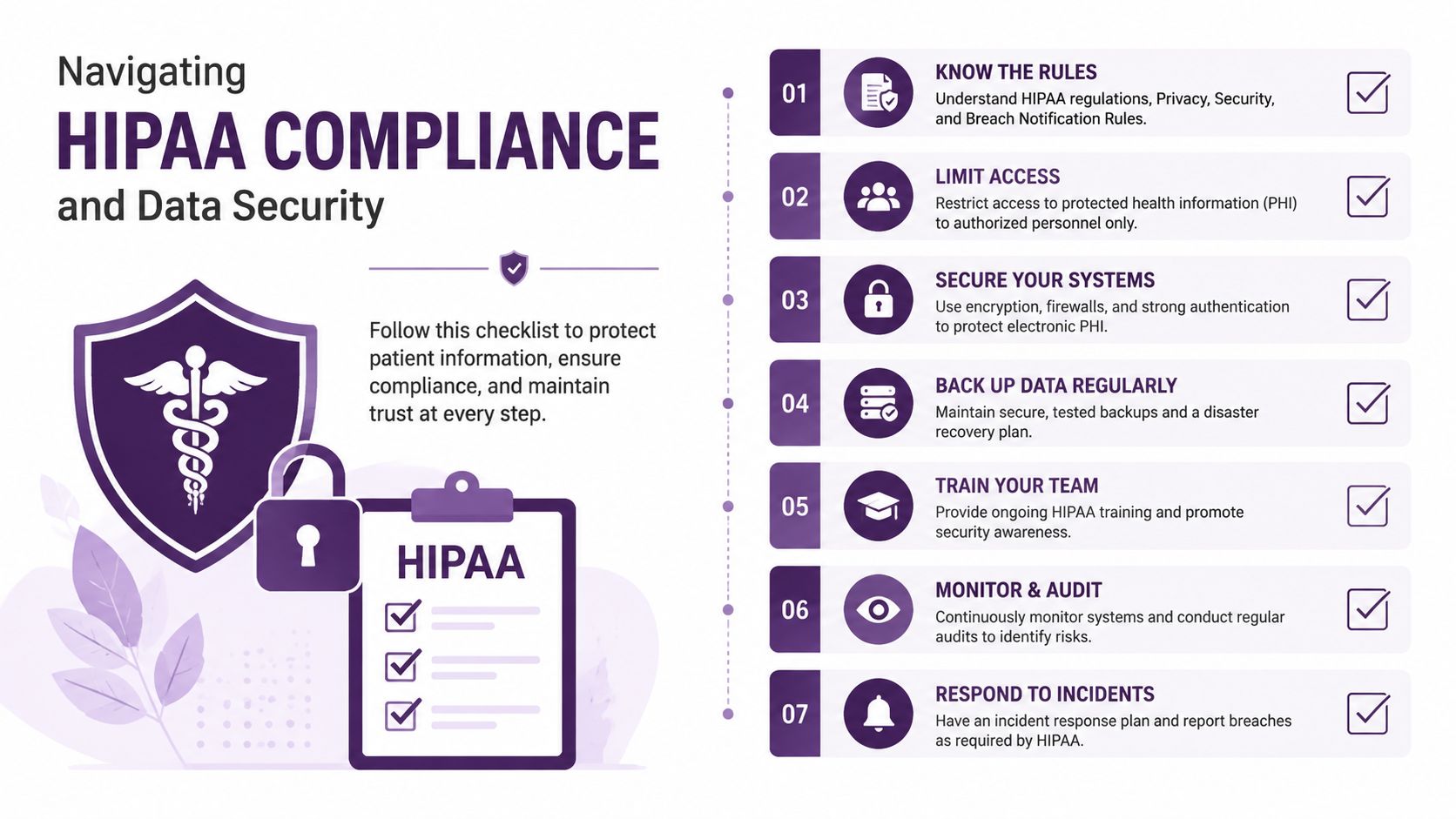
Navigating HIPAA Compliance and Data Security
If a vendor can’t explain its HIPAA controls clearly, the conversation should stop there.
In healthcare outsourcing, compliance isn’t a nice-to-have. It’s the foundation of the relationship. An outsourced team may hear, view, document, or transmit protected health information during routine tasks like scheduling, eligibility checks, or billing support. That means the provider needs more than general data security language. It needs healthcare-specific safeguards built into operations.
What HIPAA readiness should look like in practice
A serious healthcare BPO should be able to walk you through its controls in plain English. Look for these elements:
- Business Associate Agreement: The vendor should be ready to sign a BAA and discuss responsibilities without hesitation.
- Agent training: Staff handling patient communication should receive role-specific training on PHI, minimum necessary access, authentication procedures, and incident reporting.
- Secure systems: Communication channels, data storage, call recordings, and account access should be protected through documented security controls.
- Access management: Agents shouldn’t see more patient information than they need to complete the task in front of them.
- Auditability: Supervisors should be able to review who accessed what, when, and for what purpose.
- Workstation discipline: Clean desk policies, screen privacy, session timeout rules, device restrictions, and controlled environments matter more than many buyers realize.
- Incident response: The vendor needs a clear process for identifying, escalating, containing, and reporting security events.
If your organization wants a benchmark for what a healthcare-ready support operation should cover, review this overview of a HIPAA-compliant call center.
Security isn’t only digital
A common mistake is treating HIPAA as an IT checklist. In reality, many failures happen in human workflows. An agent verifies the wrong caller. A note is entered in the wrong field. A recording policy is unclear. A temporary process becomes permanent without review.
That’s why operational controls matter as much as technical tools. In vendor reviews, ask to see how the team handles identity verification, transfers, escalation notes, callback requests, and message delivery. Those are the moments where privacy protection either holds or breaks.
A compliant healthcare support operation is built in the workflow, not added after the contract is signed.
Don’t ignore edge cases
Some healthcare organizations also serve patients outside the United States or support cross-border administrative functions. In those settings, privacy obligations may extend beyond HIPAA. GDPR can become relevant depending on the patient base, data flow, and service model.
Physical asset handling can matter too. If your outsourcing arrangement touches retired devices or stored hardware, it helps to learn about Georgia HIPAA ITAD as part of broader data disposal planning. That’s separate from call center operations, but it reflects the same principle: patient data protection has to extend through the full operational chain.
Strategic Benefits and Potential Risks of Outsourcing
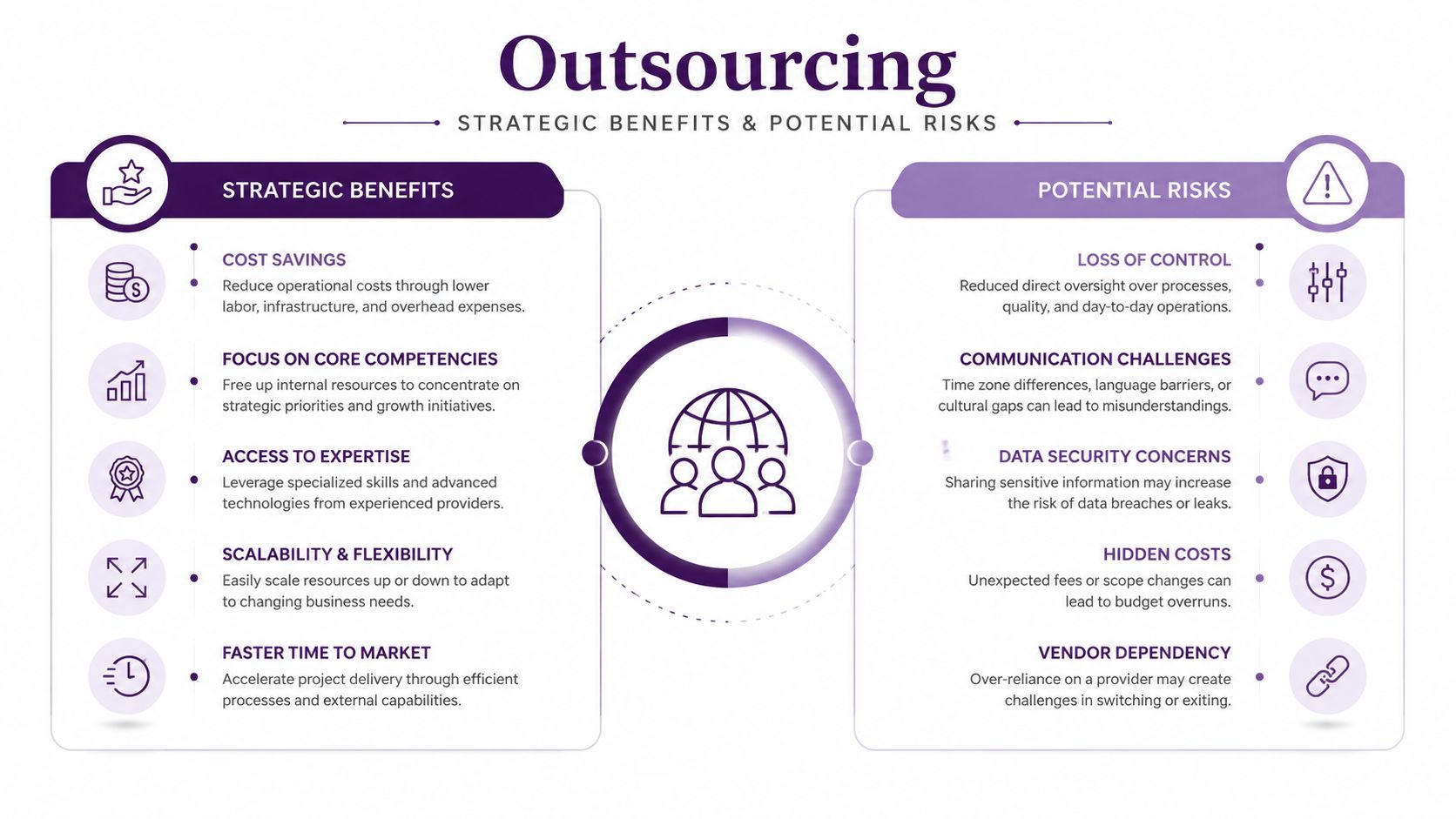
Healthcare customer service outsourcing isn’t automatically good or bad. It’s effective when the provider knows what problem it’s solving and chooses a partner that can operate inside healthcare standards.
Leaders usually feel two pressures at once. They need better coverage and lower administrative drag. They also don’t want to lose control of the patient experience. Both concerns are valid.
Where outsourcing creates real value
When the operating model is right, outsourcing can improve service in practical ways:
- Coverage flexibility: Teams can absorb overflow, after-hours contacts, seasonal demand spikes, and multi-location call traffic more smoothly than a fixed in-house desk.
- Administrative relief: Internal staff spend less time on repetitive communication tasks and more time on escalations, complex cases, and in-person support.
- Specialized handling: Agents who are trained only on healthcare workflows often outperform general reception coverage on consistency and call flow discipline.
- Bilingual patient access: Many providers need dependable English and Spanish support without constantly splitting staff between front-office duties and live calls.
- Scalable operations: New locations, provider additions, and campaign-based outreach become easier to support without rebuilding internal staffing from scratch.
This broader operational upside is one reason many organizations evaluate the business process outsourcing benefits of moving selected support functions outside the practice.
Where outsourcing can go wrong
The weak points are predictable. Most failed partnerships break down in one of three areas:
| Risk area | What it looks like in practice | What usually causes it |
|---|---|---|
| Compliance risk | Improper verification, uncontrolled access, weak documentation | Vendor lacks healthcare-specific operating discipline |
| Experience risk | Patients repeat themselves, receive inconsistent answers, or feel rushed | Training is shallow and scripts don’t match real workflows |
| Control risk | Leadership can’t see quality issues early or shape day-to-day execution | Reporting is thin and governance meetings are weak |
A useful external reference during vendor review is this 10-point HIPAA compliance checklist, especially for teams that want a simple way to pressure-test a partner’s security posture.
Practical rule: If a vendor talks mostly about price and barely about QA, escalation logic, and access control, expect problems later.
A well-chosen partner reduces most of these risks. A poorly chosen one multiplies them.
Why Nearshore Is the Smart Choice for Healthcare
The biggest strategic mistake I see is putting all outsourcing models in the same bucket. They aren’t interchangeable.
Onshore, nearshore, and offshore options each solve a different problem. For healthcare organizations in North America, nearshore support in Mexico often lands in the strongest operating position because it balances cost discipline with day-to-day manageability.
Healthcare outsourcing models compared
| Factor | Onshore (e.g., USA) | Nearshore (e.g., Mexico) | Offshore (e.g., India/Philippines) |
|---|---|---|---|
| Cost | Highest operating cost | Lower than onshore while still close to U.S. operations | Often lower labor cost, but trade-offs can grow elsewhere |
| Time zone alignment | Strong | Strong, especially for U.S. schedules | Can require overnight coordination or delayed collaboration |
| Cultural affinity | High | Typically strong for North American service expectations | Varies by provider and account training depth |
| Bilingual English and Spanish support | Often harder to scale affordably | Natural fit for many healthcare populations | Usually less native alignment for Spanish support |
| Collaboration with U.S. teams | Easy, but expensive | Easy and practical for live oversight and fast decisions | Can feel slower when operations are far removed |
| Site visits and management visibility | Simple | Simple relative to distant offshore models | More complex and less frequent |
| Fit for healthcare support | Strong if budget allows | Strong balance of cost, language, and oversight | Can work, but requires tighter governance |
Why Mexico fits healthcare particularly well
Healthcare communication is nuanced. Patients don’t just need a fast answer. They need a clear answer, often in the right language, delivered with enough context to avoid confusion. That’s where nearshore can outperform distant offshore setups.
Mexico gives providers practical advantages:
- Real-time collaboration: Your operations team can work with the vendor during the same business day, not overnight.
- Bilingual coverage: English and Spanish support is easier to structure into one unified program.
- Faster management loops: When scripts fail or scheduling logic changes, updates can happen quickly.
- Closer market familiarity: Teams near the U.S. market usually adapt more easily to North American expectations around tone, urgency, and patient communication.
- Easier oversight: Site visits, leadership workshops, and training audits are far more realistic.
For a broader market view, this overview of call centers in Mexico is worth reviewing.
Why Tijuana makes operational sense
Tijuana is especially practical for healthcare outsourcing because proximity changes behavior. Leadership visits are easier to plan. Training reviews don’t require a major travel event. Process fixes move faster because the client and partner can collaborate in near real time.
For healthcare organizations actively comparing providers, this roundup of Mexican call center options for healthcare helps frame what to evaluate.
Nearshore is the model that usually gives healthcare operators enough savings to matter, without creating the communication drag that undermines service quality.
A Healthcare BPO Vendor Selection Checklist
Vendor selection should feel less like shopping and more like risk screening.
A polished sales deck doesn’t tell you whether the team can manage referral scheduling, identify an urgent escalation, or keep billing calls from turning into patient complaints. The right questions surface that quickly.
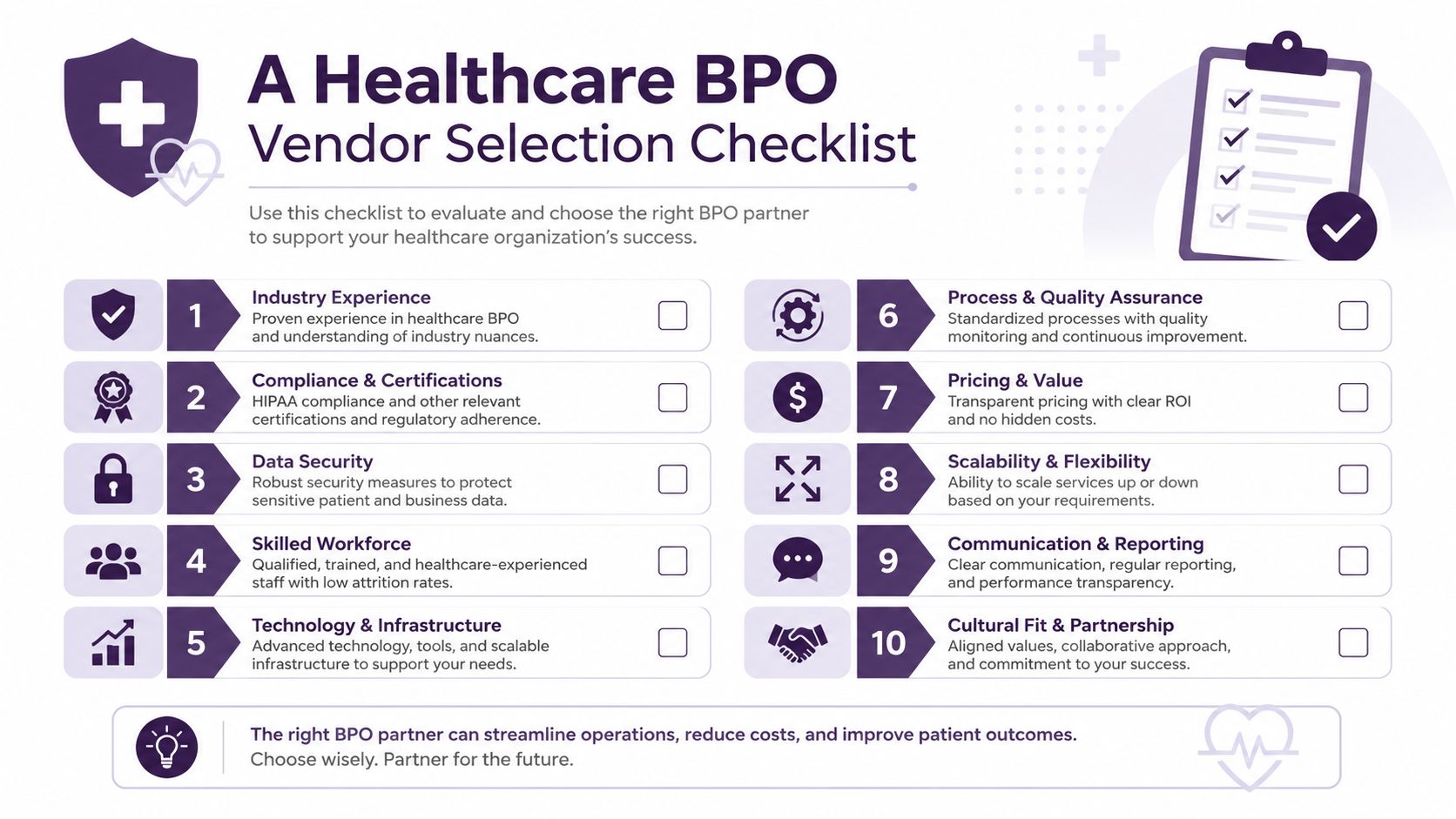
Questions to ask before you sign
Compliance and security
- Ask for the BAA early: Don’t wait until legal redlines at the end.
- Review access controls: Who gets system access, how is it approved, and how is it removed?
- Probe incident handling: Ask what happens if an agent sends information to the wrong recipient or documents a call incorrectly.
Training and quality assurance
- Request the training plan: You want to see onboarding, nesting, call calibration, refreshers, and supervisor involvement.
- Listen to sample calls if available: Tone matters. So does pacing, empathy, and message accuracy.
- Ask how quality is scored: If QA only checks courtesy and script adherence, that’s not enough for healthcare.
Technology and integration
- Clarify platform compatibility: Can the team work inside your scheduling system, CRM, telephony stack, or ticketing workflow?
- Ask about business continuity: What’s the backup plan during outages or workforce disruption?
- Understand recording and note policies: Not every interaction should be recorded the same way in a healthcare environment.
What strong answers sound like
Good vendors answer directly. Weak vendors drift into general language.
Look for specifics such as workflow examples, escalation maps, sample scorecards, credentialing steps, access restrictions, and reporting cadences. If you ask how they handle a same-day cancellation for a specialist visit, they should describe the process. They shouldn’t pivot to “our agents are highly trained.”
This is also the stage where buyers should compare firms side by side. A practical place to start is this guide on how to find and vet call center outsourcing companies.
“Show me your process” is a better buying question than “Tell me about your experience.”
A simple real-world test
Give each finalist the same scenario. For example: a Spanish-speaking patient calls about a billing question, then asks to reschedule an appointment and mentions a recent referral. Ask the vendor how the interaction would be handled from authentication to documentation to transfer or resolution.
That exercise tells you more than a capabilities slide ever will.
Implementation and Performance Management
The contract isn’t the finish line. It’s the handoff into operational work.
Most outsourcing problems don’t begin with bad intent. They begin with rushed implementation. The healthcare provider assumes the vendor will “figure it out.” The vendor assumes the workflow is simpler than it is. Patients feel the gap immediately.
The three pieces that need to be built carefully
First, technology integration has to be tight. Agents need the right system access, not broad access. Scheduling tools, CRM notes, phone systems, ticketing queues, and any approved patient communication channels must work together in a controlled way.
Second, agent training has to reflect your actual environment. Generic healthcare training won’t cover your referral rules, appointment types, scripting preferences, or triage boundaries. Teams need scenario-based practice with your terminology, your escalation pathways, and your documentation standards.
Third, performance management needs the right scorecard. Average handle time alone can push the wrong behavior in healthcare. A short call isn’t helpful if the patient leaves confused or the appointment is entered incorrectly. Many organizations, therefore, benefit from structured guidance on how to monitor call center performance.
What to track
A practical scorecard usually includes a mix of service, quality, and accuracy indicators:
- Resolution quality: Did the patient get a correct answer or a clean handoff?
- Scheduling accuracy: Was the appointment booked correctly, with the right provider, visit type, and instructions?
- Patient experience: Did the interaction feel clear, respectful, and easy to complete?
- Escalation discipline: Did the agent route urgent or sensitive issues correctly?
- Documentation quality: Were notes complete, useful, and compliant?
One provider may need after-hours scheduling support. Another may need bilingual billing assistance and reminder calls. That’s why the operating model should be customized, not templated. CallZent is one example of a nearshore provider that supports bilingual customer service and back-office workflows for North American organizations, including healthcare-related use cases.
The strongest partnerships don’t run on autopilot. They run on weekly reviews, call listening, workflow updates, and fast correction when patient friction appears.
🚀 Ready to Build Better Healthcare Customer Support?
CallZent helps North American healthcare and health-adjacent organizations build bilingual nearshore support teams for scheduling, intake, billing questions, follow-up outreach, overflow coverage, and back-office workflows.
Talk to an ExpertFAQs About Healthcare Customer Service Outsourcing
What is healthcare customer service outsourcing?
Healthcare customer service outsourcing is the practice of assigning non-clinical patient communication tasks to an external support team. These tasks may include appointment scheduling, billing questions, insurance verification, intake support, follow-up calls, and overflow coverage.
Which healthcare customer service tasks can be outsourced?
Common outsourced tasks include appointment scheduling, insurance eligibility checks, patient intake, billing support, reminder calls, post-visit follow-up, inbound patient inquiries, referral coordination, after-hours support, and overflow call handling.
Does healthcare customer service outsourcing require HIPAA compliance?
Yes. If the outsourced team handles protected health information, the vendor should follow HIPAA-ready workflows, sign a Business Associate Agreement, train agents on PHI handling, control access, document activity, and maintain clear incident response procedures.
What is a Business Associate Agreement?
A Business Associate Agreement, or BAA, is a contract that defines how a vendor will protect protected health information when working with a covered entity or healthcare organization. It should be addressed early during vendor selection.
Why do healthcare providers outsource customer service?
Providers outsource customer service to improve coverage, reduce staff overload, manage call volume, support bilingual patients, handle repetitive administrative tasks, improve responsiveness, and scale operations without overburdening internal teams.
What are the risks of healthcare customer service outsourcing?
Risks include weak HIPAA controls, poor verification procedures, inconsistent patient communication, shallow training, poor documentation, limited reporting, and low management visibility. These risks can be reduced with strong vendor selection and active oversight.
Why is nearshore healthcare outsourcing a good option?
Nearshore healthcare outsourcing can provide North American providers with cost savings, time-zone alignment, bilingual English-Spanish support, easier oversight, faster collaboration, and stronger management visibility than distant offshore models.
Why is Mexico a strong nearshore option for healthcare support?
Mexico offers strong alignment with U.S. operating hours, bilingual talent, cultural familiarity with North American service expectations, and practical proximity for training, audits, leadership visits, and real-time workflow updates.
How should healthcare organizations choose a BPO vendor?
Healthcare organizations should evaluate HIPAA readiness, BAA willingness, access controls, training plans, QA scorecards, escalation procedures, system compatibility, business continuity, reporting cadence, and healthcare workflow experience.
How can CallZent help with healthcare customer service outsourcing?
CallZent helps North American organizations build bilingual nearshore support teams for healthcare-related customer service, scheduling, intake, billing support, follow-up calls, overflow coverage, and back-office workflows from Tijuana, Mexico.
If your team is weighing healthcare customer service outsourcing and wants a nearshore model that’s easier to manage in real time, CallZent is a practical place to start the conversation. The right partner should help you evaluate fit, define workflows, and build a support program around your compliance needs, patient expectations, and operating goals.