
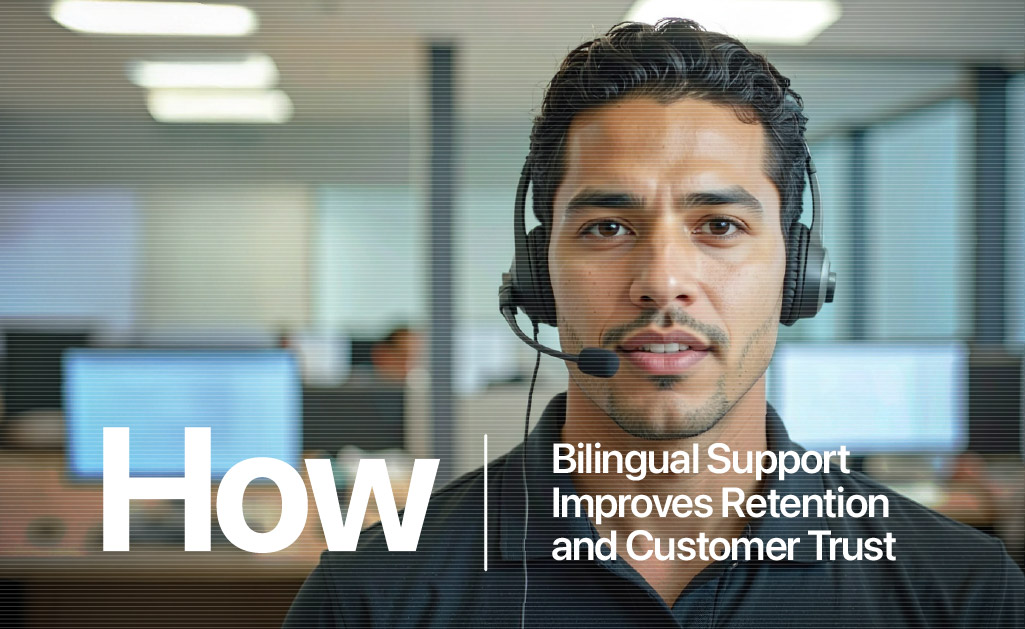
Bilingual Customer Support
How Bilingual Support Improves Retention and Customer Trust
Learn how bilingual support improves retention by reducing customer effort, preventing confusion, building trust, and improving first-contact resolution.
TL;DR — Quick Takeaways
- Bilingual support improves retention by reducing friction at critical customer moments.
- Customers are more likely to stay when they can explain billing, delivery, technical, healthcare, or account issues in the language they understand best.
- Clear communication helps prevent avoidable churn caused by misunderstanding policies, payments, renewals, troubleshooting steps, or next actions.
- Bilingual agents can improve trust, first-contact resolution, and repeat-contact trends when they are trained on both language and product knowledge.
- A strong bilingual retention strategy should measure customer satisfaction, first-contact resolution, repeat contacts, complaint themes, and cancellation reasons by language.
A customer who cannot clearly explain a billing concern, a delivery issue, or a technical problem is already closer to leaving. That is the business case for how bilingual support improves retention: it removes a source of friction at the exact moment a customer needs reassurance, resolution, and a reason to stay.
For U.S. businesses serving both English- and Spanish-speaking customers, language access is not simply a service feature. It affects whether customers complete a purchase, accept a solution, understand a policy, and feel respected by the company behind the interaction. When support is available in the customer’s preferred language, conversations become clearer and relationships become more durable. The U.S. Census Bureau’s Language Use data is a useful reference for understanding how multilingual the U.S. customer base has become.
How Bilingual Support Improves Retention at Critical Moments
Retention is rarely won through a single memorable interaction. More often, it is protected through dozens of small moments in which customers get an accurate answer without unnecessary effort. A bilingual support program helps make those moments easier, especially when an issue is urgent or emotionally charged.
Consider a customer calling about a declined payment, an insurance question, an account error, or a missed appointment. They may speak conversational English but prefer Spanish when discussing details, policies, or financial information. If they have to repeat themselves, wait for an interpreter, or rely on a family member to translate, the experience can feel stressful and impersonal. Even if the company eventually resolves the problem, the customer has learned that getting help is difficult.
Direct Spanish-language support changes that dynamic. A trained agent can clarify the issue, confirm next steps, and check understanding in the same conversation. The customer spends less energy navigating the support process and more time receiving a useful solution. That reduction in customer effort is a meaningful retention advantage.
Clear communication prevents avoidable churn
Many cancellations and complaints begin with confusion rather than dissatisfaction with the core product or service. A customer may misunderstand a renewal date, return policy, payment arrangement, prescription instruction, or troubleshooting step. When the explanation is incomplete, they may assume the business is being evasive or unfair.
Bilingual agents help close those gaps with plain, accurate communication. They can explain policies without relying on awkward scripts or literal translations that lose the intended meaning. They can also recognize when a customer is agreeing politely without fully understanding the resolution, then slow down and confirm the details.
This matters in every industry, but particularly in healthcare, consumer finance, legal services, telecom, eCommerce, and technical support. In these settings, a minor misunderstanding can have outsized consequences. Customers who feel informed are more likely to follow through, stay engaged, and return when they need help again. For healthcare and regulated environments, the U.S. Department of Health & Human Services’ guidance on Limited English Proficiency is also a helpful reference for understanding why language access matters.
Trust Grows When Customers Feel Heard
Customers do not separate language from trust as neatly as businesses sometimes do. They experience the two together. Being able to describe a problem naturally, ask follow-up questions, and hear empathy in familiar language signals that the company is prepared to serve them as an individual.
That feeling has practical value. Customers who trust a business are more likely to give it a second chance after a service issue. They are also more likely to accept a reasonable resolution instead of escalating, disputing a charge, or switching to a competitor.
The agent experience plays a major role here. Bilingual support is not just about assigning Spanish-speaking calls to anyone who speaks Spanish. Strong programs hire and develop agents who can communicate professionally in both languages, understand the client’s products and policies, and use judgment with frustrated customers. Language fluency without product knowledge can create new problems. Product knowledge without cultural awareness can make an interaction sound cold or overly scripted.
The strongest customer conversations combine both. The agent understands what the customer means, not only the words they use. They can recognize urgency, adapt their explanation, and make the person on the other end of the line feel like their concern belongs with the business. The U.S. Bureau of Labor Statistics’ overview of customer service representatives is a useful external reference for the communication, problem-solving, and customer-facing skills required in support roles.
Better Resolution Quality Reduces Repeat Contacts
A customer who contacts support three times about the same issue is unlikely to view the company as dependable. Repeat contacts increase operational costs, but they also weaken confidence. Each handoff or repeated explanation raises the chance that the customer will abandon the issue, abandon the purchase, or abandon the relationship.
Bilingual support can improve first-contact resolution by allowing customers to communicate fully from the start. Agents can ask better diagnostic questions and receive more precise answers. This is especially useful for technical troubleshooting, order processing, appointment scheduling, and collections, where a small detail can determine whether the issue is actually resolved.
For example, an eCommerce customer may call in Spanish because an order was delivered to the wrong address. An agent who can confirm the address, explain replacement options, and provide the next update in Spanish is more likely to preserve the sale than a process that forces the customer across multiple channels. The same principle applies to a patient confirming an appointment or a consumer trying to understand a payment plan.
A quality bilingual program should track repeat-contact reasons by language, not just total call volume. If Spanish-speaking customers are calling back more often about a certain policy or product issue, that is useful operational insight. It may point to unclear messaging, missing self-service content, or an internal process that needs attention.
Bilingual Service Extends the Reach of Your Brand
Retention is closely tied to consistency. Customers should receive the same standard of care whether they call in English or Spanish, contact the business after hours, or need help during a high-volume period. That requires more than translation. It requires a support operation designed around the brand promise.
For growing companies, building that capability entirely in-house can be expensive and slow. Recruiting bilingual talent, covering extended hours, maintaining training, and planning for volume changes all require sustained management attention. Outsourced bilingual support can be a practical alternative when it operates as an extension of the internal team rather than a disconnected call center.
A nearshore model can be especially effective for U.S. companies because agents work in similar time zones and understand North American customer expectations. Teams based in Mexico can provide English and Spanish support while making real-time collaboration, coaching, and quality reviews easier than with distant offshore operations.
Still, outsourcing is not automatically the right answer for every business. Companies with highly specialized, low-volume interactions may need a smaller dedicated team with deeper subject-matter training. Businesses with routine, high-volume customer contacts may benefit more quickly from a scalable bilingual partner. The right structure depends on call complexity, compliance requirements, seasonality, and the level of brand control the business needs.
What to Look for in a Bilingual Retention Strategy
A bilingual program earns its value through execution. Before expanding language support, leaders should define the customer moments where retention is most vulnerable: cancellations, payment questions, product setup, complaints, returns, service interruptions, and post-purchase follow-up are common starting points.
Then evaluate whether both language experiences are receiving equal attention. That means comparable training, accessible knowledge bases, consistent quality standards, and clear escalation paths. Spanish-speaking customers should not receive a shorter version of the support experience or be transferred more often for complex issues.
Measurement should also go beyond average handle time. Fast calls are useful only when customers leave with the right answer. Monitor first-contact resolution, repeat contacts, customer satisfaction by language, cancellation reasons, complaint themes, and retention trends for bilingual customer segments. Review conversation quality, too. Are agents confirming understanding? Are they able to explain policy choices with confidence? Are they documenting customer needs so the next interaction feels informed?
Agent empowerment belongs in this strategy. When agents have the training and authority to make reasonable decisions, they can resolve problems before they become loyalty-breaking events. A customer does not remember an internal approval workflow. They remember whether someone took ownership. This is why agent empowerment should be treated as part of retention strategy, not just an internal management philosophy.
CallZent approaches bilingual support as a relationship-building function, not a transactional coverage requirement. The goal is to give customers clear answers from engaged agents while giving growing businesses the flexibility to scale service around real demand.
Every customer interaction is a small test of whether your business is easy to stay with. Give customers the option to be understood in the language that feels most natural, and make every answer worthy of their continued trust.
🚀 Build Bilingual Support That Helps Customers Stay
If your business serves English- and Spanish-speaking customers, CallZent can help you build a bilingual support program that improves clarity, strengthens trust, and supports long-term retention.