Skip to content


Contact Center Measurement
How to Measure First Call Resolution Rate: A Practical Guide
Define resolution, build a consistent issue cohort, reconcile the evidence, and turn repeat-contact findings into better customer support.
TL;DR — Quick Takeaways
- Define the resolution rule, eligible issues, transfer treatment, and observation window before calculating FCR.
- Use the same unit and cohort in the numerator and denominator; count each issue once.
- Reconcile agent codes, customer feedback, and same-issue contacts across channels and languages.
- Keep recent cohorts provisional until their observation windows close, and disclose missing evidence.
- Read FCR with quality, satisfaction, effort, and repeat contacts, then fix the underlying workflow.
The most popular advice on how to measure first call resolution rate starts with a formula. That’s backwards. Before you calculate FCR, decide what qualifies as resolution, which issues qualify for measurement, and how you’ll catch a customer returning with the same problem. Otherwise, you’re reporting how confidently agents close tickets, not how reliably they solve problems.
A useful FCR program makes managers accountable for the measurement rules, not just agents accountable for the result. Build it around evidence you can reconcile and a scorecard that makes premature closures visible.
Why Most FCR Numbers Are Wrong Before You Start
A dashboard can display a precise FCR percentage while the underlying rules remain vague. That number is not ready for leadership reporting. Precision in presentation isn’t precision in measurement.
FCR measures first-interaction resolution, not ticket closure. Qualtrics describes first contact resolution as resolving a customer’s issue in the initial interaction. For phone-specific reporting, define whether a transfer completed within the same connected call is allowed. A no-transfer rule is a stricter local policy and should be labeled separately, not assumed to apply to every FCR report.
Consider a retailer’s hypothetical delivery inquiry. An agent provides a tracking status and closes the ticket, but the customer calls again because nobody addressed the missing package. The first agent completed a task. The customer’s problem remained open.
Write the measurement contract before publishing the result
The denominator deserves as much scrutiny as the resolution code. Abandoned calls, customer-requested callbacks, service outages, and issues outside frontline authority all require explicit treatment. Don’t let individual supervisors decide their status while preparing reports.
Use a short policy that identifies:
- Scope: The channel, customer population, issue categories, and unit being measured: calls, cases, or distinct issues.
- Eligibility: Which issues qualify, which don’t, and the business reason for each exclusion.
- Resolution evidence: What completion requires, how transfers and follow-up are treated, and which checks support the result.
- Ownership: Who approves changes and explains their effect on reporting.
Practical rule: If supervisors can change eligibility rules without documenting the change, don’t use the resulting FCR to rank their teams.
The policy also needs a repeat-contact window. Without it, a case can appear successful because the report was pulled before the customer returned.
Treat that policy as an operating agreement between operations, quality assurance, reporting, and the client. Freeze it for the reporting period. When a rule changes, label the change rather than presenting the resulting movement as better service.
That’s the foundation of an honest metric: everyone measures the same promise to the customer.
The FCR Formula and the Denominator Decisions That Matter
The calculation itself is straightforward:
For the issue-based cohort used in this guide: FCR rate = (eligible issues resolved during their first call and validated under the agreed observation rule ÷ all eligible issues whose first call occurred in the reporting cohort) × 100. Both counts must use the same scope and unit. For example, 1,500 qualifying first-call resolutions among 2,000 eligible issues produce 75% FCR. These are hypothetical figures, not benchmark results.
The difficult part is deciding which distinct issues belong underneath that fraction. Apply those decisions before calculating the result, not after seeing whether it meets your target.
Define a Consistent FCR Denominator
These are recommended policy choices, not universal exclusions.
| Issue or contact type | Include in denominator? | Why |
|---|---|---|
| Distinct eligible issue first handled by phone in the cohort | Yes | Count each issue once, including eligible issues that remain unresolved. |
| Abandoned call | Separately classified | Report access failures visibly, but don’t assume an agent had a resolution opportunity. |
| Customer-requested scheduled callback | Depends on documented purpose | Distinguish a deliberately deferred request from a callback needed to finish unresolved work. |
| Technical outage contact | Segment explicitly | Decide whether the issue was resolvable during the interaction; retain the outage workload in reporting. |
| Issue outside agent authority | Depends on established eligibility | Don’t remove it merely because the agent couldn’t act. Examine the authorization rule. |
| IVR self-service completion | Separate from agent-assisted FCR | Keep automated outcomes identifiable rather than blending different service paths. |
| Bot interaction | Separate channel classification | Define the automated interaction and any subsequent agent handoff. |
| Same-issue repeat call | Link to the original issue | Link the repeat to the original issue and update its outcome; do not add a second initial issue to this cohort. |
Keep phone FCR separate from omnichannel resolution
For phone reporting, label the metric first call resolution. For a program covering phone, chat, email, text, and social interactions, use first contact resolution and define the initial interaction for each channel.
A customer who starts in chat and then calls about the same unresolved issue has already needed a second contact. Keep that journey out of a cohort defined as issues first handled by phone, while retaining the call in channel workload reporting. If a separate measure tracks resolution on the first phone call after another channel, label that narrower scope explicitly.
Use your call center KPI framework to keep these populations distinguishable.
For a spreadsheet implementation, keep one row per distinct issue, plus a linked interaction log for every call, email, or chat. Include issue ID, first-contact timestamp, initial channel, category, language, eligibility, exclusion reason, initial completion status, required follow-up, observation end, same-issue return status, and final validation outcome. Record unknown or unmatched activity rather than silently treating it as success.
For the final rate, filter to eligible phone-first issues in the cohort whose observation windows have closed. Count validated first-call resolutions and divide by all eligible issues in that same matured cohort. Keep unresolved issues in the denominator, and show provisional cohorts separately. Keep excluded workload on another visible tab. An exclusion changes the metric’s scope; it doesn’t erase the work your team handled.
Three Sources of FCR Evidence to Reconcile
An agent says the issue is resolved. The customer disagrees. The CRM shows another contact. Don’t choose whichever signal makes the report look better.
Agent logging, customer feedback, and repeat-contact analysis provide different evidence. Label agent-coded initial completion as provisional and the reconciled result after observation as validated cohort FCR. These are working labels for this guide, not universally standardized metric names. No recorded repeat is supporting evidence; it does not prove the customer’s problem was solved.
The methods below help you find disagreement rather than hide it.
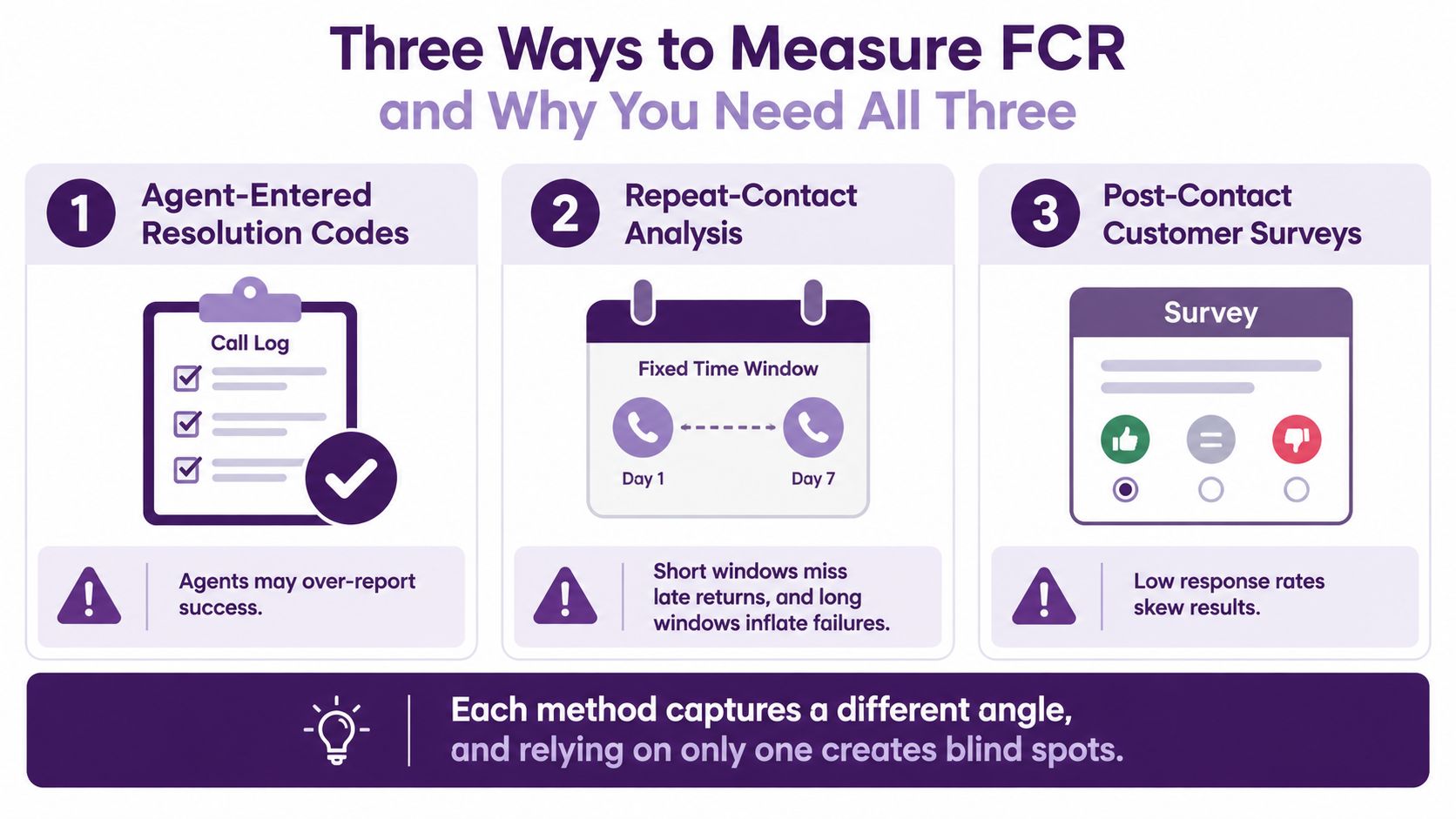
Compare the evidence, not just the totals
| Method | What it tells you | What to challenge |
|---|---|---|
| Agent-entered resolution codes | Whether the agent believed the issue was solved | Premature closure, inconsistent coding, and pressure to meet targets |
| Repeat-contact analysis | Whether the customer returned about the original issue | Missing case links, incorrect issue matching, and unsuitable observation windows |
| Post-contact surveys | Whether the customer considered the issue resolved | Response coverage, language representation, and timing |
Agent codes are useful because they capture the decision made during the interaction. They’re not independent validation. Require a short resolution note explaining what changed for the customer, rather than accepting a status selection alone.
Surveys provide a different perspective. Ask whether the original issue was fully resolved and whether another contact was needed. Link responses to the original issue, disclose response counts and response rate, and connect the findings through your voice-of-customer program. Keep satisfaction separate: a customer can appreciate the agent while still needing help.
Investigate disagreement at case level
In a hypothetical bilingual support journey, a customer calls in English and later emails in Spanish about the same billing dispute. Link both interactions through the original issue ID, verified customer identity, and case context. A customer ID or broad category alone can conflate separate billing problems. Language changes shouldn’t reset the history.
A widening gap between provisional completion and validated cohort FCR should trigger a review. Compare the same issue cohort after its window has closed, then check premature closure, failed fixes, disputed survey responses, and broken contact matching. Distinguish findings from incomplete evidence before assigning an outcome.
Assign a reviewer to disagreements. Record the evidence, final disposition, and reason for any correction, and preserve the original agent code for audit. Review unmatched contacts and survey nonresponse as coverage limitations rather than assuming every unobserved outcome is resolved.
Key takeaway: Treat agreement across the methods as supporting evidence, and disagreement as work for the operations team to investigate.
Setting a Repeat-Contact Window That Actually Fits Your Queue
A password reset and an insurance claim shouldn’t automatically share the same observation window. Choose a window that gives the customer a realistic opportunity to discover whether the original action worked.
Choose the repeat-contact window from the timing of actual same-issue returns and when customers can verify the fix. A seven-day window can be used as a hypothetical policy example, but it is not a universal FCR standard. Document any category-specific windows before comparing results.
The key decision is how long you need to observe the original issue before calling the result durable.
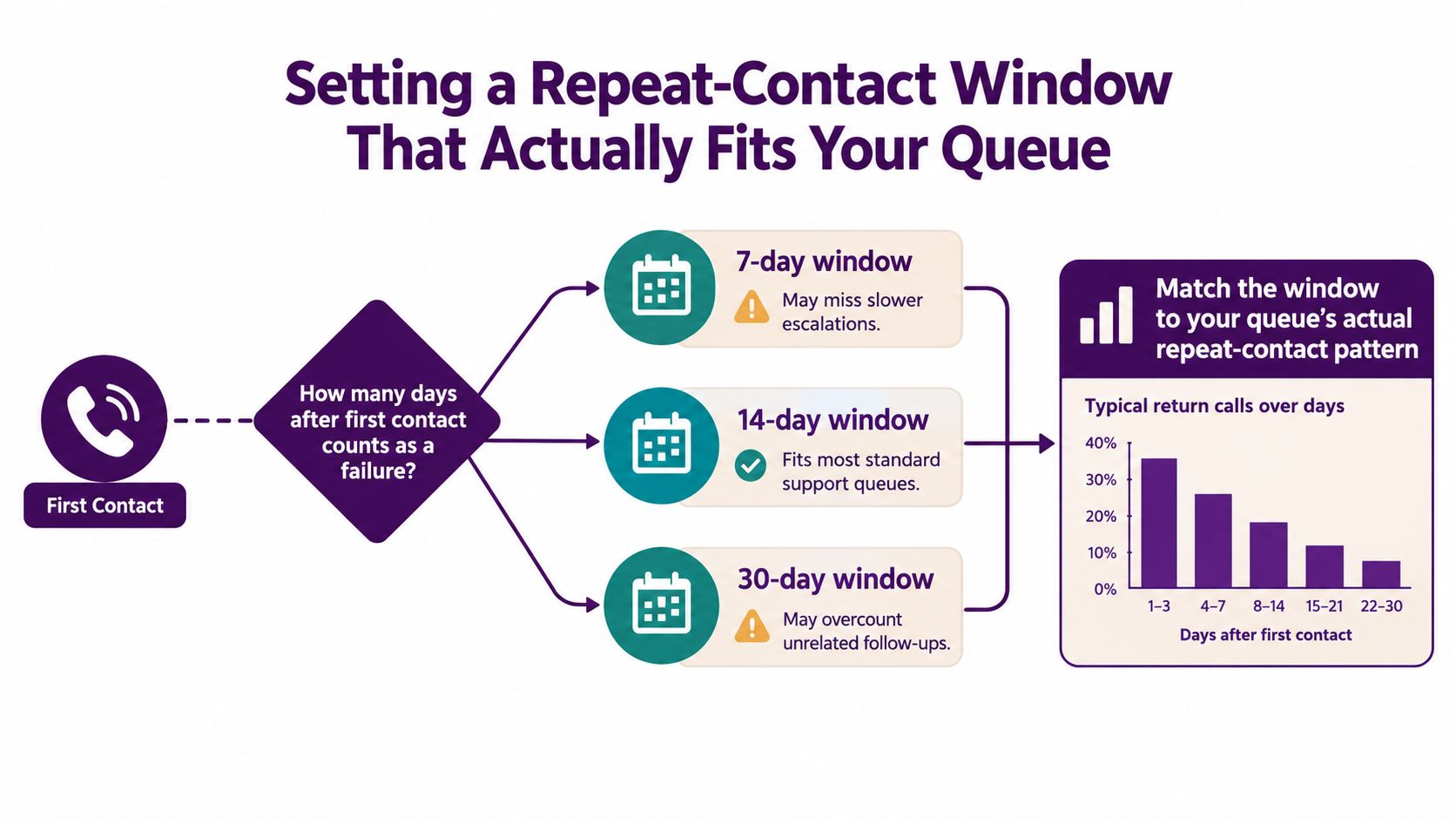
Match the window to when the customer can verify the fix
For a password reset, the customer may test the outcome immediately. For a disputed bill, verification may depend on a corrected statement. A technical repair may need observation under normal use.
Review the timing and reasons for actual same-issue returns before choosing category-specific rules. Apply category-specific windows only when the operational reason is documented, and show the category mix in reporting.
For a repair operation, link the support issue to the relevant repair work order. Distinguish a new fault from a return about unfinished work, and do not mark the original repair resolved merely because an appointment was booked. A scheduled next step and a completed customer outcome are different events.
Implement the rule in the CRM
Configure fields for the original issue ID, customer identity, issue category, initial call end, initial completion status, window end, and return-contact reason. For a consistent cohort, start the observation clock at the end of the initial call, including when the issue was not completed then. Have the matching process flag possible repeats for review rather than classifying every customer return as failure.
- Outbound follow-ups: Link them to the original case. Required unfinished work shouldn’t disappear because your team initiated the next interaction.
- Scheduled callbacks: Record whether the customer deliberately deferred action or the agent needed another interaction to resolve the issue.
- Language and channel changes: Retain the original case relationship instead of treating the new route as a new problem.
Don’t finalize validated cohort FCR before the observation window closes. Label recent cohorts as provisional, then publish the matured result.
The window is a reporting policy. Change it deliberately, document the reason, and preserve the previous definition for comparison.
Separate required follow-up from confirmation
A callback required to finish unresolved work means the issue was not completed on the initial call under this guide’s rule. A courtesy confirmation after an already completed outcome need not automatically fail FCR. Review its purpose and customer response; do not use outbound contact to hide work that remained open.
A reopened case is also a review signal, not automatic proof of a failed initial resolution. Check whether it concerns the same issue, a mistaken closure, a different request, or an administrative correction. Publish the rule for later failures discovered beyond the observation window, including when historical results will be restated.
Build a Scorecard That Makes Premature Closure Visible
If you reward agents only for initial closures, you give them a reason to close cases before the work is finished. An accurately unresolved case is more useful than a successful disposition that leaves the customer chasing support.
Blindly maximizing FCR can encourage rushing, deflection, and premature closure. Fraud investigations, prior authorizations, account takeovers, escalated complaints, and cases involving outside organizations need explicit treatment. Use a segmented scorecard that keeps first-call resolution, repeat contacts, effort, satisfaction, and reopening visible together.
Use adjusted views to explain performance, not to soften the main definition.
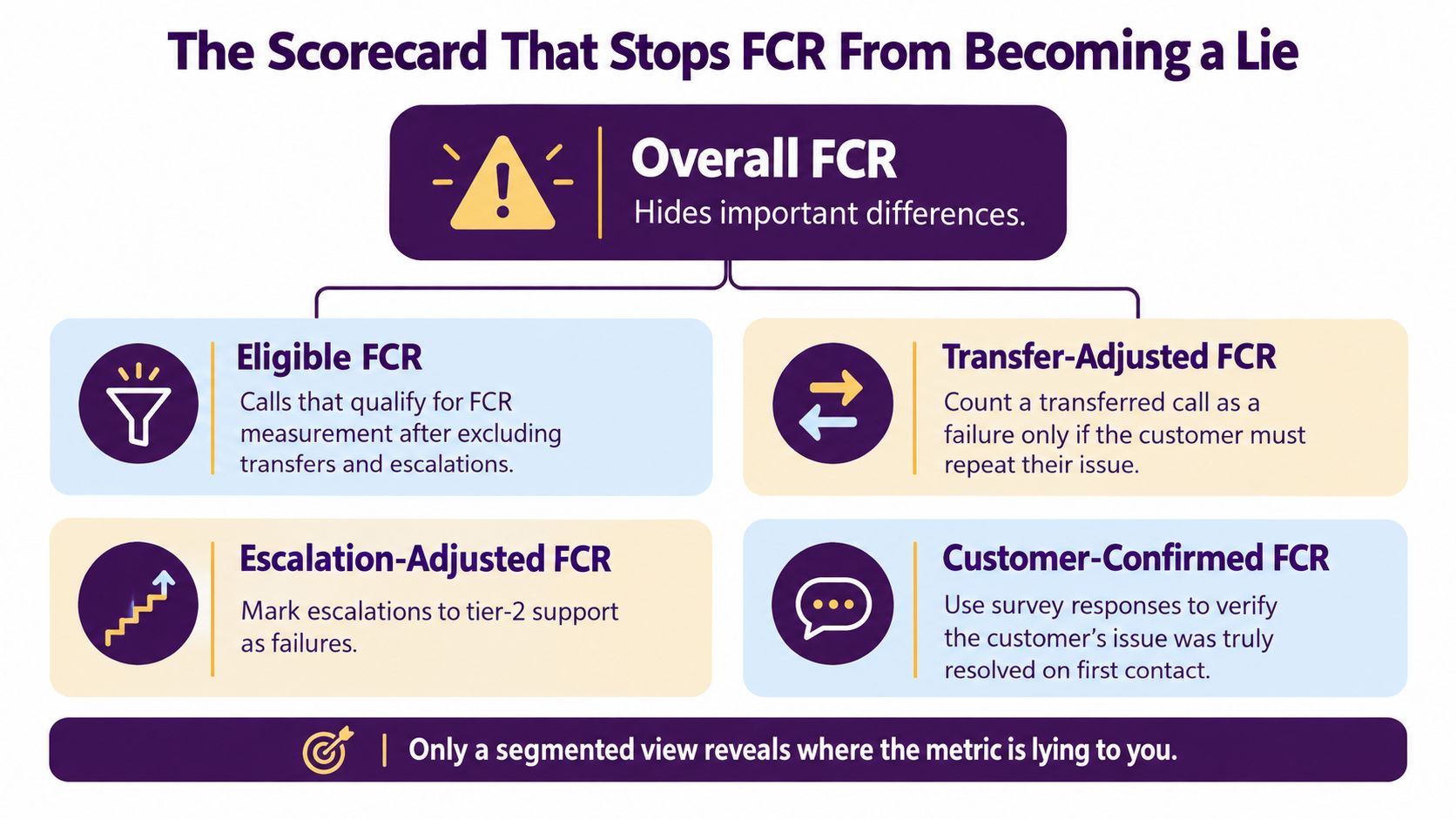
Keep adjusted measures clearly labeled
An in-call transfer does not create a second customer contact by itself. Decide whether the primary FCR definition allows a completed warm handoff within the original connected call. Track transfer rate separately, and label a stricter no-transfer first-call measure if useful. A required later interaction to finish the issue does not become first-call resolution simply because the escalation was appropriate.
| Scorecard measure | Management question |
|---|---|
| Validated cohort FCR | How often did eligible issues meet the published first-call completion and observation rules? |
| Transfer rate and optional no-transfer measure | How often are handoffs needed, and how does a separately labeled no-transfer rule affect the result? |
| Repeat-contact rate | Which issues bring customers back? |
| Customer effort | What work did the customer need to do to obtain help? |
| Customer satisfaction | How did the customer evaluate the experience? |
| Reopen rate | Which supposedly completed cases required more work? |
For a hypothetical prior-authorization case, an agent may correctly explain the process and collect the required information without securing approval during the call. Judge that interaction against the appropriate workflow standard. Don’t demand a false resolution code to protect FCR.
Audit contradictions before celebrating improvement
When FCR rises while satisfaction falls or repeat contacts worsen, investigate. The pattern may reflect coding changes or measurement gaming, but it can also expose case-matching errors or shifts in workload.
Use your contact center quality assurance process to review resolved cases against recordings, notes, subsequent activity, and customer feedback.
Require documented exclusions, retain the excluded workload, and review the combined scorecard monthly. QA should check whether agents solved the issue and whether reporting represented that outcome accurately. Both matter.
Reading FCR Benchmarks Without Fooling Yourself
A benchmark is useful only when you understand how the publisher measured it. Don’t compare a survey result with an agent-coded CRM result and call the difference a performance gap.
SQM Group’s FCR research and measurement guide discusses how results vary by contact type, industry, and measurement method. Review the publisher’s population, time period, survey wording, and calculation before treating a reference percentage as comparable.
There is no useful universal target without a compatible definition. A survey result, an agent-coded closure rate, and an issue cohort validated through subsequent activity measure different evidence. Do not average them into one headline or treat a higher value as proof of stronger service.
For a hypothetical internal comparison, moving from 150 validated resolutions out of 200 eligible matured issues to 160 out of 200 changes FCR from 75% to 80%: an increase of 5 percentage points. It is not a five-percent relative increase. Confirm that scope, case mix, and observation rules stayed comparable before interpreting the movement.
Build a comparable benchmark profile
Before presenting an external comparison, attach:
- Measurement method: Agent records, customer surveys, repeat-contact analysis, or a reconciled approach.
- Population and sample: Eligible contact volume, surveyed population, response count, and survey response rate.
- Queue segment: Industry, issue type, and complexity, rather than a blended center-wide average.
- Channel and language: Separate phone from other channels and English from Spanish support where applicable.
- Observation policy: The repeat-contact window and whether the reported cohort has completed it.
A health-insurance center reporting the same percentage as a survey benchmark through CRM records has not necessarily measured the same outcome. Compare the definitions and evidence first.
Make these details part of your performance benchmarking process, not footnotes someone must request. Leadership should see monthly FCR alongside contact volume, repeat-contact counts, exclusions, and method changes.
Set your improvement target against a stable internal baseline with comparable cases. External benchmarks can tell you where to ask questions; they can’t tell you which workflow to fix.
Turning FCR Into a Weekly Operating Habit
A measurement policy won’t change service unless someone uses the findings to make decisions. Give each review a purpose and each corrective action an owner.
Weekly, examine repeat-contact flags by queue and language. Ask supervisors to bring cases showing why the first interaction failed, then distinguish coaching needs from missing information, routing problems, and authorization barriers.
Run the review at the right cadence
Monthly, publish validated cohort FCR, provisional completion, customer satisfaction, and reopen rate together, using clearly labeled cohorts. Include unresolved disagreements between the evidence sources rather than forcing them into a clean headline.
Quarterly, audit excluded cases and retest whether the repeat-contact window still fits the work. Review policy changes with operations, QA, and the client before applying them.
Use call center reporting and KPI dashboards to make those decisions traceable. A dashboard should help managers move from a result to the cases behind it.
Before reporting to leadership, verify:
- Definition: The resolution standard and eligibility rules are current.
- Denominator: Eligible and excluded populations reconcile with the source records.
- Window: The reported cases have completed the required observation period.
- Coverage: Sample size, channel, and language segments are visible.
- Cross-check: Customer survey evidence has been compared with operational records.
- Action: A named owner is addressing the cause of repeat contacts.
For example, if customers return because a refund explanation omits the next step, revise the knowledge article and coach agents on that explanation. If an approval barrier prevents completion, review the authorization limit.
Improve the work, then measure the outcome. Don’t ask agents to improve the number without changing what prevents them from resolving the issue.
Frequently Asked Questions
How do you measure first call resolution rate?
Define the eligible issue cohort and resolution rules first. For the issue-based approach in this guide, divide eligible issues resolved during the first call and validated under the observation rule by all eligible issues in the same matured cohort, then multiply by 100. Reconcile agent records, customer feedback, and subsequent activity.
What is the first call resolution formula?
For the issue-based cohort used here, FCR equals validated first-call resolutions divided by all eligible issues whose first call occurred in that cohort, multiplied by 100. For example, 1,500 qualifying resolutions among 2,000 eligible issues equals 75%. Keep numerator and denominator consistent; do not mix distinct issues with all calls.
What is the difference between first call and first contact resolution?
First call resolution focuses on a defined phone interaction population. First contact resolution can cover the initial interaction across channels. Link the same unresolved issue across chat, email, phone, and language changes so a later channel does not reset its history.
Does a transfer automatically fail first call resolution?
Not under every definition. A transfer completed within the same connected call may qualify if the published policy allows it and the issue is fully resolved. A no-transfer rule is a stricter measure that should be labeled separately. A later interaction required to finish the issue does not qualify under this guide’s first-call completion rule.
How long should the FCR repeat-contact window be?
Choose the window from actual return patterns and the time customers need to verify the fix. Seven days is an example policy, not a universal requirement. Define the clock consistently, document category differences, and keep the cohort provisional until the observation window closes.
What is a good first call resolution rate?
A useful target depends on the issue mix, eligibility rules, channel, language, measurement method, and observation window. Start with a stable internal baseline and compare external figures only when definitions and populations are compatible. Review quality, satisfaction, repeat contacts, and exclusions alongside FCR.
Bilingual Nearshore Support
Build Support Around Better Resolution
Talk with CallZent about your English-Spanish support queues, resolution rules, QA priorities, and reporting needs. Define a nearshore program that connects first-call outcomes with customer feedback and repeat-contact insights.