Skip to content

Nearshore Call Center Operations
Levels of Services: A Practical Guide to Nearshore Call Center Tiers
Compare service tiers through coverage, response targets, bilingual support, resolution quality, and escalation—not package names alone.
TL;DR — Quick Takeaways
- Service tiers should define staffing, authority, coverage, channels, quality controls, and escalation.
- An SLI measures performance, an SLO sets the target, and an SLA documents commitments and consequences.
- Basic, Professional, and Enterprise are illustrative labels; provider definitions vary.
- English-Spanish coverage can be scoped at any level and should be measured by language.
- Evaluate 24/7 support by what the overnight team can resolve and how exceptions are handled.
What do “basic,” “professional,” or “enterprise” guarantee when a customer needs help at night, speaks Spanish, or calls back because the first interaction solved nothing? A tier defined only by hours and channels can look efficient in a proposal while creating repeat contacts, abandoned calls, and avoidable pressure on your internal team.
For a North American business evaluating a BPO partner, service levels should describe an operating model, not a menu of features. The right model connects staffing, technology, quality monitoring, language coverage, response targets, and resolution expectations. A Mexico-based nearshore operation can offer proximity and bilingual talent, but those advantages matter only when the contract translates them into measurable customer outcomes.
The right service tier is the one that protects the customer experience when demand spikes, language needs change, or the first answer is not enough.
What Service Levels Actually Mean in a Nearshore Call Center
Consider a hypothetical e-commerce company that selects a low-cost call-center package. The proposal lists business-hours support, phone coverage, and a response commitment. After launch, long waits and repeat contacts reveal that the agents lack the staffing or authority to complete common requests.
In this example, the company selected a tier without understanding the operating assumptions behind it. The package described availability, but not the quality of that availability, the complexity agents could handle, or the conditions that triggered escalation.

The promise behind the label
A basic tier should mean more than fewer channels. It should define who answers, when they answer, which issues they can resolve, and how performance is measured. A professional tier might add extended coverage, more channels, stronger quality controls, or dedicated coordination. Bilingual staffing can be required at any tier. An enterprise tier should address complex workflows, specialized queues, compliance requirements, and detailed reporting.
The difference isn’t cosmetic. A customer with a simple order-status question may need a fast answer from a well-trained generalist. A patient asking about a medication refill, or a consumer disputing a financial transaction, needs authentication, documentation, and a reliable human escalation path.
Your contract should spell out those commitments in a measurable call center service level agreement. It should also show how phone, email, chat, SMS, and back-office work connect. A connected workflow should preserve customer history and assign an owner when a contact moves between channels.
Levels of services are structured commitments tied to customer risk, demand patterns, and resolution quality. Price matters, but a lower monthly fee can become expensive when customers make repeat contacts or agents transfer work back to your team.
The Three-Layer Framework Behind Every Service Tier
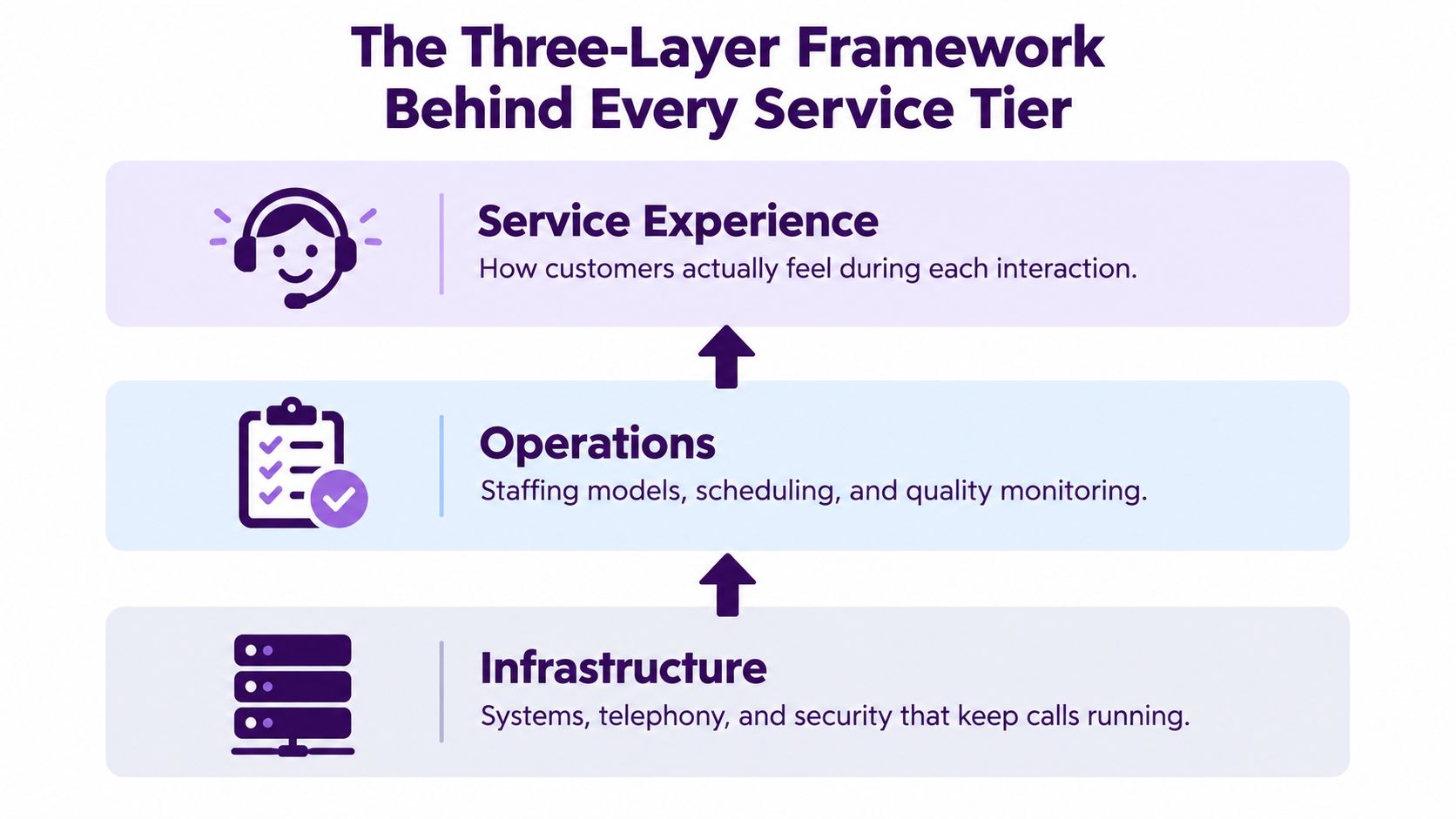
A provider’s package becomes easier to evaluate when you separate what it measures from what it promises. The framework has three layers: service-level indicators, service-level objectives, and service-level agreements.
Google’s service-level objectives framework distinguishes the measured indicator, its target, and the agreement that sets consequences for missing the target. Although developed for technology services, this distinction is useful when structuring contact-center commitments. NIST’s cloud service metrics guidance also emphasizes explicit definitions and measurement rules; it does not prescribe call-center benchmarks.
Start with the SLI
An SLI tells you what happened. Common call-center indicators include:
- Answer rate: The share of offered calls answered, using an agreed denominator.
- Service level: The share of eligible calls answered within a defined threshold, with documented rules for abandoned calls.
- Average speed of answer: How long customers wait before reaching an agent.
- Abandonment rate: The share of callers who disconnect before speaking with someone.
- First-contact resolution: Whether the issue is completed without another contact.
- Quality score: How closely the interaction follows the required process and standard.
- Customer satisfaction: How customers evaluate the interaction afterward.
An SLI must have a clear unit, measurement window, data source, exclusions, and reporting cadence. “Fast response” isn’t an indicator until the provider defines whether fast means seconds, minutes, or a channel-specific business period.
Set the SLO before discussing the SLA
The SLO is the operating target. In an illustrative example, an SLI might show that 78 percent of calls were answered within 30 seconds, while the SLO sets a target of 85 percent. These figures are examples, not universal benchmarks. The gap tells managers to review forecasting, schedules, queue behavior, absenteeism, and escalation capacity.
The SLO should also reflect issue complexity. A simple password reset and a technical troubleshooting call shouldn’t automatically receive identical resolution objectives. Speed can matter most for one queue, while accuracy and specialist handling matter more for another.
Make the SLA enforceable
The SLA turns the target into a business commitment. It should define the measurement method, reporting schedule, exclusions, ownership, and remedy when performance stays below target. Remedies may include a service credit, staffing adjustment, root-cause review, or formal remediation plan.
Ask to see how telephony, customer relationship management records, quality assurance, and workforce management data are reconciled. The important question is whether the systems produce trustworthy evidence for the commitments in your contract.
Define the denominator before approving a target
A service-level target is incomplete without its calculation. Specify when the timer starts, which calls are eligible, how short abandons are treated, whether callbacks count, and whether performance is reviewed by interval, day, or month. Monthly averages can hide poor coverage during peak hours.
For example, a hypothetical 80/20 objective means answering 80% of eligible calls within 20 seconds under the agreed formula. It does not mean every customer waits less than 20 seconds. Document abandoned-call exclusions and review abandonment alongside the target so that missed contacts remain visible.
Define first-contact resolution just as carefully: identify the same issue, set the repeat-contact window, and explain how transfers or later specialist actions affect the result. For email and chat, distinguish first response from final resolution and define business-hour versus elapsed-time clocks.
Basic, Professional, and Enterprise Service Tiers Explained
Tier names are easy. What matters is what the tier buys you: better resolution, real bilingual parity, and after-hours coverage that can solve problems instead of just logging them. Providers may use similar labels for very different commitments. The stronger partner is the one that can show how each level changes staffing, supervision, escalation, and customer outcomes.
The comparison below is an illustrative buying framework, not an industry standard or a published CallZent package list. English-Spanish coverage can be designed at any level; confirm the scope in the proposal. Set the tier against your forecast, issue complexity, language mix, and risk tolerance before you discuss commercials.
Service Tier Comparison for Nearshore Call Centers
| Tier | Coverage Hours | Language Support | Channels | Response Target | Ideal For |
|---|---|---|---|---|---|
| Basic | Core business hours | English and/or Spanish, as scoped | Phone and email | Defined business-hours answer and first-response objectives | Small businesses with predictable volume and straightforward requests |
| Professional | Extended hours | English-Spanish coverage across agreed shifts | Phone, email, and live chat | Tighter channel-specific targets with queue monitoring | Growing companies serving mixed-language customer populations |
| Enterprise | 24/7, with designed after-hours workflows | English-Spanish coverage; confirm any additional languages separately | Voice, email, chat, SMS, and specialized workflows | Separate targets for priority queues, response, resolution, quality, and escalation | Regulated industries, complex operations, and high-consequence interactions |
Basic works when simplicity is real
A Basic tier fits a business with stable demand and low-complexity contacts, for example order status, store details, appointment requests, or routine account questions. It still needs defined answer times, email response windows, quality reviews, escalation rules, and reporting. If a provider cannot document those controls, the tier is underbuilt.
Do not choose Basic because volume looks low on paper. A small queue can still carry high risk. Fraud disputes, billing conflicts, and clinical or benefits questions need tighter handling than a larger stream of simple “where is my order” contacts.
Professional adds practical depth
A Professional design may fit customers who need extended support hours, coordinated channels, and more structured supervision. A Mexico-based bilingual team can support collaboration with North American operations, but staffing, training, and documented handoffs determine the quality delivered.
Parity matters more than availability alone. If your Spanish queue gets slower answers, weaker QA, or more transfers than your English queue, you do not have bilingual service. You have two different service standards. Require separate measurement by language and channel.
Professional should also connect voice, email, and chat around the same knowledge base and escalation path. Add an account manager who can spot repeat failure points and turn them into training, process fixes, or routing changes.
Enterprise earns its cost through control
An Enterprise tier should pay for control, not for a fancier label. Expect priority routing, specialist teams, compliance-aware workflows, custom reporting, embedded QA, and documented overflow or disruption procedures. Extra language coverage only makes sense if the provider has enough trained staff to maintain quality at that level.
Ask the provider to explain how tighter targets change staffing, supervision, and specialist availability. Compare those assumptions with a clear BPO pricing model. Approve a more complex tier when the additional controls address your actual operating needs, not because its name sounds more capable.
Why 24-7 Does Not Always Equal Better Service
A 24/7 badge doesn’t tell you whether a customer reaches a capable person. It may mean an automated acknowledgment, a knowledge-base article, emergency escalation, a next-business-day callback, or live-agent coverage with enough skill to resolve the issue.
Customers may need help outside your office hours, but access without resolution can create another failed interaction. Match overnight coverage to the requests that occur then and the consequences of delaying them.

Five versions of 24/7 coverage
- Automated acknowledgment: The system confirms receipt and records the request. It doesn’t solve the issue.
- Knowledge-base self-service: Customers can search approved answers, which works for narrow and low-risk questions.
- Live-agent coverage: Customers reach an agent who can authenticate, troubleshoot, and complete the request.
- Emergency escalation: The overnight team handles only defined urgent scenarios and routes everything else.
- Next-business-day callback: The provider captures the interaction and schedules follow-up during staffed hours.
These options aren’t equivalent. A retailer may accept automated order-status assistance overnight. A healthcare provider may need live scheduling support plus urgent escalation. A financial firm may need controlled authentication and documented handoffs.
Measure the after-hours experience
Request separate reporting for after-hours answer rate, abandonment, first-contact resolution, transfer rate, language, and escalation completion. If English customers reach trained agents while Spanish-speaking customers receive automation or delayed callbacks, the operation isn’t bilingual in any meaningful service-quality sense.
A limited-hours operation with strong first-contact resolution can outperform a 24/7 operation that shifts unresolved work into the morning queue. The 24/7 call center services approach should therefore be evaluated by capability, not by the clock icon in a sales presentation.
Ask one question before accepting 24/7: “What can the overnight customer actually get resolved?”
Industry Examples – E-commerce and Healthcare Service Tiers
Service tiers become useful when they change staffing and workflow decisions. The right choice for an e-commerce operation won’t automatically fit a healthcare clinic, even if both businesses want bilingual support and shorter waits.
E-commerce needs flexible resolution paths
Consider an e-commerce company handling 8,000 inbound inquiries per month. Its customers ask about order status, returns, delivery changes, payment issues, and damaged goods. A sensible design could use a Basic operational backbone during core hours and a Professional after-hours layer with English-Spanish agents, live chat, and clear escalation for payment or fulfillment exceptions.
The company shouldn’t judge performance by speed alone. Its scorecard should track:
- First-contact resolution: Whether the agent completes the request without a new contact.
- Repeat-contact rate: Whether customers return because the first interaction failed.
- Return-processing accuracy: Whether the agent applies the correct policy and records the transaction properly.
- Language parity: Whether English and Spanish customers receive comparable resolution and escalation quality.
- Queue recovery: Whether overnight requests are handled without overwhelming the morning team.
A customer asking for an order status may receive an automated answer. A customer reporting an unauthorized payment needs a controlled handoff. The tier should distinguish those paths instead of sending every interaction through the same script.
Healthcare requires control before convenience
A regional healthcare clinic serving a mixed-language population should not treat appointment scheduling and medication-refill requests as ordinary low-risk contacts. Even routine interactions can involve identity verification, privacy controls, documentation, and escalation to clinical staff.
An Enterprise design may include Spanish-language parity, prioritized urgent queues, quality monitoring focused on required workflows, and performance reviews that examine both access and safe completion. The provider should report appointment completion, transfer quality, unresolved contacts, and escalation timing by issue type.
Self-service can support narrow tasks, but it should connect to an appropriate human escalation path when a request exceeds its scope. In healthcare, clinical questions and urgent symptoms should follow client-approved routing to qualified staff; customer-service agents should not provide clinical advice.
For both industries, the contract should specify who owns exceptions. A nearshore team in Mexico can manage routine work, bilingual conversations, and defined escalations, while the client retains responsibility for clinical, financial, or policy decisions that require internal authority.
How to Choose the Right Service Tier for Your Business
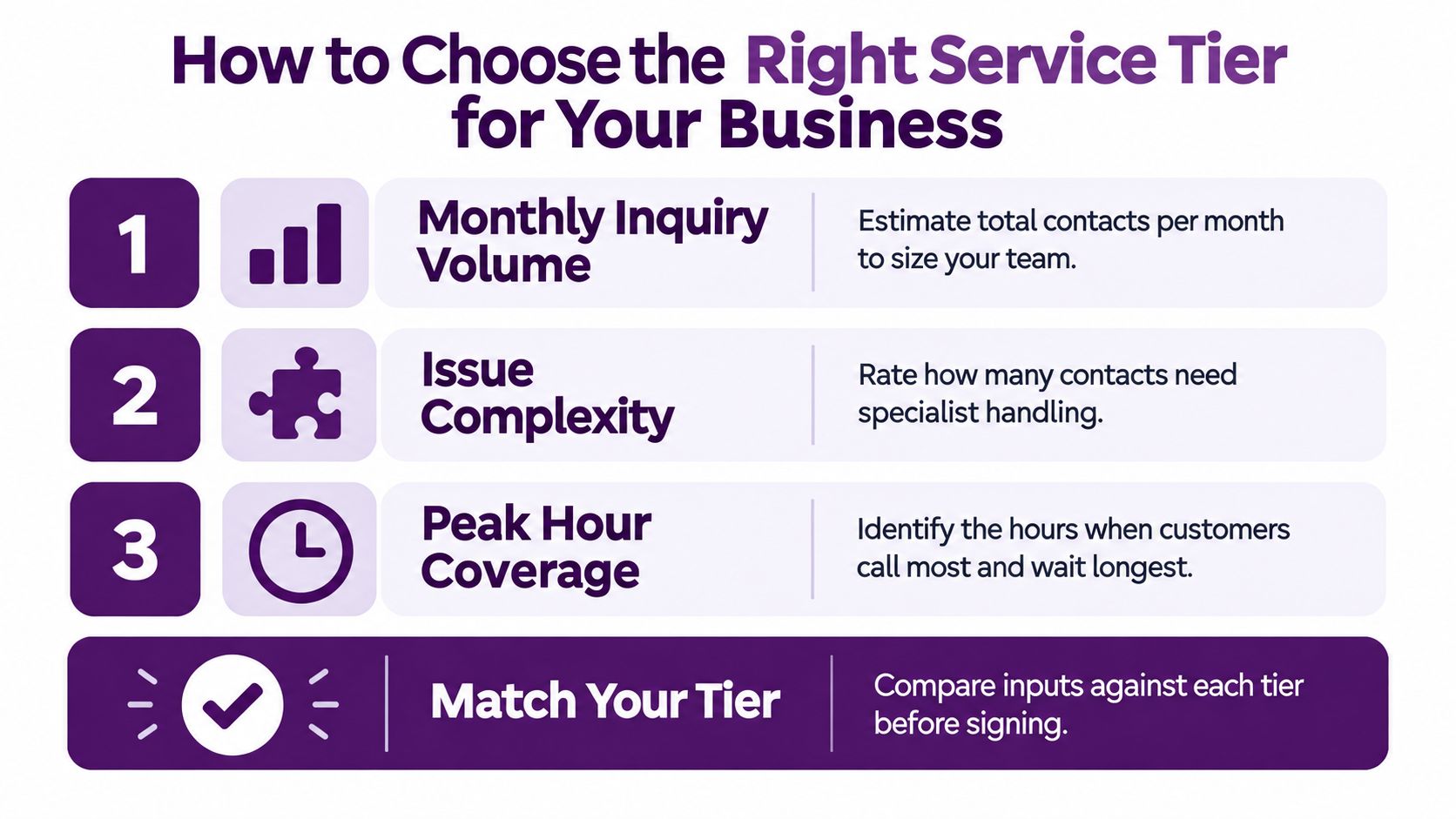
Start with three inputs, not the provider’s package names: monthly inquiry volume, issue complexity, and language requirements. Then add peak-hour behavior, because a moderate daily average can hide a difficult queue during a short demand window.
Use this decision model
- Choose Basic when demand is predictable, requests are straightforward, the agreed language coverage is sufficient, and customers mainly need support during core business hours.
- Choose Professional when demand spans extended hours, customers need English-Spanish support, live chat matters, or unresolved contacts create visible churn and operational rework.
- Choose Enterprise when interactions involve regulated data, financial exposure, clinical risk, complex troubleshooting, multiple languages, or strict priority and escalation requirements.
Then test the proposal against evidence. Ask the provider for recent SLI data, the proposed SLOs, the SLA remedies, the exclusions, and the reporting schedule. Confirm that the data separates speed from resolution quality and distinguishes English from Spanish performance when bilingual service is part of the promise.
Red flags worth rejecting
- Vague response promises: “Prompt support” without an answer interval or measurement window.
- Undisclosed after-hours capability: A 24/7 label with no explanation of who handles calls.
- Bilingual marketing without parity data: Spanish support exists, but no language-specific resolution or wait reporting.
- No first-contact resolution metric: The provider measures answered calls while ignoring completed outcomes.
- Unclear exclusions: Abandoned calls, IVR-resolved calls, transfers, and callbacks aren’t defined.
Compare recurring costs only after you understand the staffing, channel coverage, agent authority, reporting, and exception handling included. Faster response targets usually require more coverage capacity; a low price does not explain how that capacity will be supplied.
Use the same questions for every bidder and ask for representative reports with confidential data removed. Consistent evidence makes staffing, coverage, and resolution differences easier to assess.
Turning Service Levels Into Long-Term Partnership Value
The hypothetical e-commerce company didn’t need a prettier tier label. It needed a service design that connected staffing to customer outcomes. Once the business examined resolution quality, bilingual coverage, queue peaks, and callback ownership, it could choose a partner based on the work customers needed completed.
That is the central distinction between buying hours and building an operating partnership. A provider that reports only handled contacts may appear efficient while leaving your customers to repeat themselves. A provider that reports answer speed, resolution, language parity, quality, and escalation performance gives you the evidence to improve the operation.
Nearshore delivery from Mexico can support that partnership through close time-zone alignment, English-Spanish capability, and direct collaboration with North American teams. Those advantages still require disciplined forecasting, training, workforce management, quality assurance, and transparent reporting. Geography helps. Operating detail determines the result.
The best service levels disappear into reliable operations. Customers get answers in the language they prefer, issues reach the right specialist, and your team stops cleaning up preventable failures.
Evaluate every tier by what happens when demand spikes, a customer needs Spanish support, an automated answer fails, or a regulated issue requires escalation. Don’t buy 24/7 access, buy a dependable resolution path.
Frequently Asked Questions
What do levels of services mean in a call center?
They describe the operating scope and commitments of a support program, including coverage hours, channels, language requirements, agent authority, response targets, quality monitoring, and escalation. Package names vary by provider.
What is the difference between an SLI, an SLO, and an SLA?
An SLI is a defined performance measure. An SLO is the target for that measure. An SLA documents agreed commitments, measurement rules, responsibilities, and consequences when specified targets are missed.
Are Basic, Professional, and Enterprise standard BPO packages?
No. These are illustrative labels used to compare operating needs. They are not universal industry standards or a published CallZent package list. Confirm the exact scope, staffing, and reporting in each proposal.
Does bilingual support require an Enterprise tier?
No. English-Spanish coverage can be included in any appropriately scoped service model. Confirm staffing across required shifts and compare response, quality, resolution, and escalation performance by language.
Does 24/7 coverage guarantee immediate resolution?
No. Around-the-clock coverage may include acknowledgment, self-service, live agents, urgent escalation, or callbacks. Specify what each channel and shift can complete, and who owns requests that remain unresolved.
How should a business choose a service tier?
Assess contact volume by interval, issue complexity, language mix, customer risk, and required hours. Compare staffing assumptions, agent authority, measurement definitions, exception handling, reporting, and total costs before choosing a model.
Bilingual Nearshore Support in Mexico
Build a Service Model Around the Work Your Customers Need Done
Discuss your volume, support hours, language requirements, and escalation needs with CallZent. Define the operating scope and measurable outcomes that fit your business.