

Loan and Lease Servicing
Loan and Lease Servicing Guide for 2026
Learn how loan and lease servicing works, where operations break down, which KPIs matter, and why nearshore BPO support can improve efficiency and compliance.
TL;DR — Quick Takeaways
- Loan and lease servicing is the day-to-day management of an account after it is booked, from payment handling and customer support to compliance, delinquency follow-up, and closure.
- Servicing quality affects cash flow, customer experience, compliance exposure, and growth. Poor workflows create avoidable cost, risk, and customer friction.
- The strongest servicing operations depend on clean onboarding, payment discipline, exception handling, reporting, and trained customer-facing teams.
- Nearshore BPO support can help lenders and finance companies add bilingual capacity, reduce operational strain, and scale servicing without losing control.
Are you spending more time fixing payment errors, answering borrower questions, and managing exception queues than building the lending business you want to grow?
That’s the trap many lenders, auto finance teams, and lease portfolios fall into. Servicing starts as a back-office necessity, then gradually becomes the function that shapes cash flow, customer experience, compliance exposure, and renewal opportunities. If it runs poorly, every downstream metric gets worse. If it runs well, the business feels easier to scale.
Loan and lease servicing is no longer a side process. It’s where operational discipline shows up in practice.
Is Managing Loan and Lease Servicing Holding You Back
TL;DR: Loan and lease servicing is the day-to-day management of a loan or lease after it’s booked, from payment handling and customer support to compliance, delinquency follow-up, and final closure. Done well, it reduces friction, protects revenue, and improves borrower loyalty. Done poorly, it creates avoidable cost and risk.
A practical definition matters here. Loan servicing is the ongoing post-origination management of credit accounts, including customer outreach, request handling, and compliance work across the account lifecycle, from disbursal through closure, as described in LoanPro’s loan servicing glossary. In operational terms, that means your team isn’t just posting payments. They’re managing the customer relationship, the control environment, and the timing of every exception.
The scale of the market explains why servicing pressure keeps rising. The United States accounts for over 41% of worldwide servicing volume, and the global loan servicing market was valued at USD 0.75 billion in 2024 and is projected to reach USD 1.95 billion by 2033 according to Business Research Insights on the loan servicing market. That isn’t abstract growth. It reflects a larger operational burden on lenders, finance companies, and servicing teams.
“The difference between a struggling lender and a thriving one often lies in how they handle the day-to-day work of loan and lease servicing.”
In practice, the warning signs are easy to spot:
- Payments are coming in: but cash posting takes too long and exception queues keep growing.
- Customers are calling: but agents can answer basic questions, not account-specific issues with confidence.
- Compliance work is happening: but it depends too much on tribal knowledge and manual checks.
- Leadership wants growth: but supervisors spend their week firefighting instead of improving process.
Many finance teams first try to solve this with more headcount. Sometimes that helps. Often it just adds cost without fixing workflow design. In those cases, related functions such as accounts receivable outsourcing support can reveal where process discipline is missing and where servicing should be restructured before more volume arrives.
The Loan and Lease Servicing Lifecycle Explained
A loan or lease account behaves a lot like a long subscription with higher stakes. The customer signs, the account gets activated, recurring payments begin, exceptions happen, and eventually the agreement ends through payoff, return, renewal, or recovery. The difference is that every step carries financial and regulatory consequences.
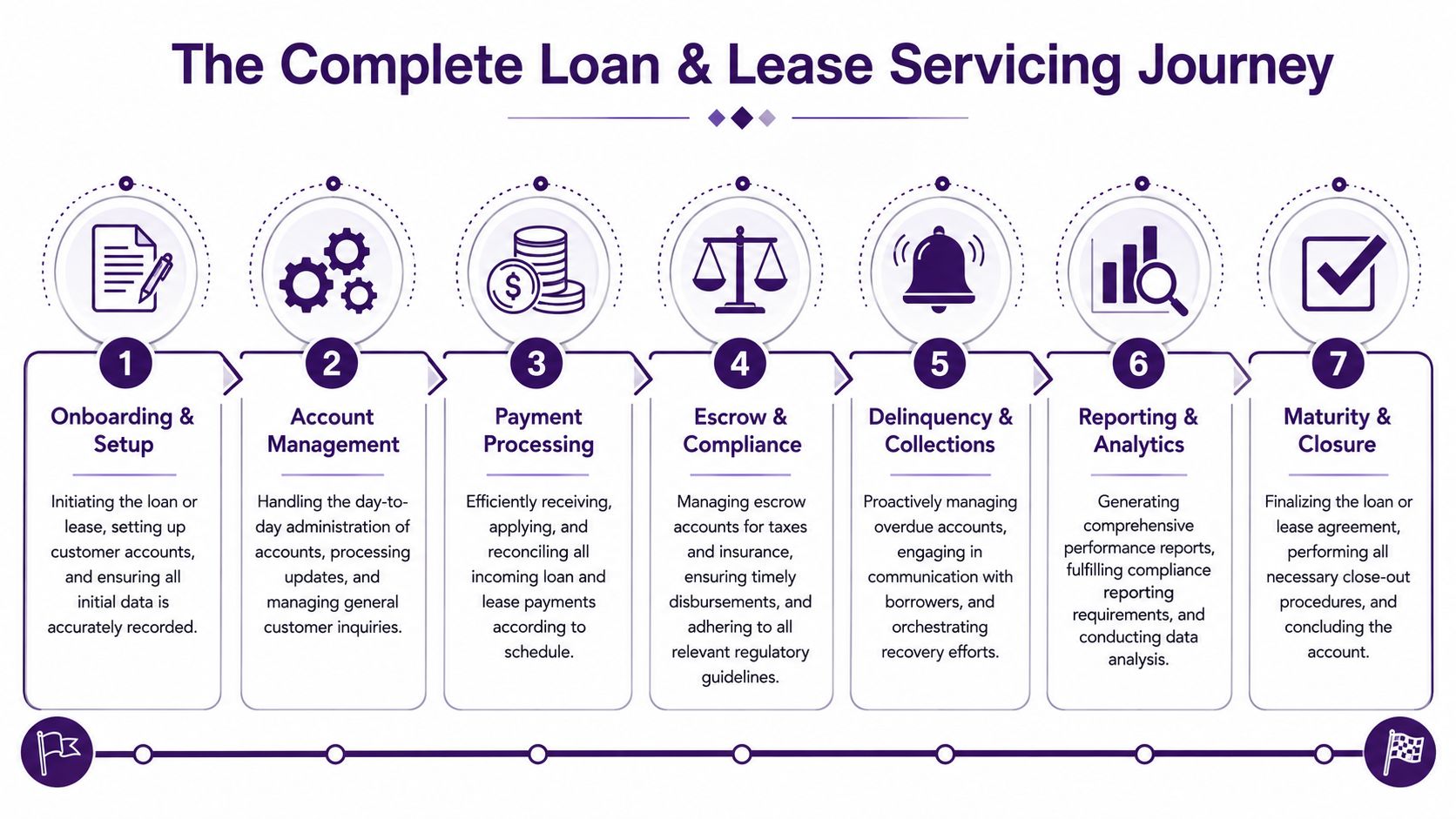
Onboarding and setup
The lifecycle starts with boarding the account correctly. Data from origination has to enter the servicing platform cleanly, including payment terms, customer contact details, due dates, escrow instructions when relevant, and asset information for lease portfolios.
Small errors at this stage create big problems later. A missing insurance field might become a compliance issue. A wrong payment due date can trigger avoidable calls and payment reversals. In auto leasing, an incorrect mileage term can create a dispute months later at lease-end.
A good servicing team treats boarding like control work, not clerical work.
Active account management
Once the account is live, servicing becomes repetitive in the way all important work is repetitive. Payments must be accepted, applied, and reconciled. Customers ask for payoff quotes, address changes, due-date explanations, and hardship options. Teams manage promises to pay, returned payments, statement questions, and account notes.
Customer communication quality matters. A borrower doesn’t judge your company by the elegance of your servicing architecture. They judge it by whether your team solves the problem on the first call.
For organizations building support around these interactions, broad call center services for financial operations often matter as much as the core servicing platform itself. Systems hold the data. People make the experience work.
Exception handling and end-of-term closure
The middle of the lifecycle is where complexity accumulates. Delinquencies happen. Escrow adjustments happen. Bankruptcy notices come in. Insurance lapses have to be tracked. A lease may be extended, bought out, or returned. Each event has a workflow, and each workflow needs ownership.
Borrowers rarely complain that servicing is too structured. They complain when no one can tell them what happens next.
Lease portfolios need especially clear end-of-term processes. Vehicle returns, purchase options, excess wear questions, and title-related steps all create avoidable friction if the playbook is vague. When legal issues enter the picture, practical explainers like what happens to leases in Chapter 7 help teams understand why lease treatment can shift quickly and why account documentation has to be current before a case escalates.
A mature servicing operation doesn’t treat closure as an afterthought. It treats payoff, return, release, and final documentation as the final proof that the whole lifecycle was managed correctly.
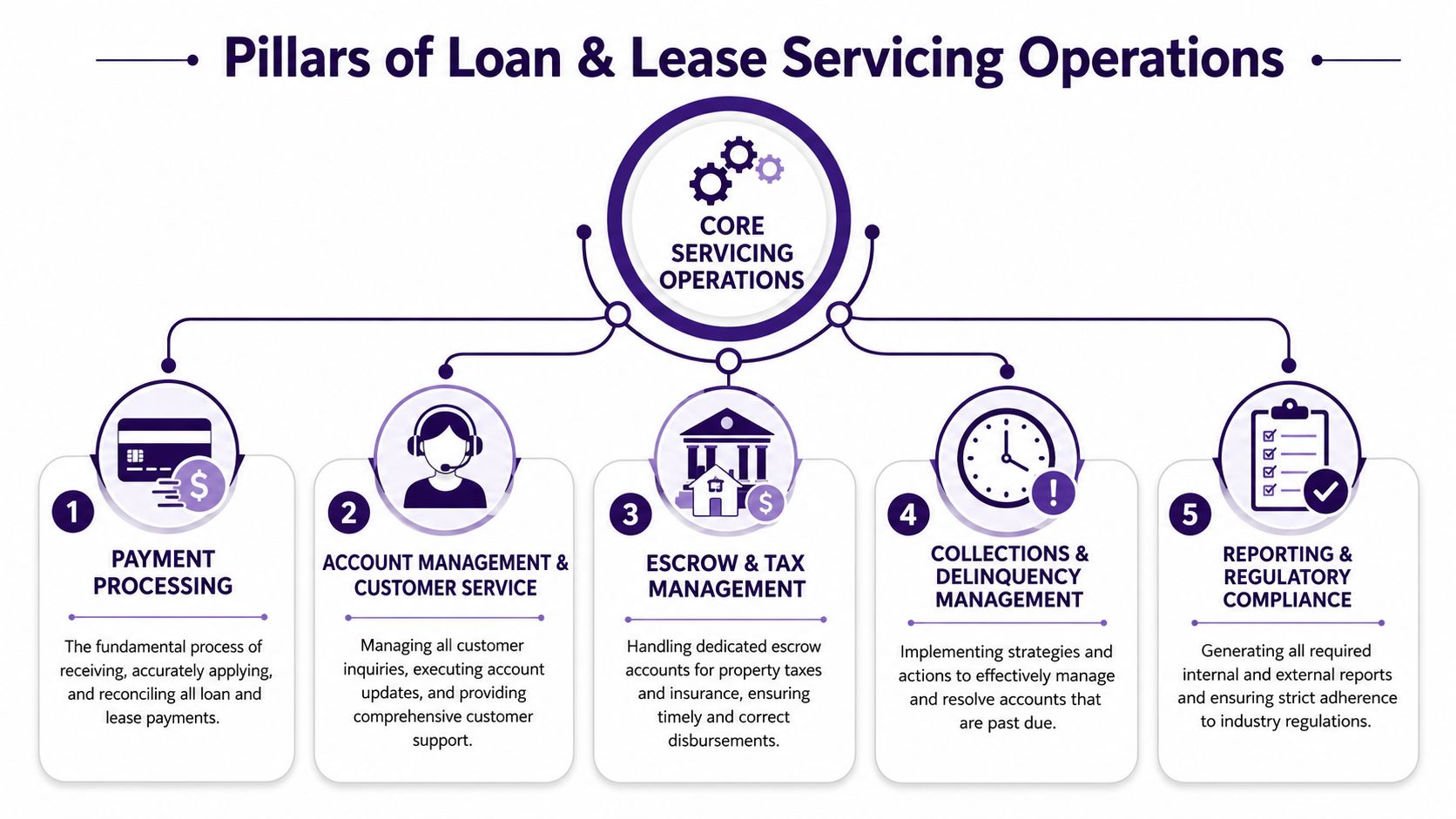
A Deep Dive into Core Servicing Operations
The servicing lifecycle looks simple from a distance. Up close, it runs on several distinct operating disciplines that have to work together every day.
The need for specialized execution is easy to understand in auto finance. The U.S. auto leasing, loans, and sales financing market was $170 billion in 2024 and is projected to reach $271.9 billion by 2032, according to P&S Market Research on the U.S. auto leasing, loans, and sales financing market. That kind of volume creates millions of opportunities for small servicing errors to become expensive ones.
Payment processing
This is the foundation. If payments aren’t posted accurately and on time, every other process starts wobbling.
A mortgage payment may include principal, interest, and escrow. An auto lease payment may need to reflect late fees, extension terms, or end-of-term charges. A partial payment, reversal, or duplicate payment can create confusion fast if the rules aren’t clear and the exception path is manual.
What works:
- Daily reconciliation discipline: teams compare payment files, processor reports, and servicing balances the same day.
- Tight exception routing: unapplied or mismatched payments go to a defined queue with ownership.
- Clear customer scripts: agents explain why a payment is pending, reversed, or split across charges.
What doesn’t work:
- Inbox-based exception handling: where agents forward issues and hope someone responds.
- Loose posting standards: where similar payment issues are handled differently by different people.
Account management and customer service
Servicing calls aren’t generic customer support. They require judgment, account knowledge, and clean documentation.
Take a bilingual borrower calling for a payoff quote after moving to a new state. The agent has to verify identity, confirm the mailing or digital delivery preference, review the account status, note any pending payments, and explain timing in clear English or Spanish. If the quote expires before the borrower acts, the interaction must be documented so the next agent doesn’t start over.
Practical rule: If your servicing agent can’t explain the next account action in one clear sentence, the process isn’t ready.
Teams looking at process maturity often benefit from outside benchmarks and software perspectives such as CEFCore’s loan servicing guide, but software alone doesn’t fix weak handling habits. Strong servicing teams know how to combine account research, empathy, and documentation discipline in one interaction.
Escrow and tax management
Escrow work rewards precision and punishes shortcuts. Taxes, insurance, disbursement dates, shortages, and customer notices all have to align. A missed insurance update or delayed tax disbursement becomes more than an accounting issue. It becomes a borrower trust issue.
This work usually improves when teams standardize:
- Review calendars
- Exception codes
- Escalation rules for missing policy data
- Owner-specific work queues
Collections and delinquency management
Early-stage delinquency is where tone matters. The best teams are firm, direct, and respectful. They don’t sound threatening. They sound organized.
A strong first-call collections interaction confirms the missed payment, checks whether the issue is temporary or ongoing, offers the right next step within policy, and records a usable summary. That’s very different from a weak interaction that repeats “your account is past due” and ends with no real commitment.
For organizations that need this mix of communication and process control across regions, international receivable management support can help unify standards across account types and customer segments.
Lease-end processing
Lease-end work is often underestimated because it arrives later in the lifecycle. It shouldn’t be. Account satisfaction and residual value protection converge at this stage.
A vehicle lessee may ask whether they should return, buy out, or extend. The servicing team doesn’t need to sell. It does need to explain the account status clearly, confirm timing, document fees or conditions properly, and hand off without confusion. If title steps, inspection coordination, or final billing are sloppy, the customer remembers the entire lease as a bad experience.
Navigating Complex Compliance and Reporting
Compliance in servicing isn’t a layer you add after operations. It has to be built into the workflow itself. If the process depends on agents remembering special rules from memory, the process is fragile.
The clearest example is event-based reporting. Modern servicing infrastructure now requires servicers to transmit loan-level transaction data in near real time, often with a deadline no later than 3:00 AM ET the next business day, as outlined in Fannie Mae’s FAQs on upcoming loan management changes. That includes reporting borrower and servicer activities such as payments, reversals, no-payment events, rate changes, delinquency status, escrow activity, and mortgage insurance cancellations.
That requirement changes the way an operation has to be run.
What compliance pressure looks like in practice
A payment reversal can no longer sit in a backlog until someone has time to review it. An escrow disbursement can’t be captured loosely and cleaned up later. Account events need to be processed, validated, and transmitted within a controlled window.
That pushes teams toward:
- Standardized data mapping
- Stronger QA on exception handling
- Clear ownership between servicing, compliance, and technology
- Reliable audit trails in every account note and activity log
A useful training baseline for frontline risk awareness is a practical guide for mortgage loan originators on UDAAP. Even when a team isn’t originating loans, the principles matter because customer communications, payment handling, and hardship conversations all create conduct risk if agents improvise.
Why expertise matters more than headcount
A larger team doesn’t automatically reduce compliance risk. In some cases it raises it, because more people are touching more workflows with uneven training. What lowers risk is a controlled operating model with documented procedures, monitored execution, and role-specific coaching.
That’s why compliance-focused operating support matters. Programs such as financial services compliance training are valuable when they connect regulations to actual servicing scenarios, not just policy language.
When compliance lives only in manuals, errors show up in production.
The strongest servicing organizations don’t ask whether compliance slows operations down. They ask whether process design is strong enough to make compliant execution the easiest path for the team.
KPIs and Technology for Modern Servicing
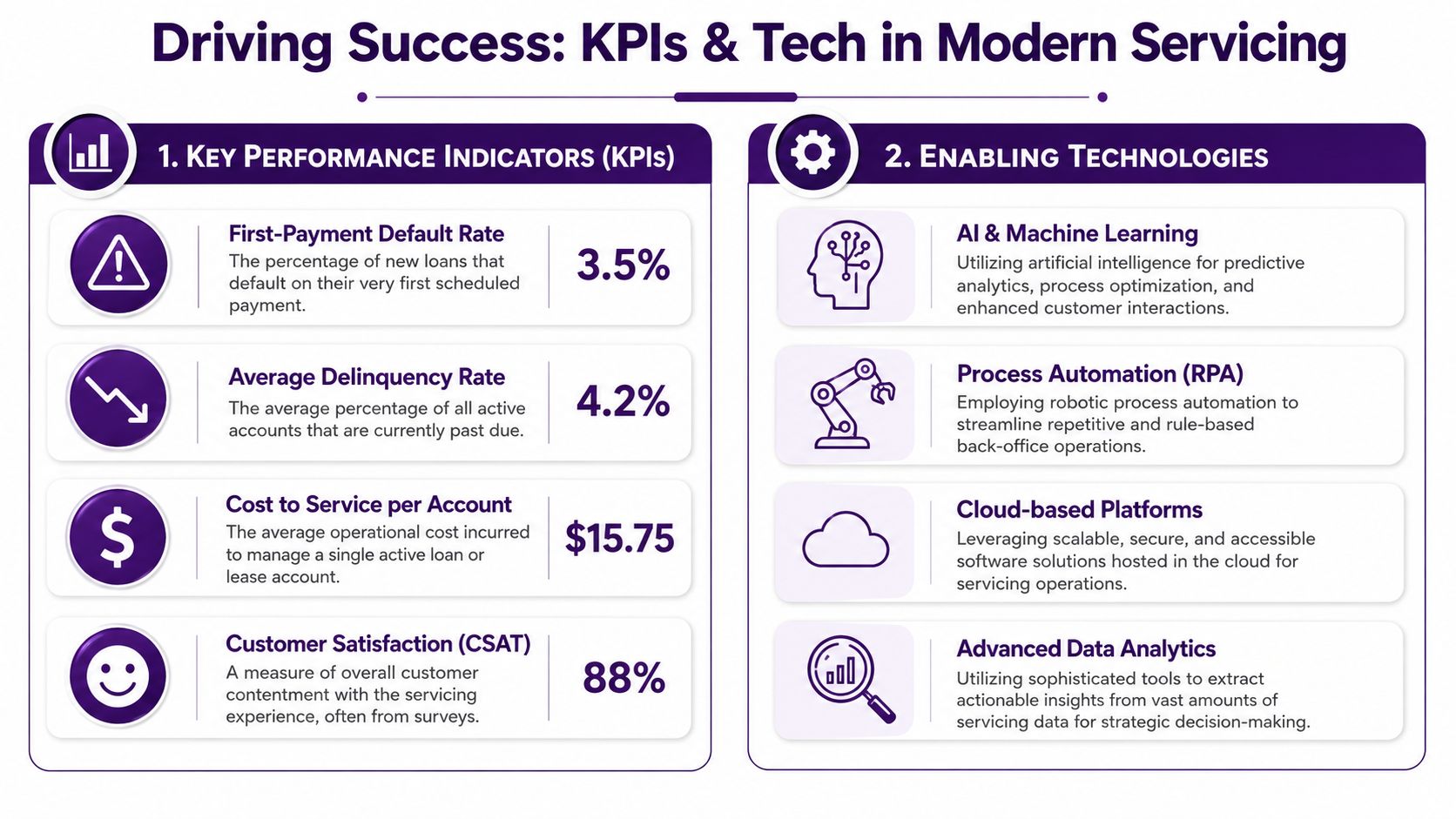
A servicing operation can feel busy and still underperform. That’s why the best teams watch a small set of KPIs that show whether work is under control.
The technology market around this work keeps expanding because operators need better visibility. The global loan servicing software market was valued at USD 4.2 billion in 2024 and is projected to hit USD 8.0 billion by 2030, according to Strategic Market Research on the loan servicing software market. Growth follows need. As servicing gets more complex, teams need better systems for workflow, reporting, and customer interaction.
The KPIs that actually matter
The exact scorecard varies by portfolio, but the most useful servicing KPIs usually include:
| KPI | What it tells you | Why it matters |
|---|---|---|
| Delinquency trends | Whether accounts are moving into risk | Early warning for collections staffing and policy review |
| Roll rates | How accounts move from one delinquency bucket to the next | Shows whether early intervention is working |
| Cost per account or cost per loan | The operational burden of servicing each active account | Helps leaders decide where automation or outsourcing makes sense |
| First contact resolution | Whether customers get a usable answer on the first interaction | Reduces repeat calls and frustration |
| Complaint patterns | Where process breakdowns are visible to borrowers | Often reveals training or policy gaps before audits do |
| Turnaround time | How fast the team completes requests like payoff quotes or account updates | Directly affects customer trust |
The mistake I see most often is tracking too many KPIs with no operating response tied to them. If a dashboard tells you delinquency is worsening, someone should know which queue, script, policy, or staffing pattern gets reviewed that day.
The technology stack behind strong servicing
Modern servicing usually depends on a mix of core servicing software, payment systems, CRM workflows, QA tools, reporting dashboards, and communication channels like voice, SMS, email, and portals. The system doesn’t need to be flashy. It needs to make work visible.
Strong stacks usually support:
- Centralized account notes: so the next agent sees the true story.
- Workflow routing: so exceptions don’t disappear in shared inboxes.
- Role-based dashboards: so supervisors, QA, compliance, and client teams see the same facts from different angles.
- Recorded interaction review: so training is based on actual calls and messages.
A practical reporting layer is often the difference between “we think performance is okay” and “we know where leakage starts.” Teams that want that visibility need disciplined call center reporting and KPI dashboards tied to servicing outcomes, not vanity metrics.
Good servicing technology doesn’t replace judgment. It gives judgment better timing.
Why Outsourcing to a Nearshore BPO is Your Smartest Move
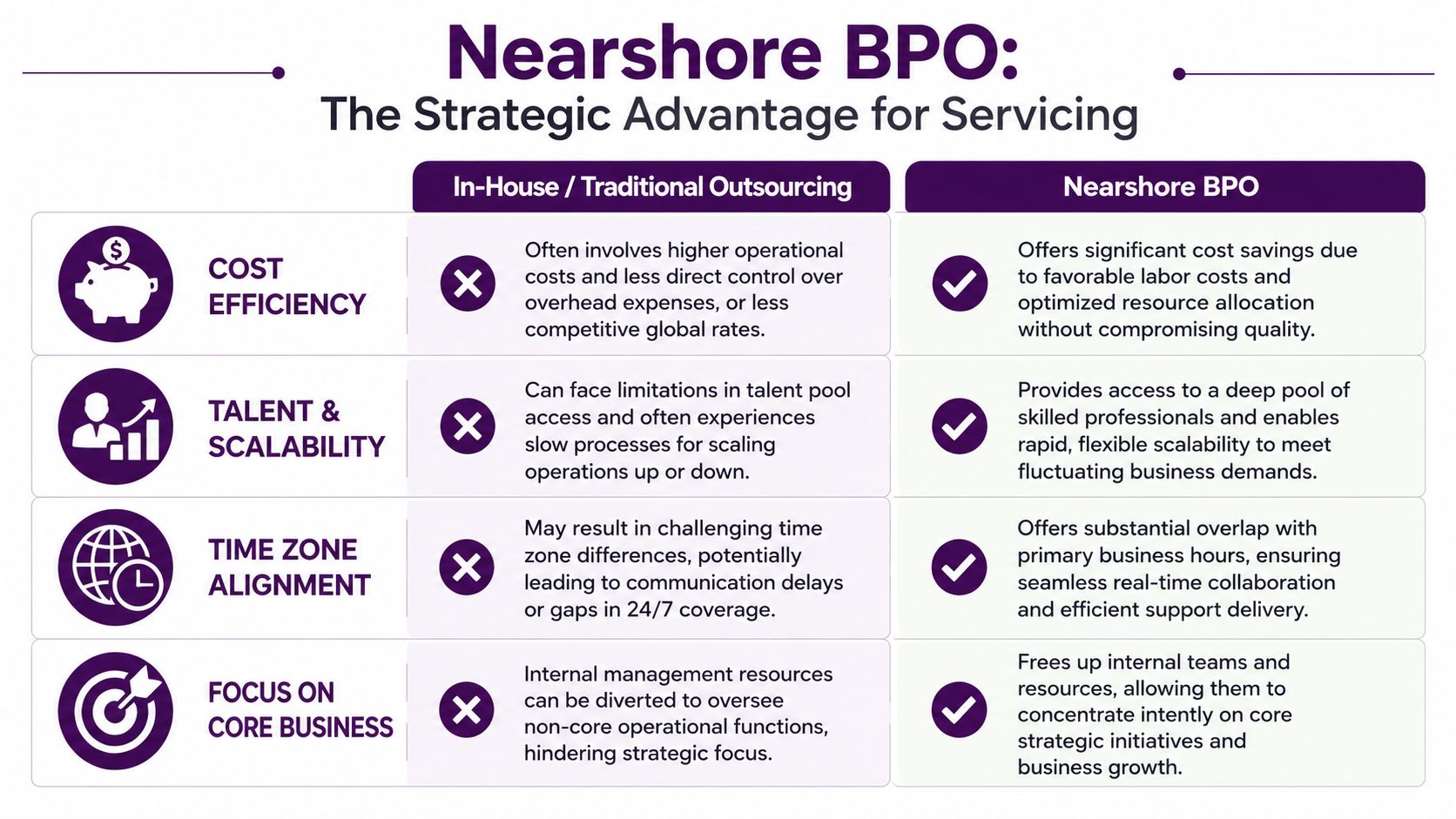
Most servicing leaders don’t outsource because they want less control. They outsource because the in-house model is consuming control. Supervisors are stretched, hiring is slow, bilingual support is inconsistent, and every new volume spike forces another scramble.
That’s where a nearshore model becomes strategic, not tactical.
The performance case is real. Specialized loan servicers reduced servicing cost per loan to $113 from $134 year-over-year, while improving recapture rates to 55%, according to the Mortgage Bankers Association mortgage performance report. The lesson isn’t that every company should copy one model exactly. The lesson is that specialization can improve both efficiency and retention at the same time.
Why nearshore works better than many teams expect
For North American lenders and finance companies, nearshore support solves several operational problems at once.
- Labor alignment: You get teams working in close time zone alignment with U.S. operations, which matters when payment windows, escalations, and borrower callbacks can’t wait overnight.
- Bilingual coverage: In loan and lease servicing, English-Spanish support isn’t a nice extra. It often determines whether a borrower resolves an issue clearly or leaves the interaction confused.
- Faster collaboration: Training, QA calibration, and workflow changes are easier when the operating day overlaps.
- More flexible scale: Nearshore partners can usually expand dedicated teams faster than an internal department trying to recruit, onboard, and coach from scratch.
This is especially useful in two common situations.
Auto finance use case
An auto finance company may have strong origination growth but weak lease-end servicing capacity. Customers start calling about purchase options, return timing, payoff requests, and late payment status. Internal agents can handle some of it, but backlogs grow during peak periods.
A nearshore team can take structured, repeatable workflows such as inbound support, account updates, payment follow-up, and lease-end communications. The internal staff then focuses on policy exceptions, partner management, and escalations.
Fintech lending use case
A fintech lender may be excellent at acquisition and digital onboarding but weak on ongoing servicing maturity. Once accounts season, borrowers need support around due dates, hardship requests, document updates, and payment issues. If the company tries to run all of that through the same team that built the lending funnel, service quality drops.
A nearshore BPO gives that lender operational depth without forcing it to build a large servicing department overnight.
What to outsource first
The best transitions start with the work that is high-volume, rules-based, and measurable.
A practical first wave often includes:
- Inbound servicing calls: payment questions, due dates, basic account support
- Back-office processing: payment research, account updates, document handling
- Early-stage collections: reminders, promises to pay, follow-up workflows
- Bilingual customer support: especially for auto lending and consumer finance portfolios
For organizations evaluating structure before full migration, back-office nearshore outsourcing is often the cleanest entry point because it reduces pressure without disrupting policy ownership.
A transition checklist that actually works
Outsourcing fails when companies transfer tasks without transferring operating logic. A better handoff looks like this:
-
Define the work clearly
Separate transactional servicing, exception handling, and regulated decisions. Don’t blend them. -
Document the existing workflow
Not the ideal workflow. Use the one your team follows in practice today, including workarounds and frequent exceptions. -
Set service levels before launch
Agree on turnaround times, QA standards, escalation paths, and reporting cadence. -
Train with real account scenarios
Use actual call types, common delinquency situations, payoff requests, and lease-end cases. -
Build a calibration routine
Operations, QA, and client stakeholders should review the same interactions regularly and score them consistently. -
Launch in phases
Start with a narrow scope, stabilize performance, then expand volume or task complexity.
SLAs matter because ambiguity is expensive
A servicing partnership needs more than a statement of work. It needs enforceable clarity. Who owns payment exceptions. Who handles complaints. Who escalates bankruptcy notices. Who signs off on script changes. If those answers are fuzzy, service quality will be fuzzy too.
The smartest outsourcing moves don’t remove accountability. They make it more visible.
Your Path to Efficient and Scalable Servicing Operations
Loan and lease servicing shapes far more than payment collection. It affects customer trust, compliance performance, operating cost, and the ability to scale without chaos. That’s why mature lenders treat servicing as a strategic operating function, not an administrative afterthought.
The organizations that do this well usually share the same habits. They board accounts carefully. They standardize payment and exception workflows. They train customer-facing teams on account logic, not just scripts. They use reporting to manage performance in real time. And when internal teams are overloaded, they add specialized support instead of letting service quality drift.
The strongest servicing model is the one that keeps operations controlled while giving your business room to grow.
If your current setup feels too manual, too expensive, or too hard to scale, the next step isn’t guesswork. It’s a serious review of workflow design, staffing model, compliance exposure, and where a nearshore partner can take pressure off the business without lowering standards.
🚀 Build a More Scalable Loan and Lease Servicing Operation
CallZent helps finance teams explore bilingual nearshore support for customer service, back-office processing, collections, and other finance-related operations that need tighter execution and more scalable coverage.
Talk to an ExpertIf you’re evaluating a better servicing model, CallZent can help you explore bilingual nearshore support for customer service, back-office processing, collections, and other finance-related operations that need tighter execution and more scalable coverage.