Skip to content
Social Media Customer Service
Build Elite Social Media Customer Service in 2026: A Nearshore BPO Playbook
Learn how to build social media customer service with the right channels, workflows, staffing, tools, and KPIs. A practical nearshore-ready playbook for scaling support.
TL;DR — Quick Takeaways
- Social media customer service is now a core support channel, not a side task.
- Strong teams choose the right platforms, assign clear ownership, train agents for public replies and private resolution, and set routing rules that protect response times and brand consistency.
- The common failures show up fast: brands respond late, split responsibility between marketing and support, and leave sensitive cases exposed in public threads longer than they should.
- The model that works best is usually hybrid. Automation handles repeatable volume. Skilled agents handle emotion, judgment, and escalations.
- Nearshore outsourcing is often the fastest way to launch or improve social support, especially when the business needs bilingual coverage, longer service hours, and tighter cost control.
Social Media Customer Service Outsourcing
Social media customer service outsourcing gives businesses a trained external team to monitor comments, direct messages, mentions, complaints, and customer questions across social platforms. Instead of leaving social support divided between marketing and internal customer service teams, an outsourced operation provides defined ownership, consistent coverage, documented workflows, and measurable service standards.
Social media support workflows that can be outsourced include:
- Comment and Mention Monitoring: Identify customer questions, complaints, service issues, and untagged brand mentions.
- Direct Message Support: Respond to private customer inquiries and handle account-specific conversations.
- Public Response Management: Provide timely, brand-aligned replies while protecting customer privacy.
- Case Triage and Routing: Classify messages and route billing, technical, order, compliance, or retention issues to the correct team.
- Social Escalation Management: Identify high-risk complaints, urgent issues, and conversations requiring supervisor involvement.
- Bilingual Customer Support: Provide English and Spanish assistance across social channels.
- CRM and Ticket Documentation: Record interactions, dispositions, escalations, and resolutions in the company’s support systems.
- Social Support Reporting: Track response times, resolution rates, backlog, sentiment, escalation volume, and service-level performance.
Customers already expect support on social. The operational question is whether your team can run that channel with the same discipline you expect from phone, chat, and email.
Companies often treat social media customer service like light community management. In practice, it behaves more like a live operations queue with public visibility, strict timing pressure, and direct impact on retention.
That changes how the function should be built. Team design, QA, escalation rules, CRM access, moderation standards, and reporting all matter here. A slow or careless reply does not just disappoint one customer. It can create a visible record of weak execution.
At CallZent, we build social support the same way we build any serious CX program. We start with channel scope, staffing coverage, language requirements, workflows, and SLA targets. Then we layer in the right mix of nearshore bilingual agents, supervisors, automation, and QA so clients can launch faster without standing up an entire department from scratch.
That approach is usually the smarter scaling move.
The companies that perform well on social do not rely on whoever happens to be online. They run a structured support function with clear ownership, trained agents, and operating rules that hold up under volume.
Why Social Media Customer Service Is No Longer Optional
A large share of customers now use social platforms to ask for help, raise complaints, and pressure brands for faster answers. For support leaders, that settles the debate. Social media is already a live service channel, whether the company has staffed it properly or not.
The operational reality is different from email and different from community management. Social issues arrive in public, spread fast, and force quick judgment calls about what to answer openly, what to move to private messages, and what to route into the core support queue. A missed post is not just a missed contact. It becomes visible proof that the brand is slow, disorganized, or absent.
That visibility changes the risk.
Customers use social because it reduces effort on their side. They can comment during a delivery delay, send a DM about an order, or flag a billing problem without opening a ticket portal. They also know public pressure often gets a response faster than lower-visibility channels. If the team cannot respond with the speed and control customers expect, the issue does not stay between one customer and one agent.
The strongest programs treat social as part of an omnichannel customer support strategy, not as a side inbox managed by whoever has time. That means clear ownership, case routing, platform-specific rules, CRM access, moderation standards, and response targets that match the urgency of the channel.
Three breakdowns show up again and again in weak social support operations:
- Slow first response: Customers read silence as avoidance, especially when the complaint is public.
- Poor routing: Marketing, ecommerce, and support teams answer from different playbooks, so the customer gets a partial or incorrect response.
- Public overexposure: Agents leave account-specific or sensitive issues in comments too long instead of shifting to DM or a secure channel.
A simple retail question about shipping can stay public. A payment dispute, address change, or account complaint cannot. Teams need rules for that. They also need agents trained to protect the brand without sounding scripted or evasive.
At CallZent, we build social support as an operating function with staffing models, escalation paths, QA, and reporting. That is one reason nearshore outsourcing makes sense here. Companies often need bilingual coverage, longer service hours, and trained agents faster than an internal team can hire and ramp. A nearshore BPO gives them that structure without the cost and delay of building a separate department from scratch.
Strong social support earns trust in plain view. Weak social support broadcasts every gap.
Laying the Foundation Your Channel and Strategy Selection
Most social media customer service problems begin before the first reply is ever sent. Brands open too many channels, assign no owner, and then wonder why messages fall through.
Start smaller. Pick the channels your customers already use for support, then decide what each one is for.
Choose channels by behavior, not popularity
Different platforms create different service patterns. X is fast and public. Instagram is strong for product questions, order friction, and brand-heavy interactions. Facebook often works well for direct messaging and recurring service inquiries. LinkedIn is a narrower service channel, but it matters for B2B questions, account relationships, and reputation management.
This comparison helps frame the trade-offs visually:
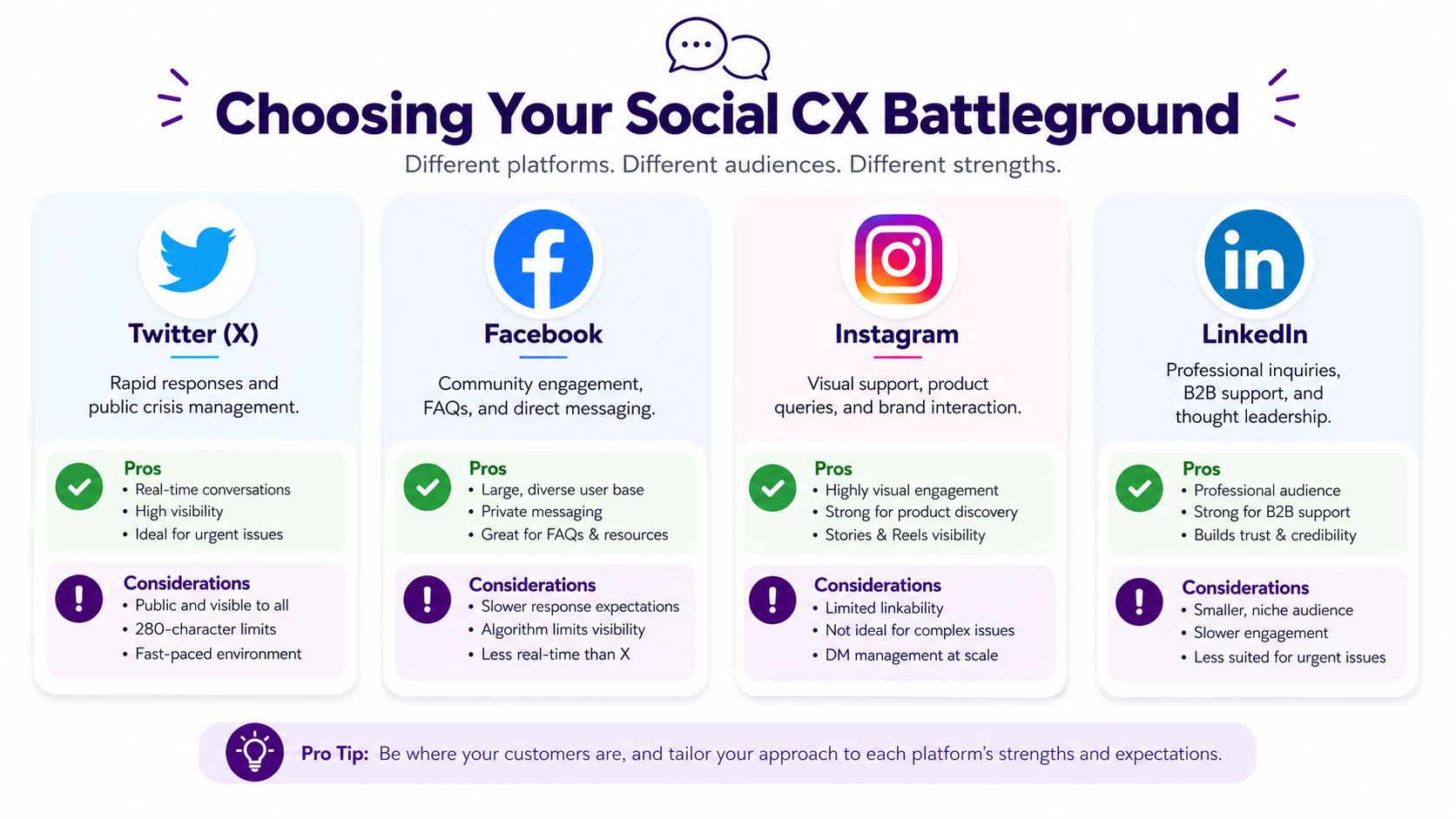
A practical way to decide:
| Platform | Best fit | Watch-out |
|---|---|---|
| X | Fast complaint handling, outage updates, public issue management | Mistakes are highly visible |
| Messenger support, FAQs, community follow-up | Volume can sprawl across comments and messages | |
| Product questions, visual issues, ecommerce engagement | Agents need context fast to avoid long back-and-forth | |
| B2B inquiries, employer brand, executive visibility | Not ideal for high-volume consumer support |
A fashion retailer usually gets more value from Instagram DMs and comment moderation than from LinkedIn support. A software company serving business accounts may prioritize LinkedIn and X because that’s where buyers and decision-makers already talk about product issues.
If your business is already trying to unify service across channels, an omnichannel customer support model keeps social from becoming a disconnected side queue.
Define what success means before you staff it
Too many teams launch social support with vague goals like “be more responsive.” That doesn’t help agents make decisions, and it doesn’t help leadership evaluate results.
Pick business goals that change operations. Examples:
- Reduce avoidable calls: Use social to answer order status, store hours, appointment questions, and policy clarifications.
- Protect brand reputation: Build a process for public complaints and escalation-sensitive posts.
- Improve resolution quality: Route technical questions to trained agents instead of whoever manages content.
- Support bilingual audiences: Make English and Spanish service available where customers already reach out.
A good channel strategy tells agents what belongs on each platform, what must move private, and what should never stay in a social inbox.
Set boundaries early
Every channel needs rules. Decide:
- What counts as a support case
- Which issues can be solved publicly
- When agents must move to DM
- Which topics require handoff to billing, tech support, compliance, or retention
- What hours are staffed and how after-hours messages are acknowledged
That foundation matters more than posting frequency or brand polish. Without it, social media customer service turns into reactive inbox cleanup. With it, the channel becomes manageable, measurable, and scalable.
Building Your A-Team Roles Training and Staffing
Technology helps, but the team determines whether social media customer service feels sharp or sloppy. Public replies require judgment. Private escalations require patience. Bilingual service requires agents who can move naturally between languages without losing tone or clarity.
That’s why staffing social support with whoever happens to be online rarely works.
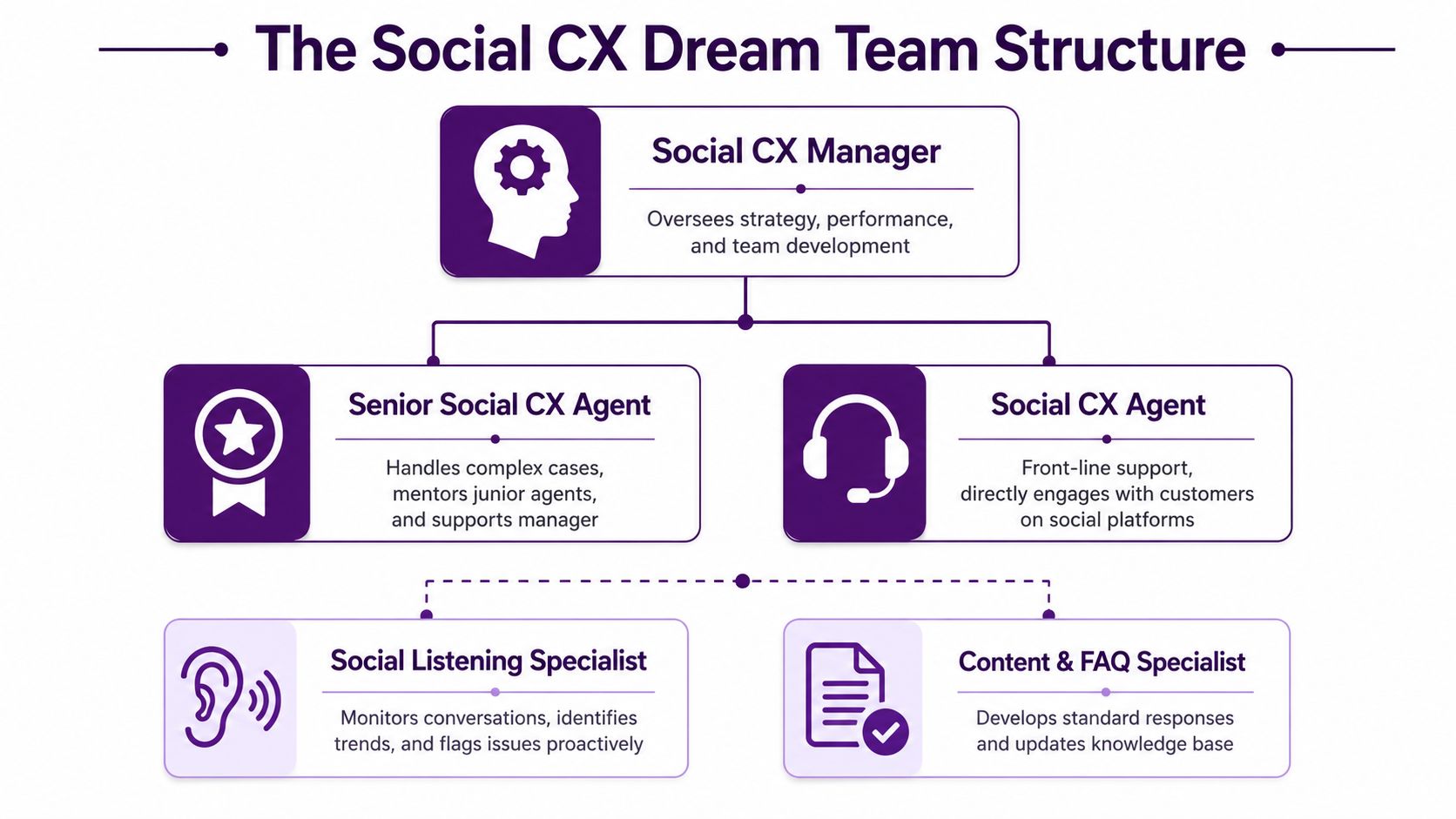
The core roles that keep the operation stable
A capable social support team usually includes a mix of frontline execution, quality control, and listening.
- Social CX agents: They handle inbound comments, tags, and direct messages. These agents need speed, writing discipline, and emotional control.
- Senior agents or escalation specialists: They take over complex billing issues, service failures, technical friction, and high-risk public complaints.
- Team leads: They approve sensitive responses, coach tone, and monitor queue health in real time.
- Social listening specialists: They catch untagged mentions, complaint trends, and emerging issues before they spread.
- Content and FAQ specialists: They keep macros, saved replies, and knowledge base references accurate.
A smaller business may combine several of these roles. A larger operation should separate them. When one person tries to monitor mentions, answer DMs, update templates, and coach quality all at once, response quality drops quickly.
Training needs to go beyond platform basics
Most brands underestimate what agents need to learn. Knowing how to use Instagram or Facebook as a consumer doesn’t prepare someone to resolve a service issue in public.
Training should cover:
- Brand voice: Agents need examples of what your brand sounds like when the customer is calm, confused, or angry.
- De-escalation: Public frustration needs acknowledgment first, not policy language.
- Escalation thresholds: Agents should know exactly when to involve billing, compliance, or technical support.
- Writing discipline: Social replies must be concise without sounding robotic.
- Privacy judgment: Teams need repeated drills on when to leave public comments and move to direct messaging.
- Tool fluency: Agents should work confidently inside the social inbox, CRM, ticketing layer, and internal notes.
For companies pricing out internal hiring, salary benchmarks can help frame the cost of building a management layer from scratch. A useful reference is this guide to remote social media manager salaries, especially when you’re comparing supervision and coordination costs against outsourced support models.
Why nearshore staffing is the practical move for scale
For North American brands, nearshore staffing solves several problems at once. You get time-zone alignment, easier collaboration with U.S.-based teams, and access to bilingual English-Spanish talent that is appropriate for customer demand.
That matters in daily operations. A healthcare group may need Spanish support for appointment questions and insurance documentation. An ecommerce brand may need bilingual order support during promotions. A telecom provider may need agents who can coordinate quickly with internal teams during service disruptions.
Practical rule: Hire social support agents for judgment and writing first. Platform knowledge is trainable. Calm decision-making under public pressure is harder to teach.
Strong onboarding programs also matter more here than in many other service channels because a visible mistake has brand impact. Teams that invest in structured agent training programs tend to ramp faster and deliver more consistent responses across shifts.
Designing Your Response Engine Workflows SLAs and Tone
Social support breaks down fast when ownership is unclear. A public complaint gets a polite reply, no one picks up the next step, and the customer ends up posting again with screenshots. That is not a writing problem. It is an operating model problem.
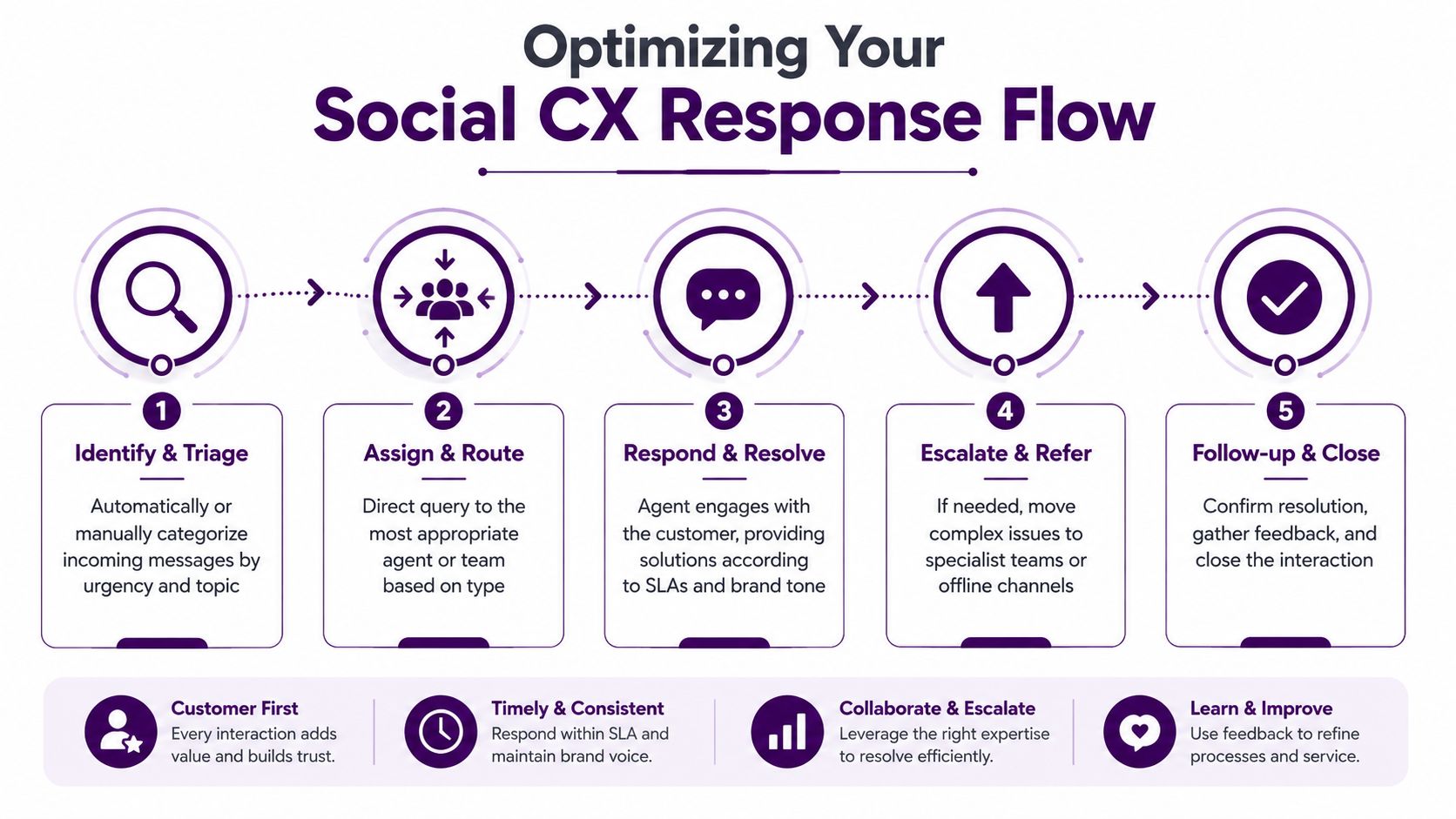
Teams need a response engine that decides three things quickly: what this message is, who owns it, and whether the reply stays public or moves private.
At CallZent, we build social workflows to work under pressure, across shifts, and in both English and Spanish. That changes how the workflow is designed. Bilingual coverage is not a staffing footnote. It affects triage rules, escalation paths, template libraries, supervisor oversight, and after-hours coverage.
A practical response engine usually follows this sequence:
- Detect the message in the social inbox, listening queue, or alert feed.
- Classify it by urgency, topic, sentiment, language, and customer type.
- Route it to the right agent, queue, or back-office function.
- Respond in the right channel based on privacy, risk, and resolution requirements.
- Close and document it so the case history is usable on the next contact.
The workflow needs more than a queue map. It needs decision rules.
An Instagram comment about a missing order should not follow the same path as a pricing question. A fraud complaint in Spanish should not wait for a translation handoff if your customer base regularly needs bilingual support. A telecom outage post may need immediate public acknowledgment, a macros-based private follow-up, and an internal escalation to operations within minutes. Good teams remove guesswork before volume spikes hit.
A simple ecommerce example shows the difference. A customer posts that an order never arrived. The agent checks whether this is a broad carrier delay or an account-specific failure, replies publicly to acknowledge the issue, and moves the customer into DM for order verification. If tracking shows a lost package, the case routes to fulfillment or refunds. After the handoff, the agent can post a short public confirmation that the team has connected and is actively helping.
That protects customer data and shows everyone else in the thread that the brand is responsive.
Set SLAs around channel reality
Social SLAs need to match channel behavior, message type, and staffing coverage. A public complaint on X or Instagram carries more reputation risk than a low-stakes Facebook comment. A DM about billing or healthcare information often needs a fast acknowledgment, but the full resolution may depend on another team. If you run nearshore support, you can usually staff longer same-day coverage without building a full overnight department internally.
The workable model is straightforward:
- Priority public complaints: immediate review and fastest first response
- Direct messages tied to account issues: fast acknowledgment, then routed handling
- General comments and low-risk questions: slower target, but still owned and tracked
- After-hours contacts: automated acknowledgment, then human follow-up in the next staffed window
What matters is consistency. Agents should know the first-response target, the escalation threshold, and the maximum time a case can sit waiting on another department. Supervisors should know exactly when to intervene. If those rules live only in a manager’s head, the SLA will fail on weekends, during launches, and anytime volume doubles.
Tone is part of the workflow
Tone guides routing, de-escalation, and risk control. It is not decoration for the brand book.
Micah Solomon’s Forbes piece on social media customer service practices stresses two points that matter operationally: frustrated customers need an empathetic response, and sensitive or technical conversations should move from public channels to private messages quickly in the right cases. Agents need approved patterns for those moments, especially when they are handling several live threads at once.
Useful templates usually include:
- Public acknowledgment: “We’re sorry you’re dealing with this. Please send us a DM with your order number so we can look into it right away.”
- Clarifying response: “Thanks for flagging this. We need a few details to help, so we’ve sent you a private message.”
- Delay management: “We’ve received your message and our team is reviewing it now.”
The better playbook also defines what agents should never do in public. Do not request account details, phone numbers, medical information, payment data, or full order information in an open thread. Do not overpromise a resolution time if another department still owns the fix. Do not use a cheerful brand voice on a serious complaint just because the social style guide says the brand is playful.
Teams perform better when supervisors can coach live before a reply goes out. That is why we often pair social queues with real-time agent assistance for live coaching and response guidance, especially during launches, service incidents, and other high-visibility periods.
This is also where nearshore outsourcing becomes the practical move. Instead of building a full internal social care department with bilingual coverage, QA oversight, and extended hours, brands can plug into an existing operation that already has the workflow discipline, language coverage, and management layer to run social support like a real service function, not a side task for the marketing team.
Optimizing Performance Tools KPIs and Reporting
Teams that answer quickly but cannot track ownership, resolution, and coaching are still running an incomplete support operation. Social media customer service needs the same management discipline as voice, chat, and email. That means the stack, the scorecard, and the reporting cadence all have to support day-to-day execution.
The toolset does not need to be oversized. It does need to be connected.
- Unified social inbox: Pulls comments, mentions, and DMs into one queue so agents can work from a single view.
- Listening and monitoring: Catches direct tags, untagged complaints, emerging issue patterns, and volume spikes.
- Ticketing or CRM connection: Gives agents account history, prior cases, and the internal context needed to avoid repeat questions.
- Automation layer: Applies tags, routes by priority or topic, and sends approved acknowledgments when queues surge.
- Analytics and QA tools: Track handling performance, expose quality drift, and give supervisors usable coaching data.
This is the visual dashboard most leaders need to build toward:
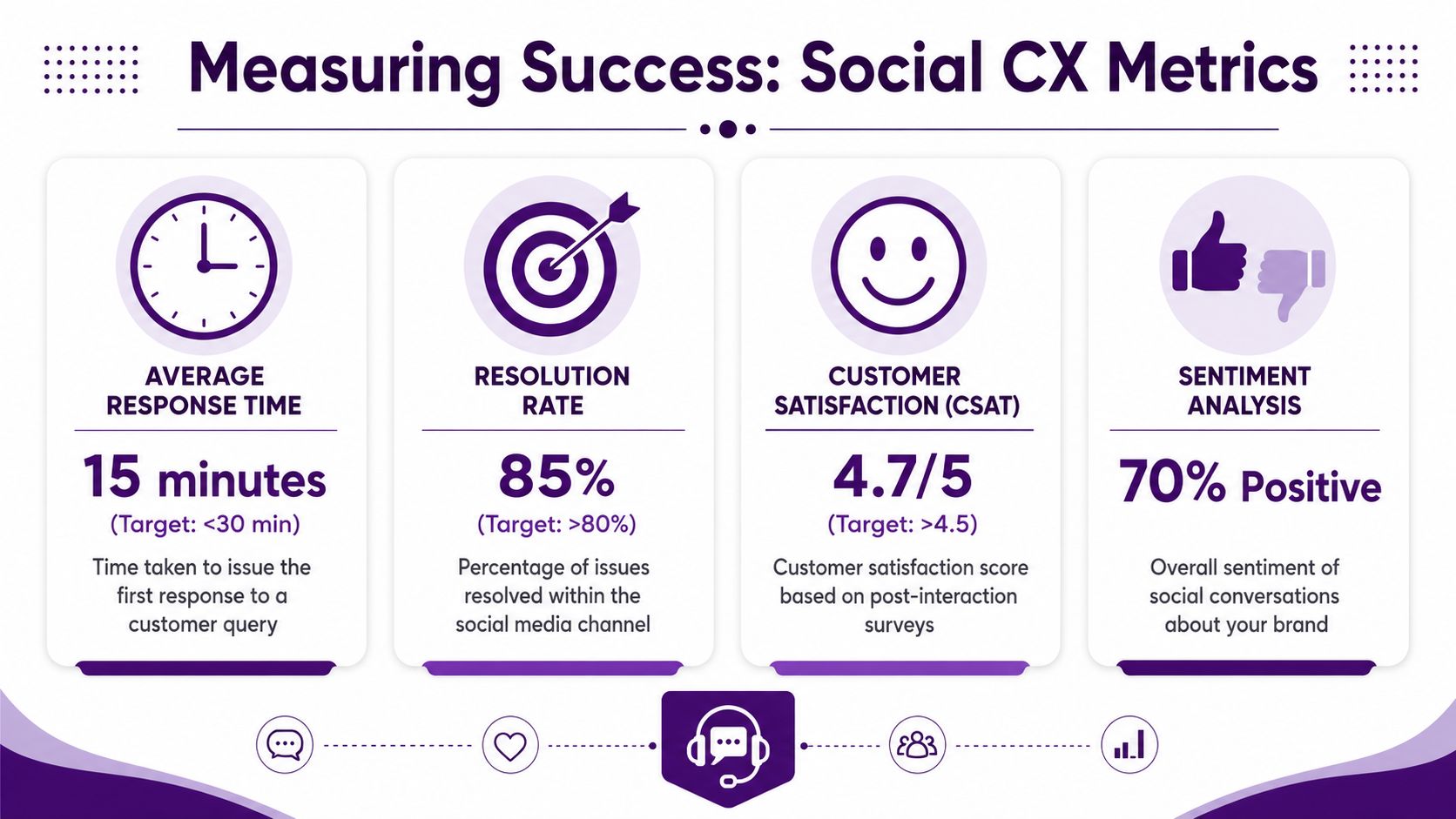
Native platform views are rarely enough once volume grows. Agents miss comments buried under paid posts, follow-ups get split across threads, and supervisors lose visibility into backlog and response discipline. That operational gap shows up in missed messages, inconsistent triage, and weak reporting. As noted in B Squared Media’s guide to social media customer service metrics, average response coverage remains low across industries, and teams improve faster when they use real-time analytics and coaching instead of relying only on end-of-week review.
Measure the KPIs that affect service quality
The right KPIs are operational first. They show whether the team is seeing demand, responding on time, resolving issues, and using labor well.
| KPI | Why it matters | What to watch for |
|---|---|---|
| First response time | Shows how quickly customers get acknowledgment | Spikes by channel, shift, or campaign period |
| Resolution rate | Shows whether cases actually close | Repeat contacts, stalled follow-ups, and handoff failures |
| Queue volume by topic | Reveals where demand is coming from | Defects, policy confusion, shipping issues, outage clusters |
| Escalation mix | Shows complexity and staffing pressure | Excess preventable escalations or poor routing rules |
| CSAT or post-case feedback | Captures customer reaction to the experience | Tone problems, unresolved friction, and slow closure |
A monthly dashboard is useful for leadership. It is not enough for operations.
Supervisors need daily reporting that answers five practical questions: Where is backlog building, which topics are driving contacts, which agents need coaching, which escalations are avoidable, and which SLAs are at risk by hour and by channel. That is the reporting structure we use at CallZent because it gives managers something to act on during the shift, not after the damage is done.
For teams handling English and Spanish support, reporting also needs to separate language queues. Blended numbers can hide staffing problems. A team may look healthy in aggregate while Spanish response times slip, overnight coverage gets thin, or one channel starts sending a disproportionate share of escalations.
For teams that need sharper visibility into customer emotion and risk patterns, sentiment analysis tools for contact centers and social support help supervisors spot rising frustration, recurring complaints, and conversations that need senior review before they spread.
The reporting standard should be simple. Every metric should lead to a staffing decision, a workflow fix, or a coaching action. If a report cannot do one of those jobs, it is noise.
When to Partner with an Expert Scaling with a Nearshore BPO
Social media support usually starts as a side assignment. Then the workload exposes what it really is. A live service operation that needs staffing plans, queue ownership, platform access controls, escalation paths, quality management, and coverage that matches customer behavior instead of office hours.
That gap is where internal teams get stuck.
I have seen brands assign social to marketing, then pull in customer support when complaints pile up, then ask operations to fix response times once public threads start escalating. By that point, they are not deciding whether to answer social messages. They are deciding whether to build a new customer care function.
A nearshore BPO becomes the right move when leadership wants professional execution without spending months building the department from scratch. The benefit is not only labor cost. It is operating readiness. You get team leads, QA structure, bilingual staffing, reporting discipline, and coverage models that already work in production.
The pressure usually shows up in a predictable sequence. Volume rises after a campaign or product release. Customers start expecting replies at night and on weekends. Supervisors need cleaner routing between public comments, DMs, and high-risk cases. Marketing wants brand control. Support wants CRM visibility. Compliance wants tighter permissions and documented handling rules.
At that stage, the build decision is straightforward. Either invest in internal hiring, management layers, workflow design, and platform administration, or bring in a partner that already runs those systems well.
Nearshore support solves several problems at once:
- Bilingual service from day one. English and Spanish coverage should be built into the model, not added after complaints expose the gap.
- Time-zone alignment with North American teams. Faster approvals, easier supervisor access, and fewer overnight handoff failures.
- Faster launch speed. Recruiting, nesting, QA calibration, and manager training do not have to start at zero.
- Elastic staffing. Teams can expand for seasonal peaks, recalls, launches, and campaign-driven spikes without rebuilding the org chart every quarter.
- Operational control. Experienced BPO teams already run scorecards, escalation handling, coaching loops, and service-level management.
The business case matters too. As noted earlier, strong social media support can increase customer value and lower service costs compared with heavier phone and email dependency. That only happens when the channel is run with discipline. Poorly staffed social support does the opposite. It creates public backlogs, inconsistent answers, and preventable escalations that spill into other queues.
A nearshore partner is usually the right fit when one or more of these conditions are already true:
- Your customer base expects bilingual support
- Your internal team cannot cover social consistently across active hours
- You need marketing and support working from one response model
- You want social tied into a broader care operation, not managed as a disconnected inbox
- You need to scale quickly without building management infrastructure first
For companies weighing the delivery model, a nearshore call center for social and customer care operations gives you tighter collaboration than offshore support and a faster, lower-risk ramp than building every role in house.
Social media customer service rewards strong operations. If your company has the time, budget, and leadership bandwidth to build that capability internally, make the investment. If not, partner with a team that already knows how to staff it, run it, and improve it under real volume.
If you need a bilingual nearshore team to launch or improve social media customer service without building the entire function from scratch, CallZent can help. From Tijuana, CallZent supports North American brands with scalable customer care, trained agents, and the operating structure needed to turn social channels into a reliable service function.
🚀 Ready to Build Social Media Customer Service That Scales?
If you need a bilingual nearshore team to launch or improve social media customer service without building the entire function from scratch, CallZent can help. From Tijuana, CallZent supports North American brands with scalable customer care, trained agents, and the operating structure needed to turn social channels into a reliable service function.
Talk to an ExpertFAQs About Social Media Customer Service
What is social media customer service?
Social media customer service is the process of helping customers through platforms such as X, Facebook, Instagram, LinkedIn, and direct messaging channels. It includes public replies, private resolution, escalation handling, moderation, and reporting.
Why is social media customer service important?
Social media customer service is important because customers already use social platforms to ask for help, complain, and pressure brands for faster answers. Poor social support creates visible service gaps that can affect trust and reputation.
Which social platforms are best for customer service?
The best platforms depend on customer behavior. X is useful for fast public issue management, Facebook works well for Messenger and recurring inquiries, Instagram is strong for product and ecommerce questions, and LinkedIn matters more for B2B reputation and account conversations.
How should businesses choose social support channels?
Businesses should choose social support channels based on where customers already ask for help, what types of issues appear on each platform, and whether the team can staff, route, monitor, and report on those channels consistently.
What roles are needed for social media customer service?
A strong social support team may include social CX agents, escalation specialists, team leads, social listening specialists, and content or FAQ specialists. Smaller teams may combine roles, but ownership should still be clear.
What KPIs should social media customer service teams track?
Social media customer service teams should track first response time, resolution rate, queue volume by topic, escalation mix, CSAT, language queue performance, backlog, and SLA risk by channel and shift.
How does automation help social media customer service?
Automation helps by tagging messages, routing cases by topic or priority, sending approved acknowledgments, and reducing repetitive work. Human agents should still handle judgment, emotion, complex issues, and escalations.
When should a social conversation move to private messages?
A social conversation should move to private messages when it involves account details, payment information, medical information, personal data, billing issues, address changes, or anything that should not remain in a public thread.
Why use nearshore outsourcing for social media customer service?
Nearshore outsourcing helps businesses launch or improve social support faster with bilingual English-Spanish agents, time-zone alignment, supervisor coverage, QA, reporting, and elastic staffing without building the full department internally.
How can CallZent help with social media customer service?
CallZent helps North American brands build nearshore social media customer service operations with bilingual agents, workflows, escalation paths, QA, reporting, automation support, and scalable coverage from Tijuana.