

NEARSHORE CALL CENTER STRATEGY
Nearshore Call Center Guide for 2026: Strategy, ROI, Vendor Selection, and Launch Planning
Learn how to choose, launch, and manage a nearshore call center with practical guidance on service models, vendor selection, KPIs, ROI, compliance, bilingual support, and long-term operational success.
Published: June 8, 2026
TL;DR — Quick Takeaways
- A nearshore call center works best when customer support is managed as a revenue-impacting function, not just a cost center.
- Time-zone alignment improves operational control. Supervisors can coach agents faster, resolve escalations during business hours, and adjust workflows without long delays.
- Bilingual English-Spanish coverage is a major advantage for North American brands serving customers across voice, chat, email, and back-office workflows.
- Nearshore outsourcing does not automatically fix service problems. Results depend on onboarding, QA, training, knowledge management, reporting, and clear KPIs.
- The best vendor is not always the lowest-cost vendor. It is the partner with the right management bench, compliance controls, training model, and operational discipline.
Your support operation already affects revenue, retention, and brand trust. The key question isn’t whether customer service costs money. It’s whether that spend creates loyalty or just absorbs budget.
A lot of companies approach outsourcing backward. They compare hourly rates first, then try to fix quality later. That usually leads to churn, repeat contacts, and a partner that looks cheaper on paper than it feels in practice. A better approach is to start with operating design, then choose the right delivery model.
Is Your Customer Support a Cost Center or a Growth Engine
What happens when support starts driving repeat purchases instead of eating margin?
That shift usually comes from operating design, not cheaper labor alone. A nearshore call center gives U.S. companies a practical way to add capacity, keep collaboration inside the same workday, and maintain closer control over quality than many offshore setups. The model matters because service performance affects conversion, retention, refunds, and customer trust.
The core question is execution. A nearshore partner can help fix late replies, uneven QA, and weak coverage across English and Spanish. It can also create new problems if the provider lacks process discipline, training structure, or compliance controls.
Key takeaway: A nearshore model produces better results when leadership sets service standards, operating rules, and reporting cadence before launch.
A common pattern shows up in growing e-commerce teams. Ticket volume rises first. Then first-response time slips, refund queues age, and weekend coverage becomes inconsistent. By the time leadership notices the full impact, CSAT is down and repeat contacts are up. A nearshore team can absorb overflow and extend coverage hours, but only if the partner is trained on refund policy, order workflows, and escalation ownership from day one.
I have seen nearshore programs succeed when clients treat the provider like an extension of operations, not a spare labor pool. That means documented SOPs, calibration sessions, scorecards tied to customer outcomes, and clear rules for when agents solve an issue versus route it. Without that structure, companies often save on hourly rates while losing money through rework, churn, and preventable escalations.
Start with the service design. Define which contacts should be handled by the nearshore team, what success looks like by channel, and how supervisors will monitor consistency. If your team is still building that foundation, this guide to customer care orientation is a useful reference for setting expectations before you scale.
Choosing Your Service Model Nearshore vs Offshore vs Onshore
Which delivery model gives you the control you need without pushing support costs too high?
The answer depends less on geography alone and more on how your operation runs day to day. If your customer support program needs same-day coaching, fast policy updates, close QA oversight, and regular coordination with billing, logistics, or compliance teams, the wrong model creates friction quickly. If the work is standardized, volume-driven, and tightly documented, a lower-cost model can still work.
How the three models differ in practice
| Model | Best fit | Main strength | Main trade-off |
|---|---|---|---|
| Onshore | Highly sensitive customer interactions, local-only workflows | Maximum domestic alignment | Highest cost structure |
| Nearshore | North American brands that need cost control and real-time collaboration | Balance of savings, time-zone fit, and bilingual coverage | Quality varies by provider |
| Offshore | Large-scale, process-driven programs with strong documentation | Lowest labor cost potential | Greater distance in time, oversight, and communication cadence |
Onshore, nearshore, and offshore each solve a different operating problem.
Onshore works best when risk tolerance is low and customer expectations are strict. Healthcare scheduling, regulated financial support, or executive escalation desks often stay onshore because language nuance, legal review, or brand sensitivity matters more than labor savings.
Nearshore fits companies that need lower cost than domestic hiring but still want working-hour overlap and faster management response. That matters in real operations. A U.S. e-commerce brand that updates return rules weekly can train a nearshore team the same day, review failed contacts in the afternoon, and correct messaging before the next peak.
Offshore usually makes sense when the process is stable enough to run through documentation, workflow controls, and scheduled QA. Password resets, basic account updates, and high-volume transactional support can perform well offshore if the client already has mature SOPs, training assets, and escalation logic.
Where nearshore usually wins
Nearshore usually wins when support is tied closely to the rest of the business. The issue is not just hourly rate. It is management speed.
If your operations lead needs to adjust call drivers at 10 a.m., your QA manager needs calibration by noon, and your product team needs a clean list of recurring defects before close of business, nearshore is often the easiest model to run well. Fewer handoff delays mean fewer script errors, fewer repeat contacts, and more consistent customer experience across channels.
I see this most often in multi-channel environments. Voice, chat, email, back-office casework, and social response do not fail for the same reason, but they do break down when one partner cannot stay aligned with internal teams. Nearshore providers tend to hold that alignment better because supervisors, trainers, and client stakeholders can work in the same operating window.
Choose the model your team can manage consistently, measure clearly, and improve quickly.
Where onshore or offshore may still fit better
Nearshore is not the default answer for every program.
Onshore remains the better choice when domestic delivery is tied to legal requirements, union constraints, procurement rules, or customer trust. A Medicare support line or a fraud investigation queue may justify the added cost because the cost of a mistake is higher than the savings from outsourcing abroad.
Offshore can still be the right model for heavily scripted, high-volume work where process discipline matters more than real-time collaboration. The trade-off is managerial. Teams must accept longer feedback loops, invest more in documentation, and build stronger QA routines before launch.
A better way to make the decision is to map work by complexity, risk, and collaboration needs, then assign each queue to the delivery model that fits it. This guide to smart sourcing and outsourcing strategy is a useful framework for deciding what should stay in-house, what belongs with a nearshore partner, and what can be handled in a more standardized offshore model.
Key Business Advantages of a Nearshore Partnership
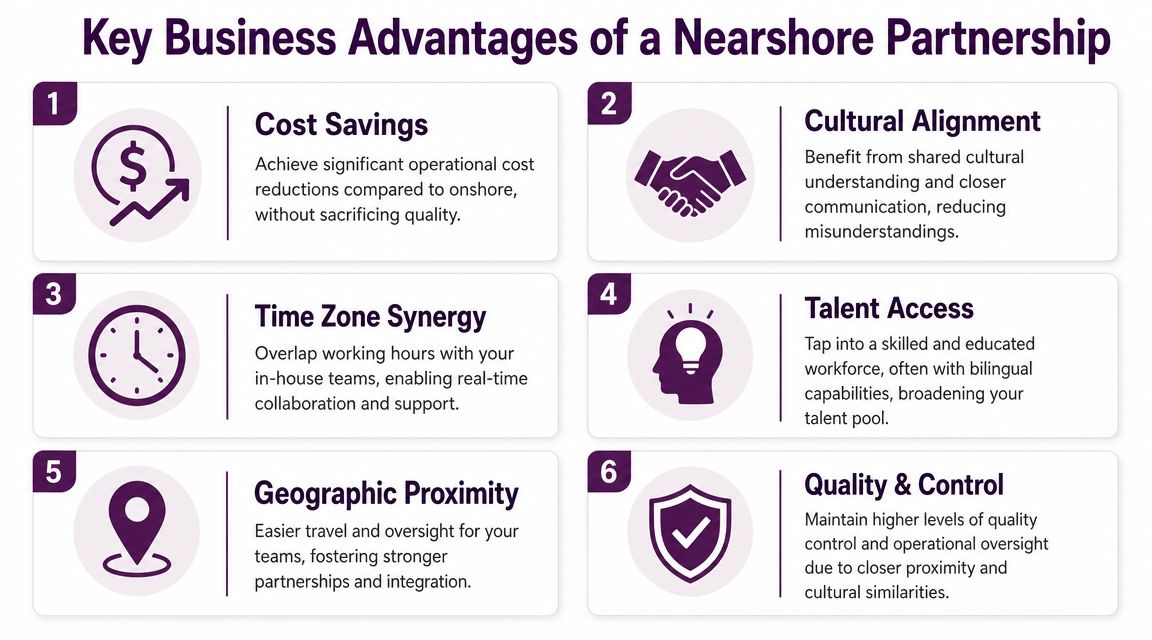
The strongest case for a nearshore call center isn’t just lower spend. It’s better execution under real operating conditions.
Time-zone overlap improves control
A nearshore call center’s main technical advantage is time-zone overlap, which enables real-time escalation handling, same-day QA feedback, and faster resolution of Tier 1 to Tier 4 issues, according to this overview of nearshore contact center operations.
That sounds simple, but it changes the rhythm of management. If your billing queue spikes in the morning, your partner can adjust staffing before lunch. If compliance flags a script issue, QA can review calls and coaching can happen the same day.
A practical example is a telecom support team handling activation failures. With nearshore delivery, the support lead, QA analyst, and client-side operations manager can all troubleshoot the issue during overlapping hours instead of passing updates across time gaps.
Bilingual service supports customer experience
Many North American businesses don’t need “Spanish support” as a separate department. They need flexible bilingual service built into the normal customer journey. A customer may start in English on web chat, move to Spanish on the phone, then receive a follow-up email in English because that’s what’s tied to the account.
A nearshore team is often better positioned for that reality. It can support voice and non-voice channels without making language feel like an exception path. For retail, healthcare intake, travel support, and account servicing, that reduces friction fast.
Proximity helps leadership stay engaged
Nearshore relationships are easier to govern when site visits, supervisor workshops, and launch meetings are practical. Travel isn’t only about audits. It helps operations leaders build shared standards before small issues become chronic ones.
Many outsourcing transitions go wrong. Buyers assume weekly reports are enough. They aren’t, especially early. Teams perform better when your trainers, QA leads, and client stakeholders can spend real time with frontline supervisors.
A provider should feel close enough to manage tightly, not distant enough to excuse surprises.
Savings are more useful when reinvested well
Cost savings matter. But they matter most when leadership uses them to strengthen the support engine. That may mean better workforce management, stronger QA, dedicated training, or expanded service hours.
For buyers evaluating the broader operational upside, this summary of benefits of nearshore outsourcing is a practical companion. The central point is straightforward. Savings alone don’t create value. Better service design does.
\n\n
Core Services Offered by Nearshore Call Centers
\n
A nearshore call center can support more than one customer-service channel. The right scope depends on the work you want to move, the level of process control required, and how closely the outsourced team needs to coordinate with your internal operation.
\n
Inbound customer support
\n
Inbound programs are often the first workload companies move to a nearshore team. Common functions include:
\n
- \n
- Customer service: order status, returns, billing questions, warranty requests, and account updates
- Bilingual support: English and Spanish service for North American customer bases
- Technical support: basic troubleshooting, password resets, product guidance, and escalation triage
- Reservation and scheduling support: booking, confirmations, changes, cancellations, and appointment coordination
\n
\n
\n
\n
\n
Outbound and revenue-support programs
\n
Nearshore teams can also support structured outbound work that follows clear scripts, qualification rules, and escalation paths. Typical use cases include:
\n
- \n
- Lead qualification
- Appointment setting
- Retention and win-back outreach
- Customer surveys and follow-up campaigns
\n
\n
\n
\n
\n
Back-office operations
\n
Process-driven administrative work can also move to a nearshore team when the workflow is documented and measurable. Examples include:
\n
- \n
- Order processing and updates
- Data entry and data cleanup
- Claims or case-documentation support
- CRM hygiene and ticket tagging
- Other repetitive, rules-based administrative workflows
\n
\n
\n
\n
\n
\n
\n
Practical rule: the best nearshore workloads are repeatable, process-driven, trainable, and supported by clear escalation rules.
\n
\n
Your Vendor Selection Checklist for Nearshore Success
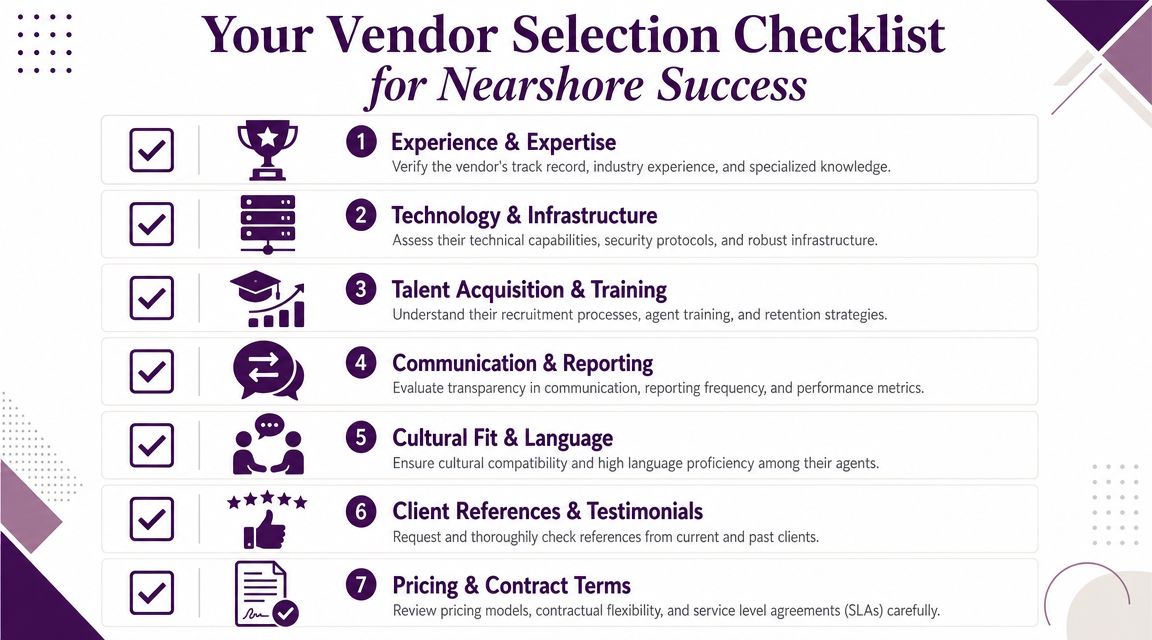
Most outsourcing disappointments start in vendor selection. Buyers ask about price, language, and launch dates. They don’t ask how the provider manages under pressure.
A nearshore call center should be vetted like an operating partner, not a staffing shortcut.
What to check before signing
- Recruiting discipline: Ask how the provider screens for communication ability, role fit, and bilingual fluency. You want a repeatable hiring process, not a vague promise that they can “find talent quickly.”
- Training design: Look for structured onboarding, nesting support, calibration routines, and documented refresh training. Fast hiring without training depth creates rework.
- Technology stack: Confirm support for your channels and tools. That includes CRM access, ticketing workflows, QA systems, knowledge base usage, and reporting visibility.
- Management bench: Ask who runs the floor, who owns QA, and who handles client communication. Thin middle management is one of the most common failure points.
- Security and access control: For regulated workflows, ask how systems are segmented, how recordings are handled, and how access is granted, reviewed, and removed.
- Scalability rules: Don’t just ask whether they can scale. Ask how they scale without weakening coaching quality and queue discipline.
Compliance is not a side topic
The operational risk of bilingual and cross-border compliance is a key differentiator. The best providers can prove controls, training, and auditability for sensitive customer interactions in industries like healthcare and finance, as discussed in this guide to nearshore call center compliance and controls.
That means buyers should ask direct questions such as:
- Who can access sensitive customer data?
- How are agents trained on regulated workflows?
- What audit trail exists for customer interactions and process exceptions?
- How are call recording rules handled across jurisdictions?
- What happens when a compliance issue is found in QA?
A healthcare scheduling program, for example, may sound simple until agents handle patient identifiers, appointment notes, and follow-up messages. A finance support queue may look routine until card data or identity verification enters the call flow. Geography does not solve those problems. Process control does.
What a good review process looks like
Run your vendor review in layers. Start with leadership interviews. Then move to operations walkthroughs, sample reporting, and QA sessions. If possible, observe how supervisors coach agents and how account managers present performance trends.
One practical resource for this stage is this guide on how to find and vet the best call center outsourcing companies. It’s especially useful when your shortlist looks similar on the surface and the key differences are in governance, controls, and management maturity.
\n\n
Nearshore Call Center Pricing Models and Onboarding
\n
Pricing should match the way your workload behaves. A model that works for steady inbound demand may be inefficient for a seasonal campaign, while a purely variable model may create consistency problems for complex programs that depend on deep product knowledge.
\n
Dedicated agent model
\n
A dedicated model reserves a defined team for your business. It is usually the best fit when volume is steady, training is complex, or agents need strong familiarity with your brand, products, and workflows.
\n
Typical fit:
\n
- \n
- Steady inbound customer support
- Complex product or service environments
- Programs that require brand immersion
- Healthcare, finance, or other workflows with tighter training and process controls
\n
\n
\n
\n
\n
Hourly or variable-capacity model
\n
An hourly model can make sense when demand changes frequently or when a company is testing a new outsourced workflow before committing to a larger dedicated team.
\n
Typical fit:
\n
- \n
- Variable call or ticket volume
- Early-stage support functions
- Limited coverage windows
- Pilot programs
\n
\n
\n
\n
\n
Hybrid model
\n
A hybrid structure combines a stable core team with additional capacity for predictable surges. This can work well for retail, e-commerce, travel, and other operations where normal demand is consistent but seasonal peaks require temporary expansion.
\n
A practical onboarding sequence
\n
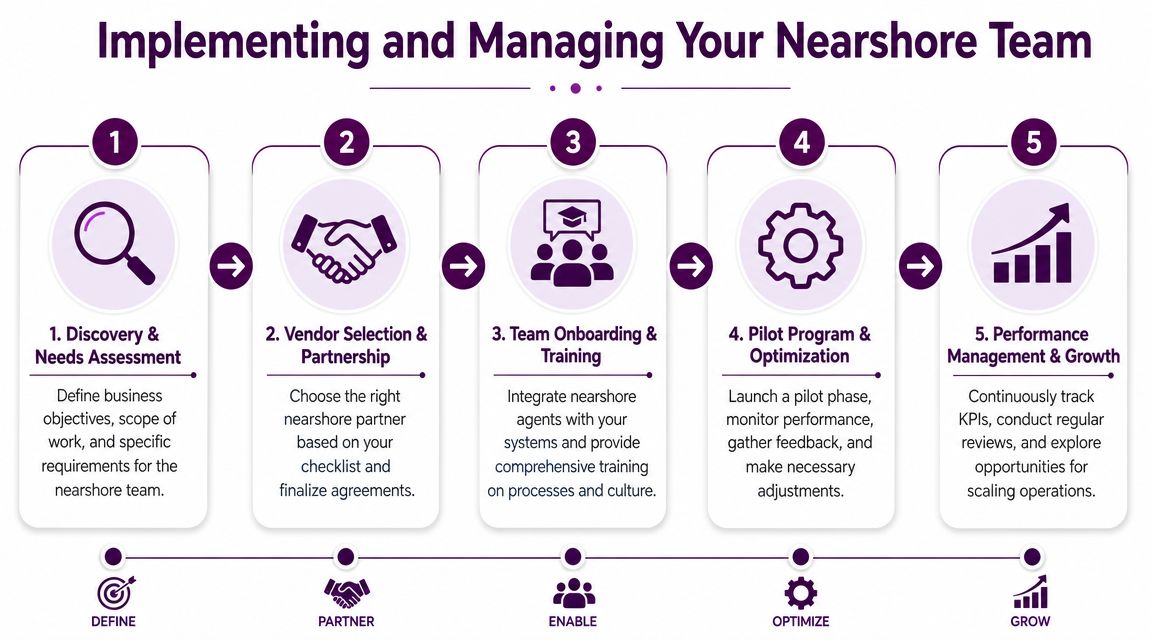
Regardless of pricing model, the launch process should be phased rather than rushed. A practical sequence is:
\n
- \n
- Discovery and scope alignment: document volumes, channels, KPIs, customer types, escalation paths, systems, and compliance needs.
- Solution design: finalize staffing, responsibilities, reporting cadence, technology access, and launch expectations.
- Training and system setup: train agents on workflows, tools, scripts, exceptions, and QA standards.
- Pilot launch: begin with controlled scope, review performance closely, and tighten SOPs before expanding.
- Scale phase: add volume or seats after the pilot demonstrates stable quality and process control.
\n
\n
\n
\n
\n
\n
Implementing and Managing Your Nearshore Team
How do companies get real value from a nearshore call center after the contract is signed?
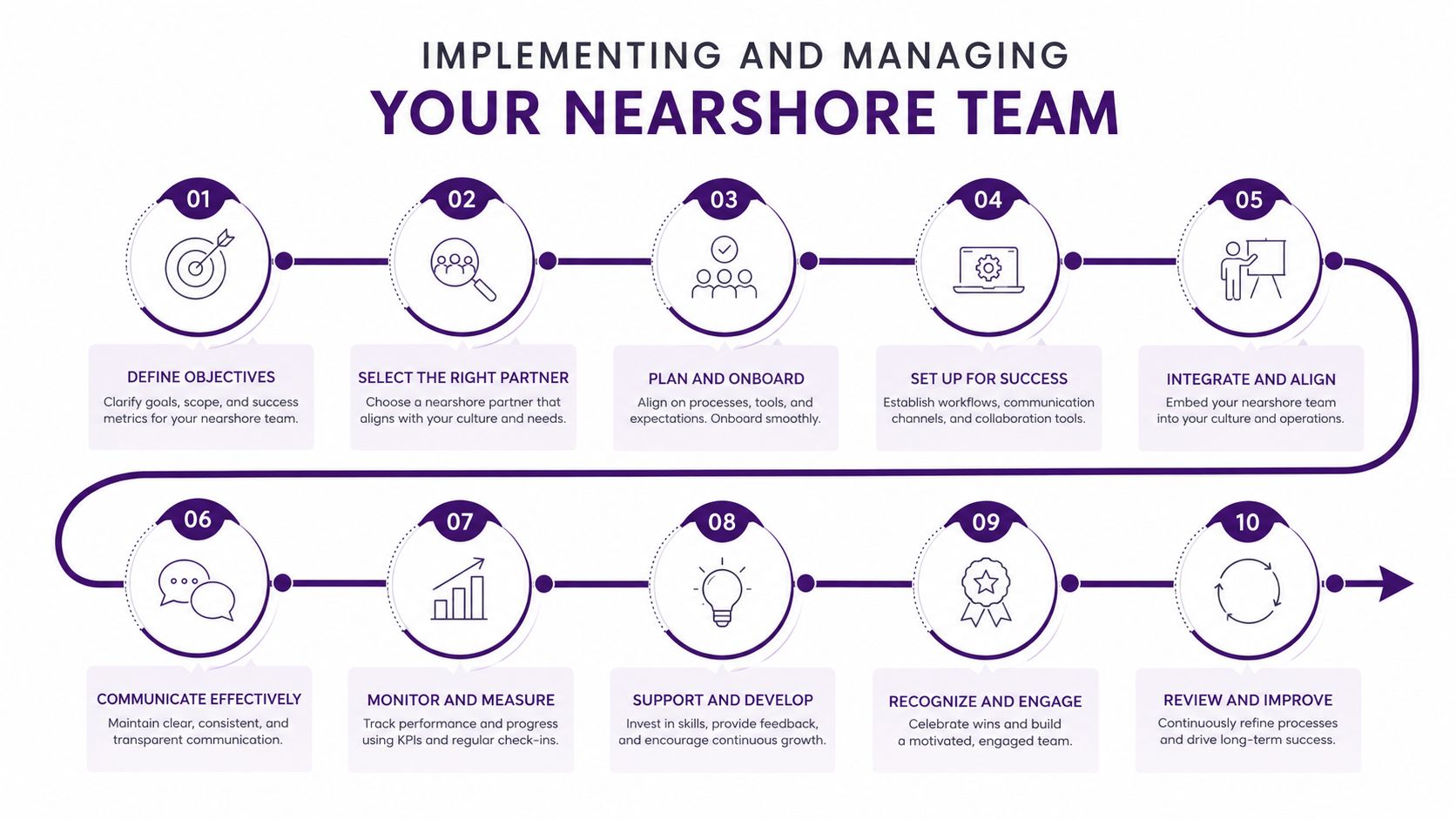
A nearshore team performs well when the launch is treated as an operating build, not a staffing event. The work starts with process design, then moves into training, controls, and management cadence. Buyers who skip that discipline usually get a familiar result. Service levels look acceptable for a few weeks, then quality drifts, escalations rise, and supervisors spend more time correcting avoidable errors than improving the customer experience.
Start with workflow control, not headcount
The strongest implementations begin before hiring. Map the reasons customers contact support, the systems agents need, the decisions they can make on their own, and the points where a case must escalate. Define what good documentation looks like in the CRM. Set rules for refunds, callbacks, identity checks, and exception handling.
Many launches falter at this stage. A client knows the process informally, the internal team fills gaps by habit, and the vendor receives a training deck that covers only the happy path. Agents then learn the actual operation through Slack threads, side chats, and supervisor interventions. That model does not hold once volume increases or new hires enter the queue.
A better approach is simple. Build the playbook around actual contact flows.
Roll out in phases and protect the pilot
Nearshore programs scale better when the first 30 days are used to validate execution. Start with one queue, one customer segment, or one channel. Measure how the team handles volume changes, policy exceptions, and handoffs to your internal staff.
A practical rollout usually follows four stages:
-
Discovery and workflow mapping
Document contact drivers, systems, approval points, and failure risks. -
Pilot launch
Limit scope so the team can prove quality before taking broader volume. -
Calibration period
Review calls, tickets, and chat transcripts. Adjust macros, scripts, tags, and routing rules. -
Steady-state management
Shift to recurring reviews, coaching plans, staffing forecasts, and process improvement.
A partner like CallZent can be evaluated through that lens alongside other providers. The useful question is whether the vendor can run the work with clear reporting, bilingual coverage, and dependable supervision. Seat availability alone tells you very little.
\n\n
Plan surge capacity before peak periods
\n
Seasonal demand is easier to manage when additional capacity is designed before volume arrives. The objective is not simply to add more agents; it is to expand without weakening training, QA, or escalation control.
\n
A practical peak-period plan includes:
\n
- \n
- A trained core team that already understands the account, policies, and customer expectations
- A reserve hiring or staffing plan for predictable surges
- A narrower initial scope for newly added agents so ramp-up remains controlled
- More frequent calibration during peak periods to catch policy, quality, and routing issues quickly
\n
\n
\n
\n
\n
This approach protects the baseline operation while giving the nearshore team room to expand in layers instead of reacting after service levels have already deteriorated.
\n
Set KPIs that drive behavior
Many buyers track the standard scorecard and still miss the operating problem. Average handle time, CSAT, and service level are useful, but they do not explain why repeat contacts rise or why one team outperforms another on the same process.
Use a KPI stack with three layers:
- Service KPIs: response time, abandonment, backlog, schedule adherence
- Quality KPIs: QA scores by error type, policy accuracy, documentation quality, escalation accuracy
- Business KPIs: repeat contact rate, save rate, conversion support, refund avoidance, customer retention impact
That structure changes the management conversation. Instead of asking why CSAT dipped, managers can identify whether the issue came from training, a broken workflow, or an upstream policy that creates avoidable friction. Teams that want a stronger financial model usually pair this operating view with a clear call center outsourcing ROI framework, so cost, service, and process gains are measured together.
Run a management rhythm that catches problems early
A nearshore team needs more than a monthly report. It needs operating tempo.
Use daily reviews for queue health, attendance gaps, and live escalations. Use weekly sessions for QA themes, coaching actions, and process errors. Use monthly business reviews to examine trends, staffing assumptions, and workflow changes that could remove repeat contacts.
I have seen two vendors produce similar topline KPIs while delivering very different outcomes. One supervisor team spent its week reacting to misses. The other came to the review with root-cause analysis, revised call guidance, and a plan to reduce preventable contacts. The second model scales. The first stays busy.
Retention and support design shape long-term performance
Agent retention has a direct effect on quality stability, training cost, and customer consistency. High churn forces the operation into a constant cycle of recruiting, nesting, and relearning. Knowledge becomes shallow. QA variance widens. Team leads spend their time restoring the baseline.
Ask the vendor how they keep experienced agents on the account. Look at schedule design, career paths, coaching quality, and how incentives are tied to performance. A lower hourly rate loses its appeal if your team turns over so often that every quarter feels like a relaunch.
Some programs also need technical depth behind the front line. Companies handling system-heavy support, workflow automation, or product integration work sometimes combine outsourced CX with specialist resources through models such as AI staff augmentation. That setup lets the customer-facing team resolve routine issues while technical specialists improve the tools, automations, or back-end processes creating those contacts in the first place.
Analyzing the ROI of a Nearshore Call Center
A realistic ROI model should be more than wage comparison. The true comparison is operating model versus operating model.
Start with total support cost
Use a table like this to frame the discussion internally.
| Cost Component | Onshore U.S. Estimate | Nearshore Mexico Estimate | Potential Savings |
|---|---|---|---|
| Agent compensation | Higher | Lower | Qualitative savings likely |
| Benefits and overhead | Higher | Lower | Qualitative savings likely |
| Recruiting and hiring | Higher pressure in many markets | Often lower per hire | Depends on provider process |
| Training and nesting | Internal burden often heavier | Shared with vendor | Depends on launch design |
| QA and supervision | Internal management load | Shared management model | Depends on contract structure |
| Office and infrastructure | Fully borne by buyer or domestic vendor | Often built into provider model | Qualitative savings likely |
| Technology licensing | Varies by stack | Varies by stack | Usually neutral unless bundled |
The reason to keep some rows qualitative is simple. Your actual cost structure depends on staffing mix, tooling, occupancy assumptions, service hours, and whether the provider bundles management or bills it separately.
Include service efficiency in the business case
ROI improves when support gets easier to manage. Faster coaching cycles, cleaner bilingual handling, and tighter escalation control reduce repeat effort across the organization. Finance feels it in lower rework. Operations feels it in fewer urgent fixes. Customers feel it in less friction.
This is why buyers should not assume every nearshore setup automatically produces superior economics. Recent industry location analysis noted that labor markets in top nearshore hubs like Mexico are tightening, and buyers should evaluate vendors on retention, training speed, and management depth instead of assuming nearshore automatically equals better service or guaranteed cost advantages, according to this location analysis for nearshore and offshore call centers.
Build an ROI model with decision questions
Use questions like these:
- What support work should remain internal? High-risk or high-complexity queues may still stay in-house.
- What work can move first? Start with stable contact types, then expand.
- What management costs disappear, and which remain? Outsourcing shifts labor, but it does not eliminate governance.
- What customer experience gains are realistic? Focus on consistency and response quality, not vanity metrics.
- How resilient is the provider’s labor model? Tight labor markets can affect ramp speed and continuity.
For teams building the internal financial case, this guide to the ROI of outsourcing call centers is a practical next step.
Nearshore Strategies for E-commerce Healthcare and Finance
The same nearshore call center shouldn’t run every industry the same way. Good partners change workflows, controls, and training by vertical.
E-commerce needs speed and flexibility
An e-commerce brand usually feels pain in three places first. Order status contacts pile up, returns create avoidable friction, and peak periods expose every weak process.
A nearshore team can help by separating simple order inquiries from exception handling. Frontline agents handle order tracking, address changes, refunds within policy, and chat-based pre-sales questions. A smaller escalation pod handles damaged shipments, fraud flags, and high-value complaints. That structure keeps routine contacts moving while protecting more sensitive cases.
For seasonal peaks, the smartest setup is usually a documented playbook. Promo calendars, return rules, shipping exception tags, and approved appeasement options should all be finalized before demand spikes.
Healthcare needs empathy and proof of control
Healthcare support is rarely just scheduling. Patients call anxious, confused, or frustrated. They may ask about forms, referrals, reminders, follow-ups, or billing steps. Agents need empathy, but empathy without process discipline creates risk.
A nearshore healthcare operation works when scripts are built around verification steps, clear escalation rules, and secure handling of sensitive information. Supervisors should review both soft skills and process adherence. If an agent is warm but skips required documentation, that’s still a failure.
One of the clearest markers of maturity in healthcare support is audit readiness. Leaders should be able to show how training works, how quality is reviewed, and how exceptions are documented.
Finance needs precision and calm communication
Financial services customers often contact support under stress. A payment failed. An account was locked. A transaction looks unfamiliar. The agent’s job is to create clarity without improvising beyond policy.
That requires tighter scripting, stronger identity-verification workflows, and cleaner escalation management than many general support programs use. Nearshore teams can perform well here when the provider treats compliance and coaching as part of the same operating system.
In finance, a confident tone isn’t enough. The interaction must also be traceable, consistent, and policy-aligned.
For insurance, lending, payment servicing, and account support, the best operating model usually blends frontline responsiveness with specialist review paths. The nearshore team resolves what it safely can and routes edge cases through a clearly controlled process.
The larger lesson across all three industries is simple. Outsourcing works when the partner understands the work, not just the channel.
🚀 Build a Smarter Nearshore Call Center Strategy With CallZent
CallZent provides bilingual nearshore call center and BPO services from Tijuana for North American businesses that need voice, back-office, customer support, technical support, and scalable customer operations with close collaboration.
If you’re evaluating a nearshore model and want a clearer view of fit, scope, and operating design, CallZent is one option to review. The company provides bilingual nearshore call center and BPO services from Tijuana for North American businesses that need voice, back-office, and customer support coverage with close collaboration.