
Meta title: Omnichannel Customer Support Guide for Growing Businesses
Meta description: Learn how omnichannel customer support works, what tech it requires, how to implement it, and how a nearshore bilingual partner improves continuity and ROI.
Customer Experience Strategy
Omnichannel Customer Support Guide for Growing Businesses
Does your customer support feel more like a maze than a conversation? Omnichannel customer support connects every touchpoint so customers, agents, and leaders can move through one continuous journey.
A customer starts in chat, gets routed to email, then calls your team and has to explain everything again. The issue may still get solved, but the experience feels disjointed. That friction is expensive. It slows agents down, frustrates customers, and makes even a well-staffed support operation look uncoordinated.
That is the gap omnichannel customer support is meant to close. Not by adding more tools for the sake of it, but by connecting customer interactions so the journey feels continuous across phone, chat, SMS, email, and social. The change is operational. Teams stop treating channels as separate queues and start managing one customer conversation with shared context, cleaner routing, and better handoffs.
Many companies understand the idea in theory. Fewer are set up to execute it well, especially when support needs to be bilingual, available across time zones, and consistent across digital and voice channels. That is where strategy matters as much as software. It also helps to understand how customer communication habits changed over time, which is why this look at the evolution of customer communication channels is useful context for any support leader planning a redesign.
TL;DR
- Omnichannel customer support connects channels into one continuous customer journey, instead of running each channel in a silo.
- Customers now expect continuity across touchpoints, not just availability on multiple channels.
- A strong omnichannel model depends on shared data, integrated systems, smart routing, and disciplined operations.
- Nearshore bilingual teams are often the practical way to support voice and digital channels together without losing service quality.
- ROI should be measured beyond CSAT, including repeat contacts, containment, escalation quality, and labor efficiency.
Does your customer support feel more like a maze than a conversation?
A customer starts in chat, gets routed to email, then calls your team and has to explain everything again. The issue may still get solved, but the experience feels disjointed. That friction is expensive. It slows agents down, frustrates customers, and makes even a well-staffed support operation look uncoordinated.
That is the gap omnichannel customer support is meant to close. Not by adding more tools for the sake of it, but by connecting customer interactions so the journey feels continuous across phone, chat, SMS, email, and social. The change is operational. Teams stop treating channels as separate queues and start managing one customer conversation with shared context, cleaner routing, and better handoffs.
Many companies understand the idea in theory. Fewer are set up to execute it well, especially when support needs to be bilingual, available across time zones, and consistent across digital and voice channels. That’s where strategy matters as much as software. It also helps to understand how customer communication habits changed over time, which is why this look at the evolution of customer communication channels is useful context for any support leader planning a redesign.
Introduction
Most support teams don’t struggle because they lack channels. They struggle because those channels don’t work together.
You can have phone support, email support, live chat, and social messaging and still deliver a fragmented experience. Customers feel that fragmentation immediately. Agents feel it too. They waste time searching across tabs, copying notes between systems, and asking questions the customer already answered somewhere else.
Omnichannel customer support fixes a specific business problem. It creates continuity. A conversation that starts in one place can continue somewhere else without losing context. That sounds simple, but it changes staffing, workflow design, reporting, and the kind of partner you need to run it well.
Key takeaway: Omnichannel customer support is not a channel expansion project. It is a continuity and operations project.
For businesses serving North America, the practical challenge is even more specific. Support often needs to be bilingual, aligned to U.S. business hours, and capable of moving between digital channels and voice without awkward handoffs. Generic software alone won’t solve that. Process design, training, and workforce structure matter just as much.
The companies that get this right don’t chase every new channel. They build a support model that fits their customers, their complexity, and their service standards.
From Multichannel Chaos to Omnichannel Cohesion
Multichannel support means you’re present in more than one place. Omnichannel support means those places are connected.
That distinction sounds small, but it changes the customer experience completely. In a multichannel setup, a customer might open a web chat, send an email later, and then call your contact center, only to be treated like three separate cases. In an omnichannel setup, the next agent sees the previous interaction history and picks up from there.
Research summarized by Pylon shows that 79% of customers expect consistent, connected interactions across departments and touchpoints, and 9 in 10 want an absolute omnichannel experience where they can move between channels without repeating themselves in these customer support statistics. That expectation changed the standard. Availability alone isn’t enough anymore.
What multichannel looks like in practice
A common example is a customer who starts with chatbot triage, doesn’t get a full answer, and escalates to a phone agent. If the agent has no access to the chat transcript, the customer starts over. The company technically offered multiple channels. The customer still experienced friction.
That kind of setup creates predictable problems:
- Duplicate work for agents because notes live in separate systems
- Higher customer effort because people repeat account details and issue history
- Inconsistent answers because each team sees only a slice of the interaction
- Weak reporting because leaders can measure channel activity but not the full journey
What omnichannel changes
Omnichannel customer support treats the customer journey as the unit of work, not the individual channel. A conversation can begin in SMS, move to voice for troubleshooting, and finish in email with a written confirmation. The record stays intact.
Multichannel is about your company’s channels. Omnichannel is about your customer’s journey.
| Feature | Multichannel Support | Omnichannel Support |
|---|---|---|
| Customer experience | Several contact options, often disconnected | One continuous experience across channels |
| Agent workflow | Agents work in separate tools or queues | Agents work from shared context |
| Data integration | Interaction history is fragmented | History follows the customer |
| Escalation quality | Handoffs often require repetition | Handoffs carry context forward |
| Reporting view | Channel-level reporting | Journey-level operational visibility |
Why this matters to service leaders
Disconnected channels create hidden cost. Not always in obvious headcount increases, but in longer interactions, repeat contacts, weak escalations, and avoidable frustration.
A business may think it has an omnichannel strategy because it added chat and social alongside voice. If those channels don’t share context, it has a multichannel stack with omnichannel branding.
The customer doesn’t care how many channels you offer. They care whether the next person already knows what happened.
That is why omnichannel customer support has become an operating model, not a feature checklist.
Why Invest in Omnichannel Customer Support
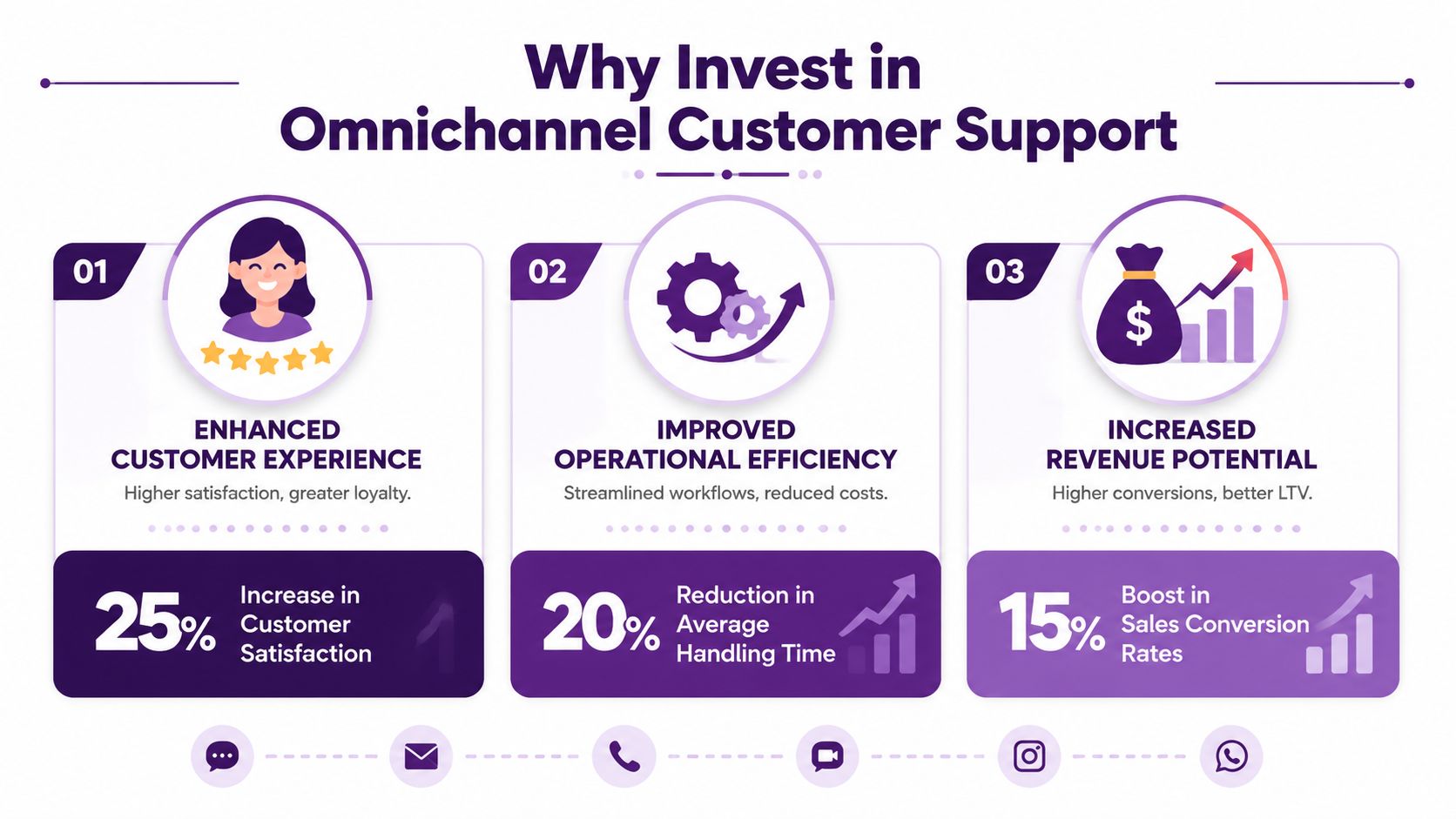
The business case for omnichannel support is no longer theoretical. Spending in the category itself shows that companies treat it as infrastructure, not an experiment. Industry coverage cited by Plivo valued the global omnichannel customer service market at about USD 14.2 billion in 2023 and projected it to reach USD 35.6 billion by 2032, implying a 10.8% CAGR, according to these omnichannel customer service statistics.
More important than market size is what integrated support changes inside the operation. The same source links omnichannel adoption with a 31% reduction in first-resolution times and a 39% decrease in customer wait times when compared with siloed structures.
Better service is only one part of the return
Most buyers first look at omnichannel through the customer experience lens. That makes sense. Customers dislike repetition and inconsistent answers. But in practice, support leaders usually see the operational gains first.
When agents work from one interaction history instead of disconnected tools, they spend less time reconstructing context. Supervisors also get cleaner visibility into where handoffs break down. That makes coaching more precise and scheduling more realistic.
A straightforward way to understand:
- Data layer gives you the customer record
- Integration layer moves that record across systems
- Engagement layer lets agents act on it in real time
If one layer is weak, the experience breaks. This is similar to a smart home. The central brain stores the rules, the wiring connects devices, and the control panel lets people use the system without thinking about the plumbing behind it.
The operational upside is usually underestimated
Leaders often budget for platform licenses and integration work. They forget to budget for what omnichannel removes.
It removes repeat questioning.
It removes manual re-entry between systems.
It removes part of the lag between one team and the next.
Those are small moments, but they add up all day.
Practical rule: If your agents have to copy customer history from one system to another, you don’t have omnichannel support yet.
Stronger insight, not just faster handling
A siloed environment can tell you what happened inside chat or voice. It struggles to tell you what happened to the customer across both.
That difference matters when you’re trying to answer practical questions such as:
- Which issues start in self-service but end in voice
- Where bilingual handoffs succeed or fail
- Which channels create noise instead of resolution
- Whether automation is reducing effort or just moving work downstream
That’s why the best omnichannel investments improve more than service speed. They improve management visibility.
The Technology Stack for Seamless Omnichannel Service
Technology decisions make or break omnichannel customer support, but most buying conversations start in the wrong place. Teams compare channels and features before they define the architecture.
The cleaner approach is to think in layers. An effective stack needs shared data, dependable integration, and an agent-facing platform that can use that information in the moment. RingCentral’s guidance on omnichannel customer service architecture describes this well: a shared source of truth should synchronize CRM, ticketing, and communications systems so context transfers automatically, supports skills-based routing, and lets the next agent see the full journey.
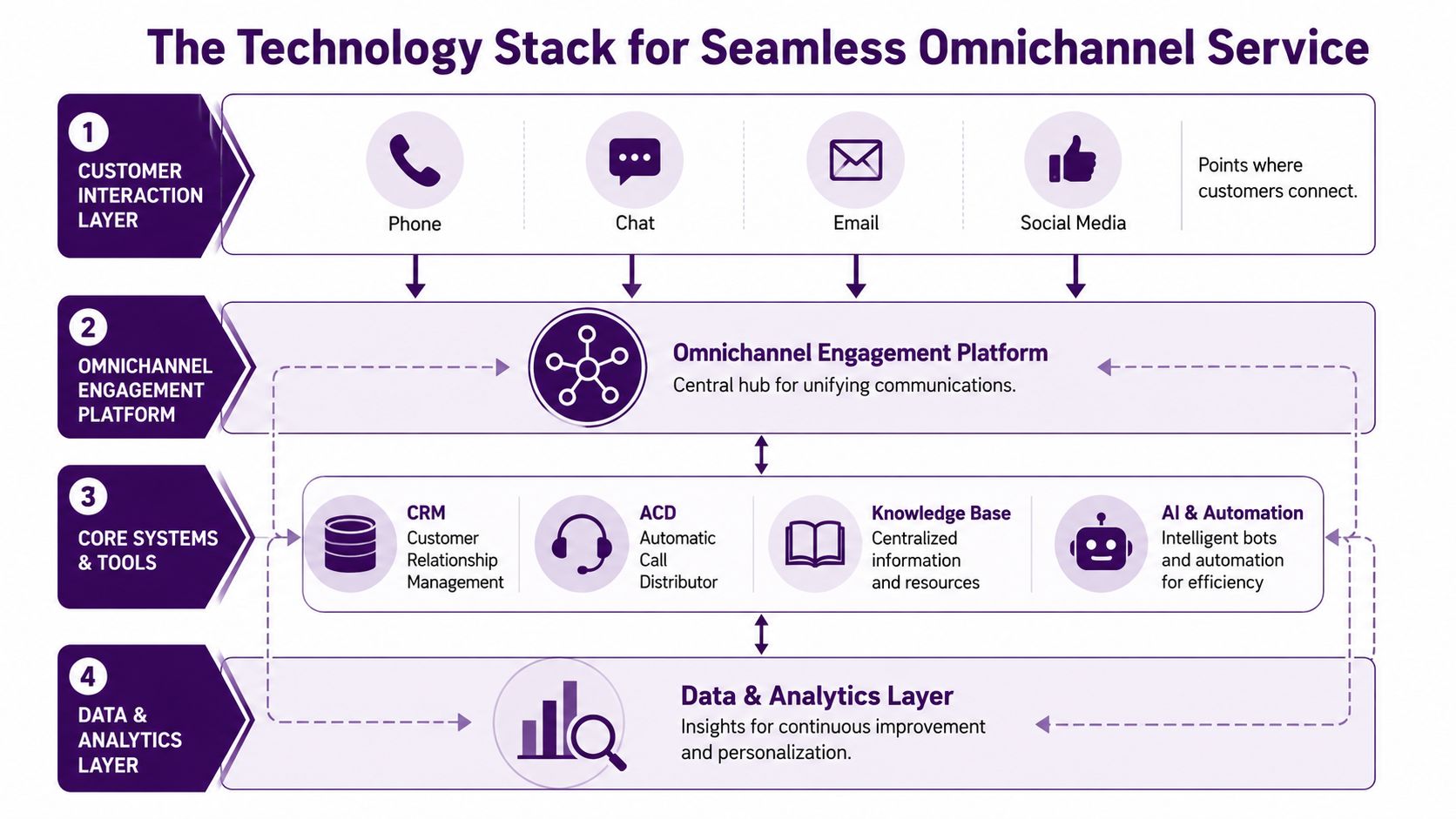
The data layer
This is the foundation. Usually it includes the CRM, customer profile, account status, order history, case history, and sometimes billing or fulfillment data. If that information is incomplete or inconsistent, every downstream workflow gets weaker.
A support leader should ask simple questions here:
- Identity matching: Does the system recognize the same customer across phone, email, SMS, and chat?
- Interaction history: Can agents see prior activity in one timeline?
- Account context: Are key facts visible without opening several tabs?
If the answer is no, agents will compensate manually. That is expensive and hard to scale.
The integration layer
This layer is less visible, but it often determines whether your omnichannel model works in production. APIs, middleware, event syncing, and logging are what move context between systems.
Many companies get stuck. They buy strong tools that don’t pass information cleanly. Or they connect systems in a way that works for reporting but not for live service. That’s why evaluating call center software features should include more than dashboards and user interface. Integration behavior matters more than presentation.
For teams also exploring AI orchestration, this is the point where workflow design matters. Resources on executing AI automation for businesses are useful because they focus on how automation fits into real operational processes, not just chatbot deployment.
The engagement layer
This is what agents and supervisors use every day. Usually that means a CCaaS platform, routing engine, knowledge base access, QA tools, and conversation logging.
The best engagement layer does three things well:
- It surfaces context without forcing agents to hunt for it.
- It routes work by skill, language, urgency, or issue type.
- It records the full path of the interaction for reporting and coaching.
A bilingual support operation especially benefits here. If routing can match a Spanish-speaking customer with the right queue while preserving chat or email history, the handoff feels natural. If not, customers experience a language switch and a context reset at the same time.
What works and what doesn’t
What works:
- A standardized CRM
- Automated conversation logging
- One routing logic across voice and digital
- Shared notes visible to the next team
What doesn’t:
- Adding channels before data is clean
- Letting each department choose separate support tools
- Treating voice and digital as unrelated operations
- Using AI summaries without validating escalation quality
Good omnichannel architecture is boring in the best way. The right information appears when the agent needs it, and the customer never notices the system behind it.
Your Step-by-Step Omnichannel Implementation Roadmap
Most omnichannel projects fail for the same reason. Companies try to launch a finished vision all at once. That usually creates integration gaps, confused agents, and reporting that no one trusts.
A phased rollout works better. It gives operations teams time to test workflows, fix routing, and train managers before complexity multiplies.
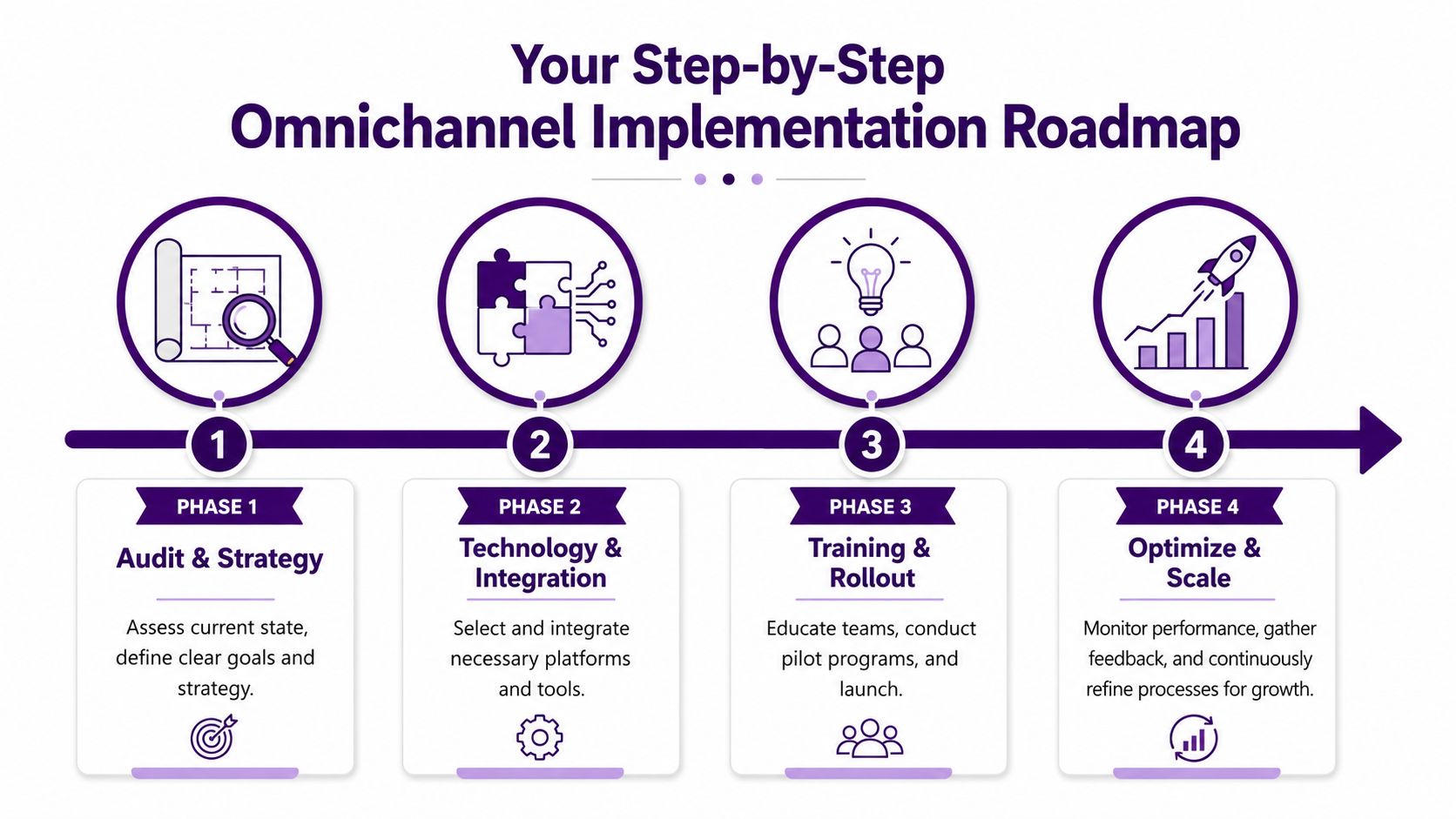
Phase 1 Audit and strategy
Start with journey mapping, not software demos.
Follow a few real support paths from beginning to end. Where do customers repeat themselves? Which handoffs create delay? Which channel shifts are intentional, and which are just signs that one queue couldn’t solve the issue?
Review these inputs together:
- Customer feedback from recent interactions
- Agent feedback on where context gets lost
- Queue-level reporting to spot repeat contacts and transfers
- Language requirements across channels and time periods
This phase also forces a useful discipline. You have to define what success looks like before buying technology.
Phase 2 Technology and partner selection
Once the friction points are clear, choose tools and operating partners that match the actual workflow.
For North America-facing brands, a nearshore model often makes the most sense. Omnichannel support works best when training, QA reviews, routing changes, and escalation design can happen with tight collaboration. A nearby bilingual BPO can usually support that rhythm far better than a distant vendor working on delayed schedules.
One example in this space is real-time agent assistance, which becomes far more useful when agents already have context from previous channels instead of handling each interaction cold.
Phase 3 Training and rollout
Don’t launch every channel at once. Start with the places where continuity matters most and where your data quality is strongest.
A practical sequence might be:
- Begin with email and chat if you already log both well
- Add voice next once CRM matching and routing are stable
- Extend to SMS or social after supervisors can monitor cross-channel handoffs confidently
Training needs to cover more than button clicks. Agents need to know how to read prior context quickly, how to continue a conversation without repeating questions, and when to shift channels without creating customer effort.
Phase 4 Optimize and scale
After go-live, the work becomes operational refinement.
Supervisors should listen for poor handoffs. Analysts should review where self-service leads to escalation. Workforce teams should check whether bilingual staffing matches actual demand by channel and time of day.
This is also where a nearshore partner can add practical value. Better overlap with U.S. teams means faster calibration meetings, easier retraining, and less lag when scripts, workflows, or escalation rules need to change.
Roll out omnichannel customer support in the order your operation can sustain, not in the order your vendor demo suggests.
Leveraging Nearshore Talent for Omnichannel Success
Omnichannel support often gets framed as a technology project. In practice, it is a workforce design project just as much. The software may unify interactions, but people still handle escalations, recover failed journeys, and manage the moments where empathy and judgment matter.
That is why nearshore support is especially relevant for omnichannel execution. A North America-focused business usually needs bilingual coverage, close time zone alignment, and voice agents who can move naturally between phone and digital follow-up. A nearshore team is often better positioned to do that consistently than a far-off offshore model.

Bilingual continuity matters more than bilingual availability
There is a big difference between having some Spanish-speaking staff and designing true bilingual continuity.
In a strong omnichannel model, customers should be able to start in one language and continue in that language across channels without losing pace or context. That requires hiring, routing, QA, and documentation standards that support both voice and written communication. Nearshore teams in markets such as Tijuana are often built for that exact requirement. For businesses evaluating this model, a nearshore call center structure is often easier to integrate into daily operations than a more distant outsourcing setup.
More channels is not always better
One of the biggest mistakes in omnichannel planning is assuming channel count equals service quality. Guidance summarized by Assembled notes that companies should regularly audit channel usage, add channels customers use, remove unused ones, and remember that many customers still prefer low-friction options such as phone for complex issues in this overview of omnichannel customer support.
That has an important staffing implication. Even if your digital volumes are rising, skilled voice agents remain critical. Complex billing, healthcare scheduling changes, claim disputes, order exceptions, and fraud concerns still often resolve faster in a live conversation.
Where nearshore teams improve ROI
The clearest value usually shows up in execution quality:
- Cleaner handoffs: Agents can manage phone and digital follow-up in coordinated workflows
- Faster coaching cycles: Managers can calibrate with internal teams in overlapping business hours
- Better bilingual QA: Reviews can evaluate tone, accuracy, and continuity across English and Spanish interactions
- Channel discipline: Teams can help identify which channels deserve staffing and which only create noise
A nearshore partner can also absorb variability better. If one week drives higher digital volume and the next requires more voice support, a cross-trained team can often shift more smoothly than a fragmented vendor network.
The strongest omnichannel operation is not the one with the most channels. It’s the one that keeps context, language, and service quality intact when the customer changes channels.
Measuring Omnichannel ROI Beyond First-Call Resolution
How do you know an omnichannel program is paying off if one customer starts in self-service, moves to chat, and finishes on the phone?
First-call resolution still matters, but omnichannel ROI shows up in a wider set of outcomes. The core question is not whether one interaction stayed in one channel. It is whether the customer reached resolution with low effort, whether context carried forward, and whether the operation avoided unnecessary repeat work.
Talkdesk’s guidance on measuring omnichannel customer service performance points in the right direction. Support leaders need to track repeat-contact reduction, deflection quality, and escalation performance alongside CSAT and speed. That matters even more once AI, automation, and bilingual routing enter the workflow.
A nearshore model changes the math here. If English and Spanish interactions move across chat, SMS, email, and voice, ROI depends on whether the team can preserve context and service quality across those transitions without driving up handle time, transfers, or QA rework.
Three short examples that show the difference
E-commerce
A customer checks order status in chat, then calls because the package shows delivered but never arrived. If the agent sees the chat transcript, shipment data, and prior notes, the call moves straight to resolution. If not, labor costs rise because the agent spends time rebuilding the case, and the customer is more likely to call again if the answer feels incomplete.
Healthcare
A patient gets a text reminder, enters details through a portal, and then calls to reschedule. In a weak operation, the agent asks for the same information again. In a stronger one, the agent confirms what is already on file, offers available slots, and closes the issue in one conversation. That lowers effort for the patient and reduces avoidable follow-up.
Finance
A customer reports suspicious activity in an app and later reaches a fraud specialist. If the specialist has the event history, verification steps, and case notes, the interaction feels controlled and credible. If the customer has to restate everything under stress, trust drops fast, and repeat contact often follows.
Metrics That Reveal True Performance
Use a broader scorecard. A good omnichannel operation should measure what happens across the full customer journey, not just inside a single queue. A practical place to start is a set of call center reporting dashboards and KPI frameworks that connect channel data to staffing, quality, and cost outcomes.
- Repeat contact rate to confirm whether the issue was resolved
- Deflection quality to see whether self-service and chat are handling the right contacts, not just pushing work downstream
- Escalation quality to measure how well notes, transcripts, and intent data transfer to the next team
- Customer effort to show how much work the customer had to do across channels
- Labor efficiency across handoffs to track whether digital and voice are reducing work or duplicating it
- Bilingual continuity to verify that customers can switch channels and still get accurate support in English or Spanish
That last point is often missed. In bilingual environments, a handoff can look successful in the CRM while still failing the customer if language preference, tone, or prior context gets lost between channels. Nearshore teams often improve ROI here because they can support both languages in overlapping business hours and maintain tighter QA calibration with the client team.
What to watch as AI enters the workflow
AI can summarize conversations, classify intent, and automate simple requests. It can also create hidden costs.
If automation sends unclear summaries to agents, routes customers to the wrong queue, or hands off cases without enough context, the work has not gone away. It has shifted to a more expensive part of the operation. The operational picture becomes clear at the voice or specialist handoff, where poor automation creates longer calls, more corrections, and lower confidence from both agents and customers.
Measure AI-assisted journeys the same way you measure human ones. Track whether they reduce repeat contacts, preserve context, and shorten time to resolution across English and Spanish support paths. If they do not, the issue is usually not the model alone. It is the workflow design, the QA process, or the staffing mix behind it.
Omnichannel Customer Support Across Industries
Omnichannel customer support looks different in each sector because the stakes, workflows, and compliance needs are different. The common principle is continuity. The operational design changes by use case.
E-commerce
E-commerce support lives or dies on speed, visibility, and exception handling.
A customer starts a return in a mobile app. The system sends an SMS update when the package is scanned. Later, the customer opens web chat to ask why the refund hasn’t posted. In a true omnichannel setup, the chat agent sees the return request, shipment milestone, refund status, and prior customer messages in one view. The customer gets an answer, not an interrogation.
This matters most in moments that don’t fit the standard flow:
- Delivery exceptions such as missing or damaged items
- Refund delays when finance and logistics both affect the answer
- Exchange requests that require policy plus inventory visibility
- High-value orders where loyalty risk is higher
A practical mistake in retail is overinvesting in chat automation while underinvesting in voice escalation. For routine order questions, digital works well. For charge disputes, delivery conflicts, and emotionally charged complaints, a trained voice agent often resolves faster and with less customer effort.
Healthcare
Healthcare support requires continuity with more discipline.
A patient books through an online portal, receives an email confirmation, gets a text reminder, then calls because the provider needs to be changed. The support team must carry the scheduling context forward while protecting privacy and following required workflows. If the agent can see the prior appointment activity and communication history, the patient spends less time repeating details and more time getting care coordinated.
Operationally, healthcare teams often need:
- Structured identity verification
- Appointment history across channels
- Careful escalation paths between scheduling, billing, and clinical support
- Consistent bilingual communication for patient access
The strongest healthcare omnichannel model is not the flashiest. It is the one that minimizes confusion at high-stress moments such as rescheduling, pre-visit instructions, referral questions, and billing follow-up.
In healthcare, continuity is part service quality and part risk control. Every broken handoff creates confusion the patient should never have to manage.
Financial services
In finance, continuity and trust are inseparable.
Consider a customer who flags a suspicious charge in a banking app. A confirmation email follows. The customer then calls to speak with a fraud specialist. In a fragmented setup, the specialist asks for the same transaction details again and rebuilds the case from scratch. In an omnichannel setup, the specialist sees the alert, the customer’s prior actions, and the reason for escalation before the call begins.
That difference shapes the customer’s perception of competence immediately.
Financial services teams usually need omnichannel support for:
- Fraud and security events
- Loan or application status questions
- Billing or payment disputes
- Document follow-up and verification
Skilled escalation design matters. Customers may prefer digital intake because it is fast and discreet, but they often want human reassurance once the issue becomes sensitive or high risk.
Telecommunications
Telecom customers often move channels because the issue itself evolves.
They may start in chat for a billing question, switch to SMS for appointment updates, and end on a phone call when troubleshooting becomes technical. If each team sees only its own interaction, the customer experiences the company as scattered. If the journey is connected, the support model feels organized even when the issue is complex.
Telecom workflows especially benefit from:
- Shared technical notes
- Field service visibility
- Queue routing by issue type and language
- Proactive outbound updates during outages or delays
This is one of the clearest examples of why omnichannel support must include strong back-office coordination. Front-end channels can only feel effortless when dispatch, billing, and service notes are connected behind the scenes.
Insurance and broker services
Insurance support involves explanation, documentation, and reassurance.
A member might begin with a portal inquiry, receive an email request for documents, then call with questions about coverage or claim status. Omnichannel support gives the next representative enough context to continue the conversation instead of restarting it. That continuity matters because insurance interactions often carry stress, urgency, or financial concern.
For brokers and carriers, this usually means combining:
- Document-aware workflows
- Case notes across service stages
- Bilingual communication standards
- Escalation paths for sensitive claims or policy disputes
Across all these industries, the pattern is the same. Omnichannel customer support works when it is designed around the customer journey, not around whatever channels happen to be available.
Conclusion
What does omnichannel support change once the rollout is over?
It turns disconnected customer contacts into one operating model your team can manage. Customers spend less time repeating the issue. Agents make better decisions because they can see the last interaction, the current status, and the next likely step. Leaders get a clearer view of where handoffs break, where language coverage is thin, and where service costs rise.
That outcome does not come from software alone. It comes from process discipline, channel design, bilingual staffing, and back-office coordination that holds up under real volume. Companies usually find the same trade-off. Building all of that internally gives them control, but it also adds hiring pressure, training overhead, and slower execution across voice, chat, email, and case work.
For North American businesses, a nearshore model often makes the operating side more practical, especially when English and Spanish support need to stay consistent across channels. A nearshore partner can help close coverage gaps, standardize workflows, and keep digital and voice teams working from the same context. In that model, firms like CallZent are one example of a BPO option for bilingual customer service and back-office support across channels.
Across all these industries, the pattern is the same. Omnichannel customer support works when it is designed around the customer journey, not around whatever channels happen to be available.
Ready to turn fragmented support into one connected customer journey?
CallZent helps growing businesses build bilingual, nearshore customer support operations that connect voice, digital channels, back-office workflows, and customer context.
Connect with CallZentConclusion
What does omnichannel support change once the rollout is over?
It turns disconnected customer contacts into one operating model your team can manage. Customers spend less time repeating the issue. Agents make better decisions because they can see the last interaction, the current status, and the next likely step. Leaders get a clearer view of where handoffs break, where language coverage is thin, and where service costs rise.
That outcome does not come from software alone. It comes from process discipline, channel design, bilingual staffing, and back-office coordination that holds up under real volume. Companies usually find the same trade-off. Building all of that internally gives them control, but it also adds hiring pressure, training overhead, and slower execution across voice, chat, email, and case work.
For North American businesses, a nearshore model often makes the operating side more practical, especially when English and Spanish support need to stay consistent across channels. A nearshore partner can help close coverage gaps, standardize workflows, and keep digital and voice teams working from the same context. In that model, firms like CallZent are one example of a BPO option for bilingual customer service and back-office support across channels.
If you are reviewing omnichannel support, start with the points where conversations stall, transfer, or lose context. That is usually where ROI is won or lost.
If you are ready to move from theory to execution, connect with CallZent to review how a nearshore partnership can support your omnichannel goals.
FAQ: Omnichannel Customer Support
What is omnichannel customer support?
Omnichannel customer support is a connected service model where customer conversations can move across phone, chat, SMS, email, social, and other channels without losing context. The goal is one continuous customer journey, not separate channel-by-channel interactions.
How is omnichannel support different from multichannel support?
Multichannel support means a company offers several contact options. Omnichannel support means those options are integrated, so agents can see prior interactions, continue the conversation, and avoid asking the customer to repeat information.
Why does nearshore talent matter for omnichannel support?
Nearshore teams can improve omnichannel execution by supporting bilingual coverage, closer time zone alignment, faster coaching cycles, and smoother collaboration with North American operations teams.
What technology is needed for omnichannel customer support?
A strong omnichannel stack usually includes a CRM or shared customer data layer, integration tools that move context across systems, routing logic, agent-facing engagement tools, reporting dashboards, and QA processes that monitor handoffs.
How should businesses measure omnichannel ROI?
Businesses should measure omnichannel ROI with a broader scorecard that includes repeat contact rate, escalation quality, deflection quality, customer effort, labor efficiency, bilingual continuity, and first-contact or first-call resolution.
If you are reviewing omnichannel support, start with the points where conversations stall, transfer, or lose context. That is usually where ROI is won or lost.
If you’re ready to move from theory to execution, let’s discuss how a nearshore partnership can support your omnichannel goals. Connect with CallZent to review your strategy.