Skip to content
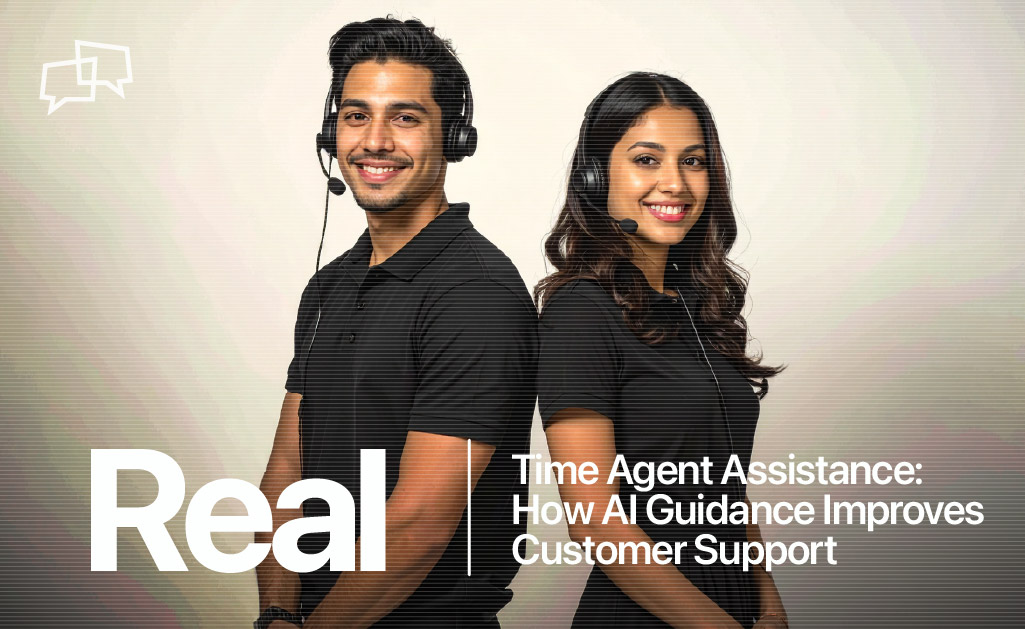
REAL TIME AGENT ASSISTANCE
Real Time Agent Assistance for Nearshore Customer Support
Learn how real time agent assistance improves customer support, compliance, bilingual operations, and agent performance — and why a nearshore BPO partner can reduce rollout complexity.
TL;DR — Quick Takeaways
- Real time agent assistance gives support agents live prompts, knowledge articles, compliance reminders, and next-best actions during customer interactions.
- The best use case is not replacing agents. It is helping agents respond faster, more accurately, and more consistently while staying human.
- Real time guidance improves consistency across shifts, channels, and training waves. This matters especially in outsourced and bilingual support environments.
- Nearshore BPO teams need agent assistance that works across accents, English-Spanish conversations, and fast-changing workflows.
- The right partner treats real time agent assistance as part of service design, not just an AI software feature.
Your agents shouldn’t have to choose between sounding human and getting the answer right.
That’s the gap many support leaders miss. They invest in scripts, QA scorecards, and training refreshers, but agents still juggle multiple tabs, hunt for policy details, and try to remember compliance language while the customer is still talking. In bilingual and cross-border operations, that pressure gets worse. One hesitation can turn a simple call into a transfer, a repeat contact, or a compliance problem.
Real Time Agent Assistance changes that. It adds a live guidance layer inside the conversation itself, so agents get the right prompt, article, disclosure, or next step while the interaction is happening. For businesses outsourcing support, that matters because the value isn’t just new software. The value is getting better execution without building the whole stack yourself.
The Future of Customer Support is Now
What happens when a customer asks a complicated question and your agent already has the right answer on screen before the full issue is even explained?
That’s no longer a future-state concept. It’s how modern contact centers are starting to operate. Real Time Agent Assistance works as a live support layer during voice and digital interactions, giving agents context, reminders, and decision support while the conversation is still active. For operators managing service quality at scale, this matters because post-call coaching helps the next conversation. Real-time guidance helps the current one.
Customer expectations keep rising, but agent work hasn’t become simpler. Agents still handle policy updates, product exceptions, emotional callers, and multiple systems at once. Traditional scripts help with standard calls, but they break down when the customer goes off-path. That’s where live guidance becomes useful. It helps teams respond with more confidence without turning the interaction into a robotic script read.
Why this matters in outsourced support
For a business using a BPO, technology decisions affect the customer experience whether the client sees the software or not. If the partner’s operation relies only on static documentation, quality tends to vary by agent experience, shift, and supervisor availability. If the operation uses live assistance well, the floor becomes more consistent.
That’s especially important in nearshore support, where speed of collaboration matters, but so does language nuance. A bilingual team can only move fast if the tools behind it can keep up with real conversations.
Key takeaway: Real Time Agent Assistance isn’t about replacing agents. It’s about reducing hesitation during the moments that shape trust.
What businesses should expect
The practical upside usually shows up in three areas:
- Better conversation flow: Agents spend less time searching and more time listening.
- Stronger consistency: Required language and process steps are easier to follow in the moment.
- Cleaner scaling: New hires can handle more complexity earlier because they aren’t relying only on memory.
Used well, this technology helps support teams feel less reactive. That changes the customer experience in ways clients notice quickly.
What Is Real Time Agent Assistance
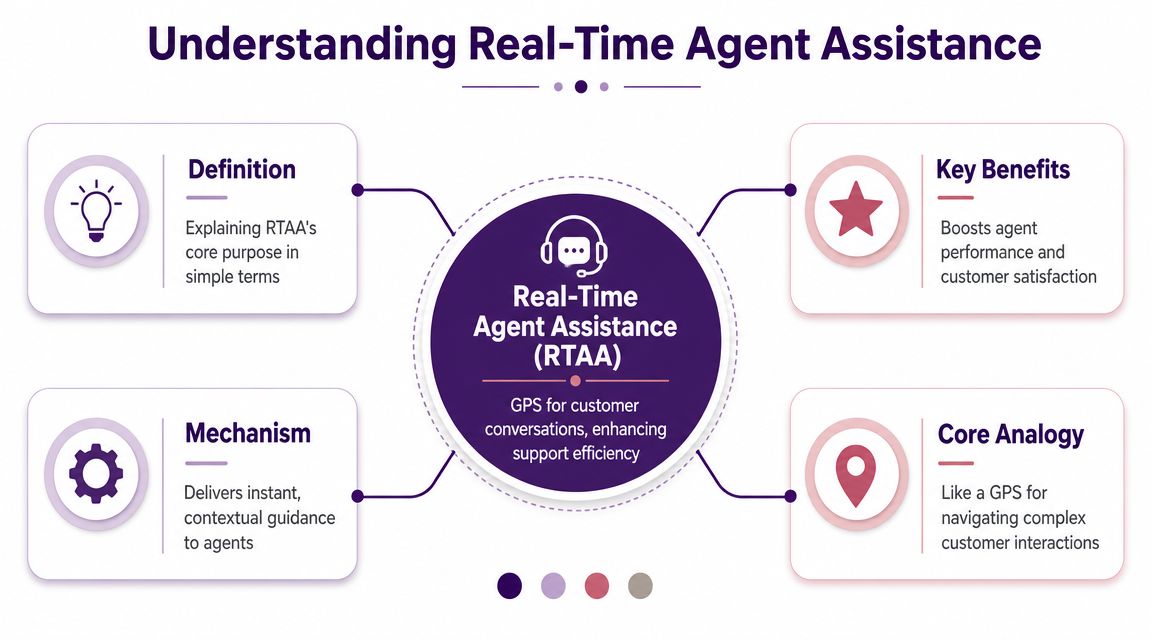
Real Time Agent Assistance is easiest to understand as a GPS for customer conversations.
A paper map gives you directions before the trip starts. It’s useful, but rigid. If there’s a road closure, a missed turn, or a better route, the map doesn’t help much. A GPS adjusts in real time based on what’s happening. Agent assistance works the same way inside support interactions.
Modern platforms analyze voice or digital conversations as they happen, then surface knowledge, compliance reminders, and next-best actions within milliseconds, shifting the industry from post-call analytics to in-the-moment guidance, as described in AssemblyAI’s overview of real-time agent assist.
How it works in plain English
During a live interaction, the system listens to the conversation or reads the chat stream. It identifies what the customer is asking, detects important phrases, and matches that context to the right article, workflow, or prompt. The agent doesn’t need to stop and search manually. The guidance appears while the issue is unfolding.
That guidance can include:
- Knowledge support: The system surfaces the most relevant procedure or product detail.
- Compliance reminders: If the customer mentions something sensitive, the agent sees the required disclosure or step.
- Suggested next actions: The workflow adapts to the customer’s spoken words, not just to a fixed script.
This is very different from a static call script. Scripts assume the conversation will follow a narrow path. Real customer interactions rarely do.
Practical rule: If your agents keep saying “Let me check that for you” while they search three systems, you don’t have a training problem alone. You have a workflow problem.
What Real Time Agent Assistance is not
It isn’t a replacement for empathy. It isn’t a magic layer that fixes broken processes. And it isn’t useful if the knowledge base underneath it is outdated.
The best way to think about it is as a co-pilot. The agent still owns the relationship, tone, and judgment. The system helps with timing, recall, and consistency. That distinction matters, especially for companies evaluating broader automation options. If you’re comparing different AI roles across customer-facing channels, this guide to AI sales and support bots) gives a useful framework for where live assist fits versus fully automated bot experiences.
For businesses exploring practical deployment paths, the more relevant question isn’t “Can AI answer customers?” It’s “Where should AI guide humans so service quality improves without losing control?” That’s the reason many teams start with assisted workflows, including models like AI agent use cases in contact center operations.
The strongest deployments make agents more capable, not less necessary.
Tangible Business Benefits of Agent Assistance
The business case for Real Time Agent Assistance has moved beyond experimentation. One market estimate places the global real-time AI agent assist category at USD 4.4 billion today, with a projection to reach USD 124.6 billion by 2034 at a 39.7% CAGR, while North America accounted for more than 45.5% of the market in 2024 and about USD 2 billion in revenue, according to Market.us research on the real-time AI agent assist market.
That scale tells you something important. Buyers aren’t treating this as a nice-to-have add-on anymore. They’re treating it as operating infrastructure.
Where clients feel the impact first
Most companies don’t buy agent assistance because they want “AI.” They buy it because service friction is expensive. Customers notice delays. Supervisors get pulled into avoidable escalations. New hires need too much support. Real-time guidance addresses those problems directly.
Here’s where the value tends to land:
| Business area | What changes in practice |
|---|---|
| Customer experience | Agents answer with more consistency and fewer pauses |
| Operations | Teams spend less time searching and less time correcting preventable errors |
| Quality and compliance | Required steps are easier to follow during the interaction itself |
The customer doesn’t see the dashboard. They feel the result. The answer comes faster, the call sounds more confident, and the interaction is less likely to bounce into a second contact.
Better service without adding more friction
A common mistake is treating speed as the only win. Faster calls matter, but only when they stay accurate. The bigger operational gain often comes from reducing variability between agents.
Consider a few day-to-day examples:
- New hire support: A newer agent can handle a refund exception because the system surfaces the right workflow without waiting for floor support.
- Escalation control: An upset caller mentions cancellation, and the agent immediately gets the retention or de-escalation path.
- Process discipline: A complex service request triggers required disclosures at the right moment instead of relying on memory.
Teams that want to manage these gains seriously should measure more than handle time. A stronger operating view includes first-contact resolution, repeat contacts, QA consistency, and customer-facing quality signals. This is why a solid framework for customer service KPIs matters before rollout, not after.
Faster support is valuable. Faster support that prevents a second call is where the economics improve.
Why this matters to outsourced programs
When a BPO uses agent assistance well, the client gets more than labor coverage. They get a support environment that is easier to standardize across products, shifts, and training waves. That can make outsourced support feel less like delegation and more like controlled extension of the in-house brand.
If you’re evaluating delivery models, it helps to view this in the broader context of customer support and BPO service options, not as a stand-alone tech feature.
The Core Technologies Driving Real Time Guidance
The visible part of Real Time Agent Assistance is simple. The agent sees a prompt, a checklist, or a recommended response. The invisible part is where the core work happens.
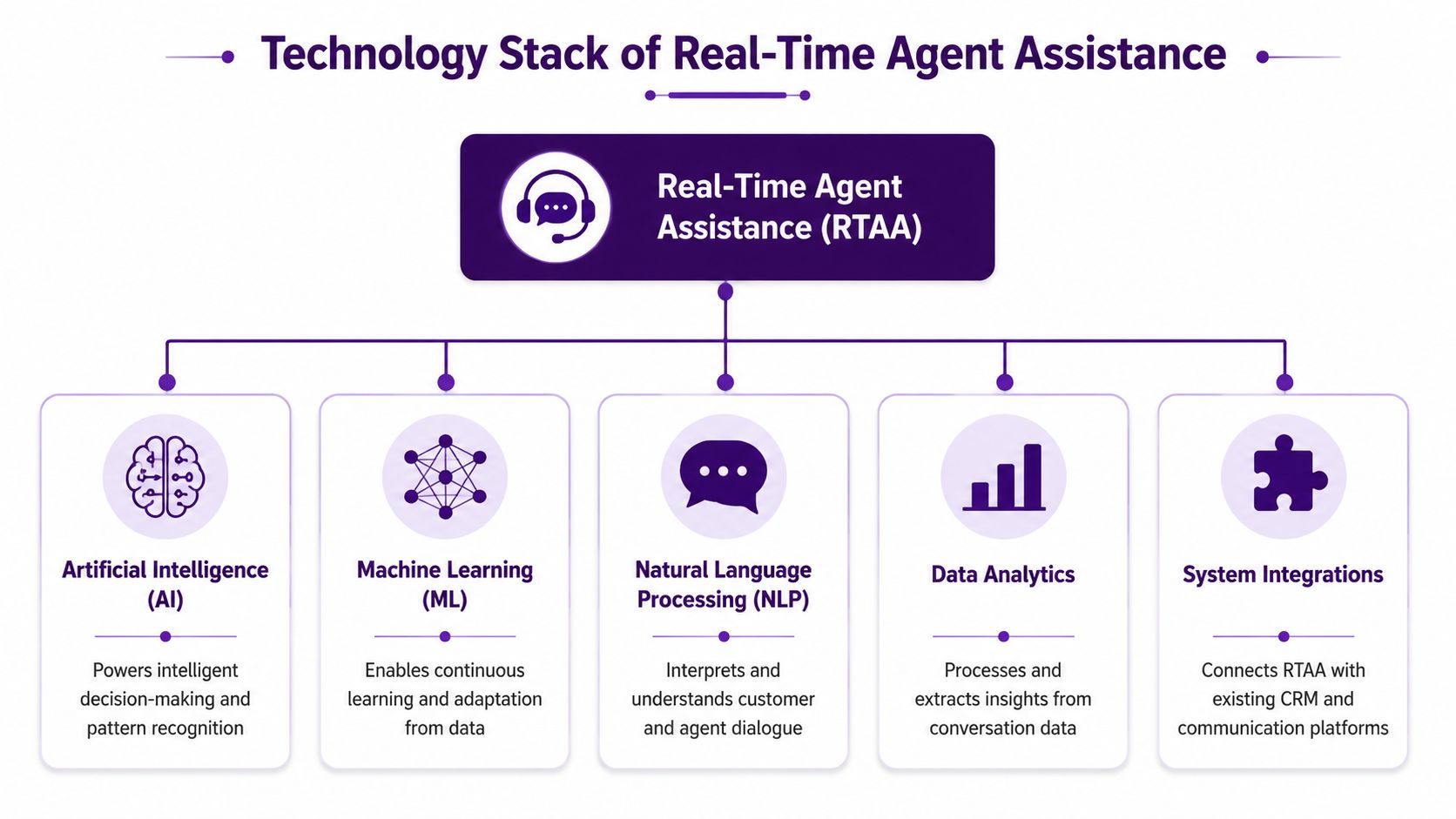
The strongest implementations combine live speech or text analysis with context-aware knowledge retrieval, compliance prompts, and dynamic routing logic. That architecture reduces manual search time and improves adherence because the system detects policy-relevant phrases and pushes reminders during the conversation rather than after it ends, as explained in NICE’s real-time agent assist overview.
The five parts that matter most
Most support leaders don’t need a deep engineering breakdown. They need to know what each layer does operationally.
- Live transcription or text capture: The system needs a clean, fast input stream from the call or chat.
- Language understanding: This is the layer that interprets customer intent, important phrases, and conversation context.
- Knowledge retrieval: The platform pulls the right article, policy, or answer instead of forcing the agent to search.
- Decision logic: Rules and models determine what the agent should see next.
- Agent interface: Guidance appears in a form the agent can use without losing the flow of the call.
If any one of those layers is weak, the whole experience suffers. Great prompts on top of poor transcription won’t help. A strong model connected to a messy knowledge base won’t help either.
What good delivery looks like on the agent screen
The best interfaces are quiet. They don’t flood the agent with alerts. They surface the next useful thing and then get out of the way.
In practice, that can look like:
- A screen pop with the exact return-policy paragraph tied to the product in question
- A live checklist for identity verification when a call enters a sensitive flow
- A discreet prompt warning the agent that a required disclosure still hasn’t been given
- A suggested next step when customer sentiment changes and the call starts drifting toward escalation
This is also where buyers should separate real operational tooling from generic AI hype. Broad overviews of conversational support can help frame the overall picture, and Recepta.ai’s customer support AI guide is useful for understanding how real-time assistance fits into a larger support stack.
Good agent assistance doesn’t overwhelm the rep with ideas. It removes one decision at the exact moment that decision becomes risky.
Integration matters more than feature lists
A platform can advertise sentiment detection, next-best action, and workflow prompts, but if it doesn’t connect cleanly to the CRM, telephony environment, and knowledge base, agents still end up tab-hopping.
That’s why technical fit matters more than flashy demos. The practical test is simple: can the guidance appear inside the workflow the agent already uses? That question should sit alongside your evaluation of core call center software features, because agent assistance only works well when the surrounding stack is stable.
Real Time Agent Assistance Use Cases by Industry
The quickest way to understand Real Time Agent Assistance is to see where it changes real conversations.

E-commerce when a simple return turns complicated
A customer calls about a return that should have been easy, but the order includes a discounted bundle, one damaged item, and a shipping issue. Without live guidance, the agent has to check order history, promotion rules, and return exceptions while trying to keep the caller calm.
With real-time assistance, the system can surface the order context, flag the relevant return policy, and guide the agent toward the correct exception path. The customer hears confidence instead of delay.
This matters most during peak periods. Seasonal volume exposes every weakness in process design. If agents can’t find answers quickly, hold times rise and repeat contacts follow.
Healthcare when accuracy matters as much as empathy
A patient calls with a benefits question and is already frustrated. The issue touches plan details, eligibility language, and privacy-sensitive information. The agent has to answer clearly while following the right disclosure process.
In that kind of interaction, live prompts are useful because they reduce memory dependence. The system can guide the rep through the required script, surface the relevant plan language, and help the agent stay composed while the caller explains a stressful situation.
For healthcare support, this is especially valuable because service quality and compliance live in the same conversation. Teams looking at outsourced models in this space often evaluate live guidance alongside broader medical call center services for patient support.
Finance and insurance when one word changes the workflow
In financial services, customers often trigger a regulated process with a single phrase. They say “dispute,” “fraud,” “beneficiary,” or “policy change,” and the interaction immediately requires stricter steps.
A capable agent assist layer can recognize that trigger and shift the workflow in the moment. The agent sees identity verification prompts, disclosure language, and the right sequence for the case type before improvisation creates risk.
That doesn’t make the call robotic. It makes it controlled.
In regulated environments, the difference between a good call and a risky one is often whether the agent got the right prompt early enough.
Telecom and bilingual support when conversations switch lanes
Telecom interactions often mix technical troubleshooting, billing context, and retention risk in one call. Add bilingual service, and the complexity rises fast. A customer may begin in English, switch to Spanish to explain the issue more precisely, then return to English for account details.
That’s where generic tools often fall short. The workflow has to support language switching, product-specific troubleshooting, and pressure-filled retention moments without slowing the rep down. When the guidance layer is tuned properly, the agent stays in control even when the conversation changes direction.
Implementation The CallZent Nearshore Advantage
Most companies don’t struggle with the idea of Real Time Agent Assistance. They struggle with rollout.
The challenge isn’t just choosing a vendor. It’s deciding how the system will connect to telephony, where knowledge content will come from, which workflows need live prompts, how agents will be trained to trust the tool, and how bilingual performance will be monitored once real calls begin. In a nearshore environment, there’s another layer. The system has to stay useful when agents and customers switch between English and Spanish, speak with different accents, and move across distributed support paths.
A major operational challenge for RTAA is performance in multilingual, nearshore environments. Systems need to return suggestions within milliseconds to remain useful, and results depend on adaptability to accents and language switching, which is especially relevant for North American companies using bilingual support, as noted in Capacity’s discussion of real-time agent assist for contact centers.
A rollout model that works in practice
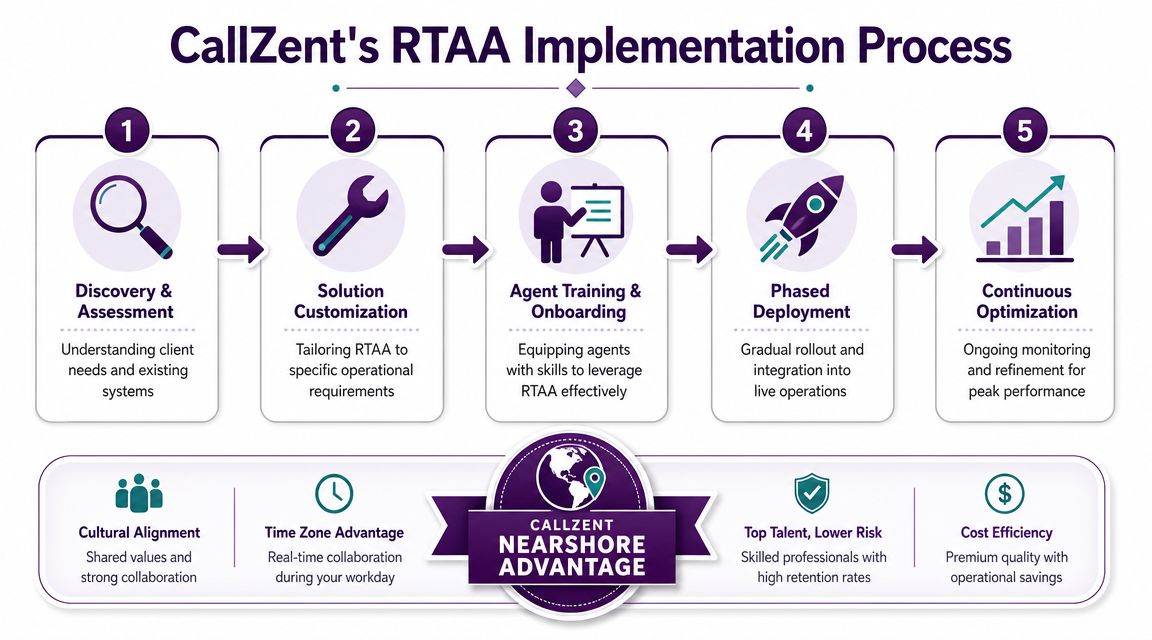
The cleanest implementations usually follow a phased path rather than a big-bang launch.
-
Discovery and assessment
Start with call types, failure points, compliance exposure, and language requirements. Don’t automate everything first. Target the moments where hesitation hurts quality. -
Solution tuning
Align prompts, knowledge articles, and workflow triggers to actual operations. If your documentation is vague or outdated, the system will repeat that weakness at scale. -
Agent onboarding
Teach agents how to use the guidance without reading it word-for-word. The goal is support, not dependency. -
Pilot deployment
Test with a narrow queue, review transcripts, and refine the prompt logic. False positives, timing issues, and language gaps often emerge at this stage. -
Continuous optimization
Update triggers as products, policies, and customer behavior change.
Why nearshore operations need a different lens
A domestic-only rollout can still fail. But bilingual nearshore support adds issues many buyers underestimate.
- Accent variation: Speech recognition has to handle regional pronunciation without degrading guidance quality.
- Code-switching: Customers often move between languages in the same interaction.
- Latency sensitivity: If prompts arrive late, the agent ignores them.
- Escalation continuity: Guidance has to remain useful when the interaction shifts teams or channels.
A nearshore partner can reduce implementation overhead. Instead of asking your internal team to own every integration, tuning cycle, and bilingual QA issue, you can work with an operator already built around these realities. CallZent offers an AI-powered agent assist capability as part of its contact center environment, positioned as a real-time copilot for agents, which is relevant for businesses evaluating managed deployment rather than a full in-house build.
For companies comparing delivery models, the bigger advantage is operational fit. Nearshore teams in Tijuana can collaborate closely with North American clients while working inside the same service window and customer context. That’s part of the broader nearshore advantage for support operations and one reason many businesses also look specifically at a call center in Tijuana when bilingual service quality matters.
Measuring Success and Choosing Your BPO Partner
The wrong way to measure Real Time Agent Assistance is to look only at shorter calls.
One study found that generative-AI assistance increased productivity by 14%, but quality improvements were not uniform across all metrics, which is why the value of agent assistance is more nuanced than speed alone, especially in regulated sectors, according to Uniphore’s real-time agent assist glossary.
That should shape how you evaluate performance. If calls get faster but answers become more generic, or agents follow prompts without judgment, you may improve one dashboard while damaging the customer experience.
What to measure beyond speed
A strong scorecard looks at whether the tool is helping agents resolve the right problems the right way.
- First-contact resolution: Are customers getting a complete answer without calling back?
- QA consistency: Are agents following required steps more reliably across teams and shifts?
- Customer sentiment outcomes: Do interactions sound more confident and less fragmented?
- Agent adoption: Are agents using the prompts naturally, or ignoring them because timing is off?
- Retention and coaching signals: Does the tool reduce stress for newer agents, or create more screen clutter?
Faster calls are only better if they are also more accurate and empathetic.
What to ask a BPO partner
Don’t stop at “Do you have AI?” That question is too shallow to be useful. Ask how the partner configures prompts, tunes workflows, handles bilingual quality checks, and measures whether live guidance is improving outcomes.
A practical checklist includes:
- Workflow fit: Can they tailor guidance to your products, policies, and escalation paths?
- Bilingual readiness: Can the model support English-Spanish interactions without breaking the experience?
- Quality governance: Who audits prompt accuracy and updates content when policies change?
- Operational reporting: Will they show how real-time guidance affects resolution, compliance, and customer-facing quality?
The right partner treats real time agent assistance as part of service design, not as a software badge.
🚀 Improve Support Quality With CallZent
CallZent helps North American businesses improve bilingual customer support, technical support, QA, agent performance, and nearshore BPO operations with service models built around people, process, and real-time guidance.
Talk to an ExpertIf you’re evaluating how to improve support quality without building a complex in-house AI deployment, CallZent can help you assess whether a nearshore, bilingual model with real-time agent guidance fits your operation.