Skip to content


CALLZENT INSIGHTS / BUSINESS PROCESS OUTSOURCING
Outsourced Billing Services: Models, Costs and Compliance.
Compare billing outsourcing models, pricing structures, compliance requirements, and performance metrics before deciding what to outsource, automate, or keep in-house.
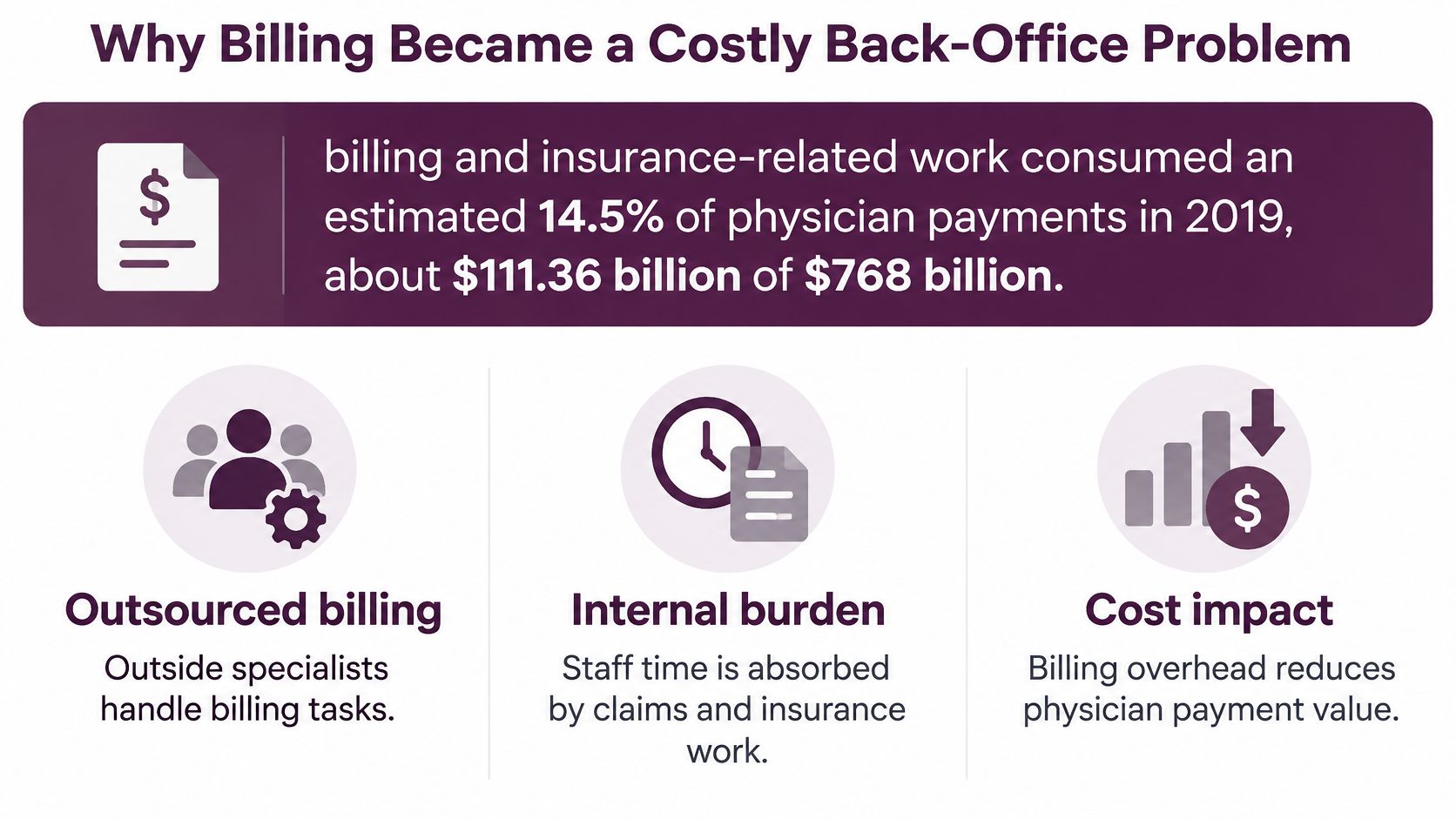
Billing and insurance-related work consumed an estimated 14.5% of physician payments in 2019, about $111.36 billion of $768 billion, according to a peer-reviewed analysis of U.S. healthcare administration .
That’s a reason to examine outsourced billing services, but not a reason to hand every billing task to an outside team.
THE OPERATIONAL CHALLENGE / 01
01
Why Billing Became a Costly Back-Office Problem
Outsourced billing services put outside specialists in charge of selected steps that turn completed work into collected cash. In healthcare, those steps can include coding, eligibility checks, claim submission, payment posting, denial follow-up, and patient statements.
The administrative expense isn’t just the cost of sending an invoice. Staff must interpret payer requirements, match documentation to claims, investigate rejected submissions, and explain balances to patients.
A vendor may bring dedicated capacity to that work, but it can’t correct missing clinical documentation without help from your practice.
When Staffing Becomes a Cash Problem
Consider a hypothetical ten-physician practice whose billing coordinator is out for three weeks. Claims pile up, payment exceptions go unchecked, and days in accounts receivable rise from 40 to 65. Those are illustrative figures, not an industry benchmark, but they show how a staffing interruption can become a working-capital problem.
The practice still pays salaries, rent, and software subscriptions while waiting for money it has already earned. Replacing the coordinator’s hours may help, but management also needs to understand why nobody else could see or work the queue.
The right question isn’t whether outside labor costs less. It’s whether a different billing process collects the right money with less rework.
Start by separating capacity problems from process problems. An overloaded team needs coverage; a team repeatedly submitting incomplete claims needs better validation and clearer ownership.
Outsourcing the second problem without changing the workflow can create an expensive handoff. Look more closely when you see these warning signs:
Rising Receivables
Open balances keep aging without documented next actions.
Unworked Denials
Rejected claims lack assigned appeal owners or deadlines.
Frequent Turnover
Critical billing knowledge lives with individuals, not documented procedures.
None of these signs proves that outsourcing is the answer. Each is a reason to measure the work before comparing vendors.
CHOOSING THE RIGHT SCOPE / 02
02
Service Models and What Each One Covers
Outsourced billing isn’t one universal service. The right operating model depends on which tasks need outside capacity, which decisions must remain internal, and how the teams share information.
| Model | Tasks the Vendor Takes | Who Keeps Control | Best Fit |
|---|---|---|---|
| Full-Service Revenue Cycle | Coding, claims, payment posting, denials, statements, collections | Vendor runs workflow; client approves policy | Practices without a dedicated billing team |
| Back-Office Billing | Claim submission, payment posting, eligibility checks | Internal team retains coding and patient relationships | Organizations with strong in-house coding |
| Denial and Receivables Recovery | Denials, appeals, aged accounts | Client retains front-end work and payer contracts | Organizations with unworked denial backlogs |
| Nearshore Customer Billing Support | Billing questions, reminders, arrangements, collection calls | Client establishes scripts and policies | Service businesses with high billing-call volume |
Choosing the Scope of Outsourced Billing Services
Full-service revenue cycle management gives the vendor broad operational responsibility. Your organization still approves write-off policies, escalation rules, and financial reporting definitions. Don’t confuse workflow ownership with permission to make unrestricted financial decisions.
Back-office billing creates a narrower boundary. Your staff retains coding and patient relationships while the vendor processes defined queues. This works best when both teams can see the same account status and know who resolves exceptions.
Denial and receivables recovery addresses an existing backlog without replacing daily operations. Separate legacy recovery from current claims so routine collections don’t appear as successful backlog work.
Nearshore customer billing support focuses on conversations: explaining charges, following up on failed payments, documenting arrangements, and escalating disputes. It suits businesses that need people to resolve questions, not just software to send notices.
Score the Transaction Before Assigning the Team
According to DataSpring’s summary of the CAQH Index , U.S. healthcare organizations avoided an estimated $258 billion in administrative costs in 2024 through electronic transactions and improved data exchange, while another $21 billion remains available through full automation.
That distinction matters. A claims-status inquiry that software can complete reliably shouldn’t automatically become an agent’s recurring task.
Transaction Cost
Include labor, software, supervision, and exception handling.
Completion Time
Measure elapsed time, not only minutes spent working on an account.
Error and Denial Rates
Identify whether errors originate upstream or during processing.
Customer Experience
Examine repeated contacts, unclear explanations, and unnecessary transfers.
Outsource, automate, or keep. Automate predictable exchanges, outsource repeatable work requiring human judgment, and retain policy decisions or clinical interpretation internally.
A vendor working from disconnected payer portals and payment spreadsheets may simply relocate administrative friction. Require a plan for connected information, exception queues, and handoffs before expanding staffing.
DIFFERENT INDUSTRIES, DIFFERENT NEEDS / 03
03
Healthcare, Finance and E-commerce Billing Needs
Healthcare Requires Coordination Before Collection
In a 2024 survey, 79% of physicians reported that a prior-authorization delay or denial at least sometimes caused patients to pay out of pocket for prescribed medication. A separate survey found that 93% said prior authorization delays care, according to the American Medical Association .
For a specialty clinic, that means the billing workflow starts before treatment. Someone must check authorization requirements, gather documentation, monitor payer responses, and tell clinical staff when approval is missing.
Track authorization turnaround and first-pass approval alongside collections. Operational measures should connect clearly to financial oversight.

Finance Needs Traceable Payment Conversations
Insurers, lenders, and brokers need accurate explanations of premiums, installments, and fees. A caller disputing a loan-payment allocation needs an account review, not a generic collection script.
Check whether calls are recorded where permitted, who reviews consumer-protection language, and how staff document consent and payment arrangements.
Our accounting and finance outsourcing offering provides a starting point for defining payment-related support, while your compliance team sets the boundaries.
E-commerce Needs Fast Resolution of Payment Exceptions
Consider a subscription-box company whose card renewals fail on the first of each month. Bilingual reminder calls can clarify whether customers need to update payment details, dispute a charge, or cancel, rather than treating every failure as unwillingness to pay.
Measure recovery rate and days to resolution for failed renewals, chargebacks, refund questions, and invoice disputes. Keep payment reminders separate from disputed-account investigations.
Questions to Ask Before Choosing a Partner
- Existing capability: Which sector-specific workflows does the team already operate?
- New requirements: Which procedures, integrations, or training would it need to build?
- Communication evidence: How does the team handle patient-facing or consumer-facing billing disputes?
CallZent’s services span healthcare support, debt collection, order processing, virtual assistance, technical support, lead generation, appointment setting, phone answering, legal intake, reservation support, telephone market research, and IT call center services. Select the functions the billing workflow needs rather than buying an unrelated bundle.
COSTS AND COMMERCIAL TERMS / 04
04
Benefits, Risks and What Outsourcing Really Costs
A low hourly rate can still produce a high cost per resolved account if claims need repeated correction or your staff must redo the work. Judge the arrangement by what happens to denials, collections, and internal workload, not by the rate alone.
Outsourcing can make staffing more predictable, add capacity for denial follow-up, and give a practice access to skills suited to complex claims or appeals. It can also help adjust support as volumes change.
The trade-off is that your team still owns the processes and decisions the vendor does not handle. Price the risks before signing: long exit terms, additional software seats, integration fees, subcontractor involvement, and correction work can change the economics.
Understand the Billing Unit
Compare BPO pricing models against the same scope and service expectations.
Percentage of Collections
Fees rise or fall with cash recovery. Define collected cash, reversals, refunds, and excluded revenue in writing.
Flat Monthly Fee
Provides predictable budgeting. Pair it with performance reporting so low output remains visible.
Per-Claim Pricing
Shows the cost of each transaction. Clarify whether resubmissions and denial rework incur separate charges.
Hourly Staffing
Fits work that changes by task or volume. Set expectations for productivity, quality, and supervision.
Typical Hourly Agent-Rate Ranges by Location
| Location | Typical Hourly Agent Rate | Main Trade-Off |
|---|---|---|
| Onshore United States | $25–$35 | Closest alignment; highest rate |
| Nearshore Mexico | $10–$15 | U.S. time-zone overlap and bilingual agents |
| Offshore India | $7–$12 | Lower rate; greater time-zone gap |
| Offshore Philippines | $8–$14 | Lower rate; greater time-zone gap |
These are indicative agent-rate ranges from the source article for comparing labor locations, not medical coder rates or binding quotes. A proposal may include staffing, supervision, quality processes, reporting, training, infrastructure, and delivery support. Confirm exactly what is included.
Mexico nearshore generally costs slightly more per hour than offshore outsourcing, while offering closer U.S. time-zone alignment, bilingual English-Spanish talent, and easier day-to-day collaboration. Specialized collections, technical, or compliance-intensive work may cost more.
Team size and coverage also affect pricing. Larger teams with standard business hours and basic technology tend to cost less than small specialist teams, extended coverage, or custom tools.
ILLUSTRATIVE COST EXAMPLE
$12 × 2,000 = $24,000
At $12 per hour for 2,000 annual hours, the hypothetical direct staffing expense is $24,000. Add excluded tools, implementation costs, and retained internal work to estimate the full program expense.
Before agreeing to a rate, get four answers in writing: what is included, what costs extra, what changes the rate, and who approves overages. A custom CallZent proposal should identify the recurring rate, billing unit, staffing assumptions, minimums, one-time charges, and scope-dependent items.
SECURITY AND RESPONSIBILITY / 05
05
Compliance Rules to Check Before Sharing Patient Data
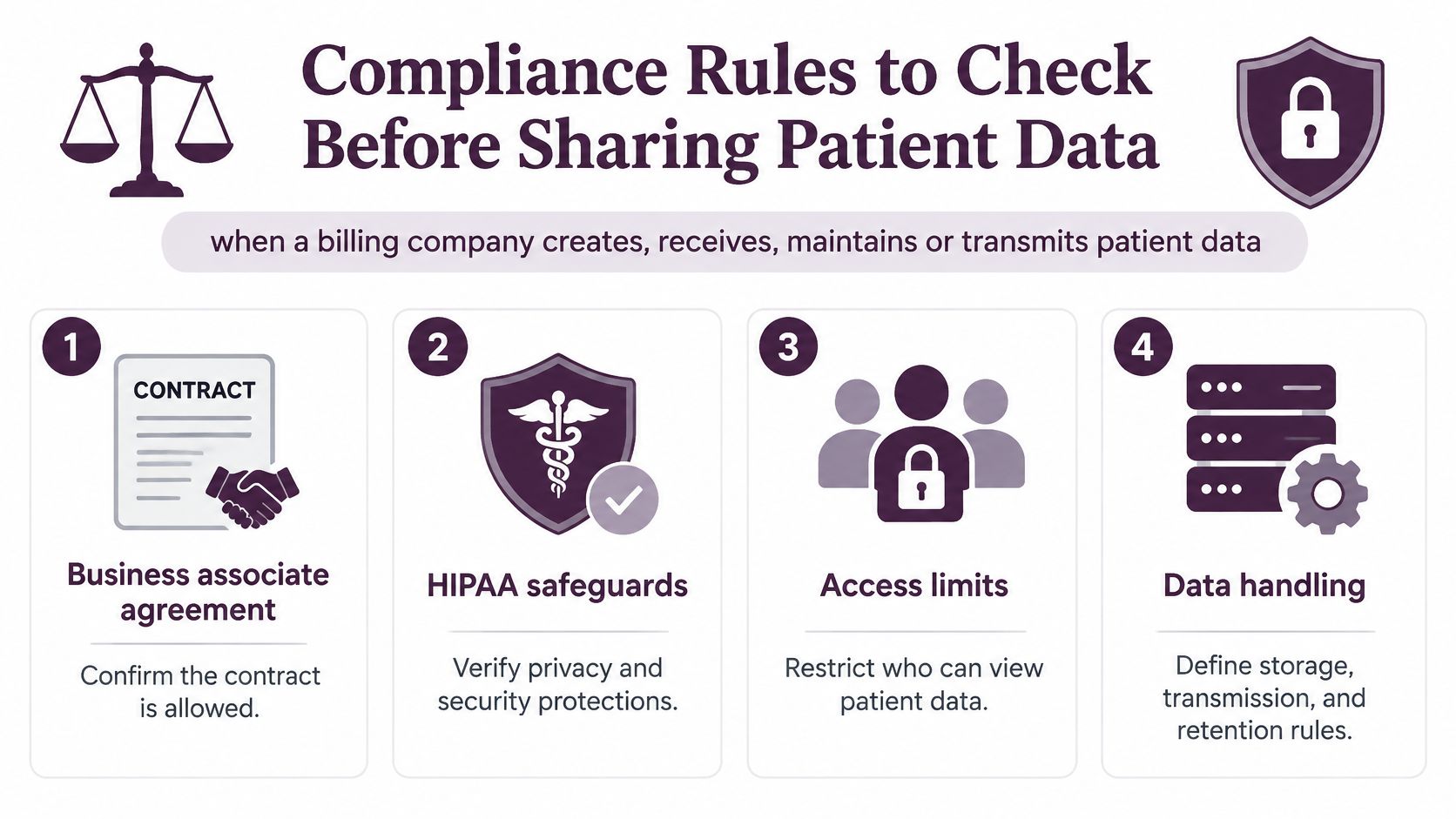
When a billing company creates, receives, maintains, or transmits protected health information for a covered healthcare entity, it generally acts as a business associate under HIPAA. Appropriate written assurances through a business associate agreement (BAA) must be in place before sharing protected information, according to HHS guidance.
Treat this as a contract gate, not a final onboarding formality. Privacy, security, and legal reviewers should approve the arrangement before production access begins.
Work Through the Data-Handling Chain
- Name the activities. Confirm the agreement covers claims processing, payment posting, patient-balance follow-up, and every other contracted activity.
- Define permitted use. Document permitted and required disclosures, restrictions on unauthorized use, and applicable privacy obligations.
- Identify subcontractors. Obtain a list of downstream parties handling protected information and confirm appropriate contractual safeguards.
- Locate cloud storage. Map where claim attachments, exports, and backups reside. A cloud provider maintaining ePHI can itself be a business associate. See HHS cloud-computing guidance .
- Test security procedures. Review access controls, encryption, incident escalation, account removal, audit logs, and contractual breach-notification timelines.
- Separate card-payment controls. Request evidence of applicable PCI DSS compliance and check how staff keep card details out of notes and recordings.
A generic vendor contract doesn’t replace activity-specific agreements, subcontractor visibility, or documented security controls.
A practice outsourcing payment posting might discover that its vendor stores attachments in an unnamed cloud environment. Finding that gap before transfer allows the practice to resolve storage, access, and contractual responsibilities without exposing records first.
For additional review, see CallZent’s healthcare outsourcing compliance guide .
ACCOUNTABILITY AND PERFORMANCE / 06
06
Vendor Criteria and the KPIs That Prove Results
The best proposal isn’t necessarily the one with the lowest price or the most polished presentation. Require comparable evidence from every shortlisted provider.
| Selection Criterion | Evidence to Review | Decision Rule |
|---|---|---|
| Healthcare Compliance | BAA, subcontractor list, security documentation | Exclude vendors that cannot satisfy requirements |
| Relevant Experience | References from comparable business segments | Prefer proven workflows over broad claims |
| Reporting Quality | Account-level and root-cause reports | Require traceable definitions |
| Communication | English-Spanish call samples and dispute scenarios | Assess accuracy, clarity, and respectful treatment |
| Accountability | Named account manager and escalation owner | Require ownership of unresolved issues |
A healthcare finalist should be able to complete the BAA process before protected information moves. After that gate, use consistent vendor evaluation criteria rather than choosing the most polished presentation.
Put Measurable Outcomes in the Agreement
HFMA’s denial-management guidance describes roughly one in ten submitted claims being denied, an industry range of approximately 5%–10%, an optimal initial denial rate below 5%, and a practical target of resolving 85% of denials within 30 days.
Billing KPIs and Benchmarks
| KPI | Benchmark or Target | What It Reveals |
|---|---|---|
| Initial Denial Rate | Below 5% optimal; industry range about 5%–10% per cited HFMA guidance | Front-end eligibility and coding accuracy |
| Denials Resolved Within 30 Days | 85% target in cited guidance | Speed of appeals and rework |
| Denial Dollars by Root Cause | Monthly reporting by category | Preventable errors versus payer-caused denials |
| Appeal Overturn Rate | Improve against the agreed baseline | Quality of appeal documentation |
| Days in Accounts Receivable | Reduce versus baseline without unsupported write-offs | Cash collection speed |
| Complaints per 1,000 Contacts | Stay below the agreed baseline | Customer experience during collections |
The final measures are proposed contract rules, not universal industry benchmarks. Define each denominator and reporting window so comparisons remain consistent.
Require denial rates, denial dollars, root causes, appeal-cycle time, overturn rates, and aging, rather than reporting only total collections. These measures help distinguish payer underpayment from missing documentation, coding errors, and submission failures.
Imagine two proposals with the same monthly fee. One vendor reports missing-documentation denials by payer and routes corrections to the clinical team; the other reports only cash collected. The first provides management with actionable information to prevent repeat work.
Demand Commercial Clarity
Every proposal should show the recurring rate, billing unit, staffing assumptions, minimums, one-time charges, scope-dependent items, and approval process for additional work. Evaluate CallZent’s Tijuana bilingual support against the same communication, reporting, and accountability standards applied to every finalist.
IMPLEMENTATION ROADMAP / 07
07
Start Your Transition With a Process Baseline
Begin with a bounded workflow, not a department-wide transfer. A defined pilot makes it easier to identify whether a change in results came from staffing, automation, a payer decision, or a different mix of accounts.
Use the following periods and shortlist size as suggested planning parameters, not mandatory industry requirements. Adjust the pilot if your transaction cycle needs a longer observation window.
Build a Controlled Transition
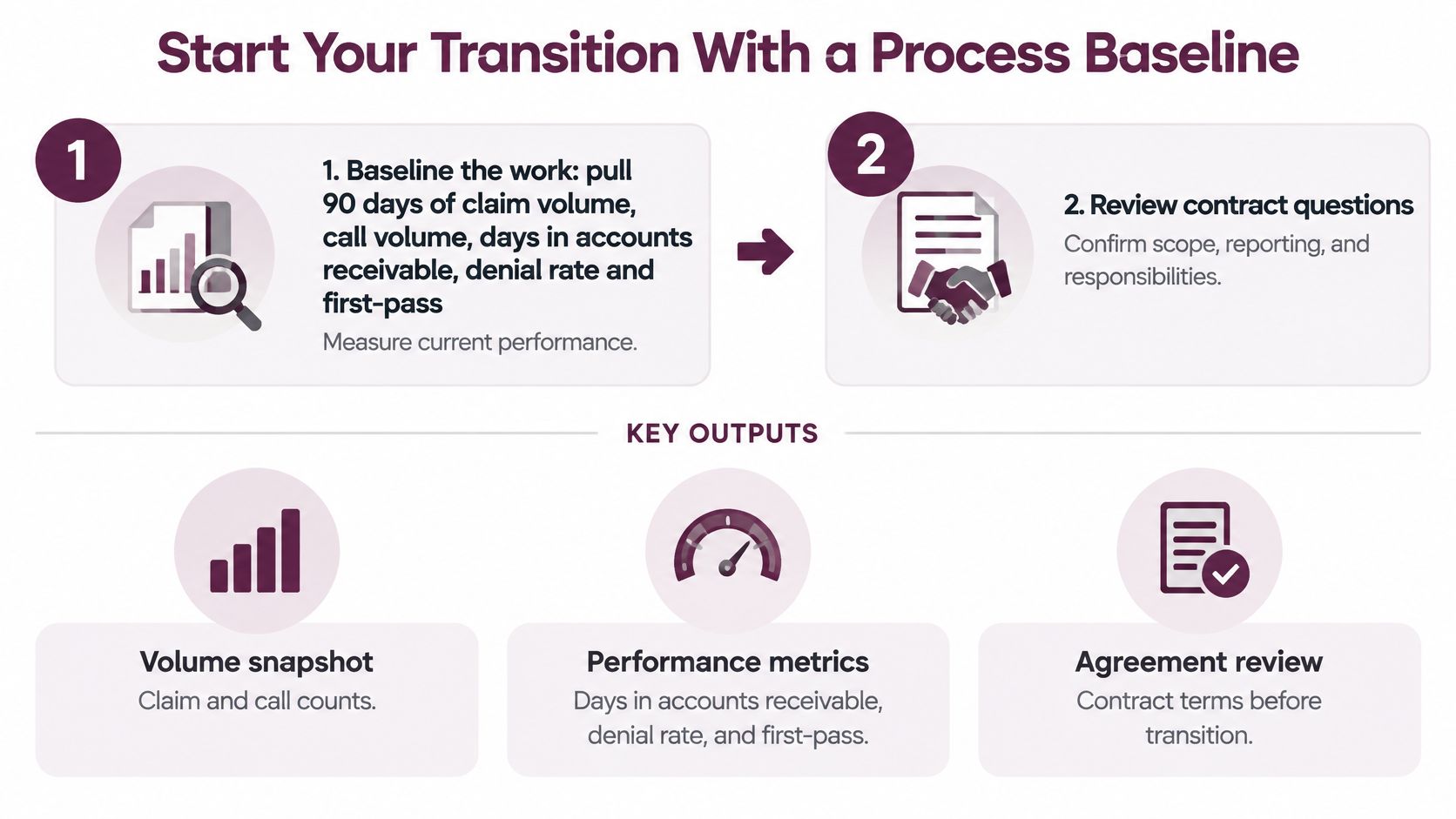
- Baseline the work. Pull 90 days of claim volume, call volume, days in accounts receivable, denial rate, and first-pass acceptance.
- Assign each task. Mark each activity outsource, automate, or keep in-house based on cost, elapsed time, error patterns, and judgment requirements.
- Shortlist three providers. Request quotes using comparable team size, hours, channels, languages, technology, workflow volume, and quality requirements.
- Approve data access. Complete the appropriate BAA, subcontractor, and security review before transferring protected information.
- Run a focused pilot. Test one payer group or product line for a suggested 60–90 days, or longer if the payment cycle requires it.
- Compare outcomes. Evaluate denial rates, days to cash, and complaint rates against a comparable baseline.
- Scale under a written agreement. Specify reporting, queue ownership, escalation, and service levels.
Keep a decision log during the pilot. Record changes to scripts, payer rules, staffing, integrations, and account eligibility so the finance lead can explain results rather than just observe them.
CallZent’s business process improvement approach supports defining the workflow before expanding the team.
Get the Contract Answers in Writing
What Is Included?
Identify queues, channels, reporting, training, and supervision covered.
What Costs Extra?
Document software seats, integrations, implementation work, and specialist activities.
What Changes the Rate?
Define volume, staffing, coverage, and complexity triggers.
Who Approves Overages?
Name the approver and required authorization process.
Also document the exit procedure. Your organization should know how account notes, open appeals, recordings where applicable, and access credentials will be returned, retained, or disabled when the relationship ends.
Start small enough to diagnose problems, but choose work that produces a meaningful financial result.
This month, select one billing task, document its current performance, and prepare a scope sheet covering volume, systems, exceptions, and ownership. Use the baseline to request a custom quote or program-specific review.
FREQUENTLY ASKED QUESTIONS
Outsourced Billing Services FAQs
What are outsourced billing services?
Outsourced billing services involve assigning selected invoicing, payment processing, claim management, receivables, or billing support tasks to an external provider. The exact scope varies by business and industry.
How much does outsourced billing cost?
Pricing may be based on a percentage of collections, a monthly fee, transaction volume, or staffing hours. Costs depend on scope, complexity, coverage, technology, and performance requirements. Quotes should identify all included and excluded services.
What billing tasks should remain in-house?
Organizations commonly retain financial-policy approvals, clinical judgment, sensitive dispute decisions, and oversight responsibilities. Outsource only tasks with clear ownership, defined procedures, and appropriate controls.
Do outsourced medical billing companies need a BAA?
When the provider is acting as a business associate and handles protected health information on behalf of a HIPAA-covered entity, an appropriate business associate agreement must generally be established before protected information is shared.
Which billing KPIs matter most?
Useful KPIs include initial denial rate, denials resolved within 30 days, days in accounts receivable, appeal overturn rate, denial dollars by cause, payment accuracy, and customer complaints. Targets should be based on comparable definitions and baselines.
Can billing operations be automated instead of outsourced?
Some predictable tasks, such as electronic transaction processing, routine reminders, status updates, and data validation, may be suitable for automation. Exceptions, disputes, judgment calls, and complex interactions may still need trained staff.
Why consider nearshore billing support in Mexico?
Nearshore support in Mexico can offer English- and Spanish-speaking teams, U.S. time-zone overlap, and competitive operating costs. The advantage depends on the vendor’s specific capabilities, security controls, training, reporting, and contract scope.
BUILD A BETTER BILLING OPERATION
Better Billing Processes. Stronger Business Results.
CallZent provides bilingual nearshore call center and back-office support from Tijuana for billing questions, payment reminders, insurance-verification workflows, and respectful collections outreach. Define a program around your workflow, systems, customers, and performance goals.