Skip to content
Telesales and Lead Generation
Outsourced Telesales Services: Pricing, KPIs, and Provider Selection
Learn how to build an outsourced telesales program around qualified opportunities, measurable pipeline, CRM accountability, compliant outreach, and reliable sales handoffs.
TL;DR — Quick Takeaways
- Outsourced telesales works when the provider is accountable for qualified pipeline and revenue-linked outcomes—not simply call volume.
- Choose the appropriate motion: outbound prospecting, inbound conversion, appointment setting, lead reactivation, or a controlled hybrid.
- Define qualification, acceptance, rejection, CRM fields, and handoff responsibilities before representatives begin calling.
- Normalize commercial proposals by calculating the effective cost per accepted opportunity rather than comparing headline rates.
- Track connect rate, qualified conversations, held meetings, opportunity progression, cost per opportunity, and pipeline generated.
- Verify consent, calling hours, do-not-call obligations, recording rules, licensing boundaries, and data handling for each market.
- Start with a paid 60-to-90-day pilot supported by clear performance criteria, reporting requirements, and exit terms.
Two SDRs leave in the same week, the pipeline target stays fixed, and your sales team still has to cover every account. You can recruit, train, and manage replacements internally, or you can add experienced phone coverage through outsourced telesales services. The decision shouldn’t be framed as “How cheaply can we make calls?” It should be framed as “Which operating model can create qualified pipeline, protect conversion quality, and give our account executives a reliable handoff?”
Core takeaway: A provider that reports dials but can’t connect those dials to qualified opportunities is giving you activity, not a sales system.
What Outsourced Telesales Services Are
Revenue targets do not pause while your team builds a new calling function. An outsourced telesales provider gives you a defined sales operation without requiring your managers to recruit, train, supervise, and equip every representative internally. Evaluate that arrangement by pipeline quality, conversion rates, accepted meetings, and revenue contribution, not by the number of dials alone.
Outsourced telesales services are third-party sales operations that staff, train, supervise, and run phone-based selling activities for your business. A provider may supplement your SDR team, qualify inbound leads, book appointments, reactivate dormant accounts, or manage outbound work through a defined handoff to your closers. The provider commonly supplies representatives, call technology, quality assurance, reporting, and daily management.
The model supports more than short-term cost control. The outsourced sales services market was estimated at $3,358.57 million in 2026 and projected to reach $4,880.33 million by 2035, with a 4.2% CAGR over that period (outsourced sales services market data). That market activity reinforces a practical point: external sales capacity is an established operating option, but its value depends on measurable commercial results.
What a serious program includes
A credible program begins with your ideal customer profile, offer, qualification rules, and CRM workflow. The provider converts those inputs into call guides, objection handling, list criteria, coaching routines, and a reporting schedule. Demand clear ownership for each stage, from the first conversation through the closer’s follow-up.
Common deliverables include:
- Outbound prospecting: Reaching named accounts through cold and warm calls.
- Lead qualification: Confirming fit, need, authority, timing, and next action.
- Appointment setting: Booking meetings that meet written acceptance criteria.
- Inbound response: Handling calls generated by advertising, forms, referrals, or campaigns.
- Reactivation: Revisiting old leads, former customers, and stalled opportunities.
The operational distinction determines the revenue outcome. A weak vendor treats the assignment as a dialing campaign. A capable partner runs a measurable sales motion, records outcomes in your CRM, and reports whether conversations create qualified opportunities. Before signing, require sample reporting, acceptance rules, escalation paths, and a paid test with explicit performance criteria. Businesses assessing phone-based prospecting can review CallZent’s outbound call center services for an example of how targeted outbound work can support an internal sales organization.
Why Growing Teams Outsource Their Sales Calls
The cost argument is incomplete. Companies outsource telesales because internal capacity is often least available when pipeline pressure is highest. Hiring takes time, new representatives need product knowledge, and managers must split attention between coaching new staff and closing current opportunities.
A specialized provider gives a growing team a faster way to test coverage. You can enter a new territory, call a new segment, or support a product launch without committing your entire internal organization to an unproven motion. If the segment responds well, you have evidence for a larger investment. If it doesn’t, you can change the campaign without carrying a permanent team designed for the wrong market.
The revenue benefits that matter
Ramp speed affects how quickly your company learns. A provider with an established recruiting, training, QA, and reporting process can move from campaign design to live conversations without requiring you to build every layer internally.
Elastic capacity protects the core team from sudden volume changes. Your internal account executives can concentrate on complex opportunities while an external team handles prospecting, qualification, and follow-up. That division only works if the provider’s definition of a qualified opportunity matches what your sellers can close.
Operating infrastructure also matters. Mature partners typically bring dialers, CRM workflows, call recording, coaching routines, and disposition controls. A small internal team may have a CRM and a phone system, but it often lacks the management depth to review patterns, correct messaging, and maintain consistent data hygiene every day.
The broader category is expanding. One estimate valued the global call and contact-center outsourcing market at USD 97.31 billion in 2024 and projected USD 163.86 billion by 2030, at a 9.8% CAGR from 2025 to 2030 (call-center outsourcing market data). That scale reflects a mature supplier ecosystem, not a temporary workaround.
What outsourcing should free your team to do
The internal team should spend more time on activities that require deeper account judgment, negotiation, technical discovery, and deal control. The outsourced team should create a consistent flow of conversations and qualified next steps.
A useful test is simple: if your account executives spend their week searching for basic fit instead of advancing real opportunities, your sales capacity is misallocated. Outsourcing isn’t automatically the answer, but it can correct that allocation when the provider accepts responsibility for pipeline quality rather than merely maximizing activity.
For a broader view of operating models, companies that outsource call centers can help leaders compare external coverage with internal staffing and hybrid approaches.
Inbound Versus Outsourced Telesales Service Models
The right model depends on where buyer intent enters your funnel. Outbound telesales creates conversations with prospects who haven’t raised their hands. Inbound telesales responds to people who already called, submitted information, requested help, or engaged with a campaign.
| Dimension | Outbound Telesales | Inbound Telesales |
|---|---|---|
| Primary purpose | Prospecting, qualification, appointment setting, direct sales | Response handling, order capture, live transfers, reactivation, support-to-sell |
| Starting point | Target account or prospect list | Incoming call, lead form, campaign response, or customer interaction |
| Core measures | Connect rate, qualified conversations, meetings, opportunities created | Conversion rate, revenue per call, order accuracy, transfer quality |
| Sales motion | Proactive and often consultative | Reactive, intent-led, and usually faster |
| Best fit | New-market entry, B2B pipeline creation, account-based outreach | Marketing response, ecommerce, renewals, customer expansion |
| Main risk | Weak targeting or poor qualification creates low-quality meetings | Slow response or poor handling wastes existing buyer intent |
Outbound programs
Outbound works well when you know whom you want to reach but can’t generate enough conversations through inbound channels. A B2B technology company might give a provider a list of target firms, ask agents to identify operational leaders, and define a qualified meeting around a specific business problem. The provider’s job isn’t to force a meeting with every contact. It’s to find legitimate fit and document why the prospect accepted the next step.
For B2C, the motion is usually more transactional. A telecom campaign may focus on upgrades, win-back, or retention, with tighter scripts and faster decisions. The KPI profile changes accordingly.
Inbound programs
Inbound telesales is less about creating demand and more about converting demand that already exists. An ecommerce brand might use agents to answer product questions, capture orders, recommend complementary products, and recover customers who need assistance before completing a purchase. A healthcare provider might route callers to appointments, but the program must follow the client’s privacy and compliance requirements.
Hybrid and handoff design
Hybrid programs flex between both motions. The same team might answer campaign-generated calls during peak periods, then work outbound follow-up when inbound demand slows. This can improve utilization, but only if training, queue rules, and reporting distinguish the two motions.
B2B and B2C shouldn’t be treated as interchangeable. B2B generally needs deeper discovery, more careful qualification, and a clean handoff to an account executive. B2C often depends on speed, consistency, offer clarity, and accurate transaction handling. Ask providers to show the exact staffing, scripts, coaching, and KPIs they would use for your funnel, not a generic service menu.
How Outsourced Telesales Services Are Priced
Most proposals use one of four commercial structures. The headline rate is rarely enough to compare them because one vendor may include list development and QA while another charges separately for telephony, CRM access, reporting, or campaign setup.
| Pricing Model | What You Pay For | Best Fit | Watch Out For |
|---|---|---|---|
| Per hour | Agent and management time | Exploratory campaigns, flexible coverage, short tests | Paying for activity without a clear output standard |
| Per lead | A contact meeting agreed qualification rules | Campaigns focused on qualified demand | Loose definitions, recycled leads, weak acceptance terms |
| Per appointment | A booked meeting that satisfies agreed criteria | Teams with strong internal closers | No-shows, poor-fit meetings, replacement disputes |
| Performance or revenue share | Closed business, sales-qualified conversion, or another outcome | High-margin offers and mature tracking | Attribution disputes, long sales cycles, limited provider control |
Read the scope behind the rate
Per-hour pricing can be sensible when you’re testing messaging or entering a market. It gives you flexibility, but you carry more performance risk. Per-lead and per-appointment models shift more risk to the provider, so the definitions must be precise. A “qualified appointment” should identify the required persona, business fit, stated need, timing, and attendance expectation.
Performance-based pricing sounds attractive, but it only works when both sides control the parts of the funnel being measured. If the provider books a qualified meeting but your sales team follows up slowly, tying payment to closed revenue can create an unfair dispute. If the provider controls prospecting, qualification, and follow-up, a shared incentive may make more sense.
Normalize every proposal
Build a comparison sheet with these fields:
- Included labor: Agents, supervisors, trainers, and QA staff.
- Technology: Dialer, recording, CRM integration, data tools, and reporting.
- Campaign inputs: List sourcing, list cleaning, scripting, and research.
- Output definition: Accepted lead, held meeting, qualified opportunity, or closed deal.
- Commercial constraints: Minimum seats, setup fees, notice periods, and replacement rules.
- Management cadence: Weekly reviews, call calibration, escalation ownership, and optimization work.
Then calculate the effective cost per accepted opportunity. A $28 hourly quote and a $150 appointment quote can’t be compared until you know how many accepted opportunities each model is expected to produce, what quality standard applies, and which costs sit outside the headline price.
Use CallZent’s call center pricing guide as a starting point for the questions your proposal should answer. Don’t select the lowest visible rate. Select the structure that gives both parties a fair reason to improve revenue outcomes.
Measuring Performance With the Right Telesales KPIs
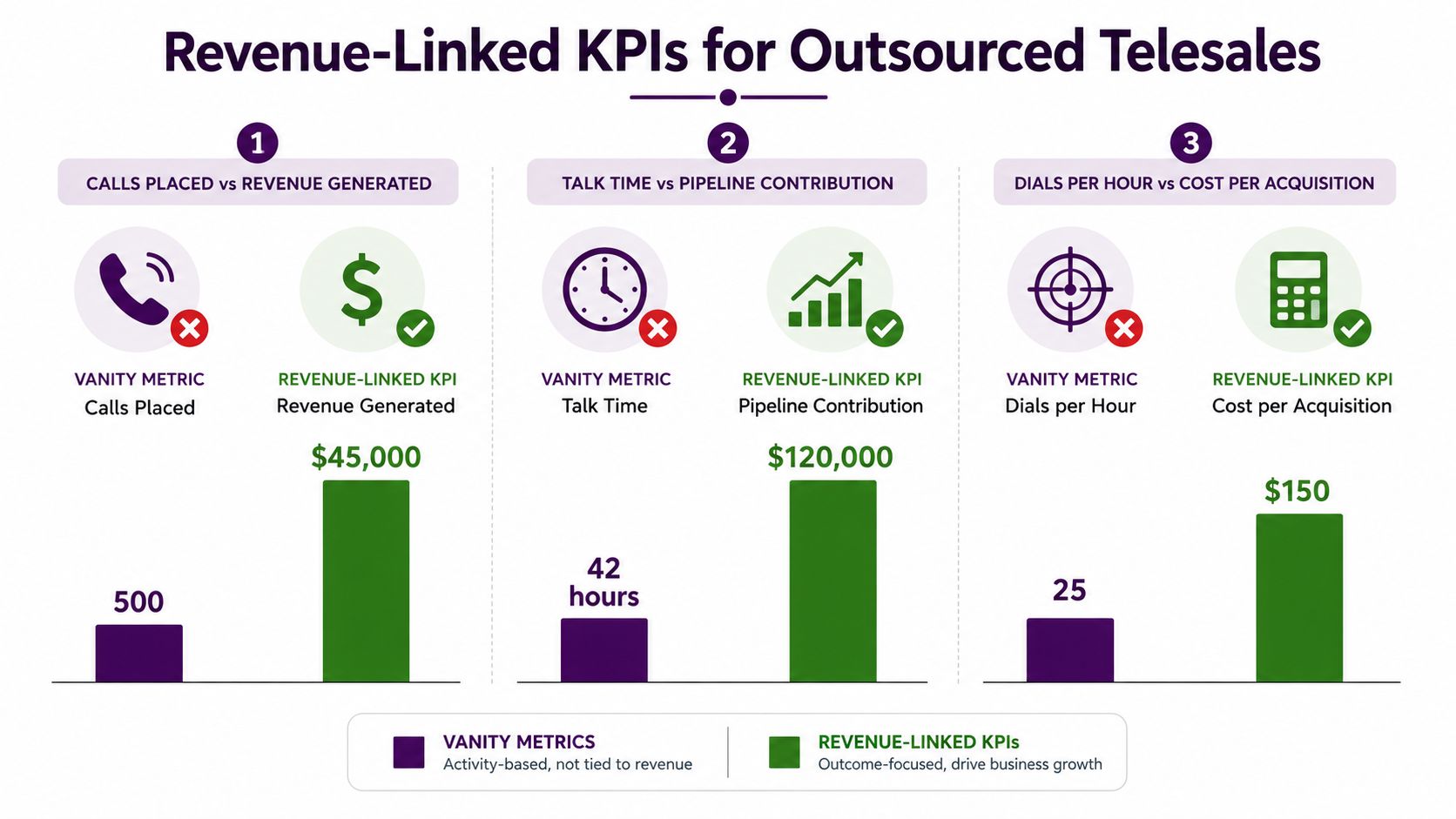
A provider can make a large number of calls and still produce an empty pipeline. Start with the metrics closest to revenue, then use activity data to diagnose why performance is strong or weak.
One benchmark framework emphasizes connect rate, meeting-to-opportunity conversion, opportunity-to-close conversion, CRM data quality, and sales-cycle fit, rather than raw dialing volume (outsourced telesales KPI framework). Operational benchmarks for B2B telemarketing commonly cite 200 to 300 dials per day with a parallel dialer, a 6% to 8% connect rate, and a 15% to 25% connect-to-meeting conversion once a prospect is reached (B2B telemarketing benchmarks). Treat those ranges as diagnostic reference points, not guaranteed results.
Build a KPI chain
Connect rate tells you whether the list, timing, caller ID, and contact data are working. A low rate isn’t fixed by demanding more dials if the provider is calling incorrect numbers or reaching the wrong roles.
Connect-to-qualified-conversation conversion shows whether agents can create relevance after someone answers. Meeting-to-opportunity conversion then tests the quality of qualification and the usefulness of the handoff. If meetings are plentiful but opportunities are scarce, the problem usually sits in targeting, discovery, or acceptance criteria.
Cost per qualified lead and pipeline generated per dollar spent belong in the executive report. They make the program comparable with paid acquisition, internal SDR capacity, and other pipeline investments.
Make CRM hygiene part of performance
Every call should produce a structured disposition, not a vague note such as “not interested.” Require fields for contact role, stated need, objection, timing, next action, and qualification status. Late or incomplete dispositions make every downstream metric less reliable.
A serious weekly report should include:
- Funnel movement: Dials, connects, qualified conversations, meetings, opportunities, and revenue influence.
- Quality evidence: Accepted versus rejected leads, reasons for rejection, and call-review findings.
- Conversion diagnosis: Connect rate, connect-to-meeting conversion, meeting show rate, and opportunity progression.
- Action ownership: What the provider will change, who owns it, and when the team will review the effect.
CallZent’s guide to call center KPIs offers a useful reference for building that reporting discipline. The rule is straightforward, activity metrics explain the work, but revenue-linked KPIs decide whether the work deserves more budget.
Where Outsourced Telesales Works Best by Industry
Industry fit matters more than headcount. A provider that performs well in ecommerce order capture may struggle with a regulated insurance qualification campaign, even if it has plenty of agents.
Healthcare
A healthcare program might combine inbound appointment requests with outbound reminders or reactivation. The provider needs disciplined scripts, careful access controls, accurate scheduling, and a clear escalation path for questions agents can’t answer. The strongest KPI isn’t calls handled. It’s completed, correctly routed interactions that support patient access without creating privacy or compliance problems.
Financial services
Financial services programs often qualify prospects for licensed advisors, introduce products, or support carefully controlled cross-sell activity. Agents must know where qualification ends and regulated advice begins. A practical campaign might call existing customers about a review with an advisor, record the reason for interest, and pass only suitable conversations to the licensed team.
E-commerce
Ecommerce benefits from a blended model. Agents can answer product questions inbound, recover hesitant buyers, support order capture, and follow up with corporate prospects who may place larger or recurring orders. A representative campaign might route high-intent callers to trained agents while outbound representatives contact business buyers who have requested pricing information.
For additional industry-specific perspectives, this overview of industries Overvue serves is useful when comparing how outsourced sales motions vary by vertical.
Telecom
Telecom campaigns tend to require fast list turnover and consistent execution. An outbound team might handle upgrades, retention, win-back, or plan changes, while an inbound team answers campaign responses. Managers should monitor offer accuracy, cancellation reasons, save rates, and customer experience, not just the number of completed calls.
Insurance
Insurance outreach can include lead response, appointment setting, renewal reminders, and customer follow-up. Scripts must distinguish general information from licensed advice, and the provider should document consent, source, and disposition for each contact. A broker testing a new product line might begin with a narrow qualification campaign, then send viable prospects to licensed producers.
The common pattern is operational specialization. The program succeeds when the provider understands the buyer, the compliance boundary, the handoff, and the commercial value of each conversation. More agents won’t compensate for a mismatched sales motion.
How to Choose the Right Telesales Outsourcing Partner
Treat provider selection as a revenue decision. Procurement can compare rates and contract terms, but sales leadership must test whether the partner can create opportunities your team will accept and advance.
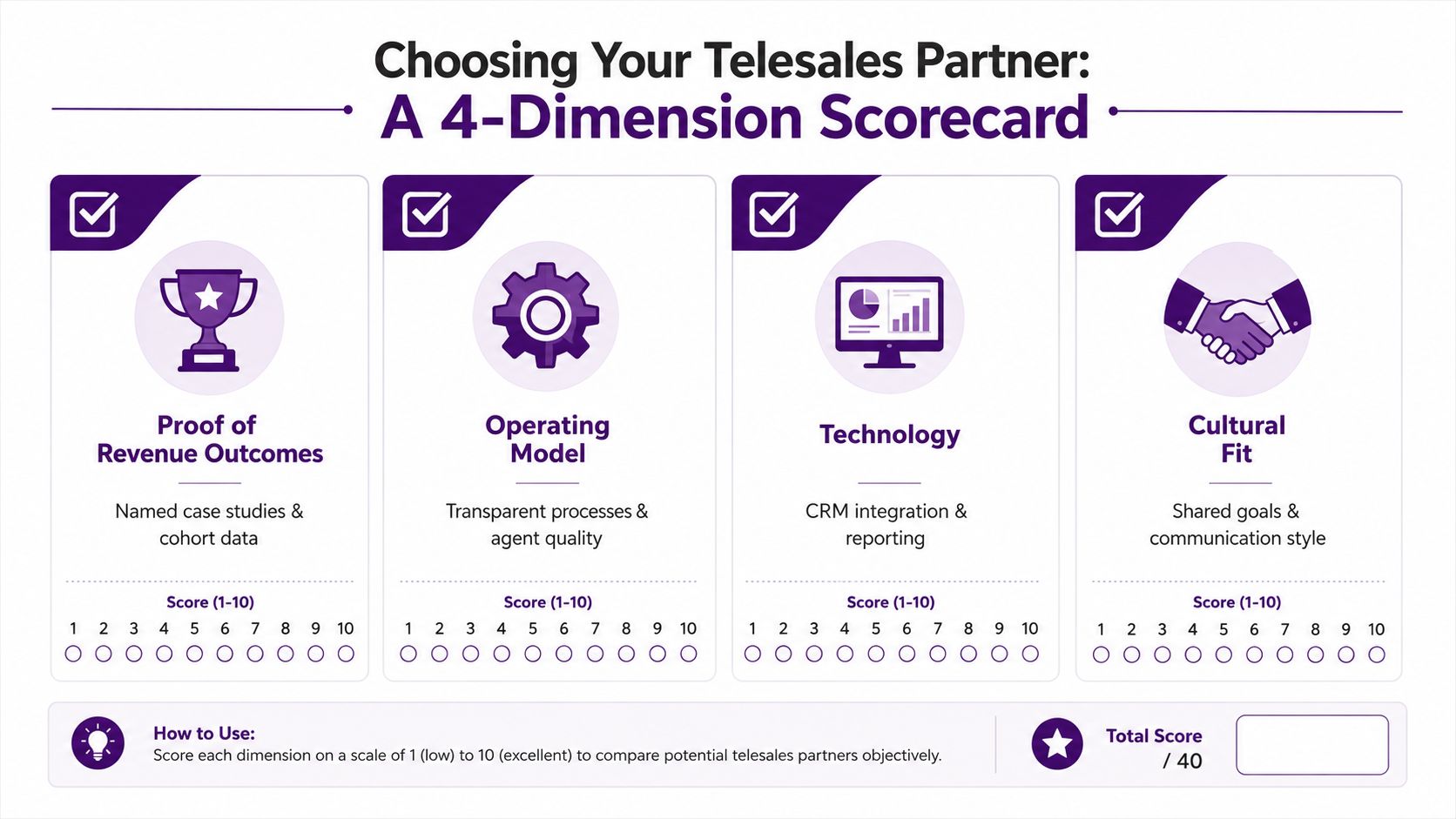
Score candidates across four dimensions:
- Proof of revenue outcomes. Ask for named case studies, cohort-level performance, rejected-lead analysis, and evidence that the provider tracks opportunity progression. Logos alone prove very little.
- Operating model transparency. Demand the ramp plan, training process, QA schedule, escalation path, supervisor coverage, and agent retention information. You should know who reviews calls and how quickly messaging changes.
- Talent and management depth. Ask who will manage the campaign, how experienced the team leads are, and how the provider handles absences, coaching, and product updates. A polished sales presentation doesn’t guarantee strong floor management.
- Commercial alignment. Review pilot terms, outcome definitions, incentives, service levels, renewal rules, and exit clauses. The provider should have a reason to improve quality, not merely extend hours.
Test the operation before signing
Request live call listening, sample recordings, CRM access, a weekly pipeline review, and a written first-month ramp plan. Ask the provider to role-play difficult objections using your actual offer. If the team can’t explain how it will distinguish curiosity from buying intent, it won’t produce dependable qualification.
Nearshore delivery can be practical for U.S. buyers who need overlapping working hours, bilingual English and Spanish coverage, close coaching, and frequent messaging changes. A Tijuana-based team can collaborate during the same business day, which makes live calibration easier than a handoff across distant schedules. It can also simplify oversight when your managers need to review calls, update a script, or address a compliance question quickly.
Regulatory control requires more than a promise to “follow the rules.” Ask how the provider handles consent, call registries, do-not-call requirements, recording permissions, and cross-border data. India’s telecom regulator reported 731,120 notices issued to unregistered telemarketers in 2025, which shows why telemarketing enforcement deserves executive attention (outsourced sales services market and compliance context).
A paid pilot lasting 60 to 90 days gives both teams enough operating time to test qualification, coaching, handoff, and pipeline movement. Put hard exit terms in writing before launch. For more perspective on provider selection, these sales outsourcing insights from Eludic can complement your vendor research. You can also use CallZent’s vendor evaluation criteria to turn qualitative impressions into a structured decision.
Your Next Step With Outsourced Telesales Services
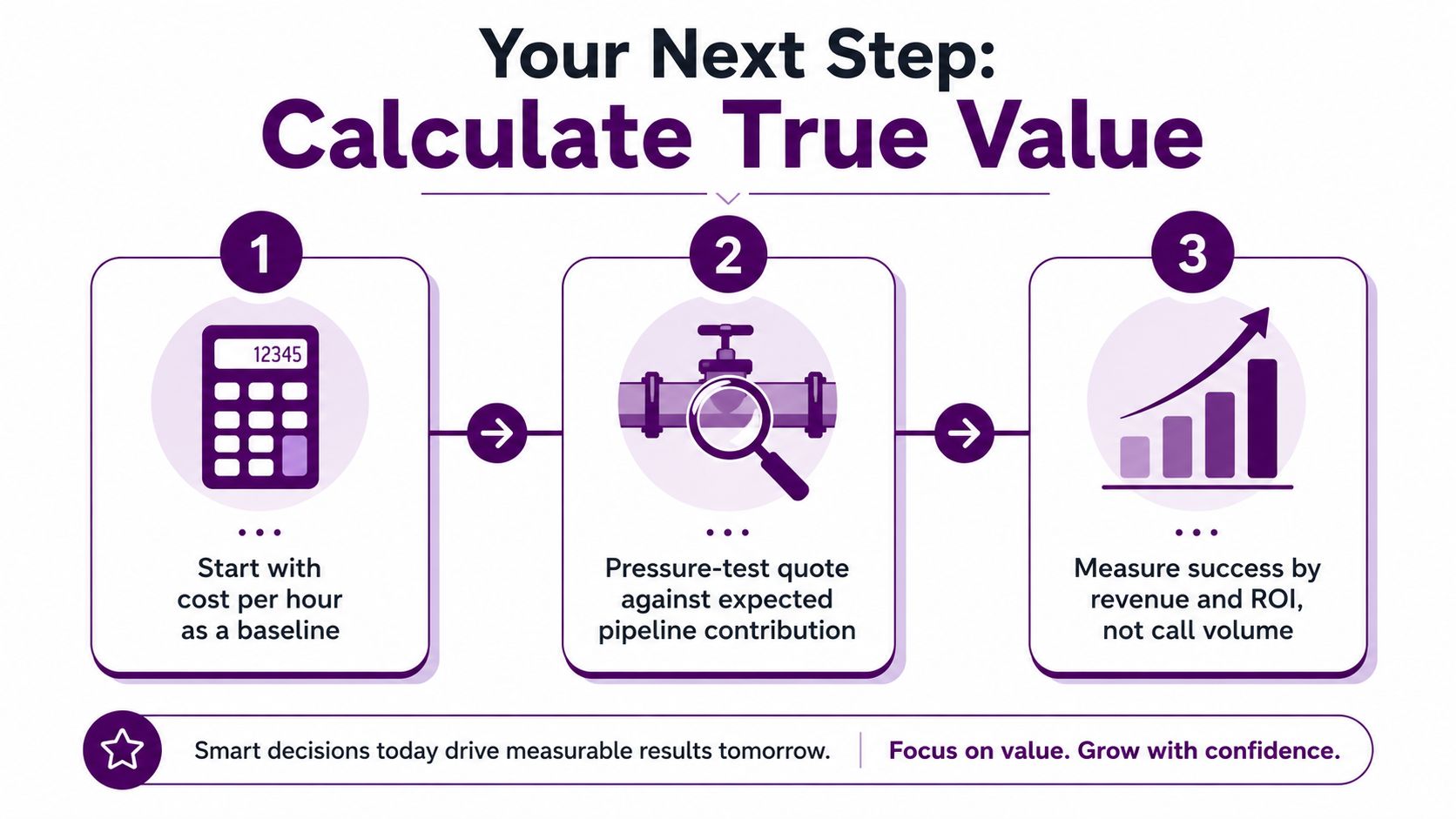
Outsourced telesales earns its place when the numbers connect to commercial value. Start with cost per hour if that’s how the proposal is presented, but pressure-test the quote against expected qualified opportunities, pipeline contribution, cost per opportunity, and cost per closed deal.
Before signing, require three deliverables:
- A written ramp projection: Show expected activity, connection, qualification, and conversion assumptions by week.
- A CRM-based KPI scorecard: Define every field, acceptance rule, handoff step, and reporting owner.
- A business review cadence: Set recurring pipeline reviews, named escalation owners, call calibration, and decision points for changing the campaign.
Use this same-day decision checklist
Ask the provider:
- Which exact buyer profiles will the team call?
- What makes a lead qualified, and who can reject it?
- Which CRM fields will agents complete after every interaction?
- How will managers review calls and coach representatives?
- What happens when meetings don’t show or opportunities aren’t accepted?
- Which compliance rules apply to each target market and channel?
- What will the pilot prove before you authorize expansion?
- Which costs sit outside the quoted rate?
- Who owns list quality, messaging changes, and sales follow-up?
- What is the exit process if the data doesn’t show a path to positive ROI?
If you need U.S. daytime coverage, bilingual communication, close AE collaboration, or careful compliance oversight, a nearshore partner may fit better than an offshore-only bid. Don’t scale because the team sounds busy. Scale when qualified pipeline, CRM evidence, and conversion trends support the decision.
Bilingual Telesales Teams in Mexico
Build a Telesales Program Around Qualified Pipeline
CallZent provides bilingual nearshore telesales, outbound calling, lead qualification, appointment setting, follow-up, and customer-support services from Mexico. Build your campaign around the right target market, CRM handoff, compliance requirements, and revenue KPIs.
Request a Custom QuoteCallZent provides bilingual nearshore call center and BPO support from Tijuana, including outbound calling, telemarketing campaigns, lead qualification, follow-up, customer service, and back-office operations. Visit CallZent to discuss a telesales program built around your target market, CRM handoff, compliance needs, and revenue KPIs.