CUSTOMER ANALYTICS & AI
Predictive Customer Analytics: A Practical Guide for Call Centers and BPOs
Predictive customer analytics helps call centers forecast churn, route high-value customers, improve staffing, and turn service data into timely action.
TL;DR — Quick Takeaways
- Predictive customer analytics uses historical, behavioral, transactional, and service data to estimate what a customer is likely to do next.
- Contact centers can use predictive scores to identify churn risk, improve routing, forecast demand, prioritize outreach, and recommend the next best action.
- A prediction creates value only when it reaches the CRM, workforce platform, agent desktop, or automated workflow in time for someone to act.
- Bilingual nearshore teams can turn predictive signals into timely English- and Spanish-language customer interventions without replacing human judgment.
Your call queue looks calm, your dashboards look fine, and then a loyal customer calls to cancel. By the time the issue reaches the front line, the warning signs were already there, missed engagement, repeated friction, a service pattern nobody connected. Predictive customer analytics is built to catch those signals earlier, so teams can act before revenue, trust, and repeat business walk out the door.
The Problem with Reactive Call Center Support
A customer reaches the cancellation flow after weeks of friction. Billing issues were resolved slowly, a support ticket stayed open too long, and the last chat ended with a generic promise to follow up. The customer doesn’t care that the problem was visible across systems, they just know the experience felt ignored.
That’s the trap of reactive support. Teams wait for the call, then scramble to explain what already went wrong. By then, the customer has usually moved from frustrated to finished.
Practical rule: if a customer has already hit the cancellation line, your team is solving yesterday’s problem.
The better approach is to use predictive customer analytics to notice the pattern before the final call. Instead of staring only at historical reports, the business looks for signals that suggest churn risk, purchase readiness, or rising effort. That shift matters because predictive analytics is now a mainstream enterprise capability, with the global market growing from $10.2 billion in 2021 to a projected $22.1 billion by 2026 industry research summary. In customer-facing operations, the use cases most often revolve around customer churn, lifetime value, and purchase propensity industry research summary.
For a service team, a proactive model becomes practical. A churn score can tell a supervisor which account needs a save call today, not next week. A next-best-action signal can point an agent toward help, education, or an offer that fits the customer’s actual behavior.
A useful complement to that mindset is claims automation for insurers, because insurance operations face the same basic problem, too much waiting, not enough early intervention. The pattern is the same across industries, the business pays more when it only reacts after the customer has already disengaged.
What Predictive Customer Analytics Actually Means
Descriptive analytics tells you what happened. Predictive analytics tells you what is likely to happen next. That difference sounds small, but it changes the entire operating model for a contact center.
Think of it this way. A monthly dashboard might show that some customers are leaving or that a segment is buying less often. Predictive customer analytics takes the next step and assigns probability scores so teams can decide who needs attention first. That is why the field has moved from basic segmentation to statistically scored customer management, and why it’s now foundational in CRM, marketing automation, and service operations industry research summary.
The underlying method is straightforward, even if the math behind it is complex. Historical behavior is fed into statistical and machine learning models, then the model estimates likely future outcomes, such as churn, conversion, or escalation predictive analytics statistics overview. In customer operations, that can mean call logs, purchase history, website sessions, email responses, and service records all contribute to one score.
A helpful way to compare the two is simple:
- Descriptive: what happened last month.
- Predictive: what is likely to happen next.
- Operational: what should happen right now because of that prediction.
For a team leader, that last point is the actual shift. The prediction only matters if it reaches an agent, a manager, or an automated workflow in time to change the customer experience. That’s the gap most businesses miss, and it’s why contact center analytics for data-driven operations matters so much in practice.
In insurance, for example, a related workflow can support boost business outcomes with analytics by helping teams act on signals faster instead of reviewing them after the fact. The idea isn’t to replace human judgment. It’s to give humans better timing.
Business Benefits for Call Centers and BPOs
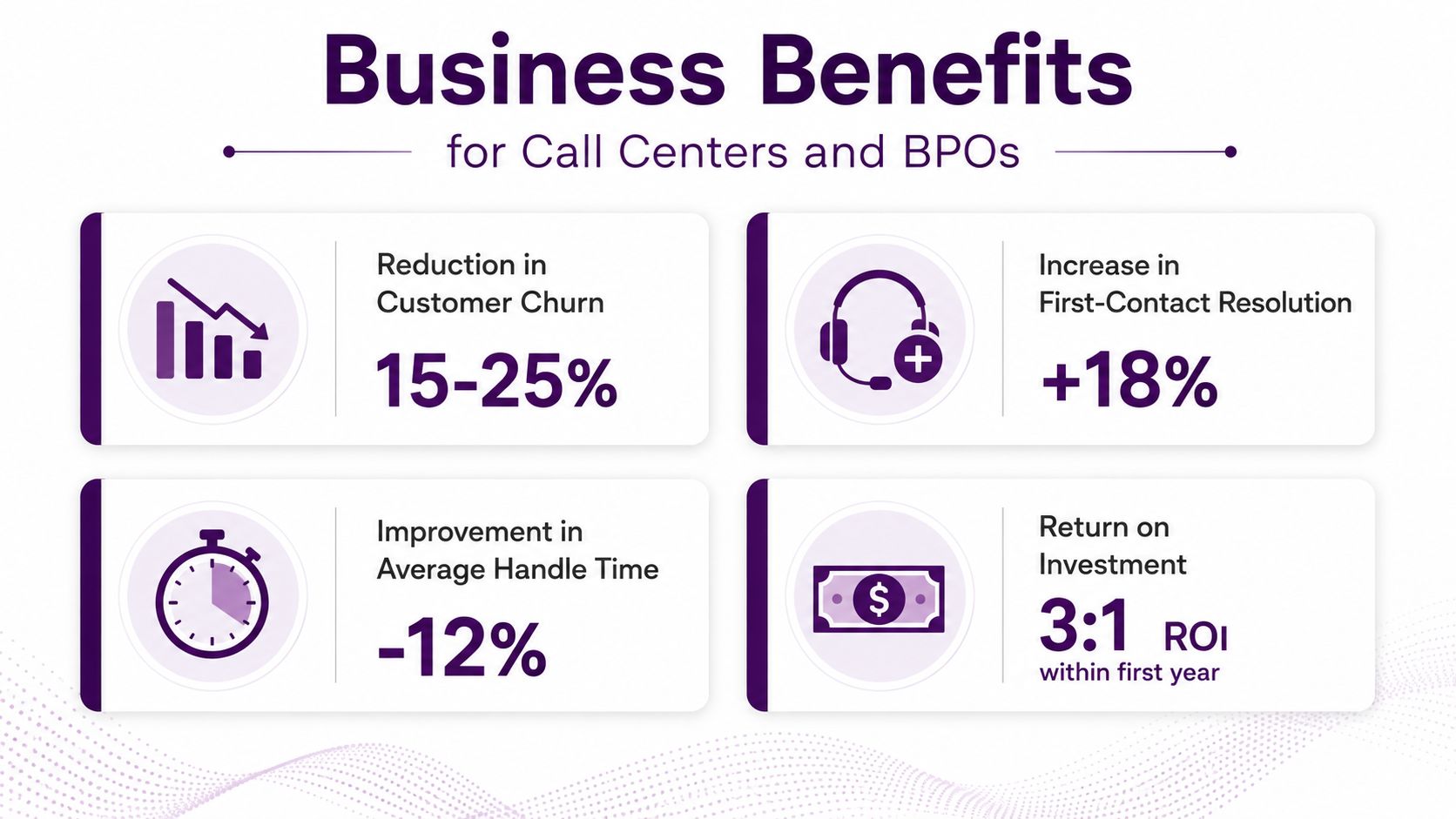
The strongest business case for predictive customer analytics isn’t a vague promise of “better experience.” It’s the combination of retention, cost control, and better use of agent time. When the model catches risk early, the business avoids the expensive scramble that usually follows a churn event or a service failure.
A common benchmark in predictive analytics research is 10-20% improvements in retention and about 9.1% average revenue growth tied to predictive use cases industry research summary. Another widely reported benchmark is a 15.5% reduction in operational costs predictive analytics statistics overview. Those numbers matter because they point to two different levers, keeping more customers and doing the work more efficiently.
Why the ROI shows up in operations first
Call centers feel the value in workflow design before they feel it in marketing campaigns. If a model helps route at-risk customers to senior agents, you reduce wasted transfers and improve the odds of saving the relationship. If it forecasts demand surges, staffing can match the likely volume instead of a rough historical average.
Key takeaway: the best predictive programs don’t just find risk, they change who gets handled, when, and by whom.
There’s also a cost-avoidance effect that often gets overlooked. Retaining an existing customer is usually cheaper than replacing one, so preventing churn protects both revenue and acquisition spend. In retail use cases, personalized recommendation engines powered by predictive models can generate 15-20% more revenue predictive analytics statistics overview, which shows how much value there is in timing the right offer well.
The lesson for BPO leaders is practical. Predictive customer analytics can help prioritize the right conversations, reduce avoidable contact, and allocate senior talent where it will do the most good. That means shorter queues, fewer pointless outreach attempts, and better handling of the interactions that move the numbers.
What the model changes day to day
- Routing decisions become more intentional because high-risk or high-value customers can reach the right agent sooner.
- Staffing plans become more responsive because demand forecasts can inform schedules before the rush starts.
- Retention work becomes more targeted because saves are based on risk signals, not guesswork.
A useful industry comparison comes from retail, where predictive recommendation engines often drive more relevant buying journeys, and from service operations, where the same logic helps the team intervene before the customer becomes unrecoverable. The math may differ, but the operational principle stays the same, act earlier, act with context, and spend effort where the payoff is greatest.
Industry Use Cases That Drive Real Results
Predictive customer analytics doesn’t look the same in every sector. The signal sources change, the intervention changes, and the teams involved change. What stays consistent is the move from scattered data to targeted action.
E-commerce and retail
In e-commerce, predictive models are often used for cart abandonment alerts, lifetime value scoring, and personalized recommendations. That helps service teams and sales teams know which customers are likely to buy again and which ones need a nudge before they disappear.
Retail teams use the same logic to align inventory and customer engagement. If purchase history and foot traffic patterns suggest rising demand, the business can prepare the right stock and the right outreach. The key is that the prediction leads to a decision, not just a report.
Healthcare
Healthcare organizations use predictive analytics to forecast patient no-shows, identify at-risk patients for outreach, and improve appointment scheduling. That can help reduce empty slots and support continuity of care. For a call center handling patient support, the model becomes a scheduling and engagement tool as much as an analytics tool.
Banking, telecom, and insurance
Financial services often apply predictive models to early fraud detection, account retention, and cross-sell timing. Telecom teams use them to anticipate service complaints and identify subscribers likely to switch. Insurance organizations use predictive signals for claims fraud, churn among policyholders, and renewal likelihood.
The common thread across those sectors is clear. Predictive customer analytics only creates value when the score connects to the right operational workflow. A churn signal is useful only if it triggers outreach, a better queue decision, or a retention offer at the right moment.
How Predictive Models Work Under the Hood
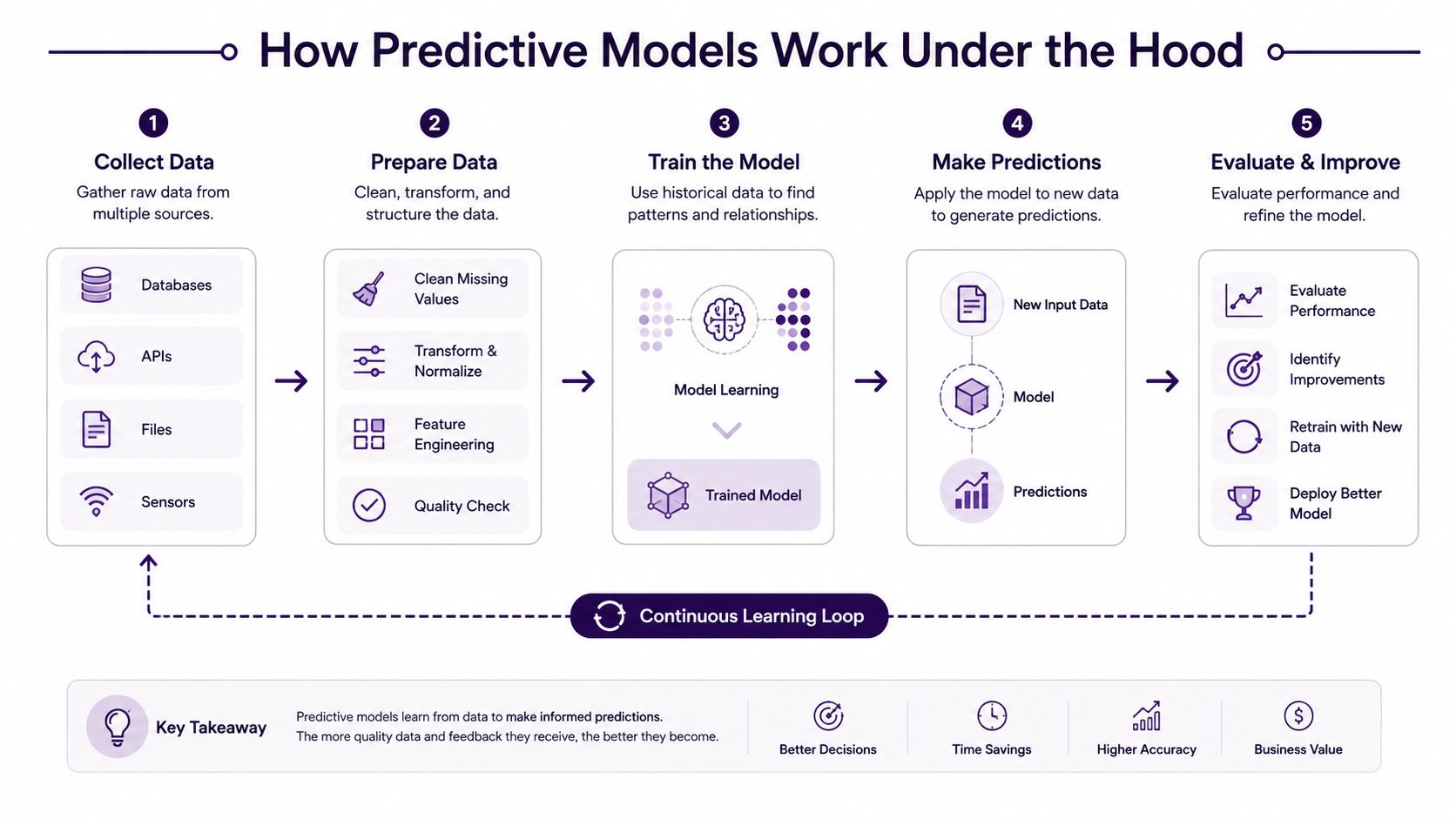
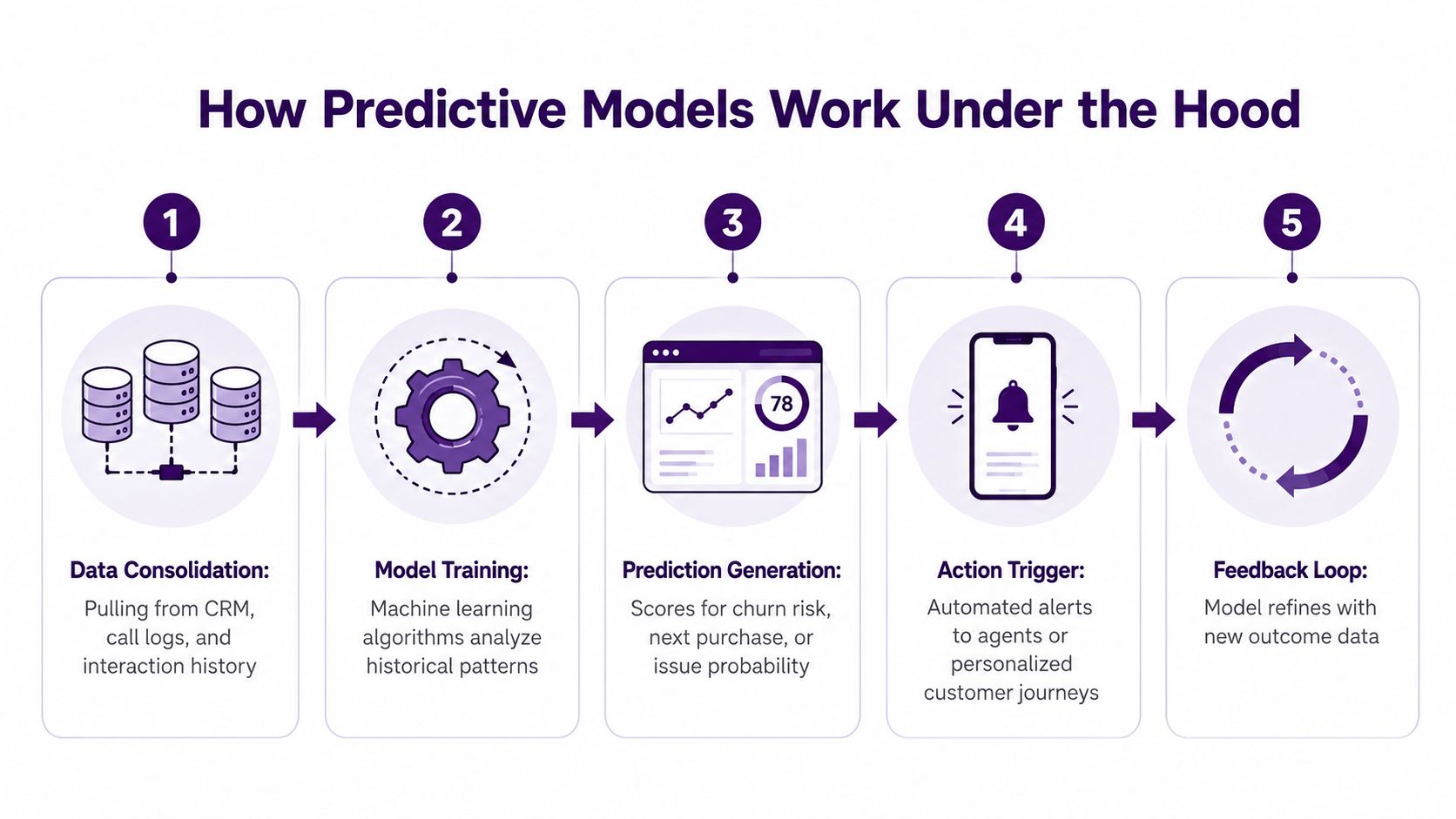
A predictive model is not a magic dashboard. It’s a workflow that turns multi-source customer data into a probability score, then pushes that score into action. That’s the part many teams miss when they think analytics is just reporting with a better chart.
The first ingredient is data consolidation. Strong models combine transactional history, behavioral patterns, demographic data, and engagement signals from multiple channels data integration guidance. That matters because a customer’s churn risk rarely lives in one field. It shows up across order frequency, abandoned carts, session depth, email response, and service history AI behavior analysis guidance.
The model learns from history, then scores the future
A useful rule of thumb is to keep about 12 to 24 months of history so the model can learn seasonality instead of treating repeating patterns as noise AI behavior analysis guidance. From there, machine learning models can classify risk, estimate value, or group customers with similar behavior patterns predictive analytics statistics overview.
That score then needs to move into a live workflow. A high-risk customer might automatically generate a task for a senior agent. A likely upgrader might get a personalized offer. A support team might see a forecasted volume spike and adjust staffing before the queue backs up.
IBM’s customer analytics guidance frames the goal clearly, use predictive profiles to choose the right customers, grow relationships, keep the right customers longer, and apply predictive intelligence at every touchpoint IBM customer analytics guidance. That’s exactly why predictive customer analytics belongs in operations, not just campaign planning.
For teams looking at implementation in practical terms, conversational intelligence in contact centers often becomes a useful companion layer because it helps the organization see what customers are saying, while predictive models help it anticipate what they’ll do next. Those two pieces work best together.
A Practical Roadmap for Implementation
The most common mistake is starting with software instead of the business question. A model can’t help if the team hasn’t defined what problem it’s supposed to solve. If the goal is churn reduction, the data and workflow should look different than they would for call volume forecasting or cross-sell timing.
Start by mapping the exact customer outcome you want. Then audit the touchpoints that already exist, calls, chats, email, web visits, purchase history, and support tickets. If the data is incomplete or inconsistent, the model will learn from gaps instead of behavior.
A phased rollout usually works best:
- Choose one high-impact use case. Start with the outcome that matters most, such as churn prevention or routing.
- Validate the data. Check quality, coverage, and whether the data can support the question you’re asking.
- Test across segments. A model that performs well in one segment may underperform elsewhere if the customer base is mixed.
- Embed the score in the workflow. Put the prediction in CRM, agent desktop, or workforce tools so the team sees it in real time.
- Track outcomes and refine. Compare predictions with actual behavior, then improve the model over time.
Practical rule: if the score doesn’t reach the person who can act on it, the model hasn’t been implemented, it’s only been built.
That last point is where many organizations lose ROI. Recent practitioner guidance emphasizes embedding models into production workflows and validating them across segments, not just designing them in isolation CX predictive analytics guidance. If you want a broader operating model for getting from concept to deployment, an AI build roadmap for CTOs can help frame the technical and organizational steps without overcomplicating the business goal.
A strong rollout doesn’t need to be huge on day one. It needs to be specific, measurable, and connected to the people who take customer-facing action every day.
Quick Wins CallZent Can Deliver for Your Business
You don’t need a full enterprise transformation to start using predictive customer analytics well. The fastest wins usually come from narrow use cases with clear ownership and visible operational impact. That’s where a nearshore BPO partner can move quickly, because the workflow changes are often more important than the platform changes.
Three quick wins that are practical from day one
- Proactive churn outreach: score customers at risk of leaving, then route them to senior agents before they cancel.
- Intelligent call routing: match predicted intent and customer value to the right skill set, so the most important calls land with the right people first.
- Demand forecasting: use historical and predictive patterns to align staffing with expected volume, which helps reduce wait times and overtime pressure.
These are not abstract ideas. They’re the kinds of actions that turn a prediction into a better customer conversation. If a customer looks likely to escalate, the system can flag that interaction before it becomes a complaint. If a queue is about to spike, managers can adjust schedules before service quality slips.
A partner like CallZent can support those changes with a bilingual team fluent in English and Spanish, plus the operational experience needed to connect data to frontline action. The value isn’t just in spotting patterns, it’s in making sure the right person sees the signal at the right time.
For businesses that want to move quickly, the win is usually not a brand-new model. It’s better routing, earlier outreach, and smarter staffing built on the data you already have.
Moving from Reactive Support to Predictive Service
Predictive customer analytics isn’t a luxury for large enterprises. It’s a practical operating shift for any call center or BPO that wants to prevent problems instead of constantly cleaning them up. The difference shows up in retention, staffing quality, and the tone of the conversations your agents handle every day.
Reactive support waits for the complaint. Predictive service acts on the signal. That changes who stays, who gets help first, and how much effort the business wastes on preventable problems.
IBM’s lifecycle approach makes the point well, predictive intelligence should support customer value across the full relationship, not in one isolated campaign IBM customer analytics guidance. That is the key advantage for service organizations, because a well-timed intervention can protect the relationship before the customer is gone.
The technology is mature, the data is available, and the best use cases are already clear in industries like e-commerce, healthcare, finance, telecom, retail, and insurance. The question is no longer whether predictive customer analytics works. It’s whether your operation is ready to act on what it predicts.
If you’re ready to turn customer signals into real operational decisions, CallZent can help you build a more proactive service model, improve routing, and support retention-focused workflows that fit your business. Visit CallZent to start a conversation about your current customer data, your biggest support challenges, and the outcomes you want to improve.
🚀 Turn Customer Signals Into Timely Action
CallZent helps North American businesses connect customer analytics with bilingual nearshore support, proactive outreach, intelligent routing, and retention-focused workflows.