
Accounts Receivable / Nearshore BPO
Receivable Management Services International for CFOs and North American Businesses
Learn how receivable management services international help recover cross-border payments, improve cash flow, reduce compliance risk, and why nearshore Tijuana BPO support is a smart option for North American firms.
TL;DR — Quick Takeaways
- Receivable management services international help businesses recover cross-border payments faster with structured follow-up, dispute handling, and multilingual communication.
- Overdue invoices are a growing cash-flow problem: 44% of B2B invoices in the U.S. are overdue and 3% are written off as bad debt.
- Nearshore receivables support in Tijuana can improve coordination, reduce costs, and strengthen English-Spanish collections performance for North American firms.
- The best receivables partners combine compliance discipline, accounting-system integration, and finance-grade reporting, not just collection calls.
International receivables problems rarely start with one bad payer. They start with a weak process, inconsistent follow-up, language friction, poor system visibility, and a finance team that’s trying to collect globally with tools built for domestic AR.
That’s why most conventional advice falls short. It treats collections like a back-office nuisance when it’s really a working-capital discipline. If you sell across borders, you need a process that combines customer communication, compliance, reporting, and accounting integration. For North American companies, a nearshore model often makes more sense than a pure onshore or offshore setup because it keeps communication close, bilingual, and operationally aligned.
Are Overdue International Invoices Draining Your Business
If your company is growing internationally but cash still feels tight, your invoice process is probably part of the problem.
U.S. businesses aren’t dealing with an isolated issue. 44% of B2B invoices are now overdue, 3% are written off as bad debts, and 34% of U.S. businesses say the average time to get paid has increased over the past year, according to Quadient’s accounts receivable statistics overview. When you add cross-border customers, different payment habits, language barriers, and legal complexity, the problem gets worse fast.

A finance leader usually notices the symptoms before the root cause. Cash forecasting becomes less reliable. Customer disputes sit open too long. Your AR staff spends too much time chasing updates instead of closing issues. Sales wants to preserve the relationship, finance wants to escalate, and nobody has a disciplined international workflow.
Why internal AR teams struggle internationally
Domestic collections are hard enough. International collections add a new layer of operational friction:
- Language gaps: A payment reminder sent in English may be technically correct but commercially ineffective if the debtor prefers Spanish.
- Time-zone drag: A simple invoice clarification can lose days when teams aren’t available during the same business hours.
- Fragmented systems: Notes live in email, payment status sits in the ERP, and promises to pay get tracked in spreadsheets.
- Inconsistent escalation: Teams often have no shared threshold for when an account moves from reminder to dispute handling to formal recovery.
That’s why a disciplined effective dunning process matters. Collections should not begin when frustration peaks. They should begin when risk signals appear.
Overdue invoices don’t just slow collections. They distort decisions across hiring, inventory, vendor payments, and growth planning.
What smart finance teams do instead
They stop treating receivables as an after-hours task for the accounting team. They build a repeatable operating model, often with outside support for the heavy lifting. That support can include multilingual outreach, dispute resolution workflows, payment follow-up, and reporting tied back to the finance stack.
If your AR function is stretched, outsourced back office support services can create structure around payment tracking and customer communication without forcing your internal team to absorb every collections task.
For companies in healthcare, e-commerce, telecom, and financial services, this shift is strategic. Better receivables discipline protects revenue you’ve already earned.
Defining International Receivable Management Services
Most companies hear “collections” and think of a late-stage agency call. That’s too narrow.
Receivable management services international is the outsourced management of cross-border accounts receivable. It covers the full payment lifecycle, not just final-stage debt recovery. A good partner acts like a logistics team for your money. They help move invoices, reminders, disputes, commitments, and payments through a messy international route with fewer delays and fewer errors.
It’s broader than debt collection
Professional receivable management usually includes a mix of these functions:
- Early intervention: Reminder schedules before an account becomes severely aged.
- Payment follow-up: Structured outreach after due dates pass.
- Dispute coordination: Resolving invoice objections, documentation issues, or missing approvals.
- Escalation workflows: Moving the account to a more formal recovery track when the customer stops engaging.
- Reporting and reconciliation support: Giving finance teams clear visibility into account status and payment activity.
That distinction matters. A strong receivables partner doesn’t just pressure debtors. They reduce avoidable delinquency and make legitimate disputes move faster.
Why the category keeps gaining importance
This is no niche service. The global receivables management market is projected to grow from USD 477.2 million in 2022 to USD 1,577.0 million by 2030, at a 16.1% CAGR, according to Grand View Research’s receivables management market projection.
That growth tells you something important. More companies now recognize AR management as an operating priority, not an administrative afterthought.
Here’s the practical interpretation for a CFO:
| Business situation | What usually happens without support | What receivable management solves |
|---|---|---|
| Cross-border invoice delays | Internal staff follows up inconsistently | Outreach becomes systematic and trackable |
| Language or cultural friction | Debtors ignore or misunderstand messages | Communication becomes more effective |
| Rising dispute volume | Finance teams lose time chasing context | Cases get routed and resolved faster |
| Aging receivables | Cash forecasting gets weaker | Collections activity becomes more predictable |
International receivable management is not a cleanup function. It’s a control function for cash flow.
A lot of firms reach this point after outgrowing a reactive AR process. They add international customers, keep the same workflow, and assume their finance team will cope. Usually it doesn’t. Collections become slower, relationships get messier, and management loses visibility.
If you’re evaluating whether this belongs inside your company or with a partner, it helps to understand the broader business process outsourcing model. In receivables, outsourcing works best when the provider plugs into your process, systems, and controls, instead of operating as a disconnected vendor.
Key Business Benefits of Expert Receivables Management
Outsourcing receivables only makes sense if it changes business outcomes. That’s the standard.
The strongest providers improve cash discipline, reduce internal drag, and help you recover revenue without turning every overdue account into a legal conflict. That matters more than fancy dashboards or scripted promises.

Faster cash flow, fewer avoidable delays
Cash flow is the first win, but not in an abstract sense. Faster collections give you more room to make operating decisions without waiting on late payers.
A simple example: an e-commerce distributor selling into multiple countries may have healthy sales but weak liquidity because customer remittances arrive unpredictably. When receivables follow-up becomes disciplined, finance can plan purchasing and vendor payments with less guesswork.
Lower DSO pressure through consistency
Most AR teams know what to do. They just can’t do it at the required pace and volume.
Collections performance often improves when someone owns the workflow every day:
- Accounts are touched on schedule
- Promises to pay are logged and followed
- Disputes don’t sit idle
- Escalation happens before accounts become stale
That consistency is usually what moves DSO in the right direction. Not a dramatic one-time intervention. Daily execution.
Effective receivable management doesn’t just recover debt; it fuels your company’s growth engine.
Better compliance posture
International collections create legal and reputational exposure fast. A poorly written message, the wrong contact sequence, or weak records can create unnecessary risk.
An expert partner helps by bringing process discipline to areas internal teams often overlook:
- Communication standards: Clear and appropriate outreach across markets
- Documentation: Reliable records of contact attempts, disputes, and payment commitments
- Escalation control: A defined path for moving from reminders to more formal action
- Operational boundaries: Separate handling for sensitive accounts, regulated sectors, or complex customer situations
More focus for your internal team
This benefit gets underestimated. When finance staff spends too much time chasing receivables, core work suffers.
A healthcare group, for example, shouldn’t have senior billing staff manually managing multilingual callbacks on aging international balances if those same employees should be fixing payer workflows, reconciliation issues, and exception handling. The same goes for a telecom or insurance operation trying to scale.
Here’s the blunt version. Your finance team should own policy, visibility, and decisions. They should not spend their week repeating reminder calls, updating spreadsheets, and trying to decode customer excuses across jurisdictions.
A capable receivables operation gives leadership cleaner reporting, gives accounting fewer surprises, and gives customer-facing teams a more professional recovery process.
The International Receivables Process and Best Practices
Good international collections don’t begin with pressure. They begin with structure.
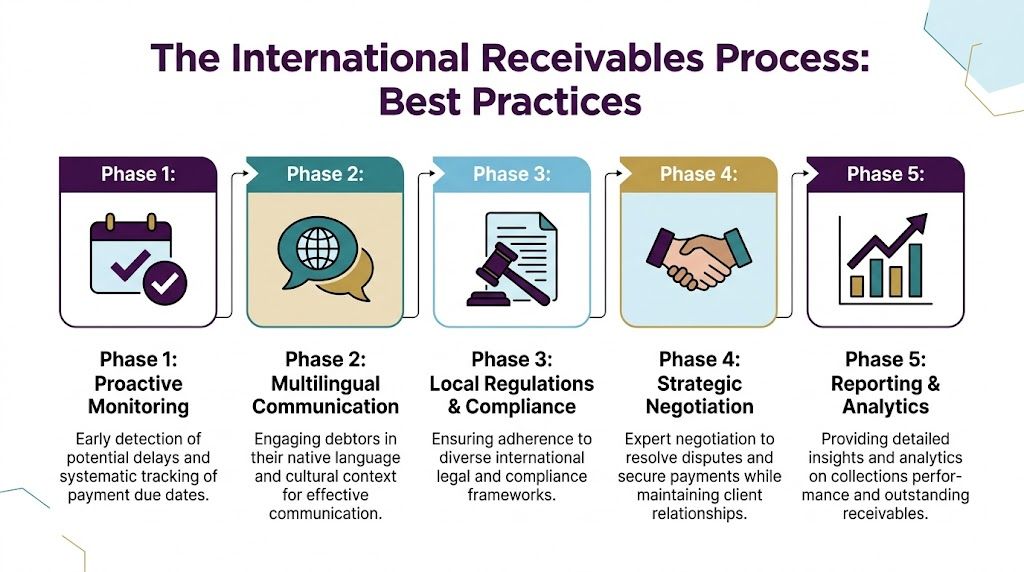
The strongest receivable management services international providers run a process that starts before delinquency, tightens as risk increases, and stays connected to your accounting system the whole time. That’s how you recover more while keeping your numbers clean.
The process works in layers
According to Bakering’s overview of receivables operations architecture, best-in-class international receivable management uses a multi-layered architecture built around proactive credit control, debt collection, and legal enforcement. It also requires bidirectional integration with accounting systems so data flows both ways and the accounting platform remains the single source of truth. That technical rigor matters. Among certified firms, only 2.27% exceeded complaint volumes above 1%.
That tells you two things. First, process quality and compliance quality are linked. Second, disconnected systems create risk.
A practical five-phase workflow
Most effective programs follow a rhythm like this:
-
Monitoring before due dates
Teams track upcoming invoices, customer behavior, and exceptions before an account slips into aging. -
Early multilingual outreach
The first reminder should be clear, professional, and easy to act on. If the customer works in Spanish, send Spanish. Don’t make language a reason for delay. -
Dispute handling with documentation
Many “late” accounts are really unresolved disputes. Missing purchase orders, tax questions, delivery concerns, or invoice mismatches need active handling. -
Negotiation and structured resolution
If the debtor is engaged but behind, a specialist can formalize commitments and follow them tightly. -
Escalation and reporting
If the account stalls, it moves into a more formal track with complete records, current balances, and clear management reporting.
Why bidirectional integration matters
A lot of vendors claim “integration” when they really mean a data import.
That’s not enough. If your provider pulls AR data from QuickBooks, NetSuite, or another accounting platform but doesn’t push updates back in a controlled way, your records drift. Finance then works from one version of the truth while the collections team works from another. That’s how duplicate outreach, missed credits, and embarrassing customer conversations happen.
A better setup supports:
- Status updates inside the accounting workflow
- Shared notes and payment commitments
- Visibility into multi-invoice payments
- Accurate handling of custom fields or project codes
- Cleaner reconciliation for finance
For teams managing call activity, using disciplined scripts also matters. A solid collection call scripts guide can help standardize conversations without making agents sound robotic.
Practical rule: If your receivables partner can’t explain how data syncs back to your accounting system, they’re not ready for international complexity.
Human judgment still matters
Automation helps, but it doesn’t replace trained judgment.
A bilingual collector handling a delayed payment from a retail buyer in Mexico may need to distinguish between a genuine documentation issue and a stalling tactic. That judgment changes how the account should be worked. Automated reminders can support the process, but they shouldn’t run it alone.
For region-specific tactics, resources on strategies for recovering funds can also be useful because they show how collection tactics must adapt to local norms and legal context.
The takeaway is simple. International receivables recovery works when process, systems, and people operate as one unit.
Navigating Global Compliance and Legal Frameworks
International collections get risky the moment a company assumes one policy works everywhere.
It won’t. The language you use, the records you keep, the way you contact debtors, and the path you take toward escalation all change across jurisdictions. If your team handles international receivables like a domestic overflow queue, you’re creating legal exposure.
Compliance is not a side task
The receivables industry already operates under heavy scrutiny. The broader international receivables management space includes over 600 organizations in a regulated secondary market, and RMAI’s certification framework is a key standard for debt buyers, collection agencies, law firms, brokers, and vendors.
That’s the useful signal for a CFO. Standards matter because cross-border recovery is not just a language issue. It’s a governance issue.
A compliant partner should understand how to work within overlapping requirements such as:
- U.S. consumer and collections rules: Especially when debtor communication touches regulated channels or timing restrictions
- European privacy obligations: Data handling and communication records can trigger strict responsibilities
- Sector-specific sensitivity: Healthcare, insurance, and financial accounts often require tighter process controls
- Documentation standards: You need a reliable record of what was sent, when it was sent, and how the account was resolved
Where companies go wrong
Most compliance failures in receivables don’t start with deliberate misconduct. They start with sloppy operations.
Here are common breakdowns:
- Uncontrolled outreach: Different team members contact the same account with no shared record.
- Weak consent tracking: Nobody can clearly verify preferred channels or past communication history.
- Poor handoffs: Finance, customer service, and outside collections teams all hold fragments of the case.
- Informal escalation: Accounts get pushed to tougher tactics before basic dispute facts are resolved.
That’s why licensing, workflow control, and governance should be part of provider selection from day one. If you’re evaluating the legal side of operations, this overview of a debt collection agency license is a useful starting point for understanding what regulated collection activity can require.
A receivables partner should be able to describe its compliance controls in operational language, not hide behind vague claims about being “fully compliant.”
Certifications are a filter, not a guarantee
Certification alone doesn’t solve every problem. It does, however, give you a practical screening tool.
Ask whether the provider’s operating model aligns with recognized standards. Ask how they document interactions, train agents, review complaints, and separate routine outreach from more sensitive legal or regulated steps. If they can’t answer that cleanly, move on.
AI and automation need tighter oversight
This area is getting harder, not easier. More collections workflows now use automated messaging, decision rules, and AI-supported tools to prioritize accounts or draft communications.
That creates a new problem. Automation can scale a bad process just as quickly as a good one.
For healthcare and financial services firms, this is especially important. Sensitive account data, multilingual communication, and auditability all need stronger controls when automation enters the workflow. A provider that uses technology without clear oversight can create risk faster than your internal team ever could.
The practical standard is simple:
| What to verify | Why it matters |
|---|---|
| Clear communication policies | Reduces inconsistent or inappropriate outreach |
| Contact records and audit trails | Protects the business during disputes or reviews |
| Defined escalation paths | Prevents premature legal or reputational risk |
| Training for bilingual staff | Improves consistency across markets |
| Role separation | Keeps customer service, billing, and collections from blurring together |
If you’re a CFO, treat compliance capability like you’d treat treasury controls or revenue recognition controls. It belongs in the operating model. Not in a sales pitch.
The Nearshore Advantage Why Tijuana Is Your Strategic Hub
Most companies frame the sourcing decision the wrong way. They compare onshore versus offshore and stop there.
That misses the strongest option for many North American businesses. A nearshore operation in Tijuana can give you lower cost, stronger bilingual coverage, and tighter collaboration than a domestic-only team, without the communication drag that often shows up in far-off offshore models.

The cost and recovery case is hard to ignore
Nearshore BPO providers in locations like Tijuana can reduce collection costs by 30% to 50% compared to U.S. onshore services, while potentially improving recovery rates by 15% to 20% through cultural fluency and proximity, according to this review of receivable management options and nearshore cost advantages.
Those numbers matter, but the logic behind them matters more.
A bilingual agent who understands U.S. business expectations and can switch naturally into Spanish has a better chance of resolving a payment issue than a team reading from translated scripts. In collections, nuance matters. Tone matters. Timing matters.
Why Tijuana fits North American receivables operations
Tijuana gives finance leaders three operational advantages:
- Time-zone alignment: Your team can review aging accounts, approve settlement parameters, and discuss escalations during the same business day.
- Bilingual communication: English and Spanish support is built into the market, which is especially useful for U.S.-Mexico receivables and Hispanic debtor bases.
- Closer management oversight: Leadership can collaborate with the provider more directly, with less lag and less cultural friction.
That’s why nearshore isn’t a compromise model. In many cases, it’s the more controlled model.
Onshore, offshore, and nearshore are not equal
| Model | Main strength | Main weakness |
|---|---|---|
| Onshore U.S. | Local familiarity | Higher operating cost |
| Traditional offshore | Lower labor cost | More distance in communication and oversight |
| Nearshore Tijuana | Cost efficiency plus proximity and bilingual alignment | Requires careful provider selection and process integration |
A nearshore specialist offers a fitting solution. For example, nearshore BPO operations in Tijuana can support bilingual collections and back-office coordination for North American companies that need closer oversight than a distant offshore model typically allows.
If your debtors are in North America, your collections workflow should operate in North American business hours and in the debtor’s preferred language.
A real-world example
Take a telecom company with overdue balances split across English- and Spanish-speaking customer groups. An onshore team may be expensive to scale. A far-off offshore team may follow process but struggle with conversational nuance and real-time collaboration. A nearshore team in Tijuana can handle outreach in both languages, coordinate with U.S. finance leadership during the same day, and move disputes or payment commitments faster because communication friction is lower.
That combination is what CFOs should care about. Not geography for its own sake. Operating fit.
How to Choose Your International Receivables Partner
How do you tell the difference between a partner that improves cash flow and one that adds another layer of reporting?
Start with operating fit. International receivables work breaks down when a provider looks good in a pitch deck but cannot handle your dispute patterns, your ERP workflow, or your customer communication standards. A CFO should screen for execution, control, and speed of coordination.
A nearshore partner deserves serious consideration here, especially for North American companies. A team in Tijuana can work in the same business day as your finance leaders, communicate fluently with English and Spanish speaking customers, and cost less than a comparable U.S.-based operation. That mix matters if you want tighter oversight without carrying full onshore cost.
Questions worth asking in the first meeting
Ask for specifics. General answers are a bad sign.
- Industry fit: Have they managed receivables in healthcare, e-commerce, insurance, telecom, or financial services with similar payment delays and dispute types?
- System integration: Can they work inside your accounting and ticketing workflow, or do they depend on spreadsheet handoffs and manual updates?
- Bilingual execution: Do they have native-level English and Spanish support for customer conversations, dispute follow-up, and payment commitment tracking?
- Compliance discipline: How do they document contacts, approvals, disputes, consent, and escalation steps across jurisdictions?
- Management reporting: What will your CFO, controller, and AR lead receive each week, and what decisions can those reports support?
- Time-zone alignment: Can your team reach supervisors and get answers the same day, or are you waiting overnight for issue resolution?
The best providers answer operational questions without hiding behind sales language.
Red flags that should end the conversation
Some providers sound polished and still create expensive friction after onboarding.
Walk away if you hear any of the following:
- No clear workflow ownership
- No practical answer on complaint handling
- Heavy automation talk with weak human controls
- Recovery language without a dispute-resolution process
- No defined method for syncing with your finance stack
- No explanation of who manages escalations for strategic accounts
A serious partner should explain who touches the account, when the account changes status, how exceptions are handled, and how your internal team stays in control.
Comparing Receivable Management Pricing Models
| Model Type | How It Works | Best For |
|---|---|---|
| Contingency | Provider is paid based on recovered amounts | Businesses that want to limit upfront cost and outsource harder-to-collect accounts |
| Flat fee | Provider charges a fixed service fee for defined work | Companies with predictable volumes and a stable internal process |
| Hybrid | Combines recurring service fees with performance-based compensation | Firms that want dedicated support plus aligned recovery incentives |
Price matters, but operating model matters more. A cheap offshore option can become expensive if resolution cycles drag out, customer communication slips, or your finance team spends hours correcting bad notes and mismatched records. A nearshore model often lands in the stronger middle ground. Lower cost than onshore, better control than distant offshore.
What to prepare before you engage a partner
Provider selection gets easier when your internal house is in order.
Prepare these items before serious evaluation:
- Aging segmentation: Which accounts are current, late, disputed, promised, or stalled
- Customer tiers: Strategic accounts, high-risk accounts, regulated accounts, and low-touch accounts
- Authority rules: Who can approve credits, payment plans, settlements, or legal escalation
- System access plan: What the provider needs to view, what they can update, and what stays restricted
- Success metrics: Faster collections, lower DSO pressure, reduced AR workload, cleaner reporting, or better dispute closure rates
Then test the provider with real scenarios. Ask how they handle a customer who says the invoice never arrived. Ask what happens when a partial payment covers multiple invoices with weak remittance detail. Ask how a bilingual team would manage a disputed account that starts in Spanish and ends with U.S. finance approval in English.
That level of discussion tells you far more than a generic capabilities slide. CallZent should be evaluated on that same standard. Clear process, bilingual coverage, same-day collaboration, and finance-grade reporting. If a partner cannot show those basics, keep looking.
Frequently Asked Questions About International Collections
What’s the difference between first-party and third-party collections
First-party collections usually happen in your brand voice or as an extension of your business, often earlier in the delinquency cycle. Third-party collections happen through an outside collections entity, usually after the account has aged further or internal efforts have stalled. The right choice depends on customer sensitivity, brand risk, and account age.
When should a company hand an account to a receivables partner
Don’t wait until the account is nearly unworkable. Hand off when your internal team sees a pattern of delay, non-response, repeated broken promises, or unresolved disputes that are consuming too much time. Early structure usually works better than late escalation.
How are different currencies handled
The operational goal is to keep balances, payment commitments, and reconciliation records clear across currencies. A capable provider should align closely with your accounting rules so your team knows what was invoiced, what was collected, and how each payment maps back to the ledger.
Can a receivables partner protect customer relationships
Yes, if the provider is disciplined. Good collections work is firm, documented, and respectful. That’s especially important when the account is late because of process friction, not pure refusal to pay.
Is nearshore support only for large enterprises
No. Small businesses and mid-market firms often benefit quickly because they usually feel AR strain sooner. They have less room for delayed cash, fewer people to dedicate to collections, and a stronger need for bilingual flexibility.
Improve Your International Cash Flow
Struggling with overdue cross-border invoices? CallZent helps North American businesses recover payments faster with bilingual nearshore receivables support.
Talk to a Receivables SpecialistIf your company is juggling overdue cross-border payments, unclear follow-up, and rising compliance pressure, CallZent is one option to evaluate for bilingual nearshore support in receivables, customer communication, and back-office workflows. The smart next step is simple: map your aging accounts, identify where your internal process breaks down, and choose a partner that can operate inside your finance system with discipline.