
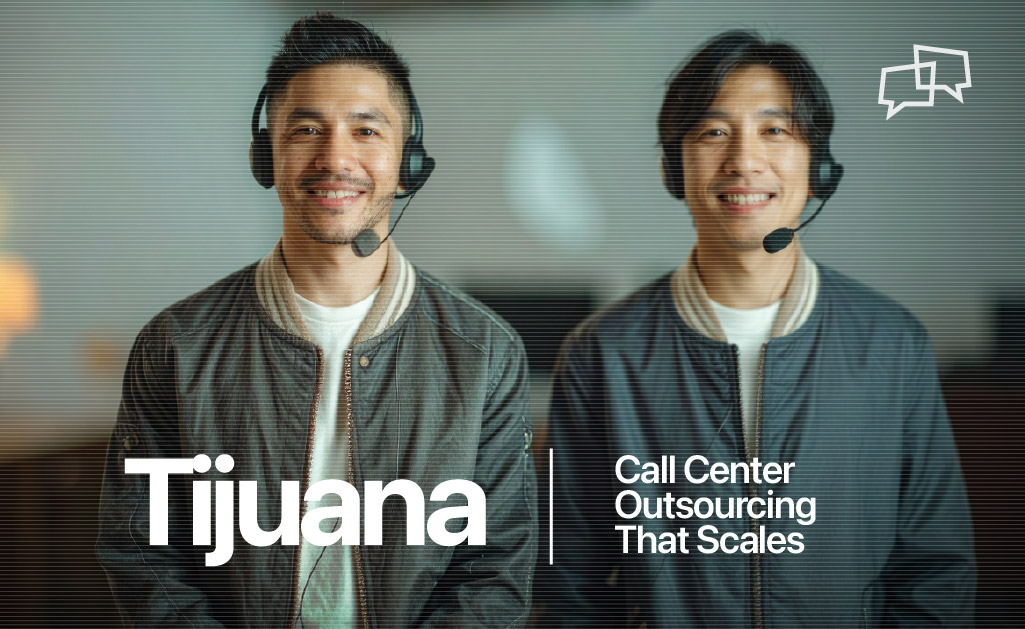
Tijuana Call Center Outsourcing
Tijuana Call Center Outsourcing: A Nearshore Growth Strategy for U.S. Companies
Learn why Tijuana call center outsourcing helps U.S. companies improve customer support, bilingual coverage, cost efficiency, and operational scalability without losing proximity or control.
TL;DR — Quick Takeaways
- Tijuana call center outsourcing helps U.S. companies expand support capacity without the delay and overhead of building larger in-house teams.
- Tijuana offers proximity to the U.S., bilingual English-Spanish talent, lower operating costs, and real-time collaboration across aligned business hours.
- The strongest nearshore programs are not just about lower cost. They are built around service quality, customer experience, reporting, training, and operational accountability.
- Nearshore support can cover customer service, lead generation, appointment setting, order processing, legal intake, technical support, email, chat, and back-office workflows.
- The right outsourcing partner should feel like an extension of your internal team, not a disconnected vendor.
When customer wait times start creeping up, sales follow-up gets inconsistent, and your in-house team is stretched too thin, the issue usually is not effort. It is capacity. That is where Tijuana call center outsourcing becomes a practical growth decision for U.S. companies that need better coverage without the delay and overhead of building a larger internal team.
Tijuana stands out because it solves several problems at once. It offers proximity to the U.S., a deep bilingual labor pool, lower operating costs than domestic hiring, and real-time collaboration across aligned business hours. For companies that want outsourcing to feel like an extension of their operation rather than a distant handoff, that combination matters.
Why Tijuana call center outsourcing keeps gaining traction
Many outsourcing decisions start with cost pressure, but the strongest nearshore programs are built around performance. A lower hourly rate is helpful, but it does not mean much if quality drops, customer satisfaction slips, or supervisors spend their days fixing preventable issues.
Tijuana gives U.S. businesses a different path. Because teams operate close to the border, communication tends to be faster and easier than with offshore models on the other side of the world. Leadership can visit the site without turning a planning meeting into an international project. Training can happen in real time. Escalations can be handled during the same business day. That operational closeness reduces friction, which is often the hidden cost in outsourced support.
There is also a customer experience advantage. For many brands, especially those serving both English- and Spanish-speaking customers, bilingual support is no longer a nice extra. It is part of delivering a complete experience. Tijuana provides access to agents who can handle those conversations naturally and professionally, which helps reduce transfers, misunderstandings, and dropped opportunities.
For companies focused on stronger customer experience, this is where location, language, and operational discipline start working together.
What nearshore support looks like in practice
The most effective programs are not built around a generic seat-fill model. They are designed around what your business actually needs to happen every day. That may mean inbound customer service, outbound lead generation, appointment setting, order processing, legal intake, technical support, or back-office work that keeps your front-end team focused on revenue and retention.
For a growing eCommerce brand, that could look like extended-hour support for order status, returns, subscription changes, and product questions. For a healthcare organization, it may mean structured patient communication, scheduling support, and documentation workflows with tighter compliance expectations. For a legal practice, speed to answer and clean intake can directly affect conversion.
This is where outsourcing decisions become more strategic. The question is not simply, “Can a partner take calls?” The better question is, “Can they represent our brand well, adapt to our workflows, and help us grow without creating more management burden?”
The business case for Tijuana call center outsourcing
Nearshore outsourcing makes financial sense because labor and operating costs in Tijuana are generally lower than in the U.S. But serious buyers know the real calculation is broader than payroll. Recruiting, training, quality assurance, scheduling, occupancy management, technology oversight, and attrition all shape the total call center outsourcing cost.
When those responsibilities sit fully in-house, scaling can be expensive and slow. Adding just a few agents often means more software licenses, more supervision, more HR work, and more exposure when turnover hits. With an experienced outsourcing partner, that infrastructure already exists.
At the same time, cheaper is not always better. If a provider wins on price by overloading agents, underinvesting in training, or keeping management thin, the short-term savings can quickly disappear. Missed SLAs, inconsistent handle times, poor call quality, and low first-contact resolution all create downstream costs. A good outsourcing model balances affordability with operational discipline.
That is why flexible engagement structures matter. Some businesses need a small dedicated team to protect brand consistency. Others need shared support for lower-volume programs. Some want a risk-free start without a long-term contract while they validate performance. The right setup depends on call volume, complexity, seasonality, and how closely support ties to revenue.
For companies comparing options, this guide on nearshore vs. offshore outsourcing can help clarify the trade-offs between cost, collaboration, speed, and control.
What to look for in a Tijuana outsourcing partner
The best partner will talk as much about people and process as pricing. A call center program succeeds when agents are trained well, supported well, and managed against clear outcomes. If the operation treats staffing like a commodity, customers will feel it.
Start with alignment. You want a provider that can build around your hours, channels, systems, and escalation rules. That includes voice, email support, live chat, SMS, CRM usage, knowledge base adoption, and reporting cadence. If the provider pushes a rigid model that forces your business to adapt around them, the relationship will become frustrating quickly.
Next, ask about transparency. You should know how pricing works, what is included, how performance is measured, and how changes are handled. Hidden fees and vague reporting create mistrust. Clear pricing and visible accountability create confidence.
Culture also deserves more attention than it usually gets. Agents who feel respected and empowered tend to bring more patience, accuracy, and consistency to customer interactions. That is not soft language. It is an operational advantage. Better agent experience often leads to lower turnover, stronger program knowledge, and more stable service quality over time. Research on employee engagement also supports the connection between clarity, coaching, and stronger workplace performance.
A company like CallZent, for example, positions this well by treating outsourced teams as an extension of the client organization rather than a transactional vendor relationship. For many U.S. businesses, that mindset is the difference between outsourcing that merely functions and outsourcing that actually improves the customer experience.
Common concerns and where trade-offs show up
Some companies hesitate because they worry outsourcing will dilute their brand voice. That can happen if onboarding is rushed or scripts replace judgment. But with the right training framework, QA process, and management attention, outsourced agents can become highly effective brand representatives.
Others worry about losing control. In reality, control depends less on whether support is in-house or outsourced and more on how the program is governed. Clear KPIs, regular reporting, calibration sessions, and direct communication between both teams usually matter more than office location. A strong approach to monitoring call center performance helps keep visibility and accountability in place.
There are trade-offs, and they should be acknowledged. If your support function involves highly specialized knowledge, complex compliance demands, or frequent internal exceptions, ramp-up may take longer. If your volume is very low and inconsistent, a dedicated model may not be the most efficient fit. If your leadership team wants daily floor-level oversight, even a nearshore partner may require an adjustment in expectations.
Still, these are planning questions, not deal breakers. Strong partners address them early and design around them.
When outsourcing in Tijuana makes the most sense
Tijuana call center outsourcing tends to work especially well for companies in growth mode. If customer demand is rising faster than your internal hiring capacity, nearshore support can give you room to scale without sacrificing responsiveness. It also works well for companies that need bilingual service, after-hours coverage, or a more cost-effective way to manage repetitive support tasks.
It is also a strong fit for businesses that have outgrown freelancers and patchwork staffing but are not ready to absorb the full cost of a large domestic support department. In that middle stage, flexibility matters. You may need 10 agents this quarter, 18 next quarter, and a blended voice and back-office team after that. A nearshore model can absorb those shifts more comfortably than most in-house structures.
The biggest gains usually come when leaders stop viewing outsourcing as a simple labor decision. The better frame is capacity, customer experience, and business continuity. If your support operation affects retention, conversion, collections, scheduling, or brand loyalty, then the right outsourced team is not just reducing cost. It is protecting revenue.
A smart outsourcing decision should make your business feel more responsive, not less. It should give your customers real human connections, give your managers back time, and give your growth plans a stronger operational foundation. Tijuana is not the right answer for every company, but for many U.S. businesses, it is one of the clearest ways to add scale, quality, and flexibility without losing proximity or control.
For companies still evaluating providers, this guide on how to find and vet the best call center outsourcing companies is a useful next step.
🚀 Ready to Scale Support with a Nearshore Team in Tijuana?
CallZent helps U.S. companies build bilingual customer support, sales follow-up, live chat, email, back-office, and call center teams from Tijuana. Get the flexibility of outsourcing with the proximity, collaboration, and accountability your operation needs.
FAQs About Tijuana Call Center Outsourcing
What is Tijuana call center outsourcing?
Tijuana call center outsourcing is the practice of hiring a nearshore call center team in Tijuana, Mexico, to handle customer service, sales support, lead generation, appointment setting, technical support, or back-office tasks for U.S. companies.
Why do U.S. companies outsource call center work to Tijuana?
U.S. companies outsource call center work to Tijuana because it offers proximity to the U.S., bilingual English-Spanish talent, lower operating costs, aligned time zones, and easier collaboration than distant offshore markets.
Is Tijuana call center outsourcing cheaper than hiring in the U.S.?
Tijuana call center outsourcing is often more cost-efficient than hiring a full U.S.-based team, especially when recruiting, training, HR, software, supervision, attrition, and management costs are included in the comparison.
What services can a Tijuana call center provide?
A Tijuana call center can provide inbound customer service, outbound sales support, lead generation, appointment setting, technical support, email support, live chat, order processing, legal intake, healthcare support, and back-office operations.
Is Tijuana a good location for bilingual customer support?
Yes. Tijuana is a strong location for bilingual English-Spanish customer support because of its proximity to the U.S., cross-border business culture, and access to agents familiar with North American customer expectations.
How does Tijuana outsourcing compare to offshore outsourcing?
Tijuana outsourcing usually offers better time-zone alignment, easier communication, faster escalation, and closer cultural familiarity than distant offshore outsourcing, while still offering cost advantages compared to many U.S.-based options.
Will outsourcing dilute my brand voice?
Outsourcing can dilute brand voice if onboarding is rushed or QA is weak. However, with strong training, scripts used as guidance, clear escalation rules, and ongoing calibration, outsourced agents can represent the brand effectively.
What should I look for in a Tijuana call center partner?
Look for a partner with bilingual talent, transparent pricing, clear reporting, QA processes, strong training, CRM readiness, flexible staffing, industry knowledge, and the ability to operate like an extension of your internal team.
When does outsourcing in Tijuana make the most sense?
Outsourcing in Tijuana makes sense when your company needs more support capacity, bilingual service, after-hours coverage, faster follow-up, more flexible staffing, or a lower-cost way to scale customer-facing operations.
How can CallZent help with Tijuana call center outsourcing?
CallZent helps U.S. companies build nearshore customer support, bilingual service, sales follow-up, email, live chat, and back-office teams from Tijuana, Mexico, with a focus on flexibility, collaboration, and customer experience.