Skip to content
Appointment Setting Services
Appointment Setting Services for 2026 Growth and ROI
Learn how appointment setting services work, how to measure quality, compare in-house vs. nearshore vs. offshore models, and choose a profitable strategy for your industry.
TL;DR — Quick Takeaways
- Appointment setting services work best when they protect seller time and improve meeting quality, not just booking volume.
- A modern program depends on clean targeting, fast follow-up, strong messaging, CRM discipline, and clear qualification rules.
- The KPI that matters most at the front end is the lead-to-booked ratio, with a strong program often targeting around 12% according to a cited sales-training benchmark in this guide’s source set.
- Pricing usually follows three models: hourly, per appointment, or monthly retainer.
- The right sourcing model depends on your need for control, speed, cost discipline, and time-zone alignment.
- In regulated and high-trust industries, screening quality and compliance-aware workflows matter more than raw calendar fill.
Your closers shouldn’t spend their mornings chasing voicemail and cleaning contact lists. Yet that’s exactly what happens in a lot of businesses that say they need more pipeline but haven’t built a real front-end sales function.
Appointment setting services solve a specific problem. They take prospecting, outreach, qualification, scheduling, and handoff out of the “whoever has time” category and turn it into an accountable revenue process. For a healthcare group, that might mean filling provider calendars with qualified consultations. For a financial firm, it can mean better first meetings with the right client profile. For a B2B sales team, it means more demos with decision-makers instead of more activity for activity’s sake.
The expensive mistake isn’t paying for appointment setting services. It’s paying closers to do setter work.
Is Your Sales Team Chasing Leads or Closing Deals
A familiar scene plays out every quarter. Your account executive is good in live conversations, handles objections well, and can move a buyer toward a decision. But instead of spending the day in discovery calls, demos, or follow-ups, that person is bouncing between cold calls, stale CRM records, inbox nudges, and calendar coordination.
That’s not just inefficient. It changes the economics of your sales team.
A founder feels it first. Revenue slows, not because the offer is weak, but because outreach is inconsistent. Then the sales manager tries to fix the problem by asking closers to prospect more. The result is predictable. Prospecting gets partial attention. Closing gets partial attention. Neither side gets done well.
Where the real bottleneck starts
Many teams don’t have a closing problem. They have a front-end capacity problem.
The issue usually looks like this:
- Inbound sits too long: A good lead comes in, but nobody responds quickly.
- Outbound is sporadic: Reps prospect when their calendars open up, not as a daily system.
- Qualification is loose: Meetings get booked with people who can’t buy, won’t buy, or aren’t ready.
- Handoffs are messy: Notes live in Slack, email, or someone’s memory instead of the CRM.
A lot of teams try to solve this with hustle. Process works better.
If seller productivity is already slipping, ways to increase sales productivity usually start with role clarity. Closers close. Setters set. Operations supports both with clean data and reporting.
What a professional setter changes
A dedicated appointment-setting function creates separation between outreach and closing. That sounds simple, but it has a major effect on throughput.
When the right person owns targeting, first contact, follow-up, qualification, and scheduling, three things happen:
- Sales conversations become more consistent.
- Closer calendars fill with better-fit meetings.
- Management can finally inspect a real funnel instead of scattered activity.
That’s why appointment setting services aren’t just an outsourcing line item. They’re often the first step toward predictable pipeline.
Defining Modern Appointment Setting Services
Appointment setting used to be treated like admin support with a headset. That framing is outdated. In modern sales teams, it’s a structured revenue function with its own workflows, metrics, and qualification standards.

What appointment setting services actually do
Appointment setting services are built to turn targeted prospects into scheduled sales conversations. That includes list validation, outreach, response handling, qualification, scheduling, and a clean handoff to the closer.
That’s different from general telemarketing.
Telemarketing often emphasizes contact volume. Lead generation may focus on surfacing names, downloads, or expressions of interest. Appointment setting sits deeper in the funnel. Its job is to produce meetings that sales teams can work.
Appointment setting is a sales development function designed to put qualified buyers on a closer’s calendar with enough context for the next conversation to move forward.
That distinction matters because the value is not the call itself. The value is the qualified handoff.
What it is not
It’s not just cold calling. It’s not just sending emails. It’s not a receptionist booking random time slots. And it shouldn’t be judged by dials alone.
A modern team usually works across phone, email, LinkedIn, text where appropriate, and CRM workflows. In that sense, the discipline overlaps with broader thinking on generating qualified B2B meetings, but the operational focus is narrower. It is built around one outcome: a meeting that deserves to happen.
Why businesses buy this function
Companies usually invest in appointment setting services when one of four conditions shows up:
- Closers are overextended
- New market outreach needs to start fast
- Internal follow-up is inconsistent
- Leadership wants a more predictable pipeline engine
The category also became more visible as a scalable sales function once outbound teams began measuring meeting-setting as a distinct KPI rather than treating it as a side task. That shift changed how buyers evaluate the work. It’s now managed like a budgeted sales channel, not a miscellaneous admin task.
For business owners, that’s the strategic lens to use. You’re not buying calls. You’re deciding whether your company needs a dedicated mechanism for turning target accounts into sales-ready meetings.
The Anatomy of a Successful Appointment Setting Campaign
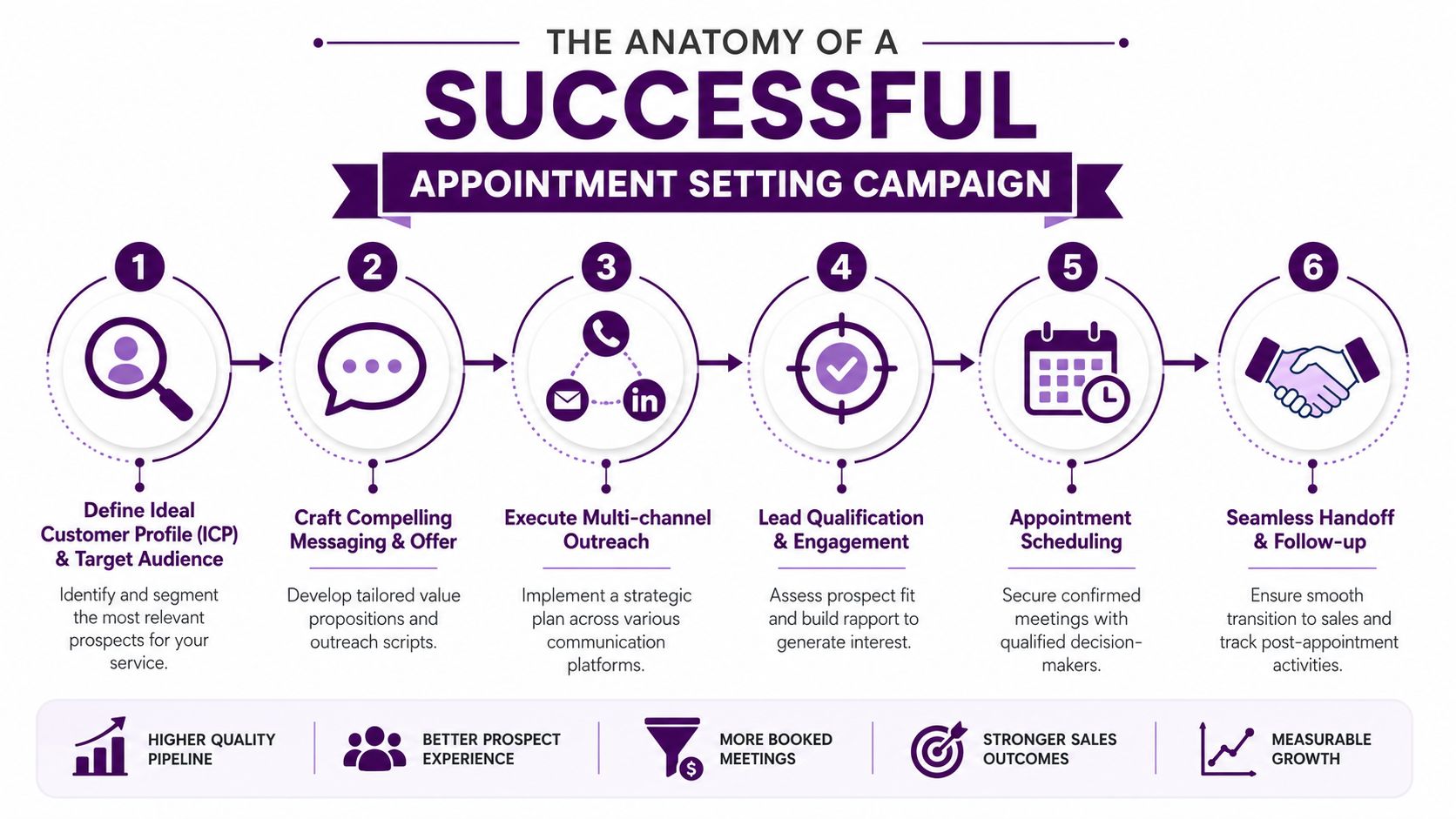
The strongest campaigns are boring in the right places. They don’t rely on heroics, lucky timing, or one rep with unusual hustle. They run on targeting discipline, fast contact, clean systems, and a handoff process that sales can trust.
Start with the right accounts
A campaign breaks early when the lead list is wrong. If the Ideal Customer Profile is fuzzy, everything downstream gets weaker. Messaging misses. Reps talk to the wrong titles. Show rates suffer because the buyer never had a real reason to take the meeting.
Good teams define the basics before touching a dialer:
- Company fit: Industry, size, geography, and business model
- Role fit: The actual decision-maker or a strong internal influencer
- Problem fit: A realistic reason the prospect would care now
A healthcare campaign, for example, often needs a different profile and a more careful compliance-aware workflow than a B2B software campaign. One-size-fits-all outreach usually fails here.
Messaging and channel mix decide whether anyone responds
Phone-first can work well when urgency is high and decision-makers are reachable. Email works better when prospects need context before they’ll speak. LinkedIn helps when the category is trust-heavy or relationship-led. In practice, the strongest campaigns usually blend channels instead of betting on one.
The sequence matters less than relevance. A setter should know what the company does, why this account was selected, and what the prospect is likely dealing with.
Practical rule: If a rep can’t explain why this account belongs in the campaign, that account shouldn’t be in the campaign.
Qualification protects your calendar
The challenge exposes weak vendors. Anyone can fill time slots if qualification is loose. The hard part is filtering for sales readiness without turning the conversation into full discovery.
BANT is still useful here. The point isn’t to force a rigid script. The point is to screen for Budget, Authority, Need, and Timeline well enough that the closer walks into a real opportunity.
That also supports cleaner commercial models. As noted in CallZent’s outbound call center services overview, modern appointment-setting architecture depends on CRM systems such as Salesforce and HubSpot, and the time-to-contact metric matters operationally because faster response is causally linked to a 100x increase in lead qualification likelihood compared with delayed responses. The same source also notes that appointments failing BANT criteria can be excluded in pay-for-performance setups, which ties revenue more closely to qualified meetings.
CRM handoff is where campaigns either scale or stall
A booked meeting without context creates friction. A booked meeting with notes, disposition history, contact details, objections raised, and qualification data gives the closer a running start.
The handoff should include:
- Account history: What outreach happened and how the prospect engaged
- Qualification notes: Why the meeting was accepted
- Scheduling clarity: Confirmed time, stakeholders, and agenda
- Ownership fields: Clear accountability inside the CRM
When teams skip this discipline, they create meetings that look good on a report and disappoint in real life.
The KPIs That Matter How to Measure Real Performance
A lot of appointment setting reports look busy. Dials are high. Emails are sent. Connects are tracked. None of that tells you whether the program is helping revenue.
The useful question is simpler: are verified leads turning into qualified conversations at an efficient rate?
Lead-to-booked ratio deserves executive attention
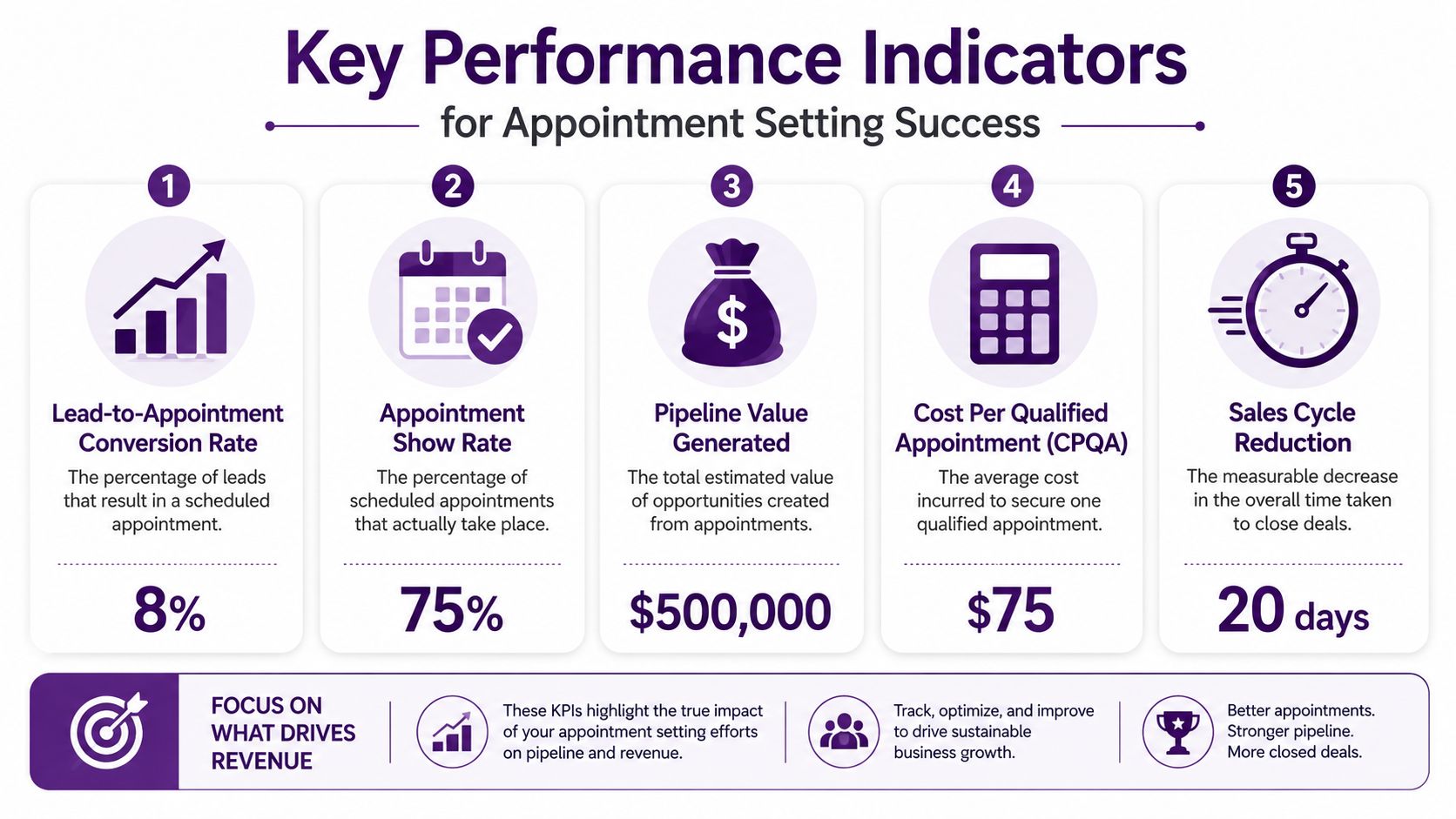
This is the front-end efficiency metric most operators should watch first. It measures how many new leads become scheduled calls.
According to the benchmark set referenced in this guide, a strong appointment-setting operation may target a lead-to-booked-call ratio of around 12% according to a cited 2026 sales-training source, while ratios below 5% often indicate issues with data quality, targeting, or messaging quality. The same benchmark notes that bad data and weak personalization are common causes when performance slips.
That matters because low conversion at this stage usually means one of three things:
- You’re feeding the team the wrong records.
- The outreach message doesn’t connect to buyer pain.
- The booking path is clunky or delayed.
What not to obsess over
Vanity metrics still have operational value, but they shouldn’t drive executive decisions.
A rep can post impressive activity numbers and still produce weak meetings. Another can work a smaller book of well-selected accounts and generate better opportunities with fewer touches. That’s why leadership should ask harder questions than “How many calls did they make?”
Use reporting to inspect quality, not just effort. A practical starting point is a dashboard that ties outreach, booked meetings, held meetings, and downstream sales feedback together. Call center KPI dashboards and reporting views are useful when they help managers identify where quality drops between lead intake and sales handoff.
The quality layer buyers often miss
Public discussion around appointment setting still spends too much time on volume and too little on meeting quality. The more useful review points are qualitative and downstream:
- Show rate: Are people attending?
- Sales acceptance: Does the AE agree the meeting was worth taking?
- Opportunity quality: Does the meeting create a real next step?
- No-show patterns: Are reminders and confirmations working?
- Pipeline relevance: Are these the right buyers, not just available buyers?
One source set used for this article also notes that some appointment-setting programs report costs of $500 to $2,000 per meeting in tech-focused markets, with broader market ranges from $50 to $3,500 depending on complexity, quality, and geography, while emphasizing that performance should be judged by efficiency and qualified conversion rather than raw volume.
A full calendar can still hide a weak pipeline. The right KPI set exposes whether meetings are helping sales move forward or just keeping reps busy.
In-House vs Outsourced Nearshore vs Offshore
Most business owners don’t ask whether appointment setting matters. They ask where it should live.
That’s the right question. The answer changes based on speed, management bandwidth, hiring capacity, and how tightly the function needs to align with your market.
When in-house makes sense
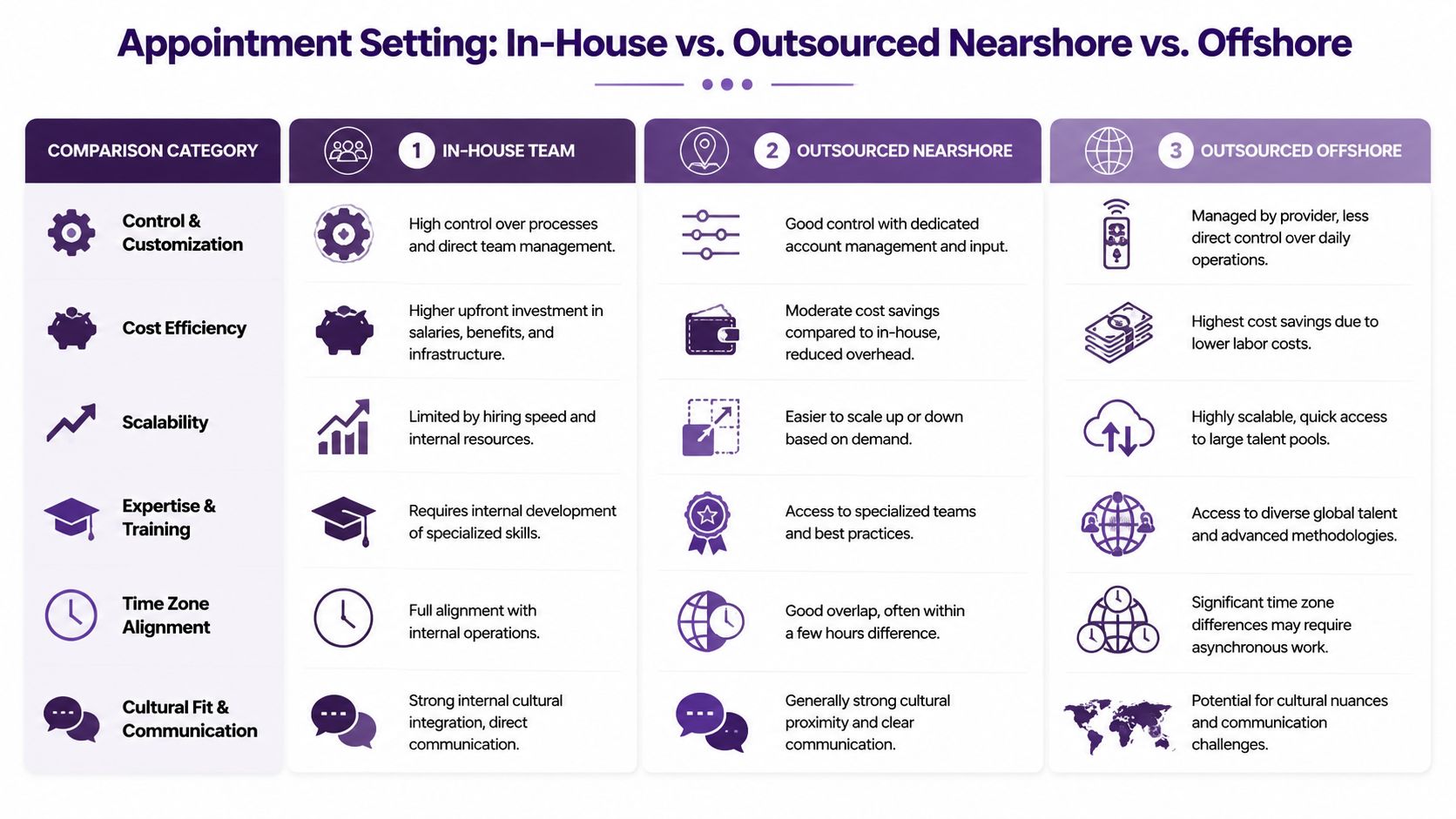
An internal team works well when the offer is nuanced, sales and marketing sit closely together, and leadership wants direct control over scripts, coaching, and account selection.
That model gives you:
- Tighter control: Managers can adjust messaging and process quickly.
- Embedded context: Setters hear product updates and sales feedback in real time.
- Direct collaboration: Account executives and setters can refine quality standards together.
The trade-off is slower ramp and higher fixed commitment. Hiring, training, tech setup, and supervision all land on your team.
Where outsourced teams earn their place
Outsourced appointment setting is often the better move when you need speed, flexible capacity, or immediate process maturity. It can also help when your closers are already overloaded and management doesn’t want to build another internal function from scratch.
Published market guidance cited in this article shows pricing often falls into familiar models such as $30 to $150 per qualified appointment, $30 to $60 per hour, and monthly packages starting around $300 and rising above $5,000 for larger campaigns, while one guide estimates in-house setters at $35,000 to $60,000 per employee per year and some outsourced scenarios at $60,000 to $90,000 annually for comparable volume in certain cases, as noted in this appointment setting cost guide.
Those ranges don’t decide the issue by themselves. They do show why many firms treat appointment setting as a managed sales channel rather than a side responsibility.
Nearshore versus offshore is not only about labor cost
Many buying decisions often go sideways. A lower hourly rate can be attractive, but appointment setting is highly sensitive to communication quality, time-zone overlap, call coaching, and feedback speed.
Nearshore tends to fit North American businesses that need:
- Working-hour overlap: Easier live coaching and same-day issue resolution
- Stronger collaboration: Faster iteration with sales and marketing
- Cultural proximity: Better tone matching and conversational flow
Offshore can fit teams that prioritize cost efficiency and can manage more asynchronous coordination. It may work well in programs with stable scripts, clear process documents, and less need for real-time collaboration.
If you’re comparing models, this nearshore vs offshore outsourcing cost and ROI breakdown is useful for framing the operational trade-offs, not just the wage difference.
For firms building outbound from scratch, broader strategy resources can help too. This B2B lead generation playbook for 2026 gives helpful context on how outsourced pipeline functions are being structured today.
A practical way to choose
Use a simple decision filter:
| Model | Best fit | Main risk |
|---|---|---|
| In-house | High-control environments with internal management bandwidth | Slow ramp and heavier overhead |
| Nearshore | North American teams needing alignment, flexibility, and close collaboration | Requires thoughtful onboarding and clear qualification rules |
| Offshore | Cost-sensitive programs with mature playbooks | Communication gaps and slower feedback loops |
A nearshore provider such as CallZent can fit companies that want outbound support in close time-zone alignment with North America, especially when bilingual coverage or tighter day-to-day coordination matters.
Decoding Pricing Models and Projecting Your ROI
Pricing is where a lot of buyers either overcomplicate the decision or oversimplify it. The useful question isn’t “What does appointment setting cost?” It’s “Which pricing model matches our sales cycle, qualification bar, and internal follow-up capacity?”
The three models buyers see most often
The common structures are straightforward:
- Per-appointment pricing: Often useful when you want a direct tie between spend and meetings booked. Published market ranges include about $30 to $150 per qualified appointment according to this pricing guide, based on the source set used for this article.
- Hourly pricing: Better when campaigns need testing, list work, script iteration, or mixed admin and outreach support. Reported ranges include $30 to $60 per hour.
- Monthly retainers: A fit for ongoing programs where the provider handles a broader function. Published packages can start around $300 and rise above $5,000 for larger campaigns.
Each model has a trade-off.
Per-appointment pricing sounds clean, but quality standards must be tight. Hourly pricing gives flexibility, but buyers need clear reporting. Retainers work well when the scope includes targeting, CRM management, and optimization, not just dialing.
How to think about ROI without guessing
The simplest ROI model starts with business value per completed sales outcome, not cost per meeting alone.
A few practical examples:
- Healthcare provider: If booked consultations create meaningful downstream patient value, the right question is whether the meetings are qualified, attended, and appropriate for the practice.
- Financial services firm: A first meeting has value only if it reaches the right client profile and leads to a real advisory process.
- B2B software company: Product demos matter when they come from accounts that match your ICP and can move into pipeline.
The cheapest meeting is often the most expensive one if sales rejects it, the buyer no-shows, or the account never had fit to begin with.
Compare outsourcing against internal cost honestly
One of the clearest budgeting anchors in the verified source set is internal staffing cost. A fully loaded in-house setter is often estimated at $35,000 to $60,000 per year, which is why many companies use outsourced models when they want more predictable pipeline generation without adding another internal headcount line.
That doesn’t mean outsourced is always better. It means ROI depends on whether the model gives you better qualified meetings, faster ramp time, and less management drag.
If you’re budgeting correctly, evaluate price only after you’ve defined what a qualified meeting is.
Selecting Your Partner and Launching for Success
A provider can sound polished and still hand your sales team weak meetings. The best buying process cuts past presentation and tests the operating model.
Questions worth asking before you sign
Ask direct questions that expose how the team works:
- How do you define a qualified meeting? If the answer is vague, quality will be vague.
- How do you screen for fit, timing, and decision-maker relevance?
- What happens before a meeting is handed to sales?
- How do you document outreach and qualification in the CRM?
- How do you handle regulated workflows, especially in healthcare or finance?
- What does onboarding look like in the first few weeks?
- How do you adjust if sales says the meetings aren’t good enough?
A useful market shift to keep in mind is that buyers now expect more than raw booking volume. The source set for this article notes growing emphasis on BANT-style screening, live handoffs to sales reps, and compliance-aware processes in regulated verticals, especially healthcare, as discussed in this qualified appointment setting overview.
What a strong launch actually needs
Most failures happen early. Not because outreach is impossible, but because expectations were sloppy.
A strong launch usually requires:
- A clear ICP
- Approval on messaging
- Defined qualification rules
- Sales feedback loops
- CRM ownership and reporting discipline
If those pieces are in place, appointment setting services can become a reliable growth lever instead of another outsourced experiment. If they aren’t, even a capable team will struggle.
Strategic appointment setting works when it protects your closers, respects your brand, and creates meetings your sales team wants more of.
🚀 Ready to Build a Stronger Appointment Setting Program?
CallZent helps North American businesses build bilingual nearshore appointment setting teams for outbound outreach, lead qualification, CRM handoffs, sales scheduling, and predictable pipeline growth.
Talk to an ExpertFAQs About Appointment Setting Services
What are appointment setting services?
Appointment setting services help businesses turn targeted prospects into scheduled sales conversations through outreach, qualification, follow-up, scheduling, CRM documentation, and clean handoffs to closers.
How are appointment setting services different from telemarketing?
Telemarketing often focuses on contact volume or broad outreach. Appointment setting focuses on producing qualified meetings that sales teams can work, usually with defined qualification criteria and CRM handoff rules.
Why do businesses outsource appointment setting?
Businesses outsource appointment setting to protect closer time, improve follow-up consistency, speed up pipeline generation, access trained outreach teams, and avoid building a full internal front-end sales function from scratch.
What makes a good appointment setting campaign?
A good campaign starts with a clear ideal customer profile, clean lead lists, relevant messaging, fast follow-up, BANT-style qualification, CRM discipline, and strong handoff notes for the sales team.
What KPIs should appointment setting services track?
Important KPIs include lead-to-booked ratio, show rate, sales acceptance rate, opportunity quality, no-show patterns, time-to-contact, CRM completion, and downstream pipeline contribution.
What is a strong lead-to-booked ratio?
A strong lead-to-booked ratio may target around 12% in some appointment-setting benchmarks, while ratios below 5% can indicate issues with data quality, targeting, messaging, or booking workflow.
How much do appointment setting services cost?
Appointment setting pricing often follows per-appointment, hourly, or monthly retainer models. Costs vary based on industry complexity, lead quality, qualification standards, geography, and whether the program is in-house, nearshore, offshore, or fully outsourced.
Is nearshore appointment setting better than offshore?
Nearshore appointment setting can be a better fit for North American companies that need time-zone alignment, bilingual coverage, fast sales feedback loops, and close collaboration. Offshore may fit cost-sensitive programs with mature scripts and lower real-time coordination needs.
Which industries benefit from appointment setting services?
Industries that benefit include healthcare, financial services, B2B software, insurance, professional services, home services, logistics, real estate, and any business that depends on qualified sales conversations.
How can CallZent help with appointment setting services?
CallZent helps businesses build bilingual nearshore appointment setting programs with outbound outreach, lead qualification, CRM handoffs, sales scheduling, reporting, and customized workflows for North American markets.
If you’re evaluating appointment setting services and want a nearshore option with North American time-zone alignment, bilingual support, and customized outbound workflows, learn more about CallZent.