Skip to content

Virtual Assistance and Nearshore Outsourcing
Virtual Assistant Outsourcing Company: How to Choose the Right Provider
A practical framework for defining the work, comparing sourcing models, evaluating bilingual providers, running a controlled pilot, and scaling virtual assistant support without losing control.
TL;DR — Quick Takeaways
- Choose a provider based on the work, language requirements, risk level, and management structure—not hourly price alone.
- Document inputs, outputs, tools, decision rights, exclusions, and escalation paths before requesting proposals.
- A nearshore provider in Mexico can offer English–Spanish coverage and strong overlap with North American business hours.
- Require evidence of security controls, supervision, backup coverage, onboarding discipline, and measurable quality assurance.
- Start with a 30- to 60-day pilot covering two or three representative workflows.
- Translate successful pilot results into SLAs, reporting requirements, access controls, and clear commercial terms.
- Scale only after the workflow is stable and the provider consistently meets agreed quality and service targets.
You’re staring at too much admin work and too little control. The question isn’t whether you need help, it’s whether you want a virtual assistant outsourcing company to become part of your operating model, or just a short-term labor fix that creates new handoffs, gaps, and rework.
A Practical Path to Choosing the Right Provider
The fastest way to make a bad outsourcing decision is to start with price. A better way is to treat provider selection as an operating-model decision, because the wrong model costs you more in supervision, rework, and missed context than it saves on hourly rates. If your team is buried in scheduling, inbox management, customer replies, and back-office cleanup, you’re not buying “help.” You’re deciding how work should flow across people, tools, and accountability.
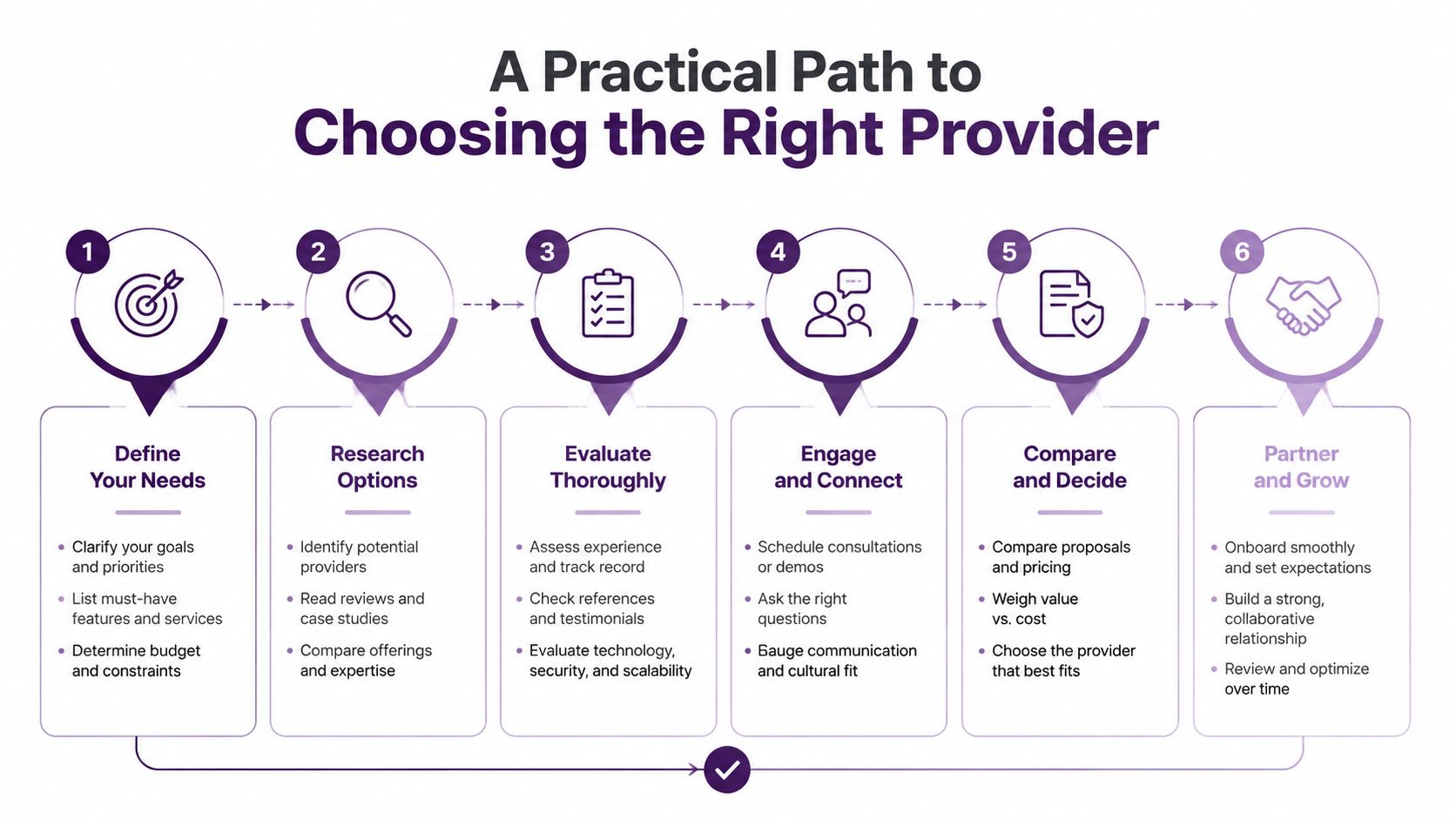
Use a six-step decision map
Start by defining the work in plain language, then decide whether that work belongs with a local hire, freelancer, AI-assisted internal support, or a virtual assistant outsourcing company. Next, shortlist providers based on evidence, not polish, and only then move into a controlled pilot. That sequence matters because it exposes whether the provider can run your process, not just talk about it.
Practical rule: If you can’t describe the task, the output, and the escalation path, you’re not ready to outsource it.
A bilingual nearshore provider often makes the most sense when customer-facing coordination is involved, because the overlap in working hours and the ability to move between English and Spanish reduces friction. That’s especially useful for businesses serving North American customers, where a resource like conversational AI platform insights can help teams think more clearly about how human support and digital assistance should work together.
The advantage of a disciplined sequence is control. You protect data, reduce ambiguity, and avoid the common trap of scaling before the workflow is stable. In the sections below, each step gets translated into actions, boundaries, and review points you can use immediately.
Define the Work Before Choosing a Virtual Assistant Outsourcing Company
A vague request like “we need help” doesn’t produce a usable proposal. It produces mismatched expectations, generic staffing recommendations, and scope creep the moment work starts moving. If you want a virtual assistant outsourcing company to price correctly and staff reliably, you need to turn the need into a task brief that shows exactly what happens, who approves it, and what good looks like.
Start with task reality, not job titles
Inventory recurring work first. Separate customer-facing tasks from back-office processing, then flag anything that needs bilingual handling, regulated judgment, or access to sensitive systems. An inbox triage queue is not the same as handling customer escalations, and a scheduling task is not the same as updating account records.
Use a short task map for each item:
- Input: What arrives, such as an email, call note, spreadsheet row, or support ticket.
- Output: What the VA must produce, such as a reply draft, completed entry, or scheduled appointment.
- Tools: What systems they must use every day.
- Decision rights: What they can decide alone and what needs escalation.
Add operating requirements before you request quotes
Your brief should also spell out hours, response expectations, language mix, data sensitivity, and integration points with your current team. If the work touches customers in both English and Spanish, say so. If it requires a handoff to sales, operations, or billing, write that down before the provider ever sees the brief.
A good scope document also states what is out of scope. That prevents the buyer from expanding the assignment after onboarding. It’s the simplest way to keep the relationship manageable.
For a practical example, an e-commerce team might ask for order-status follow-up, returns triage, and CRM updates, but exclude refunds, pricing exceptions, and customer retention offers. That boundary keeps the VA focused and keeps your manager from turning a support role into an open-ended catchall.
If you want a clean delegation model, this guide to delegate tasks effectively is worth reading before you send a request for proposal. It’s easier to choose the right provider when you already know which tasks can be delegated without losing control.
Compare Nearshore Bilingual Providers With Other Models
A nearshore bilingual provider is not automatically the right answer. It’s the right answer when collaboration, language coverage, and time-zone alignment matter enough to justify a managed team. If the work is highly contextual, tightly regulated, or needs immediate domestic oversight, another model may fit better.
Compare models on operating fit, not slogans
A U.S. company supporting Spanish-speaking customers from Mexico often gets better coordination from a nearshore team than from a distant offshore pool. The value is in quicker clarification, easier quality review, and less cultural translation in customer conversations. Mexico is described as having the largest bilingual workforce pool in Latin America, with 15.6 million English speakers (bilingual workforce reference), which is directly relevant when bilingual staffing is part of the requirement.
| Sourcing model for virtual assistant work | Collaboration & Hours | Language Fit | Cost Profile | Key Trade-off |
|---|---|---|---|---|
| Nearshore bilingual provider | Strong overlap with North American business hours | English and Spanish support is a practical advantage | Usually lower than onshore, with more management structure than freelancers | Best balance for customer-facing and shared-team work |
| Onshore staffing | Strongest local coordination | Best for domestic nuance and strict locality | Typically the highest labor and overhead burden | Easy collaboration, but expensive |
| Offshore BPO | Limited overlap depending on geography | Can support multilingual work, but cultural fit varies | Lower labor cost, higher coordination effort | Cost savings can be offset by more supervision |
| Freelance marketplace | Variable, dependent on the individual | Depends on the freelancer’s background | Flexible, but management burden sits on your team | Good for narrow tasks, weak for continuity |
| AI-augmented in-house team | Immediate internal access | Depends on your staff | Tool cost plus internal labor | Works only if managers can govern the workflow tightly |
Know when another model wins
Freelancers can win on highly contextual executive support when the same person has already learned the leader’s style and preferences. Onshore hires can be the better choice when domestic data residency or internal policy is strict. And if your team needs sub-three-hour response behavior all day, a tightly managed internal setup may be easier to enforce.
For a useful contrast on bilingual answering workflows, the BubblyPhone bilingual answering service shows how language coverage can be framed as an operational feature, not just a sales claim. The point is simple, choose the model that matches the work profile, language demand, and risk tolerance you defined earlier.
If you want a deeper cost-and-risk lens, the nearshore vs offshore outsourcing costs, risks, ROI guide is a helpful companion before you lock a sourcing direction.
Evaluate Providers With a Shortlist Scorecard
Stop looking at polished decks first. Start by narrowing the field to four to six vendors based on specialization, client mix, bilingual depth, and whether they manage work in a way that matches your scope. A defensible shortlist comes from combining desk research, risk review, and interview findings into one scorecard, not from whichever sales team followed up fastest.
Ask for proof, not marketing collateral
Request a recent SOC 2 or ISO 27001 attestation summary, sample SLAs, and anonymized performance data. That tells you more than a website brochure ever will. If a provider can’t share meaningful process evidence, you’re probably looking at a sales organization, not a controlled operating partner.
Use a simple 1 to 5 scale with minimum thresholds for each category:
- Operational fit: Does the provider handle the exact task mix, hours, and bilingual requirements?
- Security posture: Do they show documented controls, access discipline, and audit readiness?
- Talent model: Is staffing stable, supervised, and backed up?
- Commercial terms: Are scope, substitution, and exit rules clear?
- Scalability: Can they add volume without breaking quality?
- References: Do reference calls confirm the same operating pattern you were sold?
Ask references what failed first. The real issue usually appears in the weak spot, not the success story.
Use pointed interviews to surface operating maturity
These ten questions separate a managed provider from a loosely organized one:
- How do you handle backup coverage when a VA is out?
- What triggers escalation to a supervisor?
- How do you control tool access across client accounts?
- What parts of the workflow are documented in SOPs?
- How do you train a new VA on a live client process?
- What quality checks happen weekly, and who reviews them?
- How do you manage bilingual work when a task shifts between English and Spanish?
- What happens if the volume spikes unexpectedly?
- How do you track attrition or replacement risk inside the team?
- How do you report performance when a client wants more than anecdotes?
If you want a structured way to judge vendors, the vendor evaluation criteria page can help you think in terms of measurable fit instead of sales language. The right shortlist is the one that survives scrutiny on operations, not the one with the slickest pitch.
| Shortlist Scorecard for Virtual Assistant Outsourcing Companies | Weight | Provider A | Provider B | Provider C |
|---|---|---|---|---|
| Operational fit | 1 to 5 | |||
| Security posture | 1 to 5 | |||
| Talent model | 1 to 5 | |||
| Commercial terms | 1 to 5 | |||
| Scalability | 1 to 5 | |||
| References | 1 to 5 |
Run a Controlled Virtual Assistant Trial
A trial should prove fit, not exhaust your team. Keep it time-boxed, narrow, and documented, or you’ll confuse activity with evidence. The best pilot exposes how the provider behaves when the work gets messy, because that’s where the operating model shows up.
Build the pilot around real work
Use a 30 to 60 day trial and keep it to 2 to 3 representative task groups. Don’t test everything at once. A scheduling queue, an inbox queue, and a bilingual customer follow-up flow are enough to reveal whether the provider can handle volume, ambiguity, and escalation without handholding.
Interview proposed VAs with the same rubric every time. Ask how they prioritize when volume spikes, what they do when instructions are unclear, when they escalate, and how they handle a bilingual customer scenario. Score the response against the same criteria for every candidate so the decision isn’t based on charm or confidence.
Govern the trial like a real contract
Shadowing works best when your team watches actual task handling and not just a polished demo. Sample quality regularly, hold a weekly review meeting, and record what was good, what failed, and what needs revision. If you skip the notes, you’ll end up arguing from memory.
Clean rule: If the pilot can’t be measured, it can’t be renewed.
Keep access scope narrow, require NDAs, assign one success contact, and write an exit clause before the trial starts. That protects both sides and keeps the conversation professional if the fit is poor. The process should feel controlled, not tentative.
For teams managing a pilot through changing priorities, the managing outsourcing projects guide is a practical companion. A pilot that ends with a clear go, revise, or stop decision is worth more than a vague “let’s keep talking.”
Negotiate the Contract and Launch the Partnership
A strong contract turns a promising trial into a manageable operating relationship. It should define scope, substitution rules, performance credits, audit rights, termination terms, and data ownership in plain language. If those pieces are fuzzy, you’ll spend the next quarter negotiating exceptions instead of running work.
Translate pilot results into SLA terms
Use the trial to set actual SLA thresholds, not generic promises. If the provider handled response timing, quality sampling, and escalation well, bake those expectations into the agreement. The SLA should mirror the way the work behaved during the pilot, because that’s the only evidence you have that it’s realistic.
Security deserves equal attention. Require encrypted devices, multi-factor authentication, VPN use where appropriate, access reviews, data residency clarity, and defined breach-notification timelines. If the provider can’t explain how access is granted and removed, they don’t have a mature operation yet.
For contract language, the call center contracts resource is a useful reference point before final signatures go out. It’s a lot easier to enforce terms that were written with daily operations in mind.
Launch with a simple 30-60-90 structure
Start with tooling setup and knowledge transfer, then move into SOP finalization and steady-state governance. Weekly standups should happen during onboarding, with monthly business reviews after the process settles. Quarterly roadmap resets help you decide whether the arrangement should grow, stay flat, or be re-scoped.
A practical launch sequence looks like this:
- First 30 days: Set up tools, permissions, and documented workflows.
- Next 30 days: Tighten SOPs, confirm handoffs, and correct recurring errors.
- By 90 days: Lock in steady cadence, review renewal assumptions, and decide whether the model supports scale.
The point is not to make the relationship rigid. The point is to make it predictable enough that both sides know who owns what, and when issues get escalated. That’s how a virtual assistant outsourcing company becomes part of your operating system instead of an external task bucket.
Track KPIs and Scale With Confidence
If you don’t review performance weekly at the start, you’ll find out about problems too late. A managed outsourcing relationship should be run like an operating partnership, not a one-time purchase. Keep the metrics simple, visible, and tied to the work you delegated.
Watch a small set of metrics
The core dashboard should include task completion rate, quality-scoring samples, SLA adherence, CSAT or internal satisfaction, ramp time per new VA, and attrition. Use a fixed weekly scorecard review for the first 60 days, then shift to a monthly business review once performance is stable. Color-code at-risk metrics so weak spots show up before renewals or expansion decisions.
| Phased KPI and Scaling Cadence | Core Metrics | Review Cadence | Scaling Trigger |
|---|---|---|---|
| Early ramp | Task completion, quality samples | Weekly | Stable execution on agreed tasks |
| Stabilization | SLA adherence, internal satisfaction | Weekly | Fewer escalations and cleaner handoffs |
| Steady state | Ramp time, attrition | Monthly | Documented process readiness for expansion |
For a broader framework on metric discipline, the guide to KPI-driven support is a useful companion. The logic is simple, if a metric doesn’t change decisions, it doesn’t belong on the dashboard.
Replace underperforming resources early. Waiting rarely improves a weak fit.
Pre-agree what expansion means before you need it. That might be more headcount, more hours, or a new service line. Documenting learnings from each wave matters too, because the next team should inherit a tested playbook, not your first round of mistakes.
Build a Bilingual Virtual Assistant Team in Mexico
CallZent helps U.S. businesses build structured nearshore teams for virtual assistance, customer service, sales support, and back-office operations. Start with a clear scope, measurable standards, and a delivery model designed for accountability.
Request a Custom QuoteCallZent helps businesses build bilingual nearshore support teams in Tijuana with virtual assistant services, customer service, back-office work, and other outsourced operations that need structure and accountability. If you want a provider that treats onboarding, daily management, and KPI review as part of the service, visit CallZent and start the conversation with a clear scope and operating plan.