

VIRTUAL EXECUTIVE ASSISTANT SERVICES
Virtual Executive Assistant Services: How Leaders Reclaim Time and Scale Smarter
Learn how virtual executive assistant services improve executive productivity, decision quality, calendar control, workflow management, and business scalability.
TL;DR — Quick Takeaways
- Virtual executive assistant services help leaders reclaim time by moving recurring operational work off the executive desk.
- A virtual executive assistant is different from a standard VA. A VEA works from context, judgment, and priority awareness, not just task instructions.
- Nearshore support offers a strong balance of cost efficiency, time-zone alignment, bilingual capability, and real-time collaboration for North American businesses.
- The best ROI comes from protected decision-making time, fewer interruptions, cleaner follow-up, and stronger workflow control.
Your calendar is packed, your inbox is running your day, and the work that moves the business forward keeps getting pushed to tomorrow. That’s the moment many leaders realize they don’t have a time-management problem. They have a support-structure problem.
For North American executives, founders, and operators, virtual executive assistant services aren’t just about handing off admin. They’re about protecting decision-making time, reducing context switching, and creating a cleaner operating rhythm across the business.
Are You Working in Your Business or on Your Business
If you’re still the person confirming meetings, cleaning up inbox threads, chasing follow-ups, and preparing for calls at the last minute, you’re probably carrying work that shouldn’t sit at the executive level anymore. It feels manageable in isolation. Taken together, it drains focus from hiring, revenue, client relationships, and execution.
That’s why this category is growing fast. One market forecast values the virtual executive assistant market at $3.68 billion in 2025 and projects $10.29 billion by 2034, with a projected 12.10% CAGR from 2026 to 2034. A broader market view places virtual assistant services at $5.3 billion in 2025 and projects $43.4 billion by 2035, a projected 23.4% CAGR. The gap reflects different market definitions, but the direction is clear: these services have become a scaled outsourcing category, not a niche workaround for overloaded founders, according to Strategic Revenue Insights market coverage.
Key takeaway: A virtual executive assistant isn’t there to make you busier more efficiently. They’re there to remove the work that keeps you from leading.
A familiar example. A business owner blocks two hours for planning, then loses the morning to rescheduling a client call, digging through an inbox for a contract thread, and assembling notes for an internal meeting. None of those tasks are trivial. But they don’t require executive attention.
Good delegation starts by identifying work that is important but not executive-only. If you need help clarifying what belongs on your plate versus someone else’s, this guide on how to delegate tasks effectively is a practical place to start.
What Virtual Executive Assistant Services Really Mean
A lot of providers use “virtual assistant” and “virtual executive assistant” as if they mean the same thing. In practice, they don’t.
A standard VA usually works from instructions. A VEA works from context. That difference changes the value of the role.
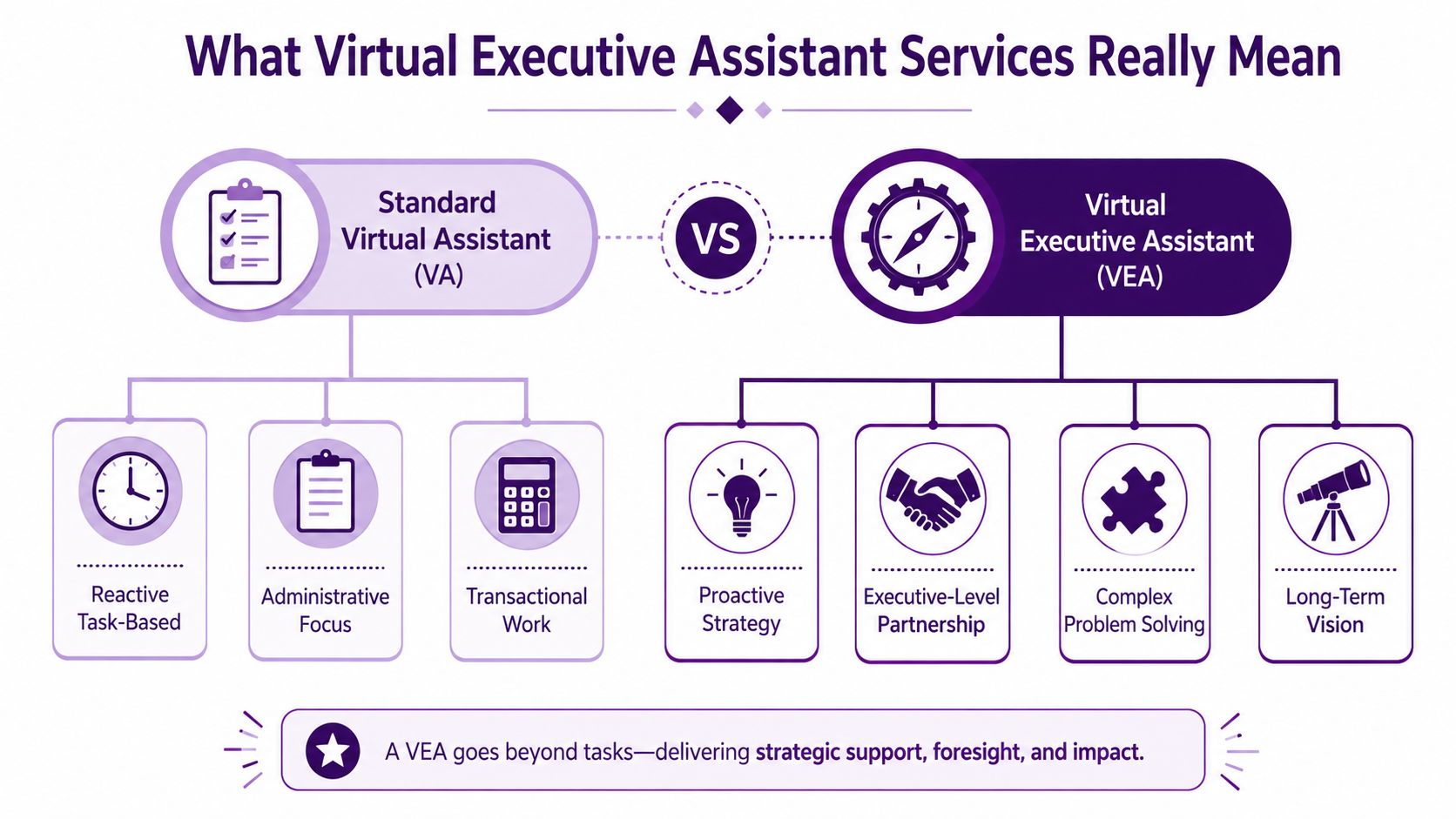
A task taker versus a focus protector
Think of a standard VA like a taxi driver. You tell them where to go, and they complete the trip.
A virtual executive assistant is closer to an air traffic controller. They don’t just respond to a destination. They manage the flow, anticipate conflicts, reduce delays, and protect the conditions for a smooth day.
The technical value is operational load shifting. By offloading recurring work such as calendar management, inbox triage, travel coordination, meeting preparation, research, and project tracking, executives preserve uninterrupted time for higher-value decisions, as described in this overview of remote executive support.
What higher-level support looks like
A real VEA should be able to:
- Spot conflicts early instead of waiting for you to notice them
- Prepare meeting context so you’re not opening calls cold
- Manage follow-through across teams, vendors, and stakeholders
- Handle sensitive information carefully with discretion
- Use judgment when priorities collide
That’s why the distinction matters. Buyers don’t just need someone who can manage a calendar. They need someone who can manage the executive’s operating system.
If you’re weighing the difference more broadly, this explainer on what a virtual assistant is helps frame the baseline role before you evaluate executive-level support.
The best executive support doesn’t wait for instructions on every task. It learns your priorities well enough to remove friction before you feel it.
There’s also a growing overlap between executive support and automation. Used well, AI can help assistants sort information, draft routine replies, summarize threads, and keep workflows moving. This piece on empowering leaders with AI virtual assistants is useful if you’re thinking about how human support and AI can work together without turning the role into a glorified chatbot.
Core Tasks and Responsibilities of a Modern VEA
The fastest way to misunderstand virtual executive assistant services is to reduce them to “calendar and email help.” That’s part of the job, but not the whole job.
A modern VEA sits at the intersection of coordination, communication, discretion, and follow-through. In strong engagements, they become the person who keeps the executive from getting pulled into every small breakdown.

Strategic calendar and meeting management
Weak support and strong support separate quickly.
A basic assistant books meetings. A strong VEA also protects focus blocks, spaces high-stakes calls, catches scheduling conflicts, and ensures the executive has what they need before each meeting. That can include an agenda, attendee context, prior thread history, decision points, and unresolved issues.
Example. A founder has investor, client, and internal meetings stacked back to back. A VEA notices that two conversations require conflicting messages about timing. They flag it before the meetings happen, restructure the day, and prep notes so the founder enters both conversations aligned.
Communication and inbox triage
Inbox work isn’t just sorting messages. It’s judgment.
A VEA can identify what needs an immediate response, what should be delegated, what should be archived, and what deserves a draft for executive review. They can also maintain templates, route approvals, and keep important threads from disappearing under low-value email volume.
Useful responsibilities often include:
- Priority filtering for executive, client, and internal communication
- Drafting support for routine replies and stakeholder follow-ups
- Escalation handling when something needs same-day attention
- Thread management so open loops don’t sit unanswered
Project and workflow coordination
Many executives lose time not on one task, but on constant follow-up. Who owns this? Did that vendor reply? Is the deck ready? Did legal review it? Is finance aligned?
A VEA often becomes the checkpoint between decision and completion.
They may update Asana, Monday.com, ClickUp, or a shared tracker. They may coordinate across sales, finance, operations, and outside partners. They may also maintain recurring workflows like board prep, leadership meetings, vendor renewals, or weekly reporting.
For businesses that need broader remote admin support beyond the executive desk, virtual office assistant services can cover adjacent workflow needs across teams.
Research and executive preparation
This is another area where quality matters. Good VEAs don’t just collect information. They make it easier to use.
That could mean building briefing notes before a partner call, compiling vendor options for review, summarizing client history before a renewal meeting, or organizing data into a short decision memo. Recent job-market evidence also reinforces the higher bar here. Executive assistant roles commonly emphasize 5 to 8 years of experience, discretion, technical fluency, adaptability, and the ability to anticipate problems and handle sensitive information, according to Prialto’s review of executive assistant expectations.
A great VEA manages your time and tasks; a world-class VEA protects your focus.
In-House vs Nearshore vs Offshore The Strategic Choice
Choosing a support model is not just a staffing decision. It affects speed, oversight, communication, and how much management work stays with the executive.
The three common models are in-house, nearshore, and offshore. Each can work. Each comes with trade-offs.
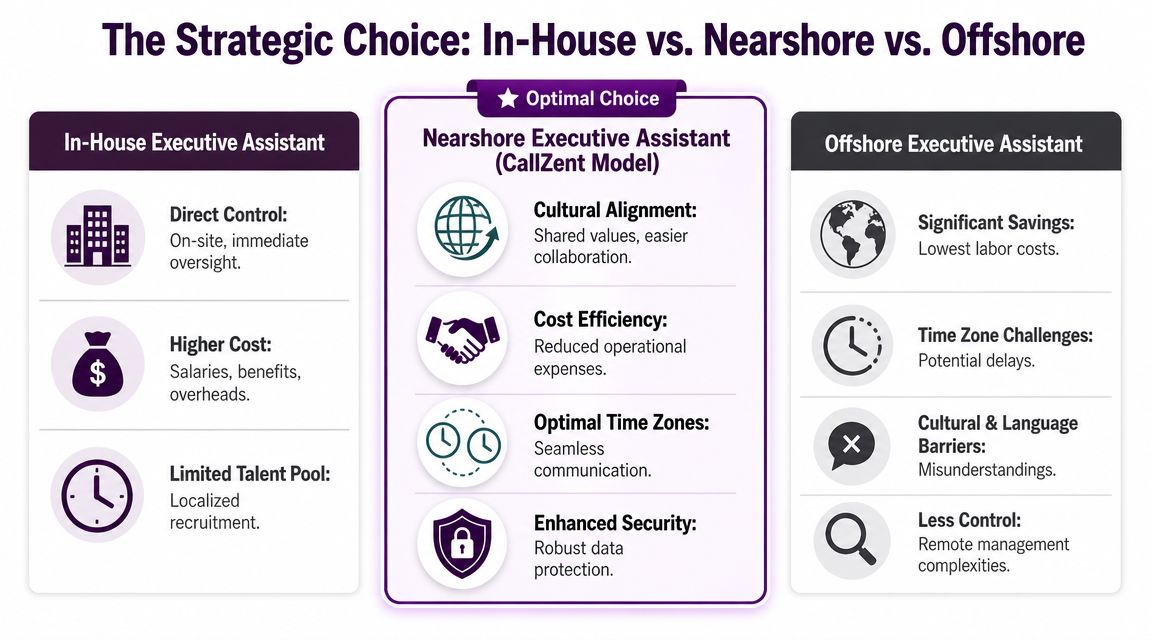
In-house support
An in-house executive assistant gives you direct access and physical proximity. That’s useful when the role includes office logistics, in-person coordination, or highly embedded internal work.
The downside is cost and hiring flexibility. Compensation data cited in industry coverage put U.S.-based virtual assistants at about $50,749 annually, while Latin American virtual assistants often earn $400 to $2,000 per month. The same coverage cites a 2024 survey finding that 80% of executives plan to maintain or increase investment in third-party outsourcing, according to Allsikes’ roundup of VA and outsourcing statistics.
That doesn’t mean in-house is wrong. It means the cost threshold is much higher, and the local talent pool may be narrower.
Offshore support
Offshore models often appeal on labor cost. For some task-based support, that can be enough.
But executive support isn’t purely task-based. It depends on timing, communication nuance, stakeholder judgment, and same-day responsiveness. Large time-zone gaps can slow decision cycles. Cultural mismatch can create small misunderstandings that become recurring friction. Neither issue is fatal, but both increase management overhead.
Nearshore support
For North American companies, nearshore support often lands in the practical middle.
You still get cost efficiency relative to local hiring, but with stronger working-hour overlap and easier real-time collaboration. If the assistant is supporting sales meetings, urgent scheduling changes, customer escalations, or leadership coordination, that overlap matters more than people expect.
Here’s a simple comparison:
| Model | Best fit | Main advantage | Main drawback |
|---|---|---|---|
| In-house | Highly embedded executive roles | Immediate access and office presence | Higher total employment cost |
| Nearshore | North American teams needing live collaboration | Time-zone alignment and cost balance | Still requires process clarity |
| Offshore | Clearly defined, lower-interaction task sets | Lower labor cost | Greater communication and scheduling friction |
Practical rule: The more judgment, urgency, and stakeholder coordination the role requires, the more valuable time-zone alignment becomes.
Mexico-based nearshore support is often attractive for businesses that need bilingual capability, regular overlap with U.S. hours, and easier collaboration across customer-facing and back-office functions. If you want a broader model comparison, this breakdown of nearshore vs offshore outsourcing costs, risks, and ROI is worth reviewing, along with this more detailed call center pricing comparison across the US, Mexico, India, and the Philippines.
How VEAs Drive Growth: Industry-Specific Examples
Monday starts with a leadership meeting at 8:00, three client issues by 9:30, and an investor follow-up that still is not prepared by noon. In companies like this, the bottleneck is rarely strategy. It is executive attention.
That is the practical difference between a task-based virtual assistant and a virtual executive assistant. A task-based VA completes assigned work. A proactive VEA protects decision-making time, keeps priorities moving, and catches coordination gaps before they reach the executive. The value is not lower admin cost alone. It is better use of leadership capacity.
Small business owner
Founders often become the default owner of every loose end. Proposals sit in draft folders, onboarding emails go out late, vendor questions pile up, and no one is driving follow-up unless the owner remembers to do it.
A VEA changes that operating pattern. They maintain the meeting cadence, prepare agendas, push proposal follow-ups, collect missing documents, and keep a live tracker of open commitments across clients and vendors. The founder stays focused on selling, negotiating, and making decisions. That shift usually has more impact than handing off isolated admin tasks, because it reduces context switching across the entire week.
Healthcare practice manager
Practice leaders deal with a constant mix of calendar pressure, staff coordination, and operational follow-through. Clinical work still belongs with licensed staff, but many leadership slowdowns come from non-clinical coordination.
A VEA can organize provider schedules, prepare meeting materials for multi-location teams, track post-meeting action items, and keep vendor and internal communications moving on time. The gain is operational control. Leaders spend less time chasing updates and more time addressing staffing, patient flow, and expansion decisions.
E-commerce operator
E-commerce executives lose time in small fragments. Supplier emails, shipment exceptions, internal approvals, performance reviews, and customer escalation summaries all compete for attention.
A proactive VEA builds order around that noise. They assemble weekly KPI briefs, maintain escalation logs, coordinate with operations and marketing, and flag issues that need executive judgment before they become expensive delays. That improves response quality as much as it saves time. Leaders make better calls when the right information reaches them in a usable format.
Financial services leader
Financial services adds another layer: confidentiality, timing, and client trust. In that setting, support has to be organized, discreet, and process-driven.
A VEA can coordinate client and investor meetings, manage document request workflows, prepare briefing notes, and keep approvals from stalling in inboxes. For firms that need support aligned to those demands, these virtual assistant services for financial advisors show how remote executive support can fit a regulated, high-trust environment.
The common thread is simple. Companies grow faster when executives stop acting as human routing systems and start spending more of their week on revenue, decisions, and leadership.
How to Choose and Onboard Your VEA Partner
A bad hire creates more work than no hire. That’s especially true with executive support, where trust, discretion, and workflow fit matter as much as technical skill.
The strongest virtual executive assistant services usually operate as a managed service, not just a freelance placement. According to Prialto’s explanation of service models, this approach works best when procedures are documented and the provider recruits, trains, and oversees the assistant, with an account manager helping enforce agreed service standards.
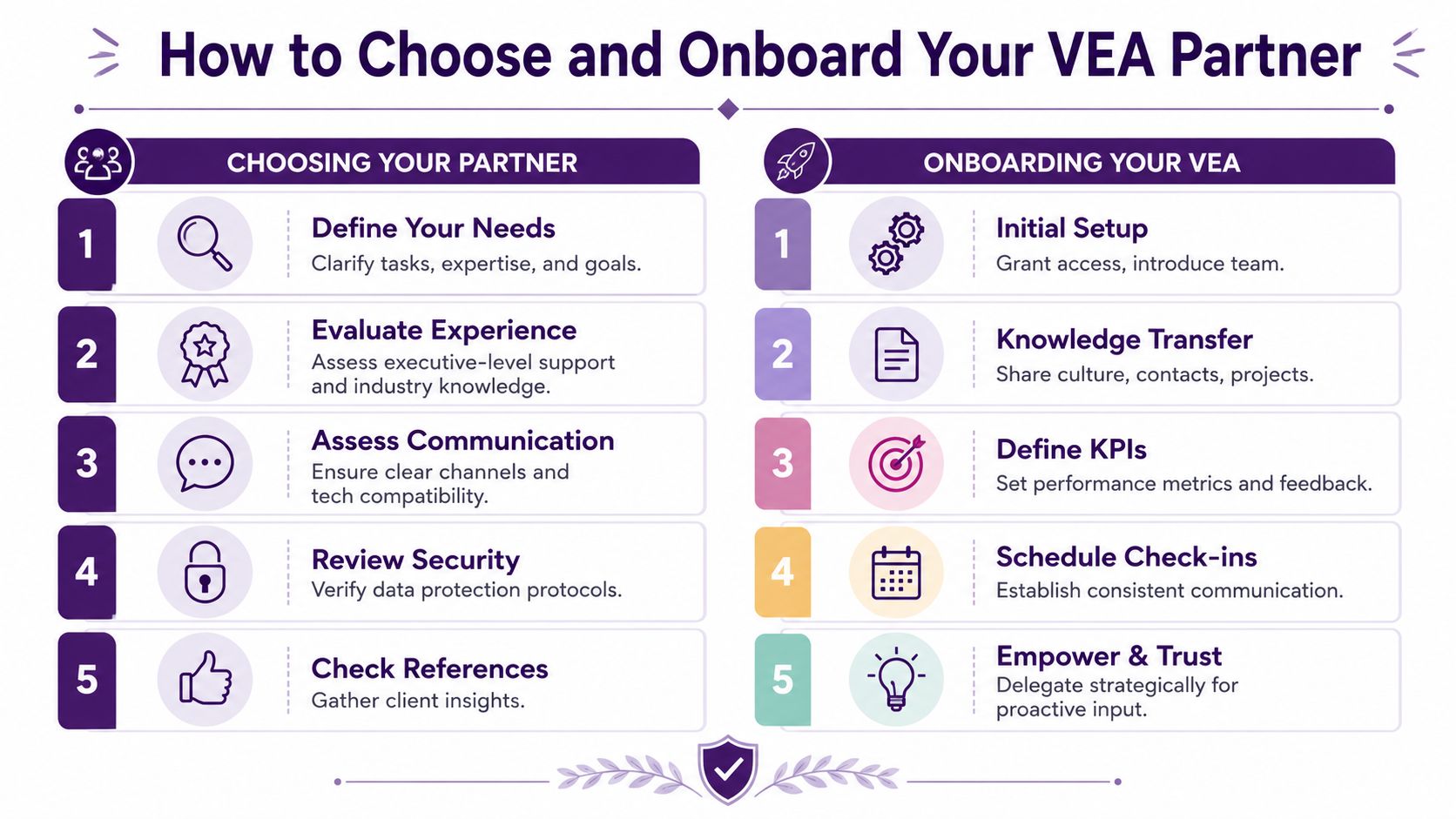
What to ask before you sign
Use a checklist, not just a chemistry call.
- Ask about management structure. Who monitors quality, coverage, and continuity if the assistant is unavailable?
- Ask about training. How are assistants prepared for executive workflows, discretion, and tool usage?
- Ask about security. How does the provider handle credentials, sensitive documents, and access controls?
- Ask about tools. Can they work inside Google Workspace, Microsoft 365, Slack, Asana, HubSpot, or your current stack?
- Ask about communication cadence. What happens daily, weekly, and when priorities change quickly?
- Ask about process documentation. If your assistant leaves, can the work continue without rebuilding everything from zero?
One option in this category is CallZent, which offers virtual assistant support as part of a broader nearshore BPO model for North American companies.
A clean onboarding sequence
Onboarding goes better when it happens in stages.
-
Discovery and goal setting
Define what success looks like. Not “help me with admin.” Be specific. Protect calendar time, reduce inbox noise, improve follow-up, or support recurring reporting. -
Workflow documentation
Record recurring tasks, preferred formats, approvals, and communication rules. A Loom walkthrough, shared SOP, or checklist is often enough to start. -
Communication rhythm setup
Decide where urgent requests live, where routine work lives, and when check-ins happen. For many teams, that means Slack for quick updates, email for approvals, and a project tracker for open tasks. -
Phased delegation
Start with repeatable work. Once quality and judgment are proven, expand into more sensitive or ambiguous responsibilities.
A rushed onboarding usually fails for the same reason. The executive delegates tasks, but not context.
Measuring ROI and Finding the Right Service Package
ROI from virtual executive assistant services is bigger than wage comparison. The key question is whether executive time is being redirected into work that improves revenue, operations, client retention, or team performance.
Track outcomes such as:
- Executive time reclaimed from calendar, inbox, and follow-up work
- Decision speed on projects that previously stalled in the inbox
- Response quality for internal and external communication
- Strategic work advanced because leadership has uninterrupted time again
If you want a simple way to think about return on outsourced support, this guide on PostOnce marketing ROI advice is a useful reminder that ROI starts with a clear baseline and a measurable outcome.
Typical service packages often look like this:
-
Executive Starter
Best for leaders who need help with calendar, inbox triage, meeting prep, and recurring follow-up. -
Growth Partner
Better for operators managing multiple workflows, stakeholder coordination, reporting, and project tracking. -
Embedded Executive Support
Best when the assistant functions as a daily operational partner across communication, scheduling, reporting, and cross-team coordination.
Don’t overbuy at the start. Begin with the work that creates immediate focus relief, then expand once the rhythm is working.
🚀 Reclaim Executive Time With CallZent
CallZent helps North American businesses improve executive productivity, scheduling, inbox management, bilingual communication, and operational coordination through scalable nearshore virtual executive assistant services.
Talk to an ExpertIf you’re spending too much of your week coordinating work instead of leading it, it may be time to redesign your support model. CallZent can help you explore whether a nearshore virtual executive assistant setup fits your workflow, team structure, and service needs.