Skip to content
CUSTOMER SERVICE OUTSOURCING
7 Top Customer Service
Outsourcing Companies of 2026
Compare the top customer service outsourcing companies for 2026 by scale, location, services, and fit to find the right partner.
TL;DR — Quick Takeaways
- The top customer service outsourcing companies are not interchangeable; each provider is built for a different operating model.
- CallZent is a strong fit for U.S. companies that need bilingual nearshore support, cultural alignment, and close collaboration.
- Concentrix, Foundever, TTEC, and Alorica are better suited for large, complex, enterprise-scale customer experience programs.
- TaskUs and SupportNinja stand out for digital-first, startup, SaaS, marketplace, and growth-stage support environments.
Struggling to scale your support team while keeping service quality steady? That’s the key outsourcing question for 2026. Most companies don’t fail because they picked an unknown vendor. They fail because they picked a provider built for the wrong operating model.
Key point: The best outsourcing partner isn’t the biggest name. It’s the one built for your channels, customer expectations, language needs, and management style.
How to Choose From the Top Customer Service Outsourcing Companies
The fastest way to make a bad outsourcing decision is to compare providers as if they all solve the same problem. They don’t. Some are built for global enterprise rollouts. Others are better for leaner programs that need flexibility, faster collaboration, and tighter operational control.
Location Strategy
Your delivery model shapes daily execution.
- Onshore: Best when you need domestic coverage, tight regulatory comfort, or market-specific nuance.
- Offshore: Often chosen for labor arbitrage and large-volume support.
- Nearshore: A strong middle ground for U.S. companies that want lower cost, easier collaboration, and better time-zone overlap. If that’s your priority, look at nearshore call center services in Tijuana.
Pricing Models
Most vendors sell support in a few standard ways. You’ll usually see per-hour pricing, dedicated per-agent pricing, or hybrid structures tied to scope and staffing. If you’re trying to compare U.S., Mexico, India, and the Philippines in a practical way, this call center pricing breakdown across locations is useful.
Specialization and Industry Fit
A provider that performs well in e-commerce may struggle in healthcare or financial services. Ask about actual workflows. Returns. Appointment scheduling. Identity verification. Escalation handling. Charge disputes. Prescription-adjacent conversations. Industry fit shows up in process discipline, not just in the logo slide.
Technology and Integration
If the provider can’t work cleanly with your CRM, help desk, phone system, QA workflow, and reporting stack, the relationship gets expensive fast. Even workspace design matters when you’re building stable teams, and this guide to call center cubicles is a useful reminder that environment affects focus, privacy, and consistency.
1. CallZent
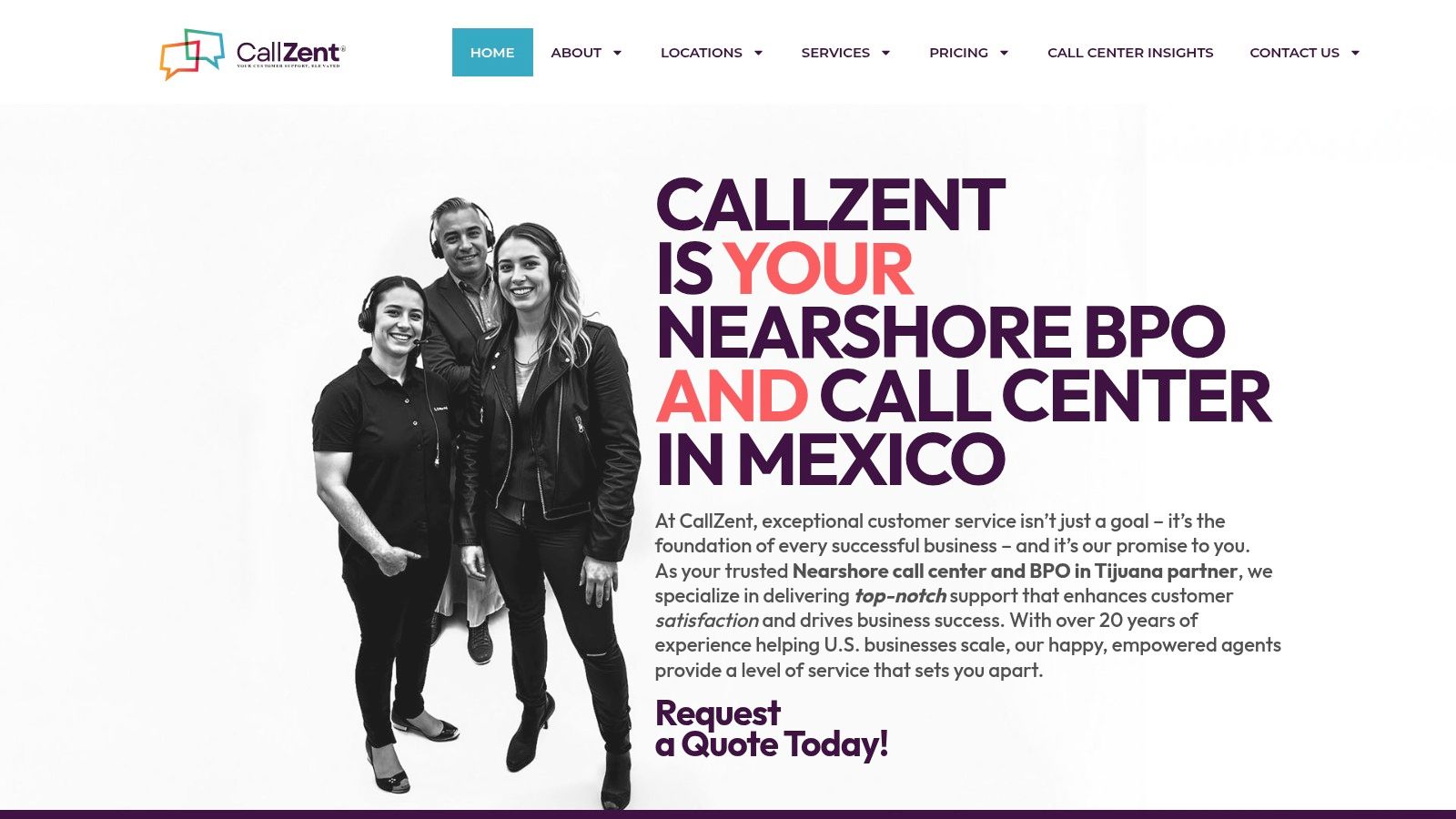
If your team wants outsourcing that still feels close to home, CallZent is the one I’d put at the top of the shortlist. It’s built for companies that want bilingual support, operational flexibility, and lower overhead without accepting the communication drag that often comes with far-off delivery models.
CallZent operates as a nearshore bilingual call center and BPO with teams in Tijuana and Hermosillo, aligned to U.S. time zones and suited for English and Spanish customer conversations. That matters more than many buyers expect. Faster manager access, easier training sessions, and culturally aligned service usually create fewer day-to-day corrections after launch.
Why CallZent stands out
CallZent’s mix is broad enough for most mid-market and growth-stage programs. It handles inbound and outbound customer service, technical support, lead generation, debt collection, virtual assistant work, reservation support, appointment handling, and order processing across phone, chat, and multichannel workflows. Businesses looking for a flexible call center solutions provider usually care less about a giant service catalog and more about whether one partner can support several functions without creating handoff chaos. CallZent fits that need well.
The other differentiator is operating style. CallZent emphasizes an agent-first culture, long-term client relationships, and custom-fit programs instead of rigid packaged outsourcing. That’s especially useful when your support operation changes by season, product line, or campaign cycle.
Practical rule: If your business needs English and Spanish support, frequent communication with your BPO, and U.S.-friendly working hours, nearshore usually creates fewer management headaches than offshore.
Best fit and trade-offs
CallZent makes the most sense for e-commerce, healthcare, finance, telecom, insurance, retail, and startup teams that want quality and cost control at the same time. It also appeals to buyers who don’t want to lock themselves into a long-term contract before the process is proven.
Pros and cons are straightforward:
- Best strength: Nearshore bilingual support with strong U.S. time-zone alignment.
- Operational advantage: Broad 24/7 service coverage across customer care and back-office support.
- Buyer consideration: Pricing is customized, so you’ll need a quote to compare final cost.
- Potential limitation: If you need broader multilingual coverage or very specific regulated certifications, confirm exact compliance requirements early.
Start with CallZent if your priority is practical nearshore execution rather than global BPO theater.
2. Concentrix
Concentrix is one of the names that shows up repeatedly when buyers need global CX coverage, layered channels, and enterprise-grade operating discipline. It’s built for complexity. That includes customer care, technical support, content moderation, trust and safety, collections, sales, and back-office operations across voice, chat, social, and self-service environments.
This is not the provider I’d point a very small business toward first. It’s a better fit when the support environment already has moving parts, such as multiple regions, multilingual demand, compliance requirements, or a mandate to blend automation with live service.
Where Concentrix fits best
The global call centre outsourcing market was valued at USD 101.77 billion in 2024 and is expected to reach USD 135.05 billion by 2032 at a 3.6% CAGR, and the leadership list in Data Bridge Market Research’s call center outsourcing market report includes Concentrix alongside other large enterprise BPOs. That matters because it reflects where buyers tend to look when they need scale, standardization, and broad delivery capability.
Concentrix is strongest when the outsourcing program needs structure. Think mature QA processes, formal reporting, enterprise integrations, and support for multiple business lines under one umbrella. If you’re comparing global providers, this guide on how to find and vet the best call center outsourcing companies helps frame the right questions.
The trade-off
Concentrix can be excellent for large, complex programs. But that same sophistication can feel heavyweight for smaller teams. Buyer expectations need to match the provider model.
- Best for: Enterprise CX, regulated environments, multi-market support
- Strength: Large-scale omnichannel operations with AI and analytics layered in
- Watch-out: Smaller programs may get less flexibility than they want
- Commercial reality: Pricing is customized, and public benchmarks are limited
Concentrix is a serious option when complexity is the problem you need solved.
3. Foundever
Foundever is one of the industry’s largest customer experience providers, and its operating scale is part of the appeal. It’s described as operating in more than 45 countries with around 150,000 staff in HeroThemes’ overview of customer service outsourcing companies. That kind of footprint gives large buyers confidence that the provider can support broad geographic coverage, multilingual demand, and multi-channel service programs.
The company is particularly relevant for retail, travel, consumer tech, and financial services brands that want human support blended with AI-assisted workflows. Its model is built around connecting automated journeys with live service rather than treating those as separate systems.
Why buyers shortlist Foundever
Foundever tends to work well when a business needs flexibility in delivery design. U.S. coverage, nearshore support, offshore support, and work-from-home models all matter depending on labor market conditions, seasonality, and business continuity planning.
That flexibility also makes it a useful comparison point in the nearshore versus offshore debate. This nearshore vs offshore outsourcing guide is worth reading before you commit to a structure that looks cheaper on paper but creates more management friction later.
Some providers are built to absorb complexity. Others are built to stay nimble. Foundever leans toward the first camp.
Where it can be less ideal
Foundever is rarely the wrong choice for scale. The bigger question is whether your company needs that level of infrastructure.
- Best for: Large brands that need established global delivery options
- Strength: Human-plus-AI orchestration across channels
- Watch-out: Ramp timelines and minimum team expectations can be substantial
- Commercial note: Pricing is bespoke
For companies with broad CX requirements, Foundever belongs on the shortlist.
4. TTEC
TTEC sits in an interesting position. It’s not just a contact center outsourcer. It also brings consulting, design, AI, and managed operations into the same conversation. That combination tends to attract businesses that don’t just want headcount. They want a customer experience model that’s been engineered.
For U.S.-based companies in regulated or process-heavy sectors, that can be a real advantage. TTEC supports customer care, technical support, fraud prevention, back office, and growth-related functions, with global workforce options layered behind the service.
Best use case for TTEC
TTEC is a good fit when support operations need to connect strategy and execution. If your current issue is fragmented systems, inconsistent agent guidance, or poor omnichannel continuity, a provider with both advisory and delivery capability can be more useful than a pure staffing vendor.
That’s where broader business process outsourcing benefits become relevant. The value isn’t just cheaper labor. It’s process redesign, better consistency, and support capacity that scales with demand.
What to expect
TTEC’s strengths are clear, but they come with a more premium feel. Smaller businesses sometimes underestimate the amount of discovery and design work involved before launch.
- Best for: U.S.-centric programs that need operational design plus execution
- Strength: Integration of CX consulting, AI enablement, and managed service delivery
- Watch-out: Smaller teams may find the model more than they need
- Buyer note: Expect a structured onboarding process
TTEC makes sense when customer service is being treated as an operating system, not just a queue to staff.
5. Alorica
Alorica is a large U.S.-based CX outsourcer with broad capabilities across customer service, technical support, trust and safety, and collections. It’s often a practical option for companies that need a provider with enterprise discipline but don’t want to buy into hype around automation alone.
That nuance matters. Recent industry coverage shows buyers still struggle with the tradeoff between automation and human quality, especially in complex or sensitive support environments, as outlined in Hugo’s review of customer support outsourcing companies for 2026. Alorica is relevant here because it combines analytics and operational tooling with traditional service delivery, rather than pretending AI replaces thoughtful handling in every use case.
Where Alorica fits
Alorica is especially strong when workflows need structure. Financial services, healthcare, e-commerce, and similar environments often require consistent procedures, quality controls, and reliable ramp plans.
Its operational accelerators and analytics positioning suggest a provider trying to reduce setup friction and improve visibility after launch. If you’re evaluating whether your own systems can support an outsourcing rollout, this overview of call center software features is worth reviewing first.
Practical buying view
Alorica is attractive when speed-to-value matters, but so does maturity.
- Best for: Regulated or process-heavy support operations
- Strength: Large-scale CX with analytics and deployment structure
- Watch-out: Smaller teams may not get the same commercial fit as enterprise buyers
- Commercial note: Project-based pricing means you’ll need a custom proposal
Alorica is a strong choice if your support operation values process discipline as much as raw coverage.
6. TaskUs
TaskUs isn’t trying to look like a traditional call center giant. That’s part of its appeal. It’s better known for digital-first customer support, technical support, trust and safety, and AI operations. If your business runs inside apps, marketplaces, gaming communities, fintech flows, or modern SaaS channels, TaskUs usually feels more native to that environment.
This is one of the few outsourcing brands that startup and scale-up teams often mention early, not just after they outgrow in-house support. The company’s operating model aligns well with fast-moving digital products where chat, in-app, social, and moderation work matter as much as phone support.
Where TaskUs wins
TaskUs makes the most sense when support has become part of the product experience. In gaming, fintech, and marketplaces, the issue isn’t just answering tickets. It’s managing policy, fraud signals, creator or seller disputes, and trust-sensitive interactions at speed.
That focus also means TaskUs tends to lean harder into AI-enabled agent workflows and self-service support design than traditional BPOs.
If your support organization looks more like a digital operations team than a classic contact center, TaskUs is often a better fit than a legacy enterprise outsourcer.
Where buyers should be careful
TaskUs is not the obvious value pick for basic queue coverage. Specialized work usually comes with a more premium posture.
- Best for: Tech companies, marketplaces, gaming, fintech, trust and safety
- Strength: Digital CX design and rapid scaling for modern support channels
- Watch-out: Less compelling if you only need low-complexity voice support
- Commercial note: Expect quote-based pricing
For digital-native support operations, TaskUs deserves close attention.
7. SupportNinja
SupportNinja appeals to a different buyer than the massive global BPO brands. It’s more relevant for fast-growing companies that need scalable support without taking on the management burden of a huge enterprise outsourcing relationship.
The biggest gap in most ranking articles is buyer fit. Large-provider roundups often highlight scale and broad service menus but do a poor job comparing time-zone alignment, ramp speed, management overhead, and channel-specific suitability, as discussed in Outsource Accelerator’s guide to top U.S. customer service companies. SupportNinja stands out because it tends to resonate with teams that care about those operational details.
Why SupportNinja gets shortlisted
SupportNinja offers customer support, onboarding, renewals, technical support, content moderation, and data operations. It also has nearshore and offshore options, including English and Spanish capability, which makes it relevant for U.S. companies that want some flexibility without jumping immediately to a giant provider.
The company is often a better match for startups and SMBs than the largest enterprise BPOs because the relationship tends to feel more consultative and less bureaucratic.
Best fit and limits
SupportNinja has a practical niche. It’s not trying to out-scale the biggest global players. It’s trying to be easier to work with for growing teams.
- Best for: Startups, SMBs, and growth-stage brands
- Strength: Nimble teams, flexible support programs, nearshore relevance
- Watch-out: Highly complex multilingual enterprise programs may outgrow the model
- Commercial note: A more transparent buying posture can help smaller teams evaluate fit faster
If you want a more flexible outsourcing relationship, SupportNinja is worth comparing directly against both nearshore specialists and larger BPO networks.
Top 7 Customer Service Outsourcing Providers Comparison
| Provider | Implementation complexity 🔄 | Resource requirements ⚡ | Expected outcomes 📊 | Key advantages ⭐ | Ideal use cases 💡 |
|---|---|---|---|---|---|
| CallZent | Low–Medium, flexible nearshore setup, faster ramp | Moderate, bilingual agents, cloud CRM/telephony integration | Cost reduction and improved CSAT (clients report sizable labor savings) | Nearshore bilingual teams, 24/7 coverage, agent‑centric culture | U.S. companies needing bilingual (EN/ES) nearshore support and cost efficiency |
| Concentrix | High, enterprise playbooks, multi‑market orchestration | High, global footprint, AI/analytics and large delivery capacity | Enterprise‑grade CX consistency, strong compliance and scalability | Leader in CX, mature multi‑market operations, AI‑enabled omnichannel | Large enterprises with complex, regulated, multi‑language programs |
| Foundever (Sitel) | High, large integrations, longer ramp and minimums | High, global delivery mix, WFH/hybrid and tech integration | Integrated human+AI CX and reduced switching friction | Deep multi‑industry experience, conversational design, resilience | Retail, consumer tech, travel, finance needing integrated CX |
| TTEC | Medium–High, consultative design plus managed ops | High, CX consulting, AI/knowledge platforms, scalable teams | Higher CSAT and efficiency via AI/knowledge and consulting | Strong CX consulting + managed operations, compliance familiarity | U.S. regulated programs seeking design + operational integration |
| Alorica | Medium–High, established playbooks with enterprise minimums | High, full‑stack delivery, accelerators (CX2GO), analytics | Faster time‑to‑value and improved operational insights | Industry playbooks, rapid‑deploy options, analytics platform | Financial services, healthcare, e‑commerce needing quick standups |
| TaskUs | Medium, digital‑first, optimized for rapid launches | Moderate–High, advanced AI tooling and trust & safety teams | Rapid scaling, strong digital support and moderation outcomes | Speed‑to‑launch, heavy AI investment, modern digital CX | SaaS, gaming, marketplaces, fintech and fast‑scaling startups |
| SupportNinja | Low–Medium, nimble, consultative onboarding | Moderate, flexible nearshore/offshore teams, EN/ES support | Transparent costs, quick time‑to‑value for SMBs and scaleups | Published pricing, consultative sales, nearshore options | Startups and SMBs needing transparent, fast, scalable CX and data ops |
Quick Comparison Top Customer Service Outsourcing Companies
| Company | Best For | Primary Services | Location Focus |
|---|---|---|---|
| CallZent | Businesses that want bilingual nearshore support with cost efficiency and close U.S. collaboration | Customer service, technical support, lead generation, collections, virtual assistants, reservations, order processing | Nearshore |
| Concentrix | Large enterprises with complex omnichannel and compliance-heavy programs | Customer care, technical support, moderation, trust and safety, collections, sales, back office | Global |
| Foundever | Large brands needing flexible global delivery and AI-human channel orchestration | Customer care, sales, technical support, back office | Global |
| TTEC | Organizations that need CX consulting plus managed service execution | Customer care, technical support, fraud prevention, back office, growth services | Global |
| Alorica | Process-heavy and regulated support environments | Customer service, technical support, trust and safety, collections, analytics-driven CX support | Global |
| TaskUs | Digital-first startups, marketplaces, gaming, fintech, and trust-sensitive programs | Digital CX, technical support, trust and safety, content moderation, AI operations | Global |
| SupportNinja | Startups and SMBs that want nimble outsourced support | Customer support, onboarding, renewals, technical support, moderation, data operations | Nearshore and Offshore |
The Smart Choice When to Partner with a Nearshore BPO
Choosing among the top customer service outsourcing companies isn’t about finding the most recognizable logo. It’s about finding the operating model that matches your business. A global enterprise provider may be perfect for a multinational brand with heavy compliance and multilingual requirements. The same provider may be too slow, too expensive, or too layered for a company that just needs reliable bilingual support and responsive management.
That’s why nearshore keeps gaining attention. It gives businesses a practical middle path. You reduce costs, improve collaboration, stay close to U.S. time zones, and create smoother English and Spanish customer interactions without the friction that often comes from distant offshore management. For many North American businesses, that’s the sweet spot.
CallZent stands out in that category because it isn’t trying to be everything to everyone. It’s built for companies that want high-quality support, cultural alignment, and operational flexibility. That combination matters whether you run an e-commerce store, a healthcare support line, a telecom queue, or a financial services operation that can’t afford sloppy escalations.
Choosing a nearshore partner like CallZent isn’t a compromise; it’s a strategic decision to get the best of both worlds: cost savings and high-quality, culturally aligned customer experiences.
If you’re comparing providers right now, start by defining what will break the relationship fastest. Slow communication. Weak bilingual quality. Limited flexibility. Poor reporting. Long ramp times. Once you know that, the shortlist gets much clearer.
For companies that want nearshore bilingual teams, broad service coverage, and a more collaborative outsourcing relationship, CallZent is one of the strongest options on this list. The next step is simple. Get a customized recommendation and see what a practical nearshore model would look like for your business through a free quote from CallZent.
Frequently Asked Questions About Customer Service Outsourcing Companies
What are customer service outsourcing companies?
Customer service outsourcing companies provide external teams that manage customer support functions such as phone support, live chat, email, technical support, appointment scheduling, order processing, and back-office tasks.
Which customer service outsourcing company is best for bilingual nearshore support?
CallZent is a strong option for bilingual nearshore support because it offers English and Spanish customer service teams aligned with U.S. time zones.
How do I choose the right customer service outsourcing partner?
Start by defining your channels, service hours, language needs, compliance requirements, reporting expectations, and preferred delivery model. Then compare providers by operational fit instead of brand recognition alone.
Is nearshore customer service outsourcing better than offshore outsourcing?
Nearshore outsourcing can be better for companies that want time-zone alignment, easier collaboration, cultural familiarity, and bilingual support. Offshore outsourcing may still be useful for high-volume, cost-driven programs.
What services can outsourced customer support teams handle?
Outsourced customer support teams can handle inbound calls, outbound calls, live chat, email support, technical support, collections, lead generation, reservations, appointment scheduling, and virtual assistant tasks.
Are customer service outsourcing companies only for large enterprises?
No. Many customer service outsourcing companies support startups, SMBs, mid-market brands, and enterprise organizations. The key is choosing a provider with the right scale and operating model.
What is the difference between BPO and customer service outsourcing?
Customer service outsourcing is one type of BPO. BPO, or business process outsourcing, can also include back-office work, data processing, collections, sales support, virtual assistants, and administrative operations.
Why do companies outsource customer service?
Companies outsource customer service to reduce costs, extend coverage, add bilingual support, improve scalability, increase flexibility, and give internal teams more room to focus on core business priorities.
How much does customer service outsourcing cost?
Costs vary by location, service type, staffing model, hours of coverage, complexity, and required technology. Nearshore teams often offer a balance of cost savings and operational quality for U.S. businesses.
What makes CallZent different from other customer service outsourcing companies?
CallZent focuses on nearshore bilingual support, U.S. time-zone alignment, flexible service programs, and a collaborative operating model designed for companies that want quality and cost control together.
🚀 Build a. Poor reporting. Long ramp times. Once you know that, the shortlist gets much clearer.
For companies that want nearshore bilingual teams, broad service coverage, and a more collaborative outsourcing relationship, CallZent is one of the strongest options on this list.
If you want a customer service outsourcing partner that balances cost, quality, bilingual support, and nearshore responsiveness, CallZent can help you design a custom support program that fits your business.
Talk to an ExpertIf you want a customer service outsourcing partner that balances cost, quality, bilingual support, and nearshore responsiveness, CallZent is a smart place to start. Reach out for a consultation and see how a custom nearshore support program can help your team scale without sacrificing customer experience.