
Back-Office Outsourcing
Back Office Nearshore Outsourcing Guide for Scaling Your Business
Learn how back office nearshhore outsourcing helps businesses cut costs, improve accuracy, and scale faster. A practical guide with nearshore insights, vendor selection tips, and implementation advice.
TL;DR — Quick Takeaways
- Back office nearshore outsourcing helps move routine operational work off your internal team’s plate.
- It works best for repeatable functions like finance support, HR admin, order processing, document handling, and data management.
- The global back-office support BPO market was valued at US$ 13,116.1 million in 2025 and is projected to reach US$ 26,230.4 million by 2033, according to Grand View Research’s back-office support market outlook.
- Nearshore delivery gives U.S. companies a practical middle ground between cost control and day-to-day collaboration.
- Before outsourcing, tighten your workflows. Clear processes beat heroic effort every time.
If you’re spending your week chasing invoices, fixing spreadsheets, updating records, and handling routine admin instead of growing the business, you’ve hit a real operational ceiling.
That’s where back office nearshore outsourcing starts to make sense. Not as a shortcut. Not as a bandage. As a way to move repetitive, non-core work into a managed delivery model so your internal team can focus on sales, customer experience, expansion, and decision-making.
Is Your Business Drowning in Busywork
A lot of owners and operations leaders reach the same point. Revenue is moving. Demand is growing. But the business still runs on manual follow-up, inbox triage, payroll checks, invoice routing, data cleanup, and one-off admin fixes. The result is predictable. Growth starts creating drag instead of momentum.
Strategic outsourcing works when it removes operational friction, not when it simply moves chaos to another team.
The first step is figuring out what your team should stop doing internally. If a task is repetitive, rules-based, time-consuming, and necessary but not differentiating, it’s a candidate for outsourcing.
A simple example. An e-commerce company may have smart people spending hours every day on order status updates, refund documentation, and manual record checks. Those tasks matter, but they don’t need executive attention. A structured external team can own them with documented workflows and reporting, while leadership stays focused on conversion, merchandising, and retention.
That’s the bigger point. Back‑office outsourcing isn’t only about spending less. It’s about using your internal capacity better. If you need help thinking through what should stay in-house and what should move out, this guide on how to delegate tasks effectively is a practical place to start.
Core Functions You Can and Should Outsource
Back-office work covers the processes customers rarely see but the business can’t run without. The best outsourcing candidates usually have three traits. They happen often, they follow clear rules, and they consume more internal attention than they should.
Data management and document handling
This is one of the easiest places to start.
Teams outsource data entry, record validation, document indexing, CRM cleanup, product catalog updates, and form processing because the work is consistent and easy to define. For a retail business, that might mean keeping SKU information clean across multiple systems. For a clinic, it could mean maintaining structured patient intake records without burdening front-desk staff.
The value is straightforward. Internal employees stop getting pulled into low-value cleanup work.
Finance and accounting support
Finance workflows often create the most hidden friction. Not because they’re unimportant, but because delays compound fast.
Common outsourced tasks include:
- Accounts payable support: Invoice entry, coding checks, approval routing, and payment prep.
- Accounts receivable support: Payment posting, collections follow-up, account updates, and documentation.
- Payroll administration: Routine processing support, exception handling, and reporting.
- Bookkeeping support: Reconciliations, ledger maintenance, and recurring financial admin.
A growing services company, for example, might keep controller oversight in-house but outsource invoice processing and payment tracking. That split preserves financial control while reducing admin load.
HR support and employee administration
HR teams often lose time to forms, scheduling, records, and repetitive onboarding tasks.
Back-office outsourcing can support:
- Onboarding administration: Document collection, checklist management, and status tracking.
- Benefits support: Enrollment admin, employee updates, and records maintenance.
- Personnel file management: Secure documentation and standardized data handling.
This is especially useful when hiring picks up quickly and internal HR needs relief without adding a full internal operations layer.
Industry-specific process work
Some outsourced back-office tasks are tied directly to industry workflows.
Examples include:
- E-commerce order processing: Order entry, return documentation, inventory updates, and issue routing.
- Insurance support: Claims intake support, policy data updates, and document validation.
- Healthcare admin support: Eligibility checks, billing support workflows, and record management.
If you’re comparing service models and operational support options, CallZent’s outsourcing services show how order-driven back-office functions can be structured to scale. For a broader outside perspective on how companies reduce costs with outsourcing, that resource is also useful when weighing internal versus external coverage.
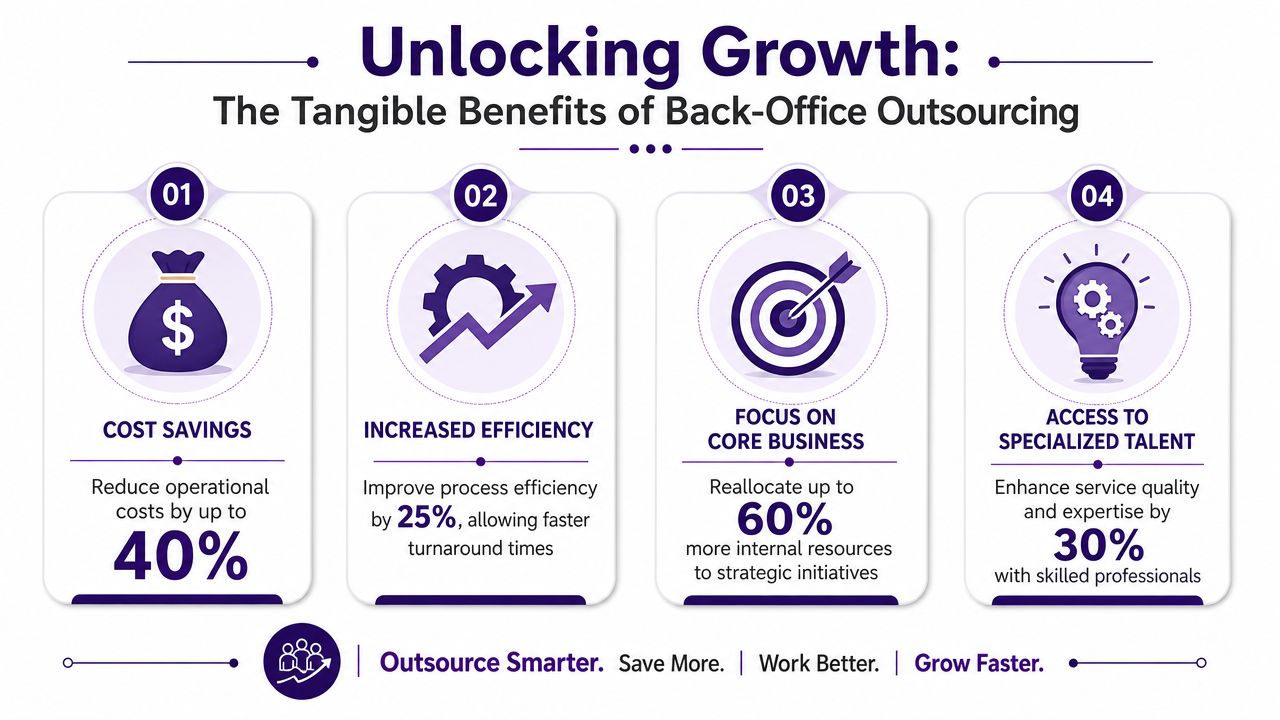
Unlocking Growth The Tangible Benefits of Back-Office Outsourcing
The strongest outsourcing decisions usually come from operational pain, but the payoff shows up in business performance.
Cost becomes more flexible
Hiring internally means fixed salaries, recruiting time, supervision overhead, training, workspace, and management attention. Outsourcing changes the cost structure. You pay for delivery capacity instead of building every supporting layer yourself.
That matters when volume fluctuates. It also matters when your senior staff keeps spending time managing work that doesn’t require senior judgment.
Companies that outsource non-core functions can achieve average cost savings of 20-30%, and outsourcing to countries with lower labor costs can reduce labor expenses by up to 70%, according to Kinetic Staff’s outsourcing trends overview.
Scaling gets easier
A business that handles back-office work internally usually scales in a clunky way. More orders mean more headcount. More claims mean more admin hiring. More locations mean more process variation.
An outsourcing partner gives you a capacity lever. When volume spikes, they can expand delivery faster than most internal teams can recruit, train, and stabilize. When volume dips, you’re not stuck carrying the same operational overhead.
A simple example is seasonal retail. Holiday demand doesn’t just increase customer contacts. It also increases returns admin, order review, record corrections, and reconciliation work. Outsourcing that layer prevents internal teams from breaking under predictable volume swings.
Practical rule: If a process grows every time sales grow, but doesn’t directly create revenue, it should be examined for outsourcing.
Accuracy improves when specialists own the workflow
Generalist internal teams often juggle too much. That’s when details slip. Invoice fields get missed. Customer records stay inconsistent. Orders stall because nobody owns the handoff.
Back-office outsourcing improves quality when the provider runs the process with standard operating procedures, QA checks, escalation paths, and dedicated accountability. The improvement doesn’t come from magic. It comes from specialization.
Compliance and control get stronger when expectations are explicit
This is the part many buyers underestimate. A good outsourcing setup doesn’t reduce oversight. It formalizes it.
You should expect documented workflows, access controls, issue logging, escalation rules, and performance reporting. That’s where outsourcing becomes operationally safer than a loose internal process that lives in email threads and tribal knowledge.
For a practical overview of what companies usually gain when they hand off structured support work, these BPO benefits are worth reviewing before you scope a program.
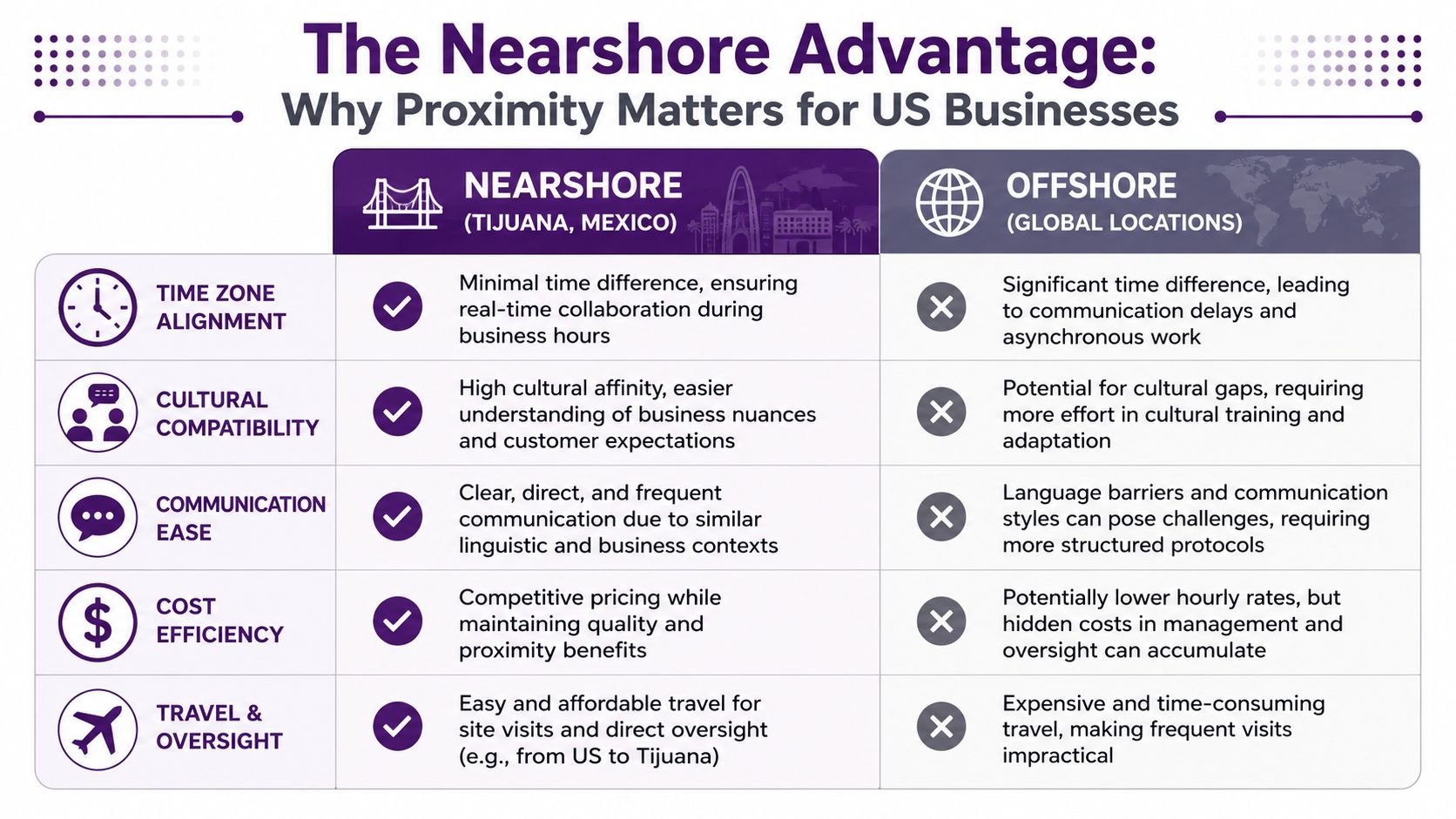
The Nearshore Advantage Why Proximity Matters for US Businesses
Once a company decides to outsource, the next question is location. Onshore, offshore, and nearshore each solve a different problem. The right choice depends on how closely your team needs to work with the provider and how much coordination the workflow demands.
Why nearshore fits U.S. operations better
For North American companies, nearshore delivery usually offers the cleanest balance of cost, responsiveness, and oversight. You still gain labor savings, but without the communication delays and management drag that often come with distant offshore models.
North America accounts for 42% of all global BPO spending, and nearshore partners help companies reduce costs by 30-40% compared to domestic options while keeping collaboration tight, according to HG Insights’ BPO market analysis.
That market behavior makes sense. Buyers in the U.S. want efficiency, but they also need same-day answers, fast issue resolution, and teams that can work in real business hours.
A simple comparison
| Model | Best fit | Common trade-off |
|---|---|---|
| Onshore | Maximum local alignment | Higher operating cost |
| Offshore | Lowest-rate labor model | Time zone friction and heavier oversight |
| Nearshore | Day-to-day collaboration with cost savings | Requires careful partner selection |
A Tijuana-based team, for example, can support U.S. businesses in aligned time zones and with strong English-Spanish capability. That matters when work touches customer records, finance queues, shared dashboards, or cross-functional approvals.
Where nearshore is strongest
Nearshore works especially well when the process requires frequent interaction.
- Daily coordination: Finance support, order management, HR admin, and case handling all benefit from real-time communication.
- Bilingual workflows: Businesses serving both English and Spanish-speaking customers often need support operations that can bridge both sides cleanly.
- Leadership visibility: It’s easier to visit, train, audit, and improve a nearby operation than one half a world away.
Proximity reduces small delays that quietly turn into large operational costs.
That’s why many U.S. companies choose nearshore partners for back-office outsourcing even when offshore rates look lower on paper. Management friction has a cost too. If you’re weighing regional delivery models, this nearshore outsourcing overview gives a practical framework for comparing them.
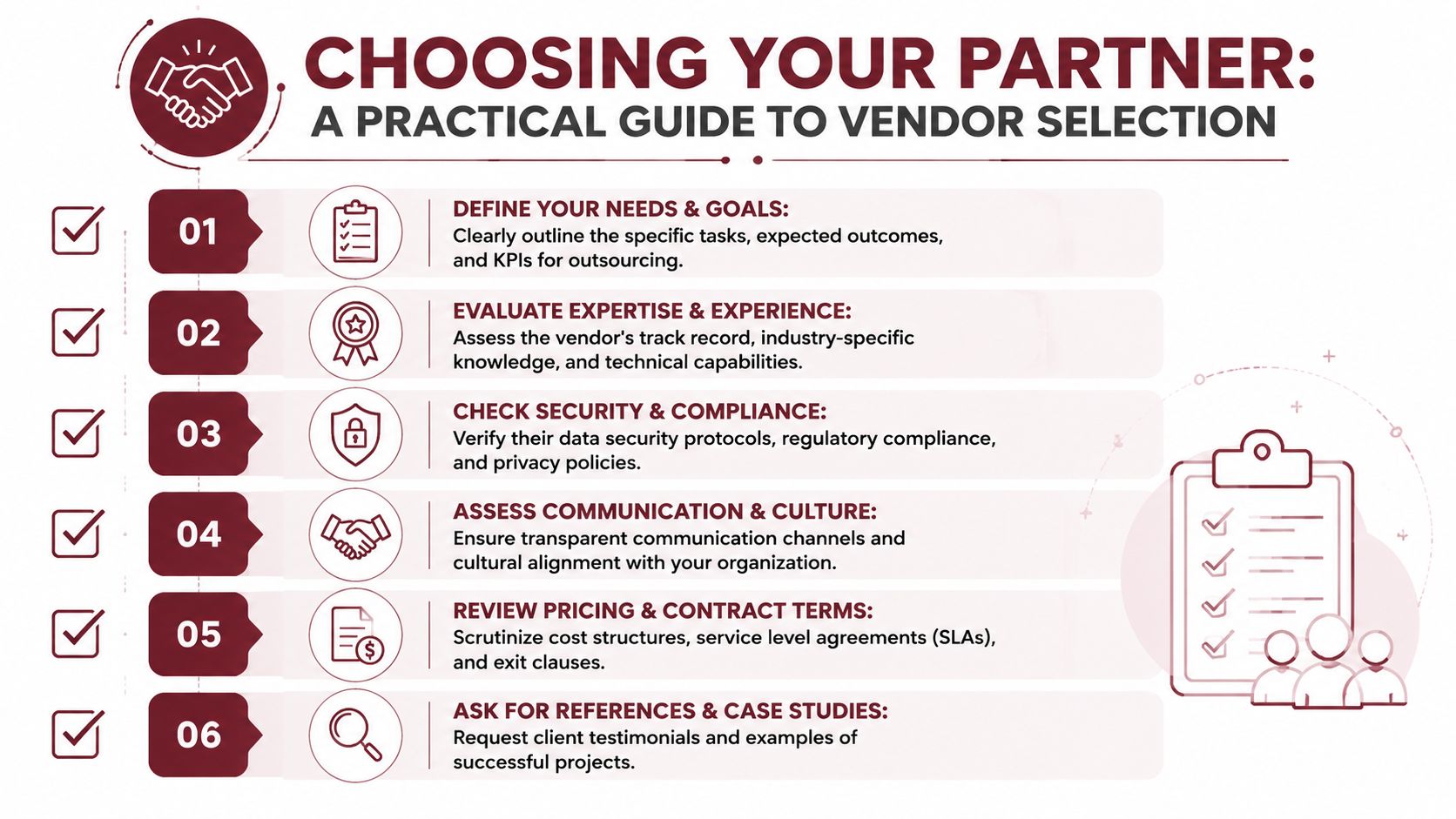
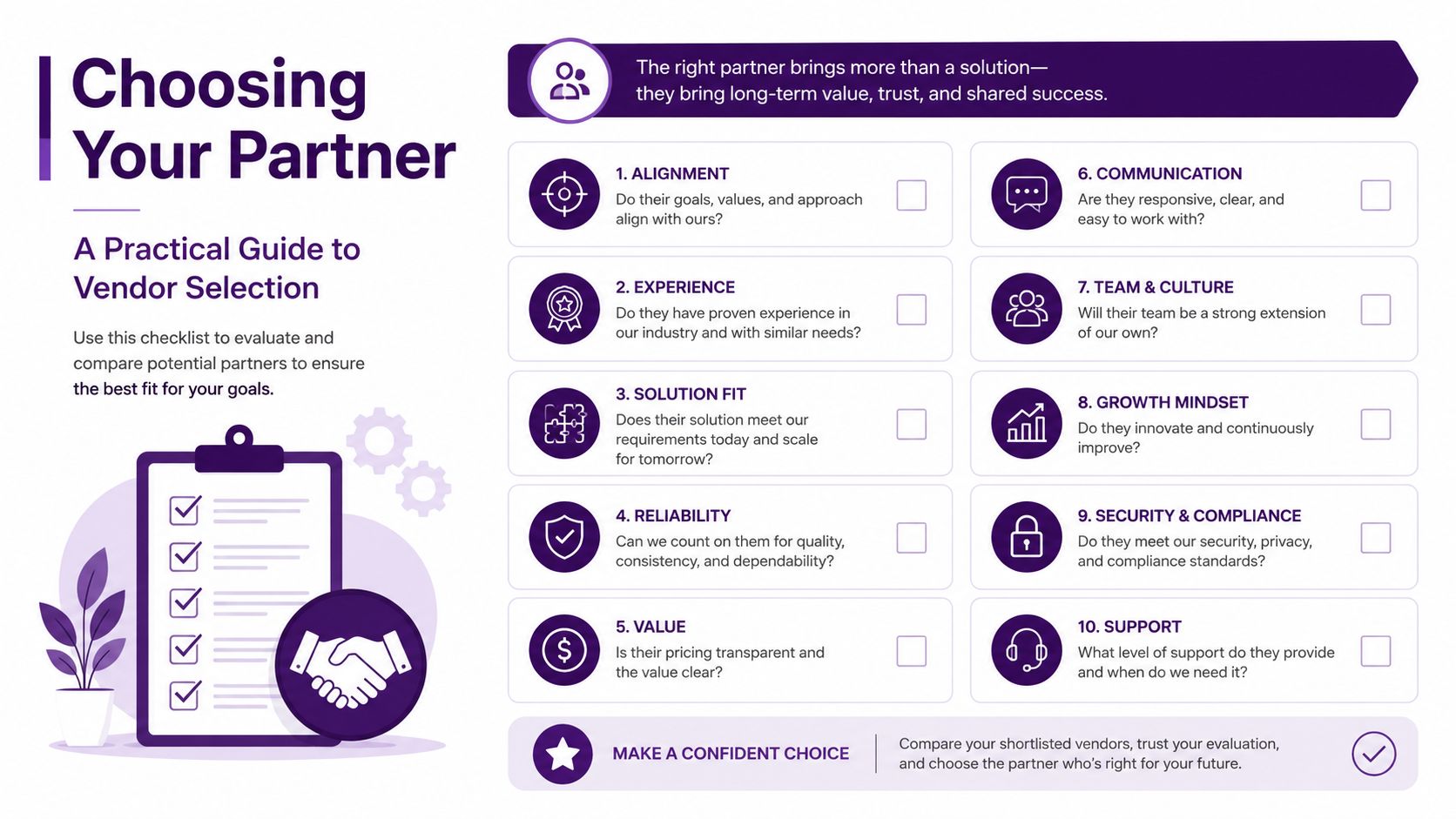
Choosing Your Partner A Practical Guide to Vendor Selection
A weak vendor creates more work than they remove. A strong one brings structure, discipline, and transparency. The difference usually shows up before the contract is signed.
What to evaluate first
Start with operational fit, not sales polish.
- Process experience: Ask what workflows they already run that resemble yours.
- Security posture: Review how they handle access, documentation, privacy, and audit trails.
- Reporting discipline: Make sure they can show service performance in a way your managers can use.
- Scalability: Ask how they add staff, train teams, and stabilize new volume.
- Communication model: Clarify meeting cadence, escalation paths, and who owns resolution.
If a provider can’t explain how work moves from intake to completion, that’s a warning sign.
Questions worth asking in every RFP
Some questions expose maturity fast.
- How do you document workflows before launch?
- What does quality assurance look like day to day?
- How do you handle exceptions, not just standard cases?
- Which tasks require client approval, and which can your team resolve independently?
- What happens if volume rises quickly or scope changes?
A partner should answer these with specifics, not generic assurances.
Watch for red flags in contract language
The contract should define operating reality. If it doesn’t, problems show up later.
Look closely at:
- Scope clarity: Vague scope creates recurring disputes.
- Service levels: Turnaround expectations, quality thresholds, and escalation timing should be written clearly.
- Data handling terms: Sensitive records need explicit controls.
- Exit language: You need a clean handoff path if the relationship changes.
A helpful outside reference on selecting business process vendors can sharpen your checklist, especially if this is your first formal BPO review.
One provider that businesses may evaluate in a nearshore search is CallZent, which offers bilingual call center and back-office support from Tijuana. The practical question is the same for any vendor. Can they run your process cleanly, securely, and predictably?
From Plan to Partnership A Blueprint for Successful Implementation
Most outsourcing problems don’t begin with the provider. They begin with unclear client processes.
That’s the part too many companies skip. They assume a new vendor will organize inconsistent approvals, undocumented exceptions, conflicting file formats, and handoffs that live inside one employee’s head. It doesn’t work that way.
SMBs often lack the well-defined processes that allow outsourcing providers to be successful. Outsourcing success depends 70% on process maturity before engagement, and companies that ignore this face 30-40% higher failure rates in initial contracts, based on the discussion and summary captured in this small business outsourcing readiness thread.
A provider can improve a process. They can’t rescue one that nobody has defined.
Start with a readiness audit
Before handing off any work, map the current process.
Write down:
- Trigger points: What starts the task?
- Owners: Who touches it today?
- Inputs: Which systems, files, or approvals are required?
- Exceptions: Where does the process break or slow down?
- Definition of done: What counts as complete and correct?
This doesn’t need to be fancy. A clean workflow doc and a list of exception scenarios are more valuable than a polished slide deck.
Build the transition in phases
The best implementations start narrow.
A practical rollout looks like this:
- Choose one contained workflow with repeatable steps.
- Document the current state including exceptions and approvals.
- Set service expectations for turnaround, quality, and escalation.
- Run a pilot period with close review.
- Refine after live feedback instead of locking the process too early.
- Expand only after stability is visible.
For example, don’t outsource all finance admin at once. Start with invoice intake or payment posting, stabilize it, then layer in adjacent tasks.
Decide how you’ll govern the work
Governance is where good intentions become a working model.
Use a simple operating rhythm:
- Daily or frequent queue visibility for active issues
- Weekly review meetings for service quality and exceptions
- Monthly performance reviews for trend analysis and process improvements
Track a few useful metrics, not dozens. Turnaround time, quality by task type, backlog aging, and exception volume are usually enough to tell you whether the process is healthy.
The companies that succeed treat back‑office outsourcing as an operating partnership. They stay involved, define ownership clearly, and fix weak processes before asking someone else to run them.
Back-Office Outsourcing in Action
The fastest way to understand back‑office outsourcing is to look at where it solves real operational pain.
Healthcare
A healthcare provider may outsource billing support, documentation review, and patient data administration so internal staff can focus on care delivery. The outsourced team handles structured, repeatable admin work under clear privacy rules and documented procedures. The payoff is less front-desk overload and cleaner back-end processing.
Financial services
Financial operations demand precision. In financial services, high-performing outsourcing models require SLAs that cover turnaround time, critical-field accuracy thresholds, and exception aging, which supports audit-ready traceability for functions like loan processing and AML checks, according to this financial services back-office outsourcing analysis.
That’s what mature outsourcing looks like in practice. Not vague promises. Defined controls.
E-commerce and retail
An online seller may outsource order review, returns documentation, inventory record updates, and payment exception handling. During peak periods, that prevents a surge in transactions from overwhelming the internal team. Marketing can keep driving demand while the back-office engine keeps orders moving.
Good outsourcing is usually invisible to the customer. They just experience faster, cleaner service because the operation behind it runs better.
🚀 Ready to Scale Your Back-Office Operations?
CallZent helps North American businesses build bilingual nearshore back-office support teams for order processing, data management, finance admin, customer support workflows, and scalable operational execution.
Talk to an ExpertFAQs About Back-Office Outsourcing
What is back-office outsourcing?
Back-office outsourcing is the practice of moving routine internal operations, such as data entry, document handling, finance support, HR admin, and order processing, to an external provider with managed workflows and reporting.
Why do companies use back-office outsourcing?
Companies use back-office outsourcing to reduce operational drag, lower costs, improve accuracy, scale support capacity, and free internal teams to focus on revenue, customer experience, and strategic work.
Which back-office tasks can be outsourced?
Common outsourced tasks include data entry, CRM cleanup, document indexing, invoice processing, accounts payable support, accounts receivable support, payroll admin, HR records, order processing, and returns documentation.
Is back-office outsourcing only about cutting costs?
No. Cost control is one benefit, but back-office outsourcing is also about improving process consistency, reducing management burden, increasing capacity, strengthening reporting, and helping the business scale more smoothly.
What is the difference between back-office and front-office outsourcing?
Front-office outsourcing usually involves customer-facing work like customer service, sales support, or technical support. Back-office outsourcing involves internal operational work such as data management, finance admin, HR support, and documentation workflows.
Why choose nearshore back-office outsourcing?
Nearshore back-office outsourcing gives U.S. companies cost savings, time-zone alignment, bilingual support, faster collaboration, and easier oversight compared with many distant offshore models.
How should a business choose a back-office outsourcing partner?
A business should evaluate process experience, security posture, reporting discipline, scalability, communication model, service levels, data handling terms, and how clearly the provider can explain workflow ownership from intake to completion.
What should companies do before outsourcing back-office work?
Companies should map their current workflow, define triggers, owners, inputs, exceptions, service expectations, and what counts as complete and correct before transferring work to a provider.
Which industries benefit from back-office outsourcing?
Industries that benefit include healthcare, e-commerce, retail, financial services, insurance, professional services, logistics, real estate, and any business with repeatable admin or operational workflows.
How can CallZent help with back-office outsourcing?
CallZent provides bilingual nearshore call center and back-office support from Tijuana for North American businesses that need flexible operational coverage, customer support, order processing, data management, and process execution.
If your team is buried in repetitive admin work and you want a clearer path to scale, it may be time to rethink how the operation is structured. CallZent provides bilingual nearshore call center and back-office support from Tijuana for North American businesses that need flexible operational coverage, customer support, and process execution without building every function internally.