Skip to content

CUSTOMER SUPPORT OUTSOURCING
Best Customer Support Outsourcing Companies in 2026: 7 Providers to Compare
Compare seven of the best customer support outsourcing companies for 2026, including CallZent, TTEC, Foundever, Concentrix, TELUS Digital, TaskUs, and PartnerHero. Learn which providers fit enterprise, nearshore, bilingual, and digital-first support needs.
TL;DR — Quick Takeaways
- The best customer support outsourcing company depends on fit, not just size. Global BPO giants, digital-first providers, and nearshore specialists solve different operating problems.
- CallZent is the strongest fit for North American companies that want bilingual English-Spanish support, nearshore collaboration, and operational visibility.
- TTEC, Foundever, Concentrix, and TELUS Digital are better suited for larger, more complex enterprise support programs.
- TaskUs and PartnerHero are strong options for digital-first, startup, SaaS, marketplace, and e-commerce support models.
- The right outsourcing partner should improve customer experience, retention, response time, QA consistency, and operational control — not just reduce labor costs.
Is your customer support operation ready to scale, or are internal teams absorbing more volume by working longer hours?
That question matters more than any vendor ranking. Support leaders rarely struggle to find outsourcing firms. They struggle to choose a model that fits the work. A provider may look strong on brand recognition, yet still create friction if timezone overlap is weak, communication feels distant, or the team cannot match the tone your customers expect. Outsourcing is already common, and analysts continue to track strong adoption and customer experience gains, as noted in Enshored’s customer service outsourcing overview.
📌 TL;DR Summary: This guide reviews seven customer support outsourcing companies, from global BPO giants to the nearshore specialist CallZent. You’ll see which providers make sense for enterprise-scale coverage, which ones fit growing North American brands that need closer collaboration, and where key trade-offs show up in cost, flexibility, and operational control. For a quick visual reference, here is a CallZent company image asset.
The right outsourcing partner is handling customer conversations that shape retention, trust, and brand perception.
The market keeps growing because the demand exists. Data Bridge Market Research’s call center outsourcing report projects continued expansion through 2032. But market size is not the decision. Fit is.
North American buyers usually need to sort through a few practical questions first. Do you need the process depth and global reach of a company like TTEC, Foundever, Concentrix, or TELUS Digital? Do you need a digital-first operator like TaskUs or PartnerHero? Or do you need a nearshore team such as CallZent that gives you lower overhead than onshore support, while keeping close timezone alignment and smoother day-to-day communication than many offshore setups?
That distinction is easy to overlook early. It becomes obvious once queues grow, escalations increase, and support starts affecting retention or revenue. The companies in this list are not interchangeable, and that is the point.
1. CallZent

CallZent stands out because it solves a problem many North American companies run into after trying larger offshore models. They get labor coverage, but they lose speed, alignment, and easy communication. CallZent takes a different route. It offers a nearshore operation in Tijuana with bilingual English and Spanish support, which is often a better fit for U.S. and Canadian brands that need close collaboration, timezone overlap, and stronger cultural alignment.
This is the provider I’d put at the top of the list for businesses that want outsourcing to feel operationally close, not distant. That matters when your support team handles order issues, appointment scheduling, billing questions, technical troubleshooting, or customer retention conversations that require judgment and tone, not just scripts.
A quick visual snapshot of the brand is available in this CallZent company image asset.
Why CallZent works for North American support programs
CallZent offers inbound and outbound services across customer service, technical support, lead generation, debt collection, virtual assistance, and reservation management. That breadth is useful if you don’t want one vendor for support, another for outbound outreach, and a third for administrative overflow.
The company also positions itself around an agent-centric culture, supported by modern contact center technology and more than 20 years of industry experience. In practice, that usually translates into something buyers care about immediately: easier communication with the provider’s leadership team and less friction during launch, QA calibration, and process changes.
A few use cases where this model tends to work well:
- Bilingual customer support: Brands serving both English and Spanish-speaking customers can keep one partner for both audiences.
- Nearshore collaboration: U.S.-based operations teams can review performance, update scripts, and handle escalations during shared business hours.
- Multi-function outsourcing: Companies can combine customer care with outbound campaigns or back-office style support instead of managing separate vendors.
Best fit: North American companies that want cost efficiency without giving up visibility, responsiveness, or bilingual quality.
Trade-offs to know before you buy
CallZent’s strengths are clear, but buyers should still do proper diligence. Pricing isn’t published, so comparison shopping requires a direct conversation. That’s normal for BPO deals, but it does slow early-stage vendor screening.
The website also doesn’t publicly list customer testimonials, awards, or explicit certification details such as HIPAA, PCI, or SOC 2. That doesn’t automatically disqualify the provider. It means regulated organizations should verify compliance requirements directly, request references, and ask for program-specific governance details before signing.
If you’re evaluating the best customer support outsourcing companies for healthcare, finance, insurance, or payment-related workflows, that last step is essential.
2. TTEC

TTEC is a strong option when you don’t just need agents. You need a provider that can help design the experience stack behind the agents too. That’s where its combination of managed operations and TTEC Digital becomes relevant.
A lot of BPOs can run voice, chat, and email queues. Fewer can also help implement or optimize IVR, contact center platforms, analytics layers, and workflow automation without forcing you to coordinate multiple vendors. For companies with messy CX infrastructure, that combined design-and-operate model can be the difference between a clean rollout and a long string of patchwork fixes.
You can also reference this CallZent visual asset for service branding when comparing how providers present service breadth.
Where TTEC fits best
TTEC is best suited to mid-market and enterprise programs with complexity. Think healthcare support lines, financial services workflows, or large customer care environments where call handling is tied to compliance steps, integrated systems, and operational reporting.
Its practical strengths include:
- Omnichannel support: Voice, chat, email, messaging, and back-office operations under one umbrella.
- Technology plus operations: Useful for companies redesigning IVR, routing logic, or analytics while outsourcing service delivery.
- Flexible delivery model: Onshore, nearshore, and offshore options give procurement teams more room to balance cost and control.
Where buyers can get stuck
TTEC usually makes more sense for larger or more mature programs. If you’re a startup that needs a small team quickly, the process can feel heavier than necessary. Discovery, solution design, implementation planning, and stakeholder alignment all take time.
That’s not a flaw. It’s a trade-off. Buyers who need structure and transformation support often appreciate it. Buyers who just need ten good agents and a fast launch often don’t.
3. Foundever

Foundever is one of those providers that becomes attractive when your support operation has to absorb volatility. Seasonal spikes, new product launches, sudden queue growth, multilingual demand, overnight coverage. Those are the scenarios where larger global providers usually earn their keep.
Foundever combines onshore, nearshore, offshore, and work-at-home delivery options. That flexibility matters if your business serves multiple regions or if your support traffic changes dramatically during promotions, holidays, or product events. It’s also useful for companies that want one provider to manage both steady-state support and surge capacity.
The company’s scale makes it part of a category that has shifted from traditional call center outsourcing into large multilingual service networks. As noted by Hugo’s 2026 overview of leading customer support outsourcing companies, top players like Teleperformance are described as operating across broad global footprints with hundreds of thousands of agents and extensive language support. That backdrop helps explain why buyers often choose firms like Foundever when global reach matters more than boutique attention.
Here’s a related CallZent brand asset if you’re comparing specialist positioning against enterprise-scale vendors.
What Foundever does well
Foundever is a practical choice for businesses that need mature global coverage and the ability to ramp quickly. It’s especially relevant for brands that don’t want to rebuild staffing models every time support demand surges.
A few strengths stand out:
- Scalable staffing: Better suited to event-driven support demand than many smaller BPOs.
- Multilingual and 24/7 coverage: Helpful for companies serving dispersed customer bases.
- AI and analytics inside operations: Useful if you want continuous improvement, not just queue coverage.
Smaller clients should scope governance carefully with large providers. If you don’t define escalation paths, QA cadence, and account ownership up front, you can feel like a small logo inside a big machine.
The main trade-off
Foundever’s biggest advantage is size. Its biggest risk is also size. Large-provider processes can be slower, more procurement-heavy, and less personal, especially for smaller contracts.
That doesn’t mean service will be poor. It means buyers need to be explicit about what “partnership” looks like before launch.
4. Concentrix

Concentrix is a serious contender for enterprise CX leaders who want more than outsourced labor. It’s built for programs where analytics, transformation work, cloud contact center modernization, and governance matter almost as much as the frontline team itself.
That makes Concentrix a strong fit for large organizations with multiple channels, multiple business units, and a need for consistency across service delivery. If your support environment includes technical support, collections, content moderation, and customer care under one umbrella, a provider like this can reduce fragmentation.
Why enterprises choose Concentrix
Concentrix tends to appeal to companies that already know customer experience isn’t just a staffing issue. It’s a systems issue. Routing logic, quality management, reporting, and digital channel performance all affect the customer outcome.
Its strengths typically include:
- Broad service range: Customer service, technical support, content moderation, and collections.
- Technology enablement: Contact center modernization and analytics support.
- Industry playbooks: Useful for buyers who want a provider with structured approaches by vertical.
Where it’s less ideal
Smaller teams can struggle with enterprise-grade onboarding and minimum expectations. If your operation is still simple, the sophistication can feel oversized.
That’s the common pattern with the best customer support outsourcing companies at the enterprise end of the market. You get mature governance and broader capability. You also accept longer implementation cycles and custom procurement processes.
5. TELUS Digital

TELUS Digital sits in an interesting middle ground between classic outsourcing and broader digital experience transformation. For buyers modernizing support operations while also trying to improve digital workflows, that can be a strong combination.
This isn’t just about putting agents on phones or chats. It’s about connecting AI, data, support operations, and managed services in a way that improves customer experience across the journey. That positioning makes TELUS Digital especially relevant for brands already investing in CX platforms and digital optimization.
For reference during vendor review, here’s a CallZent security-related site badge asset.
Where TELUS Digital adds value
TELUS Digital often appeals to organizations that want strategic support, not just execution. If a company is rethinking workflows, automating repetitive interactions, or trying to connect support data back into business decisions, the provider’s technology orientation can help.
Its value usually shows up in areas like:
- Managed support plus transformation: Better fit for brands evolving their CX stack.
- Cross-industry experience: Useful when support operations intersect with digital projects.
- AI and data capabilities: Helpful for buyers looking beyond basic outsourcing.
One practical caution
The rebrand from TELUS International to TELUS Digital can create a small amount of confusion during due diligence, especially if internal stakeholders are reviewing legacy materials, previous contracts, or older procurement notes. It’s not a major issue, but it’s worth cleaning up early in the evaluation process.
For companies that want straightforward seat-based support outsourcing with minimal transformation work, TELUS Digital may be more capability than they need.
6. TaskUs

TaskUs is one of the best customer support outsourcing companies for digital-native brands that need fast execution. If your business is a software platform, consumer app, marketplace, gaming brand, or trust-and-safety-heavy operation, TaskUs tends to feel more natural than a legacy BPO.
That’s because its operating style is built around high-growth environments. These programs often need quick launches, rapid process changes, content review, complex ticket classification, and support coverage that can expand fast when user growth spikes.
Where TaskUs is strongest
TaskUs has a clear edge in digital support environments where customer experience overlaps with moderation, trust, safety, or AI-enabled workflows. That makes it especially appealing to online platforms and modern consumer tech companies.
Its practical strengths include:
- Digital-first support operations: Good fit for online products and app-based services.
- Trust and safety capability: A real differentiator if moderation sits close to support.
- Rapid ramp playbooks: Useful when demand changes faster than internal hiring can keep up.
If your customer support team is tightly tied to product operations, fraud review, moderation, or policy enforcement, pick a provider that already understands those motions. Generalist call centers often struggle there.
Where buyers should be careful
TaskUs can be a poor fit if your core need is heavily regulated, process-dense customer support in industries that expect detailed compliance frameworks and slower operational change. It’s also not the cheapest route if a smaller regional BPO could cover your needs with less overhead.
In short, TaskUs is excellent when speed, digital fluency, and workflow complexity matter most. It’s less compelling if your operation is traditional and highly standardized.
7. PartnerHero
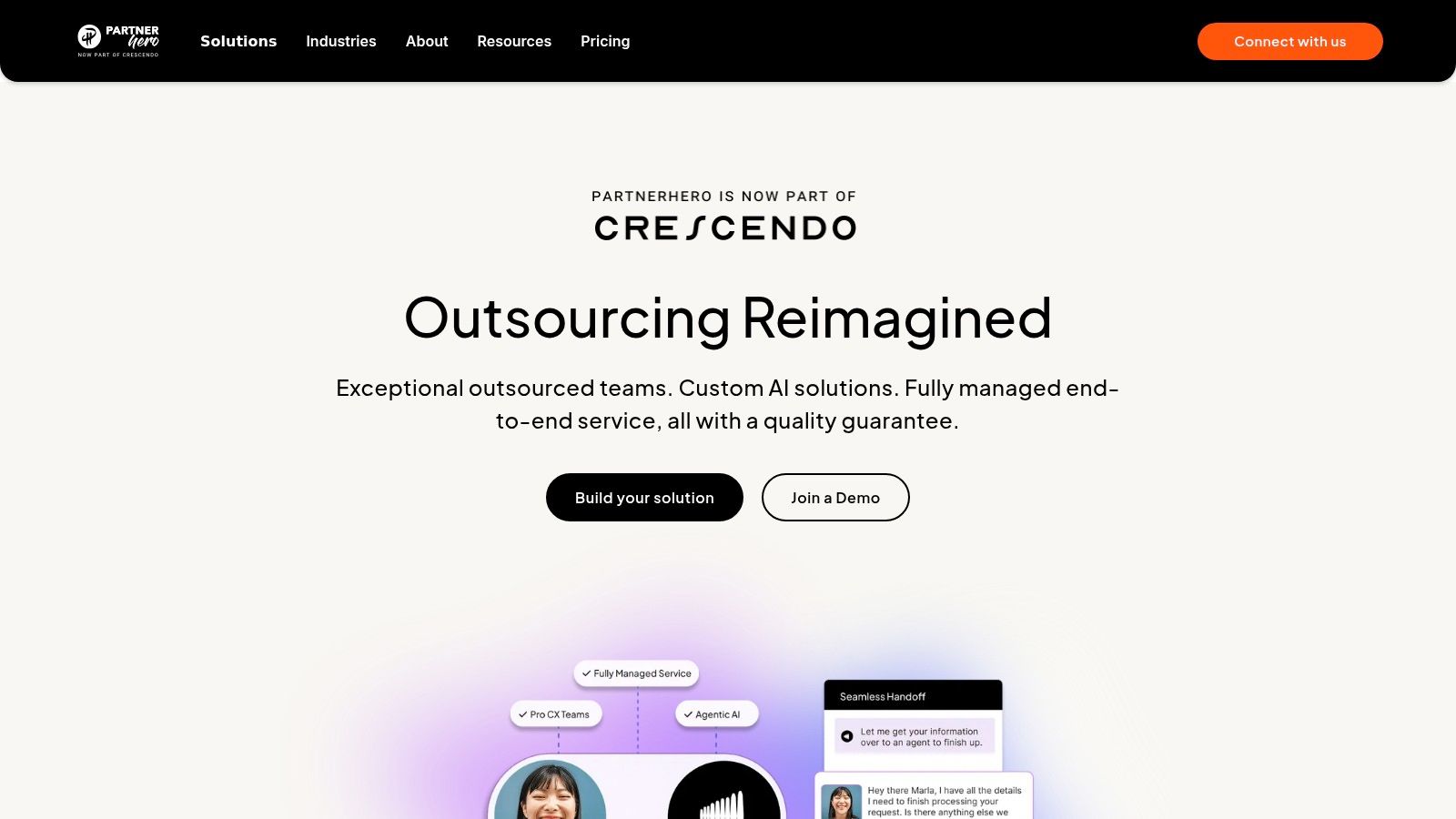
PartnerHero, now part of Crescendo, is the kind of provider many startups and mid-market brands prefer when they don’t want to be swallowed by enterprise BPO process. The appeal is simple. You get a more hands-on engagement style, more flexibility in team design, and a service model that often feels closer to an embedded partner than an outsourced department.
That’s valuable for e-commerce brands, SaaS companies, and digitally native SMBs that care a lot about brand voice and responsiveness, but don’t need the massive footprint of a mega-provider. It also helps when internal teams want regular access to the people running the program.
Here is a related CallZent partnership-themed image asset.
Why smaller and growing brands like PartnerHero
PartnerHero’s positioning works well for buyers who want support teams to be adaptable. Dedicated teams, elastic staffing options, omnichannel support, and a modern automation story all fit that audience.
A few reasons it makes shortlists:
- Flexible engagement style: Better for brands that need room to evolve scripts, workflows, and staffing.
- AI plus human support: Useful for teams trying to automate routine interactions without losing control of quality.
- Startup-friendly approach: Easier cultural fit for younger brands than some enterprise vendors.
The broader buyer challenge here is that most rankings still focus on vendor size, reviews, or generic feature lists. Zendesk’s outsourcing guide makes a more useful point: buyers should decide whether they need a handful of agents or a full BPO, and whether an onshore, nearshore, or offshore model fits best, as explained in Zendesk’s customer service outsourcing guidance. That’s exactly why PartnerHero can be right for one business and wrong for another.
The trade-off after the acquisition
The post-acquisition reality is worth noting. As offerings and branding evolve, buyers should get clear on SLAs, governance, account structure, and exactly how the AI-enabled components fit into the human support model.
That doesn’t make PartnerHero risky by default. It just means clarity matters more than marketing language during procurement.
Top 7 Customer Support Outsourcing Comparison
| Provider | Implementation Complexity 🔄 | Resource Requirements ⚡ | Expected Outcomes ⭐📊 | Ideal Use Cases 💡 | Key Advantages |
|---|---|---|---|---|---|
| CallZent | 🔄 Low–Moderate: nearshore setup, collaborative onboarding | ⚡ Cost-effective; custom quotes; scalable seat models | ⭐ Reliable bilingual CS/tech support; faster US-aligned response times | 💡 US-facing SMBs–enterprise needing bilingual 24/7 inbound/outbound | Nearshore bilingual fit, agent-centric culture, scalable packages |
| TTEC | 🔄 Moderate–High: design+operate enterprise programs, longer onboarding for small deals | ⚡ Higher resource intensity for onshore; premium/custom pricing | ⭐📊 Strong KPI improvement and compliance support for regulated sectors | 💡 Large enterprises needing end-to-end CX design and managed ops | Consulting + operations, AI/automation, global delivery options |
| Foundever (Sitel+SYKES) | 🔄 High: global footprint and mature enterprise processes | ⚡ Very large talent pool; enterprise procurement and custom pricing | ⭐📊 24/7 multilingual coverage and rapid ramp for peaks | 💡 Global brands requiring multilingual, round‑the‑clock, seasonal scale | Huge footprint, rapid ramp capability, embedded AI/analytics |
| Concentrix (includes Webhelp) | 🔄 High: CX transformation and governance-heavy implementations | ⚡ Enterprise-level investment; custom pricing and longer procurement | ⭐📊 Advanced analytics-driven CX transformation and domain playbooks | 💡 Enterprises seeking cloud modernization and industry-specific playbooks | Strong analytics, cloud contact-center tools, analyst-recognized innovation |
| TELUS Digital | 🔄 Moderate–High: digital transformation focus with managed services | ⚡ Mid–high investment; enterprise scoping; rebranding diligence advised | ⭐📊 Balanced tech + ops gains using SMART CX framework | 💡 Brands modernizing CX stacks with AI and digital ops needs | Balanced tech & operations approach; industry vertical expertise |
| TaskUs | 🔄 Moderate: playbooks for rapid ramp and digital workflows | ⚡ Fast scaling capability; premium pricing for regulated/onshore programs | ⭐📊 Rapid scale and strong execution in content moderation/trust & safety | 💡 Fast‑growing tech/consumer platforms needing 24/7 digital-first support | Digital-first execution, rapid ramp, trust & safety expertise |
| PartnerHero (Crescendo) | 🔄 Low–Moderate: boutique, flexible launches with human‑in‑the‑loop AI | ⚡ Flexible/elastic teams; outcome-based pricing; SMB-friendly | ⭐📊 High-quality CX for SMBs; reduced handle time via AI-assisted agents | 💡 Startups and mid-market e‑commerce needing hands-on, flexible support | Flexible scoping, modern agentic AI, outcome-based launch options |
Take the Next Step Build Your Dream Support Team with CallZent
The best customer support outsourcing company isn’t always the biggest name on the page. In practice, the right choice depends on how your business serves customers day to day. Some companies need global scale, broad language coverage, and enterprise procurement structure. Others need a partner that can move quickly, work in the same time zones, speak naturally with North American customers, and adapt without turning every process change into a formal transformation project.
That’s why global BPO giants and nearshore specialists belong in the same conversation, but not in the same bucket. A company like TTEC or Concentrix can be the right fit when your environment is large, complex, and heavily tied to enterprise systems. Foundever and TELUS Digital make sense when flexibility, transformation, or distributed delivery are central requirements. TaskUs and PartnerHero can be strong choices for digital-first brands with specific operating styles and growth patterns.
But many North American businesses don’t need the heaviest model. They need a practical one. They need a support partner that can scale without feeling far away. They need bilingual coverage, close collaboration, operational visibility, and the ability to launch or adjust programs without unnecessary friction.
That’s where CallZent has a compelling advantage. Its nearshore location in Tijuana gives U.S. and Canadian companies something many offshore models can’t match consistently. Shared or overlapping work hours, easier communication, better cultural alignment, and bilingual English-Spanish support under one roof. For customer support teams serving healthcare, finance, e-commerce, telecommunications, retail, insurance, and related sectors, that setup can make day-to-day management much smoother.
If your customers are in North America, your support partner should feel close to your business, not halfway around the world.
CallZent also offers the kind of service mix that’s useful once support operations start expanding. Customer service, technical support, lead generation, debt collection, virtual assistance, and reservation management can all sit inside one partnership. That reduces vendor sprawl and gives operations leaders a simpler path to scale.
The final decision still comes down to diligence. Confirm compliance needs. Review communication cadence. Ask who owns quality management, training, workforce planning, and escalations. But if your goal is to balance cost-effectiveness with quality, responsiveness, and cultural fit, CallZent deserves serious consideration.
!– CTA –>🚀 Build a Better Customer Support Team With CallZent
CallZent helps North American businesses build bilingual nearshore support teams for customer service, technical support, outbound campaigns, virtual assistance, reservation management, and back-office support — with close collaboration from Tijuana.
Talk to an ExpertIf you’re looking for a nearshore partner that can support your customers in English and Spanish, align with North American business hours, and build a customized support program around your growth goals, talk with CallZent. Their team can help you scope a practical solution for customer service, technical support, outbound programs, and back-office support without forcing you into a one-size-fits-all model.