

Reservation & Appointment Operations
Booking Management: A Practical Guide to Reservations, No-Shows, and Bilingual Support
Connect availability, confirmations, reminders, changes, and human support so that a confirmed booking becomes a dependable customer experience.
TL;DR — Quick Takeaways
- Booking management coordinates availability, requests, confirmations, reminders, changes, and cancellations.
- Use one reliable record across channels and define who owns each exception.
- Automate routine requests and route ambiguous or sensitive cases to authorized support.
- Give English- and Spanish-speaking customers usable instructions and context-preserving handoffs.
- Track booking completion, attendance, repeat contacts, no-shows, and recovered slots separately.
A holiday rush exposes the weakness in a booking process faster than any software demo. A Spanish-speaking customer needs to change a reservation, the online workflow only works in English, and the call queue offers no clear path to a bilingual agent. At the same time, a healthcare appointment remains on the calendar even though the patient never received a usable reminder. The booking exists, but the service has already begun to fail.
Why a Full Calendar Can Still Produce Failed Bookings
In an illustrative peak-demand scenario, the queue is already backing up at 8:00 a.m. A reservation team is handling a holiday rush when a customer calls to change a reservation in Spanish. The self-service flow only works in English, the handoff stalls, and she repeats the same request to two different touchpoints before giving up. The booking still sits in the system. The customer does not.
A few miles away, a clinic starts the day with a full calendar and the same underlying problem. Some patients never got a reminder they could understand. Others need to reschedule, confirm prep instructions, or clear up insurance details before they can show up ready for care. On paper, capacity looks filled. On the floor, staff deal with empty rooms, late arrivals, unnecessary transfers, and avoidable frustration.
A reservation only delivers value when the customer reaches the service with the information and support needed to complete it. A filled slot is an intermediate result, not proof that the workflow succeeded.

The calendar can hide operational failure
A common operational gap emerges when reservation teams focus on the calendar alone. They add online booking, confirmations, and reminders, then discover that the actual breakdowns happen in the exceptions. A language preference. An eligibility check. A payment hold. A high-risk booking that needs judgment before anyone should confirm it.
That is why booking management has to be run as a service-continuity function. Automation should handle the clean, repeatable steps. The moment a request turns ambiguous, bilingual support and clear escalation paths decide whether the customer gets served or drifts into a repeat contact, a no-show, or a lost sale.
Cancellation policies, payment conditions, intake requirements, and reminder workflows should be designed together. Each controls a different point of failure around the reservation.
Operational takeaway: A booking works when the right customer reaches the right service with the right information, and when exceptions reach a person who can resolve them without dropping context.
For a bilingual nearshore support operation in Mexico, these are practical workflow considerations. Teams may support English and Spanish customers across healthcare, e-commerce, telecom, insurance, retail, and financial services. If a customer cannot complete a change request, the fix usually comes down to routing, context, and accountable follow-through.
What Booking Management Actually Is
Booking management is the coordinated process of capturing, confirming, modifying, and tracking reservations or appointments across every customer touchpoint. It connects demand with available service capacity, but it also carries the customer through the moments that occur before and after the initial booking.
A useful system has five connected parts:
-
Availability and capacity: The system shows current inventory, appointment slots, agent skills, service duration, and resource constraints. A hotel needs room availability. A clinic needs provider and procedure availability. A telecom operation may need a technician, language match, and service window.
-
Booking capture: Customers should be able to request service through a website, app, phone, email, live chat, or SMS. The channel matters less than the consistency of the underlying reservation record.
-
Confirmation and reminders: The customer receives the exact time, time zone, location or access details, preparation requirements, and a clear way to confirm or change the booking.
-
Modification and recovery: Plans change. Agents need to reschedule, cancel, place customers on a waitlist, preserve notes, and offer newly available capacity without creating duplicate records.
-
Escalation and accountability: Automation should identify when it can’t safely finish the request. A trained agent then resolves ambiguity rather than forcing the customer through a broken self-service path.
A scheduling platform can provide the visible calendar, while an operation still needs rules, queues, scripts, quality checks, and ownership. A broader view of reservation management systems helps connect the technology layer with the service operation. For customer-facing support, review CallZent’s reservation services.
| Component | Function | Best practice |
|---|---|---|
| Availability | Matches demand with open capacity | Keep inventory synchronized across channels |
| Booking capture | Records the customer request | Collect only the information needed to complete the service |
| Confirmation | Creates a shared understanding | State date, time zone, location, requirements, and next action |
| Changes and cancellations | Protects capacity when plans shift | Make rescheduling easier than abandoning the booking |
| Escalation | Handles exceptions and risk | Route language, eligibility, payment, and accessibility issues to trained agents |
In a bilingual market, language routing isn’t a cosmetic feature. English-speaking customers should reach English-capable support, and Spanish-speaking customers should reach Spanish-capable support without repeating their entire request. That reduces transfers and protects the information already collected.
Why Booking Management Needs One Reliable Record
Phone notes, spreadsheets, website calendars, and separate inboxes can each contain a different version of the same reservation. A customer may cancel by phone while an automated reminder still confirms the old time. Another may reschedule online while the service team prepares for the original appointment.
Keep availability and changes synchronized
Choose a system of record and define how every channel updates it. An agent should see the current booking status, resource assignment, customer preferences, and prior changes before making another commitment. Integrations need a clear failure path when an update cannot be saved.
For simultaneous requests, the platform should reserve or lock capacity during confirmation and reject conflicting updates rather than silently creating duplicate bookings. Define how temporary holds expire and how payment status affects confirmation.
Make handoffs preserve context
A customer may start online, call to clarify details, and then need an agent to finish the booking. Carry the booking identifier, requested change, verified facts, and unresolved issue into the handoff. Record who owns the next action and when the customer should expect an update.
Centralized software improves visibility, but it still needs rules for missing information, unclear instructions, payment exceptions, and requests outside the agent’s authority. The platform keeps the record current; the support operation makes the next decision accountable.
The Data Behind No-Shows and Slot Optimization
A missed booking is rarely just an empty slot. In practice, it can mean prep time already spent, a bilingual agent held for a case that never arrives, and a high-risk customer left without the support they needed to follow through. Good booking management starts by separating routine reservations from the ones that need tighter follow-up and a human backstop.
A 2020 outpatient study examined 48,777 online appointment records from one hospital in Jinan, China, collected in 2017–2018. It reported a 15% no-show rate and associations with age, booking interval, previous missed appointments, and department. This is a setting-specific finding, not a benchmark for North American booking desks. Use local data to identify barriers and test supportive interventions.
| Risk factor | Impact | Intervention |
|---|---|---|
| Time between booking and service | Attendance patterns may differ across booking intervals | Review local patterns and test reminder timing by service type |
| Previous no-show history | Can indicate an unresolved attendance barrier | Offer supportive follow-up and easy rescheduling |
| Communication or access needs | May affect communication preferences and reminder usability | Offer clear language, channel choice, and human assistance |
| Clinical department or service type | Different services create different preparation and attendance requirements | Tailor instructions and verify required information |
| Language mismatch | Can lead to misunderstanding, abandonment, or failed preparation | Route to a qualified English- or Spanish-speaking agent |
Slot presentation also affects acceptance. A 2019 study listed by IBM Research compared sequential and nonsequential appointment offers. Its numerical tests reported slot-fill improvements of 6%–8% on average and up to 18% in the tested cases. These were model-testing results, not guaranteed gains in a live booking desk. Treat slot-ordering rules as a hypothesis to test against customer preferences and operational constraints.
The ranking model has to reflect real operating constraints. Service duration, staff skill, language, time zone, historical demand, and customer preference all shape whether a slot is viable. In a bilingual healthcare workflow, for example, giving a Spanish-speaking patient a slot tied to an English-only intake step creates continuity risk even if the calendar shows availability. The same principle applies in telecom and field service when the wrong technician skill is matched to the wrong appointment window.
Keep reminder content and payment handling appropriate
Confirm the customer’s preferred contact details, language, and channel before sending reminders. Use approved message templates and honor communication preferences. For sensitive appointments, minimize details visible in a message preview and direct customers to an authorized channel for private information.
Agents should follow the client’s approved payment process rather than collecting card details in free-text notes. In healthcare workflows, agents can explain approved administrative instructions and route questions; clinical decisions, urgent symptoms, and eligibility approvals belong with qualified or authorized staff.
Reminders should create a decision
A weak reminder only repeats the booking. A useful one helps the customer confirm, reschedule, or ask for help before the slot is lost.
A practical sequence includes:
- Immediate confirmation: Give the customer a reliable record and identify missing information.
- Advance reminder: Test a reminder 48 to 72 hours before service, with a direct response path; adjust timing to preparation needs and customer preferences.
- Final reminder: Contact the customer near the appointment and make last-minute changes easy to report.
A 2013 Cochrane review included eight randomized trials with 6,615 participants. Seven trials comparing text reminders with no reminders found improved attendance, with a risk ratio of 1.14 and a 95% confidence interval of 1.03–1.26. Evidence quality was low to moderate overall. The review supports reminders as a useful tool; it does not establish one universal timing sequence or guarantee the same result in every service operation.
Reminders still have limits. They work best when the customer clearly understands what will happen next and has an easy way to signal a problem. If prep instructions are confusing, insurance details are unresolved, or the booking involves a language barrier, the reminder should trigger escalation to a person who can close the gap.
Track the numbers that show whether the system is recovering capacity, not just sending messages: offer-to-acceptance rate, time-to-book, slot-fill rate, cancellation rate, utilization by interval, no-show rate, and recovered slots. Teams that use booking analytics can segment risk earlier, but the operational payoff comes from clear rules about what happens next, which cases get another automated touch, which ones get a bilingual callback, and which ones go straight to a trained agent.
Automation vs Human Escalation
A fully automated workflow is effective when the request is simple, the customer data is complete, and the consequences of an error are limited. A customer chooses an available hotel room, confirms a standard service, receives instructions, and can change the reservation without assistance. Automation keeps that interaction fast.
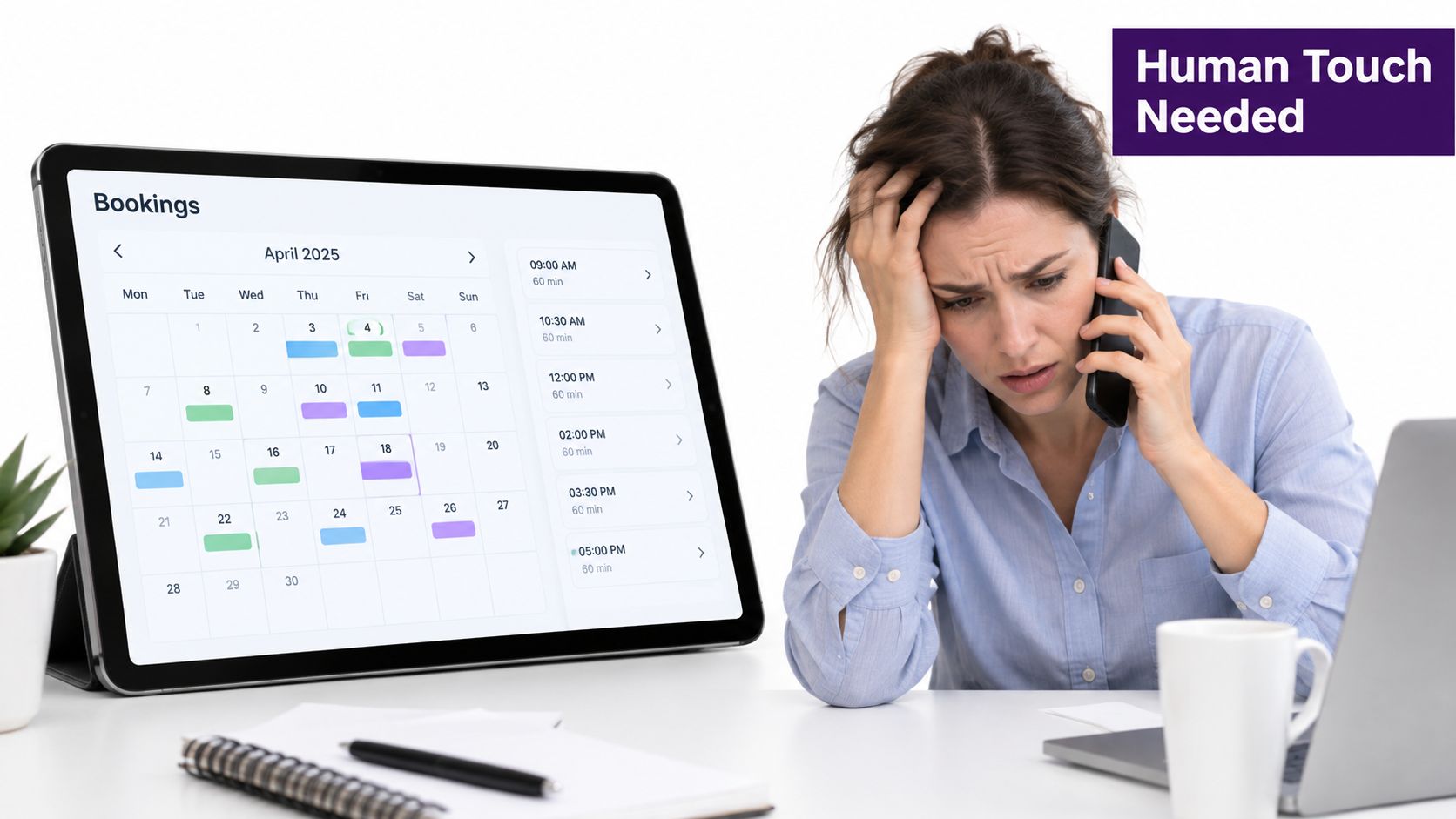
The same model becomes fragile when a booking involves ambiguity. An English-only form can exclude a Spanish-speaking customer. A healthcare patient may need insurance eligibility verified before scheduling. An e-commerce customer may need payment troubleshooting while changing a reservation. A telecom customer may need an appointment matched to a technician with the right skill and language.
Choose the operating model by risk
| Booking type | Automation role | Human role |
|---|---|---|
| Simple, low-risk reservation | Capture, confirm, remind, and process routine changes | Handle requested assistance, system failures, and unresolved exceptions |
| Language-sensitive request | Detect preferred language and collect basic details | Verify intent and complete the interaction in English or Spanish |
| Eligibility or documentation case | Ask structured intake questions | Clarify missing information and route approval decisions to authorized staff |
| Payment or deposit issue | Present secure instructions and status | Troubleshoot the exception and prevent duplicate bookings |
| Accessibility or high-value booking | Record the request and relevant preference | Confirm requirements and accept accountability for the outcome |
The practical rule is simple: automate the routine, escalate the ambiguous, and keep one accountable owner for the final booking.
A bilingual nearshore reservation desk can be the right middle ground for North American operations. Agents in Mexico can work across English and Spanish queues, preserve the existing reservation context, and handle exceptions for healthcare, insurance, financial services, telecommunications, and high-value e-commerce. The purpose isn’t to add a person to every interaction. It’s to prevent an automated success from becoming an operational failure.
Teams should define triggers before launch. Language mismatch, unclear eligibility, payment failure, accessibility needs, cross-time-zone changes, and high-value reservations should create a clear route to an approved escalation queue.
Measuring What Matters
Separate a completed reservation from completed service delivery. Booking conversion measures confirmed bookings out of eligible requests. Attendance measures customers who receive or attend the scheduled service. Use distinct denominators so that a confirmation cannot conceal a later no-show.
Define no-show rate using appointments due in the reporting period, with agreed rules for cancellations and rescheduling. Define recovered-slot rate using eligible released slots, and separately track whether the replacement customer attended. Review results by service type, shift, channel, and language.
At 8:45 a.m., the schedule can look healthy and still be heading for a bad day. Slots are full, but the wrong patients are in the wrong queues, a Spanish-speaking caller has been transferred twice, and a reschedule from yesterday never made it into the record. Booking management is a continuity job. The scorecard has to show whether the customer reached the right service, with the right context, without a risky handoff.
Start with outcomes across the full path from request to completed service. Track completed booking rate, failed handoff rate, repeat contact rate, language resolution rate, documentation accuracy, no-show rate by segment, and recovered-slot rate. Together, these measures show where the process breaks: at intake, during transfer, before service, or after a cancellation opens a slot that no one refills.
One metric on its own can mislead. High calendar utilization can hide rework. A strong booking volume can conceal poor documentation that forces frontline staff to call people back. A low overall no-show rate can still mask a serious service gap if one language queue, channel, or service line performs worse than the average.
Cancellations and rescheduling can occur shortly before service. The process should assign a person or queue to validate newly available capacity, contact eligible waitlist customers, and confirm the replacement booking.
That matters operationally. Late movement creates work for people, not just software. Teams need a short-notice waitlist, permission rules for refilling newly opened slots, and a clear owner for exceptions that could affect safety, revenue, or language access. Policies and intake controls should address preventable failure before the customer arrives.
Measure the promise kept, not just the slot sold.
For bilingual operations, split reporting by language and channel. If English bookings complete smoothly while Spanish-language customers face more transfers or repeat contacts, the average will hide the problem. That is where a trained escalation layer earns its keep. It closes the gap before a booking failure turns into a service failure.
Where a Bilingual Nearshore Booking Desk Adds Value
A booking desk proves its value when the workflow breaks. The bot offered a slot, the customer accepted, and then the constraints show up: the service needs more time than the template allowed, the caller needs Spanish support, the location is wrong, or the booking carries payment, eligibility, or cancellation risk. At that point, continuity matters more than speed.
Automation can collect structured details, present approved options, and update routine bookings. It should hand off requests when the rules, information, or authority needed to confirm the service are missing.
The teams that perform well treat booking as a two-layer operation. Software handles the clean path. People handle the exceptions before they become missed appointments, charge disputes, or frustrated repeat contacts.
Assign clear responsibilities to automation and agents
A practical hybrid workflow assigns clear responsibilities:
- Let automation handle structured demand. It can collect basic details, answer routine questions, show feasible options, and start a reservation.
- Verify the booking promise. Before confirmation, check service type, location, language, time zone, required documents, payment conditions, and cancellation rules.
- Escalate exceptions early. Ambiguous intent, sensitive information, unusual requests, and high-value reservations should move to a trained agent.
- Preserve an audit trail. Record what the customer requested, what the system selected, what changed, and who approved the final outcome.
- Offer recovery without repetition. Customers should be able to correct, cancel, or reschedule through a human handoff that keeps the existing context intact.
That handoff is an important part of evaluating a nearshore team. Proximity and bilingual coverage help teams align with North American time zones while handling multilingual exception workflows. For companies comparing nearshore outsourcing solutions, the operational question is simple: can the team resolve the cases automation should not finish on its own?
Validate improvements in your own operation. A pilot should compare similar service types and demand periods, recording both the booking result and any rework required. Better slot utilization is useful only when the customer receives the service that was promised.
Track automated completion, human takeover time, correction rate, repeat contacts after automated interactions, language resolution, and completed bookings after escalation. A high automated completion rate means little if the original booking still comes back for repair.
Getting Started with Booking Management
Start with an operational audit, not a platform purchase. Follow a booking from the first request through confirmation, reminder, service delivery, cancellation, or rescheduling. Mark every point where customers abandon, repeat information, change language, wait for eligibility decisions, or need an agent to correct the record.
Then build the workflow in a practical sequence:
- Map demand and risk. Separate simple reservations from requests involving insurance, payments, accessibility, multiple time zones, specialized resources, or high-value services.
- Standardize the reminder path. Send an immediate confirmation, a tested advance reminder suited to the service and preparation requirements, and a final reminder near the appointment. Include the time zone, location or access instructions, preparation requirements, and one-click confirm or reschedule actions.
- Define escalation triggers. Route language mismatch, unclear eligibility, payment issues, accessibility needs, and high-value reservations to trained support.
- Create recovery capacity. Maintain a short-notice waitlist and authorize agents to fill openings created by cancellations or rescheduling.
- Set the scorecard. Review completed booking rate, failed handoff rate, repeat contact rate, language resolution rate, documentation accuracy, no-show rate by segment, and recovered-slot rate.
- Test before scaling. Compare reminder timing, channel mix, slot-ranking rules, and escalation criteria by industry and customer population. Healthcare, retail, telecom, financial services, and bilingual audiences may respond differently.
The strongest starting model is usually hybrid. Let self-service handle predictable bookings, while bilingual nearshore agents manage the exceptions that can create a wrong promise, a missed appointment, or a lost customer. That approach treats booking management as service continuity, which is the standard customers experience even when the underlying technology is invisible.
Frequently Asked Questions
What is booking management?
Booking management coordinates availability, reservation requests, confirmations, reminders, changes, cancellations, and follow-up. It combines a reliable booking record with clear operating rules and support for exceptions.
How is booking management different from scheduling software?
Scheduling software supplies tools such as calendars, availability, and automated notifications. Booking management also defines staffing, customer communication, agent authority, escalation, quality checks, and ownership of unresolved requests.
Can appointment reminders reduce no-shows?
Research in healthcare indicates that text reminders can improve attendance compared with no reminders. Results vary by setting. Test timing, channel, language, and ease of rescheduling in your own operation rather than assuming one sequence will work for every customer.
When should an automated booking move to a human agent?
Route requests when the customer needs language assistance, information is unclear, a payment fails, accessibility requirements need confirmation, or the request exceeds automated rules or agent authority. Preserve the booking record and the reason for the handoff.
Which booking management metrics should a team track?
Track confirmed bookings out of eligible requests, service attendance, no-show rate, repeat contacts, handoff failures, documentation accuracy, and recovered slots. Define each denominator and review performance by service type, channel, shift, and language.
How can bilingual nearshore support help with booking management?
English-Spanish agents can handle reservation questions, confirmations, changes, and defined exceptions while working from the existing booking context. Agree on coverage, permissions, system access, escalation responsibilities, and reporting before launch.
Bilingual Nearshore Reservation Support
Keep Your Bookings Moving From Request to Service
Discuss your reservation workflow with CallZent. Define the English-Spanish support, confirmation process, change handling, and escalation ownership your customers need.