Skip to content

Call Center Cost Savings
Maximize Call Center Cost Savings in 2026 With Smarter Staffing, AI, and Nearshore Outsourcing
Learn a practical playbook for call center cost savings through KPI audits, workforce optimization, intelligent automation, and nearshore outsourcing to Tijuana without hurting customer experience.
TL;DR — Quick Takeaways
- Audit the full cost base: Start with fully loaded cost per contact, not just wages.
- Prioritize FCR over raw speed: Fast calls that do not solve the problem create waste.
- Fix staffing and routing first: Better schedules and smarter routing remove obvious inefficiencies.
- Automate routine work carefully: AI and self-service work best on repetitive, low-complexity contacts.
- Use nearshore delivery for structural savings: A lower-cost operating model can reduce spend without creating offshore friction.
- Protect retention: Agent burnout and turnover can erase gains from every other initiative.
Your support bill lands in your inbox. Payroll is up. Software costs are up. Queue times still spike on busy days. Customers aren’t noticeably happier, and your leadership team wants answers.
That’s where most companies get call center cost savings wrong. They cut headcount, pressure agents to move faster, and celebrate a lower handle time while repeat calls, transfers, and turnover push costs back up.
The better approach is to treat cost reduction as an operating system, not a one-time cut. The strongest savings usually come from four moves working together: measuring the true cost per contact, fixing routing and staffing, automating the right interactions, and shifting delivery to a lower-cost model that doesn’t damage service quality.
Your Playbook for Sustainable Call Center Cost Savings
A lot of leaders are stuck in the same spot. They know support costs are too high, but every proposed fix seems to carry risk. Cut labor too hard and service slips. Add technology too fast and customers get trapped in bad automation. Outsource carelessly and quality becomes harder to control.
Sustainable call center cost savings come from balance. You need diagnostics that show where money is being lost, operating discipline that removes waste, technology that handles routine volume, and a delivery model that lowers structural costs.
One practical way to frame it is this:
- Know the number: Calculate your true cost per contact.
- Remove avoidable work: Reduce transfers, repeats, and scheduling waste.
- Reserve people for human work: Let automation absorb simple, repetitive demand.
- Lower the cost base: Move eligible work into a more efficient operating model.
Bold takeaway: The cheapest call isn’t the shortest call. It’s the call that gets resolved correctly the first time, in the right channel, with the right staffing model behind it.
If you’re reviewing options internally, start by mapping your biggest cost drivers against your current process and vendor mix. A useful starting point is this guide on how to reduce operational costs, especially if your team is trying to separate quick wins from bigger structural changes.
Establish Your Baseline by Auditing Costs and KPIs
Most cost-reduction efforts fail for a simple reason. The business is measuring pieces of the problem, not the full system.
You need a baseline that captures the fully loaded cost per contact. The practical formula comes from The Office Gurus’ customer support cost benchmark methodology: total call center costs divided by total calls handled. That means wages, supervision, training, software, infrastructure, occupancy, and support overhead all belong in the equation.
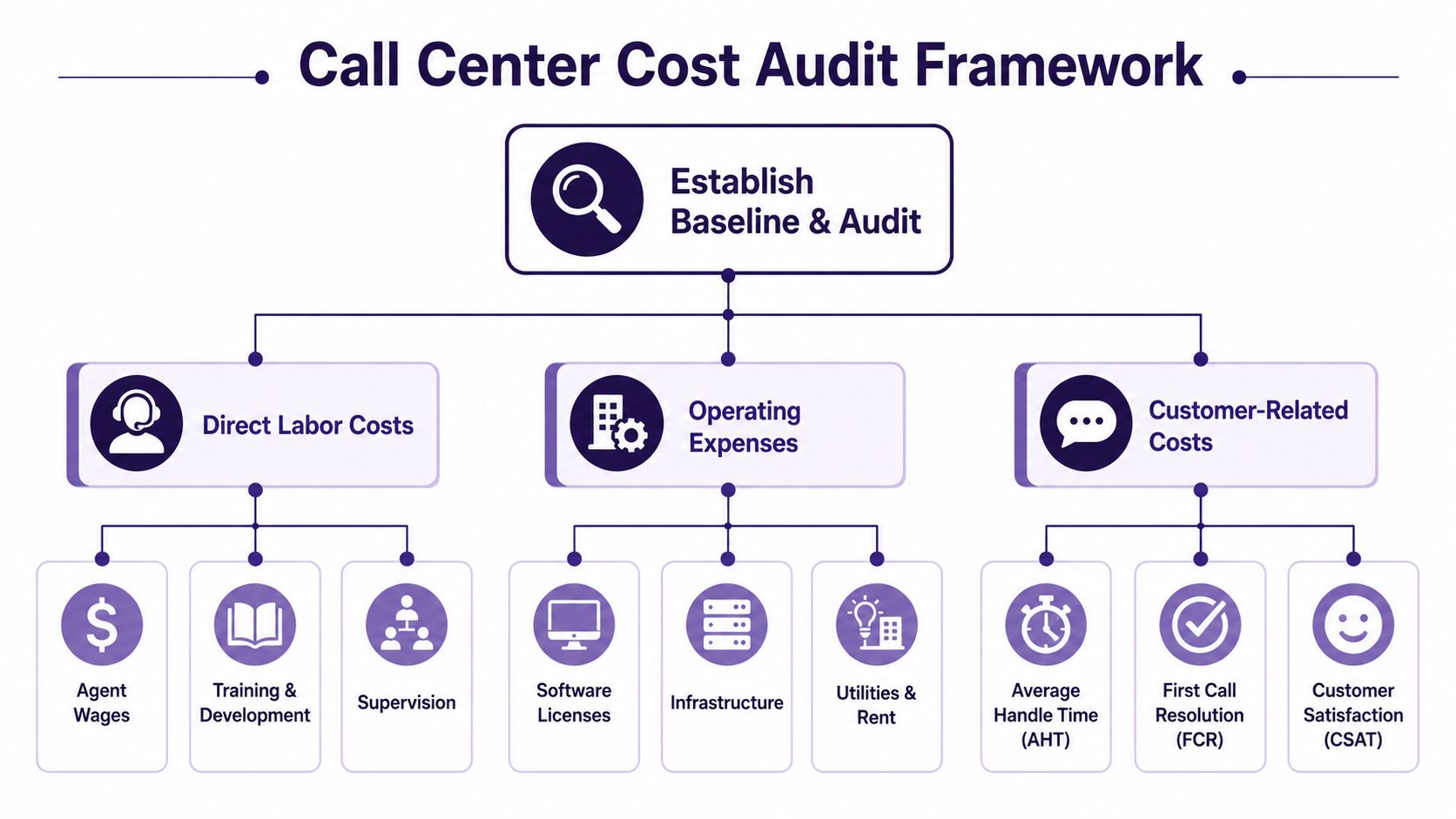
Build the cost view before you cut anything
A clean audit usually starts with three buckets:
| Cost area | What belongs in it | Why it matters |
|---|---|---|
| Direct labor | Agent wages, team leads, supervisors, training time | Labor usually carries the largest share of spend |
| Operating expenses | Phone platform, CRM, QA tools, rent, utilities, equipment | Hidden overhead often gets ignored in boardroom discussions |
| Customer-related costs | Repeat contacts, transfers, long holds, escalations | These are operating failures that show up as extra cost |
For example, a retail support team might think its issue is wage inflation. After an audit, it may find the larger problem is repeat billing calls routed to generalists who then transfer customers to another queue. The wage rate didn’t create the waste. Routing did.
If you’re also evaluating telephony spend, cloud-based systems can change the economics of the stack itself. This overview on how to reduce small business phone system costs is useful for leaders comparing fixed on-premise costs with more flexible hosted models.
Treat FCR as the real cost lever
A lot of managers go straight to Average Handle Time. That’s understandable. AHT is visible, easy to report, and easy to pressure downward.
It’s also where teams fall into trouble.
According to CloudTalk’s benchmarking guidance, the most effective starting point for cost reduction is fixing call routing logic, as getting callers to the right agent immediately lifts FCR, Service Level, and CSAT simultaneously. The same source also warns about the efficiency trap, where managers optimize speed without pairing it with quality metrics like FCR and CSAT.
Practical rule: If a faster call creates a second call, the first “saving” was fake.
Use the FCR formula exactly as defined by CloudTalk: FCR = (Issues resolved on first contact / Total first contacts) × 100 in its call center metrics guide. Once you anchor on FCR, your audit changes. Transfers become more expensive. Weak knowledge bases become more expensive. Poor routing becomes more expensive. That’s when cost analysis starts matching operational reality.
What a good KPI set looks like
Don’t run the operation on one number. Use a balanced scorecard.
- First Call Resolution: Track whether the customer’s issue was solved.
- Average Handle Time: Monitor efficiency, but never in isolation.
- CSAT: Watch for quality erosion when you change scripts, routing, or staffing.
- Transfer rate: A high transfer rate usually signals design problems.
- Repeat contact rate: This shows whether “resolution” is sticking.
A healthcare scheduling team is a good example. If agents are pushed to shorten calls, they may end interactions before confirming appointment details or insurance requirements. The conversation looks efficient. The callback volume a day later tells the truth.
Implement Smart Staffing and Workforce Optimization
Labor is where most leaders look first, and that’s appropriate. But there’s a major difference between cutting labor and using labor intelligently.
The fastest operational wins usually come from schedule accuracy, queue design, and matching agent skills to contact types. When those pieces are loose, you pay for idle time in one interval and service failures in the next.

Forecast demand with more discipline
A workforce plan should reflect how contacts arrive. Day-of-week patterns, seasonality, promotions, billing cycles, renewals, and product launches all change queue demand. If your staffing model doesn’t account for those drivers, overtime and underutilization become routine.
Workforce Management software helps because it turns historical patterns into interval-level forecasts. That gives you better schedules, cleaner break placement, and fewer moments where the queue is overstaffed in one block and exposed in the next.
A common real-world example is e-commerce. Returns, shipping updates, and order status requests often surge around promotions and holidays. Teams that still build schedules on broad monthly averages usually end up paying for missed precision.
Use flexible staffing instead of permanent overcapacity
Permanent overstaffing is expensive, but chronic understaffing is expensive too. The practical answer is flexibility.
According to Global Response’s cost-saving analysis, employing a remote workforce saves approximately $11,000 per year per agent by removing office space and utilities. The same source notes that improving first call resolution and optimizing call routing strategies yield up to 25% savings on handling costs by directing calls to the correct agents immediately.
That makes remote and hybrid staffing more than a workplace decision. It’s a financial tool.
A smart model often includes:
- Core full-time coverage: Stable staffing for predictable base volume.
- Flexible layers: Part-time or variable schedules for demand spikes.
- Remote hiring pools: Broader access to agents without expanding physical footprint.
- Cross-trained backup groups: Coverage for overflow without defaulting to overtime.
Strong staffing models don’t just lower payroll waste. They protect service levels on the days your forecast is wrong.
If your team is still building schedules manually, it’s worth reviewing the fundamentals of workforce management in a call center. Better WFM practice often fixes problems leaders mistakenly blame on agent performance.
Route by skill, not by convenience
One queue for everything is easy to administer and expensive to operate.
Skills-based routing sends a technical issue to technical support, a billing dispute to billing, and a retention call to someone trained to save the account. That reduces transfers, lowers rework, and helps newer agents stay inside the types of interactions they can solve well.
A financial services team might separate card disputes, loan servicing, and account access issues into distinct routing paths. That creates better outcomes than dropping every contact into a general pool and hoping the first available person can sort it out.
When leaders ask where to begin, routing logic is often the cleanest first move. It doesn’t require a full transformation. It requires discipline, queue analysis, and cleaner workforce design.
Automate Intelligently With Modern Call Center Technology
Automation pays when it removes simple work from expensive channels. It disappoints when companies throw it at the wrong problems.
The right target is repetitive, rules-based demand. Think order status, password resets, appointment booking, store hours, basic troubleshooting, and other low-complexity contacts that don’t require judgment or empathy.
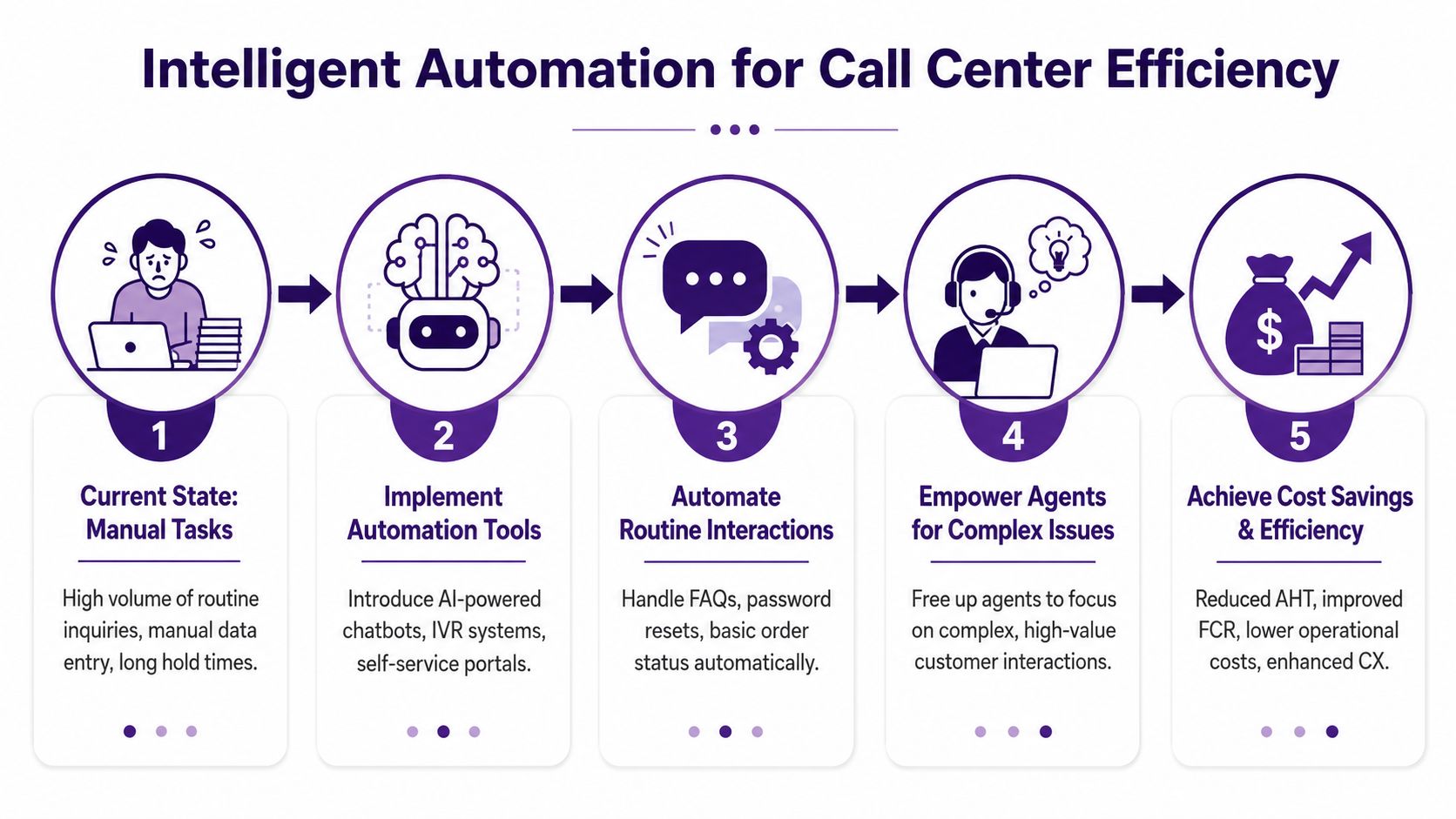
Where automation creates the biggest financial return
The strongest economic case is in voice automation for routine interactions. According to SupportYourApp’s analysis of contact center cost reduction, when AI voice agents replace outsourced human agents, the cost per minute drops from $0.50–$1.75 to just $0.07–$0.15, achieving a 90–95% cost reduction per automated interaction. The same source says artificial intelligence is projected to reduce contact center labor costs by $80 billion globally in 2026.
Those numbers explain why automation belongs in the cost conversation. But they don’t mean every interaction should be automated.
The best candidates are simple and frequent. An online retailer is a good example. Customers calling to ask where an order is don’t need a live agent if the system can authenticate them, retrieve shipment status, and answer clearly. The same is true for appointment confirmations, balance checks, or basic account updates.
Use IVR for triage, not obstruction
A modern IVR should qualify and direct the customer, not trap them.
Good IVR design does three things well:
- Collects intent early: It identifies whether the issue is billing, technical, scheduling, or something else.
- Segments urgency: It flags priority cases that need live escalation.
- Passes context forward: It gives the next step, whether bot or human, enough detail to avoid repetition.
That changes the role of the menu. Instead of acting as a gatekeeper, it becomes a triage layer that shortens the path to resolution.
A telecom support line might use IVR to separate service outages from plan changes. The outage caller can be routed to a targeted message or specialist path. The plan-change caller may complete the request through self-service or reach sales support directly. Both paths remove unnecessary talk time.
Keep humans focused on complex work
The operational mistake is assuming automation only matters on the front end. It also matters inside the agent workflow.
Agent-assist tools can surface knowledge base articles during a call, suggest next steps, and generate post-call summaries so agents spend less time typing notes. That doesn’t replace the human conversation. It reduces the work wrapped around it.
Automation should absorb repetition, not remove judgment.
This is also where implementation discipline matters. The Office Gurus warns in its earlier benchmark methodology that automation can erode savings if it deflects rather than resolves issues. When a bot handles the easy part but pushes the customer into a second contact, cost goes back up.
For teams comparing options, automation in customer service is worth evaluating as a layered model. Use self-service and AI for predictable intent. Keep skilled agents available for emotionally charged, high-value, or exception-based contacts. That split is where call center cost savings usually hold up under real operating pressure.
Unlock Game-Changing Savings With Nearshore Outsourcing
There’s a point where internal optimization stops being enough. You can improve routing, sharpen staffing, and deploy automation, but if your operating model is still built on a high-cost labor market, your savings ceiling stays low.
That’s where nearshore outsourcing changes the math. It lowers the cost base without introducing the same friction many companies worry about in more distant offshore models.
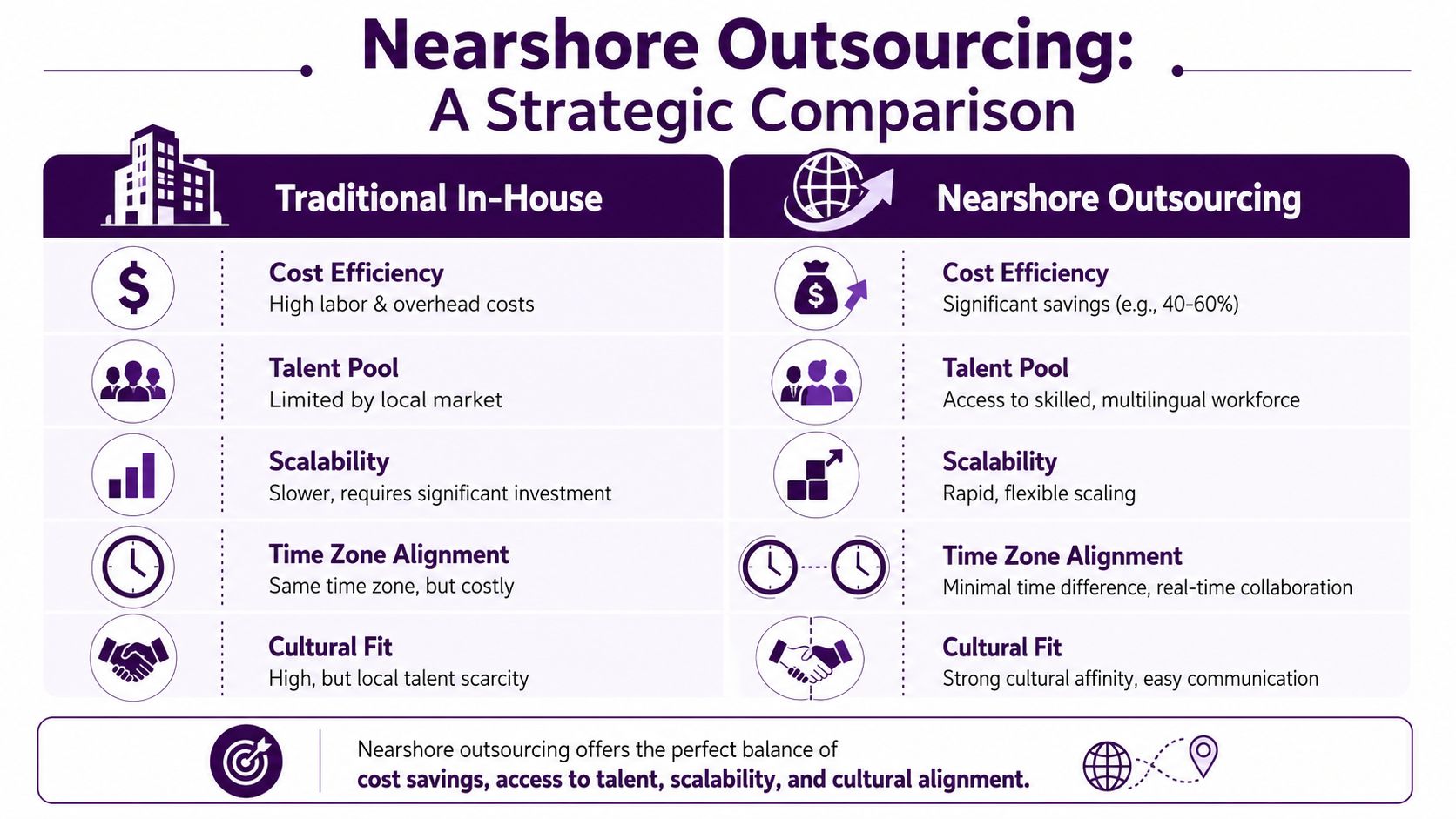
Why Tijuana stands out for call center cost savings
The cost difference is material. According to CCSI’s nearshore call center comparison, nearshore call center agents in Tijuana typically cost $13–$19 per hour, while U.S.-based agents range from $28–$42 per hour, generating direct labor savings of approximately 40–52% and enabling companies to reduce total support operations costs by 33–50% when adopting the nearshore model.
That gap matters for companies carrying large customer service, sales support, technical support, or back-office teams. It creates room to improve coverage, quality assurance, and management support without running the same payroll burden as a fully domestic setup.
Other verified data supports the same direction. Outsource Consultants reports that nearshore outsourcing to Tijuana reduces operational costs by 30–50% compared to U.S.-based centers, while businesses also report improvements in customer satisfaction and first-call resolution rates. Mexico-wide, Saint MX notes that nearshore outsourcing delivers 40–60% cost savings compared to U.S. labor across core functions, depending on specialization and language needs.
The non-financial advantages matter just as much
Labor arbitrage gets attention, but operating fit is what makes the savings sustainable.
A nearshore model in Tijuana gives U.S. and Canadian companies practical advantages:
- Time-zone alignment: Teams can manage operations in real time instead of waiting overnight for answers.
- Cultural proximity: Customer interactions generally feel more natural than they often do in far-off offshore environments.
- Bilingual talent: English and Spanish support can be built into the same operating structure.
- Simpler collaboration: Training sessions, QA calibration, and workflow changes are easier to run when teams overlap during the workday.
A healthcare provider, for example, may need bilingual appointment scheduling and insurance support with close supervision from an internal operations team. A nearshore environment makes that coordination easier than a model with major time gaps and weaker cultural alignment.
What a smart transition looks like
Outsourcing works when companies treat transition as an operational build, not just a procurement event.
Use a checklist like this before moving work:
-
Define the scope clearly
Separate routine contacts from high-complexity ones. Don’t migrate everything at once. -
Audit process maturity
If your knowledge base, SOPs, and escalation rules are messy, fix them first. -
Map systems access
Make sure telephony, CRM, ticketing, QA, and reporting can be integrated cleanly. -
Set quality controls early
Calibration, scorecards, and service-level expectations should be agreed before launch. -
Pilot before expanding
Start with one queue, one channel, or one customer segment. Then scale based on results. -
Protect customer experience
Watch FCR, transfer rate, and customer feedback during ramp-up, not just spend.
The best outsourcing transitions start with a narrow lane, disciplined reporting, and weekly operating reviews.
For companies exploring this route, how nearshore call centers reduce costs lays out the economics and operating model in more detail. One option in this category is CallZent, a bilingual nearshore call center and BPO in Tijuana that supports North American businesses with customer service and back-office operations.
Measure ROI and Build a Sustainable Cost-Saving Culture
A cost-saving initiative isn’t finished when the invoice drops. It’s finished when the new model keeps producing savings without hurting service quality, team stability, or customer loyalty.
That’s why ROI needs to include more than direct labor or software savings. It should reflect the total operational effect.
Use a simple ROI lens
A practical ROI review asks four questions:
| ROI area | What to measure | What to watch for |
|---|---|---|
| Cost reduction | Lower cost per contact, lower overhead, lower external spend | Savings that disappear because repeat contacts rise |
| Productivity | Better schedule adherence, cleaner routing, less manual work | “Efficiency” that pushes unresolved issues downstream |
| Quality | FCR, transfer rate, customer feedback, escalation volume | Faster service with weaker outcomes |
| Stability | Attrition, training burden, manager load | Savings undone by constant rehiring |
Many companies overlook the core leak. They treat agent experience as a soft issue instead of a cost issue.
According to Contentsquare’s guidance on call center cost reduction, a 10% increase in agent turnover can raise operational costs by up to 30% due to retraining and lost productivity. The same source notes that under-investing in agent training and retention inflates cost-per-call through higher error rates and customer re-contact.
The hidden cost of speed
Teams often chase lower handle times with tighter staffing, shorter coaching, and more pressure on the floor. It can look efficient in the dashboard for a while.
Then the actual bill shows up. New hires ramp slowly. Experienced agents leave. Quality drifts. Customers call back because the first answer wasn’t complete. Supervisors spend more time correcting avoidable mistakes. Cost goes up, just in a less obvious line item.
Lower AHT doesn’t help if your best agents burn out and leave.
A better culture for call center cost savings looks different:
- Training is treated as cost control: Better-prepared agents solve more issues correctly.
- Coaching is tied to quality: Supervisors reinforce judgment, not just speed.
- Retention is an operating metric: Tenure supports consistency, productivity, and customer trust.
- Recognition matters: Agents who feel supported stay longer and perform better.
If you’re building a business case for a structural shift, this breakdown of the ROI of outsourcing call centers to save time and money is a useful framework. It helps leaders compare visible savings with the less visible effects of turnover, rework, and management overhead.
The strongest cost programs usually share one trait. They don’t ask agents to absorb every efficiency target personally. They redesign the system so agents can do better work inside a healthier operation.
🚀 Reduce Call Center Costs Without Hurting Customer Experience
If you are evaluating call center cost savings and want a practical view of what to fix first, CallZent offers nearshore support and BPO solutions from Tijuana for North American companies that need lower operating costs, bilingual coverage, and a more sustainable delivery model.
Talk to an ExpertIf you’re evaluating call center cost savings and want a practical view of what to fix first, CallZent offers nearshore support and BPO solutions from Tijuana for North American companies that need lower operating costs, bilingual coverage, and a more sustainable delivery model.