Skip to content
Outsourced Technical Support Security
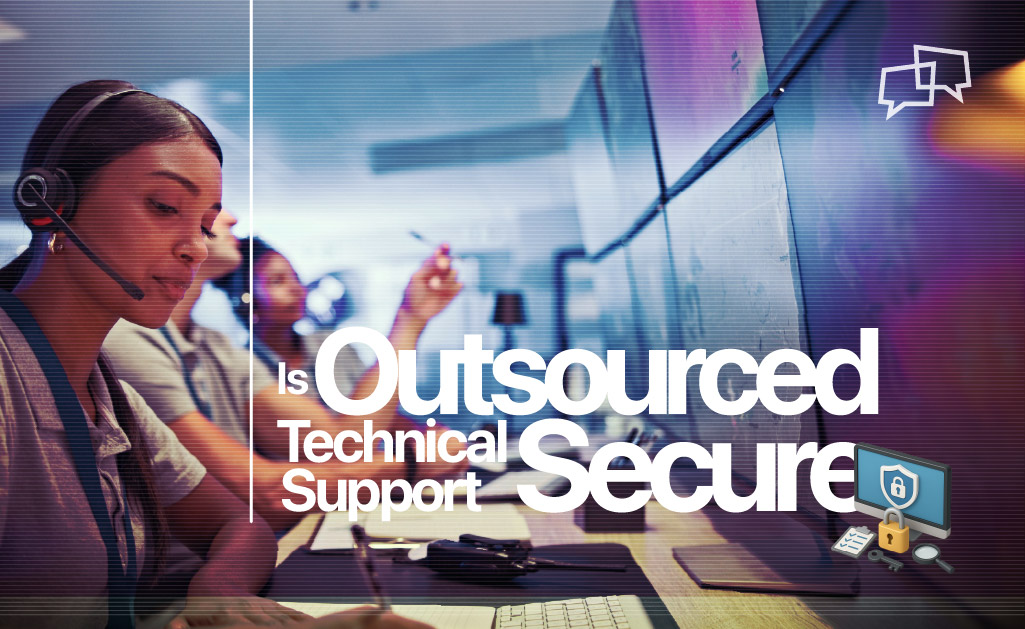
Is Outsourced Technical Support Secure?
Learn when outsourced technical support is secure, which risks to watch, how to evaluate vendors, and why nearshore support can improve oversight.
TL;DR — Quick Takeaways
- Outsourced technical support can be secure when access, workflows, training, monitoring, and incident response are designed correctly.
- Security risk is not caused by outsourcing alone. Risk grows when permissions are too broad, processes are unclear, oversight is weak, or speed is prioritized over control.
- The best providers operate under a shared-responsibility model where the client defines expectations and the provider executes with documented controls.
- Nearshore support can strengthen oversight through time-zone alignment, faster escalation, better collaboration, and closer operational rhythm.
If your support team touches customer accounts, payment details, health information, or internal systems, the question is not theoretical. Is outsourced technical support secure enough for your business, your customers, and your reputation? That depends less on outsourcing itself and more on how the operation is designed, managed, and monitored.
Security problems do not start because a team sits outside your office. They start when access is too broad, processes are undocumented, oversight is weak, or speed is valued more than control. A well-run outsourced support program can be highly secure. A poorly managed in-house team can be risky for the same reasons. The real issue is governance.
Is outsourced technical support secure in practice?
Yes, it can be. Many outsourced technical support teams operate under stricter controls than internal departments because they are built to meet client requirements from day one. Access can be limited by role, sessions can be monitored, workflows can be documented in detail, and compliance expectations can be written directly into the engagement.
That said, security is never automatic. Outsourcing introduces a shared-responsibility model. Your provider may manage staffing, facilities, supervision, and daily execution, but your company still needs to define security expectations, approve access levels, and verify that controls are being followed. If either side treats security as someone else’s job, gaps appear quickly. This is why businesses evaluating support partners should also review practical vendor security expectations, such as the FTC’s cybersecurity guidance for small businesses.
For growth-stage companies, this is where the decision often gets clearer. Building a secure internal support function takes time, management attention, training discipline, and infrastructure investment. The right outsourced partner can shorten that path, but only if they operate like an extension of your team and not a detached vendor. A structured vendor evaluation process can help separate real security maturity from sales language.
What actually makes outsourced technical support secure
Security in outsourced support comes down to a few operational fundamentals working together.
First, access control matters more than promises. Agents should only be able to reach the systems, records, and tools required for their specific role. If a password reset specialist can also view full billing histories or administrative settings without a business reason, that is a process problem. Secure programs use role-based access, approval workflows, and regular reviews to remove permissions that are no longer needed. This aligns with the broader zero-trust principle that access should not be granted simply because a user or device appears to be inside a trusted environment, as outlined in NIST’s Zero Trust Architecture.
Second, endpoint and environment security matter. If support agents are handling customer interactions on unmanaged devices, unsecured networks, or loosely monitored desktops, risk increases fast. Secure operations use controlled workstations, restricted downloads, session tracking, and clear rules about where and how customer data can be handled.
Third, people management is part of security. Technical support agents are often the front line for social engineering attempts. An agent who is rushed, undertrained, or disconnected from the client’s standards is more likely to be manipulated into giving away information or bypassing a process. Strong hiring, background screening when appropriate, structured training, and active quality assurance are not just service measures. They are security controls. This is where a disciplined quality assurance process becomes part of risk management.
Fourth, documentation matters. Secure support teams do not rely on memory or informal habits. They use approved scripts, escalation paths, verification steps, and incident procedures. This protects customers while also protecting your brand from inconsistent judgment calls.
The biggest risks to watch for
Most leaders ask whether outsourcing creates new risks. The better question is which risks become more visible once another company is involved.
Over-permissioned access is one of the most common issues. In fast-moving support environments, teams sometimes grant broad system access to avoid delays. That may feel efficient in the short term, but it creates unnecessary exposure. Good partners push back on this and help design narrower permissions.
Weak customer verification is another major risk. Technical support often deals with frustrated users who want quick help. If identity checks are vague or inconsistently applied, agents can be pressured into account changes they should never make. Secure providers train for this pressure and measure adherence, not just handle time. For password reset and account recovery workflows, teams can also compare their process against practical references like the OWASP Forgot Password Cheat Sheet.
Shadow processes are also dangerous. When agents invent workarounds to resolve issues faster, they may unintentionally bypass approved controls. This is why program design, supervisor oversight, and regular audits matter so much. A support operation should not depend on tribal knowledge.
Finally, there is the vendor visibility problem. If your outsourced partner cannot clearly explain how access is granted, how incidents are reported, who supervises the team, and what happens when an agent leaves the program, you are being asked to trust what you cannot inspect. That is not a security strategy.
How to evaluate a secure outsourcing partner
A secure provider should be able to answer practical questions without hesitation.
Ask how agent access is provisioned and removed. Ask whether credentials are unique to each agent and whether permissions are reviewed regularly. Ask how they separate teams serving different clients and how they prevent unauthorized data sharing across programs.
Ask about training. Not general onboarding, but training specific to data handling, identity verification, fraud awareness, escalation procedures, and incident response. Technical support security depends on repetition and reinforcement, not a one-time presentation. When compliance-sensitive workflows are involved, financial services compliance training can be a useful model for connecting policy requirements to real support scenarios.
Ask how quality assurance works. Security controls are only useful if someone is checking them in live operations. Reviews should include call handling, ticket behavior, authentication steps, and adherence to approved workflows.
Ask what happens when something goes wrong. A strong partner will have a defined incident response process, internal reporting paths, containment steps, and client communication standards. You do not want improvisation during a live issue. For a stronger framework, teams can review NIST’s Computer Security Incident Handling Guide, which explains why incident response requires planning, defined capability, and coordinated handling.
For many U.S. companies, geography also matters. A nearshore model can make oversight easier because time zone alignment, leadership accessibility, and cultural proximity support faster communication and stronger operational rhythm. That does not guarantee security, but it can make secure collaboration easier to maintain.
Why nearshore can strengthen security oversight
When support operates close to your business day, problems get surfaced faster. Questions about workflow changes, new access requests, or suspicious activity do not sit overnight waiting for clarification. That responsiveness can reduce exposure, especially in technical support where account access and troubleshooting decisions happen in real time.
Nearshore outsourcing can also improve collaboration between your internal IT, compliance, and support leadership teams. Reviews are easier to schedule. Escalations move faster. Process changes can be rolled out with less lag. For a company that wants outsourced support to function as an extension of its internal team, that operational closeness has real security value.
This is one reason companies working with providers like CallZent often look beyond labor savings. They want cost efficiency, but they also want tighter communication, accountable management, and a partner that can adapt without losing control of the details. For companies comparing delivery models, this guide to nearshore vs offshore outsourcing can help clarify the trade-offs around cost, coordination, and control.
Security is not just technical – it is cultural
One of the most overlooked truths in outsourcing is that secure operations come from stable teams. High turnover, low engagement, and weak supervision create avoidable risk. Agents who feel unsupported are more likely to make mistakes, miss red flags, or cut corners under pressure.
By contrast, when a provider invests in training, clear expectations, and agent empowerment, customers notice better service and businesses see stronger consistency. Security improves too, because engaged teams tend to follow process with more discipline and escalate concerns sooner. Culture does not replace controls, but it does affect whether controls hold up in the middle of a busy shift.
That is why the right partner talks about people and process together. Secure technical support is not only about software restrictions and policy documents. It is about building an environment where agents know what good judgment looks like and have the support to apply it every time. Strong reporting and KPI dashboards also help leaders spot patterns before they become larger operational or security issues.
So, is outsourced technical support secure for your business?
It can be very secure, and in some cases more secure than an overstretched internal team. But the answer depends on whether your provider has disciplined access management, controlled workflows, trained agents, visible oversight, and a culture that takes accountability seriously.
Outsourcing is not a shortcut around security responsibilities. It is a decision to share execution with a partner who should make your operation stronger, not more exposed. If you choose a provider that welcomes scrutiny, documents its controls, and operates as a true extension of your business, security becomes part of the value you gain, not a risk you accept.
The smartest next step is not asking for reassurance. It is asking better questions and choosing a partner whose answers stand up to real operational pressure. Companies evaluating outsourced support can start by reviewing how CallZent approaches nearshore support, operational alignment, and scalable customer service delivery.
🚀 Build Secure, Scalable Technical Support
CallZent helps businesses explore nearshore technical support models built around training, operational alignment, quality assurance, bilingual service, and scalable customer support delivery.