

Call Center Employee Retention
Master Call Center Employee Retention for 2026 Success
Learn a practical four-part framework to improve call center employee retention in 2026. Diagnose attrition, apply the right strategies, support agents with better technology, and measure ROI.
TL;DR — Quick Takeaways
- Call center employee retention is an operating problem, not only an HR problem.
- Strong retention work starts by diagnosing where attrition begins by tenure band, manager, shift, account, and stage of the agent lifecycle.
- The most effective strategy focuses on recruiting, onboarding, coaching, career paths, fair compensation, scheduling flexibility, and agent wellbeing.
- Technology should reduce agent effort, uncertainty, and stress instead of adding surveillance or tool overload.
- Retention ROI should connect lower attrition to service quality, cost per contact, overtime reduction, QA trends, and customer outcomes.
If your contact center feels like it’s always hiring, always training, and never fully stable, the problem probably isn’t effort. It’s the system. In 2026, the annual call center turnover rate averages between 40% and 45% across the industry, which means many operations replace nearly half their workforce every year, while a strong-performing center keeps attrition below 25% according to Insignia Resources’ turnover benchmarks.
That gap matters because turnover isn’t just an HR issue. It shows up in service quality, team morale, ramp time, and manager bandwidth.
The Revolving Door Problem in Call Centers
Frontline call center turnover is expensive long before finance totals it up. SHRM notes that replacing an employee can cost from six to nine months of that employee’s salary, and in contact centers that cost hits operations twice through hiring spend and lost production during ramp-up, as outlined in SHRM’s overview of replacement costs.
In practice, the revolving door shows up in places leaders feel every day. Queue performance gets less predictable. Quality scores swing wider because newer agents need time to build judgment. Team leads spend more time backfilling basic coaching and less time improving performance. Customers notice the inconsistency before executives do.
That is why retention belongs in the operating model, not in a side program run once a quarter.
The centers that reduce attrition do four things well:
- Diagnose where exits cluster, by tenure band, manager, shift, and account
- Strategize around the few retention levers that fit those patterns
- Implement changes in sequence, so scheduling, coaching, hiring, and tools support each other
- Measure whether retention gains also improve service levels, quality, and cost per contact
Random tactics rarely hold. A gift card campaign might lift mood for a week. A recognition event might help one supervisor’s team. Neither fixes a broken nesting period, a schedule mismatch, or a manager who burns through new hires in the first 90 days.
I have seen the same pattern across in-house centers and outsourced programs. Turnover falls when leaders treat attrition like any other performance problem. Find the failure point, fix the conditions behind it, and check whether the result holds for more than one month.
This also explains why delivery model matters. A nearshore partner with stronger labor stability, better supervisor coverage, and tighter hiring discipline can reduce the churn built into some domestic programs. For a closer look at the business impact, see this article on agent retention and the value of stability.
The point is simple. High attrition is not background noise. It is a signal that the operation is asking agents to succeed inside conditions that push them out.
Diagnosing the Real Causes of Agent Attrition
Attrition usually breaks in patterns, not at random. If agents are leaving in week three, after nesting, or right after a schedule change, the job is signaling where the operation is failing them. Good retention work starts by finding that point of failure.
Build a retention dashboard that shows where churn starts
A useful dashboard does not need fancy software. It needs the right cuts of data. Track exits by tenure band, line of business, shift, site, and direct manager. Then compare those patterns against attendance, quality, and schedule adherence.
Focus on a few indicators that point to root cause:
- Early exits after training: This often signals poor job preview, weak nesting support, or a schedule mismatch.
- Turnover by team lead: Large gaps between supervisors usually point to inconsistent coaching, poor escalation support, or avoidable pressure on the floor.
- Absenteeism before resignation: Call-offs often rise before an agent quits.
- Training graduation and post-training survival: Measure who finishes training and who is still on the floor 30, 60, and 90 days later. The SQM contact center benchmarking guide recommends separating these stages so leaders can see whether the loss is happening in hiring, training, or frontline management.
Many teams misread the problem. They report one blended attrition number, then argue about pay. That hides the difference between a recruiting issue, a nesting issue, and a supervisor issue.
If you support multiple clients or campaigns, keep those views separate. Billing support, sales, and technical troubleshooting create different stress patterns, and they need different fixes.
Ask better questions before people quit
Exit interviews still matter, but stay conversations usually produce better operational insight. Agents who are already leaving tend to compress the story into “better opportunity” because it is easier and safer. Agents who are still with you will tell you what is making the job harder than it needs to be.
Use direct questions:
- What made the job different from what you expected
- What part of the shift or schedule creates the most strain
- Which manager behaviors help you do the job well
- What happens on difficult calls that makes you think about leaving
- What would make you stay another year
Then match those answers to the operating data. If one team reports inconsistent coaching and that same team has weak attendance, low QA confidence, and short tenure, the issue is probably not compensation alone.
I have seen leaders blame the labor market for churn that was clearly local. One manager overuses public callouts. Another changes schedules with little notice. Another rushes agents onto live contacts before they are ready. All three create avoidable exits.
For teams comparing domestic and nearshore delivery options, this breakdown of common hurdles affecting call center operations in Mexico high agent turnover is useful because it shows how labor conditions and operating discipline interact.
Fix the metric habits that hide attrition
One reporting mistake causes more confusion than any other. Teams measure attrition from total hires instead of from training graduation and production readiness. That inflates the denominator and masks where the leak originates.
Use a stage-based view instead:
- Accepted offer to training start
- Training start to training graduation
- Graduation to 30 days in production
- 30 to 90 days
- 90 days and beyond
That approach gives managers something they can act on. If losses spike before graduation, tighten hiring and training design. If they spike after graduation, look at nesting support, supervisor quality, schedule fit, and tool friction.
The same discipline shows up outside the contact center field too. Teams focused on effective employee retention in the UK also separate broad turnover numbers from the day-to-day conditions that push people out.
Strong diagnosis does more than explain attrition. It tells you which retention levers are worth using, in which order, and where a nearshore partner such as CallZent may give you an advantage through tighter hiring control, steadier labor pools, and better frontline coverage.
Strategic Levers to Improve Call Center Employee Retention
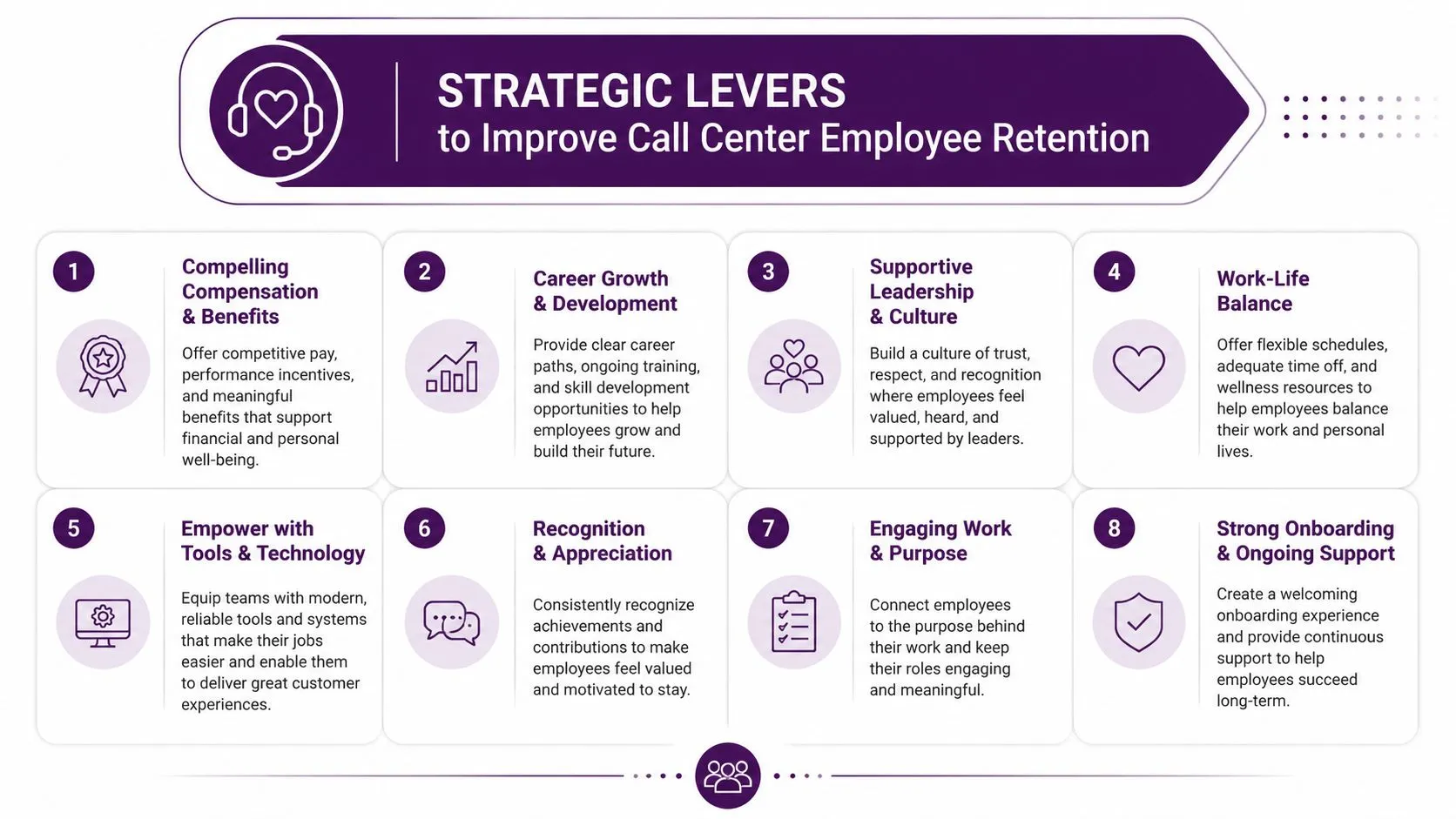
A retention plan works when it changes the agent experience in specific places: hiring, first 90 days, manager behavior, pay design, and schedule control. In the Diagnose, Strategize, Implement, Measure framework, this is the Strategize stage. The goal is to pick levers that match the attrition pattern you already found, instead of rolling out generic perks and hoping turnover drops.
Smarter recruiting and onboarding
Retention often breaks before an agent ever takes a live call. If recruiting oversells the role or hides schedule realities, the center starts with a mismatch that training cannot fix.
Start with a realistic job preview. Show candidates the pace, the systems, the customer frustration level, and the actual scorecard. Then screen hard for schedule fit and commute tolerance if the role is on site. I have seen solid hires wash out in 30 days because leaders treated shift fit as a secondary issue.
Onboarding also needs structure. SHRM’s guidance on employee onboarding points to the value of a planned, multi-stage process rather than a one-week information dump, especially when the goal is early retention and productivity, as outlined in SHRM’s onboarding recommendations. In practice, the best call center version is phased. Start with product knowledge and systems training, move into supervised calls, then raise volume in steps while team leads check work daily.
That pacing matters even more in outsourced environments where clients want speed. A nearshore partner like CallZent can help here because hiring, training, and nesting can be standardized across programs instead of rebuilt account by account.
Meaningful coaching and visible career paths
Agents stay longer when coaching improves performance instead of documenting failure. That sounds obvious, but many centers still run quality reviews like disciplinary meetings.
A better model is simple. Supervisors review a narrow set of behaviors, connect them to customer outcomes, and agree on one or two changes for the next week. The conversation is about skill growth, not score defense.
Career pathing has to be just as concrete. Agents should be able to answer four questions without asking HR:
| Focus area | What good looks like |
|---|---|
| Career tiers | Agents can see the next role or skill band |
| Evaluation timing | Reviews happen on a set cadence |
| Skill requirements | Promotion criteria are documented and used consistently |
| Coaching style | Managers teach, calibrate, and remove blockers |
This matters beyond contact centers. The same issue shows up in effective employee retention in the UK, where transparency around growth and expectations is tied closely to whether people stay.
For frontline teams, visible progression can mean specialist queues, QA cross-training, workforce planning support, or team lead preparation. Not every strong agent wants management. Many want proof that better work leads to better options.
Fair compensation and a culture that does not push people out
Pay sets the baseline. If agents believe the job is harder than the paycheck justifies, every other retention initiative has to work twice as hard.
The NICE WFM Global Survey found that 72% of customer service agents said better pay would have the highest impact on their decision to stay. The same survey reported high levels of stress and burnout. That combination should shape compensation strategy. Pay is not only about attraction. It is also about whether the daily strain feels worth carrying.
The structure of pay matters too. Variable comp should reward outcomes agents can influence without encouraging bad behavior. Good plans usually combine a stable base rate with incentives tied to quality, customer satisfaction, attendance, and tenure. Bad plans overpay for handle time reduction and create exactly the pressure that drives exits.
One rule has held up across every operation I have run. Do not build incentives that force agents to choose between helping the customer and protecting their bonus.
Culture shows up in the same place. Micromanagement, inconsistent enforcement, and public score shaming push attrition higher even when base pay is competitive. Teams stay steadier when managers trust agents to solve problems within clear limits. For a practical look at that model, see why giving agents more autonomy improves call center performance.
Flexible scheduling and agent wellbeing
Schedule control is one of the fastest retention wins because it changes daily life immediately. Pay adjustments take budget approval. Career paths take time to build. Better shift design can reduce friction this month.
Gallup found in its review of workplace flexibility that employees strongly value flexibility in where and when they work, and that the option affects retention and engagement, especially for people balancing caregiving, commuting, or schooling demands, as detailed in Gallup’s research on flexible work. For call centers, that does not automatically mean full remote. It means rigid attendance rules should be a deliberate choice with a clear service reason, not a habit.
Benefits matter in the same practical way. Health coverage, paid time off, retirement support, and mental health resources reduce the pressure that builds outside the contact center and eventually shows up as absenteeism or resignations. WorldatWork’s analysis of pay and benefits strategy also notes that employees weigh total rewards, not just hourly wage, when deciding whether to stay, especially in tight labor markets, as discussed in WorldatWork’s guidance on total rewards.
A workable model usually includes:
- Remote-eligible roles where the process supports it: Keep in-person time for training, calibration, or client requirements
- Governed shift swaps: Let agents solve personal conflicts without begging for exceptions
- Clear benefits communication: Explain health, retirement, and time-off policies in plain language
- Recovery planning after high-stress queues: Add staffing relief, coaching, or temporary rotation after difficult periods
This is also where a nearshore model can create an advantage. Providers such as CallZent can often offer schedule coverage across time zones, larger hiring pools, and lower commute friction, while still keeping cultural alignment and management visibility close enough for tight operational control.
Using Technology as an Agent’s Copilot
Poorly deployed tech drives turnover faster than many leaders expect. Agents feel it every day in longer after-call work, extra tabs, constant alerts, and QA tools that seem built to catch mistakes instead of prevent them.
The retention test is simple. Every tool in the stack should reduce effort, reduce uncertainty, or reduce stress during live work. If it does none of the three, it is overhead.
Use WFM to give agents more day-to-day control
Workforce management usually enters the business as a staffing tool. It also shapes whether agents feel trapped by the job. In operations with high attrition, I usually find the same pattern: schedules are technically optimized, but agents have very little room to handle real life without manager intervention.
Use WFM in ways agents can feel:
- Shift preferences: Collect and use preferred hours before schedules are finalized
- Shift swaps: Set clear rules so swaps do not depend on supervisor discretion
- Time-off visibility: Let agents see balances, submit requests, and track approvals in one place
- Break flexibility: Allow limited choice where service levels and occupancy can support it
That kind of control lowers daily friction. It also cuts the manager time wasted on exceptions, side messages, and avoidable attendance disputes.
Use AI to reduce cognitive load during live calls
AI helps retention when it supports the agent in the moment. It hurts retention when it acts like a scorekeeping layer sitting on top of an already hard job.
The best use cases are narrow and practical. Surface the right article while the customer is still talking. Suggest the next step for a new hire handling a billing dispute. Draft the case summary so the agent is not spending extra minutes rewriting the call after it ends. These are not flashy wins. They are the kind that make a shift feel manageable.
For many teams, the right model is a background support layer such as real-time agent assistance for live call guidance and knowledge prompts. It keeps the agent in one workflow instead of forcing a search across systems, macros, and policy documents.
A separate perspective from McKinsey’s research on customer care AI also points in the right direction. Their analysis of generative AI in customer care focuses on faster issue resolution, agent assist, and lower effort during service interactions, not tighter surveillance of frontline staff.
Here is the operating rule. If a tool makes supervisors feel informed but makes agents feel watched, attrition will rise.
Keep digital connection useful in hybrid teams
Remote and hybrid teams do not need more messages. They need faster answers, visible coaching, and recognition that feels tied to real work.
A smaller, better-used set of tools usually performs better than a bloated stack:
| Tool category | Retention value |
|---|---|
| Team chat | Faster help during difficult contacts and less isolation between queues |
| Shared knowledge base | Less searching, fewer avoidable errors, and more confidence for newer agents |
| Coaching platform | More consistent follow-up, clearer action items, and better manager discipline |
| Gamification tools | Short bursts of engagement if they support quality, not just speed |
The trade-off is real. More tools can improve support, but they also create noise. Good operators review usage, retire low-value platforms, and keep the stack focused on work that helps agents perform with less strain.
Your Six-Month Retention Implementation Roadmap
Retention programs fail when leaders launch too much at once. Agents hear announcements, managers juggle new tasks, and nothing really changes on the floor. A phased plan works better because it lets operations fix obvious pain first, then build deeper changes on top.
Months one and two for foundation and quick wins
Start with actions that show agents you’re serious.
In the first phase, focus on:
- Recognition cadence: Build a simple weekly and monthly recognition rhythm that managers can sustain
- Communication cleanup: Standardize where schedule updates, policy notes, and coaching feedback live
- Exit and stay interview process: Tighten the questions and assign ownership for trend review
- Team-lead review: Identify which supervisors need support, coaching, or accountability
This is also the right moment to review any metric that may be driving unnecessary pressure. If your operation rewards low handle time at the expense of quality, you’re likely feeding stress and turnover.
A phased rollout also gives leaders time to explain the “why.” That’s critical. Agents don’t trust retention programs that feel like another management project.
Months three and four for structural changes
This phase is where the work gets more serious. Quick wins help morale, but structural fixes change outcomes.
Priorities here usually include:
-
Structured onboarding redesign
Replace any sink-or-swim process with a phased ramp, stronger nesting, and clearer readiness gates. -
Schedule flexibility upgrades
Add shift preference logic, swap processes, or more transparent time-off workflows through your WFM setup. -
Manager coaching standards
Define how often one-on-ones happen, what gets discussed, and how coaching quality is reviewed. -
Tool simplification
Remove duplicate systems, improve knowledge access, and reduce the number of clicks needed for common tasks.
A lot of companies stall here because they try to fix everything in one committee. That rarely works. Assign one owner for onboarding, one for workforce practices, and one for frontline leadership habits.
For organizations rethinking their operating model more broadly, the perspective behind why CallZent can help frame what a stable, agent-centric service environment should look like.
Months five and six for optimization and scale
Once the basics are in place, formalize what agents need in order to believe the changes are permanent.
That usually means:
- Career path launch: Publish role tiers, skill requirements, and review windows
- Compensation alignment: Make sure pay progression and incentives support the behaviors you want
- Benefits communication refresh: Re-explain the full package in plain English
- Leadership scorecards: Hold managers accountable for attrition, engagement trends, and coaching follow-through
Sustainable retention work looks boring from the outside. That’s a good sign. It means the process is becoming part of normal operations.
This final phase is also where you review what agents used. Did they take advantage of flexible scheduling options? Are managers holding the one-on-ones they promised? Are newer agents getting support at the points where they tend to struggle?
Call center employee retention improves when systems become consistent, not when initiatives sound exciting.
Measuring Retention Success and Calculating ROI
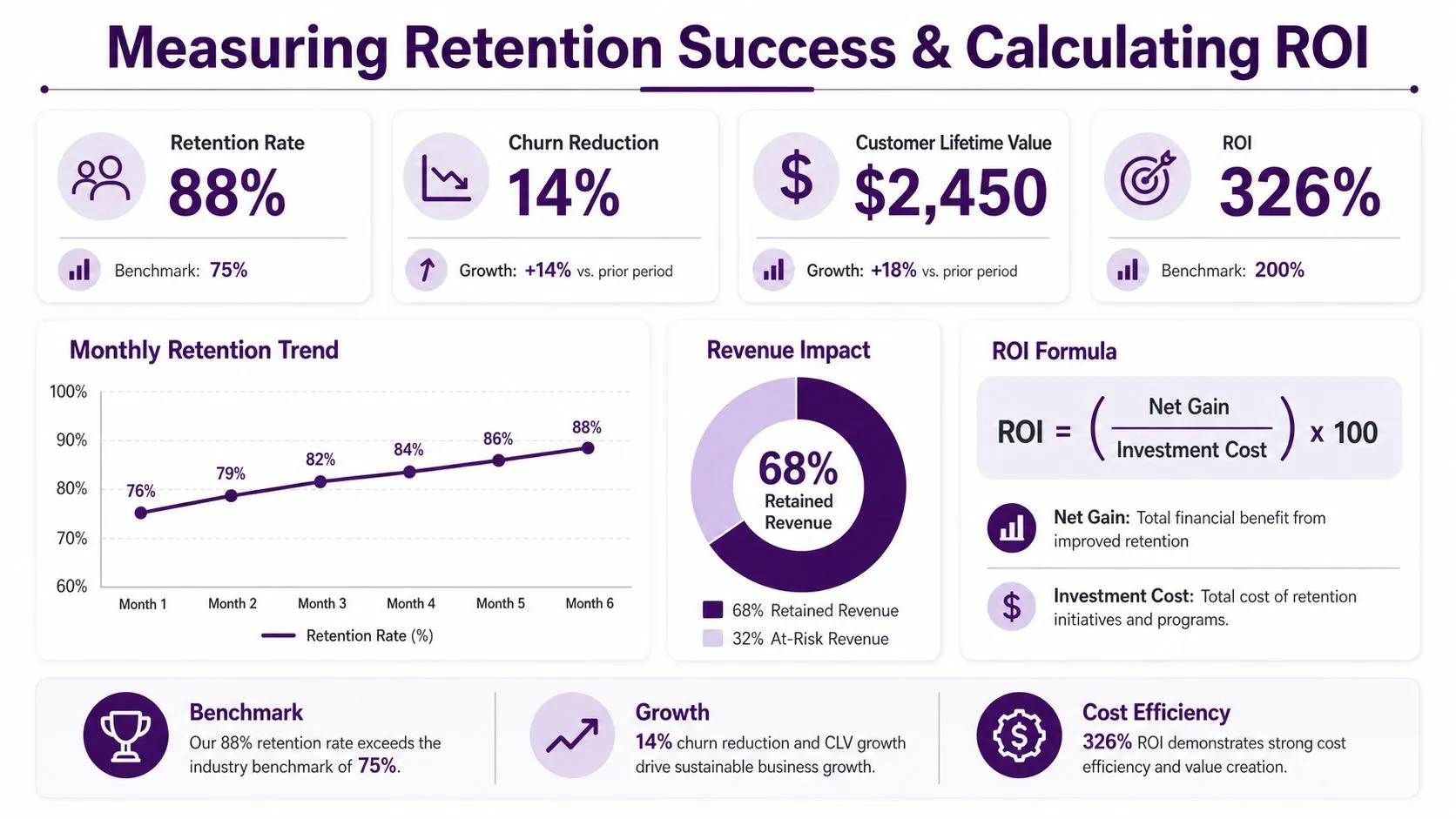
A center can spend heavily on hiring and still fall behind if it cannot keep agents long enough to become productive. Retention measurement fixes that by tying people stability to service quality, labor cost, and margin.
Start with a scorecard that reflects the full agent lifecycle
A single annual turnover number is too blunt to guide action. It tells you the outcome, but not where the system is breaking.
Measure retention at four points in the framework used throughout this article:
- Diagnose: early attrition in training, nesting, and the first 90 days
- Strategize: turnover by program, shift, site, and manager
- Implement: training completion, coaching completion, schedule change requests, and absenteeism
- Measure: annual retention, post-training retention, engagement trends, and quality results
Post-training retention deserves its own line on the scorecard. If agents leave before or right after nesting, the hiring team may look productive while operations is still losing money.
Turnover by manager also matters more than many leadership teams want to admit. In my experience, retention problems often cluster around a few supervisors, not across the whole center.
For a broader operating view, use these customer service KPI benchmarks and definitions alongside your retention scorecard.
Tie retention to service outcomes, not HR reporting
Retention work gains support when operations leaders can show what changed on the floor.
Track retention against:
| Metric | Why it matters |
|---|---|
| CSAT | Experienced agents usually handle complex conversations with more confidence |
| FCR | Lower churn means more tenured agents who can solve issues without repeat contacts |
| QA trends | Stable teams respond better to coaching and produce more consistent scores |
| Schedule adherence | Lower attrition reduces last-minute coverage gaps and overtime pressure |
| AHT by tenure band | This shows whether ramp and knowledge transfer are improving |
Look for patterns, not isolated wins. If retention improves but CSAT stalls, the issue may sit in workflow design, weak coaching, or poor knowledge access. If retention improves and overtime drops, that is a direct operational gain finance can understand.
Build the ROI case with finance-ready categories
Retention ROI does not need a complicated model. It needs a credible one.
Start with the avoidable cost of each departure:
- Hiring cost: recruiter time, assessments, interviews, background checks, and admin
- Training cost: facilitator hours, nesting support, QA calibration, and system access
- Ramp loss: lower productivity while new agents climb to target performance
- Coverage cost: overtime, shrinkage pressure, service level misses, and supervisor firefighting
- Quality cost: repeat contacts, escalations, refunds, or customer churn tied to inexperienced handling
Then compare those costs with what you spent to reduce attrition, such as better onboarding, stronger supervisor training, schedule flexibility, knowledge tools, or AI assistance.
The four-part framework pays off. Diagnose shows where attrition starts. Strategize identifies which levers are worth funding. Implement turns those decisions into operational changes. Measure proves whether the changes reduced exits and improved output.
A nearshore partner can change the math as well. Providers such as CallZent can reduce retention risk by combining bilingual talent access, closer time-zone alignment, and an operating model built around agent support instead of constant replacement. That does not remove the need for good management. It gives you a stronger starting point.
Retention earns budget approval when it is reported like any other operating priority, with clear ownership, trend lines, and a plain-language financial impact.
🚀 Build a More Stable Call Center Team
If your operation is struggling with hiring, training, turnover, and inconsistent service quality, CallZent can help you build a more stable nearshore support model with bilingual talent, stronger supervision, and scalable customer experience operations.
Talk to an Expert
Call center employee retention is one of the clearest tests of whether your operation is built to keep people productive long enough to serve customers well.