Skip to content

Industry Expertise
Industry Expertise in BPO: How to Evaluate Real Domain Knowledge
Learn how industry expertise helps BPO buyers evaluate partners, improve forecasting, strengthen compliance, protect customer experience, and build more effective outsourcing relationships.
TL;DR — Quick Takeaways
- Industry expertise is not a slogan. It is measurable operating knowledge that improves forecasts, compliance, service quality, and decision-making.
- A BPO partner with real domain depth can identify workflow gaps, escalation risks, compliance issues, and customer-experience problems before they become expensive.
- Buyers should test expertise with evidence, not tenure. Ask for training proof, QA calibration, reporting examples, and messy-case handling.
- Expertise looks different by industry. Healthcare, insurance, finance, e-commerce, and telecom each require different workflows, vocabulary, risk controls, and service priorities.
- The best BPO partnerships integrate knowledge transfer, QA calibration, reporting design, and continuous improvement from the beginning.
You’re sitting between two finalist BPO pitches. One has polished slides, vague promises, and a lot of talk about “scalability.” The other asks sharper questions about your claims workflow, backlog patterns, escalation rules, and where compliance breaks in real life. That’s usually where industry expertise stops being a slogan and starts being a buying decision.
If you’ve ever had to defend a partner choice to leadership, you already know the problem. A provider can sound experienced and still miss the details that move outcomes, while a smaller, more focused team can spot the bottlenecks faster because they’ve lived inside the work. The difference shows up in forecasting quality, compliance handling, and how customers are treated when the case gets messy.
Why Industry Expertise Decides Which BPO Partnership Actually Works
The easiest BPO pitch to like is the one that sounds smooth. The harder one to evaluate is the team that keeps interrupting the conversation with specific questions about your process, your exceptions, and the decisions your agents need to make under pressure. That second team often looks less polished, but it’s usually the one that understands industry expertise as operating knowledge, not theater.
That matters because a vendor who only executes scripts can follow a workflow without improving it. A partner with real domain depth can tell you where the workflow breaks, where the policy creates avoidable escalations, and which customer issues should be routed differently on day one. For a buyer trying to reduce risk and improve service, that difference is the whole point of outsourcing, not an optional extra. If you need a baseline on the function itself, CallZent’s overview of what business process outsourcing covers is a useful starting point.
What the buyer should be able to defend internally
Inside procurement, operations, or finance, the core question is simple. Can this partner improve outcomes without creating hidden costs? A strong answer usually comes from visible proof, not brand polish, and it should include the operational details leadership cares about, not just the sales story.
Practical rule: If a partner can’t explain how they handle exceptions, they probably don’t have the domain depth you need.
A useful way to think about it is this. Industry expertise is the ability to translate sector-specific knowledge into decisions that hold up under volume, regulation, and customer pressure. In practice, that means the team knows which metrics matter, which cases need special handling, and which decisions should never be left to generic scripting.
Buyers also need to separate expertise from years-in-market language. A provider can be active for a long time and still underperform if it hasn’t built the right feedback loops, reporting, and QA discipline. The best selection conversations feel less like a vendor beauty contest and more like a proof exercise.
What Industry Expertise Means in Practice
Industry expertise is not just “we’ve worked in your vertical.” That phrase is cheap unless it changes the quality of decisions. In practice, expertise means the team can make better calls on forecasts, compliance, customer routing, escalation priority, and the metrics that tell you whether the operation is healthy.
A useful working definition is this. Expertise is domain depth that produces better outcomes under real operating pressure. In a BPO context, that shows up when a partner can interpret a policy change, handle an edge case without improvising nonsense, and explain the business consequences in plain English.
The evidence lines up with that definition. A widely cited study on analyst specialization found that analysts with deeper sector knowledge produced KPI forecasts with 27% lower forecast error than non-industry experts after controls, and alternative model specifications still showed lower errors of 17.5% and 12.9% in the same research (industry expert analyst forecast study). That matters because buyers do not feel forecast error as a statistic. It shows up later in staffing, inventory planning, and investor guidance.
Where credible expertise comes from
Strong industry knowledge should be built from validated sources, not just anecdotes from one seasoned operator. Guidance for industry research points to government agencies, trade associations, international organizations, and major statistical databases as the backbone of credible data work, including the Census Bureau, Bureau of Economic Analysis, Bureau of Labor Statistics, OECD, IMF, and World Bank datasets (industry statistics guidance). That is the kind of sourcing discipline buyers should expect from a serious BPO partner too.
CallZent’s breakdown of the ROI of call center outsourcing is a useful reminder that the business case depends on measurable operating results, not claims about familiarity.
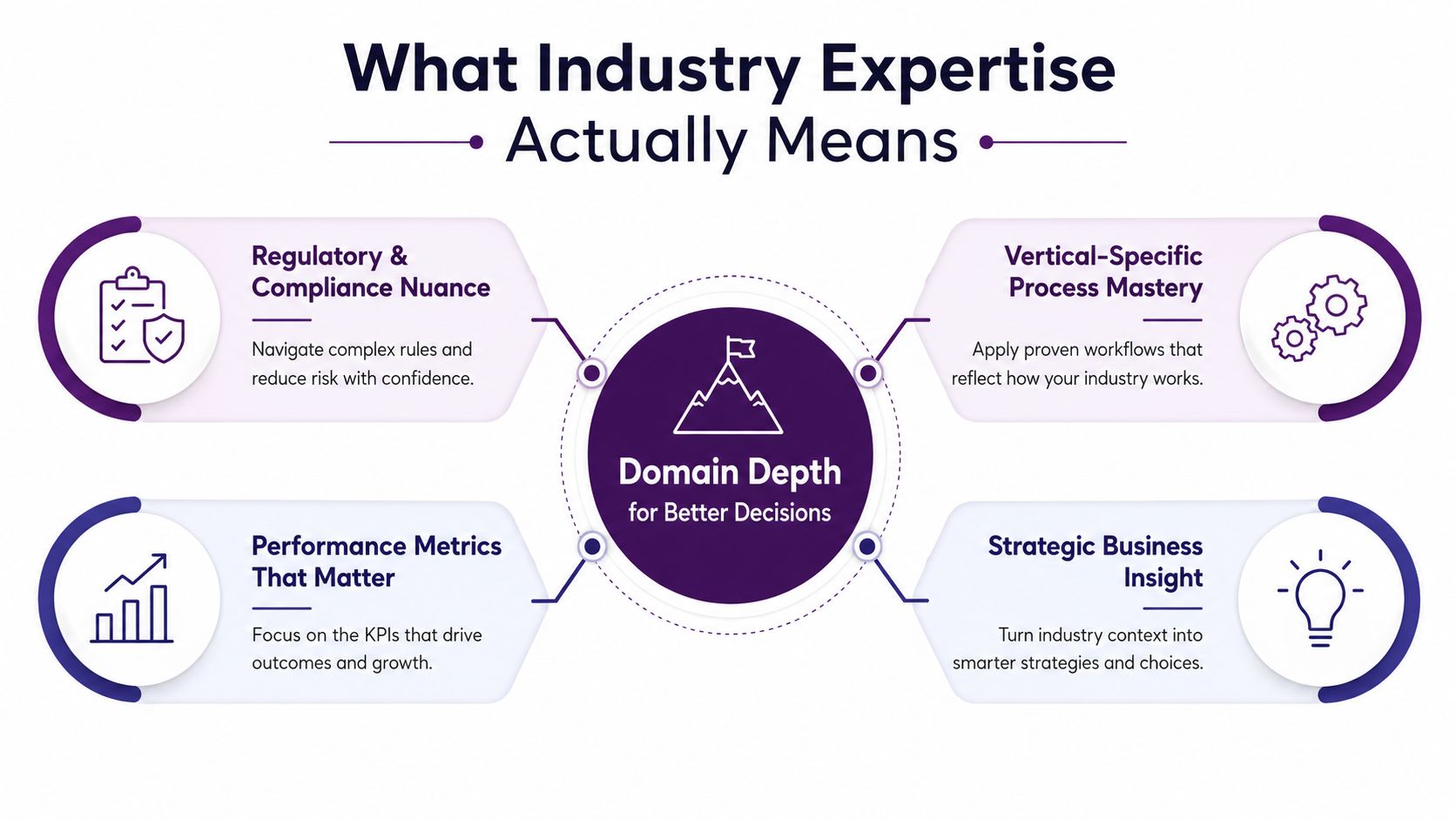
The practical takeaway is blunt. Industry expertise is testable. You can ask where the partner gets its policy updates, how it calibrates QA, what it does with recurring exceptions, and which metrics it uses to prove that knowledge is changing outcomes. If those answers stay vague, the expertise probably is too.
Business Value You Can Measure and Defend
Leadership doesn’t buy “expertise” because it sounds polished. Leadership buys it when the numbers improve, the risk profile stays controlled, and customer interactions become more accurate under pressure. That is why industry expertise should be treated as a business asset, not a branding claim.
ROI is where the proof starts
Start with forecast quality. A partner that understands your vertical should make planning steadier because the team is less likely to misread patterns, miss exceptions, or react too fast to noise. The analyst specialization research shows that lower forecast error is not just a technical metric, it affects budget discipline and operating decisions (industry expert analyst forecast study).
The same logic shows up at the board level. A Harvard Business School study found that firm value is significantly higher when industry experts serve on the board (Harvard Corporate Governance study on industry expertise). For outsourcing buyers, the point is straightforward. Domain knowledge improves decision quality, and better decisions show up in value.
Compliance is where generic support breaks down
Scripts fail at the edges. That is where industry knowledge matters most, because edge cases are usually where compliance exposure lives. In regulated environments, a team with real domain depth can catch the unusual scenario that a generic workflow would miss, especially when policy language changes in the middle of a cycle.
Process tracking matters here too. In manufacturing, expert practice means monitoring defect rates, root-cause categories, supplier on-time delivery, lead times, inventory turnover, and forecast accuracy through operational systems so anomalies can be caught before they spread (manufacturing metrics guidance). The same principle applies in service operations. If the team cannot see the failure pattern, it cannot fix the failure pattern.
Customer experience is now part of expertise
Customer expectations keep tightening. A recent global survey found 62% of customers now expect quicker responses than they did a year ago, 65% expect more personalized service than they did a year ago, and 78% of support leaders say case complexity has increased (underserved markets and support complexity survey). That combination changes what expertise has to do. It is not just subject-matter depth anymore, it is the ability to turn that depth into faster routing, clearer answers, and more consistent handling.
A board-ready way to frame the value is below.
| Outcome | What to Measure | Why It Matters |
|---|---|---|
| ROI | Forecast accuracy, rework rate, staffing stability | Better predictions reduce avoidable operating waste |
| Compliance | Audit findings, exception handling quality, policy adherence | Domain knowledge lowers exposure in edge cases |
| Customer experience | First response quality, resolution consistency, escalation volume | Expertise improves speed without sacrificing accuracy |
If you need a broader view of how outsourcing economics should be framed, the ROI of call center outsourcing is the right internal reference point.
How to Evaluate a BPO Partner for Real Expertise
A real evaluation doesn’t start with a proposal deck. It starts with evidence the partner can handle your worst day, not just your cleanest workflow. That’s especially important now, since support complexity has increased and buyers can’t afford to mistake confidence for competence.
Use a checklist, not a gut feel
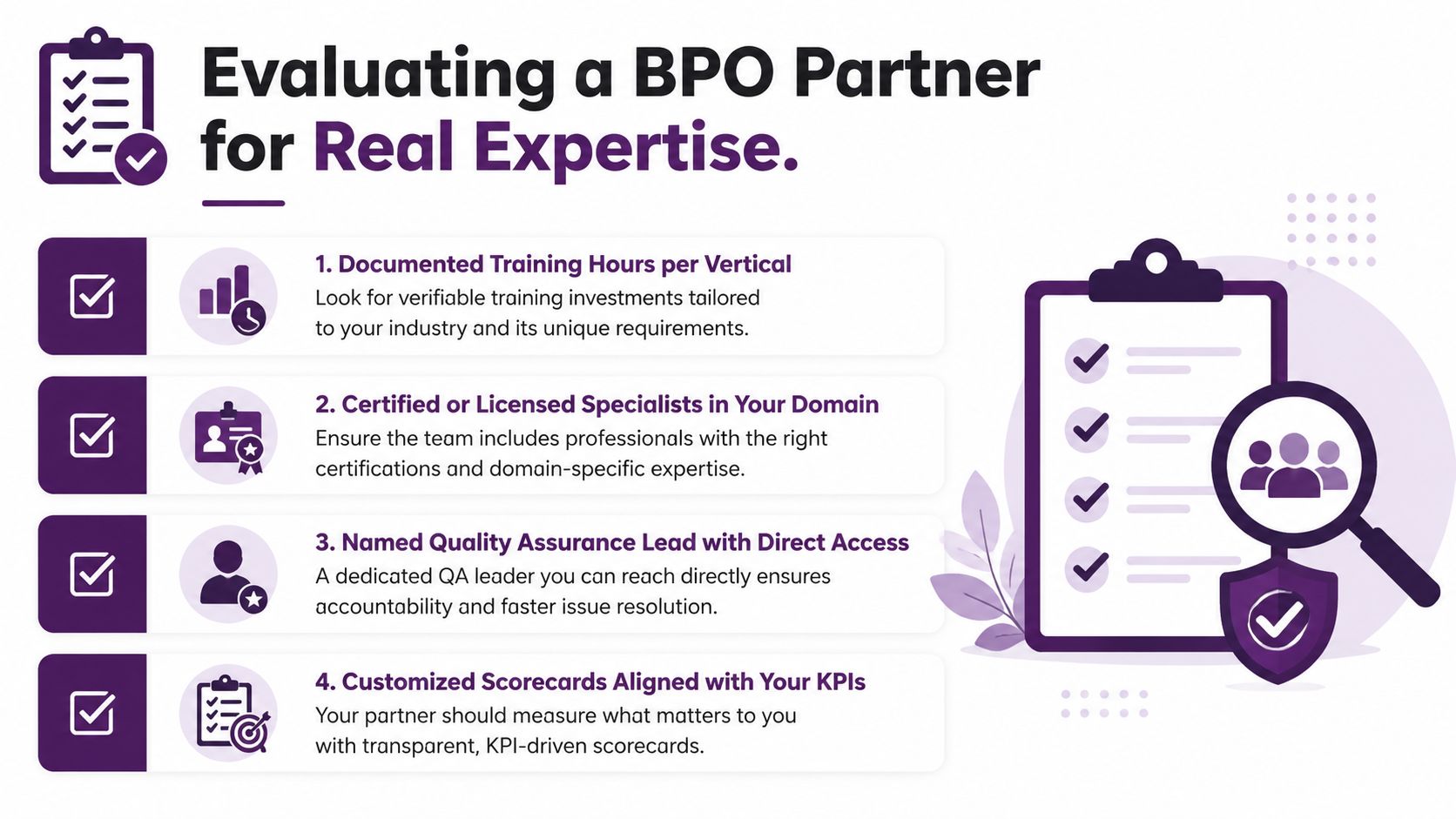
Start with what the partner can document. Ask for vertical-specific training details, named QA ownership, and examples of how reporting connects to your business KPIs rather than generic contact center metrics.
- Documented training by vertical: Ask how long agents train on your industry, what materials they use, and how they verify comprehension.
- Certified or licensed specialists: If your work touches regulated processes, confirm who is qualified to touch the queue.
- Named QA lead with direct access: A serious partner can identify who calibrates quality and who resolves disputes.
- Custom scorecards tied to your KPIs: If the scorecard doesn’t reflect your operational goals, it won’t help you manage performance.
Use the vendor evaluation criteria page as an internal reference if you need to standardize the review.
Ask questions that expose real depth
These questions work because they force the vendor out of generic answers:
- How do you handle a regulatory update in the middle of a billing cycle?
- What happens when a customer’s issue sits between two departments and the script doesn’t cover it?
- Show me how you calibrate QA when the case mix changes.
- What evidence do you have that your team has handled similar-volume programs before?
You’re looking for specificity, not charisma. If the answer relies on vague claims about “flexibility” or “experience,” that’s usually a sign the partner has not operationalized expertise. If they can’t demonstrate how they respond under pressure, they probably haven’t built the right muscle for a high-volume environment.
Ask for the messy case, not the happy-path demo. The answer tells you more than the slide deck ever will.
Sector-Specific Examples of Expertise at Work
The same phrase, industry expertise, looks very different depending on the vertical. That’s why buyers should never accept a one-size-fits-all service description. A team can sound strong in one sector and still be a poor fit in another if it doesn’t understand the workflow, vocabulary, and risk points that shape the work.
Healthcare and insurance need different kinds of precision
In healthcare, expertise means handling sensitive information carefully, using the right prior authorization language, and routing clinical escalations correctly. Generic support often gets trapped in scripted empathy without knowing when to stop talking and escalate. Expert support knows how to protect the process and the patient experience at the same time.
Insurance has a different rhythm. First-notice-of-loss intake, claims status updates, and high-volume empathy all matter, but the team also needs to keep the interaction clean and document the right details the first time. A generic queue can create repeat contacts fast, while a trained queue reduces confusion because the conversation is structured around the claim lifecycle.
Finance, e-commerce, and telecom each punish different mistakes
In finance, the biggest risk is usually not tone alone, it’s how the team handles KYC edge cases, dispute resolution under time pressure, and collections language. The wrong phrasing can create avoidable friction or compliance exposure. Expert teams know where firmness matters and where clarity matters more.
E-commerce looks simpler until peak season hits. Then expertise shows up in staffing math, returns triage, and carrier-issue navigation. Generic support can answer a ticket, but an experienced team knows which issue belongs with the carrier, which one needs internal escalation, and which customers need a faster explanation to keep churn down. For operators building that capability, Online Brand Growth’s playbook offers a useful lens on market pressure and customer-facing execution.
Telecom is its own test. Tier-1 diagnostics, outage communication, and retention conversations require clean triage and calm language because customers usually call when service is already interrupted. A team that understands the service map can reduce wasted transfers and keep the customer informed without overpromising.
CallZent’s own top industries for nearshore outsourcing page is a helpful internal resource if you’re mapping which verticals fit a nearshore model.
Implementation Steps for Integrating an Expert BPO Partner
The fastest way to ruin a good partner is to onboard it like a handoff. Expertise only creates value when knowledge transfer, QA, reporting, and ownership are set up as a working rhythm. That takes structure.
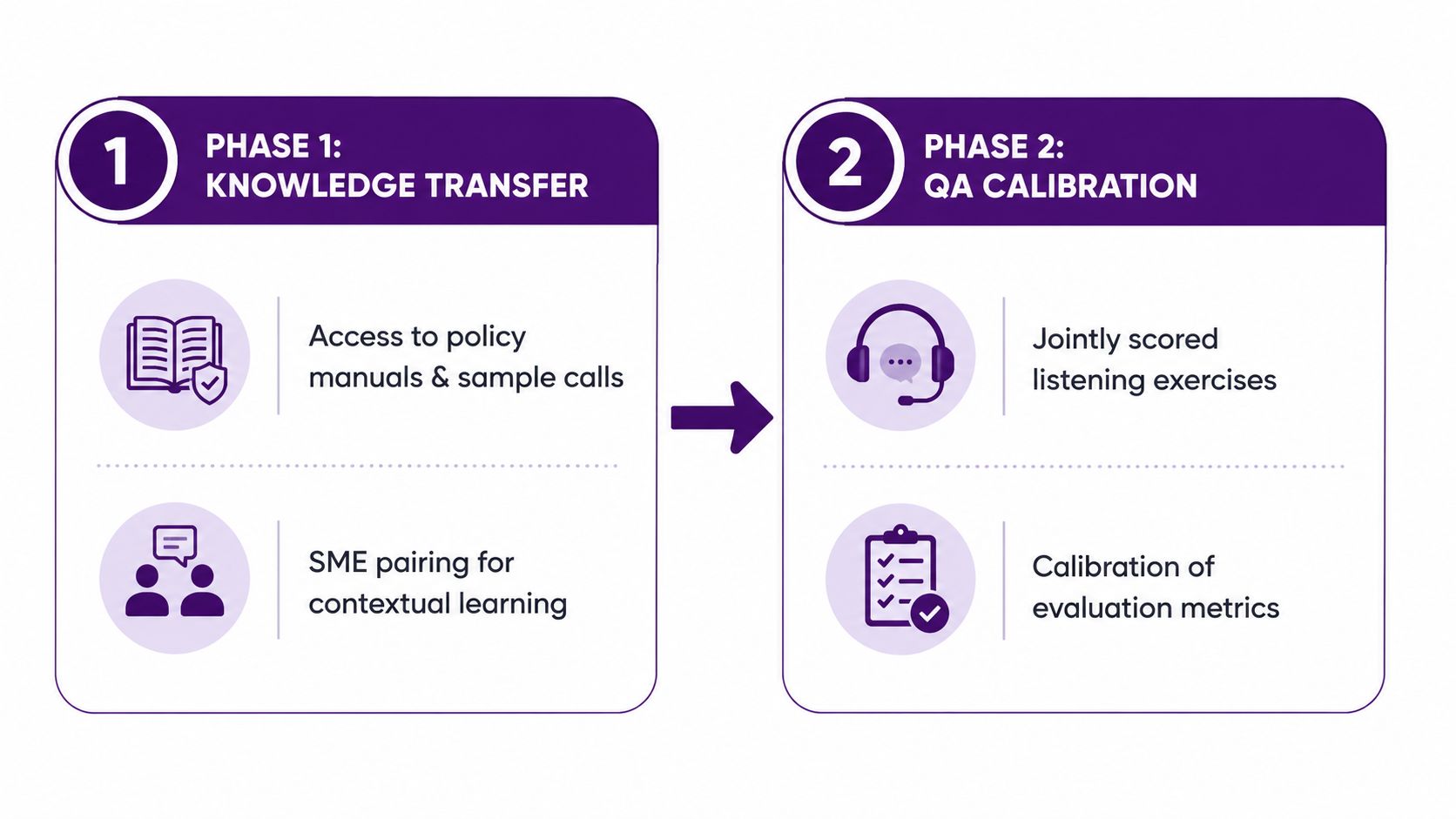
Phase 1 starts with knowledge transfer
Give the partner full operating materials. That means policy manuals, sample calls, escalation examples, and access to the subject matter experts who can explain why the rules exist, not just what the rules say. If the team only gets a script, it will only perform like a script.
Phase 2 is QA calibration
The best teams listen to calls together before they go live at scale. Joint scoring sessions reveal where the client and the provider disagree on quality, and that disagreement is usually where the process leaks. Calibration should also define the thresholds that matter, because fuzzy standards create fuzzy results.
Phase 3 is reporting design
Dashboards should expose the metrics that matter for operations, not vanity counts that look tidy on a slide. Build reporting around the measures discussed earlier, then make sure both teams can read the same story from the numbers. If the dashboard doesn’t help you make a decision, it’s just decoration.
Phase 4 is continuous improvement
Monthly trend reviews should point to root causes, not just red and green indicators. Assign ownership for fixes, track what changed, and keep the optimization roadmap visible to both sides. Collaboration matters most, because the client has to stay involved in strategy and performance tracking if the partner is expected to keep improving.
Nearshore bilingual coverage, 24/7 operations, and a customized service model can help here when they’re tied to the actual process instead of sold as standalone features. The cultural fit matters too, because capable agents and bilingual fluency make it easier to resolve issues without losing speed or tone.
Common Pitfalls and Measurable Outcomes
The biggest mistake buyers make is assuming a polished pitch equals usable expertise. That assumption usually breaks in the first 30 days, and the symptoms are predictable.
What goes wrong first
- Certifications without proof: The team sounds credentialed, but can’t handle live exceptions. The fix is to require demonstrated handling of real cases before scale-up.
- Generic scripts ignoring regulation: The operation looks consistent until a policy edge case lands. The fix is vertical-specific QA and a compliance review path.
- Weak data instrumentation: Leaders can’t tell whether the program is improving. The fix is a dashboard tied to training completion, calibration scores, first-call resolution, CSAT, compliance findings, and forecast accuracy.
- Black box partnership: The client gets reports, but not visibility. The fix is a shared operating rhythm with monthly reviews and direct escalation ownership.
The most useful leading indicators are the ones you can watch early, before customer pain becomes obvious. Training completion, calibration quality, and first-call resolution tell you whether the operation is learning. The lagging indicators tell you whether that learning stuck.
If compliance is part of the work, use CallZent’s compliance resource to align your internal stakeholders on the baseline risk language. Then keep the partner accountable to what the numbers show, not what the slide deck suggests.
Bottom line: if a BPO can’t show where its expertise lives in the process, the reporting, and the customer interaction, it’s not a real expert partner.
🚀 Choose a BPO Partner With Real Industry Expertise
If you’re comparing BPO partners and want a team that can handle bilingual support, 24/7 coverage, and performance tracking without turning the operation into a black box, CallZent can help you pressure-test industry knowledge, compliance handling, and customer experience design.
Talk to an ExpertIf you’re comparing BPO partners and want a team that can handle bilingual support, 24/7 coverage, and performance tracking without turning the operation into a black box, talk to CallZent. Use the conversation to pressure-test industry knowledge, compliance handling, and customer experience design, then ask for a model that fits your actual workflow, not a generic promise.