Customer Support Technology
Call Center IT Support: A Strategic Guide for 2026
Learn how call center IT support improves uptime, customer experience, and scalability with the right systems, bilingual support model, and nearshore partner.
TL;DR — Quick Takeaways
- Call center IT support keeps systems stable, agents productive, and customers insulated from technical failures.
- Effective support includes tiered troubleshooting, proactive monitoring, vendor coordination, and workflow-level expertise.
- Nearshore bilingual teams improve responsiveness, collaboration, and customer experience for North American companies.
- The right IT support partner helps protect uptime, revenue, CSAT, and long-term scalability, not just ticket resolution.
When a phone system lags, a CRM freezes, or agents lose access to the tools they need, customer support doesn’t slow down gracefully. It breaks all at once. Queues spike, supervisors scramble, customers repeat themselves, and every unresolved issue starts touching revenue.
That’s the point many companies realize call center IT support isn’t just a back-office function. It’s the operating layer that keeps service moving, protects customer trust, and gives leadership room to grow without adding chaos.
For companies serving North America, that conversation gets even more important when support has to be bilingual, always available, and tightly connected to business systems like CRMs, ticketing tools, payment platforms, telehealth portals, and VoIP infrastructure. The core question isn’t whether you need support. It’s whether your support model is built to keep up.
Is Your Customer Support Constantly Breaking Down
A common scenario looks like this. It’s a busy afternoon. Agents are live. Orders are coming in, patients are trying to log into a portal, or customers are calling about a billing issue. Then the softphone starts dropping calls, the knowledge base won’t load, and a login issue spreads across the floor faster than anyone can isolate it.
Your internal IT team may be capable, but they’re also juggling device issues, access requests, vendor tickets, security tasks, and everyday business support. In a call center environment, that creates a gap between general IT and operational IT. That gap is where service quality starts to slip.
That matters because call volumes aren’t static. Post-pandemic, 61% of call center leaders reported increased call volumes since 2020, with average monthly call volumes reaching roughly 4,400 calls per center. U.S. agent turnover also averages 30-40% annually, which puts pressure on training, consistency, and day-to-day support quality according to Zoom’s call center statistics roundup.
What poor support really costs
The obvious cost is downtime. The less obvious cost is confusion.
When IT support is too reactive, several things happen at once:
- Agents improvise: They create workarounds that aren’t documented and often create new errors.
- Supervisors become dispatchers: Instead of coaching performance, they chase login issues, headset failures, and routing problems.
- Customers lose confidence: They don’t care whether the issue came from your CRM, IVR, or browser session. They only see delay.
- Leadership loses visibility: Without operational support discipline, it becomes hard to tell whether performance issues are caused by people, process, or systems.
Key takeaway: Bad call center IT support doesn’t just create technical problems. It turns manageable service issues into customer experience failures.
If your operation regularly deals with repeated ticket types, slow escalations, and tool instability, that usually means support isn’t structured around the actual environment agents work in. A standard corporate help desk can support office staff. It often can’t support a live contact center with strict queue targets and real-time service expectations.
That’s why specialized support matters. It focuses on the systems that directly affect agent output and customer outcomes. If you’re seeing recurring breakdowns, a useful starting point is to audit the operational weak spots behind them, not just the symptoms. This guide to common IT help desk problems and solutions is a practical place to start.
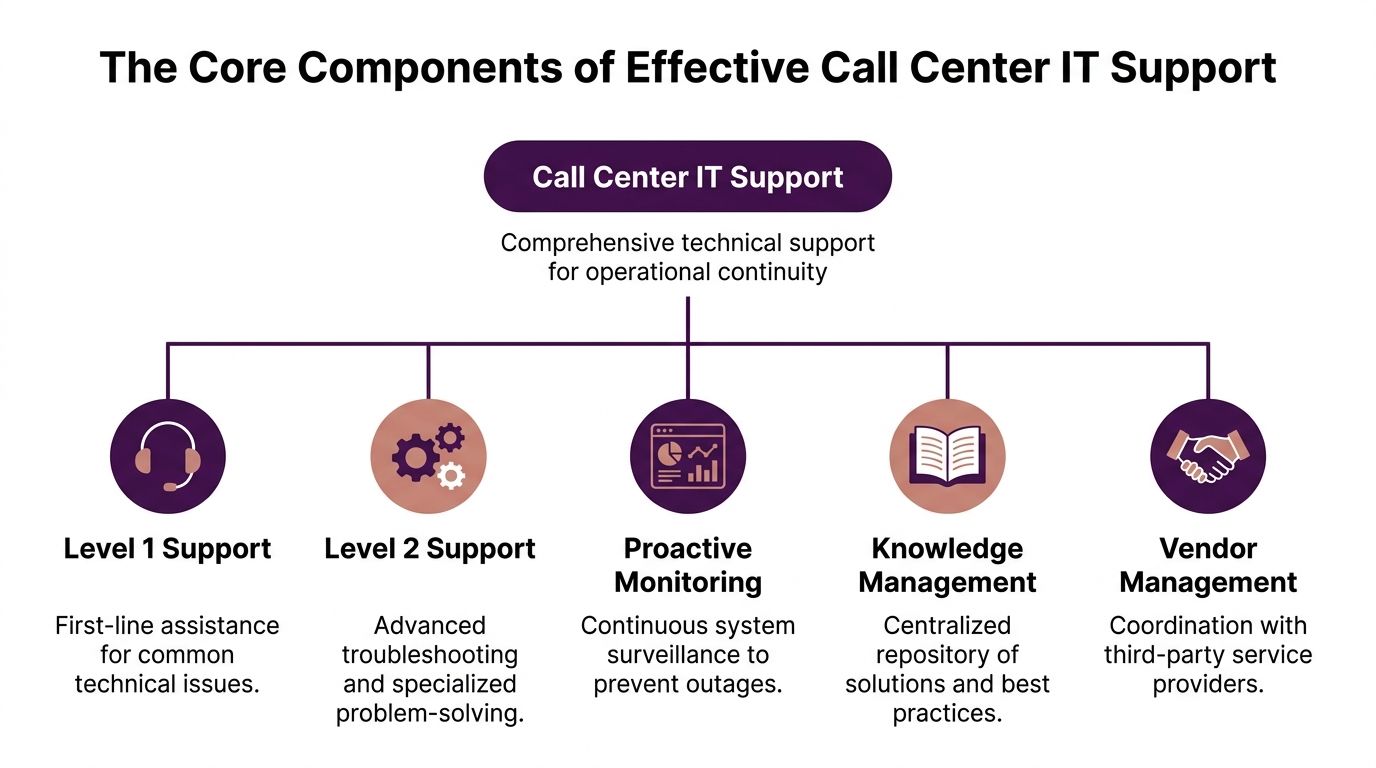
The Core Components of Effective Call Center IT Support
A good call center IT support model has layers. If every issue goes to the same person or team, response times drag, root causes get missed, and senior technical staff spend too much time on basic tickets.
The strongest setups separate work by urgency, complexity, and business impact.
Level 1 support handles speed
Level 1 is the front line. This team takes the first contact from agents or supervisors when something breaks or behaves unexpectedly.
Typical Level 1 issues include:
- Login and access problems: Password resets, MFA failures, user lockouts, account provisioning.
- Desktop and browser issues: Cached sessions, broken plugins, permissions conflicts, audio device settings.
- Call handling interruptions: Softphone misconfigurations, headset setup issues, queue login failures.
- Basic app support: CRM loading problems, ticketing errors, and known workflow issues.
This layer matters because speed matters. If agents are sitting idle while a simple issue waits on a senior engineer, costs rise fast and morale drops. A strong Level 1 team uses scripts, documented fixes, and clear escalation rules. It shouldn’t guess.
Level 2 and Level 3 support solve the hard problems
When an issue crosses from repeatable to specialized, it moves up.
Level 2 usually owns deeper troubleshooting across systems that interact with each other. That may include telephony quality issues, CRM integration failures, authentication sync problems, VPN instability, or a workflow that fails only under certain conditions.
Level 3 takes on engineering-level work. It involves dealing with infrastructure, architecture, vendor debugging, network policies, platform configuration, and recurring issues that need permanent fixes rather than repeated patches.
A useful rule in live operations is simple. Level 1 restores work fast. Level 2 isolates the cause. Level 3 removes the problem from the system.
That distinction keeps support from becoming a loop of temporary resets.
Remote troubleshooting keeps operations moving
In call center environments, remote support isn’t optional. It’s the standard operating mode.
Agents work from distributed sites, hybrid teams, or home offices. Even in centralized floors, technicians can’t walk desk to desk every time a browser crashes or a call routing tool behaves strangely. Remote troubleshooting lets support teams view sessions, collect logs, restart services, verify settings, and guide agents without losing time.
That only works when tools are standardized. If half the team uses one softphone version, another uses an outdated browser, and device permissions vary by machine, support gets slower and more error-prone. Consistency beats heroics.
For telephony-heavy environments, the underlying infrastructure also matters. Teams comparing vendors and architectures often benefit from a practical overview of VoIP call center solutions, especially when voice quality, routing flexibility, and system uptime are central to support performance.
Proactive monitoring prevents avoidable outages
Reactive support fixes incidents. Proactive monitoring catches the conditions that create them.
This includes watching:
- System health: CPU spikes, memory strain, session failures, service interruptions.
- Telephony performance: Jitter, latency, dropped connections, queue anomalies.
- Integration behavior: Failed API calls, delayed syncs, auth token errors.
- Agent environment trends: Repeated ticket types, device patterns, software conflicts.
A contact center with no monitoring usually learns about a problem when customers do.
Knowledge management and vendor management close the gaps
Many support teams underrate these two functions because they don’t look technical. They are.
Knowledge management keeps fixes documented, searchable, and current. If only one experienced technician knows how to resolve a recurring issue in Zendesk, Salesforce, Genesys, or a proprietary order system, support quality will fluctuate with staffing.
Vendor management matters because call center technology stacks are rarely owned by one provider. One vendor owns telephony. Another owns CRM. Another handles identity or workforce tools. Someone has to coordinate incidents across those lines, collect evidence, press for resolution, and keep the business side informed.
A useful way to evaluate your own stack is to check whether your tools support operations cleanly or create support overhead. This breakdown of call center software features is useful for spotting where functionality and supportability should align.
The Nearshore Advantage Why Proximity and Language Matter
Companies usually compare sourcing models on labor cost first. That’s understandable, but it’s incomplete. In call center IT support, the better comparison is cost plus responsiveness plus communication quality plus operational control.
That’s where nearshore support changes the equation.
IT support sourcing models compared
| Factor | Onshore (US) | Offshore (Asia) | Nearshore (Mexico) |
|---|---|---|---|
| Working hour overlap | High | Often limited for North American business hours | High |
| Travel for training and oversight | Easier but more expensive | Longer and more complex | Easier and more practical |
| Cultural alignment with US customers | Usually strong | Can vary widely | Usually strong |
| English and Spanish coverage | Often English-first | Varies by provider | Strong fit for bilingual operations |
| Collaboration speed with client teams | Fast | Can slow down across time zones | Fast |
| Cost structure | Highest | Often lower | Cost-effective with closer alignment |
The biggest mistake buyers make is assuming all outsourced support is interchangeable. It isn’t. The delivery model affects escalation speed, supervisor communication, training cadence, and customer experience.
Why proximity helps in live operations
Nearshore support works well for North American companies because the business day lines up.
That sounds simple, but it changes daily execution. Leaders can run calibration sessions in real time. Operations and IT can troubleshoot together during active hours. Training doesn’t require overnight handoffs. Escalations don’t sit in a queue waiting for the other side of the world to wake up.
In practice, this means fewer delays when a queue rule breaks, when a CRM permission issue affects a new team, or when a software update creates side effects that only appear during peak traffic.
Support quality improves when the people fixing the issue can talk to supervisors, QA, and client stakeholders without time-zone friction.
For businesses serving the U.S. and Canada, Mexico offers that practical overlap without forcing an onshore cost structure.
Bilingual support is a growth lever, not a courtesy
Many companies still think too narrowly. They treat Spanish support as a nice extra instead of a market access decision.
That misses the business value. Healthcare and retail organizations see 20-40% higher customer satisfaction with bilingual support, yet only 15% of small businesses use it. Nearshore bilingual agents can achieve 95% first-call resolution rates, and demand for bilingual IT support in North America is projected to rise by 25% post-2025, according to Posh’s review of bilingual answering service demand.
Those numbers point to a clear gap. Customers want support in the language they’re most comfortable using, especially when the issue is technical, urgent, or tied to money or healthcare access. Many businesses still don’t provide it well.
For call center IT support, bilingual capability matters in moments like these:
- A patient can’t access a telehealth portal and needs instructions in Spanish without being transferred repeatedly.
- An e-commerce customer hits a checkout problem and abandons the purchase if support can’t explain the fix clearly.
- A telecom subscriber troubleshoots router or app issues and needs real-time guidance in the language they use at home.
- A financial services user faces account access friction and becomes less confident if the support conversation feels uncertain.
The Tijuana advantage in practical terms
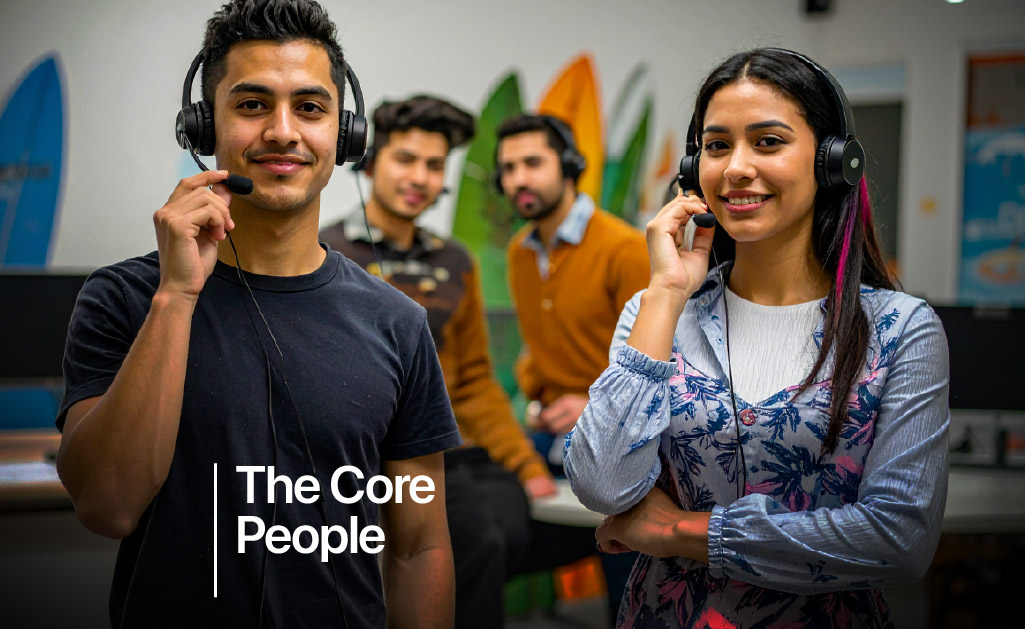
For North American businesses, Tijuana is close enough for active collaboration and far enough to offer a better cost structure than many U.S.-based models.
That creates practical benefits:
- Faster client alignment: Managers can train, audit, and refine workflows without long scheduling gaps.
- Better bilingual recruiting: English and Spanish fluency are operational strengths, not side capabilities.
- More natural customer interactions: Agents can switch languages smoothly when customers do.
- Stronger business continuity planning: Teams can expand coverage without rebuilding the operating model from scratch.
If you’re weighing service models, this overview of the nearshore advantage gives a useful business lens.
A simple real-world example from e-commerce makes the point. A retailer may have solid English support and a stable site, yet still lose sales when Spanish-speaking shoppers call about account access, payment confusion, or shipping updates and can’t get fast, clear help. Bilingual nearshore IT support doesn’t just close tickets. It removes friction at the point where revenue and customer trust meet.
Call Center IT Support in Action Across Industries
The value of call center IT support becomes obvious when you look at actual operating environments. Different industries break in different ways. The support model has to reflect that.

Healthcare needs speed and context
A healthcare support queue can’t afford vague troubleshooting. If a patient can’t get into a portal or a clinic team member loses access to scheduling or chart-related workflows, the support process needs both technical accuracy and operational sensitivity.
One example is telehealth support. A patient calls because the appointment link won’t launch, audio permissions fail, or the authentication step keeps looping. A generic help desk may walk through browser basics. A specialized call center IT support team will also know how the telehealth platform behaves, what the likely failure points are, and when to escalate to platform or EHR access support.
The same applies on the provider side. If a staff member can’t open a patient record, the issue may involve identity management, role-based permissions, integration timing, or session handling inside the EHR workflow.
In healthcare call centers, integrating SIP trunking with virtual call center platforms can reduce communication costs by 50%. When paired with EHR integration, agents get real-time access to patient data, which reduces average handle time by 20-25% and can lead to ROI within 6-9 months, based on HiRate Solutions’ analysis of healthcare call center challenges.
That combination matters because healthcare support isn’t only about being polite. It’s about reducing friction around care access.
Finance depends on clean escalation and verification
Financial support teams deal with a different kind of pressure. Customers call when they can’t log in, can’t verify a transaction, can’t use an app feature, or suspect a problem with account access.
In that environment, call center IT support has to balance service with control.
A typical scenario looks like this. A customer can’t complete a password reset because a verification workflow stalls inside the mobile app. The front-line agent needs enough support knowledge to identify whether the problem is device-related, app-related, or tied to identity controls. If the issue is broader, the support system has to escalate it quickly without exposing the customer to unnecessary transfers or risky workarounds.
The trade-off is always speed versus compliance. Moving too slowly frustrates the customer. Moving too casually creates unnecessary exposure. Good support teams build tight escalation paths, clear identity handling rules, and documented fixes for recurring app or browser issues.
In finance, the best IT support process is the one that resolves customer friction without improvising around security.
 E-commerce support has to protect conversion
E-commerce companies often discover support gaps during periods of growth. Everything works well enough at moderate volume. Then traffic rises, checkout edge cases multiply, and support starts seeing the same technical complaints over and over.
A practical example is a failed checkout tied to browser state, coupon application logic, or payment gateway handoff. The customer sees a purchase problem. The business may be facing a backend issue that support needs to detect and route properly.
Specialized call center IT support helps in two ways. It gives front-line agents enough troubleshooting structure to save the sale when the issue is local, and it gives operations a fast path to engineering or platform owners when the issue is systemic.
Blended support matters when an agent may need to reassure the customer, test the order path, collect the right error details, log the ticket correctly, and escalate without losing the customer relationship.
Telecom support lives or dies on technical clarity
Telecom customers usually contact support because the service isn’t working as expected. Internet quality drops. Hardware won’t connect. A provisioning step fails. A business client can’t get a line working. These are technical conversations, and customers can tell quickly whether the support team understands the issue.
The strongest telecom support teams know how to separate likely causes fast. Is the issue tied to local equipment, account provisioning, service outage behavior, or customer-side configuration? If that triage is weak, handle times rise and repeat contacts follow.
Telecom also benefits from bilingual technical support because troubleshooting instructions need to be understood the first time. Misunderstood steps create repeat calls and frustrated customers.
Across all four industries, the pattern is the same. Generic IT support fixes isolated issues. Specialized call center IT support keeps customer-facing operations stable while protecting the business outcome behind the interaction.
How to Choose the Right IT Support Partner
At 10:15 a.m., the queue is full, agents cannot access the CRM, supervisors are asking for updates, and customers are already waiting longer than your service target allows. That is the moment your IT support partner proves their value. Selection should be based on how they perform in that scenario, because call center IT support affects revenue, customer trust, and your ability to scale into new markets.
Price still matters. It just cannot be the first filter.
A cheaper provider that struggles with live operations, vendor coordination, or bilingual support usually costs more once outages, repeat incidents, and customer churn show up in the numbers. The better question is whether the partner can protect service levels while helping the business grow.
Judge service levels by operational impact
Uptime language is only one piece of the decision.
Operations leaders need to know who responds first, who owns escalation, how updates are shared, and how long the business is expected to operate in a degraded state. Those commitments should align with your queue design, staffing model, and customer expectations. Teams serving healthcare, telecom, or financial customers cannot rely on vague promises.
Ask direct questions:
- What happens when agents cannot log in or take calls
- How fast does the issue move from first-line triage to a technical lead
- Who manages third-party vendors when the failure sits with the carrier, CCaaS platform, or identity provider
- What status updates will supervisors and operations managers receive during an active incident
- How are Recovery Time Objectives (RTOs) defined for core systems like telephony, CRM, and routing
If the provider cannot explain incident ownership in plain terms, expect confusion during a real outage.
Review platform fit and support depth
A support partner has to work inside your stack without slowing the operation down. That means practical experience with the tools your agents and supervisors use every day, not a generic staffing pitch.
Look for direct experience across:
- CRMs and ticketing tools: Salesforce, HubSpot, Zendesk, Freshdesk
- Telephony and CX platforms: Genesys, Five9, NICE, cloud VoIP platforms
- Identity and access controls: SSO, MFA, role-based permissions
- WFM and QA systems: scheduling, scorecards, monitoring, internal knowledge bases
AI belongs in the evaluation too, but with discipline. LiveAgent’s call center statistics overview notes that AI adoption is tied to higher resolution rates and lower handle time. The trade-off is straightforward. Useful AI reduces agent effort in routing, summarization, and knowledge retrieval. Poorly deployed AI adds clicks, creates bad handoffs, and makes troubleshooting slower.
Treat security and compliance as operating requirements
Security reviews often get reduced to a checklist. That misses the actual risk.
In call center environments, support teams touch account access, call recordings, authentication flows, and customer data during live interactions. A credible partner should be able to show how access is granted, how sessions are monitored, how incidents are logged, and how customer information is protected during support work. If they support regulated industries, they should explain those controls in operational terms, not just list certifications.
One rule has held up well in vendor reviews. If a provider spends more time talking about seat count than access control and incident discipline, keep looking.
Check onboarding, calibration, and language coverage
Transitions fail when the provider learns your business too late.
Strong onboarding is built around workflows, failure points, escalation paths, and communication standards. It should also account for the reality of your customer base. If you serve English and Spanish-speaking customers in the U.S., bilingual support is not a nice extra. It affects first-contact resolution, CSAT, and how confidently agents handle technical conversations.
Nearshore teams have an advantage here because they can calibrate with U.S. operations in real time, support overlapping hours, and reduce communication gaps that slow down issue resolution. For a practical screening framework, use this guide to finding technology support companies.
Match the commercial model to the work
The right pricing model depends on ticket volume, complexity, and how much context the support team needs to retain.
- Dedicated team pricing: better for complex workflows and stable process ownership
- Per-ticket pricing: fits narrow, repeatable issue types
- Per-agent support models: useful in tightly managed contact center environments
- Hybrid models: good for a steady core workload with seasonal or campaign-driven spikes
The trade-off is continuity versus flexibility. Dedicated teams usually perform better when your operation depends on product knowledge, bilingual support, and close coordination with CX leaders. Variable pricing can look efficient on paper, but it often creates turnover and weaker issue ownership.
CallZent is one example of a nearshore provider serving North American companies with bilingual technical and customer support from Tijuana. That model makes sense for businesses that need lower cost than U.S. domestic support, stronger timezone alignment than offshore teams, and language coverage that supports expansion across diverse customer bases.
Build a Resilient and Growth-Oriented Support System
Most companies start thinking about call center IT support when something breaks. The smarter move is to build it before repeated failures start shaping the customer experience.
Value isn’t just faster troubleshooting. It’s better continuity, cleaner escalation, stronger agent performance, and a support operation that can scale without becoming unstable. That’s why mature businesses treat call center IT support as part of revenue protection and growth, not just overhead.
What modern support should look like
Legacy tools often create the very inefficiencies teams are trying to solve. In healthcare, legacy IVR is still used by 84% of centers and ACD by 82%. Moving to AI-powered smart routing and unified agent desktops can improve first-contact resolution by 25-40%, with LLMs predicting intent with 92% accuracy and cutting AHT by 30%, according to NovelVox’s review of healthcare call center challenges.
That lesson applies beyond healthcare. Fragmented systems slow agents down. Unified desktops, better routing, and clearer intent handling remove friction from the work itself.
Resilience has to be planned
A resilient support system needs more than tools. It needs defined ownership, backup processes, escalation logic, and recovery targets that match business reality. If your phone platform, CRM access, or routing layer fails, your team should already know what gets restored first and how quickly that needs to happen.
For leaders refining continuity plans, this guide to Recovery Time Objectives (RTOs) is useful because it frames recovery planning in business terms, not just technical ones.
A durable support model also needs the right operating partner behind it. Bilingual coverage, real-time collaboration, and support for customer-facing workflows are no longer edge advantages. For many North American companies, they’re the practical baseline.
If you’re evaluating what that model should include, this overview of support maintenance services is a solid next step.
🚀 Build a Stronger Call Center IT Support Model
If your team is dealing with recurring outages, unstable workflows, or rising bilingual support demands, CallZent can help you build a nearshore support operation designed for uptime, customer experience, and scalable growth.
Talk to an ExpertFrequently Asked Questions
What is call center IT support?
Call center IT support is the specialized technical support function that keeps customer service operations running. It covers telephony, CRM access, integrations, user support, troubleshooting, monitoring, and escalation management.
Why is call center IT support different from a general help desk?
A general help desk supports broad business users. Call center IT support is built for live service environments where delays affect queue times, customer experience, and revenue in real time.
What should a strong call center IT support model include?
It should include Level 1, Level 2, and Level 3 support, proactive monitoring, remote troubleshooting, documented workflows, vendor coordination, and clear escalation ownership.
How does nearshore IT support help North American companies?
Nearshore IT support improves timezone overlap, communication speed, training alignment, and operational responsiveness while offering a more cost-effective model than fully onshore teams.
Why does bilingual support matter in call center operations?
Bilingual support improves clarity, first-contact resolution, and customer confidence for English and Spanish-speaking customers, especially in healthcare, finance, telecom, and e-commerce environments.
Which tools does call center IT support usually manage?
Support teams commonly work across CRMs, ticketing systems, cloud telephony platforms, softphones, workforce management tools, QA systems, authentication systems, and internal knowledge bases.
How do you measure the performance of an IT support partner?
Key indicators include response time, resolution time, escalation quality, downtime impact, communication during incidents, recurring issue reduction, and alignment with business continuity targets.
What industries benefit most from specialized call center IT support?
Healthcare, finance, e-commerce, telecom, and other high-volume customer support environments benefit the most because technical issues quickly affect service quality and customer trust.
When should a company outsource call center IT support?
Companies should consider outsourcing when outages are frequent, internal IT is stretched thin, bilingual support is needed, or the business is scaling faster than internal support can handle.
How can CallZent help with call center IT support?
CallZent provides nearshore bilingual support tailored to North American companies that need operational stability, faster collaboration, scalable workflows, and customer-facing technical support aligned with real business needs.
If your team is dealing with recurring technical friction, unstable support workflows, or growing bilingual service demands, it may be time to rethink how your operation is supported. Talk with CallZent about a call center IT support model built around your systems, your customers, and the way your business actually runs.