Skip to content

CALL CENTER STRATEGY / BPO
A Guide to Call Center in US Options for 2026
Explore call center in US options for 2026. Compare in-house, domestic, nearshore, and offshore models across cost, quality, compliance, and scalability.
TL;DR — Quick Takeaways
- Businesses now choose between in-house, domestic outsourced, nearshore, and offshore call center models.
- The best call center in US strategy balances cost, quality, scalability, and operational control.
- Nearshore outsourcing often delivers the strongest balance of performance and affordability.
- CallZent helps businesses scale customer support with bilingual nearshore call center solutions.
Is your customer support becoming a cost center instead of a growth engine?
That’s the wrong question for most leaders. The better one is this: what kind of operating model gives you reliable service, room to scale, and a cost structure you can live with? A call center in us can still make sense for some businesses, but it’s no longer the default answer for every company that needs customer support, sales help, or back-office coverage.
The market changed. Hiring is harder. retention is harder. Customers still expect fast answers, but many teams now have to deliver them with tighter margins, more channels, and more compliance pressure than they had a few years ago.
Your Guide to Choosing a Call Center
TL;DR
- There are four main models for customer support: in-house, domestic outsourced, nearshore outsourced, and offshore outsourced.
- The best choice isn’t automatically the cheapest one. You’re balancing cost, quality, and control.
- A traditional call center in us can offer proximity and oversight, but many operators now face hiring strain and turnover pressure.
- Nearshore outsourcing often lands in the strategic middle, especially for businesses that need bilingual support, real-time collaboration, and cost discipline.
- Your evaluation process should focus on operations, not pitch decks. Ask about blocked calls, staffing, training, compliance, and integration.
In 2026, the right call center isn’t just a vendor; it’s a strategic partner in your growth.
Leaders usually start with one goal, cut costs. Then reality shows up. They also need consistent service quality, trained agents who stay, managers who can coach performance, and enough flexibility to absorb seasonality without breaking the customer experience.
That’s why a smart outsourcing decision starts with structure, not price. If you’re comparing providers, this practical guide on how to find and vet the best call center outsourcing companies is a useful place to start.
What business leaders are actually deciding
A support model touches more than the contact center team. It affects revenue, retention, compliance risk, and customer trust. If your agents can’t answer quickly, can’t resolve issues cleanly, or can’t serve your customer base in the right language, the problem spills into churn, refunds, escalations, and brand damage.
Practical rule: Don’t choose a call center model based only on labor rate. Choose it based on whether it can protect the customer experience while your business changes.
Some businesses need close internal control. Others need speed and flexibility. Many need both. That’s where the trade-offs become strategic, not operational.
 The Real State of US Call Center Operations
A lot of companies still assume a domestic model is the safest route. In practice, a call center in us now comes with real operating friction.
From 2016 to 2023, the number of new call centers opened or expanded in the United States fell from 223 to 26, and contact center employment shrank by 350,000 workers between 2014 and 2023, according to Statista’s overview of the U.S. call center services industry. The same source notes agent turnover rates of 30% to 45% annually.
Those numbers matter because they show two different pressures at once. Fewer expansions suggest caution in the market. Lower employment and high turnover suggest that even businesses willing to invest still have to fight to staff and stabilize operations.
Why the pressure shows up on the customer side
When staffing gets tight, service quality usually slips in familiar ways:
- Queues get longer: Customers wait longer for help during peaks.
- Training gets compressed: New agents hit the floor before they’re fully ready.
- Consistency drops: One customer gets a polished answer, another gets a partial one.
- Supervisors get stretched: Coaching time falls when managers spend their day plugging gaps.
This doesn’t mean domestic teams can’t perform well. Many do. It means the operating model is under more strain than many buyers expect.
Cost is only one part of the problem
A domestic center often carries stronger direct oversight and easier legal coordination. But if the team is hard to hire, hard to retain, and expensive to stabilize, your headline plan can fail in execution.
That’s also why policy changes get so much attention. Regulation can shape where companies place work, but it doesn’t remove the underlying labor and operating constraints. This overview of the Keep Call Centers in America Act of 2025 is worth reading if you’re weighing domestic versus non-domestic support models.
A support strategy fails when leadership buys the model they want on paper instead of the one they can operate well in real life.
For many businesses, the search for alternatives isn’t about chasing the lowest possible price. It’s about finding a setup that can hold quality as the company grows.
Your Strategic Call Center Models Explained
The market usually presents too many labels and not enough clarity. Most businesses are really choosing among four operating models.
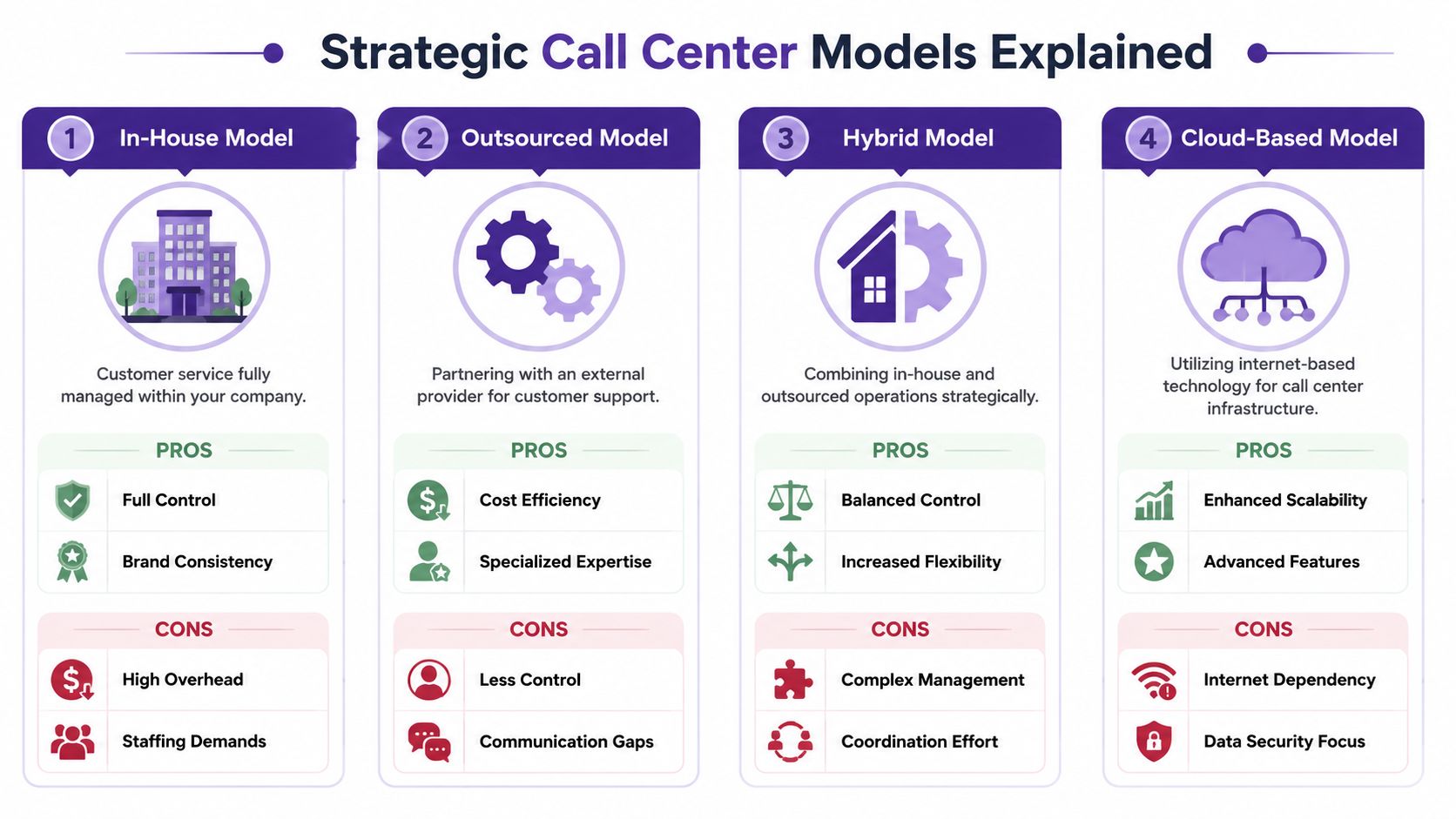
The four models in plain English
In-house
You hire, train, manage, and equip the team yourself. This gives you the most direct control over scripts, escalation rules, QA, scheduling, and culture. It also gives you the full burden of recruiting, workforce management, attrition, and technology decisions.
This works best when support is tightly tied to product complexity, compliance sensitivity, or brand differentiation.
Domestic outsourced
A third-party provider runs the operation, but the team remains U.S.-based. You gain outsourcing expertise and operational infrastructure without building everything internally. You still pay a premium compared with lower-cost international models.
This option often appeals to brands that want external help without moving away from a U.S. operating footprint.
Nearshore outsourced
A provider serves your customers from a nearby country, often with overlapping time zones and stronger cultural alignment than far-off offshore locations. For North American companies, this frequently means Mexico or other parts of Latin America.
According to Axios’ reporting on staffing shortages and nearshore alternatives, nearshore BPO solutions such as those in Tijuana can reduce operational costs by 30% to 50% compared to onshore U.S. centers, while maintaining time-zone overlap and cultural alignment.
Offshore outsourced
A provider operates from a more distant region, typically chosen for labor arbitrage and large labor pools. This can work well for highly standardized processes with mature training and strong documentation. It becomes riskier when the work depends on nuance, real-time collaboration, or high-emotion customer interactions.
Call Center Model Comparison At a Glance
| Model | Average Cost | Quality & Control | Scalability | Best For |
|---|---|---|---|---|
| In-house | Highest | Highest control if leadership is strong | Harder to scale quickly | Complex brands that want direct ownership |
| Domestic outsourced | High | Strong quality potential, moderate control | Good | Companies that want U.S.-based support without building internally |
| Nearshore outsourced | Moderate | Strong balance of quality, access, and collaboration | Strong | Firms needing bilingual support and flexible growth |
| Offshore outsourced | Lowest | More variable, depends heavily on process discipline | Strong | High-volume, process-driven programs |
Where hybrid and cloud fit
Hybrid and cloud-based setups aren’t separate geography choices. They’re operating layers you can combine with any of the four models above.
A hybrid model might keep escalations in-house while outsourcing routine support. A cloud-based model gives distributed teams access to shared tools, reporting, call routing, and QA systems. If you’re sorting through the differences between distant outsourcing and closer alternatives, this breakdown of offshoring call centers can help clarify where the practical gaps show up.
The Trade-Off Triangle Cost Quality and Control
Every support leader wants all three. Lower cost. Better quality. More control.
Most call center models force a compromise. The mistake is pretending they don’t.
What each corner really means
Cost is not just wage expense. It includes recruiting drag, supervisory load, training time, shrinkage, turnover impact, and the overhead that shows up when service quality slips.
Quality means customers get a correct answer fast, in the right tone, with clean follow-through. It includes language fit, issue ownership, and whether agents can recover a tense conversation without sounding scripted.
Control means your team can steer operations. You can audit calls, change workflows, tighten QA, adjust staffing rules, and align the vendor with your brand standards.
Why the cheapest model often gets expensive later
A low-cost provider can still be a bad deal if customers call back, if escalations pile up, or if your internal team has to spend too much time fixing preventable mistakes. The invoice may look efficient while the business absorbs hidden operational waste.
That’s why the strongest decision usually sits in the middle of the triangle. You want enough cost relief to improve margin, enough quality to protect the customer journey, and enough control to manage risk.
The sweet spot is the model your team can collaborate with week after week, not the one that looks best in a procurement spreadsheet.
Why nearshore often lands in the middle
Nearshore tends to solve practical issues that executives feel immediately. Leadership can communicate during the same workday. Coaching cycles are faster. Escalations don’t stall overnight. Bilingual hiring is more realistic. And agents often understand North American customer expectations better than teams operating with greater distance and less overlap.
That doesn’t make nearshore perfect. You still need disciplined onboarding, mature reporting, and a provider with strong management. But it often avoids the two extremes. It doesn’t carry the full overhead of domestic staffing, and it doesn’t introduce as much friction as far-off offshore delivery.
For many growth-stage companies, that balance matters more than squeezing every last dollar out of labor cost. This deeper look at call center cost savings is useful if you’re trying to weigh visible savings against the hidden costs of poor execution.
Industry-Specific Call Center Requirements
A generic support team won’t survive in a specialized industry. Every serious buyer should evaluate providers through the lens of their own workflows, risk profile, and customer expectations.

Healthcare needs empathy and process discipline
Healthcare support can’t rely on agents who sound polished but miss the details. Teams need to handle scheduling, patient questions, intake support, and sensitive conversations with care. Compliance matters, but so does tone. A patient who feels rushed or misunderstood may not rebook, may miss follow-up care, or may leave frustrated before the actual provider interaction even begins.
Bilingual service is especially important here. In this discussion of call center labor shifts and service outcomes, bilingual services are described as a growth driver, with a 25% lift in healthcare conversions such as appointment booking.
If you operate in this space, your provider should understand healthcare-specific workflows, escalation rules, and privacy expectations. This overview of the strategic value of medical call center support is a useful reference point.
Finance requires trust and clean handoffs
Financial support is less forgiving than general customer service. Customers call about payments, accounts, disputes, underwriting questions, billing errors, or sensitive identity-related issues. Agents need precision, but they also need judgment. A scripted answer that works in retail can fail badly in finance.
What matters most here:
- Verification discipline: Agents need clear authentication steps and escalation paths.
- Documentation quality: Notes must be complete enough for downstream teams to act on.
- Controlled transfers: Customers shouldn’t repeat their story every time the issue moves.
E-commerce and telecom need speed under pressure
These sectors live in peaks. Promotions, outages, shipping delays, and product launches create sudden spikes in volume. The right provider needs flexible staffing, omnichannel handling, and agents who can move fast without sounding robotic.
In telecom and diverse consumer markets, bilingual support also influences retention. The same GreaterWrong source notes that bilingual service can help retain 30% more customers in diverse markets where trust matters.
Customers don’t separate “support” from the brand. If your service team struggles during demand spikes, buyers blame the company, not the vendor.
Ensuring Compliance and Unlocking Bilingual Support
Leaders often treat compliance and language coverage as separate topics. In practice, they belong together. Both determine whether a provider can deliver high-quality service without creating avoidable risk.
Compliance has to show up in daily operations
A secure provider isn’t just one that says the right words in a sales call. You want evidence in the operating model. That includes access controls, role-based permissions, controlled device use, documented training, audit readiness, and clear incident handling.
Formal standards and third-party frameworks can help you assess maturity. It’s also worth reviewing practical guidance on HR and compliance for call centers because workforce practices, documentation, and risk controls affect service quality just as much as technology does.
 Bilingual support is an operating advantage
A bilingual team does more than translate. Good bilingual support reduces friction, catches nuance, and helps customers explain what they need the first time. That matters in healthcare, finance, insurance, telecom, and retail. It also matters when a customer becomes emotional, confused, or hesitant. People usually revert to their most comfortable language when the stakes rise.
A lot of companies discover this too late. They launch English-first support, add Spanish reactively, and then realize the bilingual queue has weaker staffing, weaker QA, and weaker scripting than the core operation. That setup rarely performs well.
If a provider treats bilingual support like an add-on queue, expect inconsistent quality. The stronger operators build it into hiring, training, QA, and scheduling from day one.
The best buyers ask to see how language capability is embedded operationally. Who writes scripts. Who audits calls. Who coaches agents. Who owns escalations when a bilingual interaction becomes sensitive or high risk. That’s where quality becomes real.
Your Vendor Evaluation Checklist and Next Steps
The easiest way to waste months in vendor selection is to compare branding instead of operations. A polished pitch deck won’t tell you whether a provider can protect service levels during a Monday volume spike or a seasonal surge.
Use a checklist that forces specificity.
Questions every buyer should ask
- Ask about blocked calls: Expert BPOs track Percentage of Calls Blocked, with a target of less than 2% to 5%. A blocked-call rate above 10% can drive 25% higher abandonment, according to Genesys’ guide to call center metrics and KPIs. Ask how the provider monitors blocked calls, what triggers an alert, and how they fix root causes.
- Review reporting depth: Don’t settle for a weekly slide deck. Ask to see reporting for FCR, AHT, CSAT, transfers, backlog, absenteeism, and QA trends. If they can’t explain how they use the numbers, the numbers won’t help you.
- Test training design: Find out how new agents learn your workflows. Ask who owns nesting, call calibration, and remediation when performance dips.
What to validate in the operating model
Some questions are better asked live because you can hear whether the operator really owns the floor.
-
How do you hire and retain agents?
Listen for specifics about profile matching, leadership involvement, coaching cadence, and culture. -
What does onboarding look like?
Strong providers can explain implementation clearly. They should describe discovery, process mapping, knowledge base setup, systems access, pilot readiness, and ramp planning. -
Which tools are in the stack?
Ask about CRM integration, telephony, QA software, workforce management, and how supervisors monitor live performance. -
How do you handle change?
Support operations rarely stay static. Promotions change. Policies change. Product lines expand. You want a team that can absorb updates without chaos.
The decision standard that matters most
Choose the provider that can explain how the work gets done. If answers stay vague, you’ll inherit that vagueness after launch.
If you’re evaluating partners right now and want a practical conversation about fit, process, and operating trade-offs, contact CallZent for a no-obligation discussion about your support goals, channel mix, and scaling needs.