
Workforce Planning & Bilingual Operations
Call Center Workforce Planning: Build Coverage Around Customer Demand
Connect forecasts, service goals, skills, shrinkage, and intraday decisions to create reliable coverage without sacrificing quality or agent experience.
TL;DR — Quick Takeaways
- Forecast demand by interval, channel, issue type, and language before deciding headcount.
- Define handling effort and service goals before translating workload into coverage.
- Account for shrinkage without counting the same unavailable time twice.
- Build skill and language coverage into workable schedules, then adjust within approved rules.
- Review quality, resolution, customer outcomes, and agent experience alongside cost and speed.
A support queue can look manageable at 9:00 a.m. and become a customer experience problem by noon. A product launch, billing cycle, marketing campaign, weather event, or unexpected technical issue can change contact volume fast. Call center workforce planning gives businesses a disciplined way to prepare for those shifts without overstaffing every hour of the day.
For growing companies, this is not simply a scheduling exercise. It is the operating model behind fast answers, productive agents, controlled labor costs, and customer conversations that still feel personal when demand rises. Done well, workforce planning helps your support operation respond with confidence instead of scrambling for coverage.
What Call Center Workforce Planning Really Covers
Workforce planning connects expected customer demand to the right number of trained people at the right time. It includes forecasting contact volume, estimating how long each interaction will take, setting service targets, building schedules, accounting for absences, and adjusting in real time.
The objective is not to keep every agent busy every minute. That approach may look efficient on paper, but it creates long waits, rushed conversations, burnout, and higher turnover. The goal is to balance accessibility, quality, employee experience, and cost based on what matters most to your business.
For example, an eCommerce company may need extra chat and phone coverage after promotional emails go out. A healthcare support team may need consistent daytime coverage and careful escalation paths. A legal intake program may prioritize immediate live response because a missed call can mean a missed client opportunity. The staffing model should reflect those realities, not rely on a generic headcount formula.
Start With Demand, Not Headcount
The most common workforce planning mistake is deciding how many agents to hire before understanding the work they will handle. Begin with demand patterns instead.
Review historical contacts by day, hour, channel, and reason for contact. Look beyond totals. A weekly average can conceal predictable spikes that happen every Monday morning, during lunch hours, after order shipments, or at the end of a billing period. If your data is limited, combine what you do have with business inputs such as upcoming campaigns, seasonality, new product releases, changes to policies, and anticipated customer growth.
Forecasting does not need to promise perfect accuracy. It needs to provide a credible starting point that improves over time. A new business may use informed assumptions initially, then refine them after several weeks of actual operating data. An established company with years of history can use more detailed interval forecasts, while still reserving capacity for exceptions.
Check forecast error by interval, channel, and language, alongside over- or underforecasting. Compare forecasts on periods held back from fitting or tuning and use only information available when the forecast was made. The AWS guide to evaluating forecast accuracy explains backtesting and several error measures. It is a forecasting reference, not a requirement to use a particular platform.
Measure the Work Behind Each Contact
Volume alone does not determine staffing needs. Average handle time matters just as much. A support queue receiving 500 calls a day requires a very different staffing plan when calls average three minutes versus twelve.
For voice, define handle time consistently, commonly including talk, hold, and after-contact work. Identify which documentation or research is already included, and model separate follow-up tasks explicitly. For chat, distinguish active handling effort from elapsed conversation time and test realistic concurrency. For back-office programs, measure case complexity, rework, approval steps, and turnaround commitments. If agents are expected to solve more complicated issues, longer handling times may be a sign of better resolution, not weaker performance.
This is where leaders need context. Reducing handle time can lower labor cost, but only if quality and first-contact resolution remain strong. If customers must call back because agents were rushed, the apparent efficiency disappears quickly.
Turn Service Goals Into Staffing Requirements
Once you understand expected demand and workload, define what customers should experience. Service goals might include answering a defined percentage of calls within a target time, responding to chats within seconds, returning emails within a business day, or providing 24/7 coverage for urgent issues.
These targets determine how much capacity you need. A company that can accept a short wait for routine order-status questions may use a different model than a company supporting payment issues, medical inquiries, or time-sensitive reservations. There is no universally correct service level. There is only the level that supports your customer promise and business priorities.
Occupancy is another useful measure. In a voice queue, it commonly compares handling time with handling plus available waiting time; confirm the platform’s exact formula. It is not the same as schedule adherence or utilization across an entire paid shift. Protect coaching, breaks, and approved recovery time in the schedule, and include notes or research in the appropriate workload category rather than treating the same time as both handling and shrinkage.
Translate workload into coverage using a model that fits the channel, routing, arrival variability, and service target. Dividing contact minutes by shift length estimates workload but does not account for waiting-time objectives. The AWS contact-center capacity-planning documentation illustrates how forecasts, service goals, occupancy constraints, and shrinkage inputs support a staffing scenario.
Build Schedules Around Reality
A staffing calculation is only useful when it becomes a workable schedule. That means accounting for breaks, meetings, training, paid time off, absences, system issues, and other normal sources of lost availability. These unavailable-time categories contribute to shrinkage under the agreed model. Reconcile the allowance with offline activities already placed in the schedule so the same time is not counted twice.
Ignoring shrinkage is one of the fastest ways to under-resource a support team. If ten agents are scheduled but two are in training, one is on break, and another is in a scheduled coaching session, the available team is smaller than the schedule suggests.
Hypothetical planning example: If an interval requires 20 available agents and a compatible model assumes 30% shrinkage, the simple gross-up is 20 ÷ (1 − 0.30) = 28.57, rounded up to 29 scheduled agents for that requirement. This is an illustrative allowance, not a full roster or hiring calculation. Explicit breaks, skill coverage, shift feasibility, and the time basis still need reconciliation.
Effective scheduling also considers agent skills. Bilingual service, technical troubleshooting, collections compliance, healthcare workflows, and legal intake all require specific capabilities. A schedule with enough total people can still fail if the right skills are unavailable during peak periods. Do not count one bilingual agent as simultaneously available for two contacts in different language queues. Test routing priorities and coverage by language.
For outsourced programs, this is especially important during launch. A partner should not simply fill seats. They should map the skills, hours, escalation coverage, systems access, and training requirements needed to operate as a true extension of your team.
Use Flexibility Without Creating Instability
Demand rarely follows a clean forecast. The strongest workforce plans include flexibility, but flexibility should not mean asking the same agents to absorb every surprise.
Flexible staffing models can combine several options. Cross-training can help a team shift between similar queues when volume changes. Part-time or staggered schedules may support peak hours without paying for unused capacity. Overflow coverage can protect service levels during seasonal surges. Nearshore support can also extend operating hours while keeping teams closely aligned with U.S. time zones and customer expectations.
Each option has trade-offs. Cross-training expands coverage but requires ongoing coaching. Overflow teams provide protection but need clear processes and shared quality standards. A highly variable schedule may reduce idle time, but it can damage retention if employees lack predictability. Sustainable flexibility comes from planning capacity in advance and treating agents fairly when plans change.
Make Real-Time Management Part of the Plan
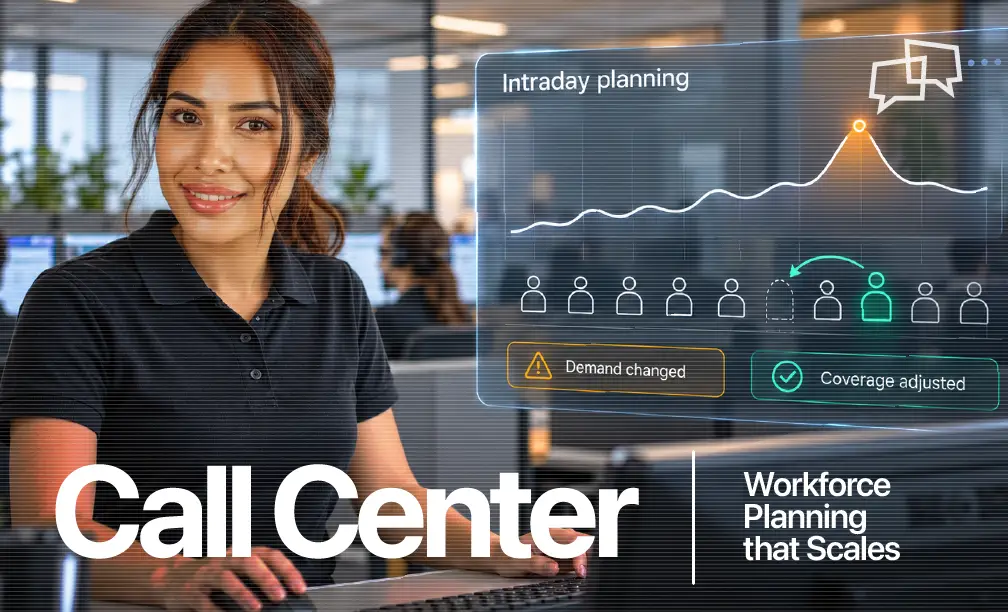
Workforce planning does not end when schedules are published. Intraday management is the practice of monitoring actual conditions and making measured adjustments throughout the day.
Leaders should compare forecasted volume, handle time, staffing, and queue performance with what is actually happening. When demand is higher than expected, the response may include reassigning qualified cross-trained agents, rescheduling permitted nonurgent offline work, using approved overflow support, or updating customers with realistic wait-time messaging. When volume is lower, use the time for coaching, quality reviews, knowledge-base improvements, or training.
The key is to avoid overreacting to every short-term fluctuation. One busy half-hour may not justify a major operational change. Look for sustained trends, then act with a clear understanding of customer impact and employee workload.
Connect Planning to Quality and Agent Experience
Workforce plans can fail when they focus only on labor efficiency. Agents are the people carrying your brand into hundreds or thousands of customer conversations. If schedules are chronically tight, breaks are interrupted, coaching is postponed, and difficult contacts stack up without support, customers will feel the effects.
A healthier model gives agents clear expectations, current training, accessible supervisors, and enough capacity to resolve issues with care. This is not separate from performance management. It is performance management. Empowered agents are more likely to use sound judgment, maintain empathy, and stay with the program long enough to build real expertise.
At CallZent, that connection between agent satisfaction and customer outcomes is central to how support programs are designed. A cost-efficient operation should still give people the structure and support required to do excellent work.
Review the Plan on a Useful Cadence
The right review schedule depends on your operation. Fast-changing programs may need daily intraday reviews and weekly forecast updates. Stable programs may focus on weekly performance reviews and monthly capacity planning. In either case, monitor a balanced set of indicators: service level, abandonment, response time, occupancy, schedule adherence, quality scores, first-contact resolution, customer satisfaction, and employee retention.
No single metric should make the decision alone. A low-cost program with poor customer outcomes is expensive in ways that do not always show up on a staffing report. Likewise, a team with excellent service but excessive idle time may need a more precise schedule, not a lower service standard.
The most valuable workforce plan is one your leaders can explain clearly: what demand is expected, what customer experience you are protecting, where flexibility exists, and what action you will take if conditions change. That clarity turns staffing from a recurring fire drill into a practical advantage for your customers, your team, and your growth.
Frequently Asked Questions
What is call center workforce planning?
Call center workforce planning connects expected customer demand with the trained capacity required to serve it. It includes forecasting, workload estimation, service targets, skills, scheduling, shrinkage, intraday management, and review of customer and employee outcomes.
How is workforce planning different from scheduling?
Scheduling assigns people and activities to specific times. Workforce planning also determines expected demand, required coverage, skills, capacity gaps, and options for responding when conditions change. A schedule is one output of the wider planning process.
What data should a call center use to forecast staffing needs?
Use reliable historical contacts and handling effort by interval, channel, issue type, and language, alongside operating hours, campaigns, seasonal events, and known service changes. Document assumptions when history is limited and compare predictions with actual results.
How does average handle time affect staffing?
Handling effort changes the workload associated with each contact. For voice, confirm whether talk, hold, and after-contact work are included. Model separate follow-up work explicitly, avoid double counting, and interpret handling time alongside complexity, quality, and resolution.
What is shrinkage in workforce planning?
Shrinkage represents scheduled or paid time that is unavailable for the modeled contact work under an agreed definition. It may include breaks, training, meetings, leave, and absence. Reconcile the allowance with explicitly scheduled activities and handle-time components so time is not counted twice.
Is occupancy the same as schedule adherence?
No. Voice occupancy commonly compares handling time with handling plus available waiting time. Adherence compares actual activity with the approved schedule. Confirm platform formulas and use both with quality and workload context rather than treating either as a complete productivity measure.
How should a call center choose its service-level target?
Choose targets around customer needs, channel behavior, issue urgency, and available resources. Define the timer, eligible contacts, exclusions, and reporting intervals. Test the staffing needed to support the objective instead of assuming a generic target fits every queue.
How should workforce planning handle bilingual agents?
Forecast demand by language, document proficiency and routing priorities, and check coverage during the intervals customers need it. One bilingual agent is shared capacity and cannot be counted as handling two simultaneous contacts simply because the agent can support both languages.
What should managers do when demand exceeds the forecast?
Compare actual demand, handling time, available skills, and service performance with the plan. Use approved actions such as qualified queue reassignment, permitted changes to nonurgent offline work, or overflow support. Preserve required breaks, quality controls, and clear customer expectations.
Can nearshore outsourcing support workforce planning?
A nearshore partner can add agreed capacity, language coverage, or operating hours when the program is properly scoped. Evaluate training, scheduling, system access, supervision, reporting, and escalation responsibilities, then review performance against shared service and quality goals.
Bilingual Nearshore Support in Mexico
Build Coverage That Works for Your Customers and Your Team
Bring your demand patterns, English-Spanish coverage needs, support hours, and service goals to CallZent. Discuss a nearshore program with clear staffing responsibilities, training, reporting, and escalation.