Skip to content


Inbound Customer Support & Nearshore Operations
Outsourced Inbound Call Center: Models, Costs, and a Practical Launch Plan
Compare staffing models, coverage, vendor controls, and total costs while building an inbound program with clear ownership and measurable customer outcomes.
TL;DR — Quick Takeaways
- Choose dedicated, shared, in-house, or hybrid support around the work and coverage required.
- Compare equivalent scope and total delivery cost rather than hourly rates alone.
- Define approved actions, restricted decisions, and accepted escalation ownership.
- Measure access, quality, resolution, repeat work, and open-case age together.
- Pilot a bounded queue and expand through readiness gates with a rollback path.
If your customers already call you, why pay someone else to answer, especially if a cheaper team creates more repeat calls, escalations, and refunds? The useful question is whether an outsourced inbound call center can handle the right conversations accurately while your company retains oversight of policy, customer data, and restricted decisions.
A lower hourly rate can help control spending, but it does not establish better value. Compare the complete operating scope, actual coverage, and cost of resolving customer issues. A well-designed program connects trained agents, approved actions, clear handoffs, and reporting that shows what happened after the phone was answered.
What an Outsourced Inbound Call Center Does
An outsourced inbound call center is a third-party operation that handles customer-initiated calls on your behalf. When the program also includes chat, email, and messaging, it is more accurately described as an inbound contact center. Confirm each channel separately in the scope.
The work may include order questions, appointments, account assistance, technical troubleshooting, billing explanations, and approved back-office follow-up. Agents identify the request, verify the caller where required, perform authorized actions, document the result, and route work beyond their permissions.
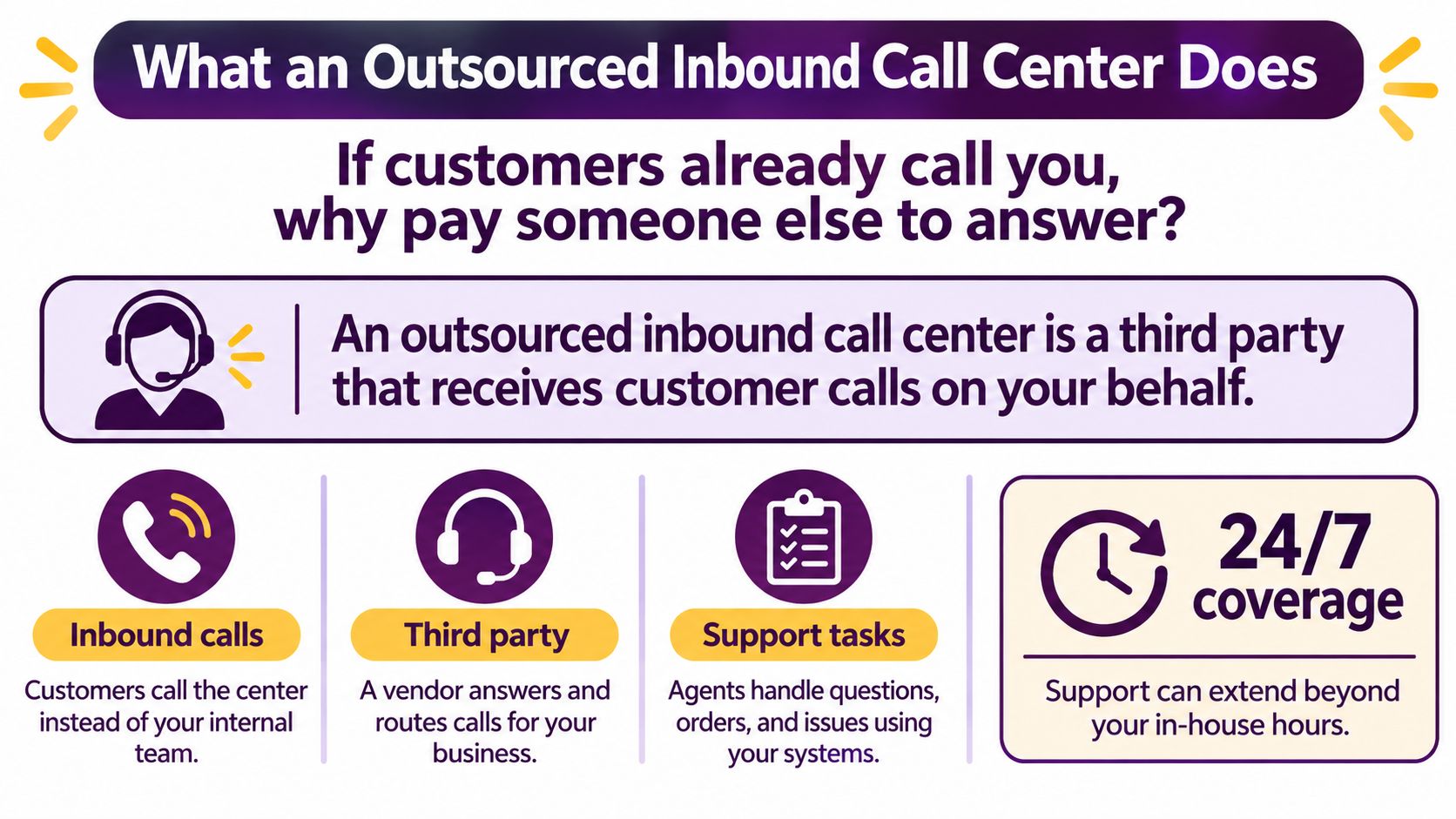
What Happens After the Agent Answers
Consider a shopper calling about a late order. Routing should connect the caller to the appropriate language and skill. The agent checks current order information, follows verification rules, and determines whether policy permits an update, replacement, or escalation.
The agent should not invent a delivery promise. If another team must approve an exception, the handoff needs complete context, an accepting owner, and a realistic update commitment. When the customer later sends an email, the next representative should be able to continue from the existing case.
You are buying dependable handling and completed work. An answered call alone does not prove resolution.
Choose the Operating Model Before the Provider
In-house support gives your managers direct responsibility for hiring, scheduling, coaching, and knowledge. It can fit work that depends on frequent collaboration with internal specialists. Your organization also carries the cost and effort of maintaining coverage.
Shared answering or overflow uses agents who serve more than one client. It can suit defined message capture, routine booking, or demand spikes when scripts, systems access, and escalation are well controlled. Confirm queue priorities and actual availability rather than assuming shared capacity is unlimited.
Dedicated support allocates agents to your program during agreed schedules. It can support deeper product training and consistent coaching, but quiet time and non-contact work still affect the economics. Dedicated does not automatically mean exclusive around-the-clock coverage.
A hybrid design can retain sensitive decisions internally while outsourcing approved frontline work. Program boundaries should follow expertise, permissions, and risk, not a blanket assumption that internal teams handle only difficult calls.
Compare Nearshore, US, and Offshore Delivery Fairly
Location affects time-zone alignment, recruitment, collaboration, travel, and commercial terms. It does not by itself prove language proficiency, regulatory capability, or service quality. Request proposals for the same scope and test the actual team’s skills.
| Delivery location | Coverage consideration | Language validation | Commercial questions |
|---|---|---|---|
| United States | Confirm local time zones, shifts, and specialist availability | Test the required English, Spanish, and other language skills | Separate employee wages from fully loaded internal or vendor cost. |
| Mexico nearshore | Working-hour alignment can support collaboration; confirm the actual city and schedule | Test English-Spanish comprehension and policy accuracy for each role | Request matching scope for supervision, training, tools, and coverage. |
| India | US daytime coverage may require local night shifts; check management overlap | Evaluate the language and technical skills of the proposed team | Confirm shift premiums, specialist access, and included technology. |
| Philippines | Confirm the shifts needed for the client’s hours and escalation support | Evaluate actual voice, writing, and any additional language requirements | Check training, continuity, supervision, and minimum commitments. |
Compare Equivalent Coverage, Not Just Headcounts
A vendor’s hourly delivery rate is not the same as an employee’s wage. Recruiting, supervision, training, quality review, facilities, software, and telephony may be included or billed separately. Define “fully loaded” in writing.
If a hypothetical operation requires 20 available positions throughout a 12-hour weekday, it needs 240 available agent-hours per day. That does not mean 20 employees can each cover the whole schedule. Breaks, training, absence, shift length, and workload patterns affect the staffing plan.
If 240 hours must represent availability after shrinkage, gross up with scheduled hours = required available hours ÷ (1 − shrinkage). For an illustrative 25% shrinkage assumption, 240 ÷ 0.75 equals 320 scheduled hours. Validate the assumption, scheduling feasibility, and billing basis; do not add the same allowance twice.
Use a total cost of ownership analysis to compare training charges, minimums, licenses, telecom, integration work, client oversight, and transition costs. Review forecast demand by interval rather than assuming a flat staffing requirement all day.
Test Bilingual Communication Against Real Work
Assess comprehension, clear explanations, and accurate handling of amounts, dates, policies, and exceptions. A pleasant accent is not a substitute for understanding a frustrated customer. Our bilingual customer service guide provides additional context for designing English-Spanish coverage.
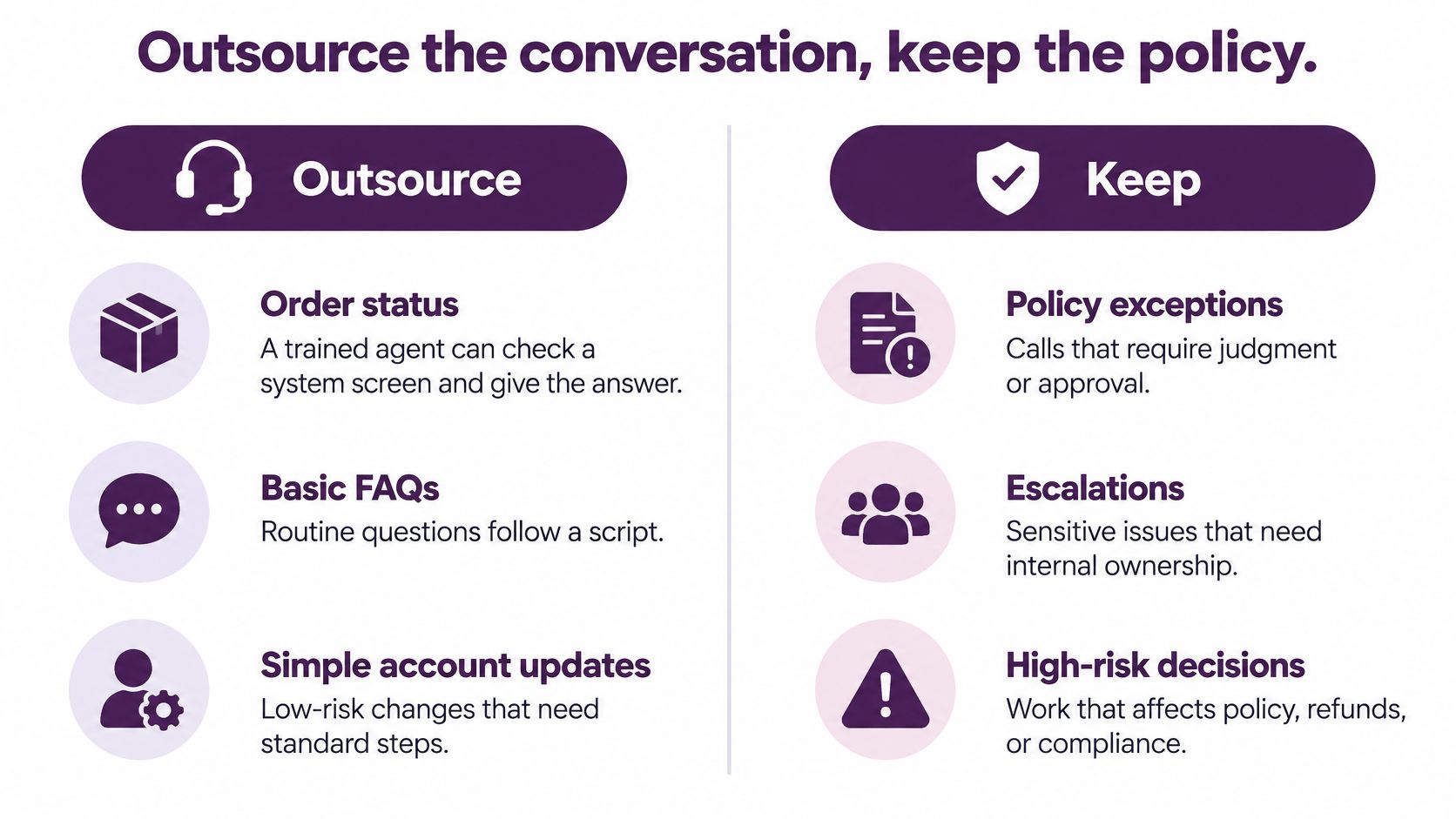
Which Calls to Outsource and Which Decisions to Retain
Delegate approved work while retaining policy ownership and oversight. Your company and provider need explicit responsibilities for verification, actions, exceptions, and escalation. Some specialized decisions may be delegated to appropriately qualified resources under a separate arrangement; ordinary administrative agents should not inherit that authority by implication.
| Work | Possible program scope | Boundary or retained responsibility |
|---|---|---|
| Order status and routine FAQs | Trained agents use approved sources and task-specific permissions | Accurate product information, access rules, and exception ownership. |
| Appointments and reservations | Agents book or change appointments within approved rules | Availability, appointment logic, verification, and urgent escalation. |
| Billing explanations and refunds | Agents explain approved terms and act within documented limits | Disputes, restricted adjustments, and exceptions follow an authorized route. |
| Identity verification | Agents execute a security-approved verification workflow | Security owners define authentication, access, recovery, and incident controls. |
| Healthcare concerns | Administrative intake, scheduling, and message routing where scoped | Clinical judgment belongs to appropriately qualified staff through a defined route. |
| Insurance claims | Approved intake, document status, and administrative follow-up | Coverage and adjudication require the appropriate authority and qualifications. |
| Debt-related contacts | Only within a specifically designed and reviewed program | Applicable rules, permissions, contact restrictions, and specialist escalation. |
| Large exceptions or suspected fraud | Gather permitted facts and initiate the approved escalation | Named decision-maker, evidence requirements, acceptance, and update time. |
A retailer might hypothetically allow a $40 replacement while requiring approval for a $400 dispute. Those are example limits, not recommendations. What matters is that agents can see the boundary and reach the required owner before promising an outcome.
Document where the case goes, who accepts it, what information travels with it, and when the customer receives an update. Sending a notification or transferring a call is not the same as accepted ownership.
Use AI Without Trapping the Caller
Automation can identify intent, retrieve approved information, collect permitted context, and support routine status checks. Failed verification, repeated misunderstanding, disputed actions, and requests outside the bot’s scope need tested routes to the right person.
Preserve relevant history at handoff, but distinguish verified facts from an automated summary. Test English-Spanish meaning, account permissions, and the next owner’s ability to act. A summary should not turn “I dispute this fee” into “I want to pay this fee.”
The NIST AI Risk Management Framework offers voluntary guidance for managing AI risks. Use it to inform governance, testing, and monitoring; it is not a certification or proof that a support workflow is safe.
Evaluate Vendors Through Evidence and SLA Terms
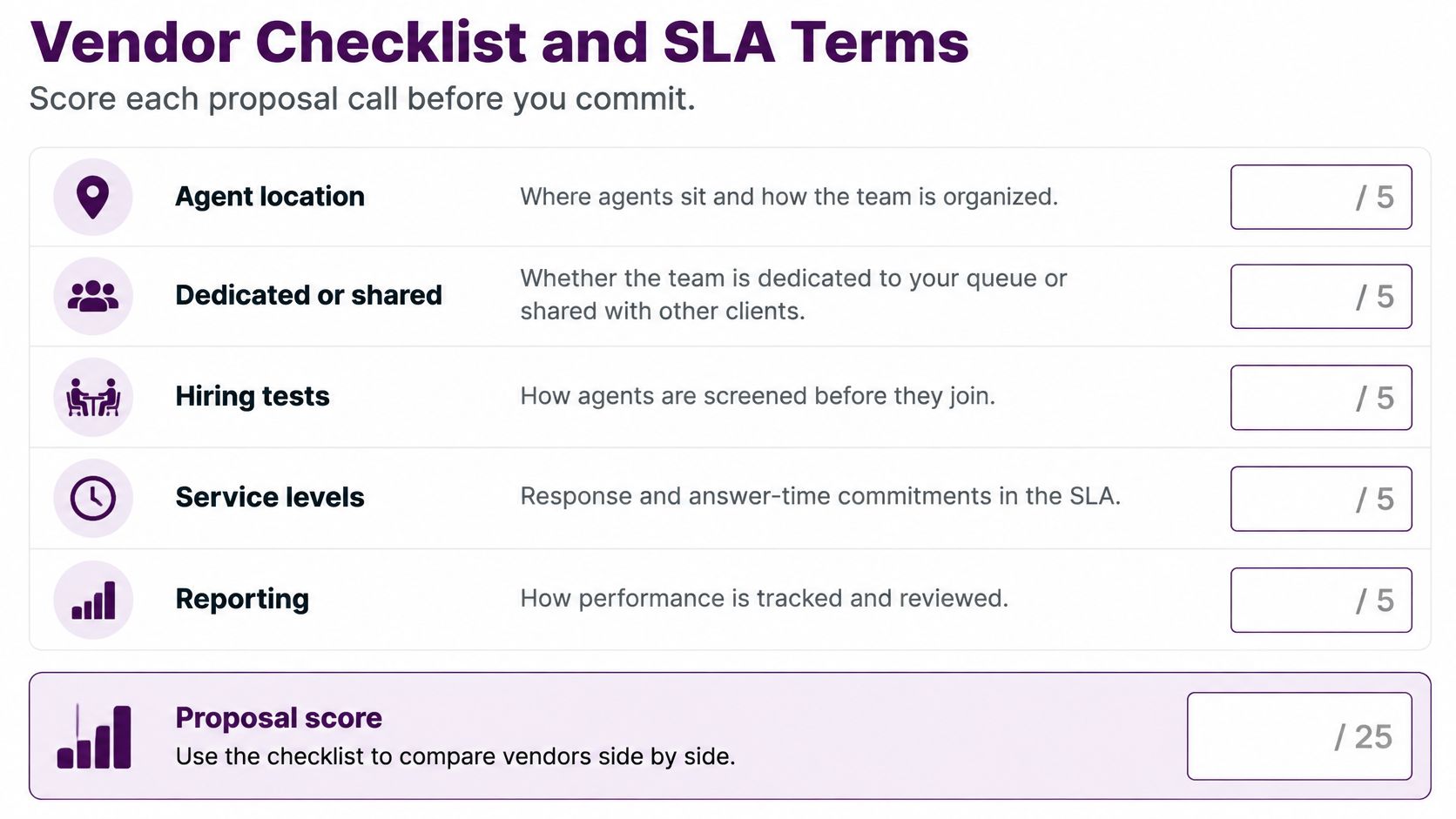
Use an evaluation rubric such as unproven, documented, and demonstrated. Define mandatory controls separately so a polished dashboard cannot offset a material security or staffing gap.
- Location and allocation: Confirm where agents work, dedicated versus shared staffing, actual schedules, and subcontracting approval.
- Language and product skills: Evaluate realistic scenarios, interruptions, policy explanations, and documentation.
- Knowledge ownership: Name who writes, translates, approves, publishes, and updates instructions.
- System permissions: Review agent-level access, exports, downloads, logging, and access removal.
- Quality and coaching: Agree on sampling, critical-error rules, calibration, feedback, and follow-up.
- Live escalation: Test receiving-owner availability and fallback routes across the proposed shifts.
- Continuity and change control: Review outage recovery, volume spikes, integration changes, and rollback.
Define Every Service Commitment
A service-level agreement needs more than a target percentage. Document eligible calls, timer starts, hours measured, abandoned-call treatment, callbacks, reporting intervals, data access, and breach response. Separate first answer, meaningful response, specialist acceptance, update, and final resolution where relevant.
Also agree on training and onboarding fees, holiday coverage, minimum commitments, ramp expectations, contract changes, dispute handling, and termination support. Our call center contracts guide helps organize the commercial discussion alongside operational ownership.
Put Healthcare Responsibilities Into the Actual Workflow
Under HHS business associate guidance, a vendor’s role in handling protected health information determines whether business-associate obligations apply. A written business associate agreement is generally required for a covered business-associate relationship; signing one alone does not establish compliance.
HHS contract guidance addresses permitted uses, safeguards, reporting, subcontractors, and return or destruction of information at termination where feasible. Translate applicable obligations into access controls, trained behavior, retention rules, and documented incident responsibilities.
Have the responsible legal and security teams validate the actual program, including recording permissions and cross-border access where relevant. Administrative support should route clinical questions and urgent concerns through approved procedures to qualified resources.
Inbound Metrics Worth Reporting Weekly
A useful review answers two questions: can customers reach the team, and does the resulting work move their issue toward a valid outcome? Set targets from baseline performance, customer impact, arrival patterns, risk, and capacity rather than adopting universal numbers.
| Metric | Definition to agree | Read alongside | Common trap |
|---|---|---|---|
| Service level | Eligible calls answered within the agreed threshold ÷ eligible offered calls | Abandonment, interval demand, and staffing | Monthly averages conceal weak peak-hour coverage. |
| Abandonment | Calls ending before answer ÷ defined offered calls, with exclusions disclosed | Wait distribution, callbacks, and access failures | Removing short abandons makes missed demand disappear. |
| First-contact resolution | Eligible first-contact issues resolved under agreed rules and repeat window | Same-issue repeats, reopens, and quality | A new ticket number hides the original unresolved issue. |
| Average handle time | Defined talk, hold, and after-contact work ÷ handled contacts | Case mix, accuracy, resolution, and customer feedback | Rushed handling creates more contacts later. |
| Transfer and escalation | Defined transferred or escalated contacts ÷ eligible handled contacts | Reason, appropriateness, context, and owner acceptance | Driving all transfers down discourages correct specialist routing. |
| Cost per resolved issue | Defined delivery cost ÷ unique resolved issues in a matched cohort and horizon | Open-case age, repeat work, quality, and cost scope | Counting each repeat contact or transfer as a new resolution. |
Make Resolution Cost Comparable
Use stable case and issue definitions. A customer who contacts you three times about the same problem has not necessarily created three resolved issues. Include related handling costs once, follow the case through the agreed observation window, and keep open work visible.
For a weekly operating view, a period-based cost measure can be useful, but label it as such: this week’s costs and closures may come from different case cohorts. For a program comparison, align the workload, costs, follow-up horizon, and resolution evidence as closely as practical.
Split results by language, issue type, shift, and escalation reason. Review quality, complaints, and customer feedback beside efficiency. Our call center KPI guide can help frame the scorecard; each operating review should end with named actions and follow-up dates.
How Six Industries Use Inbound Teams
- Healthcare: Scheduling, approved intake, and refill-message routing, with clinical matters directed to qualified staff.
- Financial services: Approved account explanations and fact gathering, with disputes and restricted decisions routed to authorized owners.
- eCommerce: Order status, returns, and replacements within defined authority, with unusual losses or suspected fraud escalated.
- Telecommunications: Approved troubleshooting and outage checks, with completed steps transferred to specialists when needed.
- Retail: Store and online order assistance using current inventory and fulfillment information before making promises.
- Insurance: Claim intake and document-status assistance, with coverage and adjudication handled by appropriately authorized professionals.
Apply Specific Controls to Debt-Related Work
For debt collectors subject to Regulation F, the CFPB explains telephone-frequency presumptions involving calls to a particular person about a particular debt. More than seven calls in seven consecutive days, or a call within seven consecutive days after a conversation about that debt, generally triggers a presumption of violation, subject to exclusions. These are not universal safe calling quotas or a complete compliance test.
Inbound debt collection and debt-relief marketing are different activities. The FTC’s debt-relief services guide explains that some inbound calls responding to advertising fall within the Telemarketing Sales Rule. An inbound label does not remove applicable obligations. Have qualified compliance owners define the specific requirements, channels, jurisdictions, and controls before launch.
A 90-Day Transition Framework With Readiness Gates
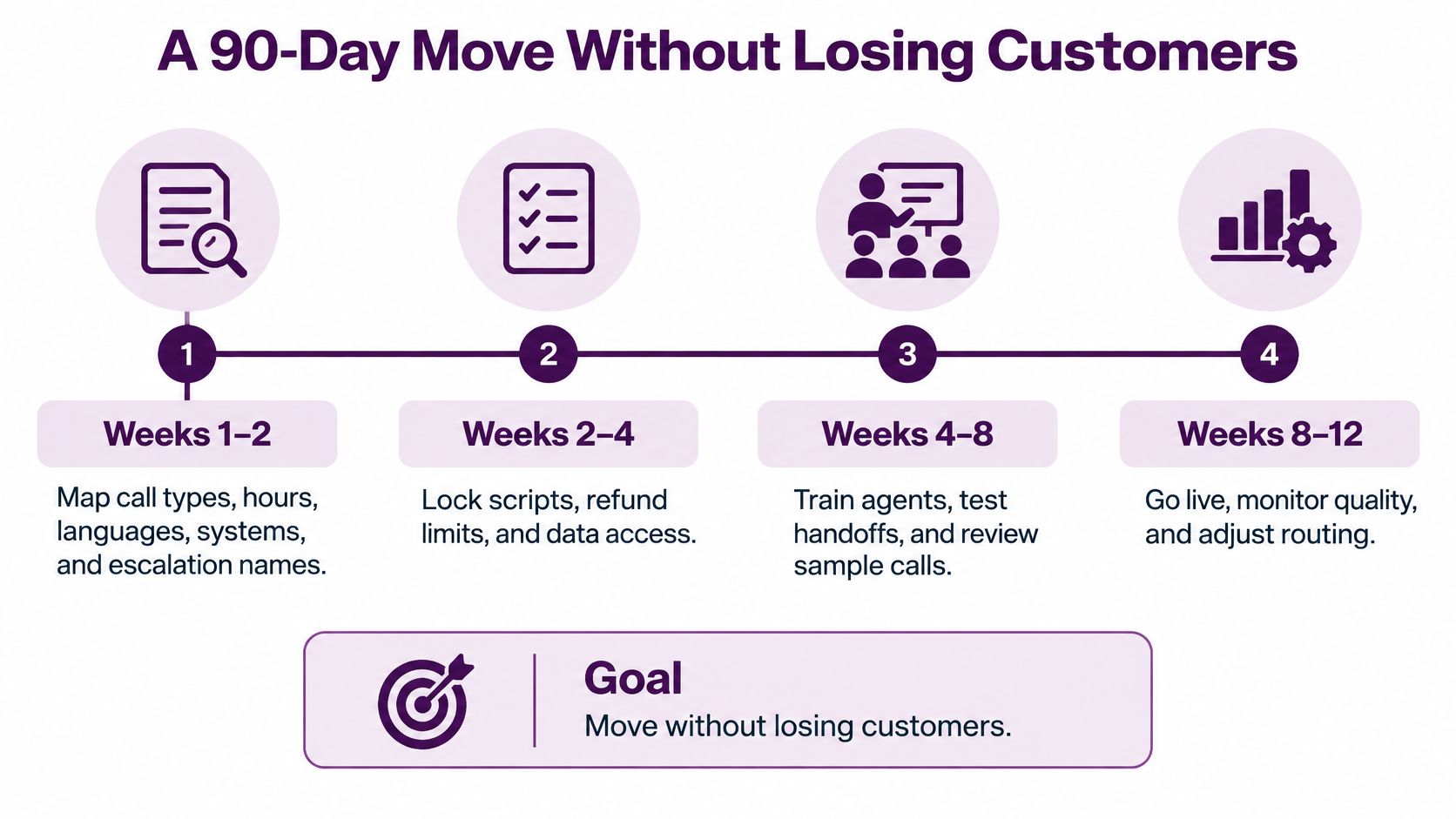
The following is an illustrative planning sequence, not a guaranteed launch time or a promise of zero customer disruption. Readiness should decide whether each stage advances.
- Weeks 1–2: Map the operation. Document contact reasons, volume by interval, languages, systems, specialist routes, and baseline outcomes.
- Weeks 2–4: Approve scope and controls. Resolve policy conflicts, permissions, agreements, recording rules, and ownership.
- Weeks 3–6: Train and validate. Use realistic practice cases, exceptions, documentation checks, and task-specific approval before production access.
- Week 6 or 7: Shadow and test. Validate routing, verification, integrations, escalations, and outage fallback with client specialists available.
- Weeks 7–10: Pilot a bounded queue. Move a defined product or coverage segment with suitable backup and a tested rollback path.
- Weeks 10–13: Review expansion. Add scope only when quality, access, security, handoffs, and capacity meet agreed acceptance criteria.
Test the Entire Customer Journey
A bot may capture an order number that never reaches the desktop. A routing rule may send Spanish callers to an unavailable skill. A supervisor directory may list someone who cannot accept the case. Test these dependencies before volume makes the failures harder to isolate.
Include language switches, interrupted verification, unavailable approvers, returning customers, incorrect records, and system outages. Maintain controlled knowledge updates and approval before material AI or workflow changes. Our outsourcing project management guide provides a useful framework for assigning responsibilities.
Set both immediate risk triggers and trend-based pause criteria. A serious security or safety failure may require action at once; do not wait for two weeks of poor results. For less urgent drift, investigate sample size, case mix, and persistence before deciding whether to pause expansion.
Build a Financial Comparison You Can Defend
Consider a hypothetical comparison of 10 agents × 160 billed hours × $12 = $19,200, versus $48,000 at an assumed $30 hourly rate. These are planning inputs, not current vendor quotes, country averages, or published CallZent rates.
If each scenario delivers 6,000 unique resolved issues under the same definition and follow-up horizon, the staffing-only cost is $3.20 versus $8 per resolved issue. That does not establish total savings until implementation, tools, telecom, client oversight, quality work, and other relevant costs are included consistently.
Test whether the hours and workload are feasible. Billable hours, scheduled hours, available hours, and contact-handling hours are different measures. Apply shrinkage and occupancy assumptions at the appropriate steps and avoid counting training or absence twice.
Choose Pricing That Supports the Work
Dedicated hourly pricing provides allocated capacity, while per-minute, per-call, or shared models may fit more variable demand. Neither structure guarantees good incentives. Define billable activity, repeat contacts, wrap-up, training, minimums, after-hours support, and quality responsibilities.
Plan the exit before signing. Agree on access to permitted exports and recordings, knowledge ownership, permission removal, transition assistance, retention, and deletion. A 30–60-day transition period can be an illustrative negotiation point, not an assumed contractual right.
When discussing an inbound program with CallZent, bring your contact mix, coverage hours, language needs, systems, authority limits, and outcome definitions. Request a quote for the actual scope, then use a controlled pilot to assess how the team handles your customers’ work.
Frequently Asked Questions
What is an outsourced inbound call center?
It is a third-party operation that handles customer-initiated calls on your behalf. The scope may include questions, appointments, order support, troubleshooting, and approved follow-up. Chat, email, and messaging should be specified separately as part of a broader contact-center program.
What is the difference between inbound and outbound support?
Inbound contacts begin with the customer seeking help or information. Outbound contacts are initiated by the business, such as follow-up or prospecting. A blended team may handle both, but workflows, staffing priorities, permissions, and applicable outreach rules must be defined.
Should a business choose dedicated agents or shared coverage?
Dedicated agents provide allocated capacity and can support deeper product knowledge. Shared coverage may fit defined answering tasks or variable overflow. Compare actual availability, supervision, training, systems access, escalation support, and total cost for the same work.
How much does inbound call center outsourcing cost?
Cost depends on coverage, volume, skills, languages, delivery model, technology, supervision, and other requirements. Request current proposals with matching scope and explicit inclusions. Illustrative hourly inputs in a budgeting example are not market averages or vendor quotes.
What are the advantages of a nearshore inbound team?
Working-hour alignment and proximity can make collaboration, training, and visits easier. English-Spanish capacity can support bilingual customers when properly staffed and trained. Validate the proposed team’s actual skills, availability, controls, and results rather than assuming geography guarantees quality.
Which customer service decisions should remain restricted?
Clinical judgment, regulated determinations, sensitive account changes, suspected fraud, and material exceptions require appropriate authority and qualifications. Administrative agents can perform approved tasks and gather permitted facts. Define specialist routes and accepted ownership before launching the program.
How should a business measure outsourced inbound performance?
Track access, service level, abandonment, first-contact resolution, repeat contacts, quality, escalation handling, and cost using documented definitions. Review languages, shifts, and issue types separately. Keep open work visible and distinguish appropriate specialist routing from avoidable transfers.
Can an inbound provider handle healthcare calls?
A suitably scoped team can handle approved administrative work with appropriate training and safeguards. Determine whether a business associate agreement and other requirements apply. Clinical questions and urgent concerns need approved routing to qualified resources; administrative staffing does not confer clinical authority.
How long does an inbound outsourcing transition take?
Timing depends on workflow complexity, integrations, training, approvals, and risk controls. A 90-day sequence can be an illustrative planning framework. Use readiness gates, a bounded pilot, backup coverage, and rollback rather than advancing solely because a calendar date has arrived.
What should an inbound call center contract include?
Define staffing, hours, channels, languages, authority, security, quality review, measurement rules, escalation, fees, changes, subcontracting, continuity, and termination. Agree on data access, retention, knowledge ownership, and transition assistance. Confirm that operating procedures can deliver the contractual commitments.
Bilingual Nearshore Support in Mexico
Build Inbound Support Around Your Customers’ Needs
Discuss your call types, English-Spanish coverage, systems, and escalation limits with CallZent. Define a focused inbound pilot with clear responsibilities and measurable customer outcomes.