

Contact Center Workforce Management
Contact Center Workforce Management: How to Balance Service, Agents, and Cost
Learn how contact center workforce management improves forecasting, scheduling, intraday control, KPIs, agent experience, and service levels in nearshore bilingual operations.
TL;DR — Quick Takeaways
- Contact center workforce management works when forecasting, scheduling, intraday control, KPIs, and manager behavior move together.
- WFM is not just a software feature list. It is the operating discipline that protects service levels, agent experience, and margin.
- Strong WFM programs account for shrinkage, adherence, attrition, forecast accuracy, and supervisor quality.
- The best dashboards connect KPIs to action, not just reporting.
- Technology matters, but culture, first-line leadership, coaching, and adoption often determine whether the WFM plan works on the floor.
- Nearshore bilingual operations can flex across English and Spanish demand while staying aligned with U.S. time zones.
Monday morning usually exposes the truth fast. The queue is climbing, two agents are sitting on the wrong skill while another team is underwater, and someone is patching a spreadsheet schedule that already broke before coffee. That’s the face of contact center workforce management, not a software feature list, but the discipline that decides whether service levels hold, agents stay sane, and margin survives the week.
If you’re trying to understand why the day keeps slipping away from your team, start with the business case for the function itself in why contact centers matter in 2025.
Why Workforce Management Makes or Breaks a Contact Center
A center can have solid hiring, decent training, and a good phone system, then lose the day because the schedule was built on guesswork. I’ve watched that happen in captive teams and outsourced programs alike. The problem isn’t usually that leaders don’t care, it’s that they treat workforce management like an admin task instead of an operating system.
That mindset gets expensive quickly. In the benchmark data, labor accounts for 60% to 70% of contact center operating cost, which means even small staffing errors create visible cost pressure, and mature WFM programs that improve forecast accuracy can translate that into real savings through better labor planning customer support workforce management statistics 2026. The same benchmark says 65% to 70% of mid- and large-sized centers were already on a dedicated WFM system by 2025, while smaller centers lagged below 35%. That gap tells you something practical, dedicated WFM isn’t a luxury once volume, channels, and attrition get messy.
Practical rule: if the schedule only looks good in Excel, it isn’t operationally ready.
WFM is where service, people, and cost collide
The strongest operators don’t ask whether WFM helps service or saves money. They ask how much pain they can remove from both at the same time. The same benchmark notes that mature programs were forecasting contact volume within 5% of actuals, and even a modest 5% staffing-efficiency gain can generate a 3x to 4x return on the platform cost in the first year customer support workforce management statistics 2026. That’s why this function deserves boardroom attention, not just a weekly scheduling review.
There’s also a human reason to care. When schedules are wrong, overstaffing breeds boredom and understaffing burns people out. In a bilingual nearshore environment, the right coverage model can absorb U.S. demand swings without forcing one team to carry the whole day. That’s where good WFM stops being administrative and starts protecting service quality.
The rest of the guide focuses on what changes outcomes, the parts of WFM, the KPIs that matter, how to judge technology without falling for a demo, and why culture often determines whether the plan works on the floor.
The Core Components of Contact Center Workforce Management
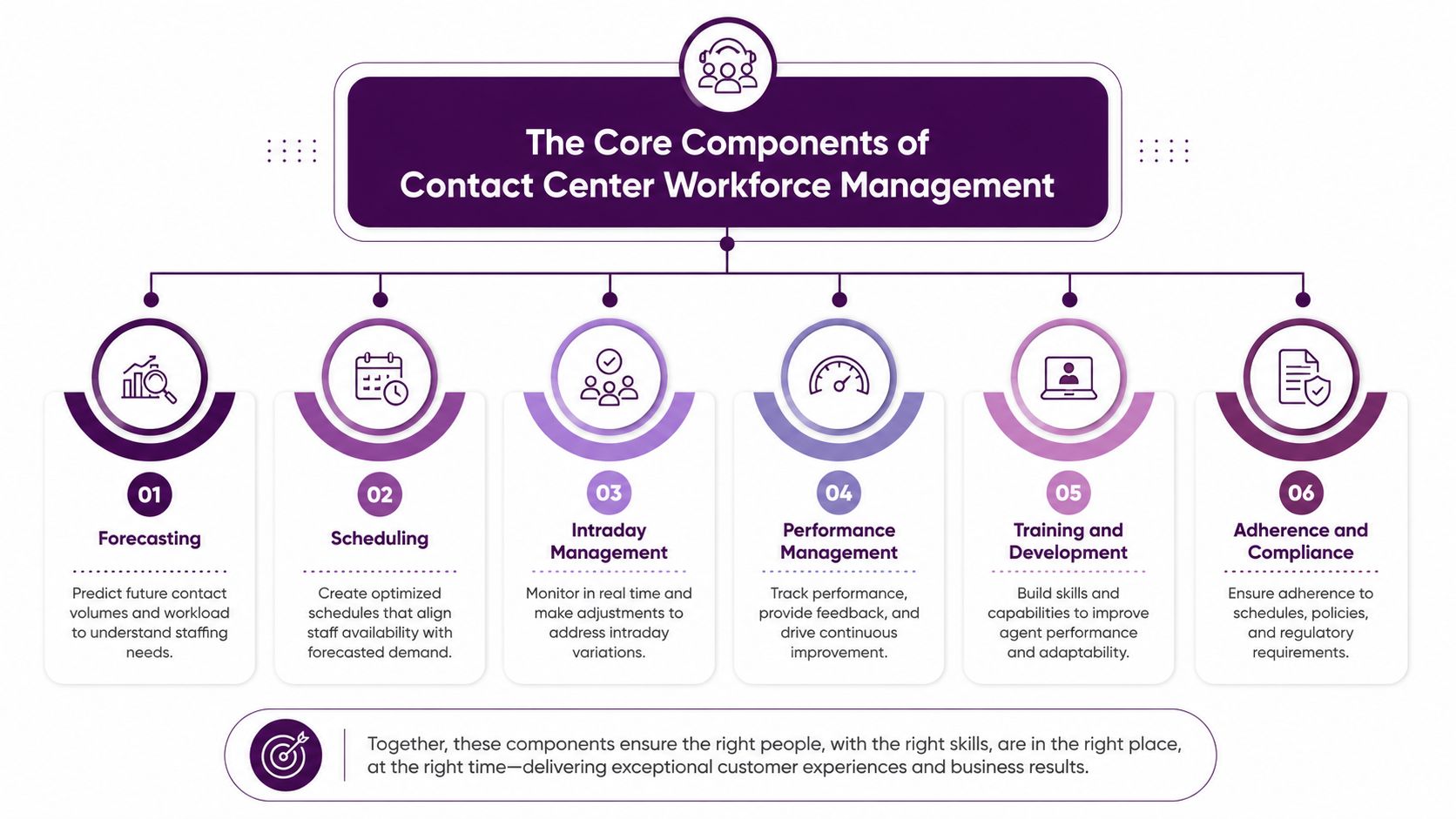
A schedule only works when the underlying process is sound. In contact center workforce management, demand gets translated into coverage, coverage gets translated into staffing, and staffing gets translated into service performance. That is why I treat WFM as a human-systems problem first and a software problem second. Verint’s buyer’s guide frames it as aligning the right number of employees with the right skills across voice, digital, in-person, and self-service, with live adjustments involving HR, operations leaders, supervisors, and agents Verint buyer’s guide. That definition matters because it keeps WFM from being reduced to shift-building alone.
The five moving parts that have to stay connected
Forecasting is the first gear, the check you make before you leave the airport parking lot. If the demand curve is wrong, every other decision bends around that mistake. COPC’s benchmarking found that 87% forecast volume and 85% forecast handle time, but only 38% use volume, AHT, and shrinkage together for scheduling COPC benchmarking.
Staffing calculation turns that forecast into required coverage. Centers often miss here when they ignore shrinkage. Raw headcount almost always overstates what is available to handle contacts, because meetings, PTO, coaching, breaks, and absences all reduce productive time.
Schedule building is the next gear. It has to account for demand, labor rules, agent preferences, and skill needs at the same time. If it does not, adherence problems start before the day starts.
Intraday management is the immediate correction layer. It works like the traffic signal system on that same highway. When demand shifts, the center has to reforecast, move people, or protect offline work instead of pretending the original plan still works.
Reporting closes the loop. Without it, teams cannot tell whether the schedule problem came from poor forecasting, weak adherence, or a staffing model that was never realistic.
Why one weak gear breaks the others
When any one of these pieces is off, the rest get distorted. Poor handle-time assumptions make staffing too thin. Weak adherence turns a good forecast into a bad day. Untracked shrinkage makes the schedule look healthier than it is.
A schedule is only as good as the inputs behind it and the discipline around it.
In practice, the best WFM leaders sketch this as a loop on a whiteboard and ask one question at each stage, what did we expect, what did we need, what happened in the middle, and what did we learn? If a team cannot answer those questions cleanly, the process is still more manual than it needs to be. In nearshore bilingual teams, especially in Tijuana-style hubs, better coverage decisions in the U.S. carry further because the staffing model can absorb demand swings across languages and channels without forcing one group to carry the full load. For a closer look at how coverage models support that balance, see flexible staffing models.
Key KPIs That Drive WFM Decisions
Too many dashboards turn into trophy cases. A useful WFM dashboard helps a manager decide whether to protect service, move people, coach a team lead, or accept that the day needs a different plan. The KPIs worth keeping are the ones that change action, not just reporting.
Call center KPI guidance only matters when the numbers lead to a decision. Service level shows whether customers are waiting too long. Average handle time shows how much capacity each interaction consumes. Occupancy shows whether people are stretched too thin. Adherence shows whether the schedule is being followed. Shrinkage shows how much planned time is unavailable. Attrition shows how much instability the staffing model has to absorb. Forecast accuracy shows whether the center is planning from reality or from hope.
WFM KPIs and the Decisions They Drive
| KPI | What It Signals | WFM Action |
|---|---|---|
| Service level | Whether demand is being met on time | Move people, change breaks, or reforecast intraday |
| Average handle time | How much capacity each contact consumes | Adjust staffing assumptions and coach for efficiency |
| Occupancy | Whether agents are stretched too thin | Rebalance workload and avoid chronic burnout |
| Adherence | Whether agents are where the schedule says they should be | Coach supervisors and fix schedule realism |
| Shrinkage | How much paid time is not productive time | Bake it into staffing calculations and scheduling |
| Attrition | How unstable the team is becoming | Add buffer, improve retention, and protect onboarding |
| Forecast accuracy | How close planning is to actual demand | Tighten volume, AHT, and shrinkage inputs |
What each metric changes in practice
Service level and AHT are the classic pair, but I have seen centers over-focus on them and still lose control because adherence was weak. If people do not follow the schedule, a precise forecast does not save the day. Shrinkage matters just as much, because productive-capacity planning only works when volume, AHT, and shrinkage are used together, as noted in COPC benchmarking.
Attrition is the wildcard. NiCE’s 2025 employer survey reported that 2024 average annual attrition fell to 39% for agents and 34% for back-office employees, down from 49% and 47% in 2023, but 58% of respondents still said unmanaged agent attrition had increased NiCE survey. Replacing a single agent is widely estimated to cost $10,000 to $20,000 in direct expense in major markets NiCE survey. That is not just an HR issue. It changes how much buffer you need in schedules, how much training time you must protect, and how much pressure lands on the rest of the floor.
Nearshore bilingual teams change the math again. When U.S. planning is paired with bilingual coverage in a Tijuana-style hub, the same staffing decision can protect service in one queue while absorbing spillover in another. That does not remove the need for disciplined forecasting, but it does make each scheduling choice more valuable because the team can absorb demand swings across languages and channels without forcing one group to carry the full load.
Bottom line: track fewer metrics, but tie each one to a specific action. If a KPI does not trigger a decision, it is noise.
How to Evaluate WFM Technology Without Getting Sold To
A vendor demo should expose your current operating pain, not just show polished charts. Buyers usually make the first mistake before they ever see the product, they shop features before they define the operating reality. A small team with stable voice demand does not need the same setup as a multi-channel, bilingual operation with volatile demand and constant intraday shifts.

Start with capability, not marketing language
The first filter is practical, can the platform handle your mix of forecast volume, AHT, shrinkage, and intraday changes without sending your team back into spreadsheets? The stronger systems reduce manual cleanup because they are built around how planners work, not around a slide deck. If a tool cannot manage those inputs together, it will look fine in a demo and create work after go-live.
Ask how the system handles multi-channel scheduling, intraday reforecasting, adherence tracking, and integrations with ACD, CRM, and HRIS. A useful feature set should also account for the planning reality that matters most, schedule creation, exception handling, supervisor approvals, and reporting that operations can act on. If you want a practical checklist of what a modern platform should cover, essential call center software features for 2026 is a useful way to pressure-test vendor claims before you get buried in product language.
Pressure-test the demo with real intraday scenarios
Keep the vendor out of a perfect-day script. Ask them to show what happens when volume spikes, PTO requests pile up, or one skill runs hot while another sits idle. The test is whether the platform helps a supervisor make a decision fast enough to protect service without creating chaos for the next interval.
A clean demo answer should show the steps a supervisor takes, not just the headline feature. If the vendor avoids live interruptions, never touches exceptions, or only talks about AI in broad terms, you are looking at a slide deck, not a planning engine. In operations, that gap shows up quickly, especially in centers where bilingual coverage, blended queues, and nearshore teams have to absorb demand shifts across languages and channels.
Watch for red flags:
- Pricing that only tracks seat count: that usually hides the implementation effort.
- Demos that skip intraday exceptions: the day rarely goes exactly as forecast.
- AI claims with no operational detail: ask what data is used, how exceptions are handled, and who approves changes.
- No discussion of adoption: a feature no supervisor uses does not improve service.
A useful demo should also make the human trade-offs visible. In a U.S. site that works with a nearshore bilingual hub, one scheduling decision can protect English service, cover Spanish overflow, and reduce the need for constant firefighting on the floor. That is where WFM pays off, not in prettier reports, but in the number of decisions it lets operations handle without manual escalation.
How WFM Looks Different in Healthcare, Finance, and E-commerce
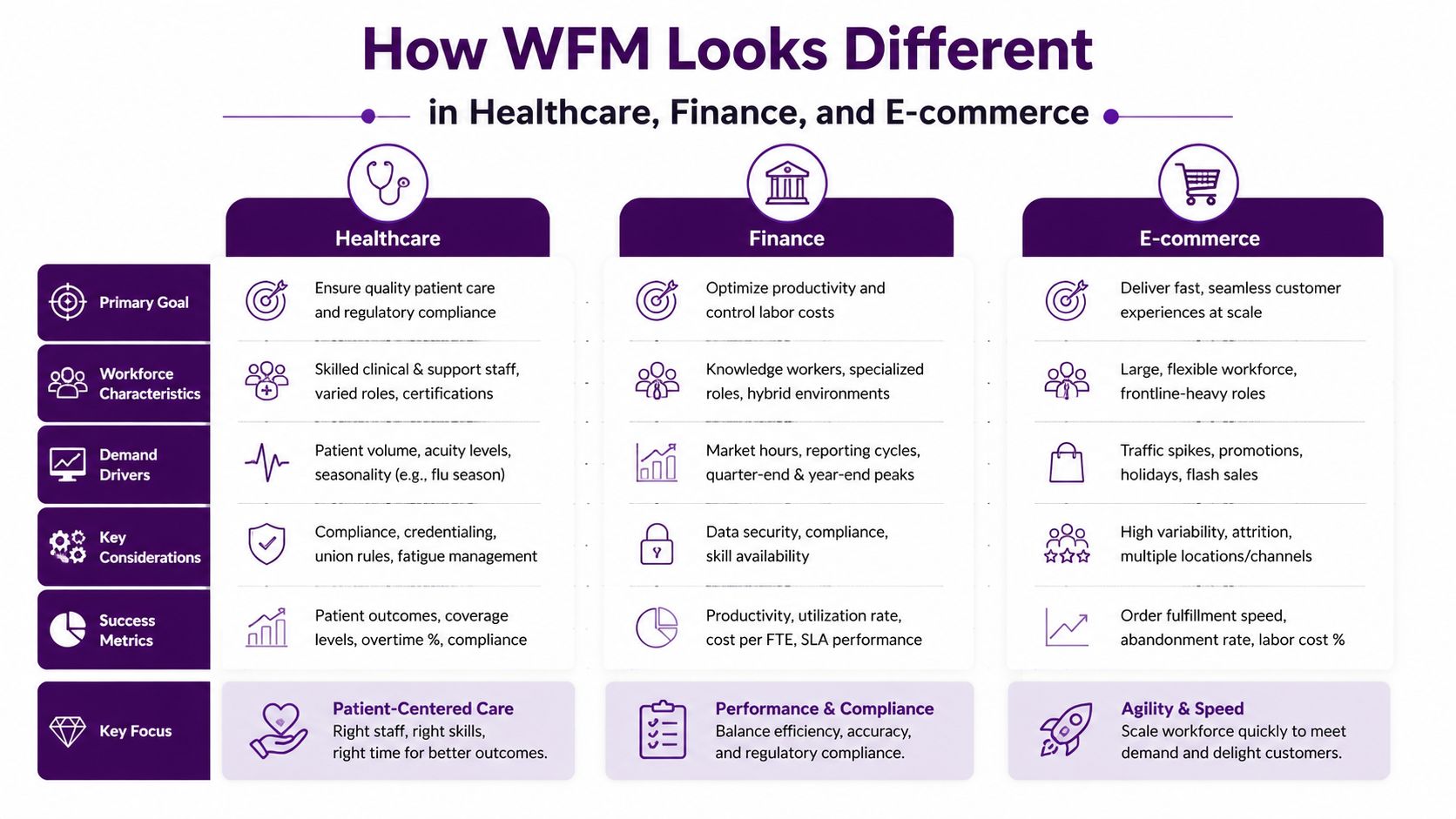
The mechanics of WFM are consistent, but the constraint set changes by industry. That’s where a lot of generic advice falls apart. A schedule that works for a retail queue can fail in healthcare because compliance, sensitivity, and skill routing are tighter. Finance and e-commerce bring different pressure points, but the same core discipline still applies.
Healthcare, finance, and e-commerce each stress a different part of the plan
In healthcare, appointment activity and patient support demand tight adherence and careful skill-based routing. Missed staffing windows don’t just slow a queue, they disrupt a care journey. The WFM burden is less about chasing volume for its own sake and more about making sure the right people are available when sensitive work arrives.
Finance adds another layer of control. Transaction windows, regulated interactions, and seasonal spikes mean the intraday plan has to be disciplined, especially around time-off management. In that environment, a weak PTO process can create more pain than a bad forecast because coverage gaps are harder to absorb.
E-commerce is usually the most elastic and the most volatile. Flash sales, holiday surges, and chat-heavy demand force teams to flex across voice and digital channels quickly. That’s where bilingual nearshore staffing can do real work, because a Tijuana-based team can cover U.S. demand patterns in the same workday while moving between English and Spanish contacts without the lag that ruins handoffs.
The common framework still wins
The industry changes, but the planning logic stays the same. Forecast demand, calculate staffing, schedule with shrinkage in mind, and control the day before it controls you. The difference is in how much flexibility you leave in the model and how tightly you define the work.
In practical terms, that means a nearshore bilingual partner can act as a pressure-release valve for U.S. centers that need coverage without losing quality. It’s not about replacing the core plan. It’s about widening the range of demand you can absorb before service starts slipping.
The Biggest Bottleneck Is Culture, Not Software
A new platform will not fix a team that does not trust its managers, or a supervisor layer that cannot coach. McKinsey’s work on contact center performance points to simple, actionable huddles, clearer KPIs, and coaching managers to run them well as performance levers, and it notes that nesting cohorts of at least six agents can create peer support for new hires McKinsey employee engagement PDF. That is a useful correction to the usual software-first mindset.
The floor still runs on trust and habits
I have seen centers buy better forecasting and still miss service because agents did not buy into the schedule, supervisors avoided hard conversations, or onboarding never built peer support. In those cases, the WFM system was doing its job, but the people system was not. If a team’s huddles are vague, KPIs are cluttered, and coaching is inconsistent, the forecast can be accurate and the floor still underperform.
That is why agent experience matters so much. The NiCE attrition data shows the cost of instability, and CallZent’s employee retention perspective is relevant here because retention belongs in WFM capacity planning. Every exit forces the center to spend again on hiring, training, and schedule disruption.
Nearshore bilingual teams can compound the benefit when the culture is healthy. Shared time zones, closer collaboration, and a more immediate feedback loop make it easier for managers to coach, for agents to feel seen, and for WFM to become day-to-day discipline instead of a monthly report. The software still matters, but it works best when the humans using it are aligned.
Real operator lesson: the best schedule in the world fails if the first-line leader cannot get the team to follow it.
Your 30-Day WFM Action Plan and What to Ask a Nearshore Partner
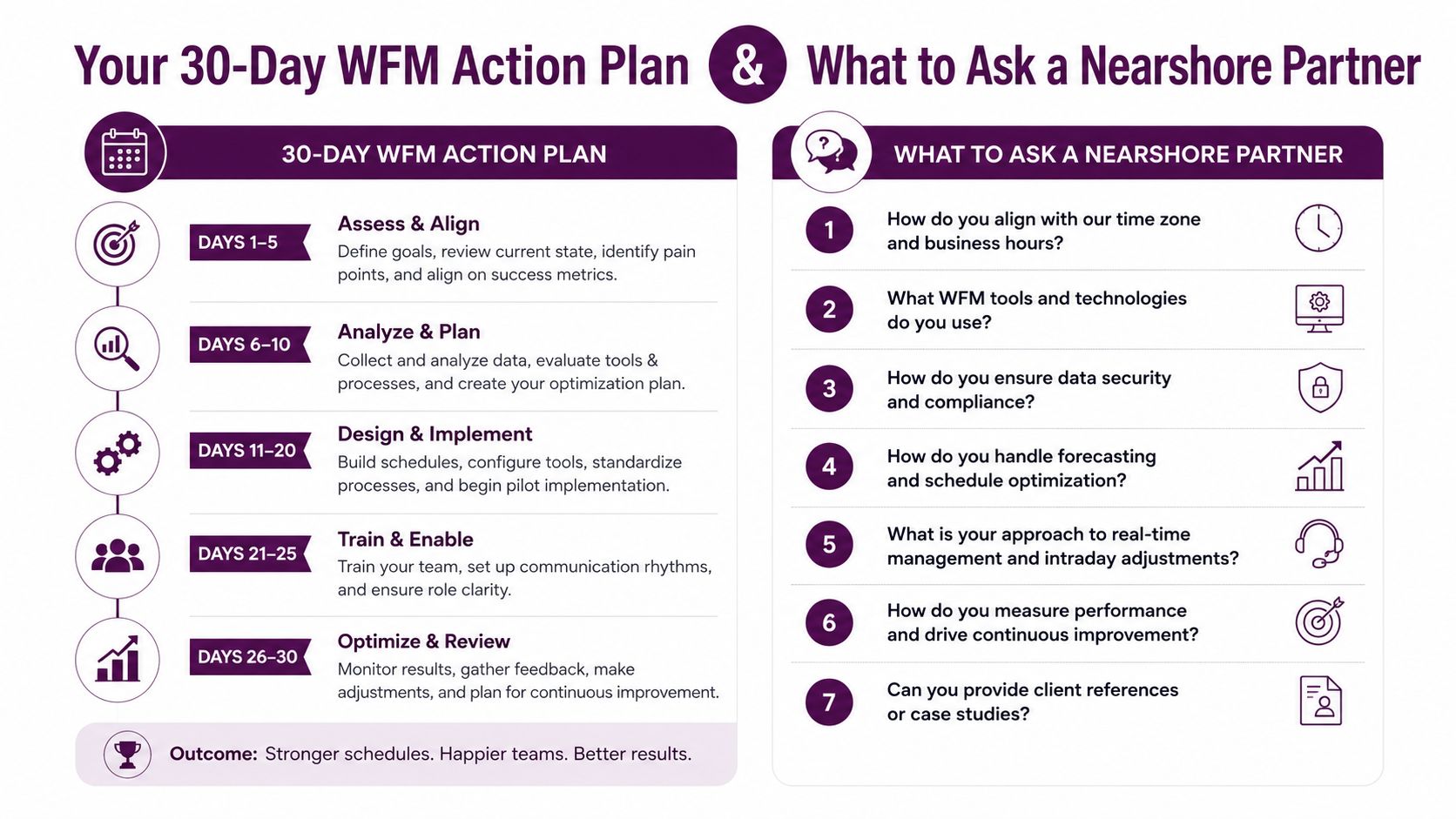
Start with a hard audit of forecast accuracy, shrinkage assumptions, and adherence gaps. Then fix the worst intraday failures first, because those are the leaks your customers and agents feel immediately. If you’re evaluating outside help, the 2026 buyer’s guide for MSPs is a good model for how to think about managed support relationships before you sign a contract.
Ask a nearshore partner these questions:
- How do you forecast volume, AHT, and shrinkage together?
- How do you handle intraday changes when the day goes off plan?
- What does adherence coaching look like on the floor?
- How do you protect agent culture during ramp and growth?
- How do bilingual teams support U.S. service levels without breaking continuity?
- How do supervisors run huddles and escalations?
- How do you prove the schedule is working after go-live?
WFM wins when forecasting, technology, and culture move in the same direction.
If you want a bilingual nearshore team that treats workforce management as an operating discipline, not a reporting exercise, visit CallZent and see how a Tijuana-based, agent-centric model can help your center protect service, control cost, and build a more stable schedule.
🚀 Build a Workforce Management Model That Protects Service
If you want a bilingual nearshore team that treats workforce management as an operating discipline, not a reporting exercise, CallZent can help your center protect service, control cost, and build a more stable schedule with a Tijuana-based, agent-centric model.
Talk to an Expert