Skip to content
E-Commerce Customer Support
Customer Service Issues in E-Commerce—and How to Solve Them
Learn how to solve customer service issues in e-commerce by improving fulfillment, returns, payments, channel SLAs, automation, and nearshore support.
What happens when a customer asks, “Where is my order?” and your agent can’t see the shipment, warehouse status, or refund eligibility? The problem may look like a slow support response, but the underlying failure often started somewhere else.
India’s National Consumer Helpline recorded nearly 20 lakh complaints against e-commerce and quick-commerce platforms over five years, with annual grievances rising from 2,24,592 in 2021 to 5,11,198 in 2025, more than a twofold increase in four years. The reported grievance data points to a larger operational truth: many customer service issues in e-commerce are logistics, warehouse, payment, and returns problems disguised as support tickets.
This distinction matters. Hiring more agents can absorb demand temporarily, but it won’t fix incorrect inventory, missing tracking events, failed payment reversals, or an unclear returns policy. Scalable e-commerce support connects frontline conversations to the systems that caused the customer’s frustration.
The Scale of E Commerce Customer Service Complaints
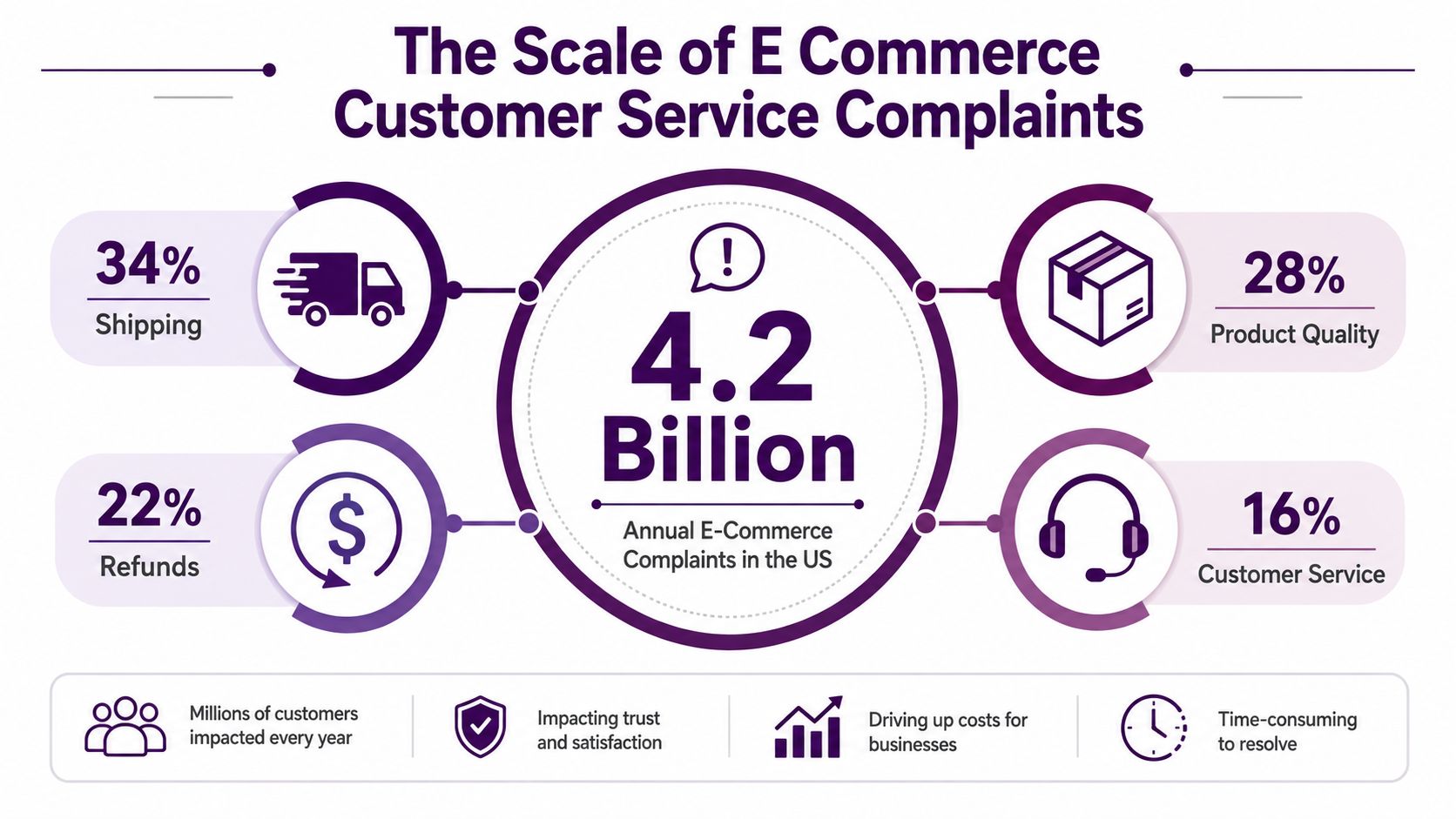
Complaint volume is an operations signal, not only a staffing signal. The Indian data shows the scale clearly, with nearly 20 lakh complaints against e-commerce and quick-commerce platforms recorded over five years. The underlying complaint record gives support leaders a reason to examine why customers contact the team, not only how many contacts agents handle.
The 2025 breakdown points toward fulfillment control. Non-delivery of products accounted for 79,818 complaints, while delivery of the wrong product accounted for 75,426. A further 15,762 complaints involved spurious, fake, or counterfeit products. The 2026 government reporting links service demand with delivery accuracy, product trust, and the controls behind order fulfillment.
Support queues reflect operational health
A missing-package contact requires more than a polite reply. The agent needs current order data, carrier-exception rules, and a defined replacement or refund decision. Without those controls, the contact center becomes a holding area for unresolved warehouse and logistics work.
The same pattern appears in older complaint records. Among 5,933 real customer complaints collected between January 2008 and March 2011, product defects represented 1,650 cases, or 27.81%. The historical complaint analysis also identifies return, exchange, and packaging problems as substantial sources of customer friction.
Operational takeaway: A support queue functions as a diagnostic report. Rising “where is my order” contacts indicate gaps in tracking visibility or carrier management. Repeated refund contacts can indicate unclear policy, payment-reversal failures, or a returns workflow that lacks ownership.
Classify tickets by root cause, then connect each category to the team that can correct it. A useful dashboard separates non-delivery, wrong-item shipments, damaged goods, product defects, payment failures, returns, refunds, and technical issues. That view helps operations leaders fix recurring failures before they generate another conversation.
Support teams also need documented escalation paths, shared order data, and clear handoffs between agents, fulfillment, payments, and returns. CallZent’s customer support approach for e-commerce provides a practical reference for organizing those support responsibilities.
The Most Common Customer Service Issues in E Commerce
Many e-commerce complaints are operations failures presented as support requests. The useful question is not whether a ticket exists, but which process created it and which team can prevent the next one.
Fulfillment failures
Non-delivery and wrong-item complaints often start with inventory accuracy, picking, packing, address validation, carrier handoff, or weak tracking visibility. A customer orders a black jacket and receives a blue one. Support can apologize, but fulfillment must verify the shipment, authorize the return, reserve the replacement, and update the customer.
Repeated “where is my order” contacts usually point to missing scans, carrier exceptions, dispatch delays, or tracking that customers cannot interpret. Review the warehouse and carrier workflow before adding another response-time target.
Defects and damaged goods
Product quality remains a major source of service failure. Historical complaint records found 1,650 product defect cases among 5,933 complaints, representing 27.81% of the sample. The finding reinforces why product information, packaging controls, quality checks, and replacement policies belong in service planning.
A customer reporting a damaged small appliance needs more than a scripted apology. The agent needs evidence requirements, a replacement rule, inventory visibility, and a process for flagging packaging or carrier failures. Without those controls, the same defect creates multiple contacts and remains invisible to the team that can correct it.
Returns, refunds, and exchanges
Returns create friction when policies are hard to find, authorization takes too long, or different channels provide conflicting instructions. Refund delays generate repeat contacts when agents cannot see payment status or confirm whether the reversal reached the customer’s account. Assign ownership across support, returns, and payments, then expose the relevant status in the agent workspace.
Payment and checkout failures
A declined card, duplicate authorization, failed discount code, or payment captured without an order can produce high-stress contacts. Resolution requires coordination between the support desk, payment gateway, fraud controls, and order-management platform. Checkout logs and clear escalation rules help separate a customer error from a system failure.
Technical support gaps
Technical products require a different support motion from basic order-status questions. Customers may need troubleshooting, compatibility guidance, account recovery, or specialist escalation. Translation quality also matters for bilingual teams handling technical terminology. Teams can apply customer support translation strategies to standardize multilingual terms and escalation instructions.
| Issue Category | Root Cause | Typical Resolution |
|---|---|---|
| Non-delivery | Carrier exception, address error, inventory or dispatch delay | Verify tracking, contact logistics, replace or refund |
| Wrong product | Picking, packing, catalog, or SKU error | Confirm item, authorize return, ship correct product |
| Product defect | Manufacturing, quality control, packaging, or handling issue | Troubleshoot, replace, repair, or refund |
| Returns and refunds | Unclear policy, approval delay, payment workflow gap | Validate eligibility, issue authorization, confirm refund status |
| Payment failure | Gateway error, fraud review, duplicate authorization | Verify transaction, release or reverse payment, restore order |
| Technical issue | Incomplete product guidance or missing specialist coverage | Troubleshoot, document steps, escalate when needed |
The fastest improvement usually comes from assigning each issue to an owner outside the contact center. CallZent’s guide to common customer complaints offers practical context for designing handling and escalation paths.
Why Response Time Expectations Vary by Channel
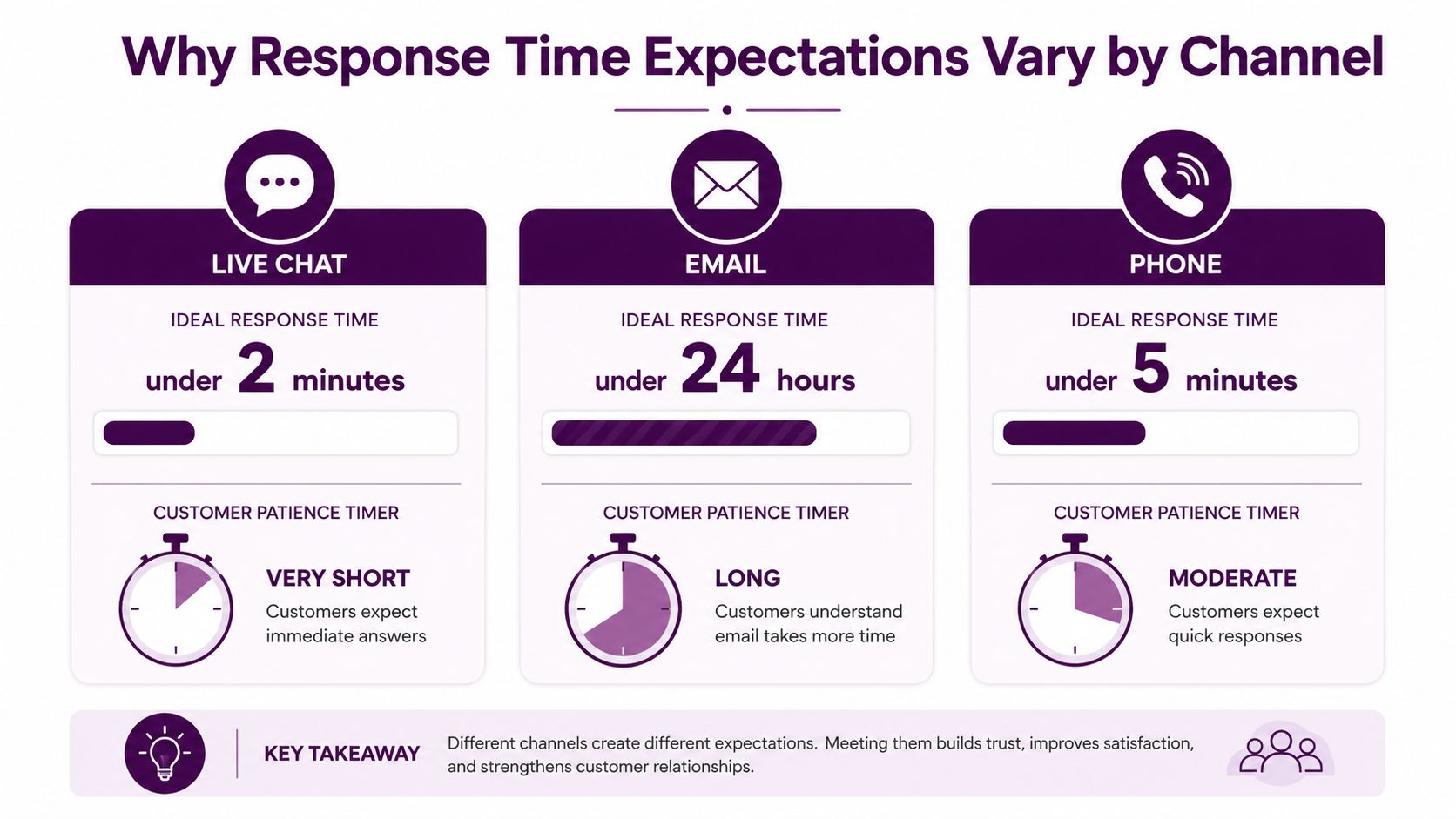
A universal response-time target sounds simple, but it creates predictable failure. Customers treat live chat, email, and phone differently because each channel signals a different level of immediacy.
Independent benchmark guidance places email first response at under four hours as a baseline and under one hour as best-in-class. For live chat, the expectation is under one minute, while phone support should answer in under 60 seconds. The channel-specific SLA guidance explains why staffing and routing can’t rely on one shared queue.
Match staffing to customer intent
Live chat usually appears during an active shopping or troubleshooting session. If nobody responds, the customer may abandon the interaction before an agent reads the message. Email allows more patience, but customers still expect a clear acknowledgement and a useful next step. Phone callers have already chosen the highest-effort channel, so long waits feel especially punitive.
A survey cited by Aircall found that 96% of shoppers expect a chat response within five minutes, 80% want one within two minutes, and 49% will leave a website if they don’t see someone typing within one minute. The Aircall research summary illustrates how response latency can affect both service perception and conversion.
Design separate service levels
The answer isn’t automatically “hire more agents.” First, separate queues by intent and urgency. A payment failure, suspected counterfeit product, or delivery exception may require immediate human handling. A tracking request with a current carrier scan may be suitable for self-service.
Teams should define:
- Live chat routing: Assign real-time coverage and escalation rules for active shoppers.
- Email priorities: Use intent tags to distinguish routine questions from order-risk cases.
- Voice handling: Protect phone capacity for complex, urgent, or trust-sensitive issues.
- Escalation timing: Set ownership rules so unresolved cases don’t circulate between departments.
An omnichannel customer support model helps unify customer history without pretending every channel has the same tolerance window. The goal is consistent context, not identical handling.
Prevention and Remediation Strategies for E Commerce Support
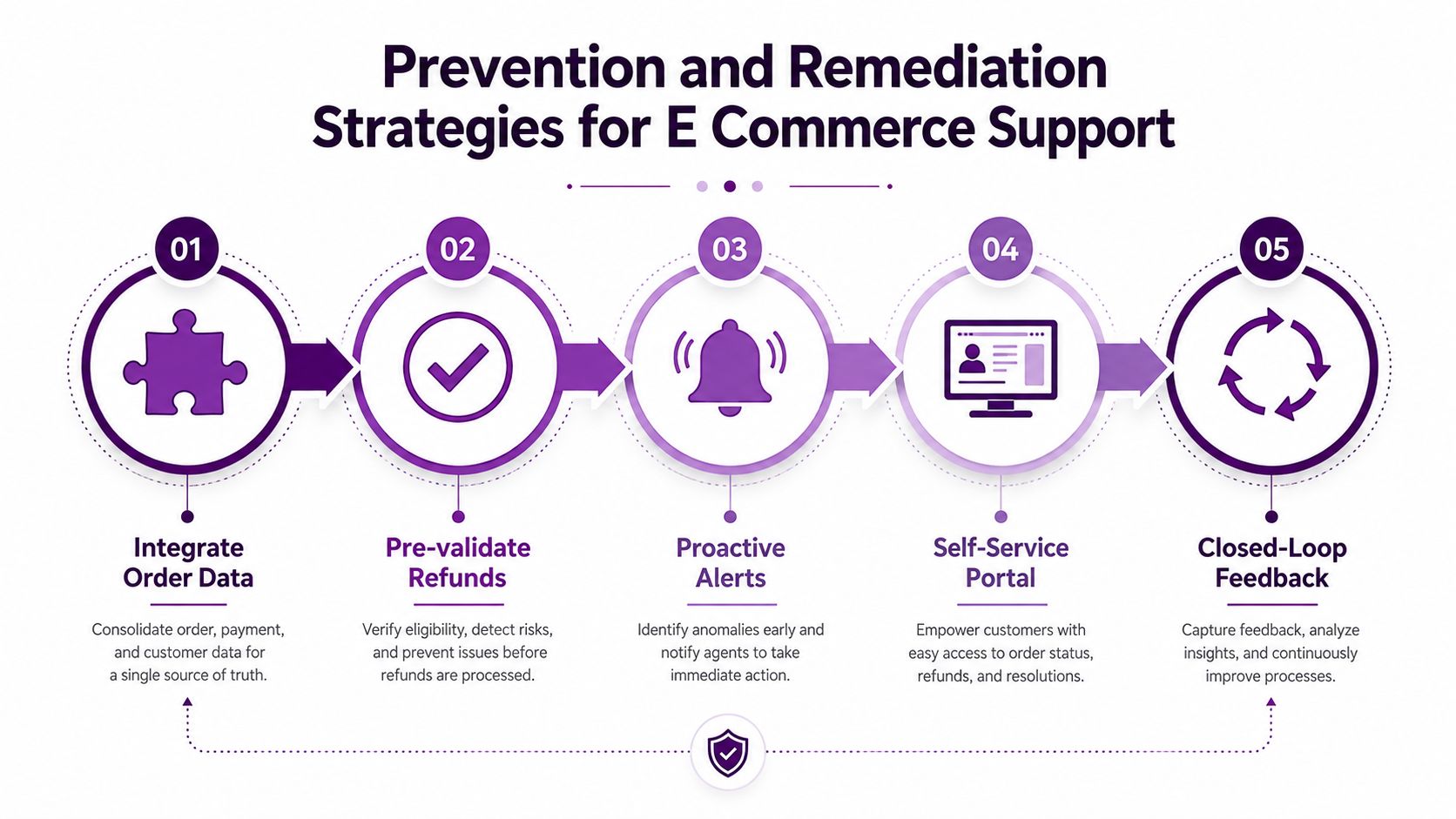
Support leaders reduce complaints by fixing the path that creates them. That requires the contact center to work with warehouse, logistics, payments, merchandising, and product teams.
Connect order data to the agent desktop
An agent should see the order number, SKU, fulfillment status, carrier scan, promised delivery window, payment state, previous contacts, and return eligibility in one workflow. Without that context, the agent asks the customer to repeat information and may provide an answer that contradicts the warehouse or payment system.
Start with the most common contacts. If tracking questions dominate, expose current carrier events and exception codes. If wrong-item complaints are common, display the ordered SKU beside the fulfilled SKU and capture warehouse feedback.
Validate refunds before promising them
Refund conversations break down when agents promise an outcome that the payment or returns system can’t execute. Build eligibility checks into the workflow. The system should identify whether the item was delivered, whether the return was received, whether the payment was captured, and whether a refund or replacement is permitted.
A clear policy doesn’t eliminate judgment. It gives agents a reliable boundary for judgment.
Use proactive alerts and useful self-service
Customers don’t need a generic “your order is delayed” message. They need the revised status, the reason when available, the next update point, and the available choices. A tracking page should let customers find an order, understand an exception, and start an approved resolution without searching through unrelated help articles.
Self-service fails when it becomes a barrier to human help. Keep escalation visible for customers dealing with missing deliveries, wrong products, damaged goods, payment disputes, or account-specific problems.
Close the feedback loop
Send recurring issue data to the responsible operational owner. A weekly review might connect wrong-item contacts to a SKU, fulfillment location, shift, or packaging process. A spike in failed refunds may belong with payments rather than training.
Teams building broader retention programs can also review actionable retention tactics for 2026, particularly where post-purchase communication and repeat buying intersect. For proactive service workflows, CallZent’s proactive customer care solutions provide another model for contacting customers before avoidable issues become complaints.
When to Outsource E Commerce Customer Service
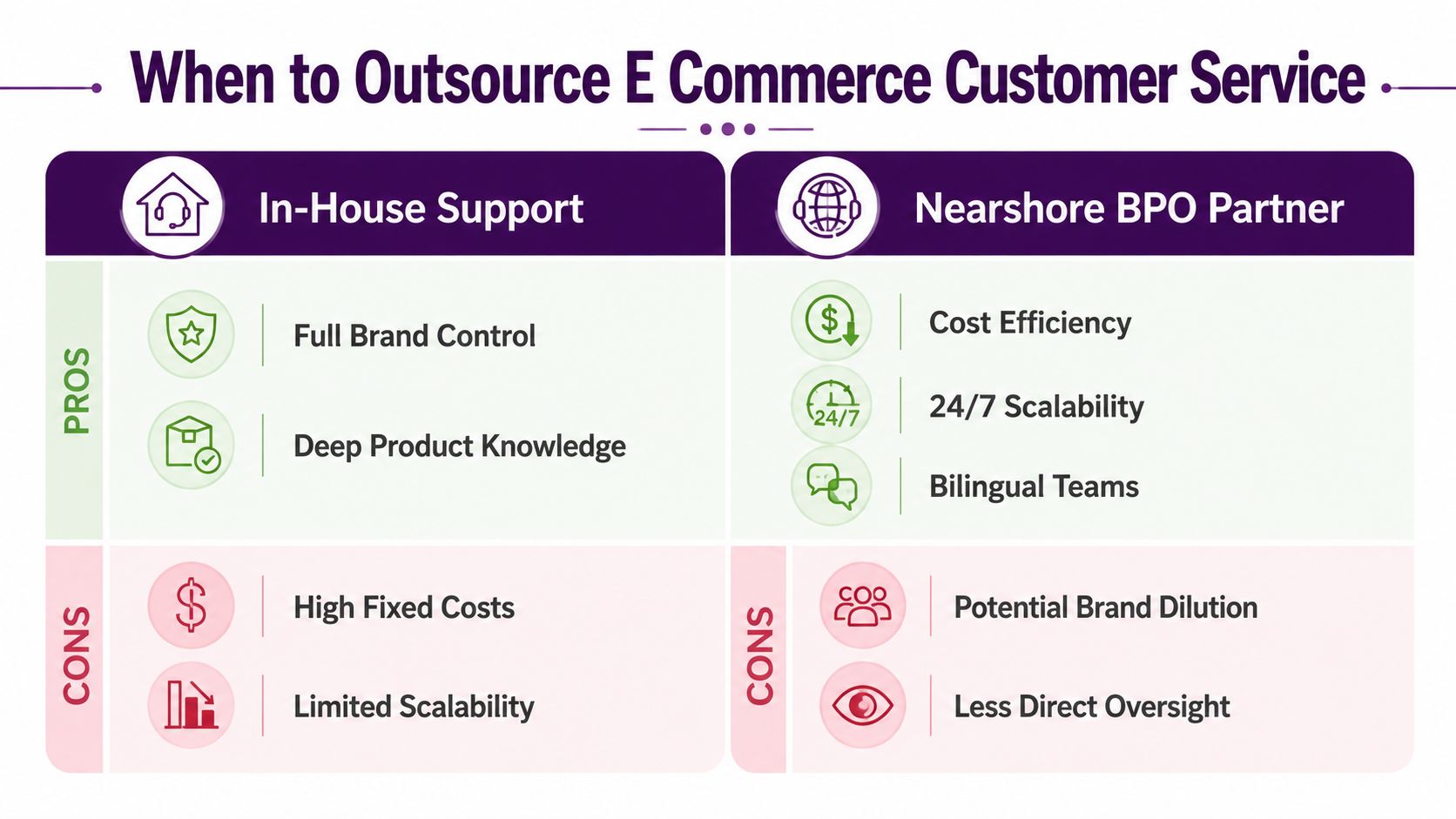
In-house support gives a brand direct control over hiring, coaching, policy interpretation, and daily communication. It can work well when the product is technically complex, the customer base is narrow, and service volume remains predictable.
A nearshore BPO changes the operating model. A partner in Tijuana can provide English and Spanish coverage, align more closely with North American business hours, and add capacity when order volume changes. That flexibility matters when a brand enters Spanish-speaking markets, launches a new product, faces seasonal demand, or needs extended coverage without building every shift internally.
Compare the trade-offs honestly
| Decision Factor | In-House Support | Nearshore BPO |
|---|---|---|
| Brand control | Direct oversight and internal culture | Requires detailed training and QA governance |
| Product knowledge | Deep institutional knowledge | Built through documentation, nesting, and coaching |
| Capacity | May be constrained by hiring and scheduling | Can flex across demand periods |
| Language coverage | Depends on local recruiting | Can provide bilingual staffing |
| Integration | Direct access to internal teams | Requires deliberate systems and escalation design |
| Cost structure | Higher fixed staffing burden | More variable operating model |
Outsourcing doesn’t remove management work. It moves that work toward service-level design, knowledge management, quality assurance, reporting, and integration. A partner that can’t access order status or follow clear refund rules will only create another layer between the customer and the solution.
Keep high-sensitivity decisions in-house when they depend on proprietary judgment, regulated processes, or constant product iteration. Outsource when the work is repeatable, measurable, and supported by clear workflows.
For brands evaluating that model, CallZent’s e-commerce customer service outsourcing describes how a nearshore operation can support order inquiries, returns, exchanges, and customer complaints.
KPIs That Reveal the Health of Your E Commerce Support
A large ticket count doesn’t tell you whether support is healthy. The useful question is what each metric says about the operation behind the contact.
First-contact resolution shows whether customers receive a complete answer without returning. Retail benchmark data places FCR around 70% to 75%, with strong performers reaching 80% or more. The customer support metrics reference links resolution performance to agent access, workflow quality, and system visibility.
CSAT adds the customer’s perspective. Retail CSAT commonly falls between 75% and 84%, while best-in-class performance exceeds 85%, according to the same benchmark source. A low score paired with long handling time may indicate poor tools, not poor effort.
Read the metrics together
Track average response time separately for chat, email, and phone. Combining channels can hide a failing queue because a fast chat response may offset a slow email backlog in the average.
Monitor ticket volume by issue category. A rising non-delivery share points toward logistics or tracking. A concentration of wrong-item contacts around particular SKUs suggests fulfillment accuracy problems. A growing refund cycle time points toward returns intake, payment processing, or approval bottlenecks.
Escalation rate is a useful training and workflow signal. If agents escalate routine cases, the knowledge base or permissions may be inadequate. If complex cases rarely escalate, quality assurance should verify that agents aren’t closing contacts prematurely.
Refund cycle time deserves its own view. Measure the time from approved return or cancellation to confirmed payment completion, then investigate every delay that requires a second customer contact.
When internal hiring is difficult, businesses may also hire remote customer service representatives while keeping KPI ownership, coaching standards, and escalation governance close to the brand.
Building a Support Operation That Scales With Your Brand
A scalable e-commerce support operation has four connected parts: accurate operational data, channel-specific response rules, prevention workflows, and accountable human escalation.
Technology helps, but automation shouldn’t become a wall between the customer and a qualified person. A 2025 contact-center study found that 74% of consumers preferred human channels for resolving an issue or receiving technical support, 61% preferred human channels overall, and 53% said bad experiences caused them to reduce spending. The reported consumer findings support a balanced model. Automate routine tracking and policy questions, but preserve fast human access for disputes, complex order changes, payment failures, and technical troubleshooting.
The strongest teams also treat every contact as operational evidence. They don’t celebrate faster ticket closure while wrong-item shipments continue. They connect agent feedback to warehouse corrections, carrier exception handling, payment fixes, product content, and returns redesign.
Key takeaway: Faster agents can reduce waiting. Integrated operations reduce the reasons customers need to wait at all.
For a growing brand, that distinction compounds. A nearshore support operation can provide bilingual coverage and flexible capacity, but it must be connected to the same order, payment, logistics, and knowledge systems that guide internal teams. Otherwise, outsourcing moves the queue without resolving the root cause.
Build E-Commerce Support Around Your Operations
CallZent provides bilingual nearshore e-commerce support from Tijuana, including order-status assistance, returns and exchanges, customer complaints, technical support, and back-office workflows.
Talk to an ExpertCallZent provides bilingual nearshore e-commerce support from Tijuana, including customer service, order status assistance, returns and exchanges, technical support, and back-office workflows. Visit CallZent to discuss a support operation built around your fulfillment data, channel SLAs, and growth plans.