

Nearshore Contact Center Operations
Escalation Management Playbook for Nearshore Contact Centers
Learn how bilingual nearshore contact centers can design escalation tiers, SLAs, routing rules, handoffs, metrics, and a practical 90-day review.
A customer in San Diego calls about a billing dispute. A Tier 1 agent in Tijuana fixes the visible charge, but the refund failure sitting behind it never gets identified. Twelve hours later, the customer calls again, reaches another agent, repeats the story, and starts from zero because neither handoff included an escalation flag.
That pattern is common in bilingual operations. Escalation management isn’t a queue. It’s an operating system for detecting risk, assigning ownership, protecting the customer experience, and moving the right case to the right person before frustration compounds. The challenge becomes sharper when language, tier, compliance, and cross-border responsibility meet in the same interaction.
Why Most Bilingual Escalations Spiral Before Anyone Notices
The first agent may sound calm and competent. The customer may even say the issue is resolved before hanging up. Yet a surface fix can hide a second failure, such as a refund that never posted, an account restriction that remains active, or a carrier claim that still needs ownership.
In a bilingual contact center, the next interaction adds another layer of risk. The first agent documents the case in English, the customer explains the problem in Spanish during the second contact, and the receiving agent interprets the issue as a new request instead of a continuation. If the CRM stores a stale language preference, the customer can also land with an agent who lacks the vocabulary or authority needed to finish the case.
Three gaps create the spiral
-
Weak Tier 1 triage: The agent handles the symptom, not the downstream consequence. A billing dispute isn’t complete just because the charge was explained. The agent also needs to verify whether a refund, credit, account adjustment, or payment reversal is required.
-
Language misrouting: A static IVR preference doesn’t always reflect the language the customer needs for a complicated issue. The customer may be comfortable greeting an agent in English but prefer Spanish for a detailed explanation of a disputed charge.
-
Incomplete transfer notes: “Customer wants refund” isn’t a handoff. The next owner needs the customer’s stated outcome, verification status, actions already taken, unresolved risk, promised follow-up, and working language.
A structured cross-cultural communication approach for BPO success helps teams treat language as an operational variable, not merely a hiring requirement. The case record should identify the language used for the conversation, the language preferred for written updates, and whether a bilingual agent must remain involved.
Practical rule: If the customer has to retell the story, the handoff failed, even if the receiving agent eventually solves the problem.
Escalation management starts before the transfer
Repeat contacts, rising handle time, avoidable callbacks, and weak customer sentiment are early-warning signals. They point to a process that may be failing before a supervisor sees a formal escalation.
The historical study of escalation supports this operating mindset. The International Crisis Behavior project covers crises from 1918 to 2021, while a related historical conflict-event dataset extends from 1468 BC to 2003, giving researchers long-run material for studying how events intensify or de-escalate across regions and regimes. One recent model using 475 crises treated behaviors that lengthen a crisis as escalatory and behaviors that shorten it as de-escalatory, as documented by the International Crisis Behavior project.
Business operations don’t face military crises, but the principle transfers well. A delayed acknowledgment, a missing note, or an unowned callback adds another step. Early intervention removes steps. The practical objective isn’t to make escalations disappear. It’s to prevent unstructured escalation from creating repeat work and customer distrust.
Defining Escalation Tiers and SLAs That Actually Hold
A tier matrix only works when each level answers four questions: who owns the case, what authority do they have, how quickly must they respond, and what evidence moves the case upward? Labels such as “urgent” or “high priority” aren’t enough for a bilingual team serving different U.S. industries.
Start with severity, then map severity to routing and authority. A service outage affecting multiple customers shouldn’t wait behind a single-account how-to question. A healthcare case involving a clinical record also requires a different control path from a retail billing issue, even if both are described internally as Severity 2.
Build the matrix around operating decisions
Use the following as a working model, then align every target with the client contract and regulatory requirements.
| Severity | Example | Response SLA | Resolution SLA | Routing Target | Bilingual Coverage |
|---|---|---|---|---|---|
| Severity 1 | Account locked, broad service outage, suspected breach | Under 15 minutes | 1 hour | Tier 2, Tier 3, engineering, management, or legal | Immediate bilingual owner, with U.S.-side coverage when required |
| Severity 2 | High-impact billing failure, repeated service issue, sensitive account action | Under 1 hour | 4 hours | Tier 2 specialist or designated client queue | Bilingual acknowledgment and documented language preference |
| Severity 3 | Individual technical or account issue requiring deeper access | Under 4 hours | Same business day or client-defined window | Tier 2 | Bilingual coverage available for the customer-facing update |
| Severity 4 | General how-to request or low-risk clarification | Within 24 hours | Routine queue target | Tier 1 or knowledge team | Match customer language where available |
These response and resolution examples reflect published escalation matrix guidance from GetHumanCall’s customer support escalation process. Another policy model sets unacknowledged-ticket escalation at 15 minutes for SEV1 and 30 minutes for SEV2, with unresolved issues escalating after 1 hour for SEV1 and 4 hours for SEV2, as outlined in this escalation policies guide.
Start the clock at confirmed triage
The first contact timestamp doesn’t prove the case was correctly classified. Start the SLA clock when an agent confirms the severity, captures the required information, and assigns the case to an accountable queue. That avoids penalizing the receiving team for an intake that was incomplete, while preventing Tier 1 from delaying classification indefinitely.
During U.S. business hours, a five-minute bilingual acknowledgment window is a useful internal control for high-priority cases. The acknowledgment should name the owner, confirm the working language, state the next action, and give the customer a realistic update time.
Set authority ceilings beside each tier:
- Tier 1: In-policy credits, standard troubleshooting, documented callbacks, and routine account actions.
- Tier 2: Larger retention offers, complex refunds, exception handling, and deeper system access.
- Tier 3: Legal, regulatory, security, major outage, and policy decisions that require client ownership.
For example, a $50 goodwill credit can sit within a Tier 1 ceiling, while a $200 retention offer requires Tier 2 approval. Tier skipping should be explicit. A suspected data breach, legal threat, multi-customer outage, or regulatory complaint can move directly from Tier 1 to the designated senior or specialist team, rather than forcing a routine handoff.
Use CallZent’s SLA management guidance to align escalation paths, ownership, triggers, and response expectations before launch. A matrix that agents can’t apply in real time is documentation, not operational control.
Tracking the Right Escalation Metrics
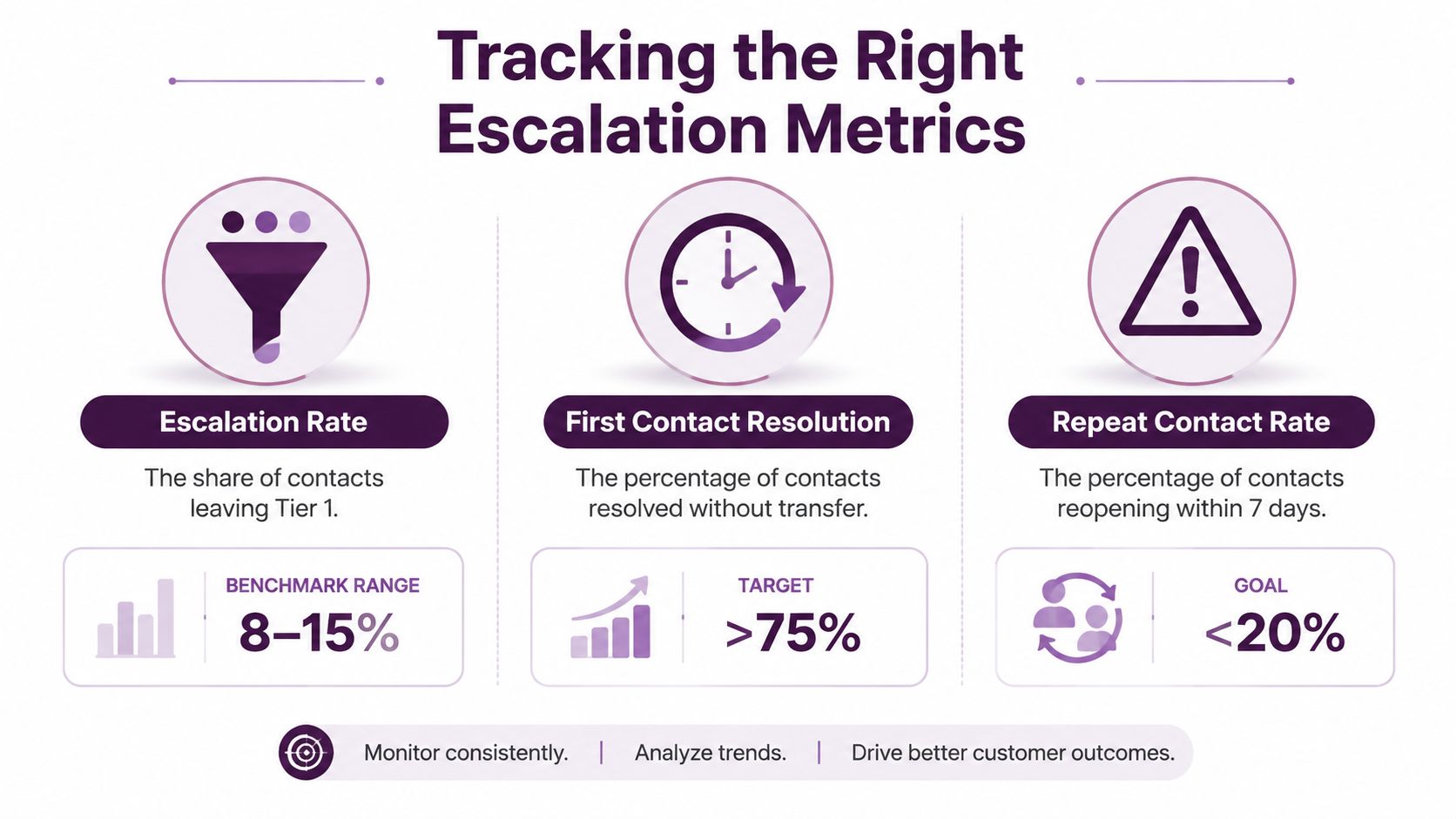
Teams often say they want to “reduce escalations,” then combine three different problems into one dashboard. That makes coaching unreliable. Escalation rate, transfer rate, and reopen rate describe different points of failure.
Escalation rate measures the share of eligible contacts that leave Tier 1. A practical benchmark keeps routine escalations below 10%, while rates above 15% call for intervention and process review, according to the CX Foundation escalation management benchmark. Published support ranges place typical L1 generalist escalation at 8–15% and L2 specialist escalation at 3–8%.
Read the failure mode, not just the headline
Transfer rate tells you how cases move after escalation. Separate successful warm transfers from cold-transfer callbacks. A warm transfer preserves context and customer confidence. A cold transfer may indicate that the receiving queue wasn’t available, the language match failed, or the original agent couldn’t complete the bridge.
A 2025 U.S. contact-center benchmark reported a 76% mean first-call-resolution rate, a 9.9% mean call-transfer rate, a $7.16 mean inbound-call cost, and a 5.0% median transfer rate, as reported in this contact-center escalation benchmark. The difference between mean and median matters. An average can conceal a small group of operations with unusually high transfer behavior.
Reopen rate shows whether the case came back after closure. Track the percentage of escalated tickets that return within 7 days as a root-cause signal. A low escalation rate paired with a high reopen rate may mean Tier 1 is avoiding escalation, closing prematurely, or promising an outcome without the authority to deliver it.
First-contact resolution belongs beside these metrics. Aggregate benchmark research reports a 69% first-contact resolution rate across thousands of call centers, implying that about 31% of contacts require escalation beyond first-level support, according to this support metrics benchmark.
Segment every metric by language pair, channel, issue type, severity, tier, and client vertical. Then use a 30/60/90 rhythm:
- First 30 days: Establish definitions and baseline behavior.
- Next 60 days: Fix the largest routing, authority, and documentation failures.
- By 90 days: Lock targets into SOPs and client reporting.
For a broader KPI structure, use CallZent’s call center KPI guidance as a reference point. The dashboard should help a supervisor decide what to change, not merely show whether a number moved.
Designing Routing and Handoff Procedures Across Languages
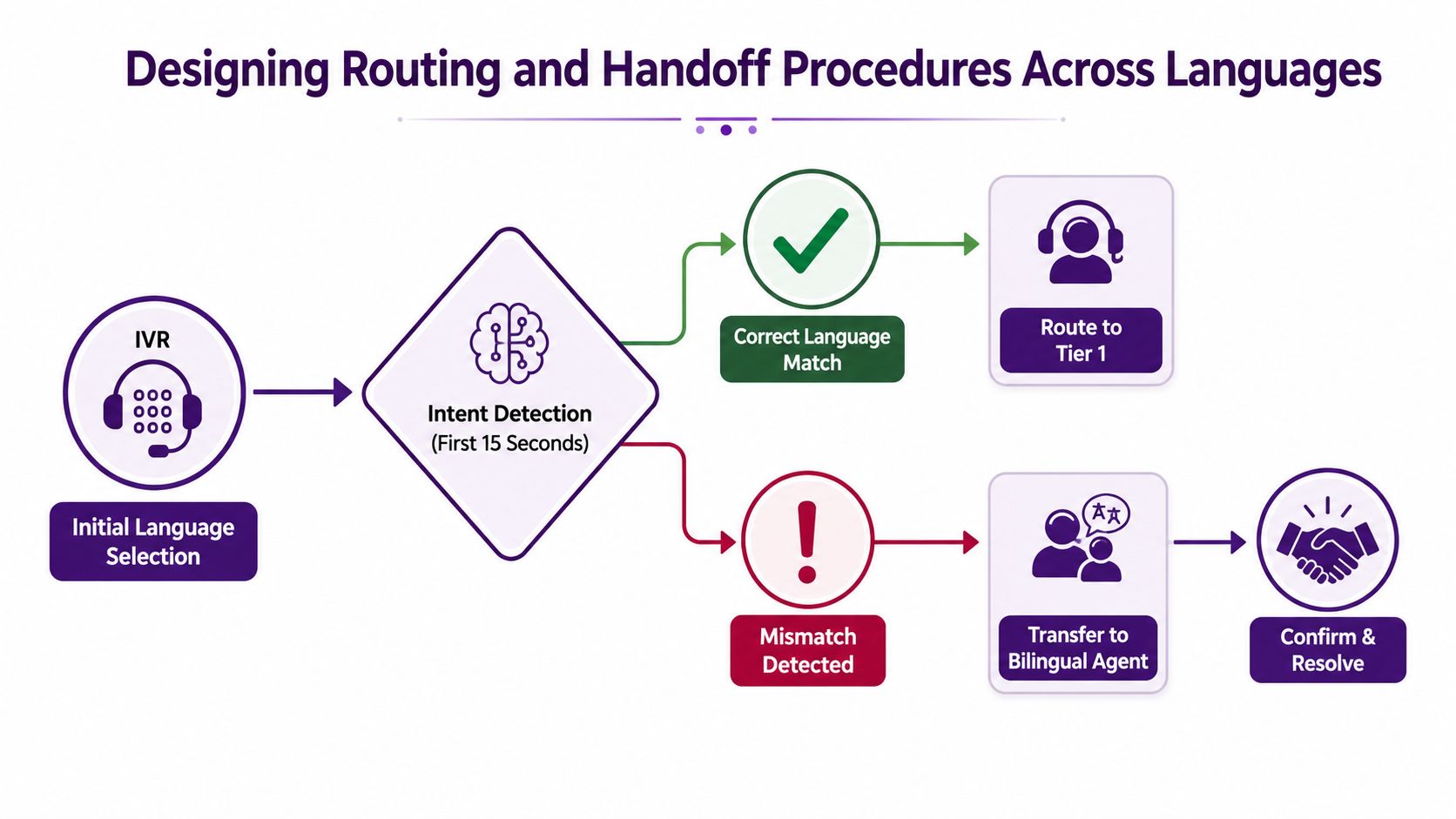
Routing failures often begin before an agent says hello. An IVR may rely on a language preference selected months ago, while the customer’s present need has changed. A bilingual customer might want English for authentication and Spanish for a detailed explanation of a billing or healthcare issue.
The first routing decision should combine the customer’s stated preference with live intent detection. Use the opening 15 seconds of speech as an operational checkpoint, not as a replacement for human judgment. If the caller’s language and the assigned queue don’t match, correct the route before the customer explains the same issue twice.
Use three language controls
-
Confirm the working language. Ask in the customer’s current language instead of trusting the CRM field. Confirm whether the customer wants the full interaction, written update, or specialist handoff in English or Spanish.
-
Document the language choice. Store the working language and any communication constraint in the case. Don’t bury it in free-text notes where the next queue may miss it.
-
Summarize before transfer. The sending agent should provide a bilingual handoff summary covering verification, issue, impact, attempted fixes, promised action, severity, and customer preference.
A 30-second agent-to-agent bridge is often enough to transfer context without making the customer repeat identity verification or reconstruct the timeline. The receiving agent should verbally accept ownership, not just receive the ticket.
Route ownership, not just skill
Map every path to a queue, an owner, and a documented SLA. A billing exception might route to a finance-trained Tier 2 queue. A network issue might require a technical specialist with topology access. A legal complaint should bypass ordinary troubleshooting and reach the client-designated legal or management path.
AI-assisted triage can flag repeat contacts, sentiment deterioration, and policy exceptions before a specialist accepts the case. Use that signal to prioritize and enrich the handoff, not to make unsupported promises. Recent telecom contact-center research analyzed 9,177 interactions over four months and found that 30.8% escalated to a human agent. Escalation ranged from 5.3% for low-complexity inquiries to 87.0% for high-complexity inquiries, with each 1-unit increase in complexity associated with an escalation probability increase of about 72.6%, as reported in this AI-enabled telecom contact-center study.
Tijuana’s proximity to the U.S. market can support real-time routing to a U.S.-side floor when compliance or jurisdictional limits require it. The advantage isn’t the border itself. The advantage is having a defined cross-border path that preserves ownership, language continuity, and the SLA.
For the underlying routing model, see what call routing means in contact-center operations. The routing map should be tested with real bilingual scenarios, not only reviewed in a slide deck.
Training and Empowering Agents to Escalate Less and Resolve More
An agent can know the correct resolution and still escalate because the policy doesn’t authorize action. In a billing queue, that might mean the agent can explain a charge but can’t issue the credit needed to close the case. The customer hears confidence in the explanation, then experiences inaction.
Policy design starts the process. Give Tier 1 a clear refund ceiling, goodwill credit limit, callback authority, and exception path. Add a one-click escalation route for cases that meet the rule. Requiring supervisor approval for every in-policy action trains agents to wait instead of decide.
Key takeaway: The goal isn’t faster escalation. The goal is fewer avoidable escalations and cleaner ownership when escalation is necessary.
Coach from the moment of failure
A useful coaching review doesn’t ask only whether the agent sounded polite. It identifies the trigger, the action the agent attempted, the missing authority or knowledge, and the exact next behavior.
For one practical coaching moment, consider an agent who hears, “I was promised a refund,” confirms the account, and transfers the caller immediately. The review may show that the agent had enough access to verify the refund status and enough authority to issue a small goodwill credit, but lacked a lookup step in the knowledge base. The correction is specific: check refund status, document the failed downstream action, offer the approved remedy, and escalate only the unresolved exception.
Train the gap with:
- Knowledge retrieval drills: Practice finding the correct policy while keeping the customer informed.
- De-escalation language: Teach ownership statements that work naturally in English and Spanish.
- Authority scenarios: Rehearse when an agent may approve a credit, initiate a callback, or skip a tier.
- Handoff documentation: Score whether the next agent could act without asking the customer to restart.
Bilingual phrasing should be standardized for empathy, ownership, hold requests, and status updates. Agents shouldn’t improvise a language switch while a frustrated customer is waiting.
Weekly calibration also matters. Have three supervisors score the same five calls, then reconcile differences in severity, documentation, language handling, and resolution authority. For teams reviewing career paths and customer-facing competencies, HiredBySkill’s skills-first CRM roles resource offers useful context for connecting role design with practical capability rather than job titles alone.
Document coaching in the case taxonomy. If escalations cluster around one policy, one language pair, or one client vertical, fix the workflow before adding another generic training module.
Industry-Specific Escalation Patterns and Templates
A single escalation script won’t survive contact with different compliance environments. The trigger, pre-handoff data, response target, and approval path should change by industry.
E-commerce teams usually deal with refund disputes, carrier claims, and promotion exceptions. The handoff should include order history, payment status, tracking details, promotion terms, and the customer’s requested remedy. A Tier 2 owner should have direct authority to coordinate carrier claims rather than sending the customer between support and fulfillment.
Healthcare requires a stricter boundary. A handoff script should confirm identity, limit unnecessary protected information, document the escalation event, and route clinical-record questions to agents trained on PHI handling. The customer-facing language must remain precise, especially when the caller is switching between English and Spanish.
Finance puts verification before context. An agent shouldn’t share account details merely because the caller knows the name or billing address. Fraud-locked accounts may require a callback to a verified line, while the case record should distinguish a security restriction from a routine access problem.
Telecom cases are different again. Tier 2 needs diagnostic history, device or service identifiers, outage context, and access to the relevant network information. A technically vague note such as “internet not working” forces another diagnostic cycle and creates unnecessary customer effort.
| Industry | Primary Trigger | Tier 2 SLA | Compliance Checkpoint |
|---|---|---|---|
| E-commerce | Refund dispute, carrier claim, or promotion exception | 24 hours | Verify order, payment, tracking, and promotion records |
| Healthcare | Issue involving a patient’s clinical record | 1 hour | Use HIPAA-aware language and confirm PHI handling requirements |
| Finance | Fraud lock, identity concern, or disputed financial action | 30 minutes | Complete identity verification before sharing context |
| Telecom | Complex technical issue or suspected network fault | 4 hours | Record diagnostics and restrict access to authorized systems |
Standardize the handoff fields
Each template should require:
- Trigger language: The exact customer statement or system event that caused escalation.
- Pre-handoff data: Verification status, timeline, attempted fixes, account or order context, and customer impact.
- SLA: Response and resolution expectations tied to severity and client terms.
- Compliance checkpoint: The control the receiving agent must confirm before reviewing or changing protected information.
The customer support escalation framework includes examples such as multi-customer outages, data loss or breaches, legal threats, regulatory complaints, and high-value cancellation threats. Use those triggers as a starting point, then adapt them to the client’s actual risk model. A nearshore team should never invent a compliance exception at the moment a case becomes difficult.
Running a 90-Day Escalation Review With Your Nearshore Partner
A new escalation process drifts when the client and BPO review different records, use different severity definitions, or assume the other side owns the next action. A 90-day operating rhythm creates enough structure to expose those gaps without turning every issue into an executive meeting.
The first phase establishes the baseline and calibrates tiers. The second tests root causes and routing. The third locks the operating model into SOPs, reporting, and client governance.
| Phase | Weeks | Cadence | Owner | Key Deliverable |
|---|---|---|---|---|
| Baseline and calibration | 1–4 | Weekly dashboard review and case sampling | Nearshore operations lead with client process owner | Agreed severity definitions, authority limits, and baseline dashboard |
| Root-cause and routing retuning | 5–8 | Weekly stand-up and monthly Tier 2 deep dive | Operations, QA, workforce, and client specialists | Revised routing rules, bilingual handoff fields, and coaching actions |
| SOP lockdown and governance | 9–12 | Weekly controls, monthly review, and executive business review | Joint client and BPO leadership | Signed SOP, SLA decisions, ownership map, and escalation incident log |
Assign decisions before the first case
The nearshore operations lead should own queue execution, staffing alignment, daily adherence, coaching follow-up, and internal routing corrections within approved policy. The client should sign off on policy exceptions, compliance controls, refund authority, legal handling, product changes, and SLA changes that affect contractual commitments.
Hold a weekly 30-minute dashboard stand-up to review escalation rate, transfer behavior, reopen cases, time to acknowledgment, and unresolved ownership. Run a monthly Tier 2 deep dive on recurring causes. Schedule quarterly executive business reviews with U.S. counterparts, using a shared incident log that spans the Tijuana operation and the client side.
If the process itself breaks, escalate the escalation process. A missed owner, an unacknowledged high-severity case, a language mismatch, or a compliance uncertainty should create an incident record with a named decision-maker. Don’t allow teams to hide process failures inside individual agent coaching.
A practical kickoff checklist includes:
- Confirm severity definitions and examples.
- Approve bilingual coverage by queue and business hour.
- Set authority ceilings and tier-skipping triggers.
- Test the warm-transfer workflow.
- Confirm required handoff fields.
- Name client and nearshore owners.
- Agree on dashboard definitions.
- Establish the shared escalation incident log.
- Set the date for the first nearshore call center review.
The most reliable partner relationship is collaborative but specific. Both sides should know which decisions can happen in Tijuana, which require U.S.-side involvement, and how quickly the receiving owner must acknowledge the case.
Build a Better Bilingual Escalation Operation
CallZent provides bilingual nearshore contact center and BPO support from Tijuana, with customized escalation tiers, routing rules, quality controls, and client-aligned SLAs.
Talk to an ExpertCallZent provides bilingual nearshore call center and BPO support from Tijuana, including structured customer service, technical support, and back-office workflows that can align escalation tiers, routing rules, and client SLAs. Visit CallZent to discuss a nearshore escalation operation built around your language coverage, industry requirements, and U.S. customer commitments.