Skip to content
HEALTHCARE LEAD GENERATION
Healthcare Lead Generation Services: How to Build a Compliant Patient and B2B Pipeline
Learn how healthcare lead generation services help medical practices, health tech companies, and healthcare organizations attract qualified leads while staying compliant, efficient, and scalable.
TL;DR — Quick Takeaways
- Healthcare lead generation services help medical practices, healthcare companies, and health tech providers identify, qualify, and nurture high-value prospects.
- Healthcare lead generation is different from general sales outreach because it requires compliance awareness, trust-building, and industry-specific messaging.
- Outbound and inbound strategies work best together, combining targeted calling, appointment setting, SEO, content, and digital conversion paths.
- Compliance is non-negotiable. Any campaign involving patient information must protect privacy, consent, and PHI handling.
- Nearshore bilingual support gives healthcare organizations a major advantage through English-Spanish outreach, time-zone alignment, and cost-efficient scaling.
Is your patient calendar looking a little empty? Struggling to connect with decision-makers for your new health tech solution? The problem might not be your service, but your sales pipeline. The answer is often specialized healthcare lead generation services—a strategic approach designed to identify, attract, and nurture high-value prospects, from individual patients to B2B executives.
This isn’t your average sales game. It requires deep industry knowledge, strict compliance, and a far more nuanced approach to build trust and drive growth.
TL;DR: Your Quick Guide to Healthcare Lead Generation
- What It Is: A specialized process to identify, attract, and qualify potential patients or B2B clients in the healthcare industry.
- Why It’s Different: Success requires navigating strict regulations like HIPAA, long sales cycles, and complex decision-making processes.
- Effective Channels: A mix of outbound (targeted telemarketing, appointment setting) and inbound (content marketing, SEO) strategies is crucial.
- Compliance is Key: You must get explicit consent and securely manage Protected Health Information (PHI) to avoid massive fines and reputational damage.
- Essential Tech: A modern tech stack including a CRM, data enrichment tools, and outreach automation is necessary for efficiency and scale.
- Key Metrics: Focus on Cost Per Lead (CPL), Lead-to-Appointment Ratio, and Customer Lifetime Value (CLV) to measure true ROI.
- The Nearshore Advantage: Partnering with a nearshore BPO in a hub like Tijuana provides bilingual talent, cultural alignment, and cost-efficiency without sacrificing quality.
What Are Healthcare Lead Generation Services?
So, how do successful medical practices and health tech companies keep their pipelines full? It’s not luck or random advertising. They use a specialized strategy that goes way beyond cold calling to create a predictable, sustainable system for growth.
Healthcare lead generation is all about attracting strangers and converting them into genuine prospects who have shown interest in your product or service. This is a tough nut to crack in healthcare, thanks to long sales cycles, complicated decision-making, and a mountain of regulations.
Why Is Finding Healthcare Leads So Different?
Here’s the core issue: healthcare organizations need a steady stream of quality leads to thrive, but they rarely have the specialized in-house team to find them. Your general sales team probably doesn’t know the unique pressures on a hospital administrator or the privacy concerns of a potential patient. To succeed, you have to develop a robust marketing strategy that is both effective and fully compliant.
For example, a generic sales rep might call a clinic and ask for “whoever buys software,” immediately getting shut down by a busy receptionist. A trained healthcare specialist, however, knows to ask for the “Practice Manager” and can speak their language, referencing common challenges like “improving revenue cycle management,” which builds instant credibility.
True success in healthcare lead generation requires deep, specialized expertise, not a generic sales approach.
This process is so much more than just buying a list of names. It involves a careful, multi-step approach:
- Identifying High-Value Prospects: This means pinpointing the exact right people, whether it’s a patient searching for a specific cosmetic procedure or a B2B buyer in charge of procurement for a hospital network.
- Engaging and Nurturing: It’s about building trust over time. This happens through multiple touchpoints, providing helpful information, and addressing every concern in a compliant way.
- Qualifying Your Leads: Before a lead ever gets to your team, it needs to be qualified. A professional BPO ensures a prospect doesn’t just have interest, but also the real need, budget, and authority to make a decision.
This structured approach takes the guesswork out of finding new business and turns it into a manageable, measurable pipeline. To see how these strategies work in action, take a look at our comprehensive lead generation marketing services designed to deliver real results.
Exploring Effective Healthcare Lead Generation Channels
A modern healthcare lead generation strategy is a lot like a physician’s treatment plan—it needs a multi-channel approach to be effective. Simply depending on one method isn’t going to build a reliable pipeline of new patients or partners anymore.
Success comes from blending proactive outbound tactics with value-driven inbound strategies. This ensures you’re not just finding new business but are also front and center when prospects are actively searching for solutions. The goal is to create multiple touchpoints that build the trust needed to capture interest and drive action.
The Power of Outbound Healthcare Lead Generation Services
Outbound strategies are all about proactively reaching out to a hand-picked list of potential leads. In healthcare, this demands a delicate touch, pinpoint targeting, and absolute compliance.
- Targeted Telemarketing: This isn’t about cold calling a phonebook. Think of a well-trained agent from a nearshore call center calling a practice manager to discuss a new medical billing software, or a hospital administrator about a medical device. It’s a human-to-human connection that can quickly qualify interest.
- Strategic Appointment Setting: The main goal of many outbound campaigns is simply to book a qualified meeting. A skilled agent can navigate past gatekeepers and clearly explain the value, setting appointments for your sales team with decision-makers who are actually ready to talk.
It’s crucial to have a team with deep industry knowledge handling these calls. You can explore how specialized outbound lead generation services are designed to manage the unique complexities of the healthcare market. This approach is especially powerful when you’re launching a new service or expanding into a new territory.
The funnel below shows how a broad pool of prospects is narrowed down to genuinely qualified leads through this kind of strategic targeting.
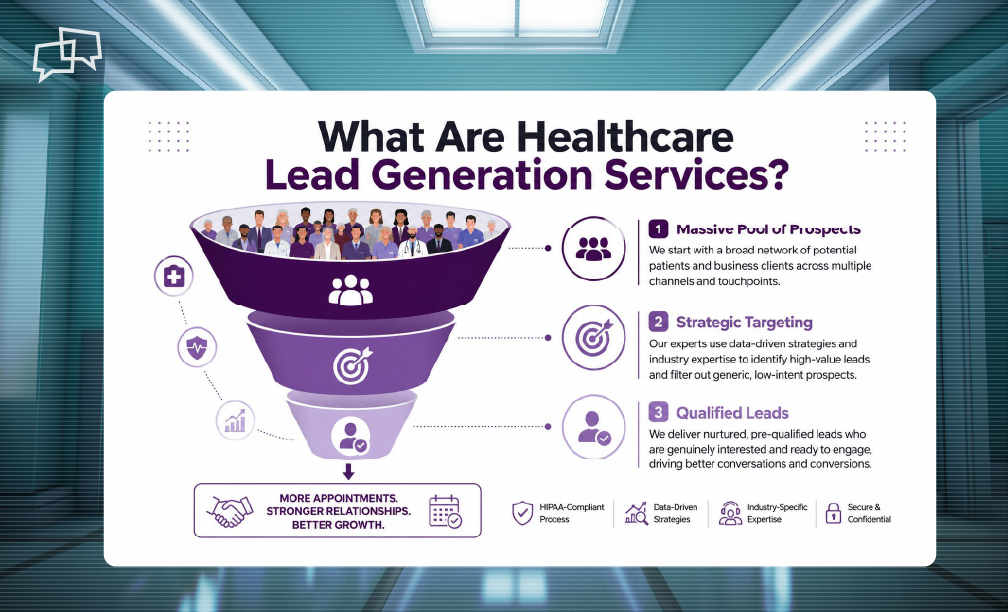
As you can see, the process is about systematically filtering and nurturing, making sure only the most promising opportunities land with your sales or admissions teams.
Capturing Intent with Inbound Strategies
While outbound pushes your message out, inbound marketing pulls prospects in by offering real value. It’s about being present where they are already looking, which is absolutely vital for building credibility in the healthcare space.
Think of a dental clinic creating blog posts optimized for “best implant dentist in my city,” or a hospital running a webinar for administrators on improving patient flow. These tactics educate and build authority, they don’t just sell.
Digital channels are where this really shines. According to a Healthgrades study, 67% of patients who view a physician’s page on its platform go on to schedule an appointment within a week. That stat shows just how quickly a well-designed digital touchpoint can convert interest into action.
A successful healthcare lead generation service doesn’t just find leads; it creates a trusted environment where prospects are guided, not sold.
When you combine an expert outbound call from a bilingual agent with a solid inbound content strategy, you create a powerful synergy. The call creates the initial awareness, and the content provides the detailed information that builds confidence, leading to a much higher conversion rate.
Staying Compliant: A Core Part of Healthcare Lead Generation Services
In healthcare, compliance isn’t just a box to check—it’s the bedrock of your reputation and legal standing. One misstep can lead to staggering fines, a tarnished brand, and a complete loss of patient trust. This makes navigating the rules, especially the Health Insurance Portability and Accountability Act (HIPAA), an absolute must for any lead generation effort.
It’s not about memorizing legal texts. It’s about putting those rules into practice with every single interaction, from a phone call to an online form. This ensures you handle every lead with the privacy and care they deserve.
The Clear Line Between B2B and B2C Compliance
Not all outreach is treated the same, and the compliance rules shift based on who you’re talking to. There’s a world of difference between generating leads for a B2B service and engaging with a potential patient.
For instance, calling a medical practice’s public business line to talk to an office manager about new billing software is a standard B2B interaction. This type of call typically involves no Protected Health Information (PHI).
But the game changes completely when you manage an inquiry from someone looking for a specific medical procedure. The second an individual submits their name, contact info, and health concern, that data is classified as PHI and falls under HIPAA’s protection.
Any information that can be used to identify a patient and relates to their past, present, or future health condition, treatment, or payment for healthcare is considered PHI.
This is where many companies stumble. A professional BPO partner like CallZent builds trust by using rigorous training and secure technology to manage both scenarios correctly, ensuring every agent understands the critical difference.
Securing Consent and Managing PHI Correctly
The heart of compliant lead generation is explicit consent. You must have clear, active permission from an individual before you contact them about health needs or store their PHI. A pre-checked box on a form simply won’t cut it.
Here are the non-negotiables for handling data the right way:
- Secure Data Transmission: Every web form collecting patient information must use encryption (HTTPS).
- Secure Storage: PHI needs to be stored in a secure, access-controlled system, completely separate from your general marketing data.
- Agent Training: All agents who might interact with potential patients must be expertly trained on HIPAA rules and privacy protocols.
- Clear Disclosures: Your privacy policy must be easy to find and spell out exactly how you plan to use the information collected.
Cutting corners here is a massive risk. Partnering with a BPO that gets these rules isn’t just about dodging fines—it’s about proving to the market that you take their privacy seriously. For those interested in the tech side, some firms like Cleffex healthcare compliance solutions offer a look into the software and development frameworks required to uphold these standards.
The Modern Technology Powering Lead Generation
Let’s be honest: in healthcare, the buying journey is now almost entirely digital. To manage it, you need the right tools. Think of it like a surgeon’s instrument tray—the right technology is what separates a successful campaign from a failed one, giving you the precision and efficiency required for a complex sale.
This “tech stack” is what allows your team to personalize outreach at the scale needed to navigate those long and intricate healthcare sales cycles.
In mature markets like the U.S., healthcare lead generation has become a major growth engine precisely because the journey is longer and more compliance-heavy than in other fields. Marketers and sales teams are leaning heavily on data-enrichment platforms, CRM systems, and outreach automation. It’s how they pinpoint decision-makers, score accounts, and turn them into real, qualified opportunities. You can discover more about the top tools in healthcare lead generation to see just how big of an impact they make.
Building Your Technology Foundation for Healthcare Lead Generation
At the core of any modern campaign is a handful of essential technologies. These tools don’t work in isolation; they connect to create a streamlined, data-driven process that makes your team’s efforts both efficient and effective. They help you organize, enrich, and act on lead data in a compliant, systematic way.
Here are the absolute must-haves:
- Customer Relationship Management (CRM) System: A CRM like Salesforce is the central nervous system for your lead generation. It’s where every prospect interaction is stored, where lead status is tracked, and what provides a single source of truth for your entire team.
- Data Enrichment Platforms: You need accurate data. Tools like Ampliz or Apollo.io are critical for verifying and adding to your contact lists with up-to-date information. They ensure you’re reaching the right decision-maker, not someone who left the company two years ago.
- Outreach Automation Tools: These platforms are workhorses. They manage email sequences and follow-ups, letting a small team engage hundreds of prospects with personalized messages. They automate the repetitive stuff so your agents can focus on what matters: building relationships.

Why This Tech Stack Is Crucial for Healthcare
In healthcare, personalization and accuracy aren’t just nice-to-haves. They’re table stakes for building trust. A solid tech stack makes this possible by connecting different parts of your lead generation process into one cohesive workflow.
Without the right technology, even the best strategy is just a theory. A well-integrated tech stack turns that strategy into a predictable, scalable lead-generating machine.
For example, your CRM can integrate with your BPO partner’s phone system to automatically log every call. At the same time, data enrichment tools can keep your lead profiles updated in real time. This means every agent has the complete picture before every conversation, which leads to far more meaningful interactions.
To take it a step further, you can explore how to apply AI agents for small business use cases to add another layer of automation and intelligence to your outreach.
How to Measure Your Campaign Success and ROI
At the end of the day, there’s only one question that matters: is this investment actually paying off? When you’re looking at healthcare lead generation services, you have to move past the flashy but empty numbers, like website traffic, and zero in on the key performance indicators (KPIs) that really tell the story of your success. Without a clear view of your data, you’re just guessing.
A transparent BPO partner will deliver clear, actionable reports on these metrics, giving you a direct line of sight into campaign performance. This data doesn’t just prove the value of your spend—it helps you fine-tune your strategy over time, making sure every single dollar is working to grow your organization.
Key Metrics for Tracking Healthcare Lead Generation Services
Some numbers just matter more than others. In healthcare, the journey from a first contact to a loyal patient or client can be a long one, so tracking progress at every step is the only way to truly understand your return on investment.
These are the KPIs you should be asking for from any partner you work with:
- Cost Per Lead (CPL): This is your baseline, calculated by dividing the total campaign spend by the number of leads you generated. A low CPL looks great on paper, but it’s completely meaningless if those leads are poor quality and go nowhere.
- Lead-to-Appointment Ratio: This metric shows you exactly what percentage of your leads convert into actual meetings or consultations. It’s a powerful sign of lead quality and tells you how effective your nurturing process is.
- Customer Lifetime Value (CLV): This is the ultimate benchmark. CLV estimates the total revenue a single patient or client will bring to your organization over their entire relationship with you. A high CLV can easily justify a higher initial cost to acquire that lead.
Calculating ROI in healthcare isn’t just about the first transaction; it’s about understanding the long-term value a new patient or partner brings to your practice or business.
Performance data from top healthcare lead generation agencies shows that the economics are incredibly strong when the targeting is precise and the follow-up is consistent. For example, some programs report a lead-to-MQL (Marketing Qualified Lead) conversion rate of 33% and an average 3-year ROI of a staggering 957%. You can learn more about the financial impact of healthcare lead generation and see how those kinds of results are achieved.
Choosing the Right Pricing Model
Knowing how your partner charges is critical for managing your budget and making sure your goals are aligned. Different pricing models work better for different objectives, so it’s important to pick one that fits your organization’s needs and comfort level with risk.
Here’s a look at the most common pricing structures you’ll encounter. This table breaks down how each one works and what kind of organization it’s best suited for, helping you make a more informed decision for your budget.
Common Pricing Models for Lead Generation Services
| Pricing Model | How It Works | Best For |
|---|---|---|
| Pay-Per-Lead | You pay a fixed price for every single lead that meets a set of pre-defined criteria. | Businesses that need a predictable flow of leads and want to control their acquisition costs upfront. |
| Pay-Per-Appointment | You only pay when a qualified appointment is successfully booked with a decision-maker. | Organizations focused purely on getting sales conversations on the calendar and want to minimize financial risk. |
| Retainer/Flat Fee | You pay a fixed monthly fee that covers a set scope of services, regardless of how many leads are generated. | Companies looking for a dedicated team to manage a comprehensive, ongoing strategy across multiple channels. |
Ultimately, the right pricing model depends entirely on your goals. If you’re laser-focused on growth and have a solid sales process, paying per appointment might be perfect. But if you need a more holistic, long-term strategy, a retainer can provide the dedicated resources you need to succeed.
Gain a Strategic Advantage With a Nearshore Partner
When you choose a partner for your healthcare lead generation services, you’re not just hiring a vendor. You’re bringing on a strategic ally meant to multiply your growth. This is exactly where the nearshore model—especially from a hub like Tijuana—gives you a serious edge that offshore alternatives just can’t match. It’s the perfect blend of proximity, cultural alignment, and specialized skill.
A nearshore team works in your time zone, speaks the language of your market fluently, and gets the cultural nuances that build instant trust with U.S. prospects. This isn’t just about saving a few bucks; it’s about making your outreach far more effective.
Proximity plus expertise equals a powerful market advantage.
The Bilingual Imperative in Healthcare
The ability to connect with prospects in both English and Spanish isn’t a nice-to-have anymore. For real growth, it’s a core requirement. A bilingual team instantly opens up huge, underserved segments of the healthcare market.
Think about a medical device company trying to expand in Florida and Texas. A bilingual team in Tijuana can seamlessly call practice managers in either language, effectively doubling the addressable market without adding any operational headaches for you. That capability is a massive force multiplier.

Combining Cost-Effectiveness With Compliance
A nearshore partner delivers significant labor cost savings compared to a U.S.-based team, but it does so without sacrificing the quality, security, and compliance expertise that healthcare demands. This model hits the sweet spot, giving you an efficient, scalable solution that protects your brand and your bottom line.
- Cultural Affinity: Agents have a deep, intuitive understanding of U.S. consumer and business culture.
- Operational Efficiency: Working in similar time zones means your partner acts as a true extension of your team, ready for real-time collaboration.
- Specialized Training: A top-tier nearshore BPO like CallZent invests heavily in HIPAA compliance and healthcare-specific sales training.
By bringing these elements together, a nearshore partner becomes more than an outsourcer—they become the engine driving your compliant, efficient, and powerful lead generation strategy. You can learn more about making this model work by exploring our guide to nearshore outsourcing management services and discover a smarter way to scale.
Frequently Asked Questions About Healthcare Lead Generation Services
Stepping into the world of specialized healthcare lead generation naturally brings up some important questions. Getting clear, honest answers is the best way to feel confident about your next move and choose the right partner for your practice’s growth.
How Long Until I See Results from Healthcare Lead Generation Services?
This is one of the first things everyone asks, and the honest answer is: it depends. You can definitely start seeing initial appointments and qualified leads pop up within a few weeks of launching a targeted outbound campaign.
But the real, measurable return on investment—the kind that truly impacts your bottom line—builds over several months. Think of it less like a switch you flip and more like planting a garden. The first sprouts appear quickly, but the full harvest comes from consistent, dedicated effort.
Can Small Practices Benefit From These Services?
Absolutely. In fact, targeted lead generation can be a game-changer for smaller clinics and solo practitioners. Modern services are incredibly scalable, meaning you don’t need a massive budget to make a big impact.
You just need a smart strategy that focuses on the right prospects. For a small dermatology clinic, for example, a focused campaign targeting 50 local families with an offer for back-to-school skin checks is far more valuable than a broad, untargeted campaign reaching 5,000 random people. Quality trumps quantity every time.
A “qualified lead” in healthcare isn’t just a name and number. It’s someone who has been vetted—they have a real need, the ability to make a decision, and are ready to take the next step. They represent a genuine opportunity.
This focus ensures your valuable time is spent in conversations that have a high likelihood of turning into new patients or clients, making it a powerful tool for practices of any size.
🚀 Grow Your Healthcare Pipeline With CallZent
CallZent helps healthcare organizations improve outbound lead generation, appointment setting, bilingual patient communication, CRM workflows, and compliant nearshore support through scalable teams in Mexico.
Talk to an ExpertAt CallZent, we build compliant, scalable lead generation programs that deliver real results for healthcare organizations of all sizes. To discover how our nearshore, bilingual team can become your strategic growth partner, contact us today.