Skip to content

LEAD GENERATION & SALES OUTSOURCING
Outbound Lead Generation Services: A 2026 Buyer’s Guide
Learn how to evaluate outbound lead generation services, compare pricing models, track KPIs, and choose a nearshore bilingual partner.
TL;DR — Quick Takeaways
- Inbound alone rarely gives leaders enough control over pipeline timing or volume.
- Modern outbound lead generation services combine email, calling, social outreach, targeting, CRM workflows, and reporting.
- Multi-channel outreach usually performs better than single-channel campaigns because buyers respond differently across touchpoints.
- Nearshore bilingual teams can improve response quality, time-zone alignment, and execution for North American sales teams.
Bold takeaway: If your company needs predictable pipeline, the key decision isn’t whether to use outbound. It’s whether your provider can target well, execute across channels, and report on business outcomes instead of activity counts.
Is Your Sales Pipeline Leaving Growth on the Table?
If your pipeline depends mostly on inbound, you’re accepting a lot of uncertainty. Search rankings shift. Paid acquisition costs move. Referral flow slows down when your market gets cautious.
That doesn’t mean inbound is weak. It means inbound is reactive by nature. You publish, optimize, wait, and hope the right prospects show up at the right time.
Outbound lead generation services change that equation. They let a company decide who to pursue, when to reach out, and how to move prospects toward a real conversation. For leaders trying to smooth out revenue swings, that control matters.
A lot of teams also miss the handoff problem. Marketing may bring traffic and form fills, but if conversion paths are weak, follow-up is slow, or qualification is loose, good demand leaks out. Before scaling outbound, it also helps to look at the top of funnel and improve form conversion rates so inbound and outbound can support each other instead of competing.
Why passive growth stops working
The common assumption is that more content, more ads, or more SEO will eventually solve pipeline gaps. Sometimes it does. Sometimes it creates a long delay between spend and results.
Outbound works better when you need to:
- Target a narrow buyer set that won’t discover you through search alone
- Open new territories where brand awareness is still low
- Reach decision-makers directly instead of waiting for lower-intent inquiries
- Keep sales capacity productive when inbound volume softens
A healthy pipeline usually comes from a mix of demand capture and proactive outreach, not from betting the quarter on one channel.
Practical teams don’t choose inbound or outbound as if they’re opposites. They build both. If you’re reviewing how outbound should fit inside your growth plan, CallZent’s guide to lead generation best practices is a useful place to benchmark the basics before you outsource.
Understanding Modern Outbound Lead Generation Services
What are you buying when you outsource outbound lead generation services?
The answer should be a working sales development system, not a batch of names and a promise of volume. A modern provider handles account selection, contact research, message development, outreach execution, CRM hygiene, and reporting in one process. The goal is simple. Create qualified conversations with the right buyers, then show you what is and is not working fast enough to improve performance.

That operating model matters because outbound has changed. Buyers screen calls, inboxes are crowded, and poor data burns time and sender reputation. Email still plays a central role in B2B outreach, and many companies still struggle to produce consistent lead flow, as noted earlier. The difference now is execution quality. Strong teams use tighter targeting, better sequencing, and cleaner reporting than the old call-center approach ever did.
Nearshore BPOs have a practical advantage here for North American companies. A bilingual team in Tijuana can work U.S. and Canadian hours, understand regional buying language, and coordinate with your sales leaders without the lag that often slows offshore programs. You usually pay less than you would for a fully in-house SDR function, but you keep tighter control over quality, coaching, and response times than many distant outsourced models allow.
Outbound is built for precision
Outbound works best when the buyer pool is defined and sales depends on reaching specific decision-makers. That includes companies selling into long-cycle B2B environments, multi-stakeholder accounts, regional markets, and segments where English and Spanish outreach both matter.
A capable partner starts with the ideal customer profile and then gets more specific. Which accounts fit. Which titles influence the purchase. Which trigger events justify outreach now. Which objections come up in the first call. That level of detail is where nearshore teams often outperform low-cost offshore vendors. Cultural alignment and time-zone overlap make it easier to refine messaging weekly instead of waiting for problems to pile up.
What a real service should include
Business leaders should expect the provider to own the parts of outbound that affect meeting quality and sales efficiency:
- Prospect research: account fit, titles, buying signals, and market relevance
- Messaging development: email copy, call scripts, objection handling, and test variations
- Outreach execution: calls, email steps, LinkedIn touches, and follow-up cadence
- System management: CRM updates, activity tracking, tagging, and disposition accuracy
- Performance feedback: reply themes, connect rates, meeting quality, and segment-level issues
That work sounds operational because it is. Outbound programs usually fail in the details. Bad lists waste dials. Weak call notes break handoff. Generic copy lowers reply rates. Delayed follow-up kills meetings that should have happened.
For franchise organizations, the same discipline applies when optimizing franchisor sales cycles. Generic outreach creates noise. Tight segmentation and repeatable follow-up create opportunities.
Practical rule: If a vendor sells contact volume, they are selling activity. If they can explain ICP logic, workflow design, QA standards, and what happens after a prospect replies, they are much closer to selling outcomes.
If you want a useful benchmark, compare your current process against these lead generation marketing services and look for missing pieces in targeting, bilingual coverage, follow-up discipline, and reporting.
Key Channels for Effective Outbound Outreach
Which channel gets the meeting. The one your buyer is willing to answer.
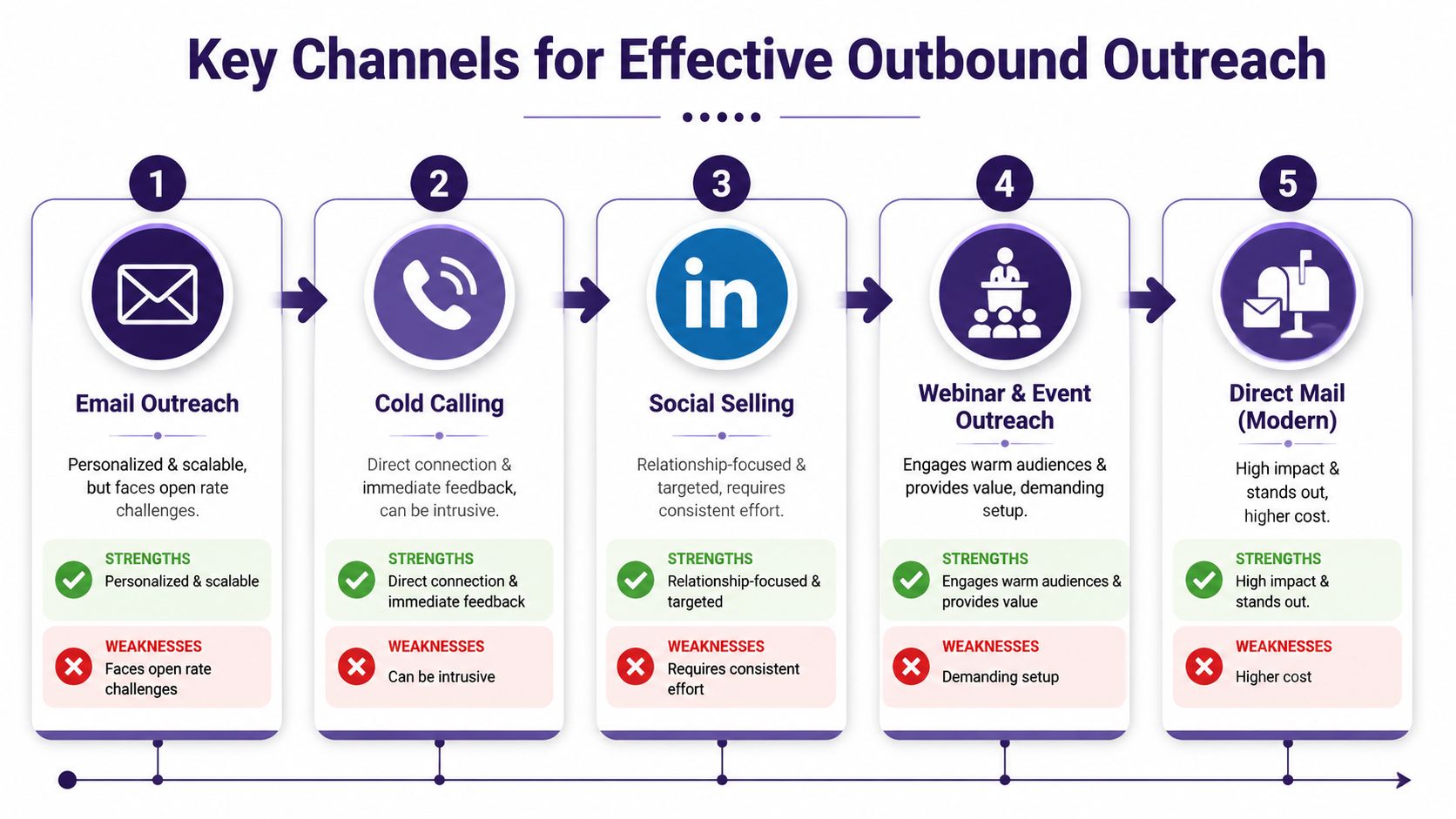
Outbound works better as a coordinated system than as a single tactic. Email reaches people at scale. Calls surface intent fast. LinkedIn adds familiarity. Event follow-up catches buyers when interest is fresh. Direct mail can open doors in high-value accounts when digital touches stall.
For North American companies, channel mix also depends on who is doing the outreach. A nearshore, bilingual BPO team has an edge here because calls, voicemail, email, and social follow-up sound closer to the market they serve. That matters in the U.S. and Canada, where tone, timing, and language comfort often decide whether a prospect replies or ignores the touch.
Email still matters, but it should support the sequence
Email is useful for testing positioning, sharing context, and reaching a large set of accounts without adding headcount. It also becomes a hiding place for weak vendors. They send campaigns, report activity, and treat low reply volume as proof that the market is cold.
Good outbound email does three things well:
- identifies the account problem clearly
- gives the prospect a reason to care now
- asks for a realistic next step
That next step is often small. Confirm the right contact. Accept a short call. Reply with timing. In practice, email does its best work when it prepares the prospect for the next touch instead of carrying the entire program on its own.
Calling gets real answers faster
A live conversation exposes things dashboards miss. You hear whether the account has budget pressure, whether the contact owns the problem, and whether the timing is wrong or unclear.
Phone outreach matters more in complex sales, higher-ticket offers, and markets where trust has to be built quickly. It also matters when speed-to-lead is uneven internally and an outsourced team needs to qualify interest before handing off to sales.
Nearshore teams tend to perform better here than distant offshore teams for a simple reason. Accent neutrality, time-zone overlap, and familiarity with North American business etiquette improve call quality. That does not mean every campaign needs heavy call volume. It means your provider should know when calls are the right tool and have the infrastructure to run them well. If you want to assess that setup, review how predictive dialing improves outbound productivity and compare it against the vendor’s actual dialing process, QA controls, and reporting.
Social and event follow-up add useful pressure
LinkedIn works well when the buyer needs more than one interaction before responding. It helps confirm roles, reinforces brand credibility, and gives reps another way to stay visible without sending the same email again.
Event and webinar follow-up often performs even better because the account has already shown interest. The mistake is treating that list like a generic blast. Strong teams segment by session topic, attendance level, region, and likely buying role, then tailor the first outreach accordingly.
A practical outbound mix often looks like this:
- Email for context so the prospect understands the offer before a call
- Calls for qualification so fit, urgency, and ownership become clear quickly
- LinkedIn for familiarity when inboxes are crowded and names need repetition
- Event follow-up for timing when interest already exists and speed matters
- Direct mail for select accounts when contract value justifies a higher-touch approach
The best sequences feel coordinated. Each touch should contribute new context, reflect the buyer’s likely preferences, and match the economics of the account. That is one reason the nearshore bilingual model keeps outperforming generic offshore teams and fully automated outbound stacks. It combines lower operating cost with better market alignment, which usually produces cleaner conversations and stronger meeting quality.
Measuring Success with Outbound KPIs and Analytics
How do you know an outsourced outbound program is producing pipeline instead of just producing reports?
That question matters more with outsourced teams because weak vendors can make activity look healthy for months. High dial counts, large send volumes, and decent open rates can hide a simple problem. Sales is not getting opportunities it wants to pursue.
Executives should measure outbound in the same way they measure any revenue function. Start with pipeline contribution, then trace backward into the inputs that shape it. That approach makes it easier to compare vendors, spot quality problems early, and see why nearshore bilingual teams often outperform lower-cost offshore options for North American outreach. Better language control and market familiarity usually show up in the numbers as stronger connect quality, fewer bad-fit meetings, and cleaner handoffs to sales.
The KPIs that deserve executive attention
A useful outbound scorecard includes:
- Lead-to-opportunity conversion rate so meeting volume does not mask weak qualification
- Lead response time because delayed follow-up kills interest that was expensive to create
- Open and reply rates to test message fit and list quality
- Meeting booking rate to show whether outreach is turning into live sales conversations
- Pipeline value created to connect campaign output to revenue potential
- Opportunity-to-closed-won rate to verify that early-stage quality holds up in later stages
- Lead drop-off by stage to expose where prospects lose interest or get mishandled
Segmentation matters as much as the KPI list itself. Break results out by industry, campaign, channel, language, geography, and rep. A blended average can make a weak program look acceptable. I have seen bilingual nearshore teams outperform broader offshore groups because they handled Spanish-speaking prospects and North American buying cues with fewer mistakes. The aggregate report looked similar at the top. The sales acceptance rate did not.
Intent signals improve timing and list quality
Static lists create wasted effort. Teams reach accounts with no clear reason to respond, then try to solve the problem with more volume.
A better model uses timing signals such as hiring activity, funding events, tech stack changes, recent engagement, or event behavior. As noted earlier, providers that build outreach around intent signals often shorten sales cycles and improve qualified opportunity creation versus flat list-based prospecting. The practical benefit is straightforward. Reps start with accounts that have a reason to take the call now, not someday.
Execution still matters. If your vendor uses automation, ask how they protect deliverability and domain health. Even technical choices such as provisioning real mailboxes for sales bots affect reply rates, inbox placement, and whether email remains a reliable top-of-funnel channel.
What to ask for in reporting
Ask every provider to show reporting in four areas, with examples from live programs rather than a polished demo.
| Reporting area | What you need to see | Why it matters |
|---|---|---|
| Campaign performance | Channel-by-channel outcomes | Shows which motions are producing conversations, not just activity |
| Lead quality | Qualification notes, disqualification reasons, and sales acceptance | Prevents inflated meeting counts |
| Funnel movement | Progress from lead to opportunity and pipeline stage | Connects outreach to actual revenue creation |
| Operational discipline | Response times, follow-up adherence, dispositions, and QA trends | Shows whether the team executes consistently |
Good reporting should change decisions. If a dashboard only shows that reps stayed busy, leadership still does not know whether the program deserves more budget.
For teams building oversight around outsourced outbound, this framework for call center reporting and metrics dashboards KPIs is a practical reference for what leadership should review every week.
Outbound Lead Generation Examples by Industry
The mechanics of outbound don’t change much across industries. The context does. The pain points, objections, timing, and language all shift, and that’s where many vendors fall apart.
Healthcare and finance need trust before speed
A healthcare group opening new service lines might need help reaching referral partners, clinics, or patient-facing stakeholders across English- and Spanish-speaking audiences. In that case, outbound lead generation services work better when agents can explain the offer clearly, handle sensitive questions with care, and route qualified interest to the right internal team.
Finance is similar. The outreach can’t sound automated or reckless. A nearshore bilingual team can support appointment setting, qualification, and follow-up while keeping conversations more natural for North American prospects.
E-commerce and telecom need consistent coverage
An e-commerce brand entering a new region may need to reach wholesale buyers, brand partners, or prospective high-value customers quickly. The sequence might start with email, move to a call, then add social touches for non-responders. The point isn’t pressure. It’s coverage.
Telecom outreach often depends on persistence and timing. Buying committees are busy, and opportunities can open after a contract review, a service complaint, or an expansion decision. A provider with structured workflows can keep those accounts in motion without overwhelming the prospect.
A practical operational detail matters here too. If your team is scaling cold email alongside calling, mailbox setup affects deliverability and account health. For teams using automation carefully, this guide on provisioning real mailboxes for sales bots is a useful operations reference.
SMB and retail teams usually need flexibility
Small businesses rarely need a giant outbound machine. They need a reliable one. That often means tighter lists, shorter feedback loops, and faster changes to message or offer.
Retail companies may use outbound to open B2B partnerships, reactivate dormant accounts, or support local store campaigns. In those cases, a provider should be able to shift between appointment setting, follow-up calls, and account qualification without rebuilding the whole program every week.
The right industry playbook doesn’t sound polished in a slide deck. It sounds correct on a live call with a real buyer.
How to Choose the Right Outbound Services Partner
What happens if the provider you hire can book meetings, but cannot represent your company well once a real buyer starts asking harder questions?
That is the decision. Price matters, but only after you confirm the partner can target the right accounts, carry a credible conversation, and feed your sales team opportunities worth pursuing. A cheap vendor that burns through your market with weak messaging costs more than it saves.
Nearshore teams deserve closer scrutiny than they usually get. For North American companies, a bilingual BPO in a border market such as Tijuana often gives you a better operating model than a far-off offshore team or a tool-only setup. You get overlapping business hours, easier QA, faster feedback cycles, and agents who can switch between English and Spanish without making the interaction sound scripted.
What to vet before pricing
Start with operating fit, not rate cards.
-
Targeting discipline
Can the partner help tighten your ICP and account list, or will they call any record you upload? -
Conversation quality
How do they train reps to handle objections, qualify interest, and know when a prospect is not a fit? -
Multichannel execution
Can they coordinate calls, email follow-up, and CRM handoff, or are they only selling one tactic? -
Bilingual coverage
If part of your market buys in Spanish, can the team hold a natural business conversation, not just read a translated script? -
Compliance and control
Who owns consent rules, suppression lists, call recording standards, and escalation paths? -
Reporting clarity
Will you see call outcomes, meeting quality, objection trends, and funnel movement, or just activity totals?
A nearshore model has practical advantages here. Shared time zones cut delays between outreach, manager review, and SDR or AE follow-up. Cultural alignment usually improves tone, especially in mid-market and SMB conversations where buyers respond quickly to phrasing that feels off. Management access is also easier. If a program needs retraining, script changes, or onsite calibration, a short flight is different from a long-haul trip across multiple time zones.
If you need a stronger evaluation framework, use this guide on how to find and vet the best call center outsourcing companies. It helps separate polished sales presentations from providers with real operating depth. CallZent is one example of the nearshore bilingual BPO model. It operates from Tijuana and supports outbound calling and lead generation for North American businesses.
Comparing common outbound service pricing models
| Pricing Model | How It Works | Best For | Potential Risk |
|---|---|---|---|
| Monthly retainer | Fixed recurring fee for team capacity and campaign management | Companies that want steady execution and room to improve scripts, lists, and process | You can keep paying for activity if strategy and QA stay weak |
| Pay per lead | Provider charges for each delivered lead or appointment | Teams that want simpler budgeting and clear volume targets | Lead definitions often get stretched unless qualification rules are strict |
| Performance-based | Compensation tied to agreed outcomes | Buyers who want tighter accountability | Reps may optimize for conversions that look good on paper but do not close |
| Hybrid model | Base fee plus outcome-based component | Companies that want stable coverage with shared incentives | Contracts get messy if ownership of data, qualification, and follow-up is vague |
Selection filter: If a provider cannot define a qualified lead in plain language, stop the evaluation there.
Good partners talk openly about trade-offs. Offshore teams can reduce labor cost, but supervision, QA speed, and buyer experience often suffer. Domestic-only teams may be easier to align with, but many programs become too expensive to scale. Nearshore tends to be the stronger middle ground for North American businesses that need cost control, English and Spanish coverage, and close operational coordination.
Implementing Your Outbound Program for Success
After the contract is signed, the essential work begins. Effective onboarding reduces the duration between the kickoff and receiving valuable sales feedback.

The economics make this discipline necessary. Inbound SEO leads can convert at 14.6%, while outbound tactics convert at 1.7%, and the average outbound cost per lead is around $198 (G2). That doesn’t mean outbound is weak. It means quality targeting, clean execution, and rapid follow-up are not optional.
A practical launch checklist
Use a simple implementation sequence:
-
Kickoff and discovery
Align on market, offer, exclusions, sales process, and success criteria. -
ICP refinement
Narrow the account list. A smaller, cleaner list usually outperforms a broader weak-fit list. -
Message development
Build call scripts, email copy, objection handling, and qualification notes around actual buyer problems. -
System integration
Connect outreach tools and CRM workflows so activity, notes, statuses, and handoffs stay visible. -
Agent training
Train on product context, tone, compliance expectations, escalation paths, and meeting standards. -
Pilot period
Launch with a manageable segment first. Review objections, message fit, and qualification quality before expanding.
What the first operating cycle should prove
In the early phase, leadership should look for:
- message-market fit
- quality of conversations
- follow-up consistency
- sales acceptance of booked meetings
- clean CRM visibility
If those pieces are working, scale becomes much safer. If they aren’t, adding more contacts only makes the inefficiency larger.
Outbound succeeds when operations, messaging, and sales handoff are built together. Most failed programs break at those seams, not because outreach itself doesn’t work.
The core lesson is simple: outbound lead generation services are a powerful growth lever only when the provider can target precisely, execute consistently, and stay accountable to pipeline quality.
🚀 Build a More Predictable Sales Pipeline
CallZent helps North American businesses scale outbound calling, lead generation, and bilingual sales support with nearshore teams built for execution.
Schedule a Strategy CallIf you’re evaluating a nearshore bilingual partner for outbound lead generation, CallZent can help you assess fit, define a realistic outreach model, and build a program that supports North American sales teams with tighter execution and clearer reporting.