Skip to content
MARKETING / LEAD GENERATION
Lead Generation Marketing Services Guide for Higher ROI in 2026
Learn how lead generation marketing services improve lead quality, qualification, CRM workflows, and ROI using inbound, outbound, and bilingual nearshore strategies.
TL;DR — Quick Takeaways
- Lead generation marketing services should focus on qualified conversations—not just raw lead volume.
- Inbound and outbound strategies work best when combined into one coordinated pipeline.
- CRM integration and lead qualification directly impact ROI and sales conversion rates.
- CallZent helps businesses improve lead quality through bilingual nearshore outreach and qualification support.
Why Most Lead Generation Campaigns Fail
Many businesses invest heavily in ads, outreach, and content creation but still struggle to build reliable sales pipeline.
The problem is rarely traffic alone. The real issue is usually weak lead qualification, poor targeting, or disconnected handoffs between marketing and sales.
Is your marketing budget creating pipeline, or just creating activity?
That gap is where most companies lose money. They invest in campaigns, forms, ads, and outreach, then discover too late that the underlying problem wasn’t lead volume. It was lead quality, weak qualification, and a sloppy handoff to sales.
Growing Your Business Starts with the Right Leads
The lead generation market is large and still growing, with the industry projected to reach $295 billion by 2027, yet the harder problem remains quality. 61% of marketers say generating high-quality leads is their biggest challenge, and about 80% of new leads never convert into sales, according to these lead generation statistics from Martal. That tells you something important. More leads alone won’t fix pipeline problems.
A lot of businesses still buy lead generation as if they were buying traffic. That’s the wrong mindset. You’re not buying clicks, dials, or form fills. You’re buying a system that should move strangers toward a sales conversation at the right time.
That system usually includes content, paid acquisition, outbound outreach, call handling, qualification, follow-up, and reporting. It may also include conversational tools on the front end. If your site gets traffic but too many visitors leave without engaging, it’s worth looking at ways to boost conversions with 24/7 bots before sending more budget into the funnel.
For a practical foundation, start with these lead generation best practices. They reflect the same reality operators see every day. Better targeting and better qualification beat bigger top-of-funnel numbers.
What Are Lead Generation Marketing Services Reallqy
Lead generation marketing services are often described too loosely. In practice, they are the operating layer between demand creation and sales conversion.
A provider shouldn’t just bring in attention. They should help your business identify the right prospects, capture intent, filter out weak fits, and move stronger opportunities toward a real conversation.
Think of it like a pipeline, not a list
A lead is basic interest. Someone filled out a form, clicked an ad, replied to an email, or took another trackable action.
A marketing qualified lead, or MQL, has crossed a more useful threshold. This person or account matches your target profile closely enough to justify follow-up from marketing or a qualification team. They’re not sales-ready by default. They’re just more promising than a raw inquiry.
A sales qualified lead, or SQL, is different. This is the point where a sales rep should engage because there’s enough fit, need, urgency, or buying intent to justify direct outreach.
A long contact list can make reporting look healthy while pipeline stays weak. The difference is qualification.
Here’s a simple example.
- Raw lead: A retail operations manager downloads a guide from your website.
- MQL: Follow-up shows the company fits your target size, location, and industry.
- SQL: A call confirms they’re reviewing vendors and want a meeting next week.
That middle layer is where many campaigns fail. Marketing celebrates the download. Sales sees no urgency and ignores it. Nothing moves.
Good services include qualification, not just capture
The better lead generation marketing services build rules around fit and intent before sales gets involved. That can include form design, email nurture, data enrichment, outbound follow-up, or live qualification calls.
For example, a software company might use content and paid search to pull in interest, then route responses into a qualification workflow. A healthcare group might use bilingual outreach to confirm appointment interest, service eligibility, and preferred contact times before handing the lead to an internal team.
That’s why businesses often outsource this function to teams built for it. A specialized partner can manage the capture-to-qualification layer more consistently than a generalist internal team stretched across multiple priorities. If you want to see what that operating model looks like, review outsourced lead generation services.
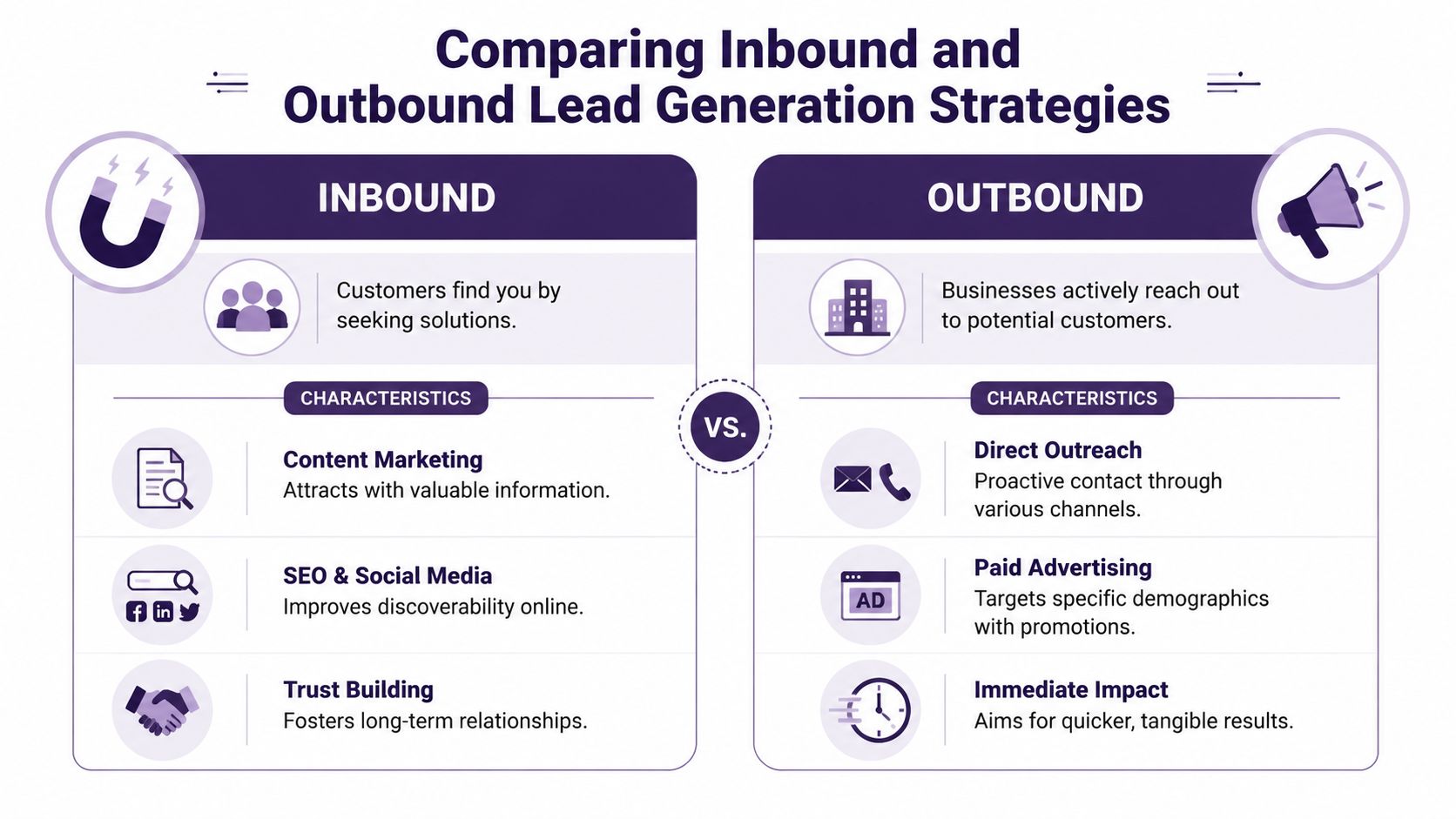
Comparing Inbound and Outbound Lead Generation Strategies
Most businesses don’t have an inbound problem or an outbound problem. They have a sequencing problem.
They either rely too heavily on inbound and wait for demand to appear, or they push outbound too hard without enough relevance, proof, or nurturing. Strong lead generation marketing services balance both.
Where inbound wins
Inbound works best when buyers already know the problem they need to solve. Search, educational content, blog articles, landing pages, and downloadable resources let prospects discover you on their own terms.
That’s one reason content is so valuable. Content marketing generates three times more leads than outbound marketing at a 62% lower cost, and companies with active blogs generate 67% to 68% more leads per month, according to Thunderbit’s lead generation statistics roundup.
Inbound usually performs well when:
- Your buyers research before talking to sales
- Your offer requires trust and explanation
- Your team can publish useful content consistently
- You want compounding value from SEO and content assets
The trade-off is speed. Inbound often takes longer to ramp, especially in crowded categories.
Where outbound wins
Outbound works when timing matters, when your market is narrow, or when your ideal buyer won’t discover you fast enough through search alone. Email outreach, telemarketing, paid prospecting, and social outreach give you direct control over who you contact and when.
Outbound is especially useful when:
- You’re entering a new market
- You need meetings faster
- Your total addressable market is well defined
- Your offer is strong but not actively searched
The trade-off is precision. If targeting is loose or messaging is generic, outbound burns budget fast.
A side-by-side comparison
| Strategy | Best use case | Speed | Lead quality pattern | Common failure point |
|---|---|---|---|---|
| Inbound | Buyers already searching for solutions | Slower to build | Often stronger intent once mature | Publishing content with no conversion path |
| Outbound | Named accounts or targeted prospect lists | Faster to launch | Depends heavily on targeting and qualification | Sending generic outreach to weak-fit accounts |
| Blended approach | Businesses that need steady pipeline and faster meetings | Balanced | Stronger overall when handoffs are clear | Teams measuring channels separately instead of by revenue |
Practical rule: If your deal size is meaningful and your sales cycle has multiple steps, a blended model usually outperforms a single-channel approach.
A practical setup looks like this: SEO and content create trust, paid campaigns capture immediate demand, and outbound follow-up targets high-fit accounts that haven’t raised their hand yet. Then a qualification team filters responses before sales spends time.
That’s the model behind many mature outbound lead generation strategies. The point isn’t to choose sides. It’s to build coverage across the buyer journey without overloading sales with weak leads.
Decoding Pricing Models and Key Performance Indicators
Lead generation pricing gets misunderstood because companies often focus on the invoice model instead of the economics behind it.
A cheap program that delivers poor-fit leads is expensive. A higher monthly fee that produces qualified pipeline can be the better deal. The right question is not “What does it cost?” It’s “What exactly am I paying for, and how will success be measured?”
The three common pricing models
Pay per lead sounds simple. You pay for each lead delivered. This can work if qualification criteria are tight and documented clearly. It fails when the provider gets paid for quantity and your team absorbs the cost of screening weak leads.
Monthly retainer is common for multi-channel programs. You’re paying for strategy, execution, optimization, and reporting over time. This model usually fits businesses that need testing, iteration, and close coordination with sales.
Commission or performance-based models appeal to companies that want risk-sharing. They can work, but only when attribution is clean and both sides agree on what counts as a qualified outcome. Otherwise, arguments start fast.
A good buyer asks these questions early:
- What counts as a lead
- What disqualifies a lead
- Who owns follow-up speed
- How many touches happen before handoff
- How results will be reported
The KPIs that matter
You don’t need a giant dashboard. You need a short list of metrics that connect effort to revenue.
One useful data point is cost context. The average organization generates 1,877 leads per month, and the mean cost per lead across industries is $198.44, according to DemandScience’s discussion of B2B marketing data for lead generation. That doesn’t give you a universal target, but it does show why lead quality and targeting discipline matter.
Use metrics like these instead of vanity numbers:
| KPI | What It Measures | Good Benchmark (Varies by Industry) |
|---|---|---|
| Cost per lead | The average spend required to generate one lead | Lower is better only if lead quality holds |
| Lead-to-opportunity rate | How many leads become real sales opportunities | Stronger when qualification is tight |
| Opportunity-to-close rate | How efficiently sales converts vetted opportunities | Depends on sales process and offer strength |
| Lead quality | Whether leads fit your ICP and buying criteria | Should be defined before launch |
| Time to follow-up | How quickly leads receive a response | Faster is generally better |
| Revenue attribution | Which channels and campaigns produce pipeline and deals | Requires CRM discipline |
If a provider leads with impressions, clicks, or list size but can’t explain lead quality rules, stop the conversation there.
You’ll make better decisions if finance, marketing, and sales all read the same scorecard. That’s one reason many companies review how to outsource lead generation before signing a contract. The delivery model matters less than KPI clarity.
How to Choose the Right Lead Generation Partner
A provider can look polished in a proposal and still fail once leads hit your CRM.
The difference usually comes down to operational fit. Can they target the right accounts, qualify them properly, and hand them to sales in a way your team will use?

Start with the handoff problem
A major issue in B2B lead generation is the disconnect between marketing and sales. That misalignment leads to wasted spend and missed opportunities, as explained in Callbox’s breakdown of B2B lead generation challenges.
A lot of agencies still stop at capture. They generate responses, pass them over, and call the job done. Your sales team then has to decide what’s real, what’s junk, and what needs follow-up.
That’s why the first screening question should be simple: do they deliver raw leads, or do they provide qualified conversations and warm handoffs?
Use this evaluation checklist
- Industry understanding: Ask how they adapt messaging for your sales cycle, compliance needs, and buyer roles.
- Qualification method: Find out how they define MQL and SQL status in plain language.
- CRM workflow: They should be able to explain how data enters your system and how reps see lead history.
- Reporting discipline: Good reporting includes lead source, disposition, qualification status, and outcome trends.
- Channel capability: If they run email, calling, paid media, and follow-up separately with no coordination, expect leakage.
- Team communication: Near-real-time feedback matters. Long delays between campaign learning and sales response reduce quality.
- Language and cultural fit: This matters more when you sell into diverse U.S. markets.
Here’s a practical test. Ask the provider to walk through a failed lead. How was it acquired? Why was it accepted? Who spoke to it? Why did it stall? Serious operators can answer that clearly.
Look for RevOps thinking, not just campaign delivery
The best partners think in systems. They care about routing logic, sales feedback loops, and pipeline quality, not just top-of-funnel activity. If you want an outside perspective on how that discipline looks in practice, this RevOps guide to B2B lead generation is a useful reference.
Bold takeaway: Choose the partner your sales team will trust, not the one with the flashiest lead volume promise.
Integrating Your Partner for a Seamless Workflow
Even a skilled provider underperforms if they work outside your systems.
Lead generation becomes efficient when marketing signals, qualification activity, and sales action all live in the same operating flow. That usually means CRM integration, shared lead definitions, and clear rules for what happens next.
CRM integration changes the quality of execution
When lead data sits in separate tools, teams guess. Reps don’t know whether a prospect opened emails, visited key pages, downloaded content, or already spoke with someone. Marketing doesn’t know which leads progressed. Reporting gets messy fast.
Integrated workflows fix that. According to Salesforce’s lead generation guide, AI-driven lead scoring inside a CRM can increase lead-to-opportunity conversion rates by 20% to 30% by using behavioral and historical data to identify higher-intent prospects.
That matters in practice because it changes rep behavior. Instead of dialing the whole list, agents and SDRs can focus on the accounts showing the strongest signals.
What good integration looks like
A strong setup usually includes:
- Shared scoring logic: Sales and marketing agree on what behaviors and attributes matter.
- Unified records: Every touchpoint, form fill, call note, and disposition stays attached to one contact or account record.
- Routing rules: High-intent leads move quickly to the right rep or queue.
- Feedback loops: Sales marks outcomes clearly so marketing and ops can refine targeting.
- Data enrichment: Firmographic and technographic context improves messaging before outreach begins.
A modern BPO is capable of adding operational value. For example, a provider such as CallZent can support outsourced lead generation with bilingual agents, outbound qualification, and CRM-connected workflows so internal sales teams receive better-prioritized conversations instead of unworked inquiries.
The fastest way to waste a good campaign is to hand off leads with no context.
The nearshore workflow advantage
Nearshore teams are often easier to integrate into North American operations because collaboration happens in overlapping work hours. Questions get answered faster. Objections from the field get reflected in scripts faster. Sales feedback reaches campaign managers before another week of spend goes out.
That operational rhythm matters more than many buyers realize. The value isn’t only language coverage or labor structure. It’s the ability to work as one team instead of two disconnected groups passing spreadsheets back and forth.
Use Cases The Nearshore Bilingual Advantage
Lead generation marketing services look very different depending on the industry. The mechanics change, but the pattern stays the same. Better outreach, stronger qualification, cleaner handoff.

E-commerce needs fast recovery and follow-up
For e-commerce brands, a lead isn’t always a whitepaper download. It may be an abandoned cart, a financing inquiry, a product question, or a return visitor who hasn’t purchased.
A bilingual nearshore team can follow up quickly with shoppers who need clarification on pricing, shipping, financing, or product fit. That’s especially useful when customers move between English and Spanish during the buying process. Email alone often misses that nuance. A live call or message exchange can resolve hesitation faster.
Some retail teams also use external SDR support for top-of-funnel prospecting or partnership outreach. If your operation is building a sales development layer from scratch, resources on how to Hire SDRs can help frame the role design.
Healthcare and finance need trust and language access
In healthcare, lead generation often blends with patient access. Someone may respond to a campaign but still need appointment scheduling, insurance clarification, or language support before becoming a real opportunity.
In financial services, leads often need careful screening before an advisor should spend time on them. Qualification calls can confirm basic fit, urgency, and service interest without forcing senior staff to handle every inbound inquiry personally.
The Hispanic market is still under-served
This is one of the clearest gaps in current lead generation strategy. More than 60 million Hispanic consumers in the U.S. represent major purchasing power, yet most lead generation strategies remain English-centric, according to Involve.me’s discussion of lead generation agency gaps.
That creates practical problems:
- Translated messaging sounds unnatural
- Scripts miss cultural context
- Inbound forms don’t match real communication preferences
- English-only agents lose trust early in the conversation
A bilingual nearshore team based close to the U.S. market can handle this better because language support isn’t bolted on. It’s built into outreach, qualification, appointment setting, and follow-up.
For businesses targeting U.S. Hispanic audiences, that nearshore model often makes more sense than relying on generic offshore scripts or domestic teams without bilingual depth. The operational case is stronger when teams can collaborate easily across time zones and work with cultural familiarity. That’s the core value behind the nearshore advantage.
Buyers notice the difference between translated outreach and culturally fluent outreach.
Frequently Asked Questions About Lead Generation Services
How long do lead generation marketing services take to show results
It depends on the channel mix. Outbound campaigns can produce conversations faster, while SEO and content usually take longer to mature. The key is setting the right expectation for each channel instead of judging everything on the same timeline.
Are lead generation services better than building in-house
Not automatically. In-house teams work well when you already have strong process control, management bandwidth, and channel expertise. Outsourcing makes sense when you need speed, specialized execution, bilingual capacity, or more disciplined qualification.
Can these services work for niche industries
Yes, if the provider knows how to build targeting, messaging, and qualification around a narrow buyer profile. Niche markets usually punish generic outreach, so the partner’s discovery process matters a lot.
What’s the biggest mistake companies make
They buy leads instead of buying a lead management process. A vendor may deliver names, but if qualification criteria, routing rules, and sales follow-up aren’t clear, quality falls apart quickly.
Should one partner handle both lead generation and qualification
Often, yes. When one team handles both, the handoff tends to be cleaner and sales gets more context. If acquisition and qualification sit with different vendors, weak communication can create gaps.
What should I ask on a first call with a provider
Ask how they define a qualified lead, how they report outcomes, how they integrate with your CRM, and how they handle lead rejection feedback from sales. Those answers tell you more than a slide deck ever will.
🚀 Improve Lead Quality and Pipeline Performance
Talk with CallZent about bilingual nearshore lead generation solutions designed to improve qualification, customer engagement, and sales conversion rates.
If your business needs a lead generation engine that does more than collect names, CallZent offers bilingual nearshore support for outreach, qualification, and customer conversations that fit North American teams. The right setup depends on your sales model, target market, and workflow, but the goal stays the same. Better leads, cleaner handoffs, and a pipeline your sales team will work.